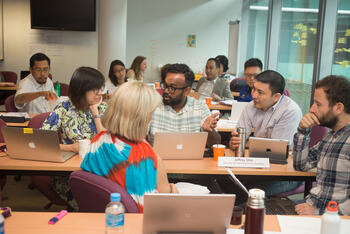
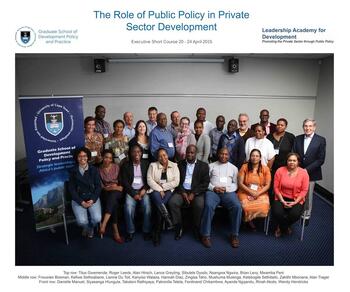
This five day intensive program for a select group of mid- and high-level Brazilian government officials and business leaders is designed to address how government can encourage and enable the private sector to play a larger, more constructive role as a force for economic growth and development. A driving principle of this LAD-Insper program is that policy reform is not like engineering or other technical fields that have discrete skills and clear, optimal solutions. Instead, successful reformers must be politically aware and weigh a broad range of factors that influence policy outcomes. For example, they must have a solid grasp of country-specific economic, financial, political and cultural realities. Most importantly, they must have a sense of how to set priorities, sequence actions and build coalitions. This program is designed to provide participants with an analytical framework to build these leadership abilities and operate effectively under adverse conditions.
Abstract: Nuclear war and climate change present the two most serious threats to global security since World War II. This talk shows that nuclear weapons research and climate science were historically connected in deep, sometimes intimate ways. Each developed its own knowledge infrastructure, including people, technical systems, and organizations, with surprising parallels and frequent exchanges across the classified/civilian divide. From the 1940s on, nuclear weapons research and climate science both relied heavily on computer models, used related physics and numerical methods, and shared human as well as technical resources. Radiocarbon from nuclear weapons tests contributed to understanding of the global carbon cycle, while fallout monitoring networks produced critical knowledge about the stratosphere. In the 1980s, the potential for “nuclear winter” — a war-induced climatic catastrophe — became a major political issue, but the groundwork for this concern had been laid long before.
This interplay not only continued, but became even more significant after the Cold War’s end, when the weapons labs’ expertise, equipment, and observing systems were partially repurposed. Several US national laboratories now play essential roles in climate and Earth system science. Among these roles are the Program on Climate Model Diagnosis and Intercomparison, based at Livermore and responsible for the important Coupled Model Intercomparison Project (CMIP), a major unifying force in climate modeling for the Intergovernmental Panel on Climate Change assessments. The cyberinfrastructure underlying CMIP and similar projects must address mounting challenges related to data access controls, software support, and the security of huge data collections, while their institutional and human bases depend on ongoing national support. Crafting effective climate policy, I argue, will require understanding and rethinking the dynamics of these knowledge infrastructures for the present, rapidly evolving context.
About the Speaker: Paul Edwards is a Professor in the School of Information (SI) and the Dept. of History at the University of Michigan. SI is an interdisciplinary professional school focused on bringing people, information, and technology together in more valuable ways.
His research explores the history, politics, and cultural aspects of computers, information infrastructures, and global climate science. His current research focuses on knowledge infrastructures for the Anthropocene.
Dr. Edwards is co-editor (with Geoffrey C. Bowker) of the Infrastructures book series (MIT Press), and he serves on the editorial boards of Big Data & Society: Critical Interdisciplinary Inquiries and Information & Culture: A Journal of History. His most recent book is A Vast Machine: Computer Models, Climate Data, and the Politics of Global Warming (MIT Press, 2010).
Paul Edwards
Professor of Information and History
University of Michigan
Abstract: In 2004, al-Qaeda’s security chief smuggled 42 handwritten pages out of Iran, where he was confined under a loose form of house arrest. The notes written by Sayf al-Adl were each folded into a bundle the size of a cigarette, and they included two seminal documents: a history of ISIS Godfather Abu Mus'ab al-Zarqawi's original engagement with al-Qaeda in 2000, and a high-level plan to re-establish the Caliphate between 2013 and 2016.
Al-Adl’s history has formed the basis of virtually every subsequent retelling of the development of al-Qaeda in Iraq and the Islamic State. But none other than Osama bin Laden himself has repudiated al-Adl’s history, and newly available al-Qaeda correspondence from the period suggests that intra-jihadi competition drove al-Qaeda’s original engagement with Zarqawi more than strategic or ideological alignment.
Al-Adl’s other document, a seven-stage ‘Master Plan’ that foretold the declaration of the Caliphate in 2014, has proved extraordinarily prescient. It aimed to exploit a geopolitical loophole to al-Qaeda’s basic worldview and finally unify Zarqawi’s movement with al-Qaeda. The strategic vision proved powerful, but the alliance it was built for was not.
About the Speaker: Brian Fishman is a Counterterrorism Research Fellow with the International Security Program at New America, a Washington, DC think tank and a Fellow with the Combating Terrorism Center (CTC) at West Point, where he previously served as the Director of Research. He currently manages policy at Facebook regarding terrorism and violent extremism. Fishman also served as an assistant professor in West Point’s Department of Social Sciences. Fishman built and led Palantir Technologies’ Disaster Relief and Crisis Response team, which brought some of the world’s most sophisticated technology to humanitarian organizations. Fishman is a term member of the Council on Foreign Relations and was a founding editor of the CTC Sentinel.
Fishman is the author of numerous studies U.S. national security, terrorism and international jihadi groups. He has specialized in the so-called Islamic State and its predecessors since 2005 and taught a dedicated course about the Islamic State of Iraq in 2008. Fishman coauthored seminal investigations of al-Qaeda's foreign fighters in Iraq and Iranian support for Shia militias fighting U.S. troops in Iraq. Fault Lines in Global Jihad: Organizational, Strategic, and Ideological Fissures, a volume Fishman co-edited with Assaf Moghadam, was named one of the top books for understanding terrorist recruitment. He regularly appears in domestic and international media regarding terrorism and national security issues.
Fishman has taught as an adjunct professor in Georgetown's School of Foreign Service and Columbia's School of International and Public Affairs. Before joining the CTC, Fishman was the Foreign Affairs/Defense Legislative Assistant for Congresswoman Lynn Woolsey. Fishman holds a Masters in International Affairs (MIA) from Columbia University and a B.A. from the University of California, Los Angeles.
Counterterrorism Research Fellow, International Security Program
New America
In a recent piece in The American Interest, FSI Senior Fellow Larry Diamond, alongside Christopher Walker and Marc Plattner of the National Endowment for Democracy, describe how undemocratic states are cooperating and wielding sophisticated soft power arsenals to expand their areas of influence and reshape international values and norms. While the U.S. and E.U. have scaled back their support for democracy abroad, the authors argue that democracies must better leverage new technologies in media to translate and distribute democratic knowledge; improve the functioning of their own democratic institutions; and band together to stop autocratic efforts at restricting internet freedom.
Hero Image
TV screens display Russia President Vladimir Putin. | NATALIA KOLESNIKOVA/AFP/Getty Images
Abstract: The conventional wisdom about current space dynamics paints a picture of a rising China, a resurgent Russia, and a drifting United States. It also argues that international governance mechanisms in space are failing and not worth U.S. efforts to repair. Thus, it suggests that nationalist and protectionist responses are the best policy directions for the United States. This presentation posits that both arguments are wrong. First, it makes the case that as 21st century space power shifts toward the commercial sector, the United States is well suited to compete with its rivals through innovation, international engagement, and network-building in space. Such efforts are more likely to succeed under emerging conditions in space than traditional, state-led efforts. Second, it argues that the possible breakdown of international space governance mechanisms poses a serious threat to American interests and will require the attention of both the U.S. government and the expanding commercial space sector.
About the Speaker: James Clay Moltz holds a joint appointment as a professor in the Department of National Security Affairs (NSA) and in the Space Systems Academic Group at the Naval Postgraduate School (NPS) in Monterey, California. He also serves as the NSA Department’s Associate Chairman for Research and directs the DTRA-funded Project on Advanced Systems and Concepts for Countering Weapons of Mass Destruction, based at NPS. He is the author of the recent books Crowded Orbits: Conflict and Cooperation in Space (Columbia University Press, 2014), Asia’s Space Race: National Motivations, Regional Rivalries, and International Risks (Columbia University Press, 2012), and The Politics of Space Security: Strategic Restraint and the Pursuit of National Interests (Stanford University Press, 2008 and 2011 editions). Prof. Moltz holds a Ph.D. in Political Science from the University of California at Berkeley and an M.A. and B.A. (with Distinction) from Stanford University. He has served as an advisor to the NASA-Ames Research Center and to the U.S. Department of Energy and has provided expert testimony on space issues before the U.S. Congress. His commentary on space topics has appeared in such periodicals as Aviation Week and Space Technology, Nature, and the New York Times. At NPS, his honors include the 2015 Carl E. and Jesse W. Menneken Award for Excellence in Scientific Research and Sustained Contribution to the Navy and the Defense Department and the 2010 Richard W. Hamming Award for Interdisciplinary Achievement.
James Clay Moltz
Professor in the Department of National Security Affairs (NSA) and in the Space Systems Academic Group
Naval Postgraduate School
South Korea has become an economic powerhouse, but faces multiple challenges. The conference will focus on four areas that South Korea needs to turn its attention to: 1) the higher education and development; 2) entrepreneurship and innovation; 3) global competitiveness; and 4) demographic changes and immigration policy.
During the conference, a keynote speech is open to the public. Please click here for more information about the public keynote.
Abstract: Various regions of the world struggle to properly manage their freshwater resources in a sustainable manner. Even a greater number of regions are vulnerable to supply disruptions that can last for a year or more. This talk will provide a global overview of water supply vulnerability with respect to demand, endowment, institutions, and infrastructure. Examples of regional hydroeconomic models to evaluate potential management policies will be discussed with a focus on our approach to the challenges of coupling human-natural systems.
About the Speaker: Steven Gorelick is the Cyrus F. Tolman Professor in the School of Earth, Energy, and Environmental Sciences and Senior Fellow at the Woods Institute for the Environment. At Stanford since 1988, he directs the Global Freshwater Initiative, which employs an interdisciplinary approach to analyzing water-supply vulnerability in developing nations. Past and current projects include those in Mexico, India, Vietnam, Cambodia, and Jordan. Much of his work involves development of hydrologic-economic models to evaluate the likely effectiveness of policy instruments such as taxes, quotas, and regulations. Projects also have evaluated the viability of an agricultural water rental market and alternatives to enhance food security. He has over 140 publications in 22 different science and engineering journals (including Science, Nature, and PNAS), and three commercialized patents. His 2010 book, Oil Panic and the Global Crisis, debated the notion of imminent global oil depletion. He is a member of the US National Academy of Engineering (NAE), and he has received Guggenheim and Fulbright fellowships.
Steven Gorelick
Cyrus F. Tolman Professor, Department of Earth System Science
Dept. of Earth System Science Stanford University
The Leadership Academy for Development (LAD) is an innovative program at Stanford’s Center on Democracy, Development and the Rule of Law that trains mid-level government officials and business leaders to be more effective in promoting policy changes in developing countries.
In order to accomplish this goal, LAD teaches weeklong courses with partner institutions located in Africa, Asia, Latin America, and the Former Soviet Union. The most recent workshop was held in Tbilisi, Georgia in partnership with a leading Georgian think tank.
LAD’s programs attract leaders from the private and public sector who are driving public policy in countries that are transitioning to democracy and strengthening their public institutions. Since LAD’s launch in 2010, the Program has trained over 400 students hailing from nations as diverse as Timor-Leste, Zimbabwe, and the United Kingdom.
The LAD teaching team is composed of faculty from Stanford, Johns Hopkins’s School of Advanced International Studies, Georgetown University, and Texas A&M.
At the core of LAD’s curriculum is a set of case studies that encourage students to think critically about the best methods for solving a policy problem. LAD’s case studies are developed by Stanford faculty and students, and are grounded in real-world scenarios drawn from many of the countries where the program is taught. Case studies reframe policy problems based on various scenarios that invite students to contribute their own perspectives and experience.
Image
As described by LAD co-founder and CDDRL Director Francis Fukuyama, "The Leadership Academy for Development is unique in that by utilizing the case study method, it provides students with a hands-on, interactive framework for problem solving.” Fukuyama continued, “Students must put themselves in the shoes of the case study's protagonist and then devise a solution to the dilemma presented in the text."
Case study authors are sent to the field where they conduct original interviews and research topics ranging from the funding of a vaccination program in Bangladesh to the challenge of administrative decentralization in Peru. To date, LAD has grown its case study library to over 20 cases that are publically available online for wider use and dissemination.
Michael Goldfien, an alumnus of Stanford’s International Policy Studies master’s program, researched and wrote three case studies for LAD over the course of a year.
“While I was writing a case about wine export promotion in the Republic of Georgia, speaking with current and former government officials helped put the challenges facing the Georgian wine industry in a broader domestic and international political context, said Goldfien.”
Goldfien continued, “Researching and writing a LAD case study is about more than simply establishing the facts of a specific policy initiative, it’s about putting things in context and mapping out the constellation of stakeholders who stand to gain or lose from a particular reform to understand the political landscape that a would-be reformer must navigate to effect change.”
One of LAD’s more commonly employed case studies is Gifford Pinchot and Sustainable Forest Management, which introduces the student to Gifford Pinchot, who served as the chief forester in the US at the turn of
Image
the 20th century. Grounded in the political history during this period, Pinchot faces the moral dilemma of whether he should expose the corrupt political patronage practices reaching all the way up to the office of President Taft, or keep his job and continue to fight for the relevance of the fledgling U.S. Forest Bureau. This case study exposes students to pivotal leadership decisions that they may have to face in their own professional careers.
Farai Maguwu, a prominent civil society leader in Zimbabwe who participated in the LAD workshop in Kenya last year summarized his experience, “The case study method was very effective as it made it easy for us to understand that Public-Private Partnerships (PPP’s) are a viable option if there is political will.” Maguwu continued, “For instance, we saw evidence of PPP in practice in one particular case that clearly demonstrated how the private sector could make a public park both beautiful and profitable.”
To learn more about the LAD program and access the case study library, please click here.
Hero Image
CDDRL Director Francis Fukuyama leads a lecture during the Leadership Academy for Development workshop in Tblisi, Georgia. January 2016.