
 FSI researchers examine the role of energy sources from regulatory, economic and societal angles. The Program on Energy and Sustainable Development (PESD) investigates how the production and consumption of energy affect human welfare and environmental quality. Professors assess natural gas and coal markets, as well as the smart energy grid and how to create effective climate policy in an imperfect world. This includes how state-owned enterprises – like oil companies – affect energy markets around the world. Regulatory barriers are examined for understanding obstacles to lowering carbon in energy services. Realistic cap and trade policies in California are studied, as is the creation of a giant coal market in China.

Gerald Fuller
Shriram Center, Room 086,
443 Via Ortega, Stanford, California 94305-5025
0
ggf@stanford.edu
Fletcher Jones Professor in the School of Engineering
University - Faculty
The Tropical Oil Crop Revolution: Food, Feed, Fuel, and Forests
Paragraphs
Over the last two decades global production of soybean and palm oil seeds have increased enormously. Because these tropically rainfed crops are used for food, cooking, animal feed, and biofuels, they have entered the agriculture, food, and energy chains of most nations despite their actual growth being increasingly concentrated in Southeast Asia and South America. The planting of these crops is controversial because they are sown on formerly forested lands, rely on large farmers and agribusiness rather than smallholders for their development, and supply export markets. The contrasts with the famed Green Revolution in rice and wheat of the 1960s through the 1980s are stark, as those irrigated crops were primarily grown by smallholders, depended upon public subsidies for cultivation, and served largely domestic sectors.
The overall aim of the book is to provide a broad synthesis of the major supply and demand drivers of the rapid expansion of oil crops in the tropics; its economic, social, and environmental impacts; and the future outlook to 2050. After introducing the dramatic surge in oil crops, chapters provide a comparative perspective from different producing regions for two of the world's most important crops, oil palm and soybeans in the tropics. The following chapters examine the drivers of demand of vegetable oils for food, animal feed, and biodiesel and introduce the reader to price formation in vegetable oil markets and the role of trade in linking consumers across the world to distant producers in a handful of exporting countries. The remaining chapters review evidence on the economic, social, and environmental impacts of the oil crop revolution in the tropics. While both economic benefits and social and environmental costs have been huge, the outlook is for reduced trade-offs and more sustainable outcomes as the oil crop revolution slows and the global, national, and local communities converge on ways to better managed land use changes and land rights.
Food, Feed, Fuel, and Forests
by Derek Byerlee, Walter P. Falcon, and Rosamond L. Naylor
will be published by Oxford University Press on November 10, 2016
$74.00 | 304 Pages | 9780190222987
by Derek Byerlee, Walter P. Falcon, and Rosamond L. Naylor
will be published by Oxford University Press on November 10, 2016
$74.00 | 304 Pages | 9780190222987
All Publications button
1
Publication Type
Books
Publication Date
Journal Publisher
Oxford University Press
External Purchase Links
Reset of U.S. Nuclear Waste Management Strategy and Policy
-
The United States’ strategy for the storage and disposal of highly radioactive nuclear waste is at a stalemate: spent nuclear fuel accumulates at nuclear power plants, yet there is no long-term, national strategy for spent fuel management and disposal. A federal commission emphasized the urgency of finding a geologic repository, but work on the proposed site -- Yucca Mountain – has stopped and its fate is unclear. The political impasse has overwhelmed meaningful discussion of technical, risk management and other policy questions.
To inform efforts to reset the U.S. nuclear waste program, CISAC, with the support of FSI and the Precourt Institute for Energy, has convened a group of international experts to examine nuclear waste management strategies with fresh eyes.
Speakers include:
- Sally Benson – Precourt Institute and Energy Resources Engineering, Stanford University
- Peter Davies – Nuclear Energy and Fuel Cycle Programs, Sandia National Laboratories
- Saida Laârouchi Engström – Strategy and Program, SKB, Sweden
- Rod Ewing – CISAC and School of Earth Sciences, Stanford University
- Bernd Grambow – Ecole des Mines de Nantes and SUBATECH Laboratory, France
- Daniel Metlay – U.S. Nuclear Waste Technical Review Board
- Mark Peters –Energy & Global Security Directorate, Argonne National Laboratory
- Christophe Poinssot - French Atomic and Alternatives Energy Commission and the National Institute of Nuclear Science and Technology
- Chris Whipple – ENVIRON
Follow-Up Materials
CISAC Central Conference Room
Encina Hall
616 Serra Street,
Stanford, CA 94305
Interschool Honors Program in International Security Studies Information Session
-
CISAC Interschool Honors Program in International Security Studies
INFORMATION SESSION
for Stanford undergraduates interested in applying for the 2015-2016 academic year
Meet program faculty, current students, and alumni.
Learn about the program.
Eat pizza!
CISAC’s Interschool Honors Program in International Security Studies provides Stanford undergraduates with strong academic records and interest in international security topics from all undergraduate schools and majors the opportunity to earn Honors in International Security Studies by writing a rigorous, policy-relevant thesis.
Students are admitted to the program on a competitive basis.
For more information and/or to apply, please visit: http://cisac.fsi.stanford.edu/docs/undergraduate_honors_program.
Application deadline: February 27, 2015
Please direct questions to Shelby Speer, Honors Program Coordinator, sspeer@stanford.edu.
Image

CISAC Interschool Honors Program in International Security Studies
Download pdf
Encina Hall (2nd floor)
Coit D. Blacker
Freeman Spogli Institute for International Studies
Stanford University
Encina Hall
616 Serra Street, C137
Stanford, CA 94305-6055
0
cblacker@stanford.edu
Senior Fellow Emeritus at the Freeman Spogli Institute for International Studies
Olivier Nomellini Professor Emeritus in International Studies at the School of Humanities and Sciences
Coit Blacker is a senior fellow emeritus at the Freeman Spogli Institute for International Studies, the Olivier Nomellini Professor Emeritus in International Studies at the School of Humanities and Sciences, and a Bass University Fellow in Undergraduate Education. He served as director of FSI from 2003 to 2012. From 2005 to 2011, he was co-chair of the International Initiative of the Stanford Challenge, and from 2004 to 2007, served as a member of the Development Committee of the university's Board of Trustees.
During the first Clinton administration, Blacker served as special assistant to the president for National Security Affairs and senior director for Russian, Ukrainian and Eurasian affairs at the National Security Council (NSC). At the NSC, he oversaw the implementation of U.S. policy toward Russia and the New Independent States, while also serving as principal staff assistant to the president and the National Security Advisor on matters relating to the former Soviet Union.
Following his government service, Blacker returned to Stanford to resume his research and teaching. From 1998 to 2003, he also co-directed the Aspen Institute's U.S.-Russia Dialogue, which brought together prominent U.S. and Russian specialists on foreign and defense policy for discussion and review of critical issues in the bilateral relationship. He was a study group member of the U.S. Commission on National Security in the 21st Century (the Hart-Rudman Commission) throughout the commission's tenure.
In 2001, Blacker was the recipient of the Laurence and Naomi Carpenter Hoagland Prize for Undergraduate Teaching at Stanford.
Blacker holds an honorary doctorate from the Russian Academy of Sciences' Institute of Far Eastern Studies for his work on U.S.-Russian relations. He is a graduate of Occidental College (A.B., Political Science) and the Fletcher School of Law and Diplomacy (M.A., M.A.L.D., and Ph.D).
Blacker's association with Stanford began in 1977, when he was awarded a post-doctoral fellowship by the Arms Control and Disarmament Program, the precursor to the Center for International Security and Cooperation at FSI.
Faculty member at the Center for International Security and Cooperation
Faculty member at the Center on Democracy, Development, and the Rule of Law
Hide publication sections
Off
Martha Crenshaw
Senior Fellow at FSI and CISAC, Professor of political science by courtesy
Speaker
Stanford University
Panel Discussions
Hecker & Milani: Stop killing Iranian nuclear scientists
Paragraphs
CISAC's Siegfried Hecker and Abbas Milani note in this article for the Bulletin of Atomic Scientists that for merely working in their field of expertise, Iranian nuclear scientists face perils and pressures that are nothing less than Shakespearean. The question for them is, in a very real sense, "To be or not to be." In the course of the last four decades, these scientists have faced intimidation and severe punishment, including prison terms, at the hands of their own government. In recent years, at least five Iranian nuclear scientists have been the target of assassination attempts often attributed to Israeli intelligence. Regardless of their source, all such threats against scientists are morally indefensible. They offend the scientific spirit, working against the free exchange of ideas that is necessary for humanity to advance. The authors assert, these threats against scientists in Iran undermine global peace, targeting experts whose international collaboration is required to deal effectively with the nuclear risks facing the world today. Simply put, killing nuclear scientists makes reducing the threat of nuclear war harder, not easier.
All Publications button
1
Publication Type
Commentary
Publication Date
Journal Publisher
Bulletin of the Atomic Scientists
CDDRL Senior Honors Program Information Session
-
This event is open to Stanford undergraduate students only.
The Center on Democracy, Development, and the Rule of Law (CDDRL) is currently accepting applications from eligible juniors due February 27, 2015 who are interested in writing their senior thesis on a subject touching upon democracy, economic development, and rule of law (DDRL) from any university department. CDDRL faculty and current honors students will be present to discuss the program and answer any questions.
For more information on the CDDRL Senior Honors Program, please click here.
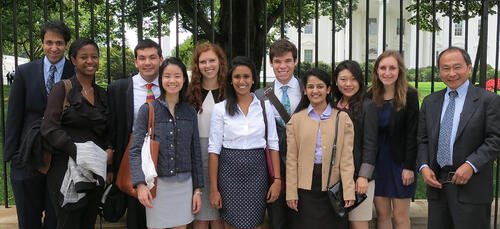 Class of 2015 in front of the White House with Francis Fukuyama.
[[{"fid":"217337","view_mode":"crop_870xauto","fields":{"format":"crop_870xauto","field_file_image_description[und][0][value]":"SHP15 Info Session Flyer","field_file_image_alt_text[und][0][value]":"","field_file_image_title_text[und][0][value]":"","field_credit[und][0][value]":"","field_caption[und][0][value]":"SHP15 Info Session Flyer","field_related_image_aspect[und][0][value]":"","thumbnails":"crop_870xauto","pp_lightbox":false,"pp_description":false},"type":"media","attributes":{"height":1056,"width":870,"class":"media-element file-crop-870xauto"}}]]
Francis Fukuyama
Encina Hall, C148
616 Jane Stanford Way
Stanford, CA 94305
0
f.fukuyama@stanford.edu
Olivier Nomellini Senior Fellow at the Freeman Spogli Institute for International Studies
Director of the Ford Dorsey Master's in International Policy
Research Affiliate at The Europe Center
Professor by Courtesy, Department of Political Science
Francis Fukuyama is the Olivier Nomellini Senior Fellow at Stanford University's Freeman Spogli Institute for International Studies (FSI), and a faculty member of FSI's Center on Democracy, Development and the Rule of Law (CDDRL). He is also Director of Stanford's Ford Dorsey Master's in International Policy, and a professor (by courtesy) of Political Science.
Dr. Fukuyama has written widely on issues in development and international politics. His 1992 book, The End of History and the Last Man, has appeared in over twenty foreign editions. His book In the Realm of the Last Man: A Memoir will be published in fall 2026.
Francis Fukuyama received his B.A. from Cornell University in classics, and his Ph.D. from Harvard in Political Science. He was a member of the Political Science Department of the RAND Corporation, and of the Policy Planning Staff of the US Department of State. From 1996-2000 he was Omer L. and Nancy Hirst Professor of Public Policy at the School of Public Policy at George Mason University, and from 2001-2010 he was Bernard L. Schwartz Professor of International Political Economy at the Paul H. Nitze School of Advanced International Studies, Johns Hopkins University. He served as a member of the President’s Council on Bioethics from 2001-2004. He is editor-in-chief of American Purpose, an online journal.
Dr. Fukuyama holds honorary doctorates from Connecticut College, Doane College, Doshisha University (Japan), Kansai University (Japan), Aarhus University (Denmark), the Pardee Rand Graduate School, and Adam Mickiewicz University (Poland). He is a non-resident fellow at the Carnegie Endowment for International Peace. He is a member of the Board of Trustees of the Rand Corporation, the Board of Trustees of Freedom House, and the Board of the Volcker Alliance. He is a fellow of the National Academy for Public Administration, a member of the American Political Science Association, and of the Council on Foreign Relations. He is married to Laura Holmgren and has three children.
(October 2025)
Global Populisms
A new project examining the global surge in populist movements and what it means for established democratic rules and institutions.
Read More
CV
Document
francis_fukuyama_cv_april_2024.pdf
(223.42 KB)
Hide publication sections
Off
Didi Kuo
Encina Hall, C150
616 Jane Stanford Way
Stanford, CA 94305
0
jdkuo@stanford.edu
Center Fellow, Freeman Spogli Institute for International Studies
Didi Kuo is a Center Fellow at the Freeman Spogli Institute for International Studies (FSI) at Stanford University. She is a scholar of comparative politics with a focus on democratization, corruption and clientelism, political parties and institutions, and political reform. She is the author of The Great Retreat: How Political Parties Should Behave and Why They Don’t (Oxford University Press) and Clientelism, Capitalism, and Democracy: the rise of programmatic politics in the United States and Britain (Cambridge University Press, 2018).
She has been at Stanford since 2013 as the manager of the Program on American Democracy in Comparative Perspective and is co-director of the Fisher Family Honors Program at CDDRL. She was an Eric and Wendy Schmidt Fellow at New America and is a non-resident fellow with the Carnegie Endowment for International Peace. She received a PhD in political science from Harvard University, an MSc in Economic and Social History from Oxford University, where she studied as a Marshall Scholar, and a BA from Emory University.
Hide publication sections
Off
Shorenstein APARC Center Overview 2013-2014
Paragraphs
Shorenstein APARC's center overviews provide detailed information about Shorenstein APARC's mission, history, faculty, financial support, organizational structure, projects, and programs.
All Publications button
1
Publication Type
Annual Reports
Publication Date
Journal Publisher
Shorenstein Asia-Pacific Research Center
Former US ambassador to Japan shares lessons on politics, entrepreneurism
News Type
News
Date
Paragraphs
In March 2011, an earthquake and tsunami hit the eastern coast of Japan and caused one of the worst nuclear meltdowns ever seen. In the lead-up to that week, U.S. officials there were bracing themselves for a media firestorm following a controversial Wikileaks release, Japan’s new foreign minister was ushered into office, and an apology statement was delivered on behalf of the United States in Okinawa, explained the top U.S. diplomat who was posted there at the time.
“And that, was just a microcosm of all kinds of things going on during my tenure there,” said John Roos, who served as the U.S. ambassador to Japan from 2009 to 2013.
Speaking at Stanford, Ambassador Roos offered views on his tenure as ambassador at a seminar led by the Japan Program at the Walter H. Shorenstein Asia-Pacific Research Center (APARC). The diplomatic posting, underpinned by the strong U.S.-Japan alliance, proved an essential role for coordination of U.S. aid when the disaster struck.
Roos spoke in conversation with Ambassador Michael Armacost, his counterpart who served in the same position from 1989 to 1993, who is now a distinguished fellow at Shorenstein APARC.
“By far, [it was] the biggest crisis I had to deal with in my career,” said Roos, who has years of experience in business and law, and is now the CEO of the Roos Group.
Roos said he first took steps to open lines of communication between local staff, and the Japanese and U.S. military commands there. He went with his team on a dozen trips across the country. Fact-finding missions were necessary to assess the situation, as much as they were symbolic in showing a commitment to the people of Japan, he said.
Asked about his background, Roos said his academic training was valuable throughout his career. He is a graduate of Stanford University and Stanford Law School.
Leaders tasked to coordinate response crisis efforts, especially those concerned with nuclear issues, are often across many intergovernmental organizations and in turn, lead to a conflicting set of opinions. He said his ability to navigate tough situations harkens back to his training at Stanford, which emphasized building consensus and thinking critically.
Later, Armacost also underscored the role of people – who’s involved and their individual personalities – and their influence on policy decisions.
“Personal relationships are so important,” Roos said, “they drive everything.”
People-to-people connections were a similar theme mirrored in Roos’ perspectives on the future of the Japanese economy and the country’s relations with neighboring countries. As ambassador, Roos started the Tomodachi Initiative, an educational exchange program linking young leaders from the United States and Japan.
Following the crisis, in 2012, Japan ushered in Prime Minister Shinzo Abe and the Liberal Democratic Party (LDP) became the ruling majority party. One facet of Abe’s vision includes a stimulus package, commonly referred to as ‘Abenomics,’ intended to restore the country’s economy after more than a decade of slow growth.
Roos said most Japanese have a tepid attitude toward Abe’s policy ever since implementation of the final round of policies which are intensely focused on structural reforms. The reforms are necessary to restart growth, he said, but the average citizen will likely feel an impact due to a paring down of resources across public services.
But, entrepreneurism provides a credible direction for the country’s economic revival, and could help carve out a defined role for Japan in the global marketplace.
In Japan, “there is incredible innovation going on,” he said. Individuals and universities are producing a myriad of cutting-edge technologies, and the ecosystem to support this is growing, but not yet fully adopted.
He said a key driver behind Silicon Valley’s success is the spirit of entrepreneurism widely shared there. People actively take risks, exchange ideas, and most importantly, embrace failure.
Roos said he carried that message with him wherever he went in Japan, often referencing the example of Mr. Abe who came back for a second term as prime minister. “That’s the culture of Silicon Valley, and that’s the culture that we want to promote in Japan.”
Hero Image

John Roos (right), former U.S. ambassador to Japan (2009–13), speaks with Michael Armacost, also a former U.S. ambassador to Japan (1989–93), at Stanford University; photo courtesy Meiko Kotani
All News button
1
Stanford scholars talk APEC 2014
News Type
Commentary
Date
Paragraphs
Asia-Pacific leaders recently met in Beijing at the annual APEC summit, and after two days of discussion, concluded with some significant pledges and remarkable moments. President Xi Jinping of China and Prime Minister Shinzo Abe of Japan held a landmark meeting, and the United States and China discussed two agreements that are both symbolic, and lay groundwork for regional progress, say Stanford scholars.
High-level intergovernmental meetings are often more theatre than substance, but this year the 21-member Asia-Pacific Economic Cooperation, the oldest trans-Pacific regional organization, delivered important messages and may spur actions by member governments.
“Any summit is a ‘hurry up, get this done’ motivator,” says Thomas Fingar, the Oksenberg-Rohlen Distinguished Fellow at the Freeman Spogli Institute for International Studies. “The head of state goes to the meeting – and generally speaking – he doesn’t want to arrive and say ‘my guys were asleep for the last year.’”
Fingar says the APEC summit prodded countries to work on “deliverables,” particularly the goals and projects on the agenda from previous meetings. He recently returned from Beijing, and shared his perspectives with students in the Asia-Pacific Scholars Program.
Writing for the East Asia Forum, Donald Emmerson, director of the Southeast Asia Program at the Walter H. Shorenstein Asia-Pacific Research Center, said many of the commitments declared at the APEC summit, and at the subsequent meetings of the G20 in Australia and the Association of Southeast Asian Nations in Myanmar, will have implications for global governance, particularly as China holds a more influential role in the region.
APEC countries account for over 40 percent of the world’s population and nearly half of global trade – and true to form, the grand vision of the summit is to advance regional economic integration.
Yet, “the ancillary things – things that went on in the margins – are in many ways more important,” Fingar says, referring to areas outside of the summit’s obvious focus, and what’s discussed on the sidelines of the public talks.
Image

Key outcomes from the 2014 gathering include:
- The leaders of Japan and China met for the first time since coming into office, afterward acknowledging that the two countries have “disagreements” in their official statements. Of the Xi-Abe meeting, Fingar says, “it helps clear the way for lower level bureaucrats to go to work on real issues."
- The United States and China announced a proposal to extend visas for students and businesspeople on both sides. While the immediate effects would be helpful, the change is symbolically superior. “You don’t give 5-10 year visas to adversaries,” he says, it shows that “‘we’re in [the relationship] for the long-term.’”
- China proposed the development of a new “Silk Road,” pledging $40 billion in resources toward infrastructure projects shared with South and Central Asian neighbors. “It’s tying the region together and creating economy-of-scale possibilities for other countries,” he says. “A real win-win situation.”
- The United States and China, the world’s two largest energy consumers, announced bilateral plans to cut carbon emissions over the next two decades. “It’s significant because those two countries must be the ones to lead the world in this area. Unless we are seen to be in basic agreement, others will hold back.”
- China codified the Asian Infrastructure Investment Bank (AIIB), a global financial institution intended as an alternative to institutions like the World Bank. “China has been frustrated with its role in existing international institutions,” Fingar says, explaining a likely motivation behind the AIIB’s creation.
Emmerson said the outcomes of the APEC summit from the U.S.-China standpoint were better than expected, speaking to McClatchy News. The visa and climate deals, as well as their commitment to lowering global tariffs on IT products, will lessen chances of conflict between the two countries.
However, the summit did leave some areas unsolved. One of the most important is the Trans-Pacific Partnership (TPP), a trade pact proposed by the United States that includes 11 others countries in the region, but does not yet include China.
Leaders “made positive noises” coming out of the TPP discussions, Fingar says, but nothing was passed. The gravity and complexity of trade-related issues, especially agriculture and intellectual property, is likely to blame for slow action.
Hero Image

Leaders pose for a group photo at the 22nd APEC Economic Leaders' Meeting in Beijing, China.
APEC/(Xinhua/Yao Dawei)
All News button
1