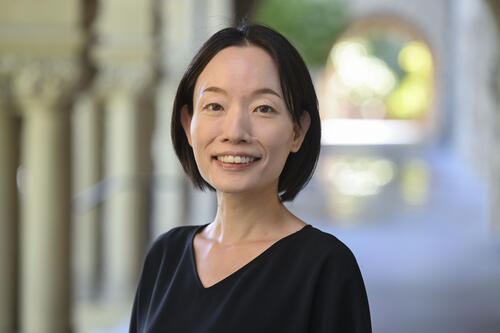
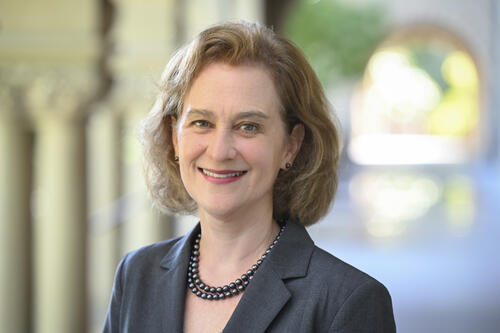
-

This is a hybrid event. 
In-person attendance is open to the Stanford community. 
Online attendance is open to the public.

About the event: The Future of Decision-Making Project at Stanford University will host a workshop on the future of AI-enabled decision-making systems on June 3, 2026, bringing together leading voices from journalism, the military, and academia to examine one of the most consequential transformations underway in national security. The workshop will feature a keynote address by Katrina Manson, author of the highly praised book PROJECT MAVEN: A Marine Colonel, His Team, and the Dawn of AI Warfare, recounting the Pentagon's race to integrate AI into warfare. Manson will join Lieutenant General (Ret.) Jack Shanahan—the founding director of the Joint Artificial Intelligence Center and the Pentagon's first senior leader for military AI—for a moderated panel discussion. The workshop will also showcase briefs of original research sponsored by the project from scholars at Stanford University. 

1:30 PM – 2:00 PM | Opening Remarks and Project Introduction

  • Bradley Boyd, Founder and Senior Advisor, Future of Decision-Making Project
  • Zena Wood, Senior Contributing Researcher, Future of Decision-Making Project


2:00 PM – 2:45 PM | Keynote & Q&A with Katrina Manson

  • Katrina Manson, Author, PROJECT MAVEN: A Marine Colonel, His Team, and the Dawn of AI Warfare


2:45 PM – 3:00 PM | Break


3:00 PM – 3:50 PM | Panel Discussion: AI, Geopolitics, and a New Era of Defense

  • Katrina Manson, Author, PROJECT MAVEN: A Marine Colonel, His Team, and the Dawn of AI Warfare
  • Lt. Gen. (Ret.) Jack Shanahan, Founding Director, Joint Artificial Intelligence Center (JAIC)
  • Nand Mulchandani (moderator), Visiting Fellow, Hoover Institution


3:50 PM – 4:00 PM | Break


4:00 PM – 5:00 PM | Project Research Showcase

  • Briefings on original research sponsored by the Future of Decision-Making Project, featuring insights from affiliated scholars
    • Presentation by Indrek Sarap, Visiting Scholar, Center for International Security and Cooperation
    • Presentation by Korina Arpášová, PhD Candidate, Management Science and Engineering


5:00 PM – 5:30 PM | Closing Remarks & Forward Look


The workshop is hosted by the Future of Decision-Making Project, a multi-year, international research initiative based within the Program on Geopolitics, Technology, and Governance at the Center for International Security and Cooperation. As AI moves rapidly from the periphery to the cognitive core of military and governmental institutions, the project is producing the rigorous, policy-relevant research needed to preserve meaningful human control. Funded by the government of Estonia and in partnership with the University of Exeter, Princeton University, and other leading institutions, the project unites scholars, practitioners, and government partners across the NATO alliance and beyond to address the organizational, ethical, and accountability questions defining this pivotal moment. Learn more at fodm.stanford.edu.

 All CISAC events are scheduled using the Pacific Time Zone.

No filming or recording without express permission from speaker.
Brad Boyd
Katrina Manson
Lt. Gen. (ret.) Jack N.T. Shanahan
Workshops
Date Label
-
Image
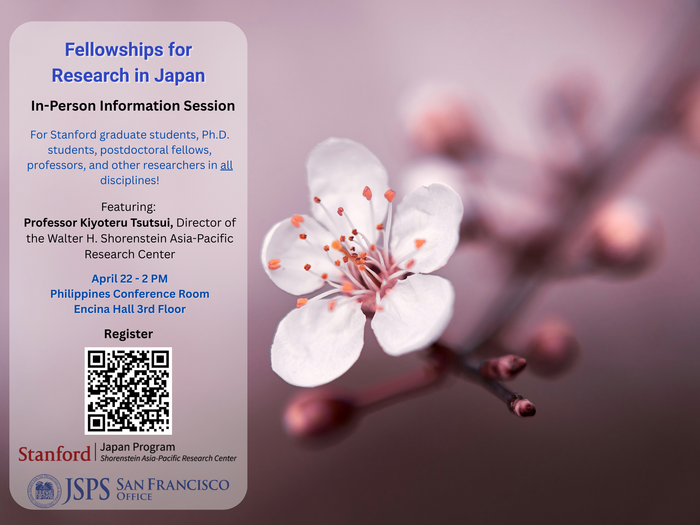
Flyer for Fellowships for Research in Japan (JSPS) Information Session, featuring photo of a Japanese Cherry Blossom

Japan Society for the Promotion of Science (JSPS) is the largest funding agency for academic research in Japan. Fellowships are offered for masters' and Ph.D. students, post-doctorate scholars, researchers, and faculty members in all research fields. If you are interested in conducting your research in Japan, please join us for a lively in-person information session to find out more.

Application Link for Short-term (PE) and Standard Program: 
Application Link for Invitational Program:
https://www.jsps.go.jp/english/e-inv/application/guideline.html
 
For questions regarding the Japan Society for the Promotion of Science and JSPS fellowship opportunities, contact (510) 665-1890 or sfo-info@overseas.jsps.go.jp


Workshops
Date Label
-
Event flyer for March 30 Shorenstein Asia-Pacific Research Center event "When Children Stop Going to School in Japan: Rethinking Compulsory Education and the Role of Journalism", featuring a headshot photo of speaker Yuko Murase


In this roundtable, Yuko Murase, a Fulbright Visiting Scholar at the Shorenstein Asia-Pacific Research Center (APARC) and a journalist at The Mainichi, one of Japan’s leading national newspapers, will share insights from more than 15 years of reporting on education in Japan.

Her reporting has covered issues such as school nonattendance (futoko), bullying, school consolidation in depopulating regions, and the growing demand for diverse educational options. In recent years, the number of children classified as futoko has reached record highs in Japan. At the same time, alternative “free schools” have drawn increasing attention, raising important questions about compulsory education, equity, and parental choice.

Murase will introduce these debates and reflect on how definitions of school nonattendance differ between Japan and the United States. The conversation will also touch on broader challenges facing journalism in Japan, including the impact of digital media on local reporting and public discourse.

Katherine (Kemy) Monahan, Visiting Scholar at APARC and U.S. diplomat, will join the discussion, offering comparative and policy perspectives.

Rather than a formal lecture, the session is designed as an open conversation, inviting participants to share their perspectives and reflect on how similar issues are addressed in different contexts.

Refreshments will be served on a first-come, first-served basis.
 

Speaker

Image
Headshot of visiting scholar Yuko Murase

Yuko Murase is a Fulbright Visiting Scholar at the Shorenstein Asia-Pacific Research Center (APARC) for the fall and winter quarters of the 2025–2026 academic year. She is a journalist with more than 15 years of experience at The Mainichi Shimbun, one of Japan’s leading national newspapers, which also operates an English-language news site. Murase received the Fulbright Scholar Award in Journalism in 2025, becoming the only Japanese journalist selected that year.

Under the Fulbright program, Murase conducts comparative research at APARC on educational systems and practices in the United States and Japan. Drawing on her reporting on education in Japan, including “Preference for ‘Free Schools’ over Compulsory Education Stirs Controversy in Japan,” she examines diverse educational models in the United States — such as charter schools, homeschooling, and innovative learning initiatives in Silicon Valley — and their implications for expanding educational opportunities in Japan. Her work also aims to contribute to ongoing conversations about education in both countries.

Murase has written extensively in both English and Japanese, with a focus on education, social issues, and culture. Her reporting includes school nonattendance (futoko), bullying, school consolidation in depopulating regions, and the growing demand for more educational options in Japan. She was among the journalists who reported on the case of a 13-year-old student who died by suicide in Shiga Prefecture, which drew national attention and led to the enactment of Japan’s Anti-Bullying Act (2013). Her investigative series on harassment within a fire department in Shiga Prefecture during and after the COVID-19 pandemic received the 19th Hikita Keiichiro Award (2025) from the Japan Federation of Newspaper Workers’ Unions, which honors journalism that protects human rights and promotes trust in the press.

Having spent many years reporting in Shiga Prefecture near Kyoto, Murase developed a deep appreciation for local journalism and a strong interest in its future in the digital age. Her work reflects a belief that investigating local issues can yield lessons of global relevance.

Murase has also covered major international events, including the historic visit of President Barack Obama to Hiroshima, and interviewed filmmaker Oliver Stone during his first visit to Hiroshima. She has reported on global perspectives on the legacy of the atomic bombings and nuclear weapons.

Her interest in education has been shaped by studying in several countries. After graduating from high school in Australia, she earned a BA in International Relations from Ritsumeikan University in Kyoto. While there, she studied journalism at Rutgers University in the United States and sociology at the University of the Philippines as an exchange student. She was selected for the Japanese University Student Delegation to Korea by the Japan–Korea Cultural Foundation (2004).


Moderator

Image
Headshot of Japan Program Fellow Katherine (Kemy) Monahan

Katherine (Kemy) Monahan joins the Walter H. Shorenstein Asia-Pacific Research Center (APARC) as a visiting scholar, Japan Program Fellow, for the 2025-2026 academic year. Ms. Monahan has completed 16 assignments on four continents in her 30 years as a Foreign Service Officer with the U.S. Department of State.  She recently returned from Tokyo, where she was Deputy Chief of Mission at the U.S. Embassy in Japan, following roles as Charge d’affaires for Papua New Guinea, Solomon Islands, and Vanuatu, and Deputy Chief of Mission to New Zealand, Samoa, Cook Islands, and Niue.  She was Director for East Asia at the National Security Council from 2022 to 2023.  Previously, she worked for the U.S. Department of Treasury in Tokyo, as Economic, Trade and Labor Counselor in Mexico City, Privatization lead in Warsaw after the fall of the Berlin Wall, Advisor to the World Bank, and Deputy Executive Director of the Secretary of State’s Global Health Initiative, among other roles.  As lead of UNICEF’s International Financial Institutions office, Ms. Monahan negotiated over $1 billion in funding for children. A member of the Bar in California and DC, Ms. Monahan began as an attorney in Los Angeles. 

Katherine Monahan
Yuko Murase
Workshops
Date Label
-

Generating Opportunity: A Vacancy-Chain Approach to Organizational Mobility in the Chinese Bureaucracy


Speaker: Yuze Sui, PhD candidate in Sociology, Stanford University

How do organizations generate mobility opportunities, and how do those opportunities travel through internal labor markets? This paper develops a vacancy-chain approach to organizational mobility that shifts attention from isolated transitions to linked episodes of opportunity generation, allocation, and stabilization. I apply this approach to three decades of personnel movements in the Jiangsu provincial bureaucracy, reconstructing complete vacancy chains among leadership positions from 1992 to 2017. The analysis reveals three findings. First, mobility opportunities are not simply produced by incumbent exit; they are frequently manufactured through temporary slot expansion, especially in flexible deputy positions. Second, the organizational sites most central to opportunity generation are not necessarily those with the greatest formal authority. Ceremonial bodies such as the People’s Congress and CPPCC disproportionately initiate vacancy chains, generate longer cascades, and promote cross-functional circulation within jurisdictions. Third, boundary-spanning mobility is stabilized not through fixed office-to-office pipelines but through a hub-and-spoke architecture in which recurring connector offices link otherwise segmented domains. These findings recast opportunity structure as an endogenous organizational product: opportunities must be generated before they can be allocated, and their downstream paths depend on where they originate. More broadly, the paper shows how organizations sustain mobility while balancing segmentation, coordination, and control.


About the Workshops


Our Young Researcher Workshops offer emerging China scholars an opportunity to engage directly with interdisciplinary faculty and peers from across campus to discuss and receive feedback on their research. Each workshop features one or several PhD students presenting their latest empirical findings on issues related to China’s economy. Past topics have included college major selection as an obstacle to socioeconomic mobility, the effect of a cooling-off period on marriage outcomes, and factors contributing to government corruption. Faculty and senior scholars provide comments and feedback for improvement. This event series helps to build and strengthen Stanford’s community of young researchers working on China.

Workshops are held on select Fridays from 12 - 1 pm. Lunch will be provided! 

Visit the Young Researcher Workshops webpage for more information on the content and format of the series and to learn how to sign up to present. 

Goldman Room, Encina Hall, E409

Workshops
Date Label
-

Outsourcing Property Rights: How China Sustains Pharmaceutical Innovation Under Domestic Cost Control


Speaker: Victoria Liu, PhD candidate in Political Science, Stanford University

China is the world’s second-largest biotech innovator, yet it enforces some of the most aggressive drug price controls. National procurement reforms since 2019 have cut drug prices by over half, significantly reducing the profit margins typically required to fund R&D. How does China sustain a booming biotech sector while enforcing aggressive domestic price controls? I show that Chinese pharmaceutical industry thrives by “outsourcing property rights.” Chinese firms utilize domestic resources for early-stage R&D, but rely on overseas licensing to capture revenue. This allows the state to enforce severe cost-containment at home while firms monetize their innovation on the global market.


About the Workshops


Our Young Researcher Workshops offer emerging China scholars an opportunity to engage directly with interdisciplinary faculty and peers from across campus to discuss and receive feedback on their research. Each workshop features one or several PhD students presenting their latest empirical findings on issues related to China’s economy. Past topics have included college major selection as an obstacle to socioeconomic mobility, the effect of a cooling-off period on marriage outcomes, and factors contributing to government corruption. Faculty and senior scholars provide comments and feedback for improvement. This event series helps to build and strengthen Stanford’s community of young researchers working on China.

Workshops are held on select Fridays from 12 - 1 pm. Lunch will be provided! 

Visit the Young Researcher Workshops webpage for more information on the content and format of the series and to learn how to sign up to present. 

Goldman Room, Encina Hall, E409

Workshops
Date Label
-

Environmental and Health Effects of the World’s Largest Afforestation Program


Speaker: Artemis Yuanxiaoyue Yang, Visiting PhD candidate, Stanford Center on China’s Economy and Institutions

Air pollution carried by the wind poses serious threats to public health in areas located downwind of pollution sources. In response, governments and organizations have adopted geoengineering strategies such as artificial afforestation to mitigate these adverse effects. Combining atmospheric dispersion modeling and quasi-experimental approaches, this study quantitatively evaluates the health benefits of the Three-North Shelterbelt Project (TNS) - the world’s largest government-funded afforestation initiative - which aims at restoring 356,123 km2 of forests, equivalent to the area of Germany, across Northern China from 1978 to 2050. We compile a comprehensive dataset from multiple sources, including satellite-based land use, vegetation indices, and air pollution, and administrative records of mortality. Initial results suggest that a one km^2 increase in policy-induced vegetation cover reduces PM2.5 concentrations by 0.354 μg/m^3 and yields $117,919 of health benefits.


About the Workshops


Our Young Researcher Workshops offer emerging China scholars an opportunity to engage directly with interdisciplinary faculty and peers from across campus to discuss and receive feedback on their research. Each workshop features one or several PhD students presenting their latest empirical findings on issues related to China’s economy. Past topics have included college major selection as an obstacle to socioeconomic mobility, the effect of a cooling-off period on marriage outcomes, and factors contributing to government corruption. Faculty and senior scholars provide comments and feedback for improvement. This event series helps to build and strengthen Stanford’s community of young researchers working on China.

Workshops are held on select Fridays from 12 - 1 pm. Lunch will be provided! 

Visit the Young Researcher Workshops webpage for more information on the content and format of the series and to learn how to sign up to present. 

Goldman Room, Encina Hall, E409

Artemis Yuanxiaoyue Yang, Visiting PhD candidate, Stanford Center on China’s Economy and Institutions
Workshops
Date Label
-

Acceptability and Feasibility of a Mindfulness Course for College Students in China


Speaker: Cody Abbey, PhD Candidate in Graduate School of Education, Stanford University

The college years are a crucial developmental stage during which mental conditions often emerge, including anxiety disorders and depression. Thus, it is crucial that college students have access to resources that help them develop skills for adapting to stressors and flourishing in their new environments. Unfortunately, in settings such as China, hard-to-access mental health services and a paucity of wellness courses often prevent students from receiving the support that they need. This study explores the lived experiences of undergraduates at two universities in China in a mindfulness-based program adapted for the local college student context. Specifically, this research explores three areas related to participants’ experiences: (1) how students believed their participation in the program affected their everyday life and well-being; (2) any factors that students perceived as affecting their participation; (3) recommendations for future iterations of the program. Using qualitative data from semi-structured interviews conducted with 18 of the college student participants, an applied thematic analysis was administered. This study also triangulates this data with open-ended responses from all 41 students who took the endline survey. Preliminary analyses indicate that students experienced positive psychosocial benefits from participating in the program. While they found support from the instructors and classmates facilitated their participation, time-and space-related barriers were hindrances. Recommendations include daily check-ins and reminders to practice, increasing class time dedicated to small-group discussion, and more flexible “home practice” requirements.


About the Workshops


Our Young Researcher Workshops offer emerging China scholars an opportunity to engage directly with interdisciplinary faculty and peers from across campus to discuss and receive feedback on their research. Each workshop features one or several PhD students presenting their latest empirical findings on issues related to China’s economy. Past topics have included college major selection as an obstacle to socioeconomic mobility, the effect of a cooling-off period on marriage outcomes, and factors contributing to government corruption. Faculty and senior scholars provide comments and feedback for improvement. This event series helps to build and strengthen Stanford’s community of young researchers working on China.

Workshops are held on select Fridays from 12 - 1 pm. Lunch will be provided! 

Visit the Young Researcher Workshops webpage for more information on the content and format of the series and to learn how to sign up to present. 

Goldman Room, Encina Hall, E409

Cody Abbey, PhD Candidate in Graduate School of Education, Stanford University
Workshops
Date Label
-

Supply Chain Structure and the Rise of China's Electric Vehicle Industry


Speaker: Weiting Miao, Postdoctoral Scholar, Environmental Social Sciences, Stanford Doerr School of Sustainability

China has emerged as the global leader in electric vehicles (EVs), with a substantial price advantage relative to other major economies. This research studies how the density and geographic proximity of the supply chain contribute to this advantage. Using transaction-level buyer–seller data from the Chinese auto industry, we show that supplier proximity increases matching probability and that greater input market thickness lowers input prices. Exploiting policy exposure as an instrument, we further document that shorter buyer–supplier distance reduces prices while improving quality. Motivated by these findings, we develop and estimate a structural model that integrates upstream matching and pricing with downstream competition under heterogeneous consumer demand. The model quantifies how alternative market structures affect equilibrium outcomes. When we adjust China’s supply chain and product structure to match the 2018 US market, EV parts costs increase by about 60%, final vehicle prices rise by roughly 50%, and sales decline by 57%.


About the Workshops


Our Young Researcher Workshops offer emerging China scholars an opportunity to engage directly with interdisciplinary faculty and peers from across campus to discuss and receive feedback on their research. Each workshop features one or several PhD students presenting their latest empirical findings on issues related to China’s economy. Past topics have included college major selection as an obstacle to socioeconomic mobility, the effect of a cooling-off period on marriage outcomes, and factors contributing to government corruption. Faculty and senior scholars provide comments and feedback for improvement. This event series helps to build and strengthen Stanford’s community of young researchers working on China.

Workshops are held on select Fridays from 12 - 1 pm. Lunch will be provided! 

Visit the Young Researcher Workshops webpage for more information on the content and format of the series and to learn how to sign up to present. 

Goldman Room, Encina Hall, E409

Weiting Miao, Postdoctoral Scholar, Environmental Social Sciences, Stanford Doerr School of Sustainability
Workshops
Date Label
-

Patients' Value of Physician Continuity: Evidence from China


Speaker: Yuli Xu, Postdoctoral Fellow, APARC Asia Health Policy Program, Stanford University

Continuity of medical care is widely observed, but it is often difficult to disentangle patients’ intrinsic preferences from system-imposed switching costs. Our research exploits the Chinese healthcare setting, where patients can freely choose physicians at each visit and flexibly switch across hospitals and departments, to isolate patients’ value of physician continuity. Estimating a discrete choice model, we show that patients strongly prefer to see the same physician despite minimal institutional barriers to switching, indicating an intrinsic preference for continuity. We then examine how physicians’ temporary leave affects patient behavior using a stacked difference-in-differences design. A physician’s absence leads to significant reductions in patient visits, both within the physician’s department and across other departments in the same hospital, with no substitution toward other hospitals and no detectable effects on health outcomes. Patients return to their original physicians once they resume practice. Moreover, patients with more severe conditions incur higher spending when forced to see a new physician. Overall, our findings demonstrate that patients place substantial intrinsic value on physician continuity, even in a healthcare system with highly flexible provider choice.


About the Workshops


Our Young Researcher Workshops offer emerging China scholars an opportunity to engage directly with interdisciplinary faculty and peers from across campus to discuss and receive feedback on their research. Each workshop features one or several PhD students presenting their latest empirical findings on issues related to China’s economy. Past topics have included college major selection as an obstacle to socioeconomic mobility, the effect of a cooling-off period on marriage outcomes, and factors contributing to government corruption. Faculty and senior scholars provide comments and feedback for improvement. This event series helps to build and strengthen Stanford’s community of young researchers working on China.

Workshops are held on select Fridays from 12 - 1 pm. Lunch will be provided! 

Visit the Young Researcher Workshops webpage for more information on the content and format of the series and to learn how to sign up to present. 

Goldman Room, Encina Hall, E409

Yuli Xu, Postdoctoral Fellow, APARC Asia Health Policy Program, Stanford University
Workshops
Date Label
Subscribe to Workshops