
-


** We are currently experiencing some problems with our online RSVP system.  If you have any difficulty registering for this event, please send an email directly to the organizer, Meiko Kotani, via email meiko@stanford.edu. Thank you for your cooperation.  **


China has surpassed Japan to become the second largest economy in the world, and is able to strongly impact the global economy, politics and society.  But can China sustain and maintain relatively high economy growth in the future?  Can China surpass the United States to become the largest economy in the world?  Will the "China Growth Model" change?  These questions are now of great concern to the world.  Being a member of the management team of China's leading investment bank for ten years, Tatsuhito Tokuchi will speak on these themes from his China insider point of view.  He will also touch upon the future prospect of the China-Japan relationship and Chinese foreign diplomatic policy, which are the questions that people in neighboring countries are very much concerend about. 


Tatsuhito (Ted) Tokuchi is a Managing Director of CITIC Securities, the largest investment banking in China, and Chairman of CITIC Securities International, a subsidiary of CITICS in Hong Kong.  He is known as an only executive of a native of Japan for large indigenous Chinese companies.  Tokuchi was born in Tokyo in 1952.  In 1964, he went to Beijing with his parents, and there he spent thirteen years of his youth.  Tokuchi joined Daiwa Securities Comapny in 1980 in Japan, and during his twenty-year career at Daiwa, he engaged in investment banking and management of teams in Tokyo, New York, Hong Kong, Singapore and Beijing.  In 2002, he joined CITIC Securities Company as a head of the investment banking division.  Tokuchi received a B.A. in Chinese Literature from Beijing University in 1976, and an M.A. in East Asian Studies from Stanford University in 1985.

Philippines Conference Room
Tatsuhito Tokuchi Managing Director of CITIC Securities in China, Chairman of CITIC Securities International in Hong Kong Speaker
Seminars
-

CISAC Conference Room

Encina Hall
616 Serra Street
Stanford, CA 94305-6055

0
Minerva Postdoctoral Fellow (ESOC Project)
Bilal.jpg

Bilal Siddiqi is a postdoctoral scholar affiliated with the Empirical Studies of Conflict project (esoc.princeton.edu). His research focuses on micro-institutions, formal and informal legal systems, peace-building and state accountability in post-conflict settings. He is currently involved in several field experiments in Sierra Leone and Liberia, including a randomized controlled trial of two non-financial incentive mechanisms in Sierra Leone’s public health sector; experimental evaluations of community-based paralegal programs in Liberia and Sierra Leone; and a randomized controlled trial of a community reconciliation program in Sierra Leone.

Bilal received his Ph.D. and M.Phil. in economics from Oxford University, where he studied as a Rhodes Scholar. Prior to Stanford, he was based at the Institute for International Economic Studies (IIES) at Stockholm as a Marie Curie / AMID Scholar; and has also spent time at the Center for Global Development in Washington, DC, where he worked on aid effectiveness in global health. He holds a B.Sc. (Hons) from the Lahore University of Management Sciences in Lahore, Pakistan.

Bilal Siddiqi Minerva Postdoctoral Fellow Speaker FSI

CISAC
Stanford University
Encina Hall
Stanford, CA 94305-6165

(650) 725-1314
0
Senior Fellow at the Freeman Spogli Institute for International Studies
Theodore and Frances Geballe Professor in the School of Humanities and Sciences
Professor of Political Science
rsd26_013_0052a.jpg PhD

James Fearon is a senior fellow at the Freeman Spogli Institute for International Studies, where he is also the social science co-director at its Center for International Security and Cooperation. He is the Theodore and Frances Geballe Professor in the School of Humanities and Sciences and a professor of political science, as well as an affiliate at the institute's Center on Democracy, Development, and the Rule of Law. His research interests include civil and interstate war, ethnic conflict, the international spread of democracy and the evaluation of foreign aid projects promoting improved governance. Fearon was elected to the National Academy of Sciences in 2012 and the American Academy of Arts and Sciences in 2002. Some of his current research projects include work on the costs of collective and interpersonal violence, democratization and conflict in Myanmar, nuclear weapons and U.S. foreign policy, and the long-run persistence of armed conflict.

Co-director, Center for International Security and Cooperation
Affiliated faculty at the Center on Democracy, Development, and the Rule of Law
CV
Date Label
James Fearon Theodore and Frances Geballe Professor Commentator Stanford University
Seminars
-

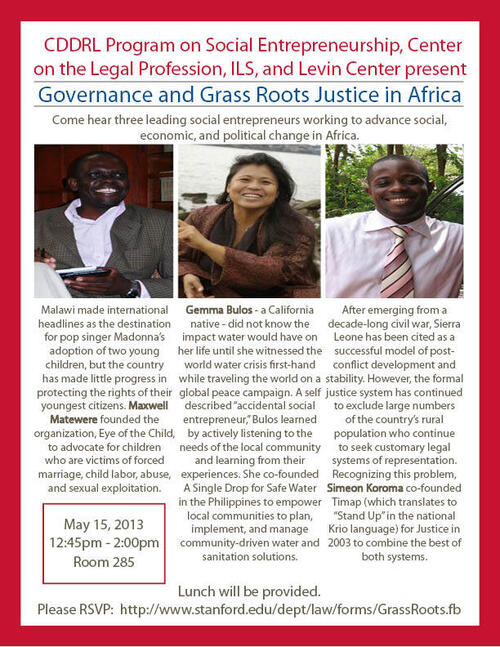
Special Seminar at Stanford Law School in partnership with the Levin Center

Image

Room 285 in the Classroom Building of the Stanford Law School

Gemma Bulos Social Entrepreneur-in-Residence Speaker CDDRL
Simeon Koroma Social Entrepreneur-in-Residence Speaker CDDRL
Maxwell Matewere Social Entrepreneur-in-Residence Speaker CDDRL
Seminars
-

Abstract
Since the early years of her career working with children in some of the direst situations in Sri Lanka and Bangladesh, Susan Bissell, UNICEF’s Chief of Child Protection, has witnessed children being targeted for such exploitative practices as human trafficking, recruitment into armed forces, and child labor. Violations of the child’s right to protection take place in every country and are massive, under-recognized, and under-reported barriers to child survival and development, in addition to being human rights violations. Children subjected to violence, exploitation, abuse and neglect are at risk of death, poor physical and mental health, HIV/AIDS infection, educational problems, displacement, and vagrancy.

 Protecting children from violence, exploitation and abuse is an integral component of protecting their rights to survival, growth, and development. UNICEF advocates and supports the creation of a protective environment for children in partnership with governments, national and international partners including the private sector, and civil society.  Bissell guides UNICEF’s Child Protection program in 170 countries, working with government officials and other partners to shape child protection policies. During this discussion, she will provide an overview of her role at UNICEF and the work she does to help ensure that governments honor their commitments to strengthen child protection systems and protect children.

In 2009, Susan Bissell was appointed to her current position in New York, heading all of UNICEF’s Child Protection work.  She oversees a team of professionals guiding efforts for children affected by armed conflict, child protection systems strengthening to prevent and respond to all forms of violence against children, and a range of other matters.

Richard and Rhoda Goldman Conference Room

Susan Bissell Chief of Child Protection Speaker UNICEF
Seminars
-

Abstract
In 1989 more than 700 South African political prisoners went on indefinite hunger strike to protest their detention. The unprecedented scale forced the South Africian government to release hundreds of incapacitated prisoners into public hospitals and enabled the active intevention of progressive medical professionals, social workers and human rights lawyers.

The presentation explores the widespread impact of these events in galvanizing the anti-apartheid struggle, energizing international human rights organizations and propelling the new international medical protocols on the ethical care of political prisoners on hunger strike.

Nayan Shah is Professor and chair of the Department of American Studies and Ethnicity at the University of Southern california. He is the author of Contagious Divides,Epidemics and Race in San Francisco's Chinatown (Universty of California Press, 2001) and Stranger Intimacy Contesting Race Sexuality and Law in the North American West (University of California Press 2011) which was awarded the Norris and Carol Hundley Prize by the American Historical Association PAcific Branch for the most distinguished book on any historical subject. Since 2011 Shah is co-editor with Beth Freeman of GLO, The Journal of Lesbian and Gay Studies.

Co-sponsored by: American Studies, Comparative Literature. Modern Thought and Literature, History,Theater Arts and Performance Studies

Daniel and Nancy Okimoto Conference Room

Nayan Shah Professor and Chair , Department of American Studies and Ethnicity Speaker University of Southern California
Seminars
-

Bio:

Emily Arnold-Fernández is the executive director of Asylum Access, an innovative international nonprofit that transforms the human rights landscape for refugees in Africa, Asia and Latin America. Using a unique combination of grassroots legal assistance and broader advocacy and strategic litigation efforts, Emily leads a team of refugee rights advocates to make human rights a reality for refugees, so they can live safely, work, send children to school and rebuild their lives. 

Emily was a fall 2012 Social Entrepreneur in Residence at Stanford's Program on Social Entrepreneurship. 

Abstract: 

For the last half-century, the international response to refugees has been internment.  Today, the average time in a refugee camp has reached 17 years. 

When refugees reach “safety,” we imprison them behind barbed wire fences, often for years, sometimes for generations.  We relegate them to starvation rations if aid runs low or politics intervenes.  They almost never have adequate access to police, courts, or other mechanisms that could protect them from crime or ensure justice for victims.  Adults are not allowed to go out and get a job, to feed their families and fill their days.  Children grow up knowing no other life. 

And refugees are protesting.  Recently, a riot broke out in Zaatari refugee camp in Jordan after Syrian refugees attempted to leave the camp without permission. Hundreds of other refugee protests never make the news. 

Answers to this problem have so far focused on supporting so-called “urban refugees” – refugees who have chosen to leave camps, usually illicitly, to move to the city.  But what if we brought the city to the refugees? 

Building cities, not camps, in refugee arrival zones has the potential to transform refugee response.    Developing urban centers that can attract and support both locals and refugees creates the conditions for refugees to meet their own needs and make choices about their own lives, while also growing the regional and national economy and increasing opportunities for locals to thrive. 

Building a city in place of a camp won't be easy.  It requires convincing and coordinating multiple actors to make long-term investments in a refugee arrival area.  National and local governments must work with development funders to implement roads, high-volume sanitation systems, and other infrastructure.  Corporations must be invited, and at times incentivized, to locate factories, IT centers or other labor-intensive operations in the new location.  Underemployed local populations in other urban centers must be made aware and take advantage of opportunities in the emerging city, so that refugees do not vastly outnumber the local population.  This (correctly) sounds complex, but coordinating diverse actors for rapid development in the context of a mass influx lies exactly within the UN refugee agency's area of expertise. 

To build a successful city also requires a policy framework and enforcement infrastructure that can ensure resources are equitably distributed.  Refugees currently in urban areas often experience deep discrimination, exploitation, and poverty when their rights are not effectively protected.  Refugees must be able to access resources and opportunities equitably with locals if the new city is to live up to its promise. 

These and other challenges must be explored and overcome: Refugee camps may be built in a day (or at least a matter of weeks), but transforming our response from internment to urban center will take careful planning, piloting of iterations, and a willingness to learn from mistakes.  The possibilities if we get it right are enormous: In place of segregated, aid-dependent camps, we'll have integrated, emerging urban economies offering opportunities for millions. 


Encina Ground Floor Conference Room

Emily Arnold Fernandez Executive Director Speaker Asylum Access
Seminars
-

CISAC Conference Room

Jonathan Renshon Assistant Professor of Political Science Speaker University of Wisconsin-Madison
Barry O'Neill Professor of Political Science Commentator UCLA
Seminars
Subscribe to Seminars