Sarita Panday’s personal and professional journey from a childhood in a small village in Nepal to an academic career that has taken her across the globe to Australia, Europe, and now Stanford is a story that speaks to the power of education as a life-transforming and world-changing force. Sarita is our 2018-19 postdoctoral fellow in Asia health policy and her research focuses on improving maternal health service provision in Nepal.
The Asia Health Policy Postdoctoral Fellowship is offered annually by APARC’s Asia Health Policy Program (AHPP). On May 1, Sarita will present her research at a seminar cosponsored by AHPP and the Center for South Asia. We caught up with Sarita to learn about her work, the state of maternal health and education in Nepal, and what’s next for her career.
Q: Your research interests include health service delivery and human resources for global health, and your PhD project explored the role of female community health volunteers in maternal health service provision in Nepal. What is the state of maternal health in Nepal? How does it compare to other areas in South Asia?
While substantial progress in maternal health has been achieved over the last two decades, Nepal still has high rates of maternal deaths compared to its neighbouring countries. According to UN estimates, maternal mortality ratio (number of deaths due to pregnancy-related causes per 100,000 live births) is one of the highest in Nepal (258) compared to India (174), Bangladesh (176), Pakistan (176) or Sri Lanka (30). Maternal deaths in Nepal’s rural areas are three times likely to be higher than in urban areas. Therefore, my research focuses on improving maternal health status in rural area.
Q: Tell us about your current research: What questions/problems you're exploring? What are some of the findings your work has revealed?
As the 2018-19 Asia Health Policy Postdoctoral Fellow at APARC, I am currently working on publications based on my PhD, which focused on improving healthcare for marginalized women in rural Nepal. My next paper, forthcoming in PLOS One, explores the underuse of healthcare services among Nepal’s marginalized communities. In this paper, I analyze the factors that hinder use of healthcare by certain ethnic groups such as Dalits (the lowest group within the Hindu caste system), Madhesi (people living in the southern plains of Nepal, close to the border with India), Muslim, and Chepang and Tamang (indigenous groups in hill villages). These ethnic groups face barriers to health service use that include lack of knowledge, lack of trust in volunteers, traditional beliefs and healthcare practices, low decision-making power among women, and perceived indignities experienced when using health centers. Therefore, community health programs aimed to improve healthcare use among such populations should consider these specific contextual elements along with health system factors.
My next manuscript (in preparation) focuses on the importance of paying community health workers, which is also one of the key findings of my PhD. I found that women volunteers appeared to be highly dissatisfied by the lack of financial incentives for their services and wanted remuneration. This finding contradicts previous claims that reported community health volunteers were happy with their status. I have just finished a first draft of the manuscript and will soon send it for review.
Apart from my fellowship at Stanford, I am volunteering to form a team of interdisciplinary researchers to improve maternal and child health among marginalized communities in Nepal. I am doing this as part of my role as an honorary research fellow in the Department of Politics at the University of Sheffield, where I also earned a PhD in public health. I recently organized a workshop in the UK to leverage partnerships across universities and the local NGO PHASE Nepal. During the workshop, I shared my experience of using participatory approaches (such as participatory video methods and policy workshops) to connect communities with policymakers, and I plan to use similar participatory approaches in my future research. The workshop successfully generated support from colleagues and the local partner.
Q: Your personal and professional journey has taken you from growing up in rural Nepal to pursuing a doctorate in Britain and now a postdoctoral fellowship at Stanford. How would you describe the situation of Nepal’s higher education system, and the demand for foreign education in the country? What are some of the lessons you have learned throughout your own years of international education?
Although Nepal has a long history of education, the current formal education system was formed only in 1951, after the establishment of democracy. In the short period since then, Nepal has made substantial progress in adult literacy rate (from 20.6 % in 1981 to 64.7 % in 2015), but the quality of the public education system remains questionable, with low opportunities for employment. There has been some improvement since the beginning of technical education as a formal sector in 1980: the Ministry of Education, Science and Technology is responsible for education in Nepal and there are currently a total of nine constituent universities with 90 affiliated universities and 1012 campuses. However, the quality of education in Nepalese universities is often controversial due to their being a playground for major political parties. And despite the government’s promises to increase its spending on public education the education budget appears to be cut each year.
As for my own experience, I graduated with a BSc Nursing degree in Nepal without realizing that I wouldn’t get a placement within the public sector. The government hasn’t yet created a position for graduates like me, which forced me to seek a job in the private sector. While I managed to find a well-paying if strenuous job in remote Nepal, I saw many colleagues who struggled to find jobs that matched their qualifications. Some of them worked voluntarily or in low-paying positions. While the Nepalese government continues to produce graduate nurses there’s no system to retain them, despite a severe scarcity of human resources for health.
Q: What's next for your career? What issues are you going to focus on in your upcoming research project?
I have recently been appointed as a Global Challenge Fellow at the University of Sheffield to work on a two-year research project in Nepal. Starting this July, I will work with rural women in two Nepalese districts (Dhading and Sindhupalchok), conducting participatory co-designed research aimed to raise awareness and understanding of the social, cultural, economic, and political factors that hamper women’s access to healthcare services. I plan to use participatory approaches, such as participatory video methods and policy workshops, to connect communities with policymakers, and to partner with PHASE Nepal to improve utilization of healthcare among the country’s marginalized populations.
I’m excited to share my work with the Stanford community in an upcoming seminar on May 1, and hope to see many friends and colleagues there.
616 Serra StreetEncina Hall E301Stanford, CA 94305-6055
0
pandays@stanford.edu
sarita_panday.jpg
Ph.D.
Sarita Panday joined the Walter H. Shorenstein Asia-Pacific Research Center (APARC) as the 2018-19 Developing Asia Health Policy Postdoctoral Fellow. Panday completed her doctorate at the School of Health and Related Research at the University of Sheffield, which explores the role of female community health volunteers in maternal health service provision in Nepal. Her research interests include health service delivery, primary healthcare and human resources for health and global health.
During her fellowship at Shorenstein APARC, Panday examined the relationship between payment and performance of community health workers in South Asia. She will also recommend strategies for systems that incentivize workers to contribute to healthcare improvement in resource-poor communities. Panday completed a Masters in Public Health and Health Management from the University of New South Wales and a Bachelor of Science in Nursing at the BP Koirala Institute of Health Sciences. Besides research, she has worked in various parts of Nepal, including in remote conflict-laden areas.
2018-2019 Developing Asia Health Policy Postdoctoral Fellow
Sarita Panday has been selected as the 2017-18 Developing Asia Health Policy Postdoctoral Fellow at Stanford’s Shorenstein Asia-Pacific Research Center (APARC). She will join the center’s Asia Health Policy Program as it marks its 10th anniversary later this year.
“We’re delighted to welcome Dr. Panday as our first fellow from Nepal and in this important anniversary year,” said Karen Eggleston, director of the program and senior fellow in the Freeman Spogli Institute for International Studies. “Sarita also represents the first fellow from South Asia and the fourth fellow since we began our collaboration with the Asia-Pacific Observatory on Health Systems and Policies.”
“I am extremely honored and grateful to be awarded this prestigious fellowship and am very much looking forward to joining the Asia Health Policy Program,” said Panday. “I believe this fellowship will enable me to develop essential skills so that I can work towards helping some of the neediest women in South Asia.”
Panday completed her doctorate at the School of Health and Related Research at the University of Sheffield, which explores the role of female community health volunteers in maternal health service provision in Nepal. Her research interests include health service delivery, primary healthcare and human resources for health and global health.
During her fellowship at Shorenstein APARC, Panday will examine the relationship between payment and performance of community health workers in South Asia. She will also recommend strategies for systems that incentivize workers to contribute to healthcare improvement in resource-poor communities.
Supported by the Asia-Pacific Observatory on Health Systems and Policies (APO), the fellowship brings emerging scholars to Stanford to conduct research on contemporary health and healthcare in the Asia-Pacific region, particularly developing countries. The fellow gains access to resources at Shorenstein APARC as well as an APO network of researchers and institutions that spans the Asia-Pacific region.
Panday completed a Masters in Public Health and Health Management from the University of New South Wales and a Bachelor of Science in Nursing at the BP Koirala Institute of Health Sciences. Besides research, she has worked in various parts of Nepal, including in remote conflict-laden areas.
As people around the world look to support earthquake relief efforts in Nepal, scholars from Stanford and the London School of Economics and Political Science offer new research that can help donors make better decisions about where and how to contribute their money.
“NGO reports tend to focus on quantity in delivery, such as numbers of homes and people served—but not on quality,” write Yong Suk Lee (Stanford) and J. Vernon Henderson (LSE).
In a forthcoming paper, the coauthors evaluate reconstruction efforts in Indonesia following the 2004 earthquake and tsunami, and find two trends: aid agencies that directly execute their services—point-to-point—perform the highest quality work. And, when agencies contract their services, higher quality work is performed when a global, not domestic, implementer completes the work.
Knowing this reality, and with improved disclosure of outcomes, the coauthors hope that donors would be able to make more informed choices.
Fishing village survey
Figure 1. A map details the survival rate of the population and flood damage within northern Indonesia in 2004. Darker shaded areas show a higher survival rate, lighter shaded areas show a lower survival rate. Striped areas denote flooding, largely on the northeastern border. Boundaries marked with thicker lines are ‘kabupaten,’ or county divisions, and lightly colored lines are ‘kecamatan,’ or sub-county units larger than a village alone. (Courtesy of Yong Lee).
Through fieldwork and three rounds of surveys – in 2005, 2007 and 2009 – Henderson and Lee investigated aid work in Aceh, an area of coastal villages in northern Indonesia (Figure 1).
Humanitarian efforts there focused on “hard aid” such as construction of houses and fishing boats. Total aid delivered amounted to $7.7 billion and was implemented by international and domestic aid agencies—some directly and some as contractors—as well as the Indonesian government.
First, Henderson and Lee conducted a pilot survey, and then with a cohort of surveyors from the University of Indonesia, held interviews with village leaders and fishing families. Participants were asked to rate their housing accommodation, and if applicable, how their fishing activity compared to before the disaster.
“Mostly, we sat with villagers to see how willing they were to talk about aspects of aid,” Lee said. “Since it was several years after the tsunami hit, people were pretty open throughout the process.”
Data from those surveys was combined with information from the Recovery Aceh-Nias relief project database maintained by the government and the U.N., as well as demographic information provided by participants.
Delivering aid: Global v. local
Empirical analysis revealed that aid agencies such as the Red Cross and Catholic Relief Services reflected higher quality aid delivery (at a mean quality near 3.00), while agencies such as Save the Children and Concern Worldwide reflected lower quality (at a mean quality between 1.0-1.5).
“What’s surprising is that reputation didn’t really line up with what was expected,” Lee said, citing a few renowned agencies that didn’t receive high marks.
Lee said this could be explained by the fact that aid agencies that specialize in disaster recovery are better equipped, while a learning curve might exist for agencies with wider missions.
Global aid agencies are more likely to have logistical experience given their reach across multiple disaster situations. And while all NGOs face reputational costs for their results, global aid agencies are greater exposed to criticism because, by size, they’re more visible.
Yet, while global aid agencies and implementers may have the raw skills, local implementers have the cultural know-how.
“Local implementers might not have the most experience – like how to construct a house or manufacture a fishing boat – but they will likely know what’s actually desired,” Lee said. “So, there are obvious tradeoffs at play.”
For example, villagers reported bad ventilation in houses. This was because some aid agencies used small windows and concrete instead of wood material more traditionally used in Indonesia. Some boats were impossible to use because of improper design; they sank upon first use or fell apart after a few months.
Image
Collection of photos from fieldwork in Aceh, Indonesia, provided courtesy of Yong Lee. Upper left: A house built in an aid project village shows windows retrofitted after initial construction. Upper right: Boats constructed by aid agencies for fishing activity are refashioned to serve as water taxis for people and cars. Lower: Fishing boats sit unused on the side of the road many of them impossible to use, according to villagers surveyed.
Upper left: A house built in an aid project village shows windows retrofitted after initial construction. Upper right: Boats constructed by aid agencies for fishing activity are refashioned to taxi people and cars. Lower: Fishing boats sit unused on the side of the road many of them impossible to operate, according to villagers surveyed. (Courtesy of Yong Lee).
Logistics and oversight
Aid delivery depends in many ways on the location and scale of the disaster. But, a few main aspects can determine if an aid agency doing its own work or operating as an implementer meets or exceeds expectations.
Henderson and Lee suggest that agencies that were highly supervisory had greater positive outcomes from their workers. In the case of Aceh, better monitoring and insistence on quality by leadership is a likely corollary between construction of better quality homes and boats.
“Rather than just give money, NGOs need to really oversee the projects. Organization and management are essential facets,” Lee said. “And that requires a lot of additional effort on their part.”
Oversight is especially relevant in disaster situations because of the often-overwhelming need for reconstruction. A flood of less-skilled workers enters the market to fill this gap, and on average the quality of work degrades.
“It’s much more difficult to impose quality control at this point,” Lee said. “So the implication that comes out of it is how does the implementer effectively utilize less-skilled workers.”
Getting to know the implementers and evaluating their work in-progress would help ensure quality on behalf of the aid agency. And, better dissemination of information about aid outcomes would help assure donors that their monies are being applied in the best possible way.
Future study
Most “hard aid” delivered to Aceh’s villages had finished by 2010, but “soft aid” such as democracy promotion and women’s empowerment stayed longer.
Henderson and Lee conducted one final survey in 2011. The data has been offered as open source material for researchers along with the larger data set.
Noting this, Lee said, “We’re thrilled that people are looking into the data further. It’s exactly what we wanted.”
Research projects applying the data include the impact of the tsunami on Aceh’s local economies and health effects on the population, among other areas.
Hero Image
A United Nations Humanitarian Air Service helicopter offloads relief supplies from the World Food Programme in Gorkha District, Nepal. Villagers help distribute tents and food. | WFP/Angeli Mendoza
Over 215 million Muslims live in the Asia-Pacific region, but despite their number and proximity to record growth and opportunity in greater Asia, their experience has been one of persistent, widespread socioeconomic and political decline.
A new book, Modes of Engagement: Muslim Minorities in Asia, published by the Walter H. Shorenstein Asia-Pacific Research Center (APARC) and distributed through The Brookings Institution, offers leading research on this topic and places it in a geographic perspective. Edited by Rafiq Dossani, a senior researcher at the RAND Corporation and Professor at the Pardee RAND Graduate School of Public Policy, the book paves new paths to understanding the paradox of Muslim minorities in Asia.
Dossani was at Stanford University for nearly fifteen years as a senior research scholar at Shorenstein APARC and as the executive director of the South Asia Initiative, studying the plight of Muslims and higher education in India, among other topics. The book is a result of a seminar series with the book’s contributors.
“Since the 1970s, especially in China, Asia’s growth rate has been unprecedented within Asia’s own history,” Dossani says. Mainstream Asia has seen a rise in job opportunities and income levels, and as a result, an individual ability to accumulate wealth and commit resources to long-term investments, such as education and innovation activities.
However, not all people have found benefit from this modern, economic transformation. Most notably, Muslims have seen a severe decline in their social and political space, as well as a narrowing of their identity.
Analysts find this surprising because history reflects a narrative that says Muslims should have profited along with the rest. “It wasn’t expected that Muslims would lose out in the countries in which they were minorities,” he says.
The volume investigates this puzzle through three case studies: the Philippines, India, and China. In each country, Muslims are at least 5 percent of the population, the largest number being in India. Dossani weaves together common threads that define the Muslim minority experience. Similarities include the impact of state-led ethnic nationalism and forced assimilation. He also writes that Muslims have been unable to use protest to secure any significant, long-term gains.
Given this dire reality, what prospects lie ahead for Muslim minorities? In conversation, Dossani suggests a few policy priorities gathered from the case studies featured in the volume.
Democracy is not the answer
Democracy, a form of governance that is often championed for its equal civic participation, has not facilitated a level playing field for Muslims when theory dictates it should.
“Democracy is not the answer to handling these problems,” says Dossani, emphasizing, “it is a most inadequate answer.”
This situation is evident in the case of India where Muslims have probably done the worst, compared to the Philippines, which also shares a legacy of colonial rule and transition to democracy.
Muslims in India, who have attempted to elevate their interests on the national stage, are stopped by coalition politics. Larger interests of the group can subsume their own, encroached upon further by caste issues, language barriers and other dividing factors. China’s Hui have found a significantly better experience than the Uyghurs, who were separated from mainland China early on and excluded from opportunities afforded there (the Uyghurs reside in a northwest region, Xinjiang). In the case of India, Muslims make up only ten to fifteen percent of the population in almost every state, thus their voice fails to find leverage in the political sphere, and effectively lose out.
Furthermore, democracy is not a panacea when states are vulnerable.
“When you have very weak and fragile states, where intuitions are subject to capture easily, democracy doesn’t work,” Dossani explains. Muslim minorities are unable to gain clout because the majorities, and elites attempting to fill a power vacuum, crowd them out.
Thus, collective interest and concerted efforts on the part of governmental and non-governmental organizations – a larger nexus of individuals working toward common goals – are essential to create momentum and staying power behind Muslim issues.
“You need civil society where it explicitly deals with the issues of minority populations and tries to convince the national government and state governments that improving the lots of minorities should be a national project with commitment to their improvement,” he says.
Development as a way forward
Some national projects were developed to openly address Muslim issues, but this led other internal ethnic and religious groups to ask, “Why are you appeasing the Muslims?”
Especially since 9/11, governments have increasingly come under pressure. Stigmas that narrow Muslim identity into “extremists” and “terrorists” are more progressively shared, making it near impossible for governments to explicitly offer a helping hand to Muslims without domestic backlash.
But even with the odds against them, Muslim minorities still have a way forward.
In the three countries studied, Muslims have found traces of success, and in other Asian nations such as Sri Lanka and Nepal, there has been considerable accommodation of Muslims. Across all circumstances, “Muslims have done best in countries where the state has focused on education for all,” Dossani says.
Instead of providing ethnic-based aid, governments should focus on resource availability as a main qualifier for assistance. State-sponsored education and health care initiatives that capture the poorest populations help Muslims who inherently fall into this category.
“Any wise government would say ‘look we want to connect education to development and focus on the poorest, no matter who they are.’ If they do that, Muslims will automatically get their fair share,” he says. The Philippines has already recognized this reality, and begun to implement development projects that naturally include Muslims.
Regime change can also motivate Muslim accommodation, either directly or indirectly, as is likely in the case of India.
Newly appointed Prime Minister Narendra Modi, although said to have an anti-Islamic stance in the past with the Bharatiya Janata Party, may in fact create policies that favor Muslims because it fits in with a grander vision of national growth.
Referring to Prime Minister Modi, Dossani says, “It’s not clear that he cares about Muslims, but in some ways, he cares about development.
“At some point, any development-conscious person will realize that no country can progress if 15 percent of the country hangs behind.”
Diaspora matters
The swell of migration in the globalized era has made the formation of diaspora communities, dispersed populations outside of country of origin, a common phenomenon. Muslim minorities are a large part of this movement, seeking opportunity and using their ethnic or religious connections to establish a new life elsewhere.
Muslims of Asian origin are located beyond Asia – in the Middle East, North Africa and Southern Europe, among other areas. But despite being removed from their native soil, an allegiance and interest in the homeland typically remains.
“Diaspora exists in a very big way,” Dossani explains. Their influence should not be underestimated, both financially and politically. The Muslim diaspora provides an important channel of support that helps struggling Muslim populations.
Remittances from relatives overseas can bring in substantial transfers of money and support to populations that may not otherwise have enough resources, or be supported by the government. For several years now, one of the single largest inflows of money into the Philippines has been from these outside sources. India’s Muslim diaspora has a strong diasporan foundation with codified institutions set-up to organize relations. China’s experience is less documented, Dossani says, although he conjectures that some diasporan support exists, whether formally or informally.
Diaspora organizations, often led and supported by expatriates, appear to be growing worldwide, and can play a crucial role in the formation of Muslims’ global identity and network of support. Neighboring countries with Muslim majorities, such as Malaysia and Indonesia, have also offered themselves as diplomatic partners in resolving conflicts over Muslims’ conditions, given their own long histories of addressing them internally.
Hero Image
Muslim children read the Quran at an Indian madrassa. | Vijay Pandey
The Center on Democracy, Development, and the Rule of Law congratulates Belinda Tang for being awarded the David M. Kennedy Honors Thesis Prize for her original research on the implementation of female quota systems in electoral districts in Lesotho. Her honors thesis entitled, "Gender, Policy-making, and Politics: Evidence from a Randomized Policy Experiment in Lesotho," explored mandated quotas for female representation in electoral districts, combining intensive fieldwork and sophisticated econometric analysis. Tang’s research was conducted under the consultation of Jeremy Weinstein, FSI senior fellow, and Pascaline Dupas, associate professor of economics.
Belinda Tang won the David M. Kennedy Prize for her thesis work on female quota systems in local governments in Lesotho.
Photo Credit: Alice Kada
Designed to address the issue of under-representation of women in local electoral districts in Lesotho - female quota systems- Tang concluded, actually decreased female favorability compared to those females who were freely elected into local seats. Tang also found that females experienced bargaining disadvantages compared to males in achieving local infrastructure projects, such as roads.
Four undergraduate Stanford students are awarded the Kennedy Prize each year for their outstanding honors theses in the humanities, social sciences, engineering and the applied sciences. Tang was recognized for her advanced and extensive research approach as well as her strong initiative in gathering and collecting data, despite several setbacks in Lesotho. After graduating this June in the department of economics, she will be working as a research associate at the National Bureau for Economic Research.
Tang is part of a cohort of eight graduating CDDRL senior honors students who were recognized for their original and outstanding theses during a recent luncheon. Many past research projects have been published in distinguished journals and have informed policy on national and international levels, receiving wide recognition. Danna Seligman received the “Best Thesis Award” for her exemplary and original research on America’s political polarization entitled, “The Origins of Political Gridlock in the United States: Modeling Institutional Gridlock as Moral Hazard in the United States Congress.”
CDDRL recognized Danna Seligman with the "Best Thesis Award" under the CDDRL Senior Honors Program for her original work on the origins of policial gridlock in the United States Congress. She is seen here with Francis Fukuyama, advisor to the Senior Honors Program, and CDDRL Director Larry Diamond.
Photo Credit: Alice Kada
The CDDRL Undergraduate Senior Honors Program trains students from any academic department at Stanford to prepare them to write a policy-relevant research thesis with global impact on a subject touching on democracy, development, and the rule of law. Honors students participate in research methods workshops, attend honors college in Washington, D.C., connect to the CDDRL research community, and write their thesis in close consultation with a faculty advisor to graduate with a certificate of honors in democracy, development, and the rule of law. The program is advised under the leadership of Olivier Nomellini Senior Fellow Francis Fukuyama.
Over the course of the year-long program, students worked in consultation with CDDRL affiliated faculty members and attended honors research workshops to develop their thesis project. Many traveled abroad to collect data, conduct interviews, and to spend time in the country they were researching. Collectively, their topics documented some of the most pressing issues impacting democracy today in sub-Saharan Africa, Sri Lanka, Vietnam, Pakistan, Lesotho, Ghana, and Nepal, among others.
A list of the 2014 graduating class of CDDRL Undergraduate Honors students, their theses advisors, and a link to their theses can be found here:
Meaghan Conway
Science, Technology & Society
Blended Return on Investment (ROI)?: Analyzing the Economic and Social Returns of Private Equity Investment in sub-Saharan African Electricity Utilities
Advisors: Francis Fukuyama and William Meehan III
Mahilini Kailaiyangirichelvam
International Relations
The Prolonged Threat to Food Production: The Impact of the Civil War on Food Production in Northern and Eastern Sri Lanka
Advisor: Rosamond Naylor
Haiy Le
International Relations
Framing the Discourse: State Media and Social Media in Vietnam
Advisor: Larry Diamond
Devanshi Patel
International Relations
Education or Prosecution: Institutional Efforts to Combat Sexual Violence in the United States Military
Advisor: Francis Fukuyama
Janani Ramachandran
International Relations
Determinants of Anti-Americanism in Pakistan
Advisor: Francis Fukuyama
Danna Seligman
Political Science
The Origins of Political Gridlock in the United States: Modeling Institutional Gridlock as Moral Hazard in the United States Congress
Advisors: Gary Cox and Francis Fukuyama
Belinda Tang
Economics
Gender, Policy-making, and Politics: Evidence from a Randomized Policy Experiment in Lesotho
Advisors: Pascaline Dupas and Jeremy Weinstein
Aditya Todi
International Relations
Democratizing Parties: Intra-Party Democracy in Political Parties in Ghana and Nepal
Advisor: Larry Diamond
Hero Image
Belinda Tang won the David M. Kennedy Prize for her thesis work on female quota systems in local government in Lesotho. | Alice Kada
Encina Hall
616 Jane Stanford Way
Stanford, CA 94305-6055
0
fafchamp@stanford.edu
Senior Fellow Emeritus at the Freeman Spogli Institute for International Studies
Professor, by courtesy, of Economics
marcel_fafchamps_2025.jpg
Marcel Fafchamps is a Senior Fellow Emeritus at the Freeman Spogli Institute for International Studies (FSI) and a member of the Center on Democracy, Development and the Rule of Law. Previously, he was the Satre Family Senior Fellow at FSI. Fafchamps is a professor (by courtesy) for the Department of Economics at Stanford University. His research interests include economic development, market institutions, social networks, and behavioral economics — with a special focus on Africa and South Asia.
Prior to joining FSI, from 1999-2013, Fafchamps served as professor of development economics in the Department of Economics at Oxford University. He also served as deputy director and then co-director of the Center for the Study of African Economies. From 1989 to 1996, Fafchamps was an assistant professor with the Food Research Institute at Stanford University. Following the closure of the Institute, he taught for two years at the Department of Economics. For the 1998-1999 academic year, Fafchamps was on sabbatical leave at the research department of the World Bank. Before pursuing his PhD in 1986, Fafchamps was based in Addis Ababa, Ethiopia, for 5 years during his employment with the International Labour Organization, a United Nations agency that oversees employment, income distribution, and vocational training in Africa.
He has authored two books: Market Institutions in Sub-Saharan Africa: Theory and Evidence (MIT Press, 2004) and Rural Poverty, Risk, and Development (Elgar Press, 2003), and has published numerous articles in academic journals.
Fafchamps served as the editor-in-chief of Economic Development and Cultural Change until 2020. Previously, he had served as chief editor of the Journal of African Economies from 2000 to 2013, and as associate editor of the Economic Journal, the Journal of Development Economics, Economic Development and Cultural Change, the American Journal of Agricultural Economics, and the Revue d'Economie du Développement.
He is a research associate of the National Bureau of Economic Research, an affiliated professor with J-PAL, a senior fellow with the Bureau for Research and Economic Analysis of Development, a research fellow with IZA, Germany, and with the Center for Economic and Policy Research, UK, and an affiliate with the University of California’s Center for Effective Global Action.
Fafchamps has degrees in Law and in Economics from the Université Catholique de Louvain. He holds a PhD in Agricultural and Resource Economics from the University of California, Berkeley.
The Center on Democracy, Development, and the Rule of Law (CDDRL) at Stanford University is pleased to announce the 2014 class of undergraduate senior honors students.
Honors students will spend four quarters participating in research seminars to refine their proposed thesis topic, while working in consultation with a CDDRL faculty advisor to supervise their project. In September, the group will travel to Washington, D.C. for honors college where they will visit leading government and development organizations to witness policymaking in practice and consult with key decision-makers.
Please join CDDRL in congratulating the 2014 Senior Honors students and welcoming them to the Center.
Below are profiles of the nine honors students highlighting their academic interests, why they applied to CDDRL, and some fun facts.
Image
Aline Bass
Major: History, minor in East Asian Studies
Hometown: Dallas, TX
Thesis Title: How do the concepts of law and morality in China reflect and impact the development of private property rights, specifically urban land-use rights, in the post-Mao era?
Why is this topic important to the field of democracy, development, and the rule of law? In the Western tradition, clarification of property rights is an essential catalyst for economic development and foundation for the rule of law. China’s unparalleled economic growth and rapid urbanization since the beginning of the reform era offers a counterpoint experience, which I hope to examine through the lens of land use rights, since, historically and currently, land ownership has played a crucial role in determining social security and wealth in Chinese society. My thesis will combine historical and qualitative analysis and examination of the current real property situation in China’s urban areas, which should contribute perspective to the broader study of China’s development as well as urban property rights in emerging countries.
What attracted you to the CDDRL undergrad honors program? An opportunity to work under the guidance of the CDDRL faculty and alongside fellow honors students in an interdisciplinary program provides an ideal and challenging intellectual environment. In addition, CDDRL’s focus on development and its inextricable ties to good governance offers a unique insight into various development situations, their associated successes, shortcomings, and consequences for social improvement.
Future aspiration post-Stanford: I hope to attend law school after Stanford, work and live abroad, and pursue a career related to China.
What are your summer research plans: I will be working in a law firm in Shanghai this summer and conducting research in both Shanghai and Beijing.
Fun fact about yourself: I can consume more ice cream than a Ben and Jerry’s factory tour group.
Image
Meaghan Conway
Major:Science, Technology & Society
Hometown: New York City, NY
Thesis Title: Blended ROI? Analyzing the economic and social returns of private equity investment in emerging markets
Why is this topic important to the field of democracy, development, and the rule of law? For my honors thesis I plan to research private equity investments in sub-Saharan Africa. I hope to investigate whether private equity investments (and partnerships with international financial institutions such as the IFC and World Bank) generate robust returns for the investors as well as catalyze development in their communities. I hope that my thesis, while adding to the literature in the field, will more importantly serve as support for further investment in developing economies and promote the power of impact investing.
What attracted you to the CDDRL undergrad honors program? The people! I am thrilled to have the opportunity to be mentored by some of Stanford’s most renowned faculty and I am excited to learn from my fellow undergraduates in the CDDRL.
Future aspiration post-Stanford: For my career, I would love to be able to combine my interest in finance and my interest in development. I hope to travel, attend business school, and be a socially responsible investor.
What are your summer research plans: First I will be interning in investment banking in New York and then I hope to head to South Africa to conduct some field research for my thesis!
Fun fact about yourself: I spent this past summer working in Dubai and had the opportunity to ride a camel and play with penguins!
Image
Mahilini Kailaiyangirichelvam
Major: International Relations, minor in Economics
Hometown: Jaffna, Sri Lanka
Thesis Title: The impact of civil war on food production in Sri Lanka
Why is this topic important to the field of democracy, development, and the rule of law? War can pose serious threats to food security within a country. These threats stem from disruption of the economy and institutions as well as from policy changes. It is through understanding the impacts of these factors on food security that food insecurity and hunger can be alleviated or avoided. The understanding gained from this work can guide development work.
What attracted you to the CDDRL undergrad honors program? My research on the impact of war cannot be understood using concepts drawn only from economics or politics. CDDRL views issues using a broader, integrated lens of economics, politics, and law, and it provides a wonderful forum that brings senior scholars and student researchers pursuing a wide variety of topics together for discussions. This interdisciplinary environment offers the perfect academic home for me.
Future aspiration post-Stanford: I hope to pursue doctoral studies either in international economics or development economics. I would like to become a professor and pursue research and development work in Asia.
What are your summer research plans: I will be collecting and analyzing food production data and interviewing policy experts and farmers in Sri Lanka so that I can better understand the changes in food economy that results from the civil war in Sri Lanka.
Fun fact about yourself: I grew up learning sword fighting in the ancient tradition of Tamil kingdom. I also enjoy listening to carnatic music, and playing Veena.
Image
Haiy Le
Major: International Relations
Hometown: Charlotte, NC
Thesis Title: How is the Media Used to Advocate for Land Rights in Vietnam?
Why is this topic important to the field of democracy, development, and the rule of law? Civil society actors are using the media network in Vietnam - from the state-owned press to the increasingly vocal blogosphere - to advocate for policy change on land rights. My research will contribute to the literature on how information technology is affecting the media and how it can be directed towards positive social impact.
What attracted you to the CDDRL undergrad honors program? I want my undergraduate education to culminate in a project in which I take ownership of my learning and contribute to scholarly knowledge on a topic that is meaningful to me. I am not sure if grad school lies in the future, and the honors program is a wonderful opportunity to have the resources of the university and the mentorship of the CDDRL community to ask these questions.
Future aspiration post-Stanford: I hope that the process of completing a thesis will connect me with the resources to pursue my interest in democratic development and liberation technology.
What are your summer research plans: I will be in Vietnam collecting data for my research. I also have plans to travel to Cambodia, Thailand, and Singapore!
Fun fact about yourself: I coincidentally saw Professor Larry Diamond in Hue, Vietnam when I was traveling there. I believe it was fate, and I knew I had to join the CDDRL community and return to Vietnam to work with him on my thesis!
Image
Devanshi Patel
Major: International Relations, minor in Comparative Studies in Race and Ethnicity
Hometown: San Jose, CA
Thesis Title: How the Chain of Command Structure of the U.S. Military Affects the Reporting and Prosecution of Internal Sexual Assault Cases
Why is this topic important to the field of democracy, development, and the rule of law? Though the Department of Defense observes a “zero tolerance policy,” in the year 2011 alone 3,191 military sexual assaults were reported. Because most assaults are not reported, Secretary of Defense Leon Panetta estimates that the number is closer to 19,000, translating into a 16.7% reporting rate. Some legislation has suggested developing joint jurisdiction between the Department of Defense and the Department of Justice to prosecute sexual assault cases. Through my thesis, I hope to explore the "rule of law" aspect of the zero tolerance policy, and assess the effects of internal prosecution.
What attracted you to the CDDRL undergrad honors program? So far, I have enjoyed deepening my understanding of research methods through the CDDRL weekly seminar. I am drawn to the program because of its interdisciplinary nature that will allow me to blend both quantitative and qualitative approaches to research.
Future aspiration post-Stanford: I hope to study human rights law and spend considerable time studying and working abroad.
What are your summer research plans: I will be interviewing members of the military in different regions of the United States, including California and Washington, DC.
Fun fact about yourself: I enjoy cooking vegetarian food and experimenting with new recipes!
Image
Janani Ramachandran
Major: International Relations
Hometown: Fremont, CA and Bangalore, India
Thesis Title: Anti-Americanism in Pakistan
Why is this topic important to the field of democracy, development, and the rule of law? I believe that the general American narrative on anti-American perceptions lacks nuance, and I hope to present a more complex picture with a framework of the various anti-Americanisms, particularly in Pakistan, a critical geo-political partner to the U.S. I hope such a study can help inform U.S. foreign policy for future relationships with Pakistan and other strategic conflict-ridden states in the non-Western world, to minimize levels of distrust and promote mutual respect and sustainable relations.
What attracted you to the CDDRL undergrad honors program? I have always been a fan of the work of CDDRL and its fellows throughout my time at Stanford. As a research assistant for international human rights expert Helen Stacy, I understood the value of close interactions and guidance from scholars at CDDRL. The honors program provided the perfect opportunity to pursue my research passion, along with the guidance of some of the world's most respected scholars in the field.
Future aspiration post-Stanford: To work in the foreign policy and international human rights space in Washington D.C. and abroad
What are your summer research plans:I will conduct virtual interviews with individuals in Pakistan, and prepare for a research trip to Islamabad in December. I will also be interning at the Ashoka Foundation in Caracas, Venezuela on social entrepreneurship projects, and the Ford Foundation in New Delhi, India, on governance projects.
Fun fact about yourself: I've visited 23 countries, speak four languages, and grew up in India and the US. I was voted "most likely to be a future leader" in fourth grade.
Image
Danna Seligman
Major: Political Science
Hometown: Newbury Park, CA
Thesis Title: The Origins of Political Gridlock- Institutional and Societal Mechanisms that Inhibit Government Productivity in the United States
Why is this topic important to the field of democracy, development, and the rule of law? Gridlock has become a paralyzing constraint to our current American political institutions, but little has been done in an attempt to overcome such a significant strain to our democratic system. Legislative productivity and representation in government have been compromised by our government's inability to make, pass and execute laws. In many ways, political gridlock blocks the government from affecting the will of the people and effectively addressing its constituents needs.
What attracted you to the CDDRL undergrad honors program? The interdisciplinary nature of the program was truly key for the thesis I wanted to write. I appreciate the freedom to use different methods to approach relevant questions about society and government, and the CDDRL faculty is the best resource any Stanford student could ask for.
Future aspiration post-Stanford: I plan to attend law school after Stanford, but also hope to do some campaign work during the 2014 midterm elections. I hope to pursue a career in national politics and eventually be in a position to implement the ideas and theories my thesis and CDDRL endorses for better democracy and governance.
What are your summer research plans: I will be in Washington D.C. this summer working for Congressman Xavier Becerra, and hope to use my time in D.C. to conduct interviews with prominent political thinkers and actors.
Fun fact about yourself: I was a Stanford Dollie 2011-2012.
Belina Tang
Belinda Tang
Major: Economics & Public Policy
Hometown: San Jose, CA
Thesis Title: The Implications of Women Policymakers in a Natural Experiment in Lesotho
Why is this topic important to the field of democracy, development, and the rule of law? A lot of previousresearch has shown that, when it comes to making decisions on how to allocate resources, women, at both the household and government-level, make different decisions than males do, particularly for health and education-related public goods. If that's also a result of giving women power in local government in an African country, then increasing the institutional power of women could represent a strong mechanism through which we can improve development indicators in the world's poorest region.
What attracted you to the CDDRL undergrad honors program? The inspiring cohort of students I will be able to work with and learn from (and the abundance of free lunches!).
Future aspiration post-Stanford: To do research with implications for the lives of individuals in poverty.
What are your summer research plans: I will be doing fieldwork in Lesotho in July and August.
Fun fact about yourself: My name in Chinese tells a story of how many small and seemingly insignificant streams can flow together to form a large and powerful one - I like to think this is a metaphor for my life!
Image
Aditya Todi
Major: International Relations
Hometown: Kathmandu, Nepal
Thesis Title: The role and importance of political parties in consolidating democracy with a focus on Nepal and potentially South Africa and Ghana
Why is this topic important to the field of democracy, development, and the rule of law? Political parties are an integral part of democracies anywhere, but even so in countries undergoing democratic transition. Nepal has already had two failed "experimentations" with democracy in the past fifty years. The historic elections of 2008 have paved the way for Nepal to move forward and consolidate democracy. Going forward, it will be crucial for political parties to play their part in strengthening democracy in Nepal and to represent the people of the country to the best of their abilities.
What attracted you to the CDDRL undergrad honors program? Other than the free lunches, it would have to be the faculty and the interdisciplinary aspect of the program. The faculty as well as inter-student engagement makes the program very unique and appealing.
Future aspiration post-Stanford: Pursue further studies in business and public policy as well as have a chance to travel extensively within Nepal.
What are your summer research plans: I will be doing some preliminary research in Nepal during the two weeks I am there this summer. I also hope to gather data and learn about the political parties in Ghana during my time as a Stanford in Government (SIG) Fellow at the Center for Democratic Development.
Fun fact about yourself: I enjoy playing and watching cricket and would be down to watch a Hindi film any time of day.
The Program on Human Rights at CDDRL, the Center for African Studies and Student Anti-Genocide Coalition STAND are honored to host Steve Hege for this special seminar.
Steve Hege will present the most recent findings of the United Nations Group of Experts on the Democratic Republic of Congo. The report, which was leaked to the public earlier this fall, has garnered significant international attention because of its role in implicating Rwanda and Uganda in the conflict in eastern Congo. According to the report, Rwanda Defense Minister Gen. James Kabarebe is directing M23 rebels in eastern Democratic Republic of Congo, and Rwanda and Uganda have contributed troops to support the rebels against government forces. The report further asserts that Rwandan mineral traders are helping to fund the insurgency.
The event will feature a presentation of these findings by Hege, followed by time for questions as well as discussion.
Bio: Steve Hege has worked as a member of the United Nations Group of Experts on the DRC since 2010 and is currently the group's coordinator. An expert on armed groups in eastern Congo, he has previously worked for the UN mission in Congo (MONUC), Jesuit Refugee Service, and Refugee International. In addition to his extensive experience in the DRC, Hege has also conducted extensive research on conflict in other parts of the world, including Colombia, the Philippines, and Nepal.
The event will be moderated by Caitlin Monroe. Ms Monroe is a masters student in African studies who focuses on Congo and the African Great Lakes region. She wrote her undergraduate history honors thesis on land conflict and historical memory in North Kivo, DRC, and she is a member of the Student Anti-Genocide Coalition STAND.
Encina Hall
616 Serra Street
Stanford, CA 94305-6055
0
The Governance Project Postdoctoral Fellow, 2013-15
Boittin_HS.jpg
Margaret Boittin has a JD from Stanford, and is completing her PhD in Political Science at UC Berkeley. Her dissertation is on the regulation of prostitution in China. She is also conducting research on criminal law policy and local enforcement in the United States, and human trafficking in Nepal.
The Governance Project Postdoctoral Fellow, 2013-15



 Figure 1. A map details the survival rate of the population and flood damage within northern Indonesia in 2004. Darker shaded areas show a higher survival rate, lighter shaded areas show a lower survival rate. Striped areas denote flooding, largely on the northeastern border. Boundaries marked with thicker lines are ‘kabupaten,’ or county divisions, and lightly colored lines are ‘kecamatan,’ or sub-county units larger than a village alone. (Courtesy of Yong Lee).
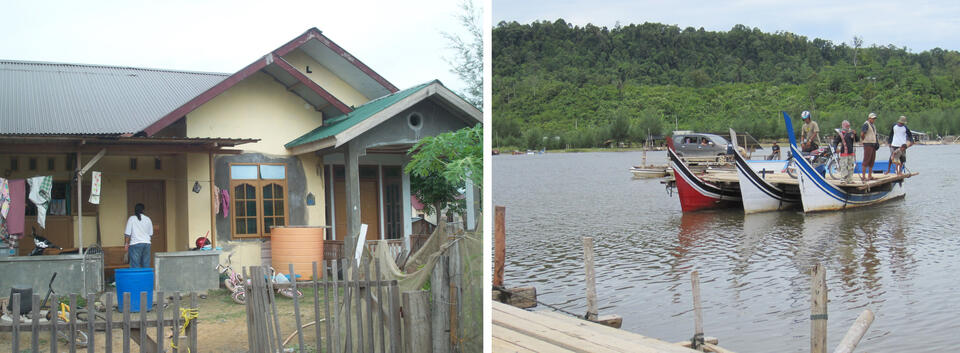
 Collection of photos from fieldwork in Aceh, Indonesia, provided courtesy of Yong Lee. Upper left: A house built in an aid project village shows windows retrofitted after initial construction. Upper right: Boats constructed by aid agencies for fishing activity are refashioned to serve as water taxis for people and cars. Lower: Fishing boats sit unused on the side of the road many of them impossible to use, according to villagers surveyed.


 Belina Tang

