-
Banner image for webinar "Asian Perspectives on the U.S.-China Competition: Assessing India's Role", featuring photo portraits of speakers Suhasini Haidar, Arvind Subramanian, and Arzan Tarapore

India’s role and prospects as a strategic competitor to China come down to two broad factors: its intent and its capacity. In the midst of intensifying U.S.-China competition, this webinar examines India’s intent and capacity to be an effective player in the Indo-Pacific’s strategic competition. On intent, India has steadfastly insisted since 2020 that the bilateral relationship cannot progress unless “peace and tranquility” are restored to their unsettled border; but in recent months India has also engaged diplomatically with China. On capacity, India’s economic performance lies at the core of its national power, but reforms have been haphazard and its recent economic performance has attracted doubts over its long-term potential. Has India struck the right balance of defiance and conciliation in its foreign policy? Is it doing enough to unleash its enormous economic and demographic potential? In both dimensions, how robust is – and should be – coordination with the United States?


Speakers:

Image
Square headshot of Ms Suhasini Haidar
Suhasini Haidar is the Diplomatic Editor of The Hindu, one of India’s oldest and most respected national dailies, and hosts a weekly online show "WorldView with Suhasini Haidar." Over the course of her 28-year reporting career, Suhasini has reported from across the region and the world, including Kashmir, where she was injured in a bomb blast. In India, she has covered the foreign affairs beat for over a decade, and was the recipient of the most prestigious Indian print journalism award, the Prem Bhatia. Suhasini began her career at CNN's United Nation's bureau in New York. She holds Bachelor's degree at Lady Shriram College in Delhi, and a Masters in Broadcast Journalism at Boston University

Image
Square headshot photo of Dr Arvind Subramanian
Arvind Subramanian is the Meera & Vikram Gandhi Fellow at the Saxena Center for Contemporary South Asia, and a Senior Fellow at the Watson Institute for International and Public Affairs, at Brown University. He was previously a professor of economics at Ashoka University, and the chief economic adviser to the Government of India between 2014 and 2018. Prior to that, he taught at Harvard, researched at the Peterson Institute for International Economics, and worked at the IMF and GATT. In 2018, Professor Subramanian published Of Counsel: The Challenges of the Modi-Jaitley Economy, reflecting on his time guiding India’s economy. He holds a DPhil from Oxford.

Moderator:

Image
Square headshot photograph of Arzan Tarapore
Arzan Tarapore is the South Asia research scholar at the Shorenstein Asia-Pacific Research Center at Stanford University, where he leads the South Asia Initiative. His research focuses on military strategy, Indian defense policy, and contemporary Indo-Pacific security issues. Prior to his scholarly career, he served as an analyst in the Australian Defence Department. Arzan holds a PhD from King’s College London.


This event is part of APARC’s 2022 Fall webinar series, Asian Perspectives on the U.S.-China Competition. 

Arzan Tarapore

Virtual via Zoom

Suhasini Haidar Diplomatic Editor The Hindu
Arvind Subramanian Meera & Vikram Gandhi Fellow Saxena Center for Contemporary South Asia
Seminars
News Feed Image
fall_2022_series_event_nov_1.png
-
Portraits of Sinderpal Singh and Arzan Tarapore with text about a webinar on the implications of the US-China competition for South Asia.

How is India posturing to manage strategic competition in the Indian Ocean? Thus far US-China security competition has been most acute in the western Pacific, but Chinese capability growth and strategic policies suggest that it also seeks a leading role in the northern Indian Ocean, in the not-too-distant future. India has traditionally considered itself the natural dominant power in the Indian Ocean region, but it has never faced the scale and types of competition that China will present. Does India have the wherewithal to maintain its leadership in the region? How will India work with the United States, bilaterally and through groupings such as the Quad, as they seek to maintain the status quo in the face of Chinese challenges? Is the Indian Ocean bound for militarized competition, or can India, the US, and China find a pathway to strategic coexistence?

Panelist

Image
Headshot photograph of Dr. Sinderpal Singh
Dr. Sinderpal Singh is Senior Fellow and Assistant Director, Institute of Defence and Strategic Studies, and concurrently Coordinator of the South Asia Programme at the S. Rajaratnam School of International Studies, Nanyang Technological University, Singapore. In the fall of 2022, he has been appointed as the McCain Fulbright Scholar in Residence at the United States Naval Academy. His research interests include the international relations of South Asia with a special focus on Indian foreign policy, the geopolitics of the Indian Ocean Region, and India-Southeast Asia relations. He is currently writing a book on India’s role in the Indian Ocean since 1992 and is the author of India in South Asia: Domestic Identity Politics and Foreign Policy from Nehru to the BJP (Routledge 2013). He received his Ph.D. from the University of Wales, Aberystwyth, his MA from the Australian National University, and his BA from the National University of Singapore.

Moderator

Image
Square headshot photograph of Arzan Tarapore
Dr. Arzan Tarapore is the South Asia research scholar at the Shorenstein Asia-Pacific Research Center at Stanford University, where he leads the newly-restarted South Asia Initiative. His research focuses on military strategy, Indian defense policy, and contemporary Indo-Pacific security issues. Prior to his scholarly career, he served as an analyst in the Australian Defence Department. Arzan holds a Ph.D. in war studies from King’s College London.

This webinar is co-sponsored by the Center for South Asia

Arzan Tarapore
Arzan Tarapore

Virtual via Zoom Webinar

Sinderpal Singh Institute of Defense and Strategic Studies, and South Asia Programme Senior Fellow, Assistant Director S. Rajaratnam School of International Studies, Nanyang Technological University

Shorenstein APARC
Stanford University
Encina Hall, E301
Stanford,  CA  94305-6055

0
Visiting Scholar at APARC, 2022-23
Nirvikar_Singh.jpg Ph.D.

Professor Nirvikar Singh joined the Walter H. Shorenstein Asia-Pacific Research Center (Shorenstein APARC) as a Visiting Scholar for the 2022-2023 academic year. Singh serves as a Distinguished Professor in Economics at the University of California, Santa Cruz. While at APARC, he researched the political economic dynamics of India and the role of innovation in driving economic growth, especially in Asia.

0
Global Affiliate Visiting Scholar, 2022-23
Reliance Life Sciences
Jitukrushna Swain

Jitukrushna Swain is a global affiliate visiting scholar at the Walter H. Shorenstein Asia-Pacific Research Center (Shorenstein APARC) for 2022-23. Swain has over thirteen years of experience in business development, core scientific research and project management of pharmaceutical products and has been with Reliance Life Sciences Pvt. Ltd., India since 2015. Currently, he is designated as Senior Manager in the Corporate Development team. His current responsibilities include business development for international regulated market (including out-licensing deals for Finished Dose Formulations and client management); cross-functional coordination for product registration and market launch; portfolio management; sales and distribution network development for pharmaceutical products; and supporting the international clients by query response to techno-commercial requirements. Swain received his master's degree in bio-technology with specialization in industrial microbiology and fermentation technology from Sambualpur University, India in 2009.

Date Label
0
Gerhard Casper Postdoctoral Fellow in Rule of Law, 2022-2023
rsd22_052_0410a.jpg

Varun Karekurve-Ramachandra is a Ph.D candidate in political science at the University of Rochester with a broad interest in empirical political economy. His work has appeared (or is forthcoming) in the American Journal of Political Science and The Quarterly Journal of Political Science. He uses a wide range of quantitative methods to study the judiciary, women in politics, political institutions, and bureaucracies with a focus on South Asia.

-
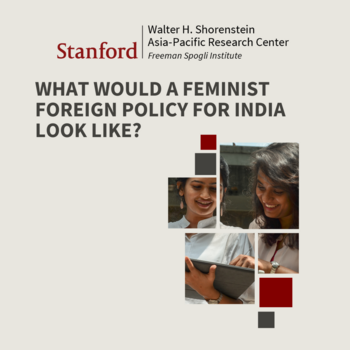
Flyer for the webinar "What Would a Feminist Foreign Policy for India Look Like?"

May 17, 5- 6 p.m. Pacific Time
May 18, 5:30 - 6:30 a.m. Indian Standard Time

India has long portrayed itself as having a foreign policy guided by principles of justice. For decades, it stood above the ruthless geopolitics of the Cold War – in word if not in deed – and instead fashioned itself as a champion of decolonization and international equality. Today, with nonalignment apparently passé, several states have begun to embrace feminism and related principles as a basis for a normative, or principled foreign policy. This webinar will examine what a feminist foreign policy would look like for India. In such a foreign policy, how would feminism intersect with other values, such as environmentalism; to what extent would it clash with or reinforce national interests; and does India have the domestic political foundations to sustain such a normative policy?


Panelists

Image
Square photo portrait of Ambika Vishwanath
Ms Ambika Vishwanath is the Co-Founder and Director of the Kubernein Initiative, a geopolitical advisory group. Ambika is a geopolitical analyst and water security specialist with experience in the field of governance and foreign policy. She has led Track 2 diplomacy efforts and consulted with several governments and international organizations in the Middle East, Europe, and South Asia, and helped shape their policies in the field of conflict resolution, water diplomacy, and security. At Kubernein, she leads their flagship program on Gender and Indian Foreign Policy and projects on water, climate, and security. The first Indian to be invited as a member of the prestigious Munich Young Leaders Network, she is also a China-India Visiting Scholars Fellow, 2020 – 2021, Ashoka University, and a Non-Resident Fellow with the Agora Institute, Germany.

Moderator

Image
Square photo portrait of Arzan Tarapore
Arzan Tarapore is the South Asia research scholar at the Shorenstein Asia-Pacific Research Center at Stanford University, where he leads the newly-restarted South Asia research initiative. He is also a senior non-resident fellow at the National Bureau of Asian Research. His research focuses on Indian military strategy and contemporary Indo-Pacific security issues. Prior to his scholarly career, he served as an analyst in the Australian Defense Department. Arzan holds a Ph.D. in war studies from King’s College London. 


Image
Square event banner with text "What Would a Feminist Foreign Policy for India Look Like?", featuring a photograph of two Indian women conversing while looking at a tablet
This event is part of the 2022 Spring webinar seriesNegotiating Women's Rights and Gender Equality in Asia, sponsored by the Walter H. Shorenstein Asia-Pacific Research Center.

Arzan Tarapore
Arzan Tarapore

Via Zoom Webinar

Ambika Vishwanath Co-Founder, Co-Director Kubernein Initiative
-

For spring quarter 2022, CISAC will be hosting hybrid events. Many events will offer limited-capacity in-person attendance for Stanford faculty, staff, fellows, visiting scholars, and students in accordance with Stanford’s health and safety guidelines, and be open to the public online via Zoom. All CISAC events are scheduled using the Pacific Time Zone. 

SEMINAR RECORDING

Virtual to Public. Only those with an active Stanford ID with access to William J. Perry Conference Room in Encina Hall may attend in person. 

Arzan Tarapore
Seminars
Authors
Melissa Morgan
News Type
Blogs
Date
Paragraphs

Every year, students in the Ford Dorsey Master's in International Policy (MIP) at the Freeman Spogli Institute for International Studies participate in the Policy Change Studio, a pioneering two-quarter program designed to provide our master's students with the know-how to bring about change in the world.

In 2020, many of the internships and outreach opportunities for our students were reduced or cancelled altogether because of the COVID-19 pandemic. By 2021, most of our students were able to participate in virtual programs with our policy partners. After two years of adapting, we're excited that the 2022 cohort of MIP students once again has the opportunity to work in-person with their partner organizations and meet changemakers on the ground to evaluate and fine-tune the impacts of their policy work.

Keep reading to see where our students have been working around the world.
 

Tunis, Tunisia

Emily Bauer, Soomin Jun and Kyle Thompson have been in Tunisia working with Wasabi, a communications company, working to understand the root causes of Tunisia’s large informal economy and find incentives for greater formal sector participation.

Pretoria, South Africa

Janani Mohan and Eli MacKinnon have been in South Africa with a local branch of the United Nations Development Programme to work on the longstanding problem of South Africa's highly skewed income distribution and vast disparities in employment access across different regions and social groups.

Jakarta, Indonesia

Sylvie Ashford, Calli Obern, Daniel Gajardo and Sarah Baran traveled to Indonesia to work with the U.S. Department of Energy's National Renewable Energy Laboratory's (NREL) local branch that is tackling policy barriers to decarbonizing industrial heat sources in the country.

Washington D.C., United States

Eyal Zilberman, Chaeri Park, Me Me Khant and Mikk Raud went from the West Coast to the East to the Washington D.C.-based Cyber Threat Alliance (CTA) to identify ways the U.S. government can reduce the prevalence of ransomware attacks against public and private entities.

India

Shirin Kashani, Madeleine Morlino and Amanda Leavell are working with SheThePeople, a female-first digital media website founded by Draper Hills alumna Shaili Chopra, that focuses on women-related journalism.

Tallinn, Estonia

Johannes Hui, Dave Sprague, Bradley Jackson and Arelena Shala partnered with the International Centre for Defense and Security (ICDS), a strategic policy think tank, to investigate the use of sub-threshold, grey-zone and hybrid military countermeasures to deter Russian provocations in the Baltic-Nordic region.

The Ford Dorsey Master's in International Policy

Want to learn more? MIP holds admission events throughout the year, including graduate fairs and webinars, where you can meet our staff and ask questions about the program.

Read More

Students from the 2022 cohort of the Ford Dorsey Master's in International Policy participate in the Policy Change Studio.
News

Where Our Master's Students are Making Policy Impacts in 2022

From women's health and reproductive rights in India to cybersecurity issues in Washington D.C., students from the 2022 cohort of the Ford Dorsey Master's in International Policy are tackling big policy projects in the Policy Change Studio.
Where Our Master's Students are Making Policy Impacts in 2022
The Ford Dorsey Master's in International Policy class of 2023
Blogs

Meet the Ford Dorsey Master’s in International Policy Class of 2023

The 2023 class of the Ford Dorsey Master’s in International Policy are finally here on campus and ready to dive into two years of learning, research and policy projects at the Freeman Spogli Institute for International Studies.
Meet the Ford Dorsey Master’s in International Policy Class of 2023
Protestors wave flags in front of San Francisco's Ferry Building against the military coup in Myanmar
Blogs

Working from Home While Worrying For Home

About the author: Me Me Khant ’22 was an FSI Global Policy Intern with the The Asia Foundation. She is currently a Ford Dorsey Master’s in International Policy student at Stanford University.
Working from Home While Worrying For Home
Hero Image
Students from the 2022 cohort of the Ford Dorsey Master's in International Policy have been working all over the world with policy partners as part of their capstone projects.
All News button
1
Subtitle

The 2022 cohort of the Ford Dorsey Master's in International Policy has been busy this quarter getting out of the classroom and into hands-on policymaking with partner organizations in Tunisia, Estonia, India and beyond.

Date Label
Display Hero Image Wide (1320px)
No
Authors
News Type
Commentary
Date
Paragraphs

India accidentally fired a cruise missile into Pakistan on March 9, 2022. The missile was not armed and only damaged some property. (No lives were lost.) Both sides projected calm in the incident’s aftermath. The Indian government issued a brief statement noting that the missile launch was “a technical malfunction” during routine maintenance. It also ordered “a high-level court of inquiry.” Pakistan publicly called out India’s mistake, asked for an explanation, and called for a “thorough and transparent investigation” to be conducted jointly by both countries. Cool heads prevailed.

Read the rest at the Bulletin of the Atomic Scientists

Hero Image
BrahMos Missile.
BrahMos Missile. | Photo Credit: Mubeenk02 Accessed via Wikipedia. CC BY-SA 3.0.
All News button
1
Subtitle

India accidentally fired a cruise missile into Pakistan on March 9, 2022. The missile was not armed and no lives were lost. Both sides projected calm in the incident’s aftermath. Still, the incident raises questions about the safety of India’s cruise missile systems, especially given the real risk of accidental escalation between nuclear-armed adversaries.

-
Logo of APARC South Asia Initiative's May 6, 2022 conference, 'A New Agenda for Indian Competitiveness'

This Conference will be held in person on our Stanford University Campus.
Only register if you are attending the Conference in person.

About the Conference

The inaugural conference of the South Asia Initiative at Stanford University's Shorenstein Asia-Pacific Research Center (APARC) focuses on the role that critical and emerging technologies can play in India’s national security. These technologies promise to deliver enormous advantages as powers like India and China compete for security and influence. India’s ability to deploy critical and emerging technologies will shape not only its military power but also its resilience and self-sufficiency, which the Indian government sees as key national goals in a post-pandemic world. To develop these technologies, India’s national security establishment will need new policy settings – including new relationships with private industry – and new ways of cooperating with key partners, especially the United States.

Our conference will be a unique forum bringing together academic experts, senior policymakers, and leading industry representatives to develop this critical policy agenda. Keynote speeches and panel discussions will contemplate the changing character of national security, the imperatives for public-private cooperation on technology policy, and the implications for national and foreign policy. In keeping with our policy-focused mission, we look forward not only to fostering important dialogues but also to convening problem-solvers with different perspectives, to understand and act on new technologies’ role in strategic competition.

Image
A photo collage of headshot portraits of 18 guest speakers participating at the Shorenstein APARC South Asia Initiative Conference "A New Agenda for Indian Competitiveness"


Conference Agenda


8:30-8:45 a.m.
Opening and Welcome Remarks

Prof. Gi-Wook Shin, Director of Asia-Pacific Research Center and Korea Program, Stanford
Dr. Arzan Tarapore, Research Scholar, Asia-Pacific Research Center, Stanford


8:45-9:30 a.m.
Keynote address: “Technology’s Role in Managing India’s Security Challenges.”


Dr. Ajay Kumar, Defence Secretary, India
Introduction by Prof. Michael McFaul, Director of the Freeman Spogli Institute for International Studies, Stanford


9:30-10:45 a.m.
Panel 1: Redefining the Military’s Relationship with Technology


Moderated by Dr. Arzan Tarapore, Research Scholar, Asia-Pacific Research Center, Stanford

LtGen Stephen D. Sklenka, Deputy Commander, U.S. Indo-Pacific Command
LtGen (ret.) Raj Shukla, ARTRAC
Ms. Kari Bingen, Hawkeye 360
Ms. Heather Richman, BMNT


10:45-11:00 a.m.
Coffee Break


11:00 a.m. -12:15 p.m.
Panel 2: The Way Forward in Defense Innovation

Moderated by Mr. Steve Blank, Adjunct Professor, Management Science and Engineering, Stanford

Mr. Sanjay Jaju, Director iDEX (Virtual)
Mr. Mike Brown, Director DIU
Ms. Colleen Laughlin, Defense Innovation Board
Ms. Lauren Bedula, Silicon Valley Defense Group


12:15-2:00 p.m.
Lunch

Fireside chat: "Looking Forward: Critical and Emerging Technology in the U.S.-India Relationship"


Mr. Jose W. Fernandez, Under-Secretary of State for Economic Growth, Energy, and Environment (virtual)
Introduction by Amb. Scot Marciel, Visiting Practitioner Fellow on Southeast Asia, Stanford

Fireside chat: "A New Agenda for US-India Relations"

Amb. Atul Keshap, USIBC (Virtual)
Mr. Vikram Singh, USIP and USISPF

With Dr. Joe Felter, Gordian Knot Center for National Security Innovation, Stanford


2:00-2:15 p.m.
Coffee Break


2:15-3:45 p.m.
Panel 3: Start-Up Success Stories

Moderated by: Sridhar Narayanan, Professor of Marketing, Stanford Graduate School of Business
 

Mr. Vinayak Dalmia, 3rditech
Ms. Vrinda Kapoor, 114AI (Virtual)
Mr. John Martellaro, Skanda Defense
Ms. Jacqueline Tame, GameBreaker AI


3:45-4:00pm
Concluding Remarks

Breakfast, lunch, and afternoon refreshments will be served at the conference.

Parking information can be found on our Shorenstein APARC Contact Us page.

Conferences
Subscribe to India