Submitted by fsid9admin on
"A Whisper to a Roar," is a documentary film that tells the heroic stories of democracy activists in five countries - Egypt, Malaysia, Ukraine, Venezuela, and Zimbabwe - who risk everything to bring freedom to their people. This teacher’s guide provides materials that supplement the information and issues explored in the film: setting-the-stage activities, note-taking handouts, answer keys, and numerous discussion questions and extension activities.

Encina Hall
616 Serra Street
Stanford, CA 94305

0
Professor of Central and Eastern European Studies and Director of the Centre for European Studies at Lund University, Sweden and Anna Lindh Fellow at The Europe Center

Barbara Törnquist-Plewa is professor of Central and Eastern European Studies and director of the Centre for European Studies at Lund University, Lund, Sweden.  Her research interest include nationalism, collective memory, myth and symbols in Central and Eastern Europe (with focus on Poland, Belarus and Ukraine) as well cultural integration in Europe.  She has been involved in and coordinated a number of research projects on these issues.  Currently she leads a large international research network called “In Search for Transcultural Memory in Europe” financed by the EU (COST-programme) and the research project “Remembering Ethnic Cleansing and Lost Cultural Diversity in Eastern European Cities”.  She is also Lund University’s coordinator for International Research Training Group (Greifswald – Lund – Tartu) “Baltic Borderlands”, funded by the German Research Foundation (DFG).

Professor Törnquist-Plewa's publications include monographs The Wheel of Polish Fortune : Myths in Polish Collective Consciousness during the First Years of Solidarity, (1992) and Belarus: Language and Nationalism in Borderlands (in Swedish), (2001) and a number of articles and book chapters, the most recent one "Coming to Terms with anti-Semitism in Poland", European Cultural Memory Post-89, 2013 inv.30 in European Studies Series, Amsterdam: Rodopi. She contributed to and edited 14 collections of essays, the recent entitled Cultural Transformations after Communism. Central and Eastern Europe in Focus (2011) and Painful Pasts and Useful Memories. Remembering and Forgetting in Europe, (2012).

-

Abstract:

The roots of the revolts known as the Arab Spring lie in many sources but one of the leading causes was the high rates of unemployment, low skill levels, and the growth of the youth populations. Now Arab governments are faced with the dual challenges of creating new political and economic systems that can meet the needs and demands of the peoples of their countries. This presentation will focus on the role of the private sector and the need to build an entrepreneurial eco-system that can foster rapid economic growth. Practical examples of reform programs will be emphasized drawing from the work of the Center for International Private Enterprise.

Speaker Bio:

John D. Sullivan is the executive director of the Center for International Private Enterprise (CIPE), an affiliate of the US Chamber of Commerce. As associate director of the Democracy Program, Sullivan helped to establish both CIPE and the National Endowment for Democracy in 1983. After serving as CIPE program director, he became executive director in 1991. Under his leadership CIPE developed a number of innovative approaches that link democratic development to market reforms: combating corruption, promoting corporate governance, building business associations, supporting the informal sector, and programs to assist women and youth entrepreneurs. Today, CIPE has more than 90 full-time staff with offices in Afghanistan, Egypt, Iraq, Pakistan, Romania, Russia, and Ukraine.

Sullivan began his career in Los Angeles’ inner city neighborhoods, helping to develop minority business programs with the Institute for Economic Research and the Office of Minority Business Enterprise. In 1976 he joined the President Ford Election Committee in the research department on campaign strategy, polling, and market research.  Sullivan joined the public affairs department of the U.S. Chamber of Commerce in 1977 as a specialist in business and economic education.

Encina Ground Floor Conference Room

John D. Sullivan Executive Director Speaker The Center for International Private Enterprise (CIPE)
Seminars
-

Stanford’s Center on Democracy, Development and the Rule of Law invites you to a screening of A Whisper to a Roar, a film chronicling the stories of five democracy activists in Egypt, Malaysia, Ukraine, Venezuela and Zimbabwe. The screening will be followed by a discussion with Venezuelan student leader Roberto Patiño, one of the activists featured in the film. Moderated by Larry Diamond.

Monday, November 12, 2012

7:00-9:30 pm

Cubberley Auditorium, Stanford University

RSVP is not required

CUBBERLEY AUDITORIUM

CDDRL
Stanford University
Encina Hall, C147
616 Jane Stanford Way
Stanford, CA 94305-6055

(650) 724-6448 (650) 723-1928
0
Mosbacher Senior Fellow in Global Democracy at the Freeman Spogli Institute for International Studies
William L. Clayton Senior Fellow at the Hoover Institution
Professor, by courtesy, of Political Science and Sociology
diamond_encina_hall.png MA, PhD

Larry Diamond is the William L. Clayton Senior Fellow at the Hoover Institution, the Mosbacher Senior Fellow in Global Democracy at the Freeman Spogli Institute for International Studies (FSI), and a Bass University Fellow in Undergraduate Education at Stanford University. He is also professor by courtesy of Political Science and Sociology at Stanford, where he lectures and teaches courses on democracy (including an online course on EdX). At the Hoover Institution, he co-leads the Project on Taiwan in the Indo-Pacific Region and participates in the Project on the U.S., China, and the World. At FSI, he is among the core faculty of the Center on Democracy, Development and the Rule of Law, which he directed for six and a half years. He leads FSI’s Israel Studies Program and is a member of the Program on Arab Reform and Development. He also co-leads the Global Digital Policy Incubator, based at FSI’s Cyber Policy Center. He served for 32 years as founding co-editor of the Journal of Democracy.

Diamond’s research focuses on global trends affecting freedom and democracy and on U.S. and international policies to defend and advance democracy. His book, Ill Winds: Saving Democracy from Russian Rage, Chinese Ambition, and American Complacency, analyzes the challenges confronting liberal democracy in the United States and around the world at this potential “hinge in history,” and offers an agenda for strengthening and defending democracy at home and abroad.  A paperback edition with a new preface was released by Penguin in April 2020. His other books include: In Search of Democracy (2016), The Spirit of Democracy (2008), Developing Democracy: Toward Consolidation (1999), Promoting Democracy in the 1990s (1995), and Class, Ethnicity, and Democracy in Nigeria (1989). He has edited or coedited more than fifty books, including China’s Influence and American Interests (2019, with Orville Schell), Silicon Triangle: The United States, China, Taiwan the Global Semiconductor Security (2023, with James O. Ellis Jr. and Orville Schell), and The Troubling State of India’s Democracy (2024, with Sumit Ganguly and Dinsha Mistree).

During 2002–03, Diamond served as a consultant to the US Agency for International Development (USAID) and was a contributing author of its report, Foreign Aid in the National Interest. He has advised and lectured to universities and think tanks around the world, and to the World Bank, the United Nations, the State Department, and other organizations dealing with governance and development. During the first three months of 2004, Diamond served as a senior adviser on governance to the Coalition Provisional Authority in Baghdad. His 2005 book, Squandered Victory: The American Occupation and the Bungled Effort to Bring Democracy to Iraq, was one of the first books to critically analyze America's postwar engagement in Iraq.

Among Diamond’s other edited books are Democracy in Decline?; Democratization and Authoritarianism in the Arab World; Will China Democratize?; and Liberation Technology: Social Media and the Struggle for Democracy, all edited with Marc F. Plattner; and Politics and Culture in Contemporary Iran, with Abbas Milani. With Juan J. Linz and Seymour Martin Lipset, he edited the series, Democracy in Developing Countries, which helped to shape a new generation of comparative study of democratic development.

Download full-resolution headshot; photo credit: Rod Searcey.

Former Director of the Center on Democracy, Development and the Rule of Law
Faculty Chair, Jan Koum Israel Studies Program
Date Label
Larry Diamond Director Moderator CDDRL
Conferences
-

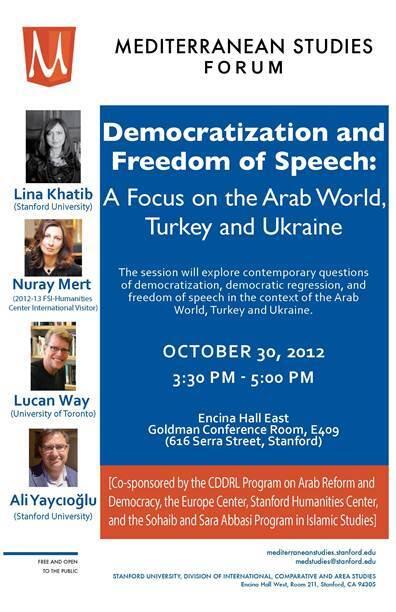
Co-sponsored by CDDRL Program on Arab Reform and Democracy, the Europe Center, Stanford Humanities Center, and the Abbasi Program in Islamic Studies

More info: http://www.stanford.edu/group/mediterranean/cgi-bin/web/2012/08/democratization-and-freedom-of-speech-a-focus-on-turkey-arab-world-and-ukraine/

Image

Richard and Rhoda Goldman Conference Room

Nuray Mert FSI-Humanities Center International Visitor Panelist
Lina Khatib Program Manager for the Program on Arab Reform and Democracy Panelist CDDRL
Lucan Way Associate Professor of Political Science Panelist University of Toronto
Ali Yaycioğlu Assistant Professor of Middle East History Moderator Stanford
Panel Discussions
-

Co-sponsored by the Abbasi Program on Islamic Studies, CDDRL Program on Arab Reform and Democracy, the Europe Center, Stanford Humanities Center, the Mediterranean Studies Forum, and the Center for Russian, East European and Eurasian Studies.

Reuben W. Hills Conference Room

Nuray Mert 2012-13 FSI-Humanities International Visitor Speaker
Lina Khatib Speaker
Lucan Way Speaker
Ali Yaycioğlu Speaker
Panel Discussions
News Type
News
Date
Paragraphs

Steven Pifer, former United States Ambassador to Ukraine and senior fellow and director of the Arms Control Initiative at Brookings, offers his insight into the current status of nuclear arms control and the issues impacting future prospects for negotiation in a presentation posted on the Brookings Institute website

Steven Pifer’s career as a Foreign Service officer centered around Europe, the former Soviet Union and arms control. In addition to Kyiv, he has had postings in London, Moscow, Geneva and Warsaw as well as on the National Security Council. Ambassador Pifer is currently a Visiting Fellow at the Brookings Institution, focusing on Ukraine and Russia issues. He is a frequent invited expert speaker at The Europe Center. 

All News button
1
Authors
News Type
News
Date
Paragraphs

As the Soviet Union was dying in December 1991, a quiet collaboration between Russian and American scientists was being born. The Russians were bankrupt, the KGB was in disarray and nuclear scientist Siegfried S. Hecker – at the time director of the Los Alamos National Laboratory – was alarmed as tens of thousands of nuclear weapons and much of the more than 1,000 tons of fissile materials across the broken Soviet states stood poorly protected.

Thousands of Soviet scientists were suddenly in limbo and President George H.W. Bush worried some might turn to Iran or Iraq to sell their nuclear knowledge. Washington suddenly found itself more threatened by Russia’s weakness than its strengths. That recognition drove U.S. Senators Sam Nunn and Richard Lugar to launch cooperative threat reduction legislation, subsequently known as the Nunn-Lugar Cooperative Threat Reduction Act.

Secretary of Energy Admiral James Watkins echoed President Bush’s concern when he called a meeting in December 1991 with Hecker, today the co-director of Stanford’s Center for International Security and Cooperation (CISAC).

“I told him, I’ve been trying to get us together with the Russians for several years,” Hecker said. “Why don’t we go to their lab directors and say, `What’s it going to take to keep your guys home and from selling their knowledge someplace else?’”

Several weeks later, in February 1992, Hecker was on a tarmac in the once-secret Russian nuclear city of Sarov, shaking hands with Yuli Khariton. The Soviet physicist was the chief designer of Russia’s atomic bomb – their Robert Oppenheimer, creator of our nuclear bomb and first director of the Los Alamos laboratory in New Mexico.

Hecker would go on to make 44 trips to Russia in the name of nuclear nonproliferation and cooperation. His most recent was last month with CISAC researchers Peter Davis and Niko Milonopoulos and a dozen Americans scientists, to commemorate 20 years of laboratory-to-laboratory cooperation. They hosted a conference with their Russian counterparts in Sarov, the Russian version of Los Alamos 300 miles east of Moscow.

Some 100 Americans and Russians attended various legs of the conference, including the scientific directors of the three Russian nuclear weapons laboratories: Rady Ilkaev, Evgeny Avrorin and Yuri Barmakov. The American delegation included Jeffery Richardson, CISAC affiliate and former head of chemistry and proliferation prevention at Lawrence Livermore National Laboratory; James W. Toevs, former project leader for the Nuclear Cities Initiatives at Los Alamos; and K. David Nokes, former vice president of national security and arms control at Sandia National Laboratory. 


CISAC Co-director Siegfried Hecker and
Rady Ilkaev, a scientific director within
the Russian Federal Nuclear Center,
swap gifts during their April 2012
conference in Sarov, Russia.

Hecker is determined to reignite the collaboration efforts, which have diminished dramatically in the last decade due to stark differences at the highest levels of our governments and because the Russian secret service agency has again tightened their grip on the nuclear complex.

“The 1990s were the heydays for us,” he said. “The scientists played a major role; we actually pushed the envelope on what we could do cooperatively. We worked well with the Russians.”

The U.S. Department of Energy supported and financed the joint efforts of the American and Russian nuclear laboratories to secure and safeguard Russian nuclear facilities and materials. They enlisted the help of civilian institutes to make urgent security upgrades at their nuclear facilities and the Americans brought the Russians to the U.S. nuclear sites – including the plutonium facility at Los Alamos – to let them see firsthand how Americans handled protection, control and accounting of nuclear material.

“The Sandia National Laboratories actually helped provide Kevlar blankets to protect Russian nuclear weapons while they were transporting them so that in case somebody shot at them, you didn’t get a mushroom cloud,” Hecker recalled.

Then, Russian President Vladimir Putin came to power for the first time in 2000 and the Federal Security Service – formerly the KGB – started tightening the screws. U.S. visas became difficult to obtain after the 9/11 terrorist attacks ratcheted up consular bureaucracy. Scientists on both sides began to feel less welcome at the labs and sites they had readily visited for a decade.

During his April trip, Hecker felt as if he were under house arrest in the worst security squeeze he’d seen in the 20 years of visiting Russia. He was followed by a security agent when he jogged, until the mud along the river became too deep for the agent’s shiny black shoes; Davis and Milonopoulos had their access denied at the last minute and were not allowed to enter Sarov to attend the three-day portion of the conference.

Many lab-to-lab cooperative agreements were allowed to expire by the Russian side in the last decade; even collaborations on fundamental research have been restricted and there is little nuclear power engineering cooperation. Worst of all, Hecker said, joint efforts to battle nuclear terrorism and compare means by which each side keeps its nuclear warheads safe and secure without nuclear testing are now virtually nonexistent.

“We ought to be working together, for heavens sake,” he said. “We’re not going to terrorize each other; we’ve got to keep the terrorists away from the rest of the world. We just have to get back to working together.”


CISAC researchers Peter Davis, left, and Niko Milonopoulous, right, with the U.S. Ambassador to Russia Michael McFaul at the ambassador's residence in Moscow in April 2012.

Their first step will be to compile the proceedings of the meetings with their Russian counterparts in Sarov, Nizhny Novgorod and Moscow. The document will be provided to the U.S. Department of Energy and policymakers in the Obama administration, as well as the three current U.S. nuclear lab directors, who are making their first joint visit to Russia in June. Hecker said his Russian counterparts are trying to coax Moscow into jumpstarting the collaboration efforts while wooing a new generation of nuclear scientists to the table.

Hecker, along with two former Russian nuclear weapons lab directors, is working on a book to document 20 years of nuclear collaboration between Russian and American nuclear scientists.

“The book is going to do a thorough job of looking at: What we did, why did it matter, what conditions made it possible and, then, what lessons were learned that might allow us to reestablish the relationship,” he said.

Hecker had another mission on his recent trip to Sarov. He wanted to reassure his Russian counterparts that their personal relationships truly mattered.

With the collapse of the Soviet Union in 1991, scientists in Russia, Ukraine, Kazakhstan and Belarus were confronted with a new reality: They went from lives of privilege to poverty. Programs launched by the U.S. Departments of State and Energy brought financial support to Russia’s closed nuclear cities, showed the Russian nuclear workers that they had a future in non-weapons research – and that someone cared about their well-being.

“One thing that came out, talk after talk during this trip, was how important the social relationships were between the scientists; how they are absolutely crucial,” Hecker said. Those little-known relationships – many of which became enduring friendships that celebrate marriages and grandchildren – led to significant steps in the U.S.-Russian nuclear threat reduction program.

President Ronald Reagan used one of his signature phrases, “Trust, but verify,” when he and Soviet General Secretary Mikhail Gorbachev signed the Intermediate-Range Nuclear Forces Treaty in 1987, eliminating nuclear and conventional ground-launched ballistic and cruise missiles with intermediate ranges. The phrase was taken from an old Russian proverb.

A year later, that proverb was put in effect with Hecker’s hand on the nuclear button at the Nevada test site for the Joint Verification Experiment.

“In August of ’88, the Soviets were at our test sites in Nevada and I was in the control room, essentially pushing the button to blow up one of our nuclear devices down hole, while the Russians had a cable that ran down the hole with which they were going to measure the magnitude of the nuclear explosion,” Hecker said. The following month, American scientists were in Russia to do the same.

“So I was sitting there in our control room, with the Russians right across the table from me,” he recalls. “That introduced us to the Russian nuclear scientists for the first time. You know what we said? These guys are just like us. They just want to do exactly the same thing for their country that we were doing for ours: keep their country safe and secure. And that started the process of working together.”

Today, the Russian proverb made famous by an American president could be turned on its head if the Russian-American nuclear collaboration is allowed to thrive: Verify through Trust.

Hero Image
1 P1040839
All News button
1
-

This talk will address a primary foreign policy challenge for independent Ukraine which has been to strike a proper balance between its relations with the West and those with Russia.  Today, democratic backsliding is upsetting the balance, which will undermine President Yanukovych’s ability to achieve his professed foreign policy aims.


Steven Pifer
is a senior fellow at the Brookings Institution’s Center on the United States and Europe and director of the Brookings Arms Control Initiative.  He focuses on nuclear arms control, Russia and Ukraine.  He has offered commentary on these issues on CNN, Fox News, BBC, National Public Radio and VOA, and his articles have run in the International Herald Tribune, New York Times, Washington Post and Moscow Times, among others.

A retired Foreign Service officer, his more than 25 years with the State Department focused on U.S. relations with the former Soviet Union and Europe, as well as arms control and security issues.  He served as deputy assistant secretary of state in the Bureau of European and Eurasian Affairs with responsibilities for Russia and Ukraine (2001-2004), U.S. ambassador to Ukraine (1998-2000), and special assistant to the president and senior director for Russia, Ukraine and Eurasia on the National Security Council (1996-1997).

His publications include “Ukraine’s Perilous Balancing Act,” Current History (March 2012), “NATO, Nuclear Weapons and Arms Control,” Brookings Arms Control Series (July 2011); “The Next Round:  The United States and Nuclear Arms Reductions After New START,” Brookings Arms Control Series (November 2010); “Ukraine’s Geopolitical Choice, 2009,” Eurasian Geography and Economics (July 2009); and “Reversing the Decline:  An Agenda for U.S.-Russian Relations in 2009,” Brookings Foreign Policy Paper (January 2009).

Ambassador Pifer is a 1976 graduate of Stanford University with a B.A. in Economics.  He is a member of the Council on Foreign Relations. 


Co-sponsored by the Center for Russian, East European, and Eurasian Studies

Reuben W. Hills Conference Room

Steve Pifer Senior Fellow at the Brookings Institution’s Center on the United States and Europe and Director of the Brookings Arms Control Initiative Speaker
Seminars
Subscribe to Ukraine