0
CDDRL Visiting UELP Scholar, 2021-22
yulia_bezvershenko_2022.jpg

Yulia Bezvershenko is the former Director General of Directorate for Science and Innovation at the Ministry of Education and Science. The Directorate was created for policy development and implementation in the research, development and innovation sector.

Since the Revolution of Dignity, Bezvershenko has been deeply involved in the reform of science development and implementation process. Her mission is to build knowledge-based Ukraine as economy and society based on knowledge, science and innovation. She has contributed to the Law on Science, which was adopted by Parliament in 2015. In cooperation with scientists and reformers she developed and actively participated in the creation of two new institutions, the National Council on Science and Technology and the National Science Fund. Bezvershenko currently works both on implementation of the aforementioned law and on its future iterations.

Bezvershenko holds a PhD in Theoretical Physics from the Bogolyubov Institute for Theoretical Physics (National Academy of Science of Ukraine) and a Master’s degree in Public Policy and Governance from the Kyiv School of Economics. She has diverse experience in the research and development sector, having worked as a researcher at the Bogolyubov Institute as well as a senior lecturer on quantum theory at Kyiv-Mohyla Academy. Until 2019, Yulia was a Deputy Head of Young Scientists Council of National Academy of Science of Ukraine and Vice-President of NGO "Unia Scientifica" aimed to promote science and to advocate reform of science in Ukraine.


Authors
Melissa Morgan
News Type
News
Date
Paragraphs

In 2015, Volodymyr Zelenskyy was at the height of a successful career as an entertainer. Though trained as a lawyer at the Kryvyi Rih Institute of Economics in Eastern Ukraine, the then 37 year old Zelenskyy was a successful comedian and public personality. As the star of the popular TV show, Servant of the People, he played a local history teacher who inadvertently becomes the president of Ukraine following a viral video rant about corruption.

No one watching comedic President Zelenskyy then could have possibly imagined the real-life plot twist that would follow. In an incredible act of life imitating art, in April 2019, Volodymyr Zelenskyy once again stood on stage in front of a cheering crowd, but this time as the actual president of Ukraine.

He won in a landslide election against incumbent president Petro Poroshenko on a platform of systemic change and progress using an almost exclusively virtual campaign. Speaking from his headquarters on election night, he affirmed the exuberance and hope of his supporters: “I can say as a citizen of Ukraine to all countries of the post-Soviet Union: Look at us — everything is possible.”

This same message shaped the theme of President Zelenskyy’s remarks at his historic address from the Freeman Spogli Institute for International Studies (FSI) at Stanford University on September 2. The first Ukrainian president to ever visit California, President Zelenskyy, First Lady Olena Zelenska and their delegation joined a group of FSI faculty members led by FSI Director Michael McFaul at an outdoor event held in the Encina Courtyard.

In his remarks, Zelenskyy drew inspiration from Steve Jobs’ famous "How to Live Before You Die" commencement address given at Stanford in 2005.

"This is one of the most famous speeches ever given at Stanford,” he said. “It's about believing in dreams and overcoming the impossible. This is the same as my story. I am just a common guy from a common family from a common industrial town in Eastern Ukraine. Yet here I am today at Stanford, because everything is possible."

He continued, “It is the same for Ukraine. Many people look at us and think that it will be impossible to achieve the goals we hope for. But we know that our critics are wrong. The people of our country love democracy and freedom and will not let threats take those things away. We know that anything is possible."

Looking to the future, Zelenskyy outlined the steps his administration is undertaking to bring increased digitization to Ukraine. These efforts include launching fully electronic passports, moving business and legal services online and expanding the scope of e-goverance. The hope is that this meld of new technology will help curb corruption while simultaneously creating more equitable opportunities and better access to public services for more Ukranians.

Speaking on the ambitious scope of these plans, the president acknowledged, “There will be resistance to the changes and innovations that we are going to make.” Nonetheless, he remains committed to the work ahead of strengthening democratic institutions in Ukraine and building on the progress that has already been made.  “We do not have a ‘Ukrainian Dream,’ yet,” he said. “But we have a ‘Ukrainian Goal’ and a ‘Ukrainian Mission’ to make the future we want for our country.” An edited recording of his remarks is below.

Keeping with Stanford tradition, Zelenskyy took questions from the audience after his prepared remarks. A variety of students and Stanford community members from Russia, Burma, Belarus and beyond had the opportunity to engage the president on a range of issues including U.S.-Ukraine relations, armament sales abroad and concerns over Russian aggression in Crimea and influence Eastern Ukraine. Of particular meaning was Zelensky’s affirmation and support for the democratic movement in Belarus led by Svaitlana Tsikhanouskaya, whom FSI hosted earlier this summer at a faculty roundtable.

Image
Tweet from Franak Viačorka

Students and faculty alike were appreciative of the president’s candor and good nature in addressing difficult topics.

Image
Tweet from Rose Gottemoeller
Image
Tweet from Graham Webster
Image
Tweet from Me Me Khant
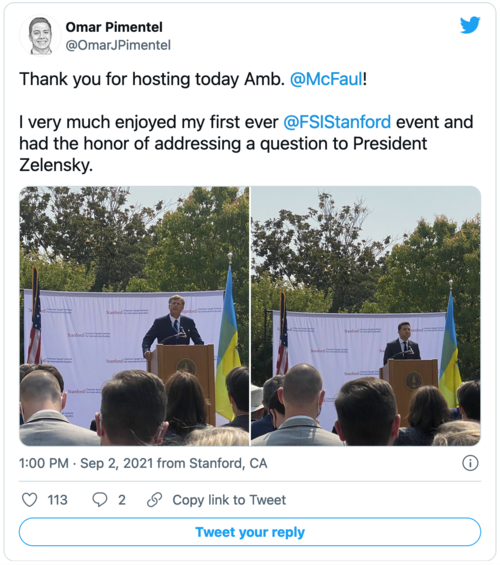
Image
Tweet from Omar Pimentel

Following the formal remarks, President Zelenskyy and First Lady Zelenska had an opportunity to meet with Stanford President Marc Tessier-Lavigne in the Memorial Church Courtyard. Prior to leaving, the First Lady also sat down with leaders and students from Stanford's Office of Accessible Education (OAE), an area of interest she would like to support and better develop in Ukraine.

For FSI, the president’s visit was another affirmation of the special connection between Ukraine and the Stanford community. Since 2016, the Center on Democracy, Development and the Rule of Law has hosted the Ukrainian Emerging Leaders Program, which provides a 10-month academic training fellowship in support of mid-career practitioners working actively as policy-makers, legal professionals, entrepreneurs and leaders of civil society organizations in Ukraine.

Speaking to this shared history in his opening introductions, FSI Director Michael McFaul emphasized the crucial need for ongoing support and intellectual investment into Ukraine. “The fight for democracy and independence in Ukraine is one of the most important causes in the world today,” he affirmed. “Not just for Ukrainians, but for all who cherish the ideals of democracy, liberty and sovereignty.”

To President Zelenskyy, McFaul extended a future invitation: “You are always welcome back, either as president or in retirement as a professor.”

“With the classes you offer, I will think about it,” Zelenskyy replied with a smile.

Read More

President Zelenskky addresses Stanford students and community members via a live video address in the CEMEX auditorium.
News

President Volodymyr Zelenskyy Calls on Students to Lead as Future Ambassadors in a Special Video Address at Stanford

Ukraine’s President Volodymyr Zelenskyy spoke to the Stanford community in a special video address about his country’s war against Russia for independence, freedom, and global democracy, which he said requires the continued support of all the people of the free world.
President Volodymyr Zelenskyy Calls on Students to Lead as Future Ambassadors in a Special Video Address at Stanford
Larry Diamond speaking in the Bechtel Conference Center in Encina Hall
Commentary

"We Have Entered a New Historical Era": Larry Diamond on the Future of Democracy

Speaking at the April 2022 meeting of the FSI Council, Larry Diamond offered his assessment of the present dangers to global democracy and the need to take decisive action in support of liberal values.
"We Have Entered a New Historical Era": Larry Diamond on the Future of Democracy
Sviatlana Tsikhanouskaya discusses the future of democracy in Belarus with a roundtable of Stanford scholars.
News

Belarusian Leader Sviatlana Tsikhanouskaya Meets with Stanford Scholars for Roundtable on Democracy in Belarus

Democratic leader Sviatlana Tsikhanouskaya and her delegation joined an interdisciplinary panel of Stanford scholars and members of the Belarusian community to discuss the future of democracy in Belarus.
Belarusian Leader Sviatlana Tsikhanouskaya Meets with Stanford Scholars for Roundtable on Democracy in Belarus
Hero Image
President Volodymyr Zelenskyy of Ukraine speaks at the Freeman Spogli Institute for International Studies
Rod Searcey
All News button
1
Subtitle

President Zelenskyy outlined the steps his administration is undertaking to bring increased digitization to Ukraine, curb corruption and create more equitable access to public services for more Ukrainians.

Authors
News Type
Commentary
Date
Paragraphs

President Volodymyr Zelensky visits Washington next week, with the highlight being a White House call on President Joe Biden. That offers the opportunity to reinvigorate the U.S.-Ukraine relationship at the highest level, following four years of Donald Trump.

This can be a very good meeting for the Ukrainian president. He should, however, take care in what he seeks. If he wants to return home with a clear success and having boosted U.S.-Ukraine relations, he should not ask for things he knows—or should know—he cannot get. Moreover, the more convincing the message that he brings regarding Kyiv’s commitment to domestic reform, the better will be his time in Washington.

Aug. 31 will be Mr. Zelensky’s first time to the White House, even though Trump offered him such a visit more than two years ago. Sadly, the former president showed no understanding of the import of Ukraine for American national interests and instead sought to extort Kyiv into interfering in U.S. politics.

When it comes to Ukraine, Biden gets it. The discussions between the presidents will undoubtedly focus on the two central challenges facing Kyiv. First, the conflict that Russia has inflicted on Ukraine since 2014, which has claimed some 14,000 lives. Zelensky can expect a strong reiteration of American support for Ukraine, including for non-recognition of Moscow’s illegal seizure of Crimea and for a settlement in Donbas that restores Ukrainian sovereignty.

The tricky part for Zelensky will turn on the specific asks he makes.

In the past, the Ukrainian president has called for a NATO membership action plan (MAP). In one sense, that is not unreasonable. Ukraine has made as much progress as many other new alliance members had made when they received MAPs.

NATO members, however, remain reluctant to put Ukraine, when it is engaged in a low-intensity war with Russia, on a membership track—despite the fact that NATO has stated that the question of membership is between the alliance and the prospective member, not any third party, i.e., not the Kremlin. That may seem unfair in Kyiv, but it is the reality.

So Zelensky should not seek a MAP. He could ask for an intensified and continuing discussion on the practical steps that Kyiv should take now so that, when a window opens for progress toward membership, Ukraine is fully ready to seize it. Mr. Zelensky can, in effect, have a MAP … if he accepts that it will not be called a MAP.

Ukraine—the biggest potential loser when Nord Stream 2 begins operation—understandably opposes it. Biden opposes it as well but remains unready to sanction German or European companies and risk a rift with Berlin and Brussels. (Kyiv should not want such a rift, which would erode U.S.-European Union unity on supporting Ukraine and sanctions against Russia.)

Zelensky thus should not urge sanctioning European companies to block the pipeline. He should instead ask how Washington, working with Berlin, intends to build with specifics on the July U.S.-German statement on supporting Ukraine, Europe’s energy security and climate goals and ensure that Russia will not use the pipeline against Kyiv. He could also propose continuing the discussion begun on Aug. 23 by the Ukrainian, German and American energy ministers about steps to strengthen Ukraine’s energy security.

Many in Kyiv have expressed frustration with the lack of progress toward settling the Donbas conflict in the “Normandy process” led by the Germans and French, and some even suggest alternative formats. Washington does not want to displace Berlin and Paris, and it benefits Kyiv to keep those key European Union members engaged. Still, Zelensky can and should press Biden to engage U.S. diplomacy more forcefully in support of the Germans and French.

He also may have an opening to ask for more. Washington reportedly has considered contingency military assistance for Ukraine. Given the Russian build-up last April, which was only partially drawn down, and the prospect that the September Zapad exercise will bring even more Russian troops close to Ukraine’s border, new U.S. military assistance would send a powerful signal of U.S. commitment to Ukraine as well as bolster its defensive capabilities.

The second central challenge facing Kyiv is putting in place the critical mass of reforms that will allow Ukraine’s economy to accelerate growth and realize its full potential, including encouraging open competition, strengthening the rule of law, curbing the outsized political and economic influence of the oligarchs, and beating back corruption. Kyiv’s record over the past two years has been mixed. These questions concerned  Biden when he had the senior lead on Ukraine in the Obama administration. If  Zelensky brings a credible, compelling message of his commitment to reform accompanied by specific ideas, he will find a receptive audience.

Zelensky’s U.S. visit can produce a major success for him and for U.S.-Ukraine relations. He should position himself to achieve such an outcome. That requires not overreaching by setting the bar impossibly high. And it means bringing a persuasive vision for how Kyiv will realize the ambitions of the Ukrainian people to become a prosperous democracy and a “normal” European state.

Steven Pifer is an affiliate of Stanford’s Center for International Security and Cooperation and a former U.S. ambassador to Ukraine.

Originally for Kyiv Post

Hero Image
Ukraine President Volodymyr Zelensky
Ukraine President Volodymyr Zelensky | Anastasia Vlasova/Getty Images
All News button
1
Subtitle

President Volodymyr Zelensky visits Washington next week, with the highlight being a White House call on President Joe Biden. That offers the opportunity to reinvigorate the U.S.-Ukraine relationship at the highest level, following four years of Donald Trump.

-

The Freeman Spogli Institute for International Studies (FSI) is honored to host the President of Ukraine, Volodymyr Zelensky, for an address on U.S.-Ukrainian relations. President Zelensky's visit to Stanford follows his August 31 meeting with United States President Joe Biden, and is the first visit to California by a Ukrainian president.

This event is publically available via Zoom. Please register in advance.

Lectures
-


The Crimean peninsula has always been an integral component of security in the Black Sea Region. In 2014 it became a flashpoint for the international order when Russia annexed the peninsula from Ukraine. Seven years later, it remains an important topic in international security and democracy promotion. Please join CDDRL and the Embassy of Ukraine in the US for a discussion on several topics related to the peninsula including:

• Political prisoners and human rights
• Security in Crimea
• Three Seas Initiative
• The Crimea Platform

This event is held in recognition of the political prisoners of Crimea, and to bring attention to the case of Osman Arifmemetov.

About the Speakers: 

Opening Remarks

Oksana Markarova is a Ukrainian politician and the current Ambassador of Ukraine to the United States. Markarova also served as former Minister of Finance.

Panelists

Emine Dzhaparova is a Crimean Tatar politician and stateswoman. She was formerly a journalist and currently serves as the first deputy minister at the Ministry of Foreign Affairs of Ukraine.

George Kent currently serves as Deputy Assistant Secretary in the European and Eurasian Bureau at the U.S. Department of State, overseeing policy towards Ukraine, Moldova, Belarus, Georgia, Armenia, and Azerbaijan. Previously, he was Deputy Chief of Mission in Kyiv, Ukraine (2015-18).

Steven Pifer is a fellow at the Robert Bosch Academy in Berlin and a non-resident senior fellow with the Brookings Institution.  He was a William J. Perry Research Fellow at the Center for International Security and Cooperation from 2018-2020. He served as deputy assistant secretary of state in the Bureau of European and Eurasian Affairs with responsibilities for Russia and Ukraine (2001-2004), ambassador to Ukraine (1998-2000), and special assistant to the president and senior director for Russia, Ukraine and Eurasia on the National Security Council (1996-1997).

Moderator
Francis Fukuyama is the Olivier Nomellini Senior Fellow at the Freeman Spogli Institute for International Studies (FSI), Mosbacher Director of FSI's Center on Democracy, Development, and the Rule of Law (CDDRL), and Director of the Ford Dorsey Master's in International Policy.  He is also a professor (by courtesy) of Political Science. 

Encina Hall, C148
616 Jane Stanford Way
Stanford, CA 94305

0
Olivier Nomellini Senior Fellow at the Freeman Spogli Institute for International Studies
Director of the Ford Dorsey Master's in International Policy
Research Affiliate at The Europe Center
Professor by Courtesy, Department of Political Science
yff-2021-14290_6500x4500_square.jpg

Francis Fukuyama is the Olivier Nomellini Senior Fellow at Stanford University's Freeman Spogli Institute for International Studies (FSI), and a faculty member of FSI's Center on Democracy, Development and the Rule of Law (CDDRL). He is also Director of Stanford's Ford Dorsey Master's in International Policy, and a professor (by courtesy) of Political Science.

Dr. Fukuyama has written widely on issues in development and international politics. His 1992 book, The End of History and the Last Man, has appeared in over twenty foreign editions. His book In the Realm of the Last Man: A Memoir will be published in fall 2026.

Francis Fukuyama received his B.A. from Cornell University in classics, and his Ph.D. from Harvard in Political Science. He was a member of the Political Science Department of the RAND Corporation, and of the Policy Planning Staff of the US Department of State. From 1996-2000 he was Omer L. and Nancy Hirst Professor of Public Policy at the School of Public Policy at George Mason University, and from 2001-2010 he was Bernard L. Schwartz Professor of International Political Economy at the Paul H. Nitze School of Advanced International Studies, Johns Hopkins University. He served as a member of the President’s Council on Bioethics from 2001-2004. He is editor-in-chief of American Purpose, an online journal.

Dr. Fukuyama holds honorary doctorates from Connecticut College, Doane College, Doshisha University (Japan), Kansai University (Japan), Aarhus University (Denmark), the Pardee Rand Graduate School, and Adam Mickiewicz University (Poland). He is a non-resident fellow at the Carnegie Endowment for International Peace. He is a member of the Board of Trustees of the Rand Corporation, the Board of Trustees of Freedom House, and the Board of the Volcker Alliance. He is a fellow of the National Academy for Public Administration, a member of the American Political Science Association, and of the Council on Foreign Relations. He is married to Laura Holmgren and has three children.

(October 2025)

CV
Date Label
Panel Discussions
Authors
News Type
Commentary
Date
Paragraphs

President Volodymyr Zelensky reportedly will soon travel to Paris to meet with French President Emmanuel Macron. That is a trip very much worth making. After German Chancellor Angela Merkel steps down this fall, Zelensky may find himself more dependent on Macron, both in the Normandy format and for leadership in the European Union regarding the conflict that Russia has inflicted on his country.

The sooner Zelensky gets to Paris, the better.

First, he could ask Macron to call explicitly on Vladimir Putin to deescalate the tensions Russia has caused by its large and continuing build-up of military forces near Ukraine.

On April 3, the German and French foreign ministries issued a statement calling for restraint on “all sides”—a wrongly balanced appeal given that Russian actions provoked the crisis.  Merkel corrected this on April 8, when she spoke with Putin and “demanded that this [Russian] build-up be unwound in order to de-escalate the situation.” Macron has yet to speak in such clear terms.

Second, Zelensky should strengthen Macron’s understanding of the conflict and Ukraine’s position.  The Germans and French have for six years sought to broker a settlement between the Ukrainians and Russians in the Normandy format, with Merkel playing the lead role.  Later this year, when she steps down, the leadership of that process may well pass from Berlin to Paris.

Ukrainians often express frustration with the Normandy format and the Minsk II agreement that it produced in February 2015.  The terms of the agreement were never fully implemented, and thousands of Ukrainians have since died.  Berlin and Paris have not found the key to getting Russian and Russian proxy forces to leave Donbas, to say nothing of occupied Crimea.  (In fairness, it is not clear that anyone could have.)

However, the Normandy process has kept the two large continental European powers engaged in trying to resolve the conflict. That is to Kyiv’s advantage. The Minsk II agreement has provided the basis for sustaining European Union sanctions on Russia, sanctions that have proven far more resilient than many would have predicted when EU member states first approved them in 2014.

Merkel and German diplomats deserve credit for maintaining EU unity on sanctions, despite calls from some member states to move back toward business as usual with Moscow.  She has taken a greater interest in the Russia-Ukraine conflict than Macron or his predecessor.  That reflects in part her background, having been raised in the German Democratic Republic, her understanding of Russia, and her command of Russian.

But Merkel steps down this fall after 16 years as chancellor. While the German election is still more than five months off, most predictions suggest one of two coalitions will result: a combination of the Christian Democratic Union/Christian Socialist Union and Greens Party, or a grouping of the Greens, the Social Democratic Party, and Free Democratic Party.

In the first combination, the likely candidates for chancellor are Armin Laschet and Markus Soeder.  Both come from what was West Germany.  Neither has real experience with or appears to have shown particular interest in the Russia-Ukraine conflict.  Either might question the investment that Merkel put into the Normandy discussions, given that they have not succeeded and offer little pay-off in terms of German domestic politics.

In the second combination, the chancellor likely would come from the Greens.  That could bode well for Kyiv, as the Greens are skeptical about Russia, criticize Moscow’s human rights record, and oppose the Nord Stream 2 gas pipeline.  However, the Greens have been out of government since 2005, and they might need time to get up to speed.

If the new German chancellor is uninterested in or needs time to engage in a meaningful manner, leadership within the Normandy format will move to Paris, something the Kremlin likely would welcome.  Macron has taken a less harsh tone on Russian misbehavior.  He has sought to regenerate links with Moscow.  For example, before the 2019 G7 summit in France, he hosted Putin for a bilateral meeting, seemingly seeking to make Paris a bridge between Moscow and the rest of the G7.

A pro-Russian tilt, even a small one, in the duo heading up the Normandy format process is hardly in Kyiv’s interest.  Zelensky needs to make his strongest possible case to Macron as regards the realities of the Russia-Ukraine conflict, for continuing to steward the Normandy format with Merkel’s steadiness, and for not succumbing to Putin’s blandishments, which would come at Ukraine’s expense.


Originally for Kyiv Post

Hero Image
Ukraine's President Volodymyr Zelenskiy (L) and French President Emmanuel Macron
Ukraine's President Volodymyr Zelenskiy (L) and French President Emmanuel Macron | AFP
All News button
1
Subtitle

President Volodymyr Zelensky reportedly will soon travel to Paris to meet with French President Emmanuel Macron. That is a trip very much worth making.

Authors
News Type
Commentary
Date
Paragraphs

BERLIN — Over the past week, Russia has reinforced its military presence on the Crimean peninsula, moved military units close to the Russia-Ukraine border and announced military “readiness checks.” Most likely, this is just a ploy to unnerve the government in Kyiv and test the West’s reaction. 

But it could be something worse. If the Kremlin is weighing the costs and benefits of a military assault on Ukraine, Europe and the United States should ensure that Moscow does not miscalculate because it underestimates the costs. 

Read the rest at Politico

Hero Image
Destroyed tank
Getty Images
All News button
1
Subtitle

Europe and the United States must ensure that Moscow does not underestimate the costs of a military assault.

Authors
News Type
Commentary
Date
Paragraphs

In a December 2020 New York Times interview, Ukrainian President Volodymyr Zelensky welcomed Joe Biden’s election as U.S. president. Zelensky observed that Biden “knows Ukraine better than the previous president” and “will really help strengthen relations, help settle the war in Donbas, and end the occupation of our territory.”[1]

While Zelensky’s comments may prove overly optimistic, there is little reason to doubt that the Biden presidency will be good for Ukraine. The incoming president knows the country, and he understands both the value of a stable and successful Ukraine for U.S. interests in Europe and the challenges posed to Ukraine and the West by Russia. That might—might, not will, but might—help break the logjam on the stalemated Donbas conflict, which Zelensky of course would welcome. Perhaps less welcome to the Ukrainian president may be Biden’s readiness to play hardball to press Kyiv to take needed but politically difficult reform and anti-corruption steps. Ukraine’s success as a liberal democracy depends not just on ending its conflict with Russia but also on combating corruption and advancing still necessary economic reforms.

U.S.-Ukraine Relations under Trump

In one sense, U.S. policy toward Ukraine during the Trump administration had its strengths. It continued political and military support for Kyiv, including the provision of lethal military assistance that the Obama administration had been unwilling to provide. It maintained and strengthened Ukraine-related sanctions on Russia. And it took further steps to bolster the U.S. and NATO military presence in central European states on Ukraine’s western border.

However, Donald Trump never seemed committed to his administration’s policy. His primary engagement on Ukraine was his bid to extort Kyiv into manufacturing derogatory information on his Democratic opponent, a bid that led to his impeachment.[2] Beyond that, Trump showed no interest in the country and consistently refused to criticize Vladimir Putin, who has inflicted more than six years of low-intensity war on Ukraine.

The Biden presidency will end this dichotomy in Washington’s approach to Kyiv. The president and his administration will align on policy. That new predictability will mean that Ukrainian officials no longer have to worry about late night presidential tweets or the subjugation of U.S. policy interests to the president’s personal political vendettas.

Two Challenges Confronting Ukraine

As Biden takes office, two principal challenges confront Ukraine. The conflict with Russia poses the first.[3] In March 2014, in the aftermath of the Maidan Revolution, Russian military forces seized Crimea. Weeks later, Russian security forces instigated a conflict in Donbas, masked poorly as a “separatist” uprising. The Kremlin provided leadership, funding, heavy weapons, ammunition, other supplies and, when necessary, regular units of the Russian army. Now in its seventh year, that conflict has claimed the lives of some 13,000 people.

While Moscow illegally annexed Crimea, it has not moved to annex Donbas. It appears instead to want to use a simmering conflict in that eastern Ukrainian region as a means to put pressure on, destabilize and disorient the government in Kyiv, with the goal of making it harder for the government to build a successful Ukrainian state and draw closer to Europe. (Moscow has interfered elsewhere in the post-Soviet space to try to maintain a Russian sphere of influence.)

Without the Kremlin’s cooperation, Kyiv on its own cannot resolve the conflict in Donbas, and Crimea poses an even harder question. However, meeting the second of the challenges facing Ukraine—implementation of reforms and anti-corruption measures needed to build a fair, robust and growing economy—lies largely within Kyiv’s purview. Unfortunately, after a good start by Zelensky and his first government, reforms have stagnated, oligarchs retain undue political and economic influence (including within Zelensky’s Servant of the People party), and the judicial branch remains wholly unreconstructed.[4] Among other things, this depresses much-needed investment in the country.

Progress Toward a Resolution in Donbas?

The Biden presidency might well play a more active role in the moribund negotiating process regarding Donbas. As co-chairs of the “Normandy process,” German Chancellor Angela Merkel and French President Emmanuel Macron have had little success of late in implementation of the 2015 Minsk agreement, which laid out a path to a settlement and restoration of full Ukrainian sovereignty over Donbas.[5] Unfortunately, it appears that the Kremlin calculates that the benefits of keeping Kyiv distracted currently outweigh the costs, including of Western sanctions.

Zelensky believes that a more active U.S. role could change that calculation and inject momentum into the process. At a minimum, the Biden presidency should appoint a special envoy to coordinate with the Germans and French, and, more broadly, with the European Union, Britain, Canada and others on Western support for Ukraine and sanctions against Russia. That position has gone unfilled since September 2019.

Whether Biden, who will face many demands on his time, will choose to engage personally is a different question. He knows Ukraine, having traveled there six times when he served as vice president. And, unlike Trump, who sought quick victories, Biden understands that solving a question like Donbas would require an investment of his time over a sustained period. It would make sense if it became clear that his engagement would shake up things in a way that would increase the prospects of a settlement and return of Donbas to Ukrainian sovereignty.

At first glance, the Kremlin might not welcome that kind of U.S. involvement, but there are good arguments for it. First of all, the United States is Ukraine’s strongest Western supporter, and Washington’s voice carries considerable weight in Kyiv. Second, Russia’s current conflict against Ukraine is not just about Donbas; it is also about Ukraine’s place in Europe, that is, where the country fits between Russia and institutions such as the European Union and NATO.[6] Addressing that question will require diplomatic finesse. Given the trans-Atlantic relationship, which will be revived under Biden, it is difficult to see such a geopolitical discussion taking place without American participation.

As for Crimea, Ukraine cannot at present muster the political, diplomatic, economic and military leverage to effect the peninsula’s return. Still, the U.S. government knows how to do non-recognition policy.[7] It did so for five decades with regard to the Baltic states’ incorporation into the Soviet Union. The Biden presidency will remain supportive of Kyiv’s claim to Crimea and not recognize its annexation by Russia—and the White House will express this view.

Domestic Reform

After an encouraging start on reform, Zelensky wavered in 2020. He has to do more, and Biden can be helpful, though in a manner the Ukrainian president may not appreciate. A big part of the problem is that Zelensky himself seems to have lost his way. Ruslan Ryaboshapka, his reformist first prosecutor general, observed that “Instead of fighting oligarchs, [Zelensky] chose to peacefully coexist with them.”[8] Biden could well prove the kind of friend that Ukraine needs now: supportive but direct with Zelensky on what must be done, and ready to push him to take politically hard measures that he might prefer to avoid.

Biden has already shown that he can do this. As vice president in the Obama administration, he had the lead on U.S. engagement with Ukraine. When necessary, he applied “tough love,” famously withholding a one-billion-dollar loan guarantee until then-President Petro Poroshenko fired a prosecutor general who was viewed widely, inside and outside of Ukraine, as corrupt.[9]

A dose of such tough love now seems necessary with Kyiv. One question concerns access to low interest credits under Ukraine’s stand-by agreement with the International Monetary Fund.[10] The IMF conditions disbursements of those credits on how Ukraine implements reform commitments that it made to secure the agreement. The Biden administration should, and almost certainly will, back the IMF in insisting that Ukraine needs to deliver on its commitments in order to secure additional disbursements.

Likewise, the Biden administration should make more bilateral U.S. assistance conditional on Ukraine tackling particular reforms. In doing so, it should consult and coordinate closely with the European Union, which has greater assistance resources available. Introducing a higher degree of conditionality to Western assistance programs could usefully ratchet up the pressure on the leadership in Kyiv to take reform steps that are in the country’s broader interest but opposed by key oligarchs or political groups who stand to lose from such reforms.

Priority should go to encouraging reform of the judicial branch, including the Constitutional Court, which has a core of judges who appear beholden to special interests. The high court reversed earlier laws requiring members of parliament and government officials to disclose their assets and could threaten other reforms.[11]

At home, the Biden administration can assist Ukraine by implementing a ban on anonymous shell companies by requiring disclosure of who actually forms companies in the United States as contained in the Corporate Transparency Act, part of the National Defense Authorization Act.[12] This will make it more difficult for corrupt Ukrainians to shelter ill-gotten gains in U.S. assets.

The Biden presidency is good news for Ukraine and those who wish to see it develop into a modern European state. It will mean more high-level but hard-nosed U.S. support. That could lead to greater progress on reform within the country. And, with some imaginative diplomacy and luck, it might even help break the logjam with Russia over resolving the fate of Donbas.


[1] Kramer, Andrew E. “With Trump Fading, Ukraine's President Looks to a Reset With the U.S.” The New York Times. The New York Times Company, December 19, 2020. https://www.nytimes.com/2020/12/19/world/europe/trump-zelensky-biden-ukr....

[2] Nichols, Tom. “Trump Is Being Impeached over an Extortion Scheme, Not a 'Policy Dispute'.” USA Today. Gannett Satellite Information Network, January 30, 2020. https://www.usatoday.com/story/opinion/2020/01/30/trump-impeachment-blac....

[3] Masters, Jonathan. “Ukraine: Conflict at the Crossroads of Europe and Russia.” Council on Foreign Relations. Council on Foreign Relations, February 5, 2020. https://www.cfr.org/backgrounder/ukraine-conflict-crossroads-europe-and-....

[4] Iliyas, Boktakoz. “Anti-Corruption Backtracking in Ukraine – Has Ze Reform Moment Passed?” Control Risks. Control Risks Group Holdings Ltd., December 17, 2020. https://www.controlrisks.com/our-thinking/insights/anti-corruption-backt....

[5] “Ukraine Walks a Tightrope to Peace in the East.” International Crisis Group, January 29, 2020. https://www.crisisgroup.org/europe-central-asia/eastern-europe/ukraine/ukraine-walks-tightrope-peace-east.; “Ukraine Ceasefire: New Minsk Agreement Key Points.” BBC News. BBC, February 12, 2015. https://www.bbc.com/news/world-europe-31436513.

[6] Tefft, John F. “ Reflections on Russia, Ukraine and the U.S. in the Post-Soviet World.” American Foreign Service Association, n.d. https://www.afsa.org/reflections-russia-ukraine-and-us-post-soviet-world.

[7] Pompeo, Michael R. “Crimea Is Ukraine.” U.S. Department of State. U.S. Department of State, February 26, 2020. https://www.state.gov/crimea-is-ukraine-3/.

[8] Kranolutska, Daryna, and Volodymyr Verbyany. “Ukraine's Leader Is Being Broken by the System He Vowed to Crush.” Bloomberg.com. Bloomberg, December 16, 2020. https://www.bloomberg.com/news/articles/2020-12-17/ukraine-s-leader-is-b....

[9] Subramanian, Courtney. “Explainer: Biden, Allies Pushed out Ukrainian Prosecutor Because He Didn't Pursue Corruption Cases.” USA Today. Gannett Satellite Information Network, October 3, 2019. https://www.usatoday.com/story/news/politics/2019/10/03/what-really-happ....

[10] “IMF Executive Board Approves 18-Month US$5 Billion Stand-By Arrangement for Ukraine.” International Monetary Fund. International Monetary Fund Communications Department, June 9, 2020. https://www.imf.org/en/News/Articles/2020/06/09/pr20239-ukraine-imf-exec....

[11] “Ukraine's Constitutional Court Attacks Anti-Corruption Laws.” The Economist. The Economist Newspaper, November 14, 2020. https://www.economist.com/europe/2020/11/14/ukraines-constitutional-cour....

[12] Pearl, Morris. “Commentary: Congress Just Passed the Most Important Anti-Corruption Reform in Decades, but Hardly Anyone Knows about It.” Fortune. Fortune Media IP, December 26, 2020. https://fortune.com/2020/12/26/ndaa-2021-shell-companies-corporate-trans....


Originally for Stanford International Policy Review

Hero Image
President Joseph Biden
Chip Somodevilla / Getty Images
All News button
1
Subtitle

In a December 2020 New York Times interview, Ukrainian President Volodymyr Zelensky welcomed Joe Biden’s election as U.S. president. Zelensky observed that Biden “knows Ukraine better than the previous president” and “will really help strengthen relations, help settle the war in Donbas, and end the occupation of our territory.”

News Type
News
Date
Paragraphs

Meet our Postdoctoral Scholars 

Image
Postdoctoral Scholars Leah Rosenzweig, Nathan Grubman, and Salma Mousa

Each year the Center on Democracy, Development and the Rule of Law invites several pre and/or postdoctoral scholars to Stanford. Our fellows work in any of the three program areas of democracy, development, and rule of law.   Over the course of the academic year, scholars use their fellowship to complete their projects, participate in seminars, and interact with each other and the resident faculty and research staff. 

This year we are very excited to have Nathan Grubman, Salma Mousa, and Leah Rosenzweig with us at the Center. We talked to them about their research interests, what they're working on while at Stanford, and why they chose to come to CDDRL. 


Nathan Grubman
Yale University


About Nathan: 

Nathan expects to receive his PhD in political science from Yale University in December 2020. He is currently working on a book project on the question of why party systems in some new democracies tend to lack left-right cleavages that are often found in established democracies. In particular, he looks at the case of Tunisia after the 2010-11 uprising. Nathan recently presented his research in the talk "Nostalgia and Populisms in Contemporary Tunisia" for the CDDRL Seminar Series. 

Why did you choose CDDRL?

"I’ve followed CDDRL for a very long time. It has a unique mix of people who are focused on democracy and democratization in parts of the world where it doesn’t receive as much attention, and scholars focused on democracy in the US as well. I’m also really excited by some of the people at CDDRL—those who focus on the Arab world but also those who focus on Eastern Europe and democratization more generally. They can help me broaden the scope of my research."

Learn more about Nathan's research in this interview with Associate Director for Research Didi Kuo.


Salma Mousa
Stanford University 


About Salma: 

An Egyptian-Canadian raised in Saudi Arabia, the UAE, Qatar, and Canada, Salma Mousa received her PhD in Political Science from Stanford University in 2020. She is currently working on two research agendas. The first is about the tools and strategies we have for building social cohesion, primarily between migrants and host societies, but also between religious and ethnic groups in the Middle East and the US. Her second research focus is how we can best integrate refugees in the US economically and socially. She will be presenting her research for CDDRL in the upcoming talk "Building Social Cohesion through Soccer in Post-ISIS Iraq". 

Why did you choose CDDRL?

"I’ve been floating around CDDRL during my time at Stanford, including teaching for Professor Fukuyama. But for me it was a natural home given that my work is very interdisciplinary. Work on intergroup contact and prejudice reduction and integration has a lot of implications for economics, social psychology, political science, sociology, and I draw on methods and theories from all of these places. At the same time I try to make my work as policy relevant and as situated in the real world with real world interventions as much as possible. To get that interdisciplinary exposure and to have the chance to pick the brains and workshop my ideas with a group of scholars who are so policy oriented really fit my research model."

Hear more about Salma's work in this interview with Mosbacher Director of CDDRL Francis Fukuyama.


-

Leah Rosenzweig
MIT


About Leah: 

Leah Rosenzweig holds a PhD in Political Science from MIT. Her current project looks at social voting in semi-authoritarian states. In places where elections aren't competitive why does anyone even vote? Her answer is that there is social pressure--not out of civic duty to the state, but rather to the local community. People see elections as a way to gain benefits and help their local communities. She tests this theory in Tanzania and Uganda. She recently presented her talk "Informing Government Response to COVID-19 in Sub-Saharan Africa" for CDDRL. 

Why did you choose CDDRL?

"CDDRL covers a lot of the same themes and topics that I’m interested in within development and democracy. But mostly I was drawn to the interdisciplinary group of scholars engaged in policy-relevant research, whether that’s other political scientists like myself, economists, legal scholars, and others. The environment of all of these really great intellectuals engaging on these topics was what attracted me to the program."

Learn more about Leah and her work in this interview.


The CDDRL Pre and Post Doctoral Fellowship Program is now accepting applications. Please visit this site to learn more about the application process, and contact kdchandl@stanford.edu with any questions. 

All News button
1
Subtitle

Our 2020-21 Post-Doctoral Scholars explain why they chose to complete their fellowship at CDDRL.

Authors
News Type
Commentary
Date
Paragraphs

The New Europe Center, a Ukraine-based think tank, asked six American experts to comment on the implications of the U.S. presidential election for Ukraine.  The following is Steven Pifer's contribution.

For Americans, the November 3 presidential election will be the most significant vote in many decades.  The election also will have consequences for Ukraine:  Whether Donald Trump or Joe Biden sits in the White House at the end of the day on January 20, 2021 will matter greatly for U.S. policy toward Ukraine and Europe.

Since Ukraine regained its independence in 1991, the United States has proven a strong and supportive partner.  Presidents Clinton, Bush and Obama each saw a stable, independent, democratic Ukrainian state with a robust market economy as in the U.S. interest, including in contributing to a more stable and secure Europe.  Washington thus has provided substantial political, economic and—particularly since 2014—military support to Kyiv.  It has sanctioned Russia for its aggression in Crimea and Donbas and sought to bolster NATO in the face of a growing Kremlin challenge to Western security.

The Trump administration has largely continued these policies.  It has provided Kyiv reform and military aid, including lethal military assistance.  It has applied additional sanctions on Russia, albeit under pressure from Congress.  And it has taken steps to strengthen the U.S. military presence in NATO, at least until recently.

However, it has never been clear that Mr. Trump himself supports these policies.  His principal engagement on Ukraine was his attempted extortion of Kyiv to advance his personal political prospects, an effort that led to his impeachment.  While his administration has taken a tough line on Russia, Mr. Trump seems incapable of criticizing Vladimir Putin or Russian misdeeds.  He apparently thinks that Ukraine, not Russia, interfered in the 2016 U.S. presidential election, ignoring the conclusions of the U.S. intelligence community, the Mueller investigation and the Republican-led Senate Intelligence Committee.

Mr. Trump’s disdain for NATO has long been clear, going back to the 1980s.  In June, he decided to withdraw 10,000 U.S. troops from Germany, apparently out of pique at Chancellor Merkel’s refusal to attend a G7 summit at Camp David.  Senior Pentagon officials scrambled for weeks to offer military justifications for the drawdown, but those that they provided did not survive serious scrutiny.

If Mr. Trump is re-elected, he will not have to worry about facing the voters in another election campaign.  He will cement his control of the Republican Party, leaving Republicans in the Senate and House of Representatives less able to block his bad instincts.  What accommodations would he make with Mr. Putin?  Would he be inclined, as he suggested in 2016, to recognize Russia’s illegal annexation of Crimea and lift economic sanctions?   Would he withdraw the United States from NATO, as many former U.S. officials fear?  The Alliance’s collapse would be a huge gift to Mr. Putin and leave Ukraine in a precarious geopolitical position.

It will be different if Mr. Biden is elected (full transparency:  the author fervently hopes for this).  The United States would have a president who understands the U.S. interest in a successful Ukraine and who knows the country well from his time as vice president.  He would be the kind of friend that Ukraine needs, supportive but also ready to press the Ukrainian leadership to take necessary reform steps.  He recognizes the security challenge that Russia presents to Ukraine and the West, and he realizes the importance of a strong trans-Atlantic relationship with a robust NATO at its core.  And Mr. Biden might prove a president who could bind some of the differences that so badly divide Americans today.  An America more unified at home would be a stronger international actor.

Whether Mr. Trump or Mr. Biden wins the elections will mean very different things for U.S. policies affecting Ukraine.  That said, the American electorate will decide the next president largely on domestic issues, such as the Trump administration’s handling of COVID19 and the economy.  Ukraine has no role to play in this, and Ukrainian officials should continue to do all that they can to avoid their country becoming a political football in the U.S. campaign.

* * * * *

Steven Pifer is a William Perry Research Fellow at Stanford University’s Center for International Security and Cooperation and a former U.S. ambassador to Ukraine.

Hero Image
Man smiling
All News button
1
Subtitle

For Americans, the November 3 presidential election will be the most significant vote in many decades. The election also will have consequences for Ukraine: Whether Donald Trump or Joe Biden sits in the White House at the end of the day on January 20, 2021 will matter greatly for U.S. policy toward Ukraine and Europe.

Subscribe to Ukraine