News Type
News
Date
Paragraphs

A day after President Obama's address on the San Bernardino shootings, FSI Senior Fellow Larry Diamond speaks with Michael Krasny of NPR News on the U.S. response to global terrorist threats. In addition to a unified, international coalition, Diamond believes one of the keys to defeating ISIS lies with empowerment of the people of Iraq and Syria, addressing the need for political change in the region. Diamond was accompanied by Jessica Stern, research professor at Boston University and Shibley Telhami, senior fellow at the Center for Middle East Policy at the Brookings Institution.

Hero Image
21870887685 3479207ce9 o
All News button
1
-

Kenji Kushida will provide an overview of canonical works of Silicon Valley, including work of Martin Kenney and his classic co-edited volume "Understanding Silicon Valley" and other more recent work drawn from the Stanford Silicon Valley - New Japan project’s "Top Ten Reading List of Silicon Valley." He will also share insights from a recent report co-authored with Richard Dasher, Nobuyuki Harada, Takeo Hoshi, and Tetsuji Okazaki entitled "Institutional Foundations for Growth" which partially draws from research on Silicon Valley.   

Kanetaka Maki will present his new research from a paper entitled "Milestones to University-Based Startup Success: What Is the Impact of Academic Inventor Involvement?” Based on the data analysis of 533 University of California startups, he will explain the impact of inventor involvement in the growth and success of university-based startups.

RSVP Required


Agenda
4:15pm: Doors open
4:30pm-5:30pm: Lecture, followed by discussion
5:30pm-6:00pm: Networking


For more information about the Silicon Valley-New Japan Project please visit: http://www.stanford-svnj.org/

Philippines Conference RoomEncina Hall, 3rd Floor616 Serra StStanford, CA 94305
Kenji Kushida, Research Associate, Shorenstein APARC Japan Program and Stanford Silicon Valley - New Japan Project leader
Kanetaka Maki, Research Associate, Shorenstein APARC Japan Program
Seminars
News Type
News
Date
Paragraphs

Scholars with the American Democracy in Comparative Perspective Program at Stanford’s Center on Democracy, Development, and the Rule of Law published a series of articles in the latest edition of the “The American Interest,” on the current challenges facing American democracy. In the run up to the U.S. Presidential elections, Francis Fukuyama, Larry Diamond, Bruce Cain, Nate Persily, Stephen Stedman, and Didi Kuo weigh in on polarization, campaign finance, and the structural challenges of reform that grip the American system. This collection of articles outline concrete policy reforms that can improve the performance of the American political system. 


Image
the american interest   the american interest
 
BRUCE E. CAIN & FRANCIS FUKUYAMA
 
FRANCIS FUKUYAMA
 
LARRY DIAMOND
 
STEPHEN JOHN STEDMAN


Hero Image
obama health care speech to joint session of congress
President Obama addresses Congress on September 9, 2009. | Lawrence Jackson; www.whitehouse.gov
All News button
1
Authors
Didi Kuo
News Type
News
Date
Paragraphs

While John Boehner was able to avoid a government shutdown this month, his successor as Speaker of the House will face another potential shutdown in December over budgetary matters. The politics of Congressional budgeting are unique among advanced democracies, since most countries insulate their budgetary procedures from partisan politics. 

America is unique in experiencing shutdowns; most advanced democracies have budgetary procedures that are insulated from partisan politics. Francis Fukuyama, the Olivier Nomellini Senior Fellow at the Freeman Spogli Institute, and the Program on American Democracy in Comparative Perspective hosted a conference on budgeting in May 2014 to think through possible reforms to the Congressional budgeting process. The conference brought scholars of American institutions and comparative budget policy with policymakers who have worked in American agencies such as the Office of Management and Budget and the Congressional Budget Office. Further, the conference included experts from the World Bank, the International Monetary Fund, and the Organisation for Economic Co-operation and Development to compare the United States budgeting process to international benchmarks and standards. The conference report recommended institutional and technical reforms to decrease the likelihood of shutdowns.
 
 
Hero Image
president obamas proposed fiscal year 2015 united states federal budget
The fiscal year 2015 United States federal budget proposal offered by President Barack Obama, in book format. | Office of Management and Budget
All News button
1
News Type
News
Date
Paragraphs
From September 13-19, 2015, CDDRL honors students attended the annual Honors College in Washington, D.C., gaining firsthand exposure to how the federal government, policy organizations and think tanks work to advance democracy and development around the world.
 
Throughout the week, students had the opportunity to learn about the government's vision for democracy at the State Department and the National Security Council. The Honors College agenda also included visits to regional organizations such as the Asia Institute, the Inter-American Dialogue and the Tahrir Institute for the Middle East Policy, where students were able to get a sense of how policy is implemented on the ground.
 
Scholars at the World Bank and Johns Hopkins School of Advanced International Studies provided an academic view of development, while speakers at Freedom House and the National Endowment for Democracy explain the challenges and advantages of empowering local democratic activists, particularly in countries hostile to democracy. This year, the students also had the privilege of meeting Gayle Smith, President Obama's nominee to lead the United States Agency for International Development.
 
CDDRL's Interdisciplinary Undergraduate Honors Program aims to provide an opportunity for eligible seniors focusing on democracy, economic development, and rule of law subjects in any university department to earn honors in democracy, development, and rule of law (DDRL). Beyond Honors College, students also meet weekly as a group and with advisors to develop their honors theses. This year's Honors College was led by Steve Stedman, director the honors program, alongside CDDRL scholars Francis Fukuyama and Larry Diamond. To view student testimonials and photos from this year's honors college, see below.
 

Photo Album


Student Testimonials


Image
potter

"I had never spent a significant amount of time in D.C. before honors college. Throughout the entire week I was amazed as I realized that there is an entire city that is passionate about interests similar to mine. After meeting some influential and motivating people, I feel compelled to work in D.C. at some point in my future."

-Hannah Potter


Image
sorensen

"Even though I had already spent a lot of time in D.C., spending a week there with CDDRL faculty and students showed me a side of the city I hadn't experienced before. Meeting with senior staff at think tanks, nonprofits, academic institutions and government agencies helped me understand how the academic concepts I've learned at Stanford are actually applied by people working to promote democracy and development around the world."

-Zachary Sorensen


Image
reid

"One thing that was really amazing about Honors College was the ability to explore D.C., even beyond meeting with leaders in the fields of democracy and development. We were able to walk around and see what an interesting, historical, and hip city D.C. actually is. One morning, my roommate on the trip, Hannah Potter, and I took a run down to the Georgetown Waterfront and explored the beautiful walkway there. 

-Hadley Reid


Image
meropol

"The CDDRL Honor's Program trip to Washington, D.C., was a unique opportunity to experience many different facets of policy-making and academia in the United States. From think tanks to government agencies, I was fascinated by the plethora of ways in which I can work in the realm of democracy and development."

-Hannah Meropol


To find out more about CDDRL's Interdisciplinary Undergraduate Honors Program, please click here. Applications for our 2016-2017 cohort of honors students will be due in February 2016. 


Hero Image
img 3571
2015-2016 Undergraduate Honors Students pose for a group photo outside the White House. | Didi Kuo
All News button
1
-

Abstract: Do states plan their grand strategies, or does grand strategy emerge in an ad hoc fashion as individual foreign policy decisions accumulate over time? The existing literature rests on the assumption, which has yet to be examined empirically, that grand strategies form according to an emergence model of grand strategy formation. This project tests that assumption by developing an original planning model and testing it on a “least-likely” case: the U.S. response to China’s rise after 9/11. This is a period in which the planning capacity of the Executive was severely taxed by the simultaneous wars in Afghanistan and Iraq. If, during that time, the U.S. formulated and enacted a long-term, integrated, and holistic (“grand”) plan in response to China’s rise, significant doubt would be cast on the assumed emergence model. Contrary to the expectations of the emergence model, this research finds that the U.S. developed a long-term military-diplomatic strategy in response to China’s rise, and that this strategy was substantially enacted as planned. This finding suggests that long-term plans govern U.S. behavior far more than is assumed in the scholarly literature. It also challenges the common belief among policy commentators that the wars in Afghanistan and Iraq distracted the U.S. from attending to China’s rise. The findings of this research were not, however, wholly positive. Foreign economic policy and nuclear strategy were not fully integrated with the military-diplomatic strategy, indicating the existence of some serious stove-pipes in U.S. planning processes.

About the Speaker: Dr. Nina Silove is a Postdoctoral Fellow at the Center for International Security and Cooperation (CISAC) at Stanford University. Her research focuses on grand strategy, strategic planning, and U.S. policy toward the Asia-Pacific region. She holds a DPhil (PhD) in International Relations from the University of Oxford and a degree in law with first class honors from the University of Technology, Sydney, where she also received the Alumni Association Achievement Award for Contribution to the University. Previously, Dr. Silove was a Research Fellow in the International Security Program at the Belfer Center in the John F. Kennedy School of Government at Harvard University, a visiting Lecturer in the Department of Government and International Relations at the University of Sydney, and the Tutor for International Politics in Diplomatic Studies at the University of Oxford.


Stanton Nuclear Security and Social Science Postdoctoral Fellow CISAC
Seminars
Authors
News Type
Commentary
Date
Paragraphs

It is the end of summer and time for another Iowa report. My wife and I own a medium-sized farm in East Central Iowa that produces corn and soybeans, and beef from a cow/calf herd. My day job is as Professor of International Agricultural Policy at Stanford University, typically working on hunger problems in Asia. The summer keeps me in direct contact with rural life in the Midwest. 

My previous Iowa postings have been dominated by weather—severe drought in 2012, massive flooding in 2013, and tornados in 2014. In a different way, weather features again this year. We had 10 inches of rain and a hailstorm during the first 10 days following my June return from California. But after that episode, the weather has been nearly perfect for our locale. Things could still go wrong—a typical farmer comment—but at the moment, we are looking at near-record yields on our farm. My guess is 210 bushels per acre for corn, and 65 bushels per acre for soybeans, both about 10% higher than for recent years. 

Crops throughout the region look generally good, and the following couplet is a standard feature of local conversations: 

“Don’t the crops look great?”  
“Yeah, but they aren’t worth nothing.”  

A sharp run-up in corn prices the last two weeks of June—from $3.50 to $4.40 per bushel—left farmers hopeful with what would turn out to be faulty expectations. As many waited for further price increases before selling, the good weather and the economic slow down in China caused corn prices to tumble. By Sept 1, prices were back at $3.50. These low prices left many farmers with dashed expectations, substantial amounts of 2014 corn in farm storage, and the prospects of a large upcoming October harvest. Nor will crop insurance help very much. The combination of yields and prices this year will leave most farmers just outside the range that would qualify them for 75%-revenue-protection payments. 

Few outside the farming community realize that marketing decisions are often more important than production in defining a successful farm year. Few also appreciate the differential impact on Iowa’s general prosperity from the $7 corn that prevailed in 2012-13, versus the current $3.50. 
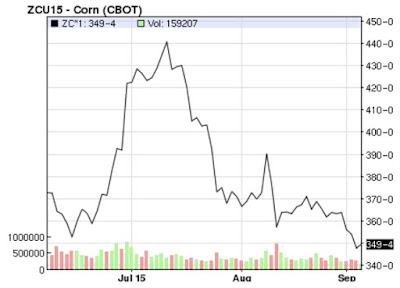
 

graph showing rise and steep fall in corn prices


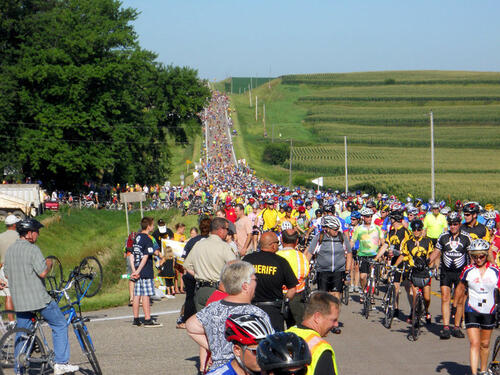
Gloom is not the only thing that has been rolling across the landscape. Two parades really had to be seen to be appreciated. Each year since 1973, the state has hosted a bike ride across Iowa called Ragbrai. It is a weeklong activity that starts at the Missouri River to the west, and ends 500 miles to the east at the Mississippi River. It has grown into a massive affair that attracts some 15,000 riders.  

Image
roz iowa bike race


Photo Credit: C. Benz 

This year’s ride was special, at least for us. This mass of rolling humanity came within two miles of our farm, and it included a sizeable number of Stanford faculty and students (including my boss, pictured below) who, among others, made mini-detours to visit us. What were most interesting to my wife and me were the impressions expressed both by the bikers and the local hosts. 

The riders marveled at the rolling topography of Iowa; the vast expanses of corn and soybeans; the welcoming hospitality of Iowans; the infinite ways pork could be served on a stick; and the best sweet corn in the world! The locals were bemused that so many sane people of all shapes and sizes would voluntarily ride 500 miles in the heat and rain; amazed by the short-term chaos that 15,000 cyclists could cause in small rural communities that were attempting to move machinery and feed cattle; and pleased by the magnitude of the expenditures. The latter was deftly described by a neighbor as “our own economic stimulus package,” and more pointedly summarized by a local headline, “Circus, Economic Windfall, or Occupying Army?” 
 

Image
roz iowa bike race 2


 Photo Credit: R. Naylor

Politicians formed the second parade (charade?) that has been rolling across the state. Iowa—with the dubious honor of having the first primary/caucus—is a genuinely purple state. It voted for President Barack Obama in 2012 and for Senator Joni Ernst in 2014. Iowans pride themselves on being able to pick winners and on being stubbornly independent. The prevailing general mood at the moment, however, is some combination of confusion and disgust. Donald Trump draws the most comments. And while he leads the polls, I have yet to hear anyone (literally) this summer say that he or she favored him. Time will tell what Iowans really believe.


Nowhere was the comedy and chaos more vivid than at the recently completed Iowa State Fair. Some 15 presidential candidates showed up. Most of them spoke at the fair’s “Soapbox Corner” before conspicuously casting their kernel-of-corn vote at the straw (corn?) ballot table. They also had the obligatory pictures taken with the life-sized cow sculpted in butter, the fair’s largest bull (there must be some symbolism here), and the fair’s heaviest pig. The latter was a 500-pound specimen named Mac. (I was disappointed that an earlier winner, my namesake “Wally”, was not in the competition.) And to no one’s surprise, all candidates thought that corn-based ethanol was a really good idea. Most of them even expressed favor with the fair’s latest cuisine contribution—the Bomb—brisket, wrapped in bacon, served on a stick! 
 

Image
wally cafe outside


Photo Credit: R. Naylor 

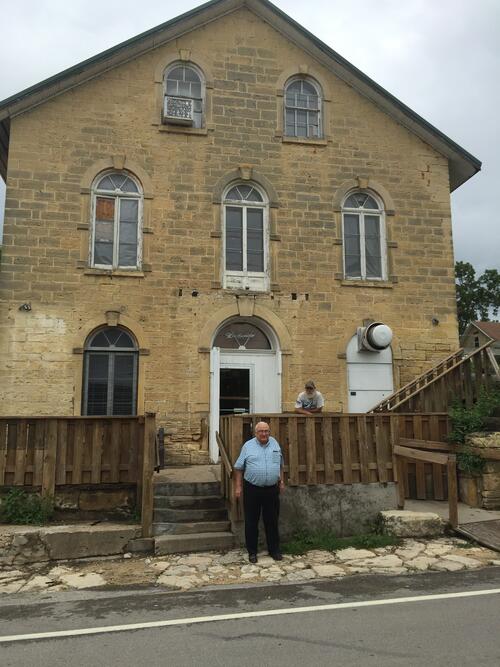
Readers of previous reports will be pleased to know that the 1868 Waubeek general store and restaurant still serves as the morning gathering place. It has changed hands, but continues its long tradition of watery coffee and stale pastry. (By request, I have included pictures; I am California hatless, plus a shot of the outside.) Besides prices, bikers, and politicians, three new topics of conversation have cropped up: water, cover crops, and weeds. All three are environmental issues that are distinctly operational. They also remind me of just how much information is exchanged around tables such as this one, though on any given morning that conclusion is not always obvious!

 
Image
wally cafe
Photo Credit: R. Naylor 


By far the most controversial topic of the summer has been water. (And to be clear, the issue is about water quality and the nutrients carried in the water, not about water supplies or allocations.) Many farmers realize that nutrient runoff from livestock operations and from fertilizer applied to fields is a very serious problem; most of them are also loathsome about EPA efforts to redefine and regulate what constitutes water flows in the U. S. 

During the last week in August, the EPA announced new clean-water rules that would give the agency new jurisdiction over bodies of water (and land), including many in agriculture, which were previously unregulated. But it remains to be seen which bodies of waters would be covered, and which specific agricultural situations that would be exempted from the rules. Six states have sued the EPA, and the question of when or if the rules will be implemented is now caught up in the courts. The Farm Bureau has declared an all-out offensive against the rules, and farm publications have added further fuel to the fire. To complicate matters even more, the Des Moines Water Works has brought suit against three counties upstream of its water plant that would require farmers to change practices and/or make investments to reduce nutrient flows (particularly nitrates) into the Raccoon River. 

Most scientists and many farmers believe that nutrient runoff constitutes the largest remaining environmental problem facing agriculture. Thus the fight, in many ways, is less about the problem, and more about philosophy. Most farmers prefer voluntary solutions arranged with the state or the USDA. They typically dislike mandatory rules of any sort, and they are particularly concerned that regulations might be of the one-size-fits-all character. The discourse is inflamed by uncertainty: the EPA has yet to write all of the regulations, and farmers simply do not know what to expect. In the absence of information, they fear the worst. Everyone I talked with had a relevant question. Will we need to get a permit to spread manure? How will drainage tiles that empty into or near creeks be handled? Will we need to file a nitrogen plan for every farm that specifies amounts and timing of fertilizer applications? On our farm, for example, we have a flowing creek that traverses a large permanent pasture. The creek provides water for the cowherd, which has direct access to it. What, if anything, will need to be changed in that arrangement? All of us wonder about the flexibility in timing and scope that will be accorded farmers who may be faced with large corrective investments. Many also fear that the regulators will know little about agricultural practices. In short, what waters are to be regulated, for what purposes, and with what instruments are issues still to be resolved? At the moment, there is considerable heat, but very little light about the answers. 

Virtually all Iowa farmers have transitioned to minimum tillage systems; plowing has become a field operation of the past. This change in tillage also creates new cropping opportunities. 
 

Image
tillage radish usda


Photo Credit: USDA


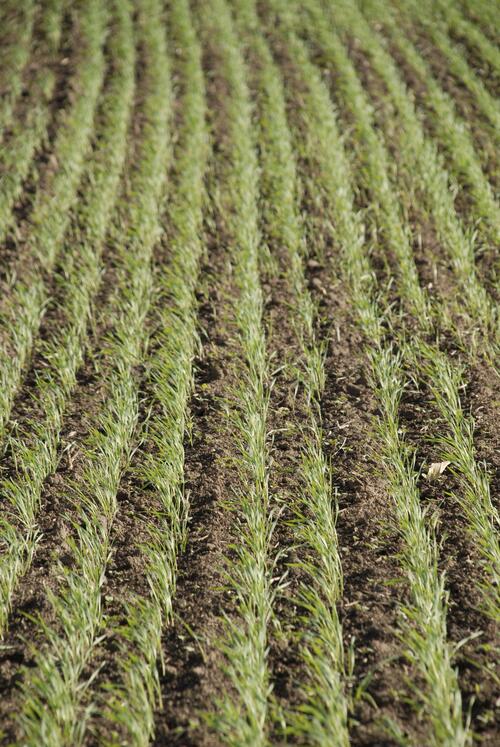
Five years ago, there was virtually no talk about or use of “cover crops.” These crops are sown in residues immediately after corn or soybean harvest. Certain of them survive the winter, but others do not. Radishes (shades of the English agricultural revolution, circa 1700!) produce long roots that punch holes in clay layers of the soil, thereby assisting drainage. They can also be grazed. Small grains are also being seeded, which add to add organic matter and can sometimes be chopped as forage for dairy or beef operations. 
 

Image
triticale

Photo Credit: Mühlhausen/landpixel


Cover crops are clearly still a work in progress, but they provide an interesting example of active on-farm experimentation. Best solutions seem to vary from farm to farm—from no cover, to radishes, to triticale—and seem importantly dependent on particular crop-livestock combinations. Discussions about the use of triticale—a cross between rye and either bread wheat or durum—were of particular interest to me. I worked with Norman Borlaug at the International Wheat and Maize Improvement Center in Mexico during the 1980s to develop modern varieties of this crop, but it has been slow to find appropriate niches in cropping systems around the world. In the 1980s, I never even contemplated that Iowa might be such a place. 

Several forces drive the new concern about weeds. Falling crop prices have squeezed profit margins severely, causing farmers to look seriously at each cost component. For the first time, I have heard farmers question new seed varieties (virtually all GMOs), both because of their cost and their effectiveness. They increasingly wonder if the $200 seed-cost-per-acre for corn is justified. The current year, with its excellent growing season, meant there was less need for certain stacked traits such as drought resistance. Moreover, the year was equally good for weeds, whose resistance to major herbicides like Roundup seemed to be spreading. 

Water hemp, in particular, gave soybean farmers grief, and is causing them to rethink seed-weed strategies. They worry about the consequences from applying new combination-herbicides (some still under various reviews) that attack both grasses and broad-leafed weeds. They are particularly concerned that spraying some of the new products will also destroy the grasses in waterways left specifically to prevent water erosion. 

My conjecture is that most farmers will still use the specialized seeds next year. I predict, however, that they will also be searching more carefully for lower-cost ways—both via seeds and herbicides—to manage weeds. The growing weed resistance problem has begun to scare them—a recent Greenwire Poll indicates that 90% are worried—and has belatedly driven home the difficulties that arise from overuse of only one or two herbicides. 


Image
cow calf


No Iowa report is complete without some cattle commentary. 

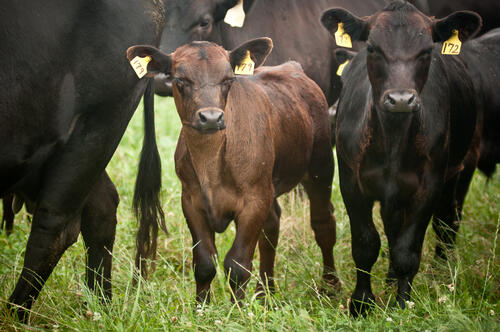
My father was a cattle feeder, and some of those “cattle genes” carried forward a generation. I grew up knowing a lot about purebreds, about corn and soybean-meal feed rations, and about 2-pound-per-day rates of gain that produced 1100-pound animals for sale. Fast forward to 2015. When I look around, virtually all cattle have been crossbred for size and vigor (though in the market they may still be advertised as Angus!). Soybean meal has dropped completely out of the rations being fed in our county, having been replaced by the high-protein distillers grain, the by-product of making corn sweeteners and ethanol. Rates of gain are now 3.25 pounds per day, and finished animals are sold at 1500 pounds. What has not changed, however, is the riskiness of the enterprise. Even with cheap corn, buying 700 pound feeders for $2.25 per pound, and selling 1500 pound steers at $1.45 per pound has not been a great way to get rich in 2015! 

My final impression of the summer is a memorable one: rolling down the Mississippi River on a paddle boat, celebrating my wife’s and my birthdays with good friends, viewing a glorious sunset, and eating world-class prime rib. Now that’s the way to get ready for a new year of Stanford classes.

 
Image
3945950681 f49098fb76 o


Photo credit: flickr/Lance and Erin

Hero Image
roz iowa bike race 2
All News button
1

Montek Singh Ahluwalia is an economist who trained at Oxford as a Rhodes Scholar. He spent several years at the World Bank before returning to India to serve as the Economic Advisor to the Finance Minister. The Government of India then appointed him to several senior positions, including Secretary of Commerce and Secretary in the Department of Economic Affairs at the Ministry of Finance. In 1998, he was appointed as a Member of the Planning Commission and Advisory Council to the Prime Minister of India. In 2001, he became the Director of Independent Evaluation Office at the International Monetary Fund, resigning this position in 2004 to become the Deputy Chairman of the Planning Commission.

He has written widely about India and the world economy, co-authoring Redistribution with Growth: An Approach to Policy, and editing Macroeconomics and Monetary Policy: Issues for Reforming the Global Financial Architecture with Y.V. Reddy and S.S. Tarapore.

The Payne Distinguished Lectureship is named for Frank and Arthur Payne, brothers who gained an appreciation for global problems through their international business operations. This lectureship, hosted by the Freeman Spogli Institute for International Studies, brings speakers with an international reputation for leadership and visionary thinking to Stanford to deliver a major public lecture. 

This event is carried out in partnership with the Stanford Center for International Development (SCID).

A public reception will follow the lecture.

Montek Singh Ahluwalia Deputy Chairman, Planning Commission 2004-2014, Government of India Deputy Chairman, Planning Commission 2004-2014, Government of India
Lectures
Date Label
Encina Hall E301616 Serra StreetStanford, CA94305-6055
(650) 796-3699 (650) 723-6530
0
david_lee.png Ph.D.

David LEE Kuo Chuen joins the Walter H. Shorenstein Asia-Pacific Research Center (APARC) as visiting scholar for the fall of 2015.  He is currently the Director of Sim Kee Boon Institute for Financial Economics.  He holds the appointment of Practice Professor of Quantitative Finance, Lee Kong Chian School of Business, in Singapore Management University.  He is also the founder of Ferrell Asset Management Group.

His research interests encompass digital and Internet finance, digital banking, Asia finance, impact investing, financial inclusion and asset allocation. During his time as a Fulbright Scholar at Shorenstein APARC, his research will focus on harnessing Silicon Valley technology for connectivity and financial inclusion in ASEAN and Singapore.

David is also an Independent Director of two SGX-listed companies and sits on the Investment Committee and Council of two charitable organizations. He is the Vice President of the Economic Society of Singapore.  He was the Founding Vice Chairman of the Alternative Investment Management Association (Singapore Chapter), a member of the SGX Security Committee, and MAS Financial Research Council.  He was also the Group Managing Director of OUE Limited and Auric Pacific Limited, as well as the Non-Executive Chairman of MAP Technology Limited.

David speaks frequently in international conferences with occasional appearances in Bloomberg, Reuters and Channel NewsAsia.  He has published in Financial Analyst Journal, Journal of Investing, Journal of Wealth Management, Journal of Statistical Computation and Simulation, Applied Financial Economics, and several books and chapters on Household Economics and Hedge Funds.  His two books on Asia Finance focus on Banking, Sovereign Wealth Funds, REITs, Financial Trading & Markets, and Fund Performance. His latest book is on Digital Currency.

He graduated from the London School of Economics and Political Science with a BSc (Econs), MSc (Mathematical Economics and Econometrics) and a PhD in Econometrics and Mathematical Economics.

Visiting Scholar, Fulbright Fellow
News Type
News
Date
Paragraphs

Many little girls imagine being a Disney princess, but few have the chance to live their dream. Josselin is one of the lucky few. She suffers from retinoblastoma and is blind, and what she wanted most for her 14th birthday was a princess party. The Make-A-Wish Foundation made her dream a reality with help from Dr. Lee Sanders, a member of her Stanford medical team and a CHP/PCOR core faculty member. Dressed as her Prince Charming, Sanders escorted the birthday girl, attired in a custom-made Belle ball gown, to her ballroom birthday party and shared her first dance to "Beauty and the Beast."  Says Josselin, "I can’t stop thinking about my big princess party. Now I feel happier than ever."

Hero Image
josselindancingprincecharming648x444
All News button
1
Subscribe to United States