Paragraphs
Book cover of "Peace on a Knife's Edge" showing South Korean president Roh Moo-hyun alongside George W. Bush and Kim Jong-il

Lee Jong-Seok served as vice-secretary of South Korea’s National Security Council and as its unification minister under the Roh Moo-Hyun administration (2003–08). After Roh’s tragic death in 2009, Lee resolved to present a record of the so-called participatory government’s achievements and failures in the realm of unification, foreign affairs, and national security.

Peace on a Knife’s Edge is the translation of Lee’s 2014 account of Roh’s efforts to bring peace to the Korean Peninsula in the face of opposition at home from conservative forces and abroad from the Bush administration’s hard stances of “tailored containment” and its declaration of the North as part of the “axis of evil.” Lee’s narrative will give American readers rare insights into critical moments of Roh’s incumbency, including the tumultuous Six-Party Talks; the delicate process of negotiating the relocation and reduction of United States Forces Korea; Roh’s pursuit of South Korea’s “autonomous defense”; conflicts with Japan over history issues; and the North’s first nuclear weapons test.

Desk, examination, or review copies can be requested through Stanford University Press.

All Publications button
1
Publication Type
Books
Publication Date
Subtitle

The Inside Story of Roh Moo-hyun's North Korea Policy

Book Publisher
Shorenstein APARC
Authors
News Type
News
Date
Paragraphs

This piece originally appeared in Stanford News.

Secretary of State Rex Tillerson visited the Hoover Institution on Wednesday to give a speech on U.S. policies in Syria. He said a continuing presence of U.S. troops in the country is needed to stabilize the area.

In its vision for Syria, the United States wants to see a peaceful, independent country, free of weapons of mass destruction, that could welcome back millions of Syrians displaced by the past years of war, U.S. Secretary of State Rex Tillerson told a Stanford audience on Wednesday.

As part of his prepared policy speech, titled “The Way Forward in Syria,” Tillerson said that in order for that to happen, the conflict between the Syrian people and the regime of Syrian President Bashar al-Assad has to be resolved through diplomatic means, and Assad has to step aside from power. He spoke at the Hoover Institution’s Hauck Auditorium in front of some 265 Stanford students and an additional 100 staff,  faculty members and Hoover fellows, such as former Secretary of State George Shultz.

The event was cosponsored by Hoover and the Freeman Spogli Institute for International Studies (FSI).
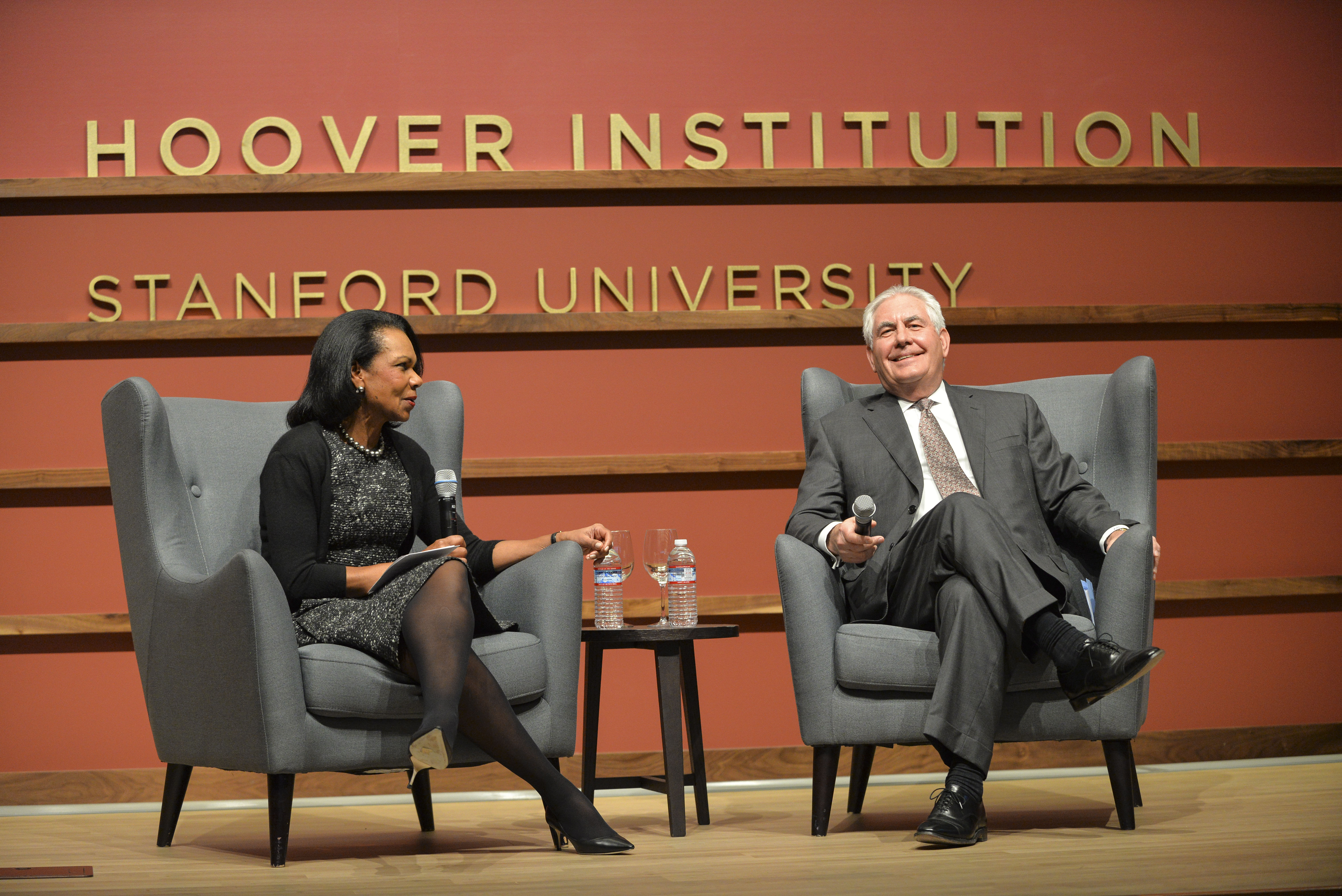
Condoleezza Rice and Rex Tillerson“A stable, unified and independent Syria ultimately requires post-Assad leadership in order to be successful,” Tillerson said.

While acknowledging that some Americans are skeptical of the continued military involvement in Syria, Tillerson said it’s vital for the U.S. be engaged in the area in order to continue fighting terrorist groups and the possibility of their resurgence.

“United States will maintain military presence in Syria, focused on ensuring ISIS cannot re-emerge,” Tillerson said. “Ungoverned spaces, especially in conflict zones, are breeding grounds for ISIS and other terrorist organizations. … The fight against ISIS is not over. … Similarly, we must persist in Syria to thwart al-Qaida, which still has substantial presence and base operations in northwest Syria.”

Tillerson said another major goal of the U.S. in Syria is to prevent Iran from growing its influence in the region, calling the country’s influence “malicious.”

In order to achieve these goals, the U.S. will continue to help de-escalate parts of Syria and to invest in stabilization initiatives, such as clearing unexploded landmines, restoring water and electricity and helping to reopen hospitals and schools, Tillerson said.

Tillerson said the U.S. will continue to work on these efforts and on overall peace negotiations with the United Nations and Russia.

“Once Assad is gone from power, the United States will gladly encourage the normalization of economic relations between Syria and other nations,” Tillerson said. “This process will take time. But we’re patient in the departure of Assad and in the establishment of new leadership.”

After his speech, Tillerson sat down with former Secretary of State Condoleezza Rice, the Denning Professor in Global Business and the Economy at Stanford Graduate School of Business, and a senior fellow at Hoover and at FSI.

As part of the conversation, Tillerson reflected on his upcoming anniversary as secretary of state. He said what he likes most about the job is the quality of the people he works with every day.

“Even if we talk about very complicated issues … the level of intelligence and the level of openness for us to have a good conversation about it is what I most look forward to,” he said.

On the flip side, he said, are the days when he has to deal with the loss of life. “Those are the days that are most difficult.”

In response to Rice’s question about the future of international assistance programs such as the President’s Emergency Plan for AIDS Relief (PEPFAR) and the Millenium Challenge Corporation, Tillerson said the United States’ commitment to provide humanitarian aid will remain but that a conversation over how much other countries contribute in aid is also important.

Tillerson also touched on the latest state of U.S. policies toward North Korea, the topic he discussed on Tuesday during a gathering of foreign ministers in Vancouver. He said that there is growing evidence that the latest tough sanctions against North Korea are working.

“We’ve never had a sanctioned regime that is as comprehensive as this one, and we’ve never had Chinese support for sanctions like we’re getting now,” Tillerson said. “We are committed – as is everyone in the international community – to denuclearize North Korea, and we’re gonna stay on that until we achieve it.”

 

Hero Image
tillerson shultz rice 2
Secretary of State Rex Tillerson meets with former Secretaries of State Condoleezza Rice and George Shultz after speaking with Stanford students about Syria. | Rod Searcey
All News button
1
News Type
News
Date
Paragraphs

Secretary Norman Y. Mineta is a person of many firsts. He was the first Asian-American mayor of a major city, San Jose, California; the first Japanese American from the mainland to be elected to Congress; and the first Asian American to serve in a presidential cabinet. Mineta served as President Bill Clinton’s Secretary of Commerce and President George W. Bush’s Secretary of Transportation. SPICE is honored to be collaborating with Mineta and Bridge Media, Inc., on making Mineta’s legacy more broadly known at the secondary and collegiate levels through the Mineta Legacy Project (MLP). The MLP will include a documentary and educational curriculum that are being developed with Mineta’s full involvement.

The documentary, titled An American Story: Norman Mineta and His Legacy, “delves into Mineta’s life, public service career, and unabashed love for his country… this, in spite of the fact that in 1942 his country betrayed him,” note producers Dianne Fukami and Debra Nakatomi.

Presidents Clinton and Bush were recently interviewed for the documentary and educational curriculum. “[Mineta’s] family was in a Japanese internment camp in World War II, and it could have made him bitter, angry,” commented President Clinton, “but instead he used that…to deepen his own commitment; to make sure that people weren’t discriminated against or held back or held down. In that sense, he represents the very best of America.”

This quote will be one of many presented to students in the educational curriculum, which pivots around the essential question, “What does it mean to be an American?” When asked this question, President Bush referred not only to key values such as freedom of speech and freedom of religion, but also to a sense of decency in the public square and to the nation’s communities of compassion. “It means that we care about each other. One of the real strengths of America [are] what I would call the ‘armies of compassion’…people in their communities who set up programs to feed the hungry or find shelter for the homeless, without the government telling them what to do.” He also referred to the United States’ long history of immigration, and said that being an American means recognizing that “although, on the one hand, we ought to enforce our laws, [on the other hand] we ought to welcome immigrants in a legal fashion, because immigrants reinvigorate our soul.”

Beyond Mineta’s groundbreaking achievements, Mineta epitomizes the dreams and aspirations of youth. He is the son of immigrants and his family was forcibly removed from his home to spend years in an internment camp for Japanese Americans during World War II. And yet, he remains a patriot, has led with integrity to achieve a long and distinguished career as a public servant, and continues to champion the underserved and mentor students.

The educational curriculum is being developed by Rylan Sekiguchi of SPICE in consultation with Fukami and Nakatomi and is targeted to high school and college educators and students. The curriculum will be offered free on the MLP and SPICE websites and is being developed in coordination with the documentary. The standards-aligned lesson plans will highlight six key themes connected to the life of Secretary Mineta—immigration, civil liberties & equity, civic engagement, justice & reconciliation, leadership & decision-making, and U.S.–Japan relations—and ask students to examine them in both historical and current-day contexts. Mineta himself has underscored the enduring relevance of these themes in U.S. society, for example drawing parallels between the Japanese-American experience following the Pearl Harbor attack in 1941 and the Arab-American and Muslim-American experience following 9/11. As our country debates contentious topics such as deportations, immigration bans and restrictions, surveillance, and registries, the lessons learned from Mineta’s life can help us.

To stay informed of SPICE-related news, follow SPICE on Facebook and Twitter.


Hero Image
mlp team with bush manual rotate 360
President George W. Bush with Producers Dianne Fukami (fourth from left) and Debra Nakatomi (third from right) and Rylan Sekiguchi (far right) | Mineta Legacy Project
All News button
1
Submitted by Rylan Sekiguchi on

The Reischauer Scholars Program (RSP) is an interactive, synchronous online course for high school students in the United States. As part of Stanford University’s SPICE Program in Pre-Collegiate Global Learning, the RSP provides students with a broad overview of Japanese history, literature, religion, art, politics, economics, and contemporary society, with a special focus on the U.S.–Japan relationship. Although intensive, the RSP will equip participants with a rare degree of expertise about Japan that may have a significant impact on their choice of study and future career.

News Type
News
Date
Paragraphs

Former U.S. ambassador to South Korea Kathleen Stephens spoke on the "PBS News Hour" about the first high-level talks between North Korea and South Korea in more than two years. The two nations agreed to hold future military talks aimed at easing border tensions and the North pledged to send a delegation to the Olympic Games next month.

Stephens called it a good first step and an “all-too-rare positive development” on the peninsula. The decrease in potential for disruptions to next month’s games could—according to Stephens-be seen as the first deliverable by South Korea’s new president, Moon Jae-In, on a promise to reengage with the North.

Ambassador Stephens said it was not surprising that denuclearization did not come up during Tuesday’s talks, noting North Korea’s position that the issue is one to be dealt with the United States. Ambassador Stephens speculated that once the Olympics closed, the peninsula might experience a period of reduced tensions along with confidence building. However, she believes that come the spring there would still remain important questions about military exercises as well as nuclear weapons.

Asked about news reports of discussions within the Trump administration on the possibility of targeted strikes against North Korean military sites, Ambassador Stephens described it as a very risky strategy, adding that the discussions alone could prove unnerving in South Korea as well as North Korea.

The full interview is available on PBS.

Hero Image
Former Ambassador Stephens discusses talks between North and South Korea on PBS News Hour
All News button
1
News Type
Commentary
Date
Paragraphs

In advance of talks between North Korea and South Korea, APARC’s Daniel Sneider says the most immediate threat on the peninsula actually comes from the latter.

In a piece for The Hill, Sneider writes that by embracing North Korea’s offer for dialogue, South Korean President Moon Jae-in—who seeks a peaceful Olympic Games, good relations with China, and reduced tensions with the North—risks diminishing America’s presence in the region.

The challenge for the U.S. administration, accordng to Sneider, is to afford South Korea freedom to explore opportunities for dialogue, while ensuring that such freedom does not result in driving the United States off the peninsula.

The full article is available at The Hill


Hero Image
  Joint Security Area;  Panmunjom, DPRK (North Korea)
Flickr/John Pavelka
All News button
1
Authors
News Type
Commentary
Date
Paragraphs

In the New York Post article written by Ken Scheve and David Stasavage, the co-authors of Taxing the Rich: A History of Fiscal Fairness in the United States and Europe, the real motivation behind opposition to the GOP tax bill is examined in light of their research. 

To read the full article, please visit the Washington Post (Monkey Cage) webpage.

Hero Image
Congressional Democrats Speak At Rally Protesting GOP Tax Bill On Capitol Hill
Congressional Democrats Speak At Rally Protesting GOP Tax Bill On Capitol Hill. | Chip Somodevilla/Getty Images
All News button
1
News Type
Commentary
Date
Paragraphs

In this JAMA commentary, Stanford Health Policy's Victor Fuchs asks whether a single-payer system is an answer to the embattled U.S. health-care industry.

Fuchs, the Henry J. Kaiser, Jr., Professor of Economics and of Health Research and Policy, Emeritus, is also a senior fellow at the Freeman Spogli Institute for International Studies.

Considered one of the greatest thinkers on U.S. health-care policy and reform, Fuchs discusses three key problems for health care for Americans: the uninsured, poor health outcomes (relative to other high-income countries) and high cost. In discussing costs, he said, it will be critical to consider the form that a single-payer health-care system might take. 

"The recent challenges to the Affordable Care Act (ACA), which has increased the number of individuals with health insurance in the United States but has had little effect on cost, has revived the debate about a single-payer health care system. Whether a single-payer system is the answer or not depends on what question is being asked and what form single payer will take. Single payer can take many forms, and many questions can be asked. This Viewpoint considers 3 problems of US health care: the uninsured, poor health outcomes (relative to other high-income countries), and high cost. In discussing cost, it will be critical to consider the form that a single-payer health care system might take."


Read Full Article


Hero Image
healthcare for all
A small group of activists rally against the GOP health care plan outside of the Metropolitan Republican Club, July 5, 2017, in New York City. | Drew Angerer/Getty Images
All News button
1
News Type
Commentary
Date
Paragraphs

How NOT to regulate social media: "To say that digital technology has disrupted society is already a cliché. Yet we are only just starting to grasp the radical break we are facing with respect to our legal institutions and norms" writes Eileen Donahoe, Executive Director of the Global Digital Policy Incubator for The American Interest. Read here.

Hero Image
facebook 1905890 1920
All News button
1
Authors
Gary Mukai
News Type
News
Date
Paragraphs

The U.S.-Japan Council’s TOMODACHI Emerging Leaders Program (ELP) identifies, cultivates, and empowers a new generation of Japanese American leaders. A new cohort of Emerging Leaders is selected annually to attend USJC’s Annual Conference, participate in leadership education, and join program alumni in bridging the future of the U.S.–Japan relationship.


SPICE’s Rylan Sekiguchi, Manager of Curriculum and Instructional Design, recently returned from Washington, DC, where he participated in the U.S.-Japan Council’s annual conference as a member of the 2017 TOMODACHI Emerging Leaders Program (ELP). USJC was conceptualized by the late Senator Daniel K. Inouye of Hawaii and Irene Hirano Inouye, President of USJC.

Sekiguchi was born and raised in Honolulu, and from as far back as he can remember, Senator Inouye was a role model and iconic figure in Hawaii, serving as the state’s U.S. Senator from 1963 to 2012 and as President pro tempore of the Senate from 2010 until his death in 2012. Sekiguchi graduated from Roosevelt High School and chose Stanford University over Harvard and Yale—to avoid the snowy winters—for his undergraduate studies. He joined SPICE in 2005 shortly after graduation.

“I feel honored to participate in USJC and the ELP specifically,” reflects Sekiguchi. “The ELP is such an incredible program, and knowing that USJC was conceptualized by my home state’s late Senator Inouye makes the experience even more meaningful to me. The 2017 ELP cohort has five members who are originally from Hawaii, and I hope that we and the others in my cohort will help realize Senator Inouye’s vision of empowering a new generation of leaders in the U.S.–Japan relationship.”

Sekiguchi is one of 12 delegates of the eighth ELP cohort. “Acceptance into the ELP is highly competitive,” notes Kaz Maniwa, Senior Vice President of  USJC, who has directed the ELP since its inception. Maniwa closed his law practice in San Francisco after 36 years to dedicate himself to the Council and the empowerment of youth specifically through the ELP. “It’s exciting to be able to work with the next generation of leaders of our community and in U.S.–Japan relations. The ELP delegates are smart, compassionate, ambitious in a good way, forward-thinking and supportive of each other. They come from across the United States and Japan and have developed into a broad network of future leaders.”

Rylan Sekiguchi at the 2017 U.S.-Japan Council conference Rylan Sekiguchi at the 2017 U.S.-Japan Council conference in Washington, DC

Besides receiving leadership training and networking with program alumni, the 2017 ELP delegates attended the U.S.-Japan Council’s annual conference and met with leaders in the business, nonprofit, and government sectors. This year’s conference theme was “Unity in Diversity: Shaping the Future Together,” and its panelists and keynote speakers spanned a wide range of backgrounds, expertise, and politics, and included two current members of the U.S. Cabinet. Delegates considered changes that have arisen under the new White House administration and how Japan and the United States can continue to work together toward mutually beneficial goals.

Sekiguchi and his fellow ELP delegates have already seeded ideas to help strengthen U.S.–Japan relations. Some of the ideas lie in the area of education. For example, Sekiguchi shared his current SPICE work with the Mineta Legacy Project, which focuses on the life of former Secretary Norman Y. Mineta, Vice Chair of USJC’s Board of Councilors. Secretary Mineta served as President Bill Clinton’s Secretary of Commerce and President George W. Bush’s Secretary of Transportation. The Mineta Legacy Project will include a documentary being developed by USJC Council Leaders Dianne Fukami and Debra Nakatomi and an educational curriculum that is being developed by Sekiguchi.

The U.S.-Japan Council’s 2018 conference will take place in Tokyo in November, and plans are already underway for the eighth ELP cohort’s first reunion.


Find more information on the TOMODACHI Emerging Leaders Program online
http://www.usjapancouncil.org/tomodachi_emerging_leaders_program

Find more information on the U.S.-Japan Council online
http://www.usjapancouncil.org

Follow SPICE on Facebook and Twitter

Hero Image
Rylan Sekiguchi at the 2017 U.S.-Japan Council conference
Rylan Sekiguchi at the 2017 U.S.-Japan Council conference in Washington, DC | U.S.-Japan Council
All News button
1
Subscribe to United States