


American Institutions Are Holding Up—But Are Americans?
News Type
Commentary
Date
Paragraphs
"The midterm elections in November will be some of the most important in American history. Democratic publics can and do make mistakes, but if they fail to correct those mistakes, they are in deep trouble," writes Francis Fukuyama, CDDRL Mosbacher Director. Read here.
Hero Image

All News button
1
From sand dunes to Detective Conan
News Type
Blogs
Date
Paragraphs
Comedian Conan O’Brien recently announced that he will visit Hokuei City (aka “Conan Town”) in Tottori Prefecture, Japan, which is well known for its sand dunes and the manga character, Detective Conan. Detective Conan was created by artist Gosho Aoyama, who was born in Hokuei. In fact, Tottori’s main airport is called the Tottori Sand Dunes Conan Airport. Tourists from the United States and other countries are drawn to the sand dunes and the “Manga Kingdom,” a nickname for Tottori because it is the home prefecture of many famous manga artists like Aoyama.
Governor Shinji Hirai of Tottori, who leads these efforts to make Tottori a more notable tourist destination, recently met with Governor Phil Scott of Vermont to formalize a sister state relationship. Both governors hope to give their students more opportunities for exchange. These are just two examples of the increasing synergy between the United States and Tottori, the least populous prefecture in Japan. Thanks to the vision of Governor Hirai, SPICE launched a distance-learning course, Stanford e-Tottori, for high school students in Tottori Prefecture in 2016. The course instructor, Jonas Edman, hopes that the course will help to build even more bridges at the grassroots level between Tottori and the United States.
Now in its third year, Stanford e-Tottori enrolls students from public and private schools in Tottori Prefecture and is a cornerstone of Tottori Prefecture’s Global Leaders’ Campus, an initiative by the Tottori Prefectural Board of Education to internationalize the curriculum in all schools in Tottori. Governor Hirai’s vision has provided many Tottori high school students with the opportunity to study with Edman, who engages students in English with Stanford scholars and experts on topics ranging from U.S. high schools to cultural diversity in the United States.
On August 1, 2018, Edman participated in the opening ceremony for the third year of Stanford e-Tottori. He met Superintendent Hitoshi Yamamoto, Office Director Takuya Fukushima (High School Division), several others of the Tottori Prefectural Board of Education, and the new cohort of students. Edman also visited Tottori Nishi High School and gave a special lecture to students. “Though the technology that I use to teach Stanford e-Tottori has improved over the years, I have to say that it was enormously rewarding to meet my students in person,” reflected Edman. “Seeing them in their picturesque home prefecture—and some of them in their school [Tottori Nishi High School]—provided a context that cannot be replicated virtually. My online interaction with the students from now will feel different.”
I also had the chance to visit Tottori Prefecture on August 26, 2018 to give the opening lecture for the third-year offering of Stanford e-Tottori. In attendance were not only the current cohort students but also three students from last year’s cohort. Before class began, I could feel the nervousness among the students as they anxiously waited outside the presentation room. Once class commenced, however, I could sense that their nerves started to settle down. The students gave their best during class, and I was so impressed with their efforts in particular because it was the first lecture of the course. I have no doubt that their English skills and understanding of U.S. society and culture will improve under the mentorship of Edman.
 High school students from Tottori Prefecture with SPICE Director Gary Mukai and Stanford Visiting Scholar Junichiro Hirata
The Tottori Prefectural Board of Education encourages its students to appreciate Tottori’s historic ties to agriculture and fisheries and its natural beauty. Tottori is also said to be Japan’s best place for stargazing. Simultaneously, the Board of Education instills in its students a need to see the world in a grain of sand through courses like Stanford e-Tottori. To me, helping students appreciate the delicate balance of innovation and tradition lies at the heart of Tottori Prefecture’s Global Leaders’ Campus, and SPICE is honored to be a part of this initiative.
Hero Image

All News button
1
Paul Sniderman
(650) 723 3591
paul.sniderman_photo.jpg
0
paulms@stanford.edu
Fairleigh S. Dickinson, Jr. Professor in Public Policy.
Professor of Political Science
Paul M. Sniderman is the Fairleigh S. Dickinson, Jr. Professor in Public Policy.
Sniderman’s current research focuses on the institutional organization of political choice; multiculturalism and inclusion of Muslims in Western Europe; and the politics of race in the United States.
Most recently, he authored The Democratic Faith and co-authored Paradoxes of Liberal Democracy: Islam, Western Europe and the Danish Cartoon Crisis (with Michael Bang Petersen, Rune Slothuus, and Rune Stubager).
He has published many other books, including The Reputational Premium: A Theory of Party Identification and Policy Reasoning, Reasoning and Choice, The Scar of Race, Reaching beyond Race, The Outsider, and Black Pride and Black Prejudice, in addition to a plethora of articles. He initiated the use of computer-assisted interviewing to combine randomized experiments and general population survey research.
A fellow of the American Academy of Arts and Sciences and of the American Association for the Advancement of Science, he has been awarded the Woodrow Wilson Prize, 1992; the Franklin L. Burdette Pi Sigma Alpha Award, 1994; an award for the Outstanding Book on the Subject of Human Rights from the Gustavus Meyers Center, 1994; the Gladys M. Kammerer Award, 1998; the Pi Sigma Alpha Award; and the Ralph J. Bunche Award, 2003.
Sniderman received his B.A. degree (philosophy) from the University of Toronto and his M.A. and Ph.D. degrees from the University of California, Berkeley.
Affiliated faculty of The Europe Center
CV
Document
sniderman_2017-02_cv.pdf
(646.36 KB)
Arvind Krishnamurthy
(650) 723-1985
arvindk_profile.jpg
0
a-krishnamurthy@stanford.edu
The John S. Osterweis Professor of Finance
Arvind Krishnamurthy is John S. Osterweis Professor of Finance at the Stanford Graduate School of Business and a Research Associate at the National Bureau of Economic Research (NBER). He formerly taught at the Kellogg School of Management (1998-2014).
Professor Krishnamurthy studies finance, macroeconomics and monetary policy. He has studied the causes and consequences of liquidity crises in emerging markets and developed economies, and the role of government policy in stabilizing crises. Recently he has been examining the importance of U.S. Treasury bonds and the dollar in the international monetary system. He has published numerous journal articles and received awards for his research, including the Smith Breeden Prize for best paper published in the Journal of Finance, the Western Finance Association Corporate Finance Award, and the Swiss Finance Institute’s Outstanding Paper Award. Professor Krishnamurthy’s research on financial crises and monetary policy has received national media coverage and been cited by central banks around the world. He was formerly an associate editor at the Journal of Finance and the American Economics Journals-Macroeconomics, and is currently associate editor at the American Economic Review. He did his undergraduate studies at the University of Pennsylvania and his doctoral work at the Massachusetts Institute of Technology.
Affiliated faculty of The Europe Center
CV
Document
krishnamurthy-arvind-cv.pdf
(108.16 KB)
2018–19 EPIC Community College Faculty Fellows Program
News Type
News
Date
Paragraphs
Since 2010, Stanford Global Studies (SGS) has partnered with community colleges through innovative projects such as the Stanford Human Rights Education Initiative and the Education Partnership for Internationalizing Curriculum (EPIC) to bring together faculty and administrators committed to developing global and international studies. Jonas Edman works with SGS and FSI staff and faculty on this partnership, which has the goal of establishing a growing network of EPIC alumni who are developing innovative programs to internationalize curricula at the community college level.
From August 8 to 10, 2018, SGS convened a three-day summer intensive workshop for ten new EPIC fellows to launch this year’s EPIC Fellows Program. The 2018–19 EPIC Fellows are:
- Marina Broeder, Mission College, California
- Mary Conroy-Zouzoulas, San Jose City College, California
- Dave Dillon, Grossmont College, California
- Jennifer Fiebig, Pasadena City College, California
- Andrew Hill, St. Philip’s College, Texas
- Chigusa Katoku, Mission College, California
- Philip Tran, San Jose City College, California
- Don Uy-Barreta, De Anza College, California
- Nancy Willet, College of Marin, California
- Irene Young, St. Philip’s College, Texas
The institute featured talks by Stanford faculty, including talks on global competencies by Jeremy Weinstein, universities making knowledge in a global era by Mitchell Stevens, using films in classrooms by Pavle Levi, using maps in classrooms by Kären Wigen, and China under Mao Zedong by Andrew Walder. In addition to the talks, the EPIC fellows were introduced to library resources, including digital, map, and archival resources; as well as resources from SPICE and Lacuna Stories.
The EPIC Fellows will work collaboratively with Stanford staff for one academic year (August–May) on self-designed projects aimed at developing global competencies and awareness among community college students. From this month, the EPIC Fellows will participate in online seminars during which they will explore cutting-edge research in global studies with Stanford faculty and staff and develop innovative curricular materials and extra-academic programs to implement in their classrooms and at their home campuses. The fellowship will culminate at an end-of-year symposium on May 18, 2019 at Stanford University that will bring together faculty and administrators from community colleges and four-year universities committed to fostering global studies on their campuses.
To stay informed of SPICE-related news, follow SPICE on Facebook and Twitter.
Hero Image

All News button
1
Japan Day 2018: Recognizing future leaders in the U.S.–Japan relationship
News Type
News
Date
Paragraphs
As Stacy Shimanuki delivered her presentation about the Pacific War (1941–45), I was reflective of the fact that the 73rd anniversary of the surrender of Japan, August 15, 1945, was five days away. Stacy was one of several American and Japanese high school students who were honored by SPICE during an annual event called “Japan Day” at Stanford University on August 10, 2018. The top three students of Stanford e-Japan (fall 2017 cohort) and three students of the Reischauer Scholars Program (2018 cohort) gave presentations on their course research papers. The Reischauer Scholars Program (RSP) is a distance-learning course on Japan and U.S.–Japan relations that is offered annually to high school students in the United States, and Stanford e-Japan is a distance-learning course on the United States and U.S.–Japan relations that is offered twice annually to high school students in Japan.
For me, Japan Day is not only a day of recognition of students but is also symbolic of the close friendship between the United States and Japan that has evolved from a once-bitter rivalry. Though the six students had met their instructors Naomi Funahashi (RSP instructor; Dr. Rie Kijima taught the latter part of the 2018 RSP course) and Waka Takahashi Brown (Stanford e-Japan instructor) in online “virtual classrooms,” it was their first time meeting face-to-face. Although they had never met before, it was remarkable to me how the students on both sides of the Pacific seemed almost like old friends by the end of the day.
Japan Day opened with comments by the Honorable Tomochika Uyama, Consul General of Japan in San Francisco. He stated,
The Japan–U.S. alliance is the cornerstone of security, stability, and prosperity in the Asia-Pacific region. As we look at the global challenges we face today, I believe that we must strive to ensure that our special relationship remains strong and vital. One way to accomplish this is by preparing the best and brightest of our young people with the kind of learning opportunities that will deepen mutual understanding. It is my belief that the Reischauer Scholars Program and Stanford e-Japan are admirably working toward this goal by providing the knowledge and expertise our young people will need as future leaders in Japan–U.S. relations.
Before the student presentations, Consul General Uyama took the time to speak with each of the honorees.
| RSP honorees | Stanford e-Japan honorees |
|
|
The students presented on topics ranging from open innovation, employment and people with disabilities, and the U.S. and Japanese educational systems to language and nationalism, literature on the atomic bombing of Japan, and urbanization in Japan. Brown and Funahashi had high praise for their students. “I’m always so proud of our e-Japan award winners,” stated Brown. “Their level of research is at such a high level, and to be able to conduct their presentations in English and with such poise is an amazing achievement for students at such a young age.” During the presentations by her students, Funahashi reminded the audience, “These are high school students!” Without fail on Japan Day, Funahashi hears audience members complimenting the intellect of her students and how articulate they are.
 Waka Brown and Naomi Funahashi at podium
Following the formal program, the students enjoyed a tour of Stanford University. The SPICE staff and I were left hoping that someday we would see them again as undergraduate or graduate students on campus and more importantly, hoping that they will remain friends to further strengthen the decades of friendship between Japan and the United States.
Funding for SPICE’s distance-learning courses is generously provided by Amanda Minami Chao and David Chao, and Jean Mou and Yoshiaki Fujimori. Funding for the 2018 RSP was generously provided by Gen Isayama, the Center for Global Partnership/The Japan Foundation, and The Japan Fund, FSI. Funding for the Stanford e-Japan 2017 courses was generously provided by the United States-Japan Foundation, and for the Stanford e-Japan spring 2018 course by Noriko Honda Chen, Harry Gunji, Akira Horiguchi, Paul Li, Tomonori Tani, and the Capital Group Companies.
Hero Image

All News button
1
Stanford researchers find warming temperatures could increase suicide rates across the U.S. and Mexico
News Type
News
Date
Paragraphs
By comparing historical temperature and suicide data, researchers found a strong correlation between warm weather and increased suicides. They estimate climate change could lead to suicide rate increases across the U.S. and Mexico.
Suicide rates are likely to rise as the earth warms, according to new research published July 23 in Nature Climate Change. The study, led by Stanford economist Marshall Burke, finds that projected temperature increases through 2050 could lead to an additional 21,000 suicides in the United States and Mexico.
“When talking about climate change, it’s often easy to think in abstractions. But the thousands of additional suicides that are likely to occur as a result of unmitigated climate change are not just a number, they represent tragic losses for families across the country,” said Burke, assistant professor of Earth system science in the School of Earth, Energy & Environmental Sciences at Stanford.
Researchers have recognized for centuries that suicides tend to peak during warmer months. But, many factors beyond temperature also vary seasonally – such as unemployment rates or the amount of daylight – and up to this point it has been difficult to disentangle the role of temperature from other risk factors.
“Suicide is one of the leading causes of death globally, and suicide rates in the U.S. have risen dramatically over the last 15 years. So better understanding the causes of suicide is a public health priority,” Burke said.
Heat and suicide
To tease out the role of temperature from other factors, the researchers compared historical temperature and suicide data across thousands of U.S. counties and Mexican municipalities over several decades. The team also analyzed the language in over half a billion Twitter updates or tweets to further determine whether hotter temperatures affect mental well-being. They analyzed, for example, whether tweets contain language such as “lonely,” “trapped” or “suicidal” more often during hot spells.
The researchers found strong evidence that hotter weather increases both suicide rates and the use of depressive language on social media.
“Surprisingly, these effects differ very little based on how rich populations are or if they are used to warm weather,” Burke said.
For example, the effects in Texas are some of the highest in the country. Suicide rates have not declined over recent decades, even with the introduction and wide adaptation of air conditioning. If anything, the researchers say, the effect has grown stronger over time.
Effect of climate change
To understand how future climate change might affect suicide rates, the team used projections from global climate models. They calculate that temperature increases by 2050 could increase suicide rates by 1.4 percent in the U.S. and 2.3 percent in Mexico. These effects are roughly as large in size as the influence of economic recessions (which increase the rate) or suicide prevention programs and gun restriction laws (which decrease the rate).
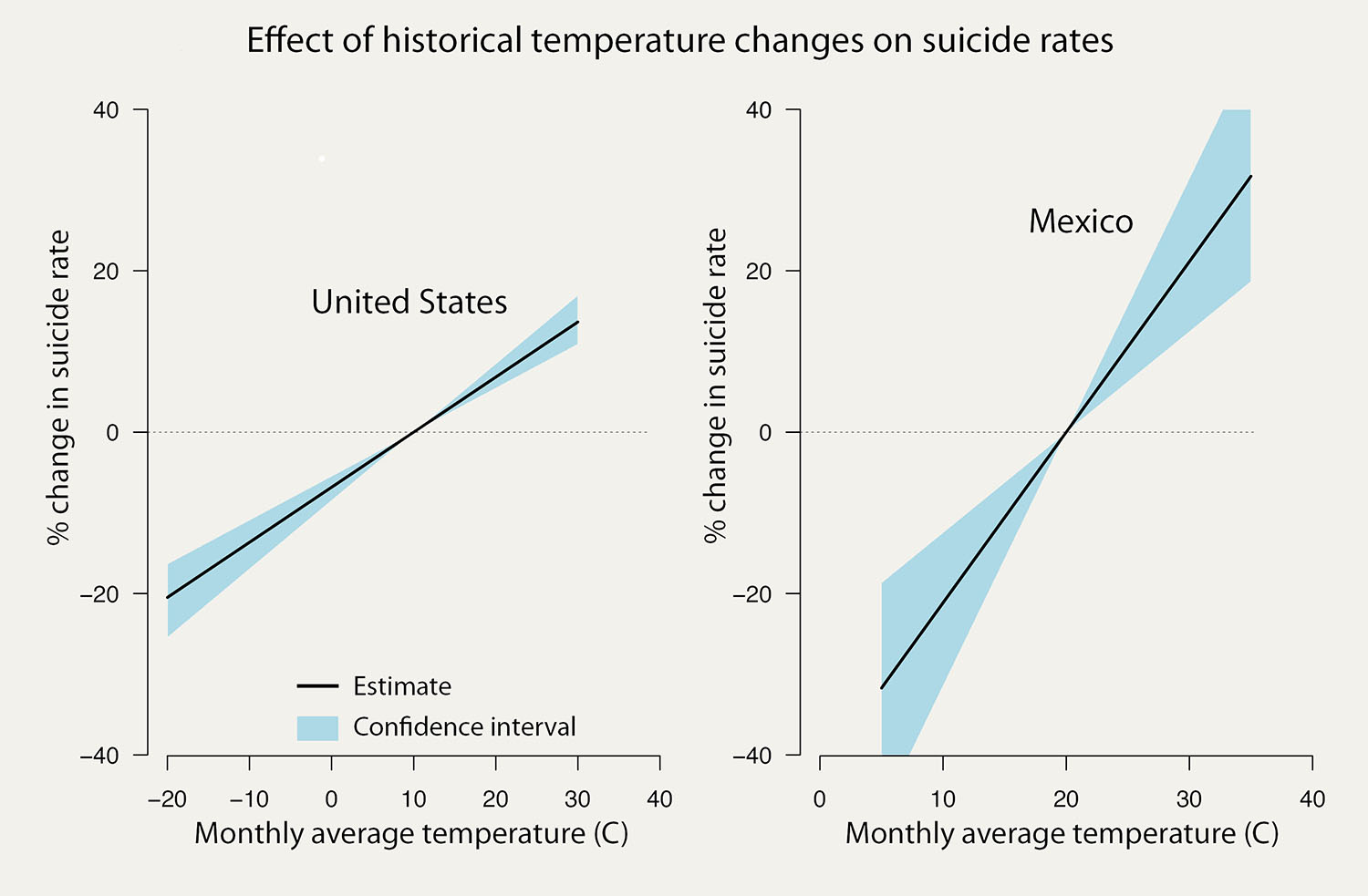 Effects of historical temperature changes on suicide rates are shown for the U.S. and Mexico. (Image credit: Marshall Burke)
Effects of historical temperature changes on suicide rates are shown for the U.S. and Mexico. (Image credit: Marshall Burke)
“We’ve been studying the effects of warming on conflict and violence for years, finding that people fight more when it’s hot. Now we see that in addition to hurting others, some individuals hurt themselves. It appears that heat profoundly affects the human mind and how we decide to inflict harm,” said Solomon Hsiang, study co-author and associate professor at the University of California, Berkeley.
The authors stress that rising temperature and climate change should not be viewed as direct motivations for suicide. Instead, they point out that temperature and climate may increase the risk of suicide by affecting the likelihood that an individual situation leads to an attempt at self-harm.
“Hotter temperatures are clearly not the only, nor the most important, risk factor for suicide,” Burke emphasized. “But our findings suggest that warming can have a surprisingly large impact on suicide risk, and this matters for both our understanding of mental health as well as for what we should expect as temperatures continue to warm.”
Marshall Burke is also a fellow at the Center on Food Security and the Environment, Stanford Woods Institute for the Environment, Freeman Spogli Institute for International Studies, and Stanford Institute for Economic Policy Research. Solomon Hsiang is also a faculty research fellow at the National Bureau of Economic Research. Other Stanford co-authors include Sanjay Basu, assistant professor of medicine, and Sam Heft-Neal, research scholar at the Stanford Center on Food Security and the Environment. Additional co-authors are from Pontificia Universidad Católica de Chile, Vancouver School of Economics, and the University of California, Berkeley. The research was partially supported by the Stanford Woods Institute for the Environment.
Hero Image

All News button
1
Laura Jakli
Encina Hall, C147
616 Jane Stanford Way
Stanford, CA 94305-6055
0
ljakli@stanford.edu
CDDRL Predoctoral Fellow, 2018-20
Fellow, Program on Democracy and the Internet, 2018-20
I am a Junior Fellow at the Harvard Society of Fellows. Starting in 2023, I will be an Assistant Professor at Harvard Business School's Business, Government and the International Economy (BGIE) unit.
My research examines political extremism, destigmatization, and radicalization, focusing on the role of popularity cues in online media. My related research examines a broad range of threats to democratic governance, including authoritarian encroachment, ethnic prejudice in public goods allocation, and misinformation.
My dissertation won APSA's Ernst B. Haas Award for the best dissertation on European Politics. I am currently working on my book project, Engineering Extremism, with generous funding from the William F. Milton Fund at Harvard.
My published work has appeared in the American Political Science Review, Governance, International Studies Quarterly, Public Administration Review, and the Virginia Journal of International Law, along with an edited volume in Democratization (Oxford University Press). My research has been featured in KQED/NPR, The Washington Post, and VICE News.
I received my Ph.D. in Political Science at the University of California, Berkeley in 2020. I was a Predoctoral Research Fellow at the Center on Democracy, Development and the Rule of Law at Stanford University and the Stanford Program on Democracy and the Internet. I hold a B.A. (Magna Cum Laude; Phi Beta Kappa) from Cornell University and an M.A. (with Distinction) from the University of California, Berkeley.
CV
Document
l.jakli_cv2022.pdf
(91.97 KB)
North Korea expert selected as 2018-19 Koret Fellow
News Type
News
Date
Paragraphs
Andray Abrahamian will be the 2018-19 Koret Fellow in the Korea Program at Stanford’s Walter H. Shorenstein Asia-Pacific Research Center (APARC). Abrahamian has been Executive Director and Director of Research for Choson Exchange, a non-profit that has trained over 2000 North Koreans in entrepreneurship and economic policy since 2010. His work for Choson Exchange and other projects has taken him to North Korea 30 times. He has also lived in Myanmar, allowing him the ability to conduct field research for his new book, North Korea and Myanmar: Divergent Paths (2018, McFarland). Divergent Paths asks how Myanmar came to end its isolation, while North Korea has yet not.
“When it comes to North Korea, Dr. Abrahamian has been very active both as an academic and on the ground. He has genuine hands-on experience of working with North Koreans from his numerous trips to the country. In this important period of flux for North Korea’s place on the world stage, we welcome Dr. Abrahamian as 2018-19 Koret Fellow, and look forward to his meaningful contributions to our activities.” “His experience and understanding of North Korea will be a great asset to our program,” Gi-Wook Shin, director of APARC said.
Image

Abrahamian is an Honorary Fellow at Macquarie University, Sydney, and an Adjunct Fellow at the Griffith Asia Institute. He is a frequent contributor to 38North.org, a website focused on North Korea analysis, and is a member of the US National Committee on North Korea. Andray holds a PhD from the University of Ulsan and an MA from the University of Sussex in International Relations. He has taught courses at Yangon University and Ulsan University.
Supported by the Koret Foundation, the fellowship brings leading professionals to Stanford to conduct research on contemporary Korean affairs with the broad aim of strengthening ties between the United States and Korea.
Hero Image

All News button
1