Authors
Beth Duff-Brown
News Type
Commentary
Date
Paragraphs

The Trump administration has proposed a new rule that would require direct-to-consumer TV advertisements for prescription drugs to disclose the price of their products.

The Centers for Medicare & Medicaid Services (CMS) said the disclosures would help consumers “make informed decisions that minimize not only their out-of-pocket costs, but also expenditures borne by Medicare and Medicaid, both of which are significant problems.”

The idea enjoys broad public support, since medical care and drug costs continue to skyrocket.  A U.S. Senate report earlier this year revealed that the cost of the 20 most commonly prescribed brand-name drugs have risen tenfold in the past five years.

In a June 2018 poll, 76 percent of Americans favored required drug advertisements to include a statement about how much the drugs cost.

But Michelle Mello, a Stanford Law School professor and Stanford Medicine professor of health research and policy, writes in this New England Journal of Medicine perspective that the proposed rule raises substantial public health and legal concerns.

A potential unintended consequence of price disclosure may be to dissuade patients from seeking care, writes Mello and her co-author, Stacie B. Dusetzina of Vanderbilt University School of Medicine, because of the perception that they cannot afford treatment. For example, Trulicity, a widely advertised drug for type 2 diabetes has a list price of $730 a month.

“Patients who could benefit from diabetes treatment may assume that they cannot afford it, when in fact insured patients’ costs for Trulicity may be much lower, and cheaper treatment options available,” they write. Metformin, for instance, costs $4 per month for patients who pay cash.

CMS would demand drug makers use the list prices from the Wholesale Acquisition Cost (WAC) in their television ads, including that costs “may be different” for those who are insured.

“This wording doesn’t communicate that costs to patients are probably much lower than the WAC,” writes Mello, a core faculty member at Stanford Health Policy.

This could have important legal implications as well, as compelled disclosures in advertising impinge on commercial speech protected by the First Amendment. Furthermore, they write, “disagreement about whether the WAC accurately represents a drug’s price could affect how courts assess the rule when constitutional challenges are inevitably filed.”

The researchers say three aspects of the proposed rule undercut the government’s ability to argue that it would improve patient decision-making and reduce drug spending: 

  1. Price information does little to inform consumer decisions if it inaccurately represents actual cost.
  2. Consumers can already obtain information on cash prices online and their own cost from their insurer.
  3. The rule contains no meaningful enforcement mechanism; CMS plans only to list violators on its website, calling into question whether companies will comply.

“We think that a better alternative would be making patient-specific cost information accessible at the point of prescribing, “ the authors write. 

The cost of prescription drugs should become a routine part of clinician-patient discussions, although they acknowledge that this would put more time constraints on medical practices.

“Providing salient cost information at the right time could help reduce drug spending while preserving patient choice, but we believe that direct-to-consumer advertising is the wrong vehicle,” they write.


Hero Image
gettyimages retro tv Getty Images
All News button
1
Authors
Beth Duff-Brown
News Type
News
Date
Paragraphs

A national panel of medical experts is recommending for the first time that clinicians offer daily preventive medication to patients who are at high risk of acquiring HIV/AIDS.

The U.S. Preventive Services Task Force estimates that 1.1 million Americans are currently living with HIV. More than 700,000 people have died from AIDS in the United States since the first cases were reported in 1981 and some 40,000 Americans are diagnosed with the virus each year.

Though HIV is treatable, there is still no vaccine and it has significant health consequences.

But the Task Force said in a published draft recommendation on Tuesday that it found “convincing evidence” that taking a daily pre-exposure prophylaxis, known as PrEP, provides a substantial benefit in decreasing the risk of HIV infection in people at high risk. 

PrEP is a combination of two drugs, tenofovir disoproxil fumarate and emtricitabine, taken in one daily pill. The Centers for Disease Control and Prevention says that PrEP reduces the risk of getting HIV from sex by more than 90 percent and by 70 percent for intravenous drug users.

“Unfortunately, HIV is still a major problem in the United States,” said Stanford Health Policy’s Douglas K. Owens, vice-chairman of the Task Force, an independent, voluntary panel of experts in prevention and evidence-based medicine. “But the evidence on this daily treatment is that, if you take it properly, it’s very effective.”

The Task Force, whose recommendations are followed by primary care physicians and clinical practices across the country, gave the recommendation its highest grade, an A. But it noted that PrEP currently is not being used in many persons at high risk of HIV infection. 

“We hope our recommendation will bring attention to a very effective preventative service,” Owens said. “We want clinicians to be aware that for patients at high risk of HIV, PrEP is an important preventive strategy to discuss.”

The global AIDS epidemic has slowed in recent year. AIDS-related deaths have been reduced by more than 50 percent since the peak of the AIDS crisis in 2004. In 2017, 940,000 people died from AIDS-related illnesses worldwide, compared to 1.4 million in 2010 and 1.9 million in 2004.

But many people remain at risk, including sex workers and people who have been trafficked.

The Task Force recommendation is only for those Americans who remain at high risk for contracting the virus, including:

  1. Sexually active men whose male partners are already living with HIV, or have a recent sexually transmitted infection (STI) such as syphilis, gonorrhea, or chlamydia;
  2. Heterosexual women and men who are sexually active and have an STI or partner living with HIV or who are inconsistent in their use of condoms with a partner at high risk of HIV;
  3. People who inject drugs and either share drug injection equipment.

The Task Force reaffirmed its 2013 recommendation that people ages 15 to 65 and all pregnant women also be screened for HIV in an additional draft recommendation. Both recommendations are open for public comment until December 26.

Hero Image
gettyimages hiv Getty Images
All News button
1
Authors
News Type
Commentary
Date
Paragraphs

Donald Trump has stated his intention to ditch the Intermediate-range Nuclear Forces (INF) Treaty. He and National Security Advisor John Bolton also appear unhappy with the New Strategic Arms Reductions Treaty (New START).

Withdrawal from New START would leave Russian strategic forces wholly unconstrained and end the flow of valuable information from the treaty’s verification and on-site inspection provisions.

Having won a majority in the House, the Democrats can protect New START and, with it, nuclear stability with Russia. To do so, they should steal a page from the playbook of Sen. Jon Kyl (R-Ariz.).

Read the rest at The Hill


Hero Image
steven pifer
All News button
1
Authors
News Type
News
Date
Paragraphs

Stanford-led group of young American and Russian scholars meet in Moscow on nuclear policy

Persistent nuclear threats and the recent erosion of relations between the United States and Russia paint a gloomy picture for the future of cooperation between nuclear powers. Despite these enormous challenges, Stanford is leading an effort to bring young nuclear scholars from the United States and Russia together to tackle urgent problems together and share ideas.

At the end of October, a group of six scholars from Stanford’s Center for International Security and Cooperation—Senior Fellow Siegfried Hecker, Visiting Scholar Chaim Braun, Postdoctoral Fellows Chantell Murphy and Kristen Ven Bruusgaard, Research Assistant Elliot Serbin and Senior Research Associate Alla Kassianova—and other American graduate students and postdoctoral fellows from Washington State University, University of Tennessee, Harvard, University of Michigan and Los Alamos National Laboratory traveled to Moscow for the Fourth Young Professionals Nuclear Forum.  The Americans joined a group of undergraduate, graduate, and postdoctoral students at the Moscow Engineering Physics University (MEPhI), Russia’s principal school training nuclear professionals.

The Forum, first launched between CISAC and MEPhI in 2016, provides a venue for young generation of American and Russian nuclear professionals to learn about current issues of nuclear safety, nuclear proliferation, and the role of nuclear power in the world’s evolving energy balance from a perspective of more than one country and more than one discipline.

In the weeks leading up to this Forum, participants on both sides of the ocean attended a series of online presentations by U.S. and Russian experts covering the complexity of the Iran nuclear program and the challenges facing further development of nuclear power.

When they met in person, the young scholars heard lectures from and participated in discussions with experts from Los Alamos National Laboratory, the Russian Center for Energy and Security, and others.

The participants then broke into small groups to work on tabletop problem solving activities. The first exercise, a crisis simulation concerning Iran’s nuclear program, brought together separate Russian and American teams to represent their government’s positions on Iran’s nuclear program and the Joint Comprehensive Plan of Action (JCPOA). Presented with a hypothetical problem—a scenario in which Iran decides to enhance its nuclear capabilities in violation of the JCPOA and President Trump threatens retaliation via Twitter—the participants gathered in small groups to see what type of cooperative Russian-American policies could be brokered in response.

The second exercise brought the group together to imagine the future of nuclear power and how to manage it. Working in small teams of 2-4 people, the participants formulated responses to eight pressing questions regarding the global future of nuclear power, including whether nuclear power is necessary to mitigate the consequences of climate change and whether nuclear proliferation challenges will limit the expansion of nuclear power. The teams presented their answers in Moscow and will continue to develop their assessments, to be published in a report next month.

Both Americans and Russians commonly remarked that the most valuable lesson they took from the exercises was the fact that both sides held remarkably different, but valuable, perspectives on issues of common concern. On the topic of nuclear energy, for example, Russians appreciated American perspectives on the value of startups in the nuclear power industry and new modes of thinking that encapsulated non-monetary aspects of nuclear power in broader economic analyses. Americans came to understand the deep Russian fascination with nuclear energy and optimistic views about the future role of nuclear energy in society, and how deeply that passion is engraved in the university system in a way wholly different from the United States.

Forum participants also had an opportunity to meet with the leadership of two committees of the Russian State Duma, the lower Chamber of the Russian legislature, the Committee on International Affairs and the Committee on Education and Science. The meeting was hosted by Ms. Inga Yumasheva,  an MP from the United Russia party. The Forum also included a visit to research labs and MEPhI facilities, which was hosted by their scientists.

View photos from the forum

About CISAC
The Center for International Security and Cooperation tackles the most critical security issues in the world today. Founded in 1983, CISAC has built on its research strengths to better understand an increasingly complex international environment. It is part of Stanford's Freeman Spogli Institute for International Studies (FSI). Though scholarly research, fellowships, and teaching, CISAC is educating the next generation of leaders in international security and creating policy impact on a wide variety of issues to help build a safer world.


Hero Image
CISAC young nuclear professionals visit Red Square, Moscow.
Elliot Serbin
All News button
1
Authors
Noa Ronkin
News Type
News
Date
Paragraphs

hallenges and Possibilities of Korean Studies in North America — Social Science panel
Future Visions: Challenges and Possibilities of Korean Studies in North America — Social Science panel. From left to right: UC Berkeley's Laura Nelson, University of Michigan's Jordan Siegel, Stanford's Yong Suk Lee, USC's David Kang, Harvard's Paul Chang.


How can Korean studies faculty cultivate supportive and critical scholarly communities with graduate students? What can be done to overcome the severe constraints on Korean language training in North America? Why is there a dearth of Korea scholarship in academic literature? And how should Korean studies librarians prepare for the future in the light of new technologies and young researchers’ increasing interest in digital scholarship?

These were some of the questions examined at a two-day conference, “Future Visions: Challenges and Possibilities of Korean Studies in North America,” convened by the Korea Program of Stanford’s Shorenstein Asia-Pacific Research Center (APARC) on November 1-2. Co-sponsored by the Seoul-based Foundation Academia Platonica, the conference, the first of its kind, gathered distinguished Korean studies scholars from twelve North American institutions to consider the state of the field, assess its challenges, and carry forward a vision for its future direction and potential. Its six unique panels focused not only on the major disciplines of Korean studies—history, literature, and the social sciences—but also on language education, library collections and services, and Korean Wave.

“The presentations and discussions by our fellow experts reflected the breadth and depth of Korean studies in North America,” says APARC Director and the Korea Program Director Gi-Wook Shin. “Our program was established at Stanford in 2001 and has since become a leader in Korean studies in North America, so it is a special privilege for us to bring together colleagues from eminent institutions around the continent to further advance Korean studies education and research in the academic and policy worlds, and to build upon our track record of action and achievements.”

“The field of Korean studies, however,” notes Shin, “has significantly changed over the past seventeen years and it isn’t without its challenges. This is our opportunity to consider frankly where we go next and how we could explore the path ahead together.”

Conference participants indeed engaged in deep conversations and shared ideas and dilemmas regarding teaching in the different disciplines of Korean studies in North America. Harvard sociologist Paul Chang listed three types of challenges facing the field: publication, academic, and professional challenges. David C. Kang, professor of international relations and director of the Korean Studies Institute at the University of Southern California, emphasized the publication challenge: why is it, asked Kang, that top academic journals in the discipline of political science and international relations publish so much more scholarship about Europe than they do about Korea and Asia at large, even while the rise of Asian nations is surely one of the most consequential issues of the twenty-first century? The onus, Kang argued, comes back to East Asia scholars “to produce better and more compelling scholarship, and to better train graduate students.”

University of British Columbia's Ross King and conference participants.

Yet complex issues surround the question of how to broaden graduate coursework—and whether to do so. Korean language and linguistics expert Ross King, head of the department of Asian Studies at the University of British Columbia in Vancouver, Canada, was one of several panelists who considered the obstacles to graduate training, among different aspects of academic challenges facing the field of Korean studies. King probed into how Sinocentrism and what he called the “Mandarin conceit”—that is, the notion that training in Literary Sinitic should be predicated on a near-native proficiency in modern Mandarin Chinese—are emerging as a major stumbling block to the study of premodern Korean literary culture. He also pointed to the constraints on language training in both Korean and hanmun in North America, which, he claimed, is why we can probably anticipate continued decrease in the number of ethnically non-Korean (non-Korea-educated) graduate students undertaking graduate study in Korean literature.

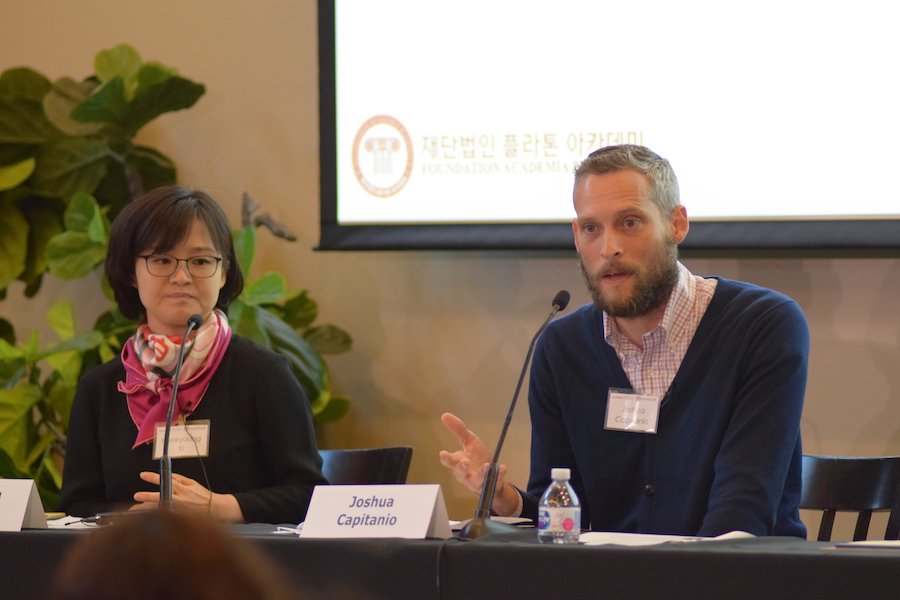
University of Washington's Hyokyoung Yi (left) and Stanford's Joshua Capitanio at a panel on library collections and service.

Sung-Ock Sohn, who coordinates the Korean language program in the department of Asian languages and cultures at the University of California – Los Angeles, further shed light on King’s prediction. She explained that while enrollments in Korean language classes have shown a sharp increase in American higher education institutions in the past decade, particularly at the introductory level and among ethnically non-Korean students, there is a high attrition rate of students from an introductory to advanced Korean classes nationwide.

How should the field move forward?

Participants proposed a host of ideas to that end. These included helping graduate students collaborate with colleagues in Korea; dedicating funding for junior faculty to spend periods of time before tenure conducting research and honing language skills in Korea at appropriate institutions, and for mid-career scholars to spend a year in Korea; emphasizing the application of social science theories and methods to premodern and modern East Asia; motivating scholars to apply a comparative lens to the study of the historical and contemporary experience of East Asia; and integrating linguistic and cultural diversity in Korean language classes by, for example, incorporating service learning in authentic contexts and extending the content spectrum to include topics such as Korean popular culture.


Image
K-pop star Siwon Choi (left) highlights closing panel on Korean Wave.

K-pop star Siwon Choi (left) highlights closing panel on Korean Wave.

Korean Wave was the focus of the conference’s widely attended closing panel that featured K-pop star Siwon Choi, a member of Korean boy band Super Junior, and multi-platinum music producer Dominique Rodriguez, managing director of SM Entertainment USA. They spoke about the global reach of Korean pop music and some of the ways in which Korean popular culture could stimulate interest in Korean studies. Dafna Zur, assistant professor in Stanford’s department of East Asian languages and cultures, who chaired the panel, challenged her students to consider “what it means not just to monetize culture but to design culture with specific markets and audience in mind.” The Stanford Daily published a detailed article on the panel.

“We are grateful to Foundation Academia Platonica for its generous support of Stanford’s Korea Program at Shorenstein APARC and for making this conference possible through our shared vision for the future of Korean studies in North America,” said Gi-Wook Shin. “Our thanks also go to our many other friends and partners, including the Korea Foundation that has helped achieve great results through its commitment to promoting understanding of Korea in academia and beyond and its support of the overseas Korean Studies Program since its establishment in 1991.”

South Korean TV company SBS NBC filmed the conference that will be featured in an upcoming documentary about Korean studies in the United States.

Read the conference report or listen to the audio recordings of the sessions, below.

Hero Image
Audience listens to panel during the conference "Future Visions: Challenges and Possibilities of Korean Studies in North America" Thom Holme, APARC
All News button
1
Authors
Beth Duff-Brown
News Type
Q&As
Date
Paragraphs

Research by Stanford Health Policy’s Michelle Mello looks at what happens when a group of hospitals started systematically acknowledging adverse outcomes in care by apologizing and proactively offering compensation where substandard care caused serious harm. 

Hospitals have traditionally “crouched in a deny-and-defend posture when things go wrong in medical care,” said Mello, a professor of law at Stanford Law School and a professor of health research and policy. The new approach, called “a communication-and-resolution program,” or CRP, is being adopted by an increasing number of health-care facilities.

“None of the hospitals experienced worsening liability or trends after CRP implementation, which suggests that transparency, apology, and proactive compensation can be pursued without adverse financial consequences,” Mello and her co-authors write in the study published Monday in Health Affairs. However, despite the growing consensus that CRPs are the right thing to do, concerns over liability risks remain.”

Stanford Health Policy asked Mello some questions about the research:

Could this new approach to resolving patient conflict be a thing of the future?

Hospitals that adopt CRPs believe they will help improve patient safety and are consistent with the ethical obligation to disclose medical errors; they also hope they will reduce liability costs. However, there is a lot of uncertainty about their effects on costs. On the one hand, being honest with patients could avoid the anger that prompts patients to sue, and compensating injured patients early on saves on litigation expenses. On the other hand, in the traditional system, very few patients injured by substandard care ever get compensated. Offering up admissions of error and early compensation could mean a lot more patients receive payment, raising total costs. Uncertainty about this issue continues to be a barrier to widespread adoption of the CRP approach.

What were the key findings in your study?

We evaluated the liability effects of CRP implementation at four Massachusetts hospitals by examining before-and-after trends in malpractice claims, volume, cost, and time to resolution. We then compared those to trends among similar hospitals in the state that did not adopt CRPs. We found that CRP implementation was associated with improved trends in the rate of new claims and legal defense costs at the two big hospitals that implemented these programs — favorable developments that were not seen at comparison hospitals with no communication-and-resolution programs in place. CRP implementation was not associated with significant changes upward or downward in trends of new claims receiving compensation, compensation costs, total liability costs, or average compensation per paid claim, nor was it associated with a significant change in time to resolution.

So then why are the findings important?

The study helps resolve uncertainty about the liability effects of admitting and compensating medical errors, especially since the study design was much stronger than that of previous studies. We found that the CRP approach does not expand liability risk and may, in fact, improve some liability outcomes. Therefore, hospitals can “do the right thing” — be honest about errors, apologize, and compensate patients who are injured by negligence — without adverse financial consequences.

Who began the CRP approach and what is the average payment proactively made to patients who did not receive proper care?

The approach dates to the late 1990s and was first publicized by a Veterans Affairs hospital in Kentucky and then by the University of Michigan Health System, both of which reported very positive outcomes.  Stanford was also an early adopter.

The model calls for patients to be compensated at about what the hospital estimates their claim would be worth in traditional litigation. In our study in Massachusetts, the median payment to patients was $75,000. That’s a lot lower than the median payment in the tort system, but the mix of injuries is different. In traditional litigation, 85 percent of claims involve very serious injuries or deaths, because smaller claims aren’t attractive to plaintiff attorneys. They just go uncompensated. In CRPs, it’s easier for patients with moderate-severity injuries to have access to justice.


Hero Image
gettyimages hospital mistake
All News button
1
News Type
News
Date
Paragraphs

On August 9, 2018 the Shorenstein Asia Pacific Research Center (APARC) Japan Program hosted a conference, "Break Through: Women in Silicon Valley, Womenomics in Japan." Women thought-leaders and entrepreneurs from Stanford, Silicon Valley, and Japan came together to discuss innovative ideas for narrowing the gender gap, and cultivating interpersonal support networks and collaboration across the pacific. The program combined panel presentations with participatory exercises and startup showcases which afford participants the opportunity to 1) discuss progress and challenges in women's advancement in Silicon Valley and Japan, 2) share practices and organizational features that better enable the hiring and retaining of women, 3) showcase Silicon Valley and Japanese women entrepreneurs and 4) provide tools for branding and building support networks. 

The Break Through conference was supported by the Acceleration Program in Tokyo for Women (APT), a program that aims to shape a new narrative by providing opportunities for women entrepreneurs to build networks, receive mentoring, and become a focal point for dynamism. The program, spearheaded by Tokyo's first female governor, Yuriko Koike, is undertaken by the Tokyo Metropolitan government and supported by Tohmatsu Venture Support. 

The full conference report, now available, outlines the issues and offers an analysis of the themes that were discussed in the presentations, panels and participatory exericses throughout the day. 

Download the Full Report

Hero Image
picture 3
All News button
1
Paragraphs

On August 9, 2018, the Shorenstein Asia Pacific Research Center (APARC) hosted a conference, “Break Through: Women in Silicon Valley, Womenomics in Japan" with support from the Acceleration Program in Tokyo for Women (APT). Women thought-leaders and entrepreneurs from Stanford, Silicon Valley, and Japan came together to discuss innovative ideas for narrowing the gender gap, and cultivated interpersonal support networks and collaboration across the Pacific. The report, which is an outcome of the conference, offers an analysis and discussion of the themes and takeaways from the day. 

All Publications button
1
Publication Type
Policy Briefs
Publication Date
Journal Publisher
Japan Program at the Shorenstein Asia-Pacific Research Center
Authors
Beth Duff-Brown
News Type
News
Date
Paragraphs

U.S. social insurance programs traditionally have been paid out to beneficiaries directly by the federal government. But the last two decades have seen an accelerated effort to subsidize private health insurance plans to provide Medicare and Medicaid benefits.

The United States has a large private health insurance sector — accounting for more than $1.1 trillion of health-care spending in 2016. Yet the taxpayer-funded Medicare and Medicaid (including special insurance for children ) account for even more than that, about $1.2 trillion, or some 40 percent of overall health-care spending in this country.

In Medicaid, which provides health care to low-income Americans, as many as 80 percent of beneficiaries are enrolled in publicly-funded, but privately-run managed care plans. That figure for Medicare, which covers the elderly and disabled, stands at more than 30 percent for their medical coverage, and many more for their drug coverage.

Over the past decade, the share of subsidization of privately run insurance plans as opposed to direct reimbursement of providers in public spending on Medicare and Medicaid has almost doubled, increasing from 22 percent to 40 percent.

“These changes raise very different policy questions, as this moves us from thinking about how, for example, Medicare should reimburse health-care providers, to how it should pay private insurers,” said Stanford Health Policy health economist, Maria Polyakova.

With the growing overlap between the public and private sources of health insurance, Polyakova worries that there is too much room for costly mistakes, or outright shenanigans.

“There’s a lot of confusion among Medicare beneficiaries about who pays how much for their benefits, as subsidies to private insurers are complex and not transparent,” said Polyakova, an assistant professor of Health Research and Policy at the School of Medicine and faculty fellow at the Stanford Institute for Economic Policy Research.

“Similarly, for policymakers, figuring out how to pay insurers rather than health-care providers raises complicated policy design questions,” Polyakova said. “We have to set up subsidies in a way that benefits patients and a competitive market, but also be aware that the private firms operating in these markets are very sophisticated and will take any advantage of any design loopholes.”

Polyakova and colleagues set out to find a formula that could benefit all sides. To do so, they focused on the private provision of prescription drug benefit in Medicare Part D. Their findings were recently released in a working paper by the National Bureau of Economic Research. 

More than 50 million individuals benefit from Medicare, which accounts for $500 billion in annual budgetary outlays by the federal government. Once enrolled in Medicare, consumers have a choice of more than a dozen Prescription Drug Plans (PDP) under what is known as the Medicare Part D program. This drug program launched in 2006 is a rapidly growing market that accounts for about a fifth of overall federal spending in Medicare, about $100 billion.

Image
pablo 40

“Beyond its sheer economic size, this market further plays an important role in policymaking, as it has become the role model for private provision of publicly funded social insurance,” wrote Polyakova and her co-authors.

Consumers of Part D bear only a small portion of the program’s cost. A consumer pays on average a $40 monthly premium, although premiums vary widely. For each consumer, the government is sending on average an additional $55 to the plan in which the consumer is enrolled, with much higher subsidies for consumers with greater health problems. The government pays the full premium for low-income beneficiaries.

The independent insurance firms are quite satisfied with the 50-percent-or-higher subsidy that comes from Washington and attracts more consumers into the market.

But is that the best use of our tax dollars?

Polyakova and her colleagues used a dataset that contains detailed information about plan prices and characteristics for all Part D plans in all markets from 2007 to 2010. The data also includes information on individual enrollment in prescription drug plans and records of drug purchases that consumers make after enrolling in a plan

They created a model that focused on two things: 

  1. They first developed and estimated a model of supply and demand for drug plans. With the model, they could compute how much of government dollars benefit consumers and how much ends up being captured by insurers.
  2. With this supply-and-demand model, they could simulate whatever market structure they wanted, imagining what would happen if the government gave each Medicare Part D consumer a voucher of, for example, $700 to pay for their prescription medications.

What they found is that, at least for Part D, the current mechanisms do a surprisingly good job at keeping costs low.

“On the supply-side, we find, perhaps surprisingly, that the current structure of the program mutes insurers’ ability to strategically raise subsidies, and hence positively affects total program efficiency,” they wrote.

At the same time, they also find that taxpayer dollars could be spent even more efficiently. 

Currently, the subsidy is found through a formula that uses prices set by insurers. Their simulation suggests that setting a fixed voucher-like subsidy would encourage insurers to lower prices for their plans even more. If insurers knew the fixed subsidy level in advance, then they would have a strong incentive to price as close as possible to this subsidy. Any difference between the subsidy and the premium would have to be paid by consumers, so costlier insurers may lose customers. 

Under the current system, the ultimate subsidy is linked to insurer prices and is not known in advance of insurers submitting their price bids, which makes the incentives to reduce prices slightly less strong. Great caution is required when setting such voucher-like subsidies, however. If they are set too low, insurers may be forced to quit the market or provide poor quality products.

Even more return on the taxpayer’s dollar could be achieved by setting higher vouchers for more economically efficient (but not lower quality) plans and lower vouchers for plans that have higher operating costs. Improving the return on the dollar could allow the government to spend less and still allow the same number of consumers to purchase coverage. 

“Most of our government health-care dollars are increasingly spent through this indirect mechanism of giving money to private firms and simply hoping that things will somehow work out,” Polyakova said. “But the way we design these mechanisms are hugely important: You may be wasting billions of dollars if these are not set up properly — and there are not that many people working on this, as these rules are incredibly involved.”

Hero Image
generic pharmacy Getty Images
All News button
1
-

In 2012, as giants such as Facebook, Twitter, and Google began to position themselves as the go-to places to read news, a little-known news app called SmartNews emerged and started gaining popularity in Japan. The SmartNews app has since been dubbed “App of the Year” on Google Play and won the “Best of” award in Apple’s App store, launched US operations in 2014, and now has over 10 million monthly active users in US and Japan.

In the age of fake news and information polarization, SmartNews is working to deliver to users a balanced diet of quality information from trusted journalism sources. The SmartNews news app uses machine learning to deliver curated news from more than 3000 sources and identify fake news. The SmartNews Delivery Algorithm not only considers users’ likes and clicks and other behavior on the app to generate suggestions, but also applies political balancing algorithms to ensure multiple viewpoints are expressed on important topics, and diversification algorithms to help break the filter bubble.

In this public forum, SmartNews Director of Product Management Yuhei Nishioka will talk about SmartNews’ story and growth trajectory, competing in the current news app landscape, and finally, discuss the process and considerations in creating the SmartNews News Delivery Algorithm. Introduction by Rich Jaroslovsky Vice President for Content and Chief Journalist of SmartNews and former Wall Street Journal White House correspondent.

MAIN SPEAKER:

Yuhei Nishioka, Director of Product Management, SmartNews

INTRODUCTION BY:

Rich Jaroslovsky, Vice President for Content and Chief Journalist, SmartNews and former Wall Street Journal White House correspondent

AGENDA:

4:15pm: Doors open
4:30pm-5:30pm: Main Content, followed by discussion
5:30pm-6:00pm: Networking

RSVP REQUIRED:

Register to attend at http://www.stanford-svnj.org/101618-public-forum

For more information about the Silicon Valley-New Japan Project please visit: http://www.stanford-svnj.org/

PARKING ON CAMPUS:

Please note there is significant construction taking place on campus, which is greatly affecting parking availability and traffic patterns at the university. Please plan accordingly.

Yuhei Nishioka, Director of Product Management, SmartNews
Seminars
Subscribe to North America