-

One of the routine assumptions of students of democratization has been that there is a close, causal relationship between liberalization and democratization. The former is said to drive those who concede it toward convoking credible elections and, eventually, tolerating ruler accountability to citizens. The link between those processes of regime transformation is alleged to be the mobilization of civil society. It has been argued that the weakness or absence of this linkage is one (among many) of the conditions which make the polities of the Middle East and North Africa resistant to democratization. We propose to open a public discussion on this topic.

Philippe Schmitter is Professor Emeritus at the European University Institute (EUI), and was on the faculty of the EUI from 1996 to 2004, after ten years at Stanford University. He is also a recurrent visiting professor at the Central European University in Budapest, at the Istituto delle Scienze Humanistiche in Florence and the University of Siena.

He has been vice-president of the American Political Science Association and the recipient of numerous professional awards and fellowships, including a Guggenheim in 1978, the award for lifetime achievement in European politics by the ECPR in 2008, and the award for lifetime achievement in the study of European integration by EUSA in 2009.

Sean Yom is a Hewlett Postdoctoral Fellow at CDDRL at Stanford University. He finished his Ph.D. at the Department of Government at Harvard University in June 2009, with a dissertation entitled "Iron Fists in Silk Gloves: Building Political Regimes in the Middle East". His primary research explores the origins and durability of authoritarian regimes in this region, focusing on the historical interplay between early social conflicts and Western geopolitical interventions.

Encina Ground Floor Conference Room

CDDRL
Stanford University
Encina Hall
616 Serra Street
Stanford, CA 94305-6055

0
Visiting Scholar 2010
Schmitter.JPG PhD

Philippe C. Schmitter is a visiting scholar at CDDRL during winter quarter 2010. Since 1967 he has been successively assistant professor, associate professor and professor in the Politics Department of the University of Chicago, then at the European University Institute (1982-86) and at Stanford (1986-96). He was Professor of Political Science at the European University Institute in Florence, Department of Political and Social Sciences until September 2004. He is now Emeritus of the Department of Political and Social Sciences at the European University Institute.

He has been visiting professor at the Universities of Paris-I, Geneva, Mannheim and Zürich, and Fellow of the Humboldt Foundation, Guggenheim Foundation and the Palo Alto Centre for Advanced Studies in the Behavioral Sciences.

He has published books and articles on comparative politics, on regional integration in Western Europe and Latin America, on the transition from authoritarian rule in Southern Europe and Latin America, and on the intermediation of class, sectoral and professional interests.

His current work is on the political characteristics of the emerging Euro-polity, on the consolidation of democracy in Southern and Eastern countries, and on the possibility of post-liberal democracy in Western Europe and North America.
Recently, Professor Schmitter was awarded the The Johan Skytte Prize in political science (2009).

He earned his PhD from the University of California at Berkeley.

Philippe C. Schmitter Professor Emeritus Speaker European University Institute, Visiting Scholar at CDDRL

N/A

0
CDDRL Hewlett Fellow 2009-2010
YOM_webphoto.jpg PhD

Sean Yom finished his Ph.D. at the Department of Government at Harvard University in June 2009, with a dissertation entitled "Iron Fists in Silk Gloves: Building Political Regimes in the Middle East." His primary research explores the origins and durability of authoritarian regimes in this region. His work contends that initial social conflicts driven by strategic Western interventions shaped the social coalitions constructed by autocratic incumbents to consolidate power in the mid-twentieth century--early choices that ultimately shaped the institutional carapaces and political fates of these governments. While at CDDRL, he will revise the dissertation in preparation for book publication, with a focus on expanding the theory to cover other post-colonial regions and states. His other research interests encompass contemporary political reforms in the Arab world, the historical architecture of Persian Gulf security, and US democracy promotion in the Middle East. Recent publications include articles in the Journal of Democracy, Middle East Report, Arab Studies Quarterly, and Arab Studies Journal.

Sean Yom Postdoctoral fellow Commentator Stanford University
Seminars
-

A graduate of Princeton and Columbia, Dr. Oren has received fellowships from the U.S. Departments of State and Defense, and from the British and Canadian governments. Formerly, he was the Lady Davis Fellow of Hebrew University, a Moshe Dayan Fellow at Tel-Aviv University, and the Distinguished Fellow at the Shalem Center in Jerusalem. He has been a visiting professor at Harvard, Yale, and Georgetown.

Ambassador Oren has written extensively for The Wall Street Journal, The New York Times, and The New Republic, where he was a contributing editor. His two most recent books, Six Days of War: June 1967 and The Making of the Modern Middle East and Power, Faith, and Fantasy:  America in the Middle East, 1776 to the Present, were both New York Times bestsellers. They won the Los Angeles Times’ History Book of the Year prize, a National Council of the Humanities Award, and the National Jewish Book Award.

Raised in New Jersey, where he was an activist in Zionist youth movements and a gold medal winning athlete in the Maccabia Games, Ambassador Oren moved to Israel in the 1970s. He served as an officer in the Israel Defense Forces, in the paratroopers in the Lebanon War, a liaison with the U.S. Sixth Fleet during the Gulf War, and an IDF spokesman during the Second Lebanon War and the recent Gaza operation.  He acted as an Israeli emissary to Jewish refuseniks in the Soviet Union, as an advisor to Israel’s delegation to the United Nations, and as the government’s director of Inter-Religious Affairs. He has testified before Congress and briefed the White House on Middle Eastern affairs.

Ambassador Oren is married to Sally, and they have three children—Yoav, Lia, and Noam.


Audio Synopsis:

Ambassador Oren begins by tracing the history of the US-Israel relationship, which he spent several decades researching as a historian prior to being appointed Ambassador. He notes that the United States and Israel have long maintained a spiritual and democratic connection, augmented in 1967 by a strategic/military relationship following the Six Days War.

Ambassador Oren was appointed in July 2009, six months in to the Obama administration. He cites three initial areas of disagreement between the current Israeli and American administrations: strategies for preventing Iran from developing nuclear weapons; settlement freezes in the West Bank and East Jerusalem; and the logistics of a two-state solution. Oren feels that these points of disjuncture have largely been overcome through close cooperation and an ongoing dialogue.  Agreements have been reached, for example, on the removal of roadblocks and checkpoints, a ten-month moratorium on West Bank construction, and the imposition of sanctions on Iran.

In conclusion, Ambassador Oren offers an optimistic outlook for the future of U.S.-Israel relations, pointing out Israel's close economic and trade partnership with the United States in addition to its strategic and ideological partnerships. He asserts that the idea of America is indivisible from the idea of a recreated Jewish state.

A question and answer session addressed such topics as the likelihood of success of sanctions against Iran; what alternatives are available if sanctions fail; whether Medvedev's administration has been more willing to engage with Israel than was Putin's administration; how problems with the Palestinian education system are being addressed by Israel; and how an independent, demilitarized Palestine might change Israel's relationship with other Middle Eastern countries.

Bechtel Conference Center

Michael B. Oren Ambassador of the State of Israel to the United States Speaker
Lectures
-

In this panel discussion, three leading scholars in the field of China and Taiwan studies will examine recent developments and future prospects for Taiwan's participation in international organizations, from the World Health Assembly to a range of other UN-affiliated and other international organizations (including new and less formal groupings such as the Community of Democracies).  More broadly, this panel discussion will examine how Taiwan is now trying to, and might in the near future, engage the international community and international organizations, in an era when relations across the strait are thawing but Beijing is still actively limiting Taiwan's international space.

Dan Blumenthal is a resident fellow at American Enterprise Institute for Public Policy Research. He is a current commissioner and former vice chairman of the U.S.-China Economic and Security Review Commission, where he directs efforts to monitor, investigate, and provide recommendations on the national security implications of the economic relationship between the two countries. Previously, he was senior director for China, Taiwan, and Mongolia in the Secretary of Defense's Office of International Security Affairs and practiced law in New York prior to his government service. At AEI, in addition to his work on the national security implications of U.S.-Sino relations, he coordinates the Tocqueville on China project, which examines the underlying civic culture of post-Mao China. Mr. Blumenthal also contributes to AEI's Asian Outlook series.

Kao-cheng Wang received his Ph.D. in Political Science from University of Pennsylvania. He is Professor and former Director of Graduate Institute of International Affairs and Strategic Studies, Tamkang University, Taipei.

Suisheng Zhao is Professor at the Graduate School of International Studies and Executive Director of the Center for China-US Cooperation, University of Denver. He is a member of the Board of Governors of the US Committee of the Council for Security Cooperation in the Asia Pacific, a member of the National Committee on US-China Relations, and a Research Associate at the Fairbank Center for East Asian Research at Harvard University. He is the founding editor of the Journal of Contemporary China.

Oksenberg Conference Room

Dan Blumenthal Resident Fellow Speaker American Enterprise Institute
Kao-cheng Wang Professor Speaker Tamkang University
Suisheng Zhao Professor Speaker University of Denver

CDDRL
Stanford University
Encina Hall, C147
616 Jane Stanford Way
Stanford, CA 94305-6055

(650) 724-6448 (650) 723-1928
0
Mosbacher Senior Fellow in Global Democracy at the Freeman Spogli Institute for International Studies
William L. Clayton Senior Fellow at the Hoover Institution
Professor, by courtesy, of Political Science and Sociology
diamond_encina_hall.png MA, PhD

Larry Diamond is the William L. Clayton Senior Fellow at the Hoover Institution, the Mosbacher Senior Fellow in Global Democracy at the Freeman Spogli Institute for International Studies (FSI), and a Bass University Fellow in Undergraduate Education at Stanford University. He is also professor by courtesy of Political Science and Sociology at Stanford, where he lectures and teaches courses on democracy (including an online course on EdX). At the Hoover Institution, he co-leads the Project on Taiwan in the Indo-Pacific Region and participates in the Project on the U.S., China, and the World. At FSI, he is among the core faculty of the Center on Democracy, Development and the Rule of Law, which he directed for six and a half years. He leads FSI’s Israel Studies Program and is a member of the Program on Arab Reform and Development. He also co-leads the Global Digital Policy Incubator, based at FSI’s Cyber Policy Center. He served for 32 years as founding co-editor of the Journal of Democracy.

Diamond’s research focuses on global trends affecting freedom and democracy and on U.S. and international policies to defend and advance democracy. His book, Ill Winds: Saving Democracy from Russian Rage, Chinese Ambition, and American Complacency, analyzes the challenges confronting liberal democracy in the United States and around the world at this potential “hinge in history,” and offers an agenda for strengthening and defending democracy at home and abroad.  A paperback edition with a new preface was released by Penguin in April 2020. His other books include: In Search of Democracy (2016), The Spirit of Democracy (2008), Developing Democracy: Toward Consolidation (1999), Promoting Democracy in the 1990s (1995), and Class, Ethnicity, and Democracy in Nigeria (1989). He has edited or coedited more than fifty books, including China’s Influence and American Interests (2019, with Orville Schell), Silicon Triangle: The United States, China, Taiwan the Global Semiconductor Security (2023, with James O. Ellis Jr. and Orville Schell), and The Troubling State of India’s Democracy (2024, with Sumit Ganguly and Dinsha Mistree).

During 2002–03, Diamond served as a consultant to the US Agency for International Development (USAID) and was a contributing author of its report, Foreign Aid in the National Interest. He has advised and lectured to universities and think tanks around the world, and to the World Bank, the United Nations, the State Department, and other organizations dealing with governance and development. During the first three months of 2004, Diamond served as a senior adviser on governance to the Coalition Provisional Authority in Baghdad. His 2005 book, Squandered Victory: The American Occupation and the Bungled Effort to Bring Democracy to Iraq, was one of the first books to critically analyze America's postwar engagement in Iraq.

Among Diamond’s other edited books are Democracy in Decline?; Democratization and Authoritarianism in the Arab WorldWill China Democratize?; and Liberation Technology: Social Media and the Struggle for Democracy, all edited with Marc F. Plattner; and Politics and Culture in Contemporary Iran, with Abbas Milani. With Juan J. Linz and Seymour Martin Lipset, he edited the series, Democracy in Developing Countries, which helped to shape a new generation of comparative study of democratic development.

Download full-resolution headshot; photo credit: Rod Searcey.

Former Director of the Center on Democracy, Development and the Rule of Law
Faculty Chair, Jan Koum Israel Studies Program
Date Label
Larry Diamond Director Moderator CDDRL
Panel Discussions
News Type
News
Date
Paragraphs

On January 21, scholars, along with government and business leaders from Japan and the United States, including U.S. Ambassador to Japan Mr. John V. Roos, came together for a transnational "Dialogue on Japan's Entrepreneurial Ecosystem." The event, which took place over Cisco Systems' TelePresence technology and simultaneously connected participants in Tokyo, San Jose, and Stanford, was an opportunity for SPRIE Researcher Robert Eberhart and SPRIE Co-director William F. Miller present new data on Japan's entrepreneurial climate.  

The data shed new light on the formation of new companies in Japan over the past ten years and is part of continuing research on Japanese entrepreneurship being undertaken by the SPRIE-Stanford Project on Japanese Entrepreneurship (SPRIE-STAJE). The dialogue presentation can be downloaded from the SPRIE website.

All News button
1

San Francisco State University will host a conference September 16-17, 2010 exploring the question and place of rights in history, politics, and society.

Rights, both individual and collective, have long been a theme in American society, often seen in conflict with state power. The conference welcomes papers on assertions of rights by insurgent groups, resistance to rights claims, and governmental efforts to suppress or promote rights, in areas including but not limited to: civil liberties; disability rights; labor and economic rights; feminism and antiracism; immigration; environmental justice; access to healthcare; the prison industrial complex; sexual orientation; the stateless; and human rights.

The goal is to bring together a wide variety of people from a range of academic, activist, legal, and community spaces to examine the place of rights within the context of American society (as situated within a boarder global political community). To that end, the conference is open to historians, both senior and junior scholars, graduate students, community advocates, archivists, and lawyers.

The deadline for submission of proposals, consisting of an abstract of 1000 words for panel and workshop proposals or 300 words for individual presentations and a one-page CV for each participant, is March 15, 2010. Send your proposals to

Christopher Waldrep
Department of History
San Francisco State University
San Francisco, California 94132

or via email to cwaldrep@sfsu.edu.

More information is available at this link.

SF State University

Conferences
Authors
News Type
Commentary
Date
Paragraphs
In their latest op-ed in "The Wall Street Journal," William Perry, George Shultz, Henry Kissinger, and Sam Nunn argue that maintaining confidence in the U.S. nuclear arsenal is necessary as the number of weapons decreases.

The four of us have come together, now joined by many others, to support a global effort to reduce reliance on nuclear weapons, to prevent their spread into potentially dangerous hands, and ultimately to end them as a threat to the world. We do so in recognition of a clear and threatening development.

The accelerating spread of nuclear weapons, nuclear know-how, and nuclear material has brought us to a tipping point. We face a very real possibility that the deadliest weapons ever invented could fall into dangerous hands.

But as we work to reduce nuclear weaponry and to realize the vision of a world without nuclear weapons, we recognize the necessity to maintain the safety, security and reliability of our own weapons. They need to be safe so they do not detonate unintentionally; secure so they cannot be used by an unauthorized party; and reliable so they can continue to provide the deterrent we need so long as other countries have these weapons. This is a solemn responsibility, given the extreme consequences of potential failure on any one of these counts.

For the past 15 years these tasks have been successfully performed by the engineers and scientists at the nation's nuclear-weapons production plants and at the three national laboratories (Lawrence Livermore in California, Los Alamos in New Mexico, and Sandia in New Mexico and California). Teams of gifted people, using increasingly powerful and sophisticated equipment, have produced methods of certifying that the stockpile meets the required high standards. The work of these scientists has enabled the secretary of defense and the secretary of energy to certify the safety, security and the reliability of the U.S. nuclear stockpile every year since the certification program was initiated in 1995.

The three labs in particular should be applauded for the success they have achieved in extending the life of existing weapons. Their work has led to important advances in the scientific understanding of nuclear explosions and obviated the need for underground nuclear explosive tests.

Yet there are potential problems ahead, as identified by the Strategic Posture Commission led by former Defense Secretaries Perry and James R. Schlesinger. This commission, which submitted its report to Congress last year, calls for significant investments in a repaired and modernized nuclear weapons infrastructure and added resources for the three national laboratories.

These investments are urgently needed to undo the adverse consequences of deep reductions over the past five years in the laboratories' budgets for the science, technology and engineering programs that support and underwrite the nation's nuclear deterrent. The United States must continue to attract, develop and retain the outstanding scientists, engineers, designers and technicians we will need to maintain our nuclear arsenal, whatever its size, for as long as the nation's security requires it.

This scientific capability is equally important to the long-term goal of achieving and maintaining a world free of nuclear weapons—with all the attendant expertise on verification, detection, prevention and enforcement that is required.

Our recommendations for maintaining a safe, secure and reliable nuclear arsenal are consistent with the findings of a recently completed technical study commissioned by the National Nuclear Security Administration in the Department of Energy. This study was performed by JASON, an independent defense advisory group of senior scientists who had full access to the pertinent classified information.

The JASON study found that the "[l]ifetimes of today's nuclear warheads could be extended for decades, with no anticipated loss in confidence, by using approaches similar to those employed in Life Extension Programs to date." But the JASON scientists also expressed concern that "[a]ll options for extending the life of the nuclear weapons stockpile rely on the continuing maintenance and renewal of expertise and capabilities in science, technology, engineering, and production unique to the nuclear weapons program." The study team said it was "concerned that this expertise is threatened by lack of program stability, perceived lack of mission importance, and degradation of the work environment."

These concerns can and must be addressed by providing adequate and stable funding for the program. Maintaining high confidence in our nuclear arsenal is critical as the number of these weapons goes down. It is also consistent with and necessary for U.S. leadership in nonproliferation, risk reduction, and arms reduction goals.

By providing for the long-term investments required, we also strengthen trust and confidence in our technical capabilities to take the essential steps needed to reduce nuclear dangers throughout the globe. These steps include preventing proliferation and preventing nuclear weapons or weapons-usable material from getting into dangerous hands.

If we are to succeed in avoiding these dangers, increased international cooperation is vital. As we work to build this cooperation, our friends and allies, as well as our adversaries, will take note of our own actions in the nuclear arena. Providing for this nation's defense will always take precedence over all other priorities.

Departures from our existing stewardship strategies should be taken when they are essential to maintain a safe, secure and effective deterrent. But as our colleague Bill Perry noted in his preface to America's Strategic Posture report, we must "move in two parallel paths—one path which reduces nuclear dangers by maintaining our deterrence, and the other which reduces nuclear dangers through arms control and international programs to prevent proliferation." Given today's threats of nuclear proliferation and nuclear terrorism, these are not mutually exclusive imperatives. To protect our nation's security, we must succeed in both.

Beyond our concern about our own stockpile, we have a deep security interest in ensuring that all nuclear weapons everywhere are resistant to accidental detonation and to detonation by terrorists or other unauthorized users. We should seek a dialogue with other states that possess nuclear weapons and share our safety and security concepts and technologies consistent with our own national security.

Mr. Shultz was secretary of state from 1982 to 1989. Mr. Perry was secretary of defense from 1994 to 1997. Mr. Kissinger was secretary of state from 1973 to 1977. Mr. Nunn is former chairman of the Senate Armed Services Committee.

Hero Image
Perry WSJ Deterrent op ed logo
All News button
1
-

Dr. Songs talk will focus on the question concerning interpretation and possible application of Article 121 of the 1982 United Nations Convention on the Law of the Sea (UNCLOS), in particular its third paragraph, to the selected disputed offshore islands or rocks that are situated in the Sea of Japan, the East China Sea, and the South China Sea. A number of recent developments occurred in the East Asian waters that are relevant to or have the potential to give rise to the problem of interpretation and application of the said article will first be cited. Then, a brief summary of the development of the "Regime of Islands" at UNCLOS III will be given, focusing in particular on those proposals made by the participating delegations to amend or delete entirely Article 121(3) of UNCLOS. The views of the law of the sea experts on interpretation and application of Article 121(3) will be examined. Several selected examples of state practices with regard to the application or interpretation of Article 121(3) will then be provided. This is to be followed by discussing the interpretation and possible application of Article 121(3) to the selected disputed offshore islands that are situated in the East Asian waters. Finally, several suggestions for possible amendment to Article 121 or policy measures to help deal with the confusion found in Article 121(3) will be offered.

Yann-huei Song received his undergraduate degree from National Chengchi University, Taipei, Taiwan, a Master's degree in Political Science from Indiana State University, Indiana, USA, a LL.M. degree from the University of California School of Law (Boalt Hall), Berkeley, California, USA, a doctoral degree in International Relations from Kent State University, Kent, Ohio, USA, and a JSD degree from the University of California School of Law (Boalt Hall), Berkeley.

Following graduation from Kent State University, Dr. Song taught at Department of Political Science, Indiana State University as Assistant Professor in 1988. He then returned to his country and taught as an Associate Professor at Institute of Maritime Law, National Taiwan Ocean University, Keelung, Taiwan in 1990. Currently, Dr. Song is a research fellow at the Institute of European and American Studies, Academia Sinica, Nankang, Taipei, Taiwan, and distinguished professor of the Graduate Institute of International Politics at National Ching Hsing University (NCHU), Taichung, Taiwan. He is also dean of the Office of International Affaris at NCHU.

Dr. Song's research interests are in the fields of International Law of the Sea, International Fisheries Law, International Environmental Law, National Ocean Policy Study, Naval Arms Control and Maritime Security. He has published articles in journals such as Political Geography Quarterly, Asian Survey, Marine Policy, Chinese Yearbook of International Law and Affairs, Issues and Studies, The American Asian Review, Ocean Development and International Law, EurAmerica, Ecology Law Review, the International Journal of Coastal and Marine Law, The Indonesian Quarterly and others.

Philippines Conference Room

Shorenstein APARC
Stanford University
Encina Hall, Room E301
Stanford, CA 94305-6055

(650) 725-2429 (650) 723-6530
0
Visiting Scholar
Yann-huei_Song.jpg PhD
Yann-huei Song Distinguished Professor the Graduate Institute of International Politics Speaker National Chung Hsing University, Taichung
Seminars
News Type
News
Date
Paragraphs

Image
teachertraining
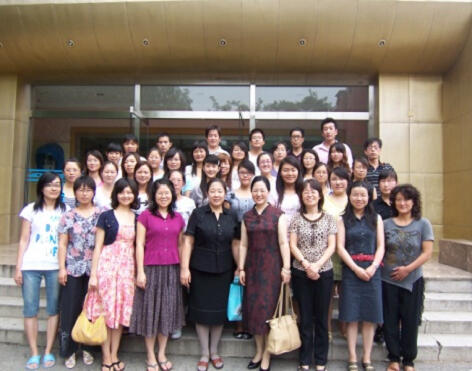
The Summer "Fresh" English Teacher Training Program, held from July 20, 2009 to August 9, 2009, aimed to raise the educational quality of migrant schools by improving the English knowledge and teaching skills of migrant school English teachers. The training team for this program consisted of English teachers from the United States, English teachers trained in China and volunteers from various universities and institutions—from both China (Renmin University and PKU) and the United States (Stanford University). The training focused on English proficiency, English teaching skills and English conversational skills. After three weeks intensive training courses, almost all of the students successfully graduated from Summer Fresh and achieved progress in different aspects.

To honor their hard work, some were awarded Certificates of Distinction.

Image
summer fresh teacher diao
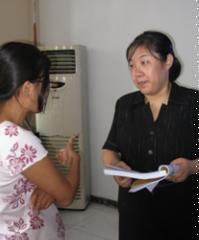
Shuqin Diao, who was the grammar teacher for Summer Fresh, started with 6 lessons of grammar and vocabulary per day. When she sensed the students were mastering the content, she accelerated to 8 lessons per day. With homework to boot, students did not have much night life. Students had a final grammar test at the end of the class which served to evaluate their work during the three weeks. According to the ranking from test, Shaofang Cheng, Youwei Li and Guocun Xiao were awarded *1st Place, 2nd Place* and *3rd Place* in their "English Grammar" Class.

Image
summer fresh teacher 1
Lisa Yiu, a Stanford Ph.D. student and former teacher from Los Angeles, lit up the days of the students as their English conversation instructor. She had them playing Bingo, doing Skits and Singing Songs. "Itsy Bitsy Spider" and many other songs were heard up and down the halls of the training facility. Not only did students improve their English conversation skills, but they also made friends with each other. In the end, three of them- Kequan Hou, Hui Huang and Li Zhang- were awarded *Excellence in English Pronunciation* for the "English Pronunciation" Class.

Image
summer fresh teacher ma
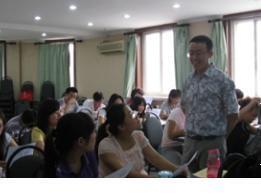
Last, but not least, Adam Ma opened the student's eyes to the world of the Theory and Practice of Being a Teacher. One of the most interesting lessons was one that divided the students into 5 groups to present a group "Lesson Plan" during the last week. During their hour "on stage," each groups presented a joint "lesson plan." Because of their impressive presentations, 3 students namely Jinyan Bu, Feng Li and Si Gao were awarded *Excellence in Teaching*, the *Greatest Potential* and *Best Teacher Presenter *for the "Theory and Practice of Teaching English" Class.

As Summer Fresh ended, the students and teachers and volunteeres all agreed, the goal of improving the English proficiency of the migrant teachers was achieved. In addition, teachers learned invaluable lessons in English teaching skills. But, perhaps most importantly, the entire class made new friends and have acquired a deeper grasp of English knowledge which we hope will make a difference in the lives of their migrant students.


Hero Image
screen shot 2014 08 22 at 3 42 33 pm
All News button
1
News Type
News
Date
Paragraphs
The second part of a special issue of Daedalus, the quarterly journal of the American Academy of Arts and Sciences, has been released. Titled, "The Global Nuclear Future, it contains articles by CISAC Co-Director Siegfried S. Hecker and Consulting Professor Thomas Isaacs. CISAC Co-Drector Scott D. Sagan coauthored the concluding essay.
All News button
1
Subscribe to North America