Democracy promotion has been a longstanding goal of US foreign policy in the Middle East and elsewhere. President George W. Bush championed democracy promotion as a way to counter the ideology and extremism that led to the September 11, 2001 terror attacks against the United States. After Bush’s attempts ended in abject failure, President Barack Obama sought to repair relations with the Muslim world but also withdraw the US footprint in the Middle East. But Obama was forced to take a far more hands-on approach with the outbreak of the 2010-2011 uprisings known as the Arab Spring. President Donald Trump, who has displayed an almost allergic aversion to Obama’s policies, has openly embraced the region’s autocrats with little regard for their abuse of human rights or absence of attention to political or economic freedom. How the United States approaches the region matters – both for aspiring democrats and for those who wish to silence them. Despite the rise of Russia and China, the United States remains the sole superpower, with the loudest voice on the world stage. Thus, the shift from democracy promoter – albeit reluctantly at times – to authoritarian enabler has made the task of democratic political reform far more challenging for people across the Middle East. This discussion will examine the recent democracy promotion efforts of the United States, with a focus on the Obama and Trump years.
SPEAKER BIO
Image
Sarah Yerkes is a fellow in the Carnegie Endowment for International Peace’s Middle East Program, where her research focuses on Tunisia’s political, economic, and security developments as well as state-society relations in the Middle East and North Africa. She has been a visiting fellow at the Brookings Institution and a Council on Foreign Relations international affairs fellow and has taught in the Security Studies Program at Georgetown University and at the Elliott School of International Affairs at the George Washington University. Yerkes is a former member of the State Department’s policy planning staff, where she focused on North Africa. Previously, she was a foreign affairs officer in the State’s Department’s Office of Israel and Palestinian affairs. Yerkes also served as a geopolitical research analyst for the U.S. military’s Joint Staff Strategic Plans and Policy Directorate (J5) at the Pentagon, advising the Joint Staff leadership on foreign policy and national security issues.
CDDRL’s Program on Arab Reform and Democracy held its annual conference at Stanford University on October 11 and 12, titled “The Struggle for Political Change in the Arab World.” The conference is an outgrowth of ARD’s efforts to support new research on the dynamics of political change in the countries of the Arab world. Scholars from across different disciplines sought to understand how social, economic, and political dynamics at the national level, as well as international and regional conflict and power rivalries, impact struggles for political and social change in the region.
Overview of Panels and Speakers
Image
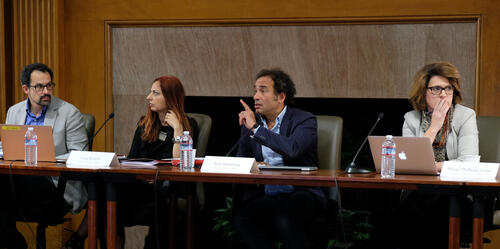
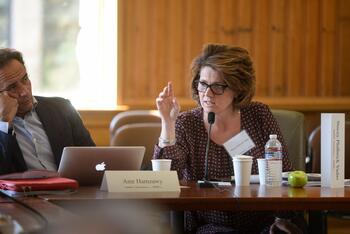
Following opening remarks by FSI Senior Fellow Larry Diamond, the first panel titled “The Boundaries of Authoritarianism post-Arab Uprisings” featured CDDRL Senior Research Scholar Amr Hamzawy. His paper examined how the regime of Abdel Fattah Al-Sisi has employed discursive strategies to discredit calls for democratic change in the country. Sean Yom, Associate Professor of Political Science at Temple University, outlined how the protest strategies of Jordanian youth have limited their effectiveness in advancing meaningful political change. University of California, Davis Scholar Samia Errazzouki discussed the failure of state-led political and economic reform in Morocco.
Chaired by Harvard University Fellow Hicham Alaoui, the second panel was titled “Popular Uprisings and Uncertain Transitions.” University of California, Santa Cruz Political Scientist Thomas Serres provided an overview of the economic disruptions that contributed to Algeria’s uprising. Lindsay Benstead, who is an Associate Professor of Political Science at Portland State University, analyzed the electoral successes of Tunisia’s Ennahda Party. Khalid Medani, Professor of Political Science at McGill University, explained how Sudanese protesters leveraged new strategies of contention to force Omar Al-Bashir out of power.
Farah Al-Nakib (right) and Michael Herb (left)
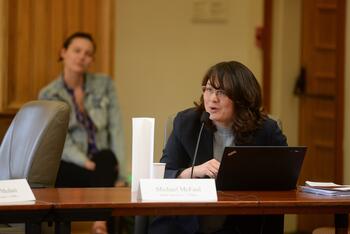
The third panel, titled “Politics, Succession and Sectarianism in the GCC States,” included Oxford University Fellow Toby Matthiesen, who discussed how Saudi Arabia and the GCC states have increasingly sought to protect their regimes by actively molding the politics of their autocratic patrons in the region, and by using new technologies to upgrade the effectiveness of their surveillance states. Georgia State University Political Scientist Michael Herb explained how the aging of the Saudi line of succession contributed to the political ascendancy of Crown Prince Mohammad Bin Salman and the decay of family rule in the country. Cal Poly Historian Farah Al-Nakib described how Kuwait’s royal family has used its sponsorship of large-scale development projects to sidestep the country’s political polarization, undermine the power of the parliament, and weaken public access to spaces of political contestation.
Image
The fourth panel focused on “Social Strife and Proxy Conflict in the Middle East.” Chatham House Scholar Lina Khatib described Syria’s transformation during the civil war from a highly centralized security state to a transactional state in which the regime depends heavily on local powerbrokers. Stacey Philbrick Yadav, Associate Professor and Chair of the Department of Political Science at Hobart and William Smith Colleges, discussed differences in how local communities in Yemen have been affected by the country’s conflict. David Patel, who serves as Associate Director for Research at the Crown Center for Middle East Studies at Brandeis University, argued that Iraq’s democratic institutions have been impressively robust to a series of existential challenges, but he also highlighted a widespread feeling among the Iraqi public that its parliamentary system is failing to deliver.
Image
Finally, the fifth panel examined the topic of “International Forces in the Arab Political Arena.” Stanford University Political Scientist Lisa Blaydes suggested that China’s efforts to involve itself in the regional economy may improve its reputation among economically-frustrated Arab citizens, but that such efforts also spell trouble for democracy and human rights in the Middle East. Hamid & Christina Moghadam Director of Iranian Studies at Stanford University Abbas Milani argued that Iran’s ideological commitment to exporting the Islamic Revolution has been remarkably consistent for several decades. Colin Kahl, Co-director of the Center for International Security and Cooperation at FSI, reviewed the strategies of US administrations toward the Middle East, and posited that President Trump’s approach of pursuing maximalist objectives with minimal commitments is particularly likely to heighten instability in the region. FSI Scholar Ayca Alemdaroglu emphasized that Turkey’s neo-Ottoman foreign policy has failed to achieve its objectives in the face of mounting regional upheaval.
Common Themes of Political Change and Continuity
Image
Several themes emerged from conference presentations. First, across the panels, scholars discussed the lessons learned by autocrats and activists alike in the aftermath of the Arab Spring, and the ways in which these lessons have transformed regional politics. Hamzawy emphasized that the Sisi regime in Egypt has increasingly relied on intensive repression over cooptation to maintain stability, while at the same time refusing to grant even limited political openings as existed under Hosni Mubarak’s presidency. In part, this change appears to be rooted in the regime’s belief that relaxing the state’s authoritarian posture had contributed to the revolutionary upheaval of 2011. Likewise, Matthiesen suggested that Saudi Arabia and the Gulf Cooperation Council States have learned to become more aggressive in strengthening their surveillance apparatus and policing popular discourse transnationally. By contrast, Serres discussed how the Algerian military and bureaucracy have responded to mass protests not by intensifying repression, but instead by attempting to coopt anti-corruption initiatives and democratic reforms to limit political and economic change. Similarly, regarding Kuwait, Al-Nakib illustrated how the restructuring of urban spaces has proved itself a subtle but successful strategy for the royal family to rehabilitate its reputation while limiting geographic focal points for popular politics.
Image
Activists have also learned their own lessons from the aftermath of the Arab Spring. According to Yom, Jordanian activists continue to look to the leaderless revolutions of Tunisia and Egypt as a model to be emulated. As a result, they prioritize agility and horizontality in their protests, and they forgo the organization of formal political movements. This approach has succeeded in acquiring short-term concessions from the regime but has failed to generate broader structural changes. On the other hand, activists in Sudan appear to have been more successful at using lessons from the Arab Spring to push for systematic transformations of their political system. According to Medani, Sudanese protesters developed novel tactics to avoid the repression of the coercive apparatus, and they were effective at gradually forging a counterhegemonic discourse that clearly exposed the regime’s failures to the public. Following the overthrow of Omar Al-Bashir, activists in Sudan have also insisted on dismantling the political and economic might of the deep state to avoid following Egypt’s path.
Image
Second, the conference discussion indicated widespread dissatisfaction with formal political institutions across the region. For instance, Hamzawy suggested that Sisi’s regime has been relatively successful at discrediting civilian political institutions, including the legislature and civilian-led ministries. Errazzouki highlighted widespread dissatisfaction in Morocco with existing political institutions. Likewise, Yom’s discussion of activists in Jordan emphasized their lack of interest in entering formal politics. In Kuwait, the royal court has found an opening to pursue urban development projects outside of normal institutions in part because of the public’s frustration with gridlock in the legislature. Patel speculated that frustration with the parliament and muhasasa system in Iraq may finally prompt major changes to the country’s political process.
Image
Third, despite this disillusionment with formal politics, these political institutions have proved remarkably durable in countries across the region. For example, though current frustrations may finally prompt change in Iraq, Patel also highlighted the resilience of the parliamentary system in the face of a sectarian civil war, US troop withdrawal, the rise of ISIS, and a number of other major challenges. For both Algeria and Sudan, Serres and Medani stressed that militaries continue to exercise significant influence despite the popular uprisings. Meanwhile, for Egypt, Hamzawy noted the firm grip of the current military regime on power, and for Morocco, Errazzouki described the lack of systematic changes to the country’s ruling monarchy, even after years of popular pressure.
Image
Fourth, this durability has not precluded a number of important shifts within existing political institutions. Regarding Syria, for instance, Khatib explained how the survival of Bashar al-Asad’s presidency has depended on moving state institutions away from a centralized security state to a transactional state reliant on local actors with a degree of independence from the regime. Herb described how the consensus-based family rule of the Saudi monarchy fell victim to deaths among the aging senior princes, which opened up opportunities for the king to appoint more officials in a manner that heightened his direct influence. Herb suggested that Mohammad Bin Salman recognized this change and knew that he would likely lose relevance upon his father’s death; as a result, he was motivated to gamble on consolidating his control while his father still held the power to issue royal decrees. In Algeria, the influence of the military and bureaucracy may remain paramount for now, but Serres also pointed out that protesters have succeeded in stripping away the civilian intermediaries who used to protect these institutions. Regarding the durability of local institutions, Yadav noted how pre-conflict and even pre-unification institutions in Yemen have continued to operate effectively in a number of local communities around the country.
Image
Fifth, foreign interventions will continue to destabilize the region and impede prospects for democratization or post-conflict reconstructions in the coming years. Khatib noted that Russia has positioned itself as the agenda setter who can bring the Syrian state back to its feet, but also that Russia and Iran are competing to profit off the country’s reconstruction. For Yemen, Yadav argued that fragmentation at the local level has important implications for best practices in the international community’s reconstruction efforts, but that current actors are not well positioned to understand these trends. Kahl predicted that the Middle East strategy of the Trump administration would likely contribute to further destabilization of the region because of its emphasis on empowering allies to do what they want and go after Iran while the United States maintains its distance. Meanwhile, Blaydes’ presentation on China’s regional involvement, Milani’s discussion of Iran’s efforts to export the Islamic Revolution, and Matthiesen’s observations about the GCC States’ authoritarian coordination all illustrated how intervening states are reducing prospects for democratic political change.
Image
Sixth, even as interventionist countries have contributed to the destabilization of the region, they have also confronted major obstacles themselves – and in some cases have failed outright to achieve their primary objectives. Khatib noted that Iran has faced backlash in Syria, while Abbas Milani and David Patel pointed to backlash against Iran in Iraq. Kahl emphasized that the Trump administration’s Middle East policy was unlikely to achieve its goals. Blaydes observed that China has not acquired greater salience in the Middle East despite its more active economic involvement, and individuals in many of the region’s countries – particularly those that are more developed – do not see China’s growth as a positive force. She also stressed the reputational risks China is taking in pursuing potentially unpopular investments through the Belt and Road Initiative. The GCC States are attempting to prop up strongmen in both Libya and Sudan, but this strategy has struggled in the face of local political dynamics; furthermore, the intervention in Yemen has been a disaster for Saudi Arabia and the UAE. Finally, Alemdaroglu stressed that Turkey’s ambitious “neo-Ottoman” foreign policy, which reflects a desire to revive Turkish influence in areas ruled by the Ottoman Empire, has largely failed. In particular, the architect of the policy, former foreign minister Ahmet Davutoglu, lost his job; the country miscalculated badly in how it handled the aftermath of the Arab Spring; and Turkey’s relations with many of its neighbors have soured.
Hero Image
ARD 2019 Annual Conference participants. Front row (from left): Sean Yom, Stacey Philbrick Yadav, Lindsay Benstead, David Patel, Michael Herb. Middle row (from left): Colin Kahl, Lina Khatib, Hicham Alaoui, Larry Diamond, Samia Errazzouki, Lisa Blaydes, Hesham Sallam. Back row (from left): Toby Matthiesen, Ayca Alemdaroglu, Abbas Milani, Amr Hamzawy, Michael McFaul, Scott Williamson
Under the title “Political Contestation and New Social Forces in the Middle East and North Africa,” the Program on Arab Reform and Democracy convened its 2018 annual conference on April 27 and 28 at Stanford University. Bringing together a diverse group of scholars from across several disciplines, the conference examined how dynamics of governance and modes of political participation have evolved in recent years in light of the resurgence of authoritarian trends throughout the region.
Image
Delivering the opening remarks of the conference, Freeman Spogli Institute (FSI) and Hoover Institution Senior Fellow Larry Diamond reflected on the state of struggle for political change in the Middle East and North Africa (MENA) region. In a panel titled “Youth, Culture, and Expressions of Resistance,” FSI Scholar Ayca Alemdaroglu discussed strategies the Turkish state has pursued to preempt and contain dissent among youth. Adel Iskandar, Assistant Professor of Communications at Simon Fraser University, explained the various ways through which Egyptian youth employ social media to express political dissent. Yasemin Ipek, Assistant Professor of Global Affairs at George Mason University, unpacked the phenomenon of “entrepreneurial activism” among Lebanese youth and discussed its role in cross-sectarian mobilization.
The conference’s second panel, tilted “Situating Gender in the Law and the Economy,” featured Texas Christian University Historian Hanan Hammad, who assessed the achievements of the movement to fight gender-based violence in Egypt. Focusing on Gulf Cooperation Council states, Alessandra Gonzales, a Visiting Postdoctoral Fellow at the Stanford Institute for Economic Policy Research, analyzed the differences in female executive hiring practices across local and foreign firms. Stanford University Political Scientist and FSI Senior Fellow Lisa Blaydes presented findings from her research on women’s attitudes toward Female Genital Mutilation (FGM) in Egypt.
Image
Speaking on a panel titled “Social Movements and Visions for Change,” Free University of Berlin Scholar Dina El-Sharnouby discussed the 2011 revolutionary movement in Egypt and the visions for social change it espouses in the contemporary moment. Oklahoma City University Political Scientist Mohamed Daadaoui analyzed the Moroccan regime’s strategies of control following the Arab Uprisings and their impact on various opposition actors. Nora Doaiji, a PhD Student in History at Harvard University, shared findings from her research examining the challenges confronting the women’s movement in Saudi Arabia.
The fourth panel of the conference, “The Economy, the State, and New Social Actors,” featured George Washington University Associate Professor of Geography Mona Atia, who presented on territorial restructuring and the politics governing poverty in Morocco. Amr Adly, an Assistant Professor of Political Science at the American University in Cairo, analyzed the relationship between the state and big business in Egypt after the 2013 military coup. Rice University Professor of Economics Mahmoud El-Gamal shared findings from his research on the economic determinants of democratization and de-democratization trends in Egypt during the past decade.
Image
The final panel focused on the international and regional dimensions of the struggle for political change in the Arab world, and featured Hicham Alaoui, a Research Fellow at Harvard University’s Weatherhead Center for International Affairs, Georgetown University Political Scientist Daniel Brumberg, and Nancy Okail, the Executive Director of the Tahrir Institute for Middle East Policy.
The conference included a special session featuring former fellows of the American Middle Eastern Network at Stanford (AMENDS), an organization dedicated to promoting understanding around the Middle East, and supporting young leaders working to ignite concrete social and economic development in the region. AMENDS affiliates from five different MENA countries shared with the Stanford community their experiences in working toward social change in their respective countries.
Hero Image
ARD 2018 Annual Conference participants.
Front row (from left): Hanan Hammad, Hamza Arsbi, Ayca Alemdaroglu, Mahdi Lafram, Lior Lapid.
Second to front row (from left): Dina El-Sharnouby, Daniel Brumberg, Radidja Nemar, Mona Atia.
Third to front row (from left): Hesham Sallam, Joel Beinin, Nora Doaiji, Hicham Alaoui, Mohamed Daadaoui, Salma Takky, Larry Diamond, Amr Adly, Sultan Al Amer, Heba Al-Hayek.
Back row (from left): Amr Gharbeia, Mahmoud El-Gamal, Amr Hamzawy
Islamism has imitated, or colluded with, the state autocracies it claims to oppose. It has failed to suggest its own answers to economic problems, social justice, education or corruption, writes Hicham Alaoui in Le Monde diplomatique. Click here to read the full article, which is based on research that Alaoui presented at UC Berkeley and CDDRL on October 10 and 11, respectively.
Hero Image
Supporters of former Egyptian President Mohammed Morsi at a Muslim Brotherhood rally. December 12, 2012. | Yuli Weeks for VOA
Gender equality is considered important for development and good governance, yet the causes of cross-national variation in gender equality are still not well understood. This paper claims that the distinct types of rule pursued by the French versus the British imperial powers selected for postcolonial institutions that are systematically correlated with gender equality. The paper evaluates this conjecture using three tests: a cross-country test of former British and French colonies, a historical comparison of Syria and Iraq, and a regression discontinuity across the former colonial border within modern-day Cameroon (see Lee and Schultz 2012). Results indicate that, despite our understanding of British colonialism as beneficial for a variety of economic institutions (Acemoglu and Johnson 2004, La Porta et al. 2008, Lipset 1994) French institutions often better promoted gender equality. This paper contributes to the discussion on the relative importance of colonial institutions versus natural resource endowments or religion (Nunn 2013, Sokoloff and Engerman 2000, Ross 2008, Fish 2002, Inglehart and Norris 2003).
Speaker Bio:
Adi Greif is a Ph.D. candidate in Political Science at Yale University and a pre-doc at CDDRL for the academic year 2013-2014. Her dissertation, "The Long-Term Impact of Colonization on Gender", investigates why gender equality varies by former colonizer (French or British) in the Middle East and globally. It uses cross-national statistics, a regression discontinuity across the former colonial border in Cameroon, and interviews from Egypt and Jordan. Her research abroad was supported by a Macmillan Dissertation Fellowship.
Adi's research interests are colonialism, international alliances, state formation and comparative gender policies with focus on the Middle East and sub-Saharan Africa. She has lived in Egypt, Jordan, and Morocco, and visited Tunisia, the United Arab Emirates, and Turkey. Adi holds an M.A. in Political Science from (Yale University) and a B.A with honors in Political Science and a minor in Math (Stanford University). Before coming to Yale, she worked at the United States Institute of Peace in Washington, D.C. through the Tom Ford Fellowship in Philanthropy.
Encina Ground Floor Conference Room
Adi Greif
2013-14 Pre-Doctoral Fellow
Speaker
CDDRL
Abstract The framework of "LGBT rights" can be critiqued as challenging tradition or as culturally specific, yet at the same time, it can be essential to one's sense of identity and justice. Where can the discourse of "public health" help overcome barriers for LGBT people, both within the right to health and beyond? What are the limits to using public health to talk about human rights, LGBT or otherwise? What are the dangers of conflating these distinct areas of concern? We will explore these questions and focus on how academics and activists can most effectively navigate challenges to benefit both public health and LGBT rights.
Jessica Stern is the Executive Director of the International Gay and Lesbian Human Rights Commission. As the first researcher on lesbian, gay, bisexual and transgender (LGBT) human rights at Human Rights Watch, she conducted fact-finding investigations and advocacy around sexual orientation and gender identity in countries including Iran, Kyrgyzstan, South Africa, and the United Arab Emirates. As a Ralph Bunche Fellow at Amnesty International, she documented police brutality for what became its landmark report on police brutality in LGBT communities in the U.S., “Stonewalled.” She was a founding collective member and co-coordinator of Bluestockings, then New York’s only women’s bookstore. She has campaigned extensively for women’s rights, LGBT rights, and economic justice with the Center for Constitutional Rights, Control Ciudadano, the National Gay & Lesbian Task Force, and the Urban Justice Center. She holds a masters degree in human rights from the London School of Economics. She is frequently quoted in the Mail & Guardian, Al Jazeera English, the Associated Press, Reuters, Agence France Presse, Deutsche Welle, Voice of America, The Guardian and The BBC.
Building 200 (History Corner)
Room 205
Stanford University
Jessica Stern
Executive Director
Speaker
International Gay and Lesbian Human Rights Commission
In July, Stanford's Center on Democracy, Development, and the Rule of Law (CDDRL) will welcome its ninth class of Draper Hills Summer Fellows hailing from 24 countries around the world. The program is an integral part of the CDDRL's effort to train practitioners who are working on the front lines of political change in places where democracy is underdeveloped or at risk.
The 2013 class was selected from over 500 applicants and represents some of the most courageous and innovative democracy leaders around the world. Their experience and track record of success earned them a spot in this highly competitive program.
From Burma to Ukraine, the 2013 fellows are leading organizations and programs - often at tremendous odds - to advance democratic practices, combat corruption and uphold human rights.
For 11 years Zing Mar Aung was a political prisoner in Burma for her involvement in the pro-democracy movement. After her release in 2009, Mar Aung dedicated her energy to building Burmese civil society by co-founding a number of civil society organizations - including the Yangon School of Political Science - to increase civic engagement. In recognition of her contributions, Mar Aung received the International Women of Courage Award in 2012 by former U.S. Secretary of State Hillary Clinton.
As the Russian government tightens its grip on civil society, the country's only independent polling center - the Levada Center - has come under attack. Working as a researcher and public commentator, Denis Volkov frequently publishes opinion pieces on the protest movements and serves as a spokesperson for Levada. Labeled as a "foreign agent" by the Russian government, the Levada Center fears closure for its independent analysis and authoritative voice.
Sultan Sooud Al Qassemi commands a significant online presence with upwards of a quarter million Twitter followers. In the height of the Arab Spring, Al Qassemi - who hails from the United Arab Emirates- became a leading commentator on Arab politics and reform for a growing online audience. In 2011, Time magazine chose Al Qassemi's Twitter feed (@SultanalQassemi) amongst its 140 Best Twitter Feeds list. His analysis is also published in Middle East-based newspapers, as well as Foreign Policy, The Guardian and The Financial Times.
The three-week fellowship program begins on July 22 and is taught by a team of interdisciplinary Stanford faculty members who include leading political scientists, lawyers and economists who are pioneering innovative research in the field of democratic development.
One of the few programs of its kind in academia, the Draper Hills Summer Fellows Program combines the rich experiences of practitioners with academic training to maximize the impact of their work to advance democratic change.
Fellows live together on the Stanford campus where they connect with peers, exchange experiences and participate in shared activities. The program is funded by the generous support of Bill and Phyllis Draper and Ingrid von Mangoldt Hills.
The program will accept applications to the 2014 program beginning in September.
To learn more about the 2013 Draper Hills Summer Fellows and their innovative work, please click here.
South Korea has become a major player in the world of nuclear energy and nuclear security, having hosted the 2012 Seoul Nuclear Security Summit and inked the largest nuclear power plant export deal in history with the United Arab Emirates. In collaboration with the East Asia Institute of South Korea, CISAC has been involved in an ongoing project to examine South Korea’s role in global nuclear governance and possible ways for South Korea to increase and improve its nuclear energy cooperation with the United States. Dr. Michael May will present his ideas on possible next steps to improve global nuclear governance, with particular focus on South Korea. Dr. Chaim Braun will then review potential bilateral and multilateral nuclear energy cooperation steps that South Korea could pursue in the interest of their national security and domestic energy needs.
About the speakers:
Chaim Braun is a CISAC consulting professor specializing in issues related to nuclear power economics and fuel supply, and nuclear nonproliferation. At CISAC, Braun pioneered the concept of proliferation rings dealing with the implications of the A.Q. Khan nuclear technology smuggling ring, the concept of the Energy Security Initiative (ESI), and the re-evaluation of nuclear fuel supply assurance measures, including nuclear fuel lease and take-back. Before joining CISAC, Braun worked as a member of Bechtel Power Corporation's Nuclear Management Group, and led studies on power plant performance and economics used to support maintenance services. He also managed nuclear marketing in East Asia and Eastern Europe. Prior to that, Braun worked at United Engineers and Constructors (UE&C), EPRI and Brookhaven National Laboratory (BNL).
Michael May is Professor Emeritus (Research) in the Stanford University School of Engineering and a senior fellow with the Freeman Spogli Institute for International Studies at Stanford University. He is the former co-director of Stanford University's Center for International Security and Cooperation, having served seven years in that capacity through January 2000. May is a director emeritus of the Lawrence Livermore National Laboratory, where he worked from 1952 to 1988, with some brief periods away from the Laboratory. While there, he held a variety of research and development positions, serving as director of the Laboratory from 1965 to 1971. May received the Distinguished Public Service and Distinguished Civilian Service Medals from the Department of Defense, and the Ernest Orlando Lawrence Award from the Atomic Energy Commission, as well as other awards. His current research interests are nuclear weapons policy in the US and in other countries; nuclear terrorism; nuclear and other forms of energy and their impact on the environment, health and safety and security; the use of statistics and mathematical models in the public sphere.
CDDRL
Encina Hall, C139
616 Serra Street
Stanford, CA 94305-6055
0
adi.greif@yale.edu
Greif_HS.jpg
Adi Greif is a Ph.D. candidate in Political Science at Yale University and a pre-doc at CDDRL from 2013-2015. Her dissertation, "The Long-Term Impact of Colonization on Gender", investigates why gender equality varies by former colonizer (French or British) in the Middle East and globally. It uses cross-national statistics, a regression discontinuity across the former colonial border in Cameroon, and interviews from Egypt and Jordan. Her research abroad was supported by a Macmillan Dissertation Fellowship.
Adi's research interests are colonialism, international alliances, state formation and comparative gender policies with focus on the Middle East and sub-Saharan Africa. She has lived in Egypt, Jordan, and Morocco, and visited Tunisia, the United Arab Emirates, and Turkey. Adi holds an M.A. in Political Science from (Yale University) and a B.A with honors in Political Science and a minor in Math (Stanford University). Before coming to Yale, she worked at the United States Institute of Peace in Washington, D.C. through the Tom Ford Fellowship in Philanthropy.
National oil companies (NOCs) produce most of the world’s oil and natural gas and bankroll governments across the globe. Although NOCs superficially resemble private-sector companies, they often behave in very different ways. To understand these pivotal state-owned enterprises and the long shadow they cast on world energy markets, the Program on Energy and Sustainable Development (PESD) at Stanford University commissioned Oil and Governance: State-owned Enterprises and the World Energy Supply. The 1000-page volume, edited by David Victor, David Hults, and Mark Thurber, explains the variation in the performance and strategy of NOCs, and provides fresh insights into the future of the oil industry as well as the politics of the oil-rich countries where NOCs dominate. It comprises fifteen case studies, each following a common research design, of NOCs based in the Middle East, Africa, Asia, Latin America, and Europe. The book also includes cross-cutting pieces on the industrial structure of the oil industry and the politics and administration of NOCs.
NOCs are distinguished from private companies by their need to respond to state goals beyond profit maximization. Governments seeking to retain their hold on power use NOCs to deliver benefits to influential elites (“private goods”) or to the broader population (“social goods”). Oil and Governance finds a strong correlation between such non-hydrocarbon burdens on the NOC—which include providing employment, subsidizing fuel, or handing out plum jobs to the politically connected—and deficiencies in oil and gas performance. The highest-performing NOCs, like Norway’s Statoil and Brazil’s Petrobras, face relatively circumscribed non-oil demands from their governments.
How governments administer their oil sectors also proves to be a crucial determinant of NOC performance. Democracies (e.g., Norway, Brazil) and autocracies (e.g., Saudi Arabia, Angola) alike are capable of grooming successful NOCs. What matters most for outcomes is not regime type per se but rather that governance systems provide unified signals to the NOC. (By contrast, regime type is observed to be an important driver of whether governments nationalize their oil sectors in the first place, or privatize existing NOCs.) Fragmented governance, in which multiple government actors assert their interests but no one assumes strategic responsibility, appears uniformly fatal to NOC performance. Nascent democracies like Mexico’s can be particularly vulnerable to oil sector dysfunction stemming from fragmentation. Governance systems must also be matched to a country’s institutional and political realities. Nigeria has arguably set back its progress in oil through attempts to slavishly imitate Norway’s forms of oil organization in the absence of Norway’s mature political and civil service institutions.
The close ties between the NOC and its government can have a detrimental effect on the ability of the NOC to manage the risks that are so characteristic of the oil and gas industry. Whereas private companies are forced to hone their geological knowledge and skills through global competition for capital and hydrocarbon licenses, NOCs for the most part are comfortably sheltered from competitive threats at home. They therefore fail to develop the global reach that helps private players (the international oil companies, or IOCs) manage risk by means of a diversified global portfolio and the ability to link resources to customers around the world. (Some NOCs have begun to internationalize in recent years, but it is striking that none of the NOCs studied in Oil and Governance went down this path until forced to by domestic resource scarcity, or at least of the perception of future scarcity.) The soft budget constraint faced by the NOC also discourages the cost efficiencies that help mitigate risk.
This gulf in risk management capabilities between IOCs and most NOCs suggests that the resource dominance of NOCs does not pose an existential threat to private oil companies. Private players will continue to play a key role in the frontiers of oil and gas development—frontiers like shale gas, oil sands, and the remote Arctic. NOCs will continue to control low-cost oil around the world, while a select few of the most focused and unencumbered among them start to build up their own risk management skills through partnerships with IOCs.
NOC control over resources has important implications for the world oil price. The NOCs studied in the book produce their reserves at half the rate of the major IOCs—whether due to lower performance or a deliberate attempt to preserve resources for the future. Moreover, governments tend to rely most heavily on the risk management skills of IOCs when prices are low and then swing back towards NOCs in high price periods when they can afford to focus on delivering benefits to favored constituencies. The result of this dynamic, which is observed in the case studies of Oil and Governance, can be “backward bending supply curves” that exaggerate price volatility in the world oil market.
This effect of NOCs on global oil supply and price appears to be much more important than any geopolitical fallout from NOC primacy around the world. Oil and Governance finds very little evidence that NOCs act as effective foreign policy weapons on behalf of their host states. Even where politicians may desire to employ NOCs in this way, the incentives of the NOC itself are usually strongly opposed to such an exercise of power. As one example, Europe’s Gazprom depends overwhelmingly on revenues from gas exports to Europe because gas is so heavily subsidized in Russia. When NOCs do venture abroad, as in the case of China’s CNPC, they are often motivated to do so precisely by the desire to achieve more autonomy from their political masters at home.
Read More
Exporting the 'Norwegian Model': The effect of administrative design on oil sector performance


 Farah Al-Nakib (right) and Michael Herb (left)