Authors
News Type
Commentary
Date
Paragraphs

In a webinar dated June 2, 2021, Georgetown University Historian Abdullah Al-Arian analyzed how the Arab Uprisings have impacted Islamist movements throughout the region. By the eve of the uprisings, he argues, the posture of Islamist movements reflected a set of political commitments that had emerged largely at the expense of their ideological program and social mission. Rooted in the historical and recent acceptance of state institutions and political structures, expressions of Islamism by parties across the Arab region reflected a shift that subsumed long held beliefs beneath the needs of (alternately or in combination) democratic pluralism and political expediency, most clearly visible in the transformation of Tunisia’s Ennahda Party. That tension has been exacerbated in the wake of political defeats experienced by many of these movements, particularly Egypt’s Muslim Brotherhood. While the “Islamist idea” is likely to endure its current bout with state repression, its survival as a political force in the future will depend on its determination to complete this evolution, a process that was both accelerated and interrupted during the critical moments of the Arab uprisings. To watch the recording of the talk, please click below.


Hero Image
Abdullah Al-Arian talk
All News button
1
-

ABSTRACT 

This talk is based on the speakers’ recently published edited volume The Unfinished Arab Spring: Micro-Dynamics of Revolts between Change and Continuity. Adopting an original analytical approach in explaining various dynamics at work behind the Arab revolts and giving voice to local dynamics and legacies rather than concentrating on debates about paradigms, we highlight micro-perspectives of change and resistance as well as of contentious politics that are often marginalized and left unexplored in favor of macro-analyses. First, we re-examine the stories of the uprisings in Tunisia, Egypt, Syria, Morocco and Algeria through diverse and novel perspectives, looking at factors that have not yet been sufficiently underlined but carry explanatory power for what has occurred. Second, rather than focusing on macro-comparative regional trends – however useful they might be – we focus on the particularities of each country, highlighting distinctive micro-dynamics of change and continuity. ​

SPEAKERS BIO

Image
Fatima el Issawi
Fatima el Issawi is a Reader in Journalism and Media Studies at the University of Essex. Her research focuses on the intersection between media, politics and conflicts in transitional contexts to democracy in North Africa. She is the Principal Investigator for the research project “Media and Transitions to Democracy: Journalistic Practices in Communicating Conflicts- the Arab Spring” funded by the British Academy Sustainable Development Programme, looking at media’s impact on communicating political conflicts in post uprisings in North Africa. Since 2012, el Issawi has been leading empirical comparative research projects on the interplay between media and political change, funded by Open Society Foundation and the Middle East Centre/LSE, covering Egypt, Tunisia, Morocco, Libya and Algeria. El Issawi’s expertise crosses journalism, public communication, policy and academia. She has over fifteen years of experience as international correspondent in conflict zones in the MENA region. She is the author of “Arab National Media and Political Change” investigating the complex intersections between traditional journalists and politics in uncertain times of transitions to democracy.

Image
Francesco Cavatorta
Francesco Cavatorta is full professor of political science and director of the Centre Interdisciplinaire de Recherche sur l’Afrique et le Moyen Orient (CIRAM) at Laval University, Quebec, Canada. His research focuses on the dynamics of authoritarianism and democratization in the Middle East and North Africa. His current research projects deal with party politics and the role of political parties in the region. He has published numerous journal articles and books.

Online, via Zoom: REGISTER

Fatima el Issawi University of Essex
Francesco Cavatorta Laval University
Seminars
-

* Please note all CISAC events are scheduled using the Pacific Time Zone.


Seminar Recording: https://youtu.be/ryBtzvLI0QQ


About the Event: Despite the importance of understanding how refugee crises end, we know little about when and why refugees, who were forced to emigrate, return home. We study the drivers of refugees’ decision-making using original observational and experimental survey data from a representative sample of approximately 3,000 Syrian refugees in Lebanon. We find that conditions in a refugee’s home country are much more important than the situation in the host country in shaping return intentions. Specifically, our findings suggest that refugees’ decisions are influenced primarily by safety and security in their place of origin, their economic prospects, the availability of public services, and their personal networks. Confidence in information is also important: we find that several drivers of return---safety, services, and networks---only impact intentions among people who have high confidence in their information. By contrast, the conditions in hosting countries–so-called “push'” factors–play a negligible role in the process of refugee return. Even in the face of outright hostility and poor living conditions, refugees are unlikely to return unless the situation at home improves significantly.


About the Speakers: 

Ala’ Alrababa’h is a Ph.D. candidate in political science at Stanford University, a graduate fellow at the Immigration Policy Lab, and a junior scholar at the International Policy Scholars Consortium and Network. His research combines fieldwork, machine learning, and experimental methods to study issues related to authoritarian media, political violence, and migration and refugees. His research has been published in Comparative Political Studies, Political Science Research and Methods, and International Studies Quarterly. Prior to arriving at Stanford University, Ala’ was a Junior Fellow at the Carnegie Endowment for International Peace.


Jeremy Weinstein is Professor of Political Science, Fisher Family Director of Stanford Global Studies, and Senior Fellow at the Freeman Spogli Institute for International Studies and the Stanford Institute for Economic Policy Research at Stanford University. He also is faculty co-director of the Immigration Policy Lab and the Data for Development Initiative. In addition, he is a non-resident fellow at the Center for Global Development in Washington, D.C.

His research focuses on civil wars and political violence; ethnic politics; the political economy of development; democracy and accountability; and migration. He is the author of Inside Rebellion: The Politics of Insurgent Violence (Cambridge University Press), which received the William Riker Prize for the best book on political economy. He is also the co-author of Coethnicity: Diversity and the Dilemmas of Collective Action (Russell Sage Foundation), which received the Gregory Luebbert Award for the best book in comparative politics.

Virtual Seminar

Ala' Alrababa'h
Seminars
Authors
News Type
News
Date
Paragraphs

In a webinar dated May 12, 2020, Villanova University Scholar Samer Abboud examined the emergent "illiberal peace" in Syria. The absence of an internationally mandated or internally negotiated peace process, he argued, has allowed the Syrian regime to craft an illiberal peace as an outcome to the nearly decade-long conflict. This illiberal peace is shaped through a politics of exclusion in which Syrian society is bifurcated into the loyal and disloyal through processes of reconciliation, settlement, and new legal regimes of citizenship. Click below to watch the recording of the talk.


Hero Image
screen shot 2020 05 13 at 2 34 19 pm
All News button
1
-

Livestream: Please click here to join the livestream webinar via Zoom or log-in with webinar ID 944 5730 9104.


About this Event: Why do some governments give foreign militants missiles that can destroy aircraft while giving others only bullets and AK-47s? Why do some governments deploy special operations forces to carry out joint attacks with some insurgent groups, while only giving others basic training on weapons handling? Despite the fact that governments often provide costly - and controversial - forms of support to foreign militant groups, we know little about why some groups receive advanced weapons technology and boots on the ground while others do not. In this presentation, I unpack trends in third-party provision of support through an in-depth examination of the CIA's provision of anti-tank missiles and the Pentagon's deployment of Special Operations Forces to support specific militant groups in the recent Syrian conflict. Drawing from an original dataset of the over 150 Syrian militant brigades that received some form of US support and over 60 interviews with Syrian militants and US and Jordanian government officials, I find that, when militant groups have similar organizational characteristics as the armed forces of their government partners, they are more likely to receive and accept costly forms of support. 


About the Speaker: Melissa Carlson is a PhD candidate in the Department of Political Science at U.C. Berkeley, specializing in international relations, comparative politics, and methodology. She will join CISAC in 2019-2020 as a Middle East Initiative Pre-doctoral Fellow. Broadly, her research examines the dynamics of military partnerships between state governments and foreign militant groups. Melissa's dissertation develops an organizational theory of third-party provision of support: when foreign militant groups and state armed forces share similar organizational characteristics, they are more likely to form joint commands, carry out joint attacks, and provide each other with advanced weapons systems.  Melissa's other research interests focus on factors that influence informal cooperation between states, and on how refugee perceptions of host communities, host governments, and aid organizations influence refugee decision-making. Prior to beginning her PhD at U.C. Berkeley, Melissa worked as Public Information consultant for the International Organization for Migration, Iraq Mission in Jordan and Iraqi Kurdistan. Melissa has a M.A. in Political Science from U.C. Berkeley, and a B.A. in International Relations and Politics, Philosophy, and Economics from Claremont McKenna College.

Virtual Seminar

0
rsd19_072_0235a.jpg

Dr. Melissa Carlson is currently working with the Defense Security Cooperation Agency's Assessment, Monitoring, and Evaluation unit, where she promotes rigorous standards of measuring the effectiveness of the U.S.'s security cooperation and assistance programming. During her tenure at CISAC, she was a postdoctoral research and teaching fellow. She received her PhD in Political Science from the University of California, Berkeley, specializing in international relations, comparative politics, and methodology. Dr. Carlson's primary research examines the factors that influence the variation and intensity of partnerships between governments and foreign militant groups with a focus on the recent conflicts in Iraq and Syria. Her book-style dissertation project finds that, when foreign militant groups and state armed forces share similar organizational characteristics, they are more likely to deploy forces to conduct joint combat operations and provide each other with advanced weapons systems. In other research, Dr. Carlson examines the factors that influence informal and secret security cooperation between states and how misinformation and rumors influence refugees' relationships with host governments, service providers, and smugglers. Her research has been published in the American Political Science Review, the Review of International Organizations, and International Studies Quarterly, among other outlets. Outside of academia, Dr. Carlson has worked as a consultant for the International Organization for Migration's Iraq and Jordan Missions.

Affiliate
Melissa Carlson Predoctoral Fellow at CISAC
Seminars
-

ABSTRACT

Democracy promotion has been a longstanding goal of US foreign policy in the Middle East and elsewhere. President George W. Bush championed democracy promotion as a way to counter the ideology and extremism that led to the September 11, 2001 terror attacks against the United States. After Bush’s attempts ended in abject failure, President Barack Obama sought to repair relations with the Muslim world but also withdraw the US footprint in the Middle East. But Obama was forced to take a far more hands-on approach with the outbreak of the 2010-2011 uprisings known as the Arab Spring. President Donald Trump, who has displayed an almost allergic aversion to Obama’s policies, has openly embraced the region’s autocrats with little regard for their abuse of human rights or absence of attention to political or economic freedom. How the United States approaches the region matters – both for aspiring democrats and for those who wish to silence them. Despite the rise of Russia and China, the United States remains the sole superpower, with the loudest voice on the world stage. Thus, the shift from democracy promoter – albeit reluctantly at times – to authoritarian enabler has made the task of democratic political reform far more challenging for people across the Middle East. This discussion will examine the recent democracy promotion efforts of the United States, with a focus on the Obama and Trump years.

SPEAKER BIO

Image
yerkes color large 2017
Sarah Yerkes is a fellow in the Carnegie Endowment for International Peace’s Middle East Program, where her research focuses on Tunisia’s political, economic, and security developments as well as state-society relations in the Middle East and North Africa.  She has been a visiting fellow at the Brookings Institution and a Council on Foreign Relations international affairs fellow and has taught in the Security Studies Program at Georgetown University and at the Elliott School of International Affairs at the George Washington University. Yerkes is a former member of the State Department’s policy planning staff, where she focused on North Africa. Previously, she was a foreign affairs officer in the State’s Department’s Office of Israel and Palestinian affairs. Yerkes also served as a geopolitical research analyst for the U.S. military’s Joint Staff Strategic Plans and Policy Directorate (J5) at the Pentagon, advising the Joint Staff leadership on foreign policy and national security issues.

Online, via Zoom: REGISTER

Sarah Yerkes Carnegie Endowment for International Peace
Seminars
-

This event is co-sponsored by the European Security Initiative

* Please note all CISAC events are scheduled using the Pacific Time Zone


Seminar Recording: https://youtu.be/1rkTwxnf2Fg


About this Event: Russia has employed the semi-state Wagner Group security company in Ukraine, Syria, the Central African Republic, Libya, Mozambique, and Mali (so far). Wagner is tightly connected to Russia's military intelligence organization (the GRU), and partially funded by one of Vladimir Putin's cronies, Evgeny Prigozhin, who also uses it for private duties. So why is Wagner technically illegal (and even unconstitutional) in Russia? Its use is less costly in budgetary and political terms than using the uniformed military, and it provides (limited) plausible deniability for Russian actions. But it is also unclear what Russia wants from impoverished sub-Saharan Africa. Using the best available evidence, this presentation explores these mysteries.


About the Speaker: Kimberly Marten is a professor of political science (and the department chair) at Barnard College, Columbia University, and a faculty member of Columbia’s Harriman Institute and Saltzman Institute. She has written four books, including Warlords: Strong-Arm Brokers in Weak States (Cornell, 2012), and Engaging the Enemy: Organization Theory and Soviet Military Innovation (Princeton, 1993) which received the Marshall Shulman Prize. The Council on Foreign Relations (where she is a member) published her special report, Reducing Tensions between Russia and NATO (2017). She is a frequent media commentator, and appeared on “The Daily Show” with Jon Stewart. She earned her A.B. at Harvard and Ph.D. at Stanford, and was a CISAC post-doc.

Virtual Seminar

Kimberly Marten Professor of Political Science (and the department chair) at Barnard College, Columbia University Barnard College, Columbia University
Seminars
Authors
News Type
Q&As
Date
Paragraphs

Brett McGurk served as Special Presidential Envoy for the Global Coalition to Counter ISIL from Oct. 23, 2015 to Dec. 31, 2018. He was appointed to the post by former President Barack Obama, but the Donald Trump administration kept McGurk in the position until his resignation in the wake of Trump’s decision to withdraw troops from Syria. McGurk has worked in diplomacy for the past 15 years, including a stint from October 2014 to January 2016 as deputy assistant secretary of state for Iraq and Iran. He is currently a lecturer at the Freeman Spogli Institute. 

The Daily sat down to talk to McGurk about his career and his thoughts on the Middle East in the wake of the withdrawal of U.S. troops from Syria and ISIL leader Abu Bakr al-Baghdadi’s death.

The Stanford Daily (TSD): Could you talk a little bit about your transition from working in the government to lecturing at Stanford?

Brett McGurk (BM): I had the unique experience of serving at fairly senior levels with President Bush, Obama and then two years of President Trump — three very different presidents. I resigned from the Trump administration at the end of last year following his decision to abruptly abandon Syria, which was very contrary to what our established policy was. 

Read the Rest at The Stanford Daily

Hero Image
1599px brett mcgurk 171024 d pb383 016 37912859172
All News button
1
Authors
News Type
News
Date
Paragraphs

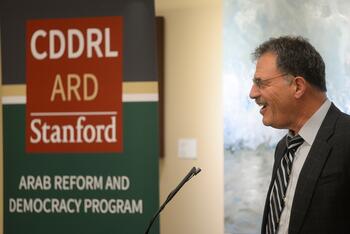
CDDRL’s Program on Arab Reform and Democracy held its annual conference at Stanford University on October 11 and 12, titled “The Struggle for Political Change in the Arab World.” The conference is an outgrowth of ARD’s efforts to support new research on the dynamics of political change in the countries of the Arab world. Scholars from across different disciplines sought to understand how social, economic, and political dynamics at the national level, as well as international and regional conflict and power rivalries, impact struggles for political and social change in the region.

Overview of Panels and Speakers

Image
larry diamond banner
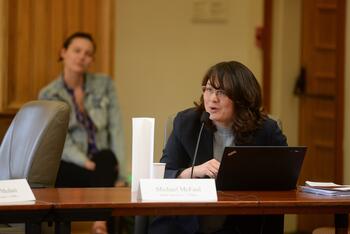
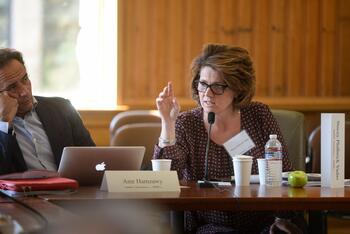
Following opening remarks by FSI Senior Fellow Larry Diamond, the first panel titled “The Boundaries of Authoritarianism post-Arab Uprisings” featured CDDRL Senior Research Scholar Amr Hamzawy. His paper examined how the regime of Abdel Fattah Al-Sisi has employed discursive strategies to discredit calls for democratic change in the country. Sean Yom, Associate Professor of Political Science at Temple University, outlined how the protest strategies of Jordanian youth have limited their effectiveness in advancing meaningful political change. University of California, Davis Scholar Samia Errazzouki discussed the failure of state-led political and economic reform in Morocco.

Chaired by Harvard University Fellow Hicham Alaoui, the second panel was titled “Popular Uprisings and Uncertain Transitions.” University of California, Santa Cruz Political Scientist Thomas Serres provided an overview of the economic disruptions that contributed to Algeria’s uprising. Lindsay Benstead, who is an Associate Professor of Political Science at Portland State University, analyzed the electoral successes of Tunisia’s Ennahda Party. Khalid Medani, Professor of Political Science at McGill University, explained how Sudanese protesters leveraged new strategies of contention to force Omar Al-Bashir out of power.

farrah al nakib and michael herb Farah Al-Nakib (right) and Michael Herb (left)
The third panel, titled “Politics, Succession and Sectarianism in the GCC States,” included Oxford University Fellow Toby Matthiesen, who discussed how Saudi Arabia and the GCC states have increasingly sought to protect their regimes by actively molding the politics of their autocratic patrons in the region, and by using new technologies to upgrade the effectiveness of their surveillance states. Georgia State University Political Scientist Michael Herb explained how the aging of the Saudi line of succession contributed to the political ascendancy of Crown Prince Mohammad Bin Salman and the decay of family rule in the country. Cal Poly Historian Farah Al-Nakib described how Kuwait’s royal family has used its sponsorship of large-scale development projects to sidestep the country’s political polarization, undermine the power of the parliament, and weaken public access to spaces of political contestation.

Image
hesham and toby matthiesen
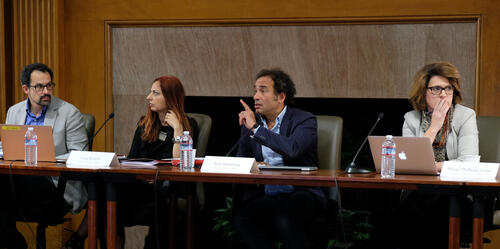
The fourth panel focused on “Social Strife and Proxy Conflict in the Middle East.” Chatham House Scholar Lina Khatib described Syria’s transformation during the civil war from a highly centralized security state to a transactional state in which the regime depends heavily on local powerbrokers. Stacey Philbrick Yadav, Associate Professor and Chair of the Department of Political Science at Hobart and William Smith Colleges, discussed differences in how local communities in Yemen have been affected by the country’s conflict. David Patel, who serves as Associate Director for Research at the Crown Center for Middle East Studies at Brandeis University, argued that Iraq’s democratic institutions have been impressively robust to a series of existential challenges, but he also highlighted a widespread feeling among the Iraqi public that its parliamentary system is failing to deliver.

Image
lisa blaydes
Finally, the fifth panel examined the topic of “International Forces in the Arab Political Arena.” Stanford University Political Scientist Lisa Blaydes suggested that China’s efforts to involve itself in the regional economy may improve its reputation among economically-frustrated Arab citizens, but that such efforts also spell trouble for democracy and human rights in the Middle East. Hamid & Christina Moghadam Director of Iranian Studies at Stanford University Abbas Milani argued that Iran’s ideological commitment to exporting the Islamic Revolution has been remarkably consistent for several decades. Colin Kahl, Co-director of the Center for International Security and Cooperation at FSI, reviewed the strategies of US administrations toward the Middle East, and posited that President Trump’s approach of pursuing maximalist objectives with minimal commitments is particularly likely to heighten instability in the region. FSI Scholar Ayca Alemdaroglu emphasized that Turkey’s neo-Ottoman foreign policy has failed to achieve its objectives in the face of mounting regional upheaval.

Common Themes of Political Change and Continuity

Image
hamzawy khatib patel stacey
Several themes emerged from conference presentations. First, across the panels, scholars discussed the lessons learned by autocrats and activists alike in the aftermath of the Arab Spring, and the ways in which these lessons have transformed regional politics. Hamzawy emphasized that the Sisi regime in Egypt has increasingly relied on intensive repression over cooptation to maintain stability, while at the same time refusing to grant even limited political openings as existed under Hosni Mubarak’s presidency. In part, this change appears to be rooted in the regime’s belief that relaxing the state’s authoritarian posture had contributed to the revolutionary upheaval of 2011. Likewise, Matthiesen suggested that Saudi Arabia and the Gulf Cooperation Council States have learned to become more aggressive in strengthening their surveillance apparatus and policing popular discourse transnationally. By contrast, Serres discussed how the Algerian military and bureaucracy have responded to mass protests not by intensifying repression, but instead by attempting to coopt anti-corruption initiatives and democratic reforms to limit political and economic change. Similarly, regarding Kuwait, Al-Nakib illustrated how the restructuring of urban spaces has proved itself a subtle but successful strategy for the royal family to rehabilitate its reputation while limiting geographic focal points for popular politics.

Image
sean yom
Activists have also learned their own lessons from the aftermath of the Arab Spring. According to Yom, Jordanian activists continue to look to the leaderless revolutions of Tunisia and Egypt as a model to be emulated. As a result, they prioritize agility and horizontality in their protests, and they forgo the organization of formal political movements. This approach has succeeded in acquiring short-term concessions from the regime but has failed to generate broader structural changes. On the other hand, activists in Sudan appear to have been more successful at using lessons from the Arab Spring to push for systematic transformations of their political system. According to Medani, Sudanese protesters developed novel tactics to avoid the repression of the coercive apparatus, and they were effective at gradually forging a counterhegemonic discourse that clearly exposed the regime’s failures to the public. Following the overthrow of Omar Al-Bashir, activists in Sudan have also insisted on dismantling the political and economic might of the deep state to avoid following Egypt’s path.

Image
hicham alaoui at conference
Second, the conference discussion indicated widespread dissatisfaction with formal political institutions across the region. For instance, Hamzawy suggested that Sisi’s regime has been relatively successful at discrediting civilian political institutions, including the legislature and civilian-led ministries. Errazzouki highlighted widespread dissatisfaction in Morocco with existing political institutions. Likewise, Yom’s discussion of activists in Jordan emphasized their lack of interest in entering formal politics. In Kuwait, the royal court has found an opening to pursue urban development projects outside of normal institutions in part because of the public’s frustration with gridlock in the legislature. Patel speculated that frustration with the parliament and muhasasa system in Iraq may finally prompt major changes to the country’s political process.

Image
thomas serres and khalid medani
Third, despite this disillusionment with formal politics, these political institutions have proved remarkably durable in countries across the region. For example, though current frustrations may finally prompt change in Iraq, Patel also highlighted the resilience of the parliamentary system in the face of a sectarian civil war, US troop withdrawal, the rise of ISIS, and a number of other major challenges. For both Algeria and Sudan, Serres and Medani stressed that militaries continue to exercise significant influence despite the popular uprisings. Meanwhile, for Egypt, Hamzawy noted the firm grip of the current military regime on power, and for Morocco, Errazzouki described the lack of systematic changes to the country’s ruling monarchy, even after years of popular pressure.

Image
stacey yadav
Fourth, this durability has not precluded a number of important shifts within existing political institutions. Regarding Syria, for instance, Khatib explained how the survival of Bashar al-Asad’s presidency has depended on moving state institutions away from a centralized security state to a transactional state reliant on local actors with a degree of independence from the regime. Herb described how the consensus-based family rule of the Saudi monarchy fell victim to deaths among the aging senior princes, which opened up opportunities for the king to appoint more officials in a manner that heightened his direct influence. Herb suggested that Mohammad Bin Salman recognized this change and knew that he would likely lose relevance upon his father’s death; as a result, he was motivated to gamble on consolidating his control while his father still held the power to issue royal decrees. In Algeria, the influence of the military and bureaucracy may remain paramount for now, but Serres also pointed out that protesters have succeeded in stripping away the civilian intermediaries who used to protect these institutions. Regarding the durability of local institutions, Yadav noted how pre-conflict and even pre-unification institutions in Yemen have continued to operate effectively in a number of local communities around the country.

Image
colin kahl with abbas and ayca
Fifth, foreign interventions will continue to destabilize the region and impede prospects for democratization or post-conflict reconstructions in the coming years. Khatib noted that Russia has positioned itself as the agenda setter who can bring the Syrian state back to its feet, but also that Russia and Iran are competing to profit off the country’s reconstruction. For Yemen, Yadav argued that fragmentation at the local level has important implications for best practices in the international community’s reconstruction efforts, but that current actors are not well positioned to understand these trends. Kahl predicted that the Middle East strategy of the Trump administration would likely contribute to further destabilization of the region because of its emphasis on empowering allies to do what they want and go after Iran while the United States maintains its distance. Meanwhile, Blaydes’ presentation on China’s regional involvement, Milani’s discussion of Iran’s efforts to export the Islamic Revolution, and Matthiesen’s observations about the GCC States’ authoritarian coordination all illustrated how intervening states are reducing prospects for democratic political change.

Image
milani with audience
Sixth, even as interventionist countries have contributed to the destabilization of the region, they have also confronted major obstacles themselves – and in some cases have failed outright to achieve their primary objectives. Khatib noted that Iran has faced backlash in Syria, while Abbas Milani and David Patel pointed to backlash against Iran in Iraq. Kahl emphasized that the Trump administration’s Middle East policy was unlikely to achieve its goals. Blaydes observed that China has not acquired greater salience in the Middle East despite its more active economic involvement, and individuals in many of the region’s countries – particularly those that are more developed – do not see China’s growth as a positive force. She also stressed the reputational risks China is taking in pursuing potentially unpopular investments through the Belt and Road Initiative. The GCC States are attempting to prop up strongmen in both Libya and Sudan, but this strategy has struggled in the face of local political dynamics; furthermore, the intervention in Yemen has been a disaster for Saudi Arabia and the UAE. Finally, Alemdaroglu stressed that Turkey’s ambitious “neo-Ottoman” foreign policy, which reflects a desire to revive Turkish influence in areas ruled by the Ottoman Empire, has largely failed. In particular, the architect of the policy, former foreign minister Ahmet Davutoglu, lost his job; the country miscalculated badly in how it handled the aftermath of the Arab Spring; and Turkey’s relations with many of its neighbors have soured.

Hero Image
group photo from annual conference
ARD 2019 Annual Conference participants. Front row (from left): Sean Yom, Stacey Philbrick Yadav, Lindsay Benstead, David Patel, Michael Herb. Middle row (from left): Colin Kahl, Lina Khatib, Hicham Alaoui, Larry Diamond, Samia Errazzouki, Lisa Blaydes, Hesham Sallam. Back row (from left): Toby Matthiesen, Ayca Alemdaroglu, Abbas Milani, Amr Hamzawy, Michael McFaul, Scott Williamson
All News button
1
Subscribe to Syria