In a webinar dated June 2, 2021, Georgetown University Historian Abdullah Al-Arian analyzed how the Arab Uprisings have impacted Islamist movements throughout the region. By the eve of the uprisings, he argues, the posture of Islamist movements reflected a set of political commitments that had emerged largely at the expense of their ideological program and social mission. Rooted in the historical and recent acceptance of state institutions and political structures, expressions of Islamism by parties across the Arab region reflected a shift that subsumed long held beliefs beneath the needs of (alternately or in combination) democratic pluralism and political expediency, most clearly visible in the transformation of Tunisia’s Ennahda Party. That tension has been exacerbated in the wake of political defeats experienced by many of these movements, particularly Egypt’s Muslim Brotherhood. While the “Islamist idea” is likely to endure its current bout with state repression, its survival as a political force in the future will depend on its determination to complete this evolution, a process that was both accelerated and interrupted during the critical moments of the Arab uprisings. To watch the recording of the talk, please click below.
This talk is based on the speakers’ recently published edited volume The Unfinished Arab Spring: Micro-Dynamics of Revolts between Change and Continuity. Adopting an original analytical approach in explaining various dynamics at work behind the Arab revolts and giving voice to local dynamics and legacies rather than concentrating on debates about paradigms, we highlight micro-perspectives of change and resistance as well as of contentious politics that are often marginalized and left unexplored in favor of macro-analyses. First, we re-examine the stories of the uprisings in Tunisia, Egypt, Syria, Morocco and Algeria through diverse and novel perspectives, looking at factors that have not yet been sufficiently underlined but carry explanatory power for what has occurred. Second, rather than focusing on macro-comparative regional trends – however useful they might be – we focus on the particularities of each country, highlighting distinctive micro-dynamics of change and continuity.
SPEAKERS BIO
Image
Fatima el Issawi is a Reader in Journalism and Media Studies at the University of Essex. Her research focuses on the intersection between media, politics and conflicts in transitional contexts to democracy in North Africa. She is the Principal Investigator for the research project “Media and Transitions to Democracy: Journalistic Practices in Communicating Conflicts- the Arab Spring” funded by the British Academy Sustainable Development Programme, looking at media’s impact on communicating political conflicts in post uprisings in North Africa. Since 2012, el Issawi has been leading empirical comparative research projects on the interplay between media and political change, funded by Open Society Foundation and the Middle East Centre/LSE, covering Egypt, Tunisia, Morocco, Libya and Algeria. El Issawi’s expertise crosses journalism, public communication, policy and academia. She has over fifteen years of experience as international correspondent in conflict zones in the MENA region. She is the author of “Arab National Media and Political Change” investigating the complex intersections between traditional journalists and politics in uncertain times of transitions to democracy.
Image
Francesco Cavatorta is full professor of political science and director of the Centre Interdisciplinaire de Recherche sur l’Afrique et le Moyen Orient (CIRAM) at Laval University, Quebec, Canada. His research focuses on the dynamics of authoritarianism and democratization in the Middle East and North Africa. His current research projects deal with party politics and the role of political parties in the region. He has published numerous journal articles and books.
Democracy promotion has been a longstanding goal of US foreign policy in the Middle East and elsewhere. President George W. Bush championed democracy promotion as a way to counter the ideology and extremism that led to the September 11, 2001 terror attacks against the United States. After Bush’s attempts ended in abject failure, President Barack Obama sought to repair relations with the Muslim world but also withdraw the US footprint in the Middle East. But Obama was forced to take a far more hands-on approach with the outbreak of the 2010-2011 uprisings known as the Arab Spring. President Donald Trump, who has displayed an almost allergic aversion to Obama’s policies, has openly embraced the region’s autocrats with little regard for their abuse of human rights or absence of attention to political or economic freedom. How the United States approaches the region matters – both for aspiring democrats and for those who wish to silence them. Despite the rise of Russia and China, the United States remains the sole superpower, with the loudest voice on the world stage. Thus, the shift from democracy promoter – albeit reluctantly at times – to authoritarian enabler has made the task of democratic political reform far more challenging for people across the Middle East. This discussion will examine the recent democracy promotion efforts of the United States, with a focus on the Obama and Trump years.
SPEAKER BIO
Image
Sarah Yerkes is a fellow in the Carnegie Endowment for International Peace’s Middle East Program, where her research focuses on Tunisia’s political, economic, and security developments as well as state-society relations in the Middle East and North Africa. She has been a visiting fellow at the Brookings Institution and a Council on Foreign Relations international affairs fellow and has taught in the Security Studies Program at Georgetown University and at the Elliott School of International Affairs at the George Washington University. Yerkes is a former member of the State Department’s policy planning staff, where she focused on North Africa. Previously, she was a foreign affairs officer in the State’s Department’s Office of Israel and Palestinian affairs. Yerkes also served as a geopolitical research analyst for the U.S. military’s Joint Staff Strategic Plans and Policy Directorate (J5) at the Pentagon, advising the Joint Staff leadership on foreign policy and national security issues.
With discussant: Brett McGurk Payne Distinguished Lecturer at the Center for International Security and Cooperation
This event is co-sponsored with the Hamid and Christina Moghadam Program in Iranian Studies
About this Event: Kim Ghattas's most recent book Black Wave tells the story of the rivalry between Saudi Arabia and Iran, a conflict born from the 1979 Iranian revolution. Ghattas, a native of the region, explores the distortion and deployment of religion in a competition that went beyond geopolitics, where each side proceeded to strategically feed intolerance, suppress cultural expression and encourage sectarian violence from Egypt to Pakistan.
About the Speaker: Kim Ghattas is an Emmy Award-winning journalist and writer who covered the Middle East for twenty years for the BBC and the Financial Times. She has also reported on the U.S State Department and American politics. She has been published in The Atlantic, the Washington Post, and Foreign Policy and is currently a non-resident scholar at the Carnegie Endowment for International Peace in Washington. Her first book, The Secretary, was a New York Times bestseller. Born and raised in Lebanon, she now lives in Beirut and Washington, D.C.
Kim Ghattas
Non-resident Scholar
Carnegie Endowment for International Peace
CDDRL’s Program on Arab Reform and Democracy held its annual conference at Stanford University on October 11 and 12, titled “The Struggle for Political Change in the Arab World.” The conference is an outgrowth of ARD’s efforts to support new research on the dynamics of political change in the countries of the Arab world. Scholars from across different disciplines sought to understand how social, economic, and political dynamics at the national level, as well as international and regional conflict and power rivalries, impact struggles for political and social change in the region.
Overview of Panels and Speakers
Image
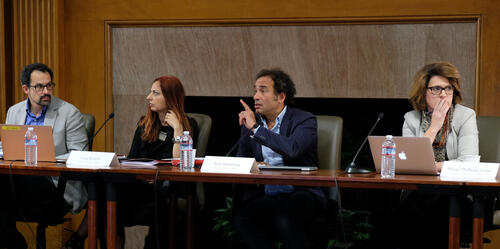
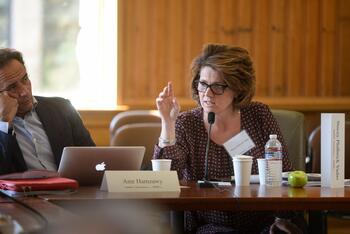
Following opening remarks by FSI Senior Fellow Larry Diamond, the first panel titled “The Boundaries of Authoritarianism post-Arab Uprisings” featured CDDRL Senior Research Scholar Amr Hamzawy. His paper examined how the regime of Abdel Fattah Al-Sisi has employed discursive strategies to discredit calls for democratic change in the country. Sean Yom, Associate Professor of Political Science at Temple University, outlined how the protest strategies of Jordanian youth have limited their effectiveness in advancing meaningful political change. University of California, Davis Scholar Samia Errazzouki discussed the failure of state-led political and economic reform in Morocco.
Chaired by Harvard University Fellow Hicham Alaoui, the second panel was titled “Popular Uprisings and Uncertain Transitions.” University of California, Santa Cruz Political Scientist Thomas Serres provided an overview of the economic disruptions that contributed to Algeria’s uprising. Lindsay Benstead, who is an Associate Professor of Political Science at Portland State University, analyzed the electoral successes of Tunisia’s Ennahda Party. Khalid Medani, Professor of Political Science at McGill University, explained how Sudanese protesters leveraged new strategies of contention to force Omar Al-Bashir out of power.
Farah Al-Nakib (right) and Michael Herb (left)
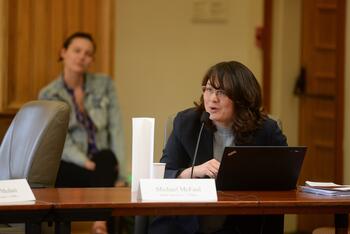
The third panel, titled “Politics, Succession and Sectarianism in the GCC States,” included Oxford University Fellow Toby Matthiesen, who discussed how Saudi Arabia and the GCC states have increasingly sought to protect their regimes by actively molding the politics of their autocratic patrons in the region, and by using new technologies to upgrade the effectiveness of their surveillance states. Georgia State University Political Scientist Michael Herb explained how the aging of the Saudi line of succession contributed to the political ascendancy of Crown Prince Mohammad Bin Salman and the decay of family rule in the country. Cal Poly Historian Farah Al-Nakib described how Kuwait’s royal family has used its sponsorship of large-scale development projects to sidestep the country’s political polarization, undermine the power of the parliament, and weaken public access to spaces of political contestation.
Image
The fourth panel focused on “Social Strife and Proxy Conflict in the Middle East.” Chatham House Scholar Lina Khatib described Syria’s transformation during the civil war from a highly centralized security state to a transactional state in which the regime depends heavily on local powerbrokers. Stacey Philbrick Yadav, Associate Professor and Chair of the Department of Political Science at Hobart and William Smith Colleges, discussed differences in how local communities in Yemen have been affected by the country’s conflict. David Patel, who serves as Associate Director for Research at the Crown Center for Middle East Studies at Brandeis University, argued that Iraq’s democratic institutions have been impressively robust to a series of existential challenges, but he also highlighted a widespread feeling among the Iraqi public that its parliamentary system is failing to deliver.
Image
Finally, the fifth panel examined the topic of “International Forces in the Arab Political Arena.” Stanford University Political Scientist Lisa Blaydes suggested that China’s efforts to involve itself in the regional economy may improve its reputation among economically-frustrated Arab citizens, but that such efforts also spell trouble for democracy and human rights in the Middle East. Hamid & Christina Moghadam Director of Iranian Studies at Stanford University Abbas Milani argued that Iran’s ideological commitment to exporting the Islamic Revolution has been remarkably consistent for several decades. Colin Kahl, Co-director of the Center for International Security and Cooperation at FSI, reviewed the strategies of US administrations toward the Middle East, and posited that President Trump’s approach of pursuing maximalist objectives with minimal commitments is particularly likely to heighten instability in the region. FSI Scholar Ayca Alemdaroglu emphasized that Turkey’s neo-Ottoman foreign policy has failed to achieve its objectives in the face of mounting regional upheaval.
Common Themes of Political Change and Continuity
Image
Several themes emerged from conference presentations. First, across the panels, scholars discussed the lessons learned by autocrats and activists alike in the aftermath of the Arab Spring, and the ways in which these lessons have transformed regional politics. Hamzawy emphasized that the Sisi regime in Egypt has increasingly relied on intensive repression over cooptation to maintain stability, while at the same time refusing to grant even limited political openings as existed under Hosni Mubarak’s presidency. In part, this change appears to be rooted in the regime’s belief that relaxing the state’s authoritarian posture had contributed to the revolutionary upheaval of 2011. Likewise, Matthiesen suggested that Saudi Arabia and the Gulf Cooperation Council States have learned to become more aggressive in strengthening their surveillance apparatus and policing popular discourse transnationally. By contrast, Serres discussed how the Algerian military and bureaucracy have responded to mass protests not by intensifying repression, but instead by attempting to coopt anti-corruption initiatives and democratic reforms to limit political and economic change. Similarly, regarding Kuwait, Al-Nakib illustrated how the restructuring of urban spaces has proved itself a subtle but successful strategy for the royal family to rehabilitate its reputation while limiting geographic focal points for popular politics.
Image
Activists have also learned their own lessons from the aftermath of the Arab Spring. According to Yom, Jordanian activists continue to look to the leaderless revolutions of Tunisia and Egypt as a model to be emulated. As a result, they prioritize agility and horizontality in their protests, and they forgo the organization of formal political movements. This approach has succeeded in acquiring short-term concessions from the regime but has failed to generate broader structural changes. On the other hand, activists in Sudan appear to have been more successful at using lessons from the Arab Spring to push for systematic transformations of their political system. According to Medani, Sudanese protesters developed novel tactics to avoid the repression of the coercive apparatus, and they were effective at gradually forging a counterhegemonic discourse that clearly exposed the regime’s failures to the public. Following the overthrow of Omar Al-Bashir, activists in Sudan have also insisted on dismantling the political and economic might of the deep state to avoid following Egypt’s path.
Image
Second, the conference discussion indicated widespread dissatisfaction with formal political institutions across the region. For instance, Hamzawy suggested that Sisi’s regime has been relatively successful at discrediting civilian political institutions, including the legislature and civilian-led ministries. Errazzouki highlighted widespread dissatisfaction in Morocco with existing political institutions. Likewise, Yom’s discussion of activists in Jordan emphasized their lack of interest in entering formal politics. In Kuwait, the royal court has found an opening to pursue urban development projects outside of normal institutions in part because of the public’s frustration with gridlock in the legislature. Patel speculated that frustration with the parliament and muhasasa system in Iraq may finally prompt major changes to the country’s political process.
Image
Third, despite this disillusionment with formal politics, these political institutions have proved remarkably durable in countries across the region. For example, though current frustrations may finally prompt change in Iraq, Patel also highlighted the resilience of the parliamentary system in the face of a sectarian civil war, US troop withdrawal, the rise of ISIS, and a number of other major challenges. For both Algeria and Sudan, Serres and Medani stressed that militaries continue to exercise significant influence despite the popular uprisings. Meanwhile, for Egypt, Hamzawy noted the firm grip of the current military regime on power, and for Morocco, Errazzouki described the lack of systematic changes to the country’s ruling monarchy, even after years of popular pressure.
Image
Fourth, this durability has not precluded a number of important shifts within existing political institutions. Regarding Syria, for instance, Khatib explained how the survival of Bashar al-Asad’s presidency has depended on moving state institutions away from a centralized security state to a transactional state reliant on local actors with a degree of independence from the regime. Herb described how the consensus-based family rule of the Saudi monarchy fell victim to deaths among the aging senior princes, which opened up opportunities for the king to appoint more officials in a manner that heightened his direct influence. Herb suggested that Mohammad Bin Salman recognized this change and knew that he would likely lose relevance upon his father’s death; as a result, he was motivated to gamble on consolidating his control while his father still held the power to issue royal decrees. In Algeria, the influence of the military and bureaucracy may remain paramount for now, but Serres also pointed out that protesters have succeeded in stripping away the civilian intermediaries who used to protect these institutions. Regarding the durability of local institutions, Yadav noted how pre-conflict and even pre-unification institutions in Yemen have continued to operate effectively in a number of local communities around the country.
Image
Fifth, foreign interventions will continue to destabilize the region and impede prospects for democratization or post-conflict reconstructions in the coming years. Khatib noted that Russia has positioned itself as the agenda setter who can bring the Syrian state back to its feet, but also that Russia and Iran are competing to profit off the country’s reconstruction. For Yemen, Yadav argued that fragmentation at the local level has important implications for best practices in the international community’s reconstruction efforts, but that current actors are not well positioned to understand these trends. Kahl predicted that the Middle East strategy of the Trump administration would likely contribute to further destabilization of the region because of its emphasis on empowering allies to do what they want and go after Iran while the United States maintains its distance. Meanwhile, Blaydes’ presentation on China’s regional involvement, Milani’s discussion of Iran’s efforts to export the Islamic Revolution, and Matthiesen’s observations about the GCC States’ authoritarian coordination all illustrated how intervening states are reducing prospects for democratic political change.
Image
Sixth, even as interventionist countries have contributed to the destabilization of the region, they have also confronted major obstacles themselves – and in some cases have failed outright to achieve their primary objectives. Khatib noted that Iran has faced backlash in Syria, while Abbas Milani and David Patel pointed to backlash against Iran in Iraq. Kahl emphasized that the Trump administration’s Middle East policy was unlikely to achieve its goals. Blaydes observed that China has not acquired greater salience in the Middle East despite its more active economic involvement, and individuals in many of the region’s countries – particularly those that are more developed – do not see China’s growth as a positive force. She also stressed the reputational risks China is taking in pursuing potentially unpopular investments through the Belt and Road Initiative. The GCC States are attempting to prop up strongmen in both Libya and Sudan, but this strategy has struggled in the face of local political dynamics; furthermore, the intervention in Yemen has been a disaster for Saudi Arabia and the UAE. Finally, Alemdaroglu stressed that Turkey’s ambitious “neo-Ottoman” foreign policy, which reflects a desire to revive Turkish influence in areas ruled by the Ottoman Empire, has largely failed. In particular, the architect of the policy, former foreign minister Ahmet Davutoglu, lost his job; the country miscalculated badly in how it handled the aftermath of the Arab Spring; and Turkey’s relations with many of its neighbors have soured.
Hero Image
ARD 2019 Annual Conference participants. Front row (from left): Sean Yom, Stacey Philbrick Yadav, Lindsay Benstead, David Patel, Michael Herb. Middle row (from left): Colin Kahl, Lina Khatib, Hicham Alaoui, Larry Diamond, Samia Errazzouki, Lisa Blaydes, Hesham Sallam. Back row (from left): Toby Matthiesen, Ayca Alemdaroglu, Abbas Milani, Amr Hamzawy, Michael McFaul, Scott Williamson
"For years, Stanford scientists have collaborated with and received funding from the Saudi national laboratory, government-supported universities and the state-owned oil company Aramco. But despite having ties with Saudi Arabia much like MIT’s — including with several of the government institutions probed in the MIT report — Stanford has undertaken no broad review of its connections to Saudi Arabia. As a result, Stanford’s Saudi relationships have continued largely under the radar. Some at Stanford find these relationships uncontroversial or point to their scientific and cultural benefits. Others approach them with more wariness or believe the University should engage more thoughtfully with the country." Our Lisa Blades and Hesham Sallam contributed to this Stanford Daily's article. Read here.
What disturbs Stanford pediatrician Paul Wise most about the cholera epidemic in Yemen is that it’s hitting the children hardest and is completely preventable.
The four-year civil war in Yemen has killed hundreds of thousands of people and has led the poorest of the Arab nations to the brink of famine. Some 22 million of the country’s 29 million people are in desperate need of humanitarian assistance, according to the United Nations.
Since 2016, two severe cholera outbreaks have impacted more than 1.2 million people. Children account for 30 percent of the infections; more than 2,500 people have died.
“Children in Yemen are not only the most vulnerable to this ongoing cholera epidemic but they are also suffering from a disastrous famine,” said Wise, a core faculty member at the Department of Pediatrics, Stanford Health Policy and the Center on Democracy, Development and the Rule of Law.
“The cholera and starvation that is currently afflicting Yemen’s children are completely man-made and preventable,” he added. “They are the product of a brutal, protracted war and the ongoing complacency of the international community.”
The conflict pits the country’s Shiite rebels known as the Houthis, against Yemen’s internationally recognized government, which is supported by a Saudi-led coalition that includes the United States. The United Nations is currently brokering peace talks in Sweden.
Wise, who leads Stanford’s Children in Crisis project, joined colleagues at the Johns Hopkins Bloomberg School of Public Health to study the preparedness and response to the epidemic, at the request U.S. Agency for International Development (USAID).
“The report is an attempt to bring together technical and political analysis in a way that calls attention to both the profound suffering of civilian communities caught up in war — and that real opportunities exist to better protect these communities through urgent global action,” Wise said.
If caught early, cholera can be treated with oral hydration salts, though more severe cases require intravenous fluids and antibiotics. But the bacterium found in food and water sources has overwhelmed Yemen because its health-care facilities and infrastructure have been devastated.
“What is critical to remember is that these cases and deaths are all preventable,” said Wise. “And children are always the most vulnerable to the indirect effects of war, the effects resulting from the destruction of the essentials of life, like food, water, shelter, and health care.”
There were three key findings in the report. First, there was likely an overcount of cases due to financial incentives to label patients with gastrointestinal symptoms as cholera cases.
Second, the report identified technical areas of slow provision of services, such as getting out the relatively new oral cholera vaccine, and poor coordination of essential interventions by the government and international humanitarian agencies.
Third, Wise and his colleagues documented at least 75 instances in which Saudi airstrikes appear to have purposely caused damage to water, health and sanitation facilities in rebel-held territory in the northern part of the country. Despite repeated calls by the international community to protect these public health sites — as is required by international law — the bombings continued.
The report found that in retaliation for rockets fired by the rebels at the Saudi Arabian capital city, Riyadh, the Saudi-led coalition in November 2017 closed the majority of airports, seaports and land crossings. Ports in government-controlled areas were quickly re-opened, but they remained closed in the north. This had the immediate effect of halting the flow of goods into Yemen, which relies almost exclusively on imports for food, fuel and medicine.
“The United States and other Western powers have been indirectly complicit in these airstrikes on civilian water and sanitation targets, as these global powers have provided the weaponry, intelligence, and until very recently, the refueling capacity to support Saudi air attacks,” Wise said. “The report is focused on the cholera epidemic; however, the findings clearly point to the relationship between the outbreak and violations of international norms in how the war is being fought.”
Wise noted that the security environment in Yemen has been one of the most dangerous in the world for humanitarian and health workers. Wise and some of this same group of experts who worked on the cholera report were able to travel to Iraq last year to evaluate the World Health Organization’ system to treat civilians injured in the battle for the city of Mosul.
But Yemen is just too dangerous and they were unable to conduct research on the ground. So they did the next best thing, reviewing dozens of documents and conducting 75 interviews with medical practitioners, donors and technical experts involved with the cholera response.
They found that despite the incredible odds, effective mobilization by community volunteers and health workers was paramount. During the second wave of the cholera epidemic in August 2017, for example, some 40,000 community health volunteers working with the WHO and UNICEF carried a door-to-door cholera-awareness campaign across 14 million households.
“The dedication and courage of these humanitarian and health workers have undoubtedly saved thousands of lives,” Wise said. “However, without urgent global action to end the fighting and provide the essentials of life, many more thousands of children will suffer, and most tragically, many will die from completely preventable causes.”
Under the title “Political Contestation and New Social Forces in the Middle East and North Africa,” the Program on Arab Reform and Democracy convened its 2018 annual conference on April 27 and 28 at Stanford University. Bringing together a diverse group of scholars from across several disciplines, the conference examined how dynamics of governance and modes of political participation have evolved in recent years in light of the resurgence of authoritarian trends throughout the region.
Image
Delivering the opening remarks of the conference, Freeman Spogli Institute (FSI) and Hoover Institution Senior Fellow Larry Diamond reflected on the state of struggle for political change in the Middle East and North Africa (MENA) region. In a panel titled “Youth, Culture, and Expressions of Resistance,” FSI Scholar Ayca Alemdaroglu discussed strategies the Turkish state has pursued to preempt and contain dissent among youth. Adel Iskandar, Assistant Professor of Communications at Simon Fraser University, explained the various ways through which Egyptian youth employ social media to express political dissent. Yasemin Ipek, Assistant Professor of Global Affairs at George Mason University, unpacked the phenomenon of “entrepreneurial activism” among Lebanese youth and discussed its role in cross-sectarian mobilization.
The conference’s second panel, tilted “Situating Gender in the Law and the Economy,” featured Texas Christian University Historian Hanan Hammad, who assessed the achievements of the movement to fight gender-based violence in Egypt. Focusing on Gulf Cooperation Council states, Alessandra Gonzales, a Visiting Postdoctoral Fellow at the Stanford Institute for Economic Policy Research, analyzed the differences in female executive hiring practices across local and foreign firms. Stanford University Political Scientist and FSI Senior Fellow Lisa Blaydes presented findings from her research on women’s attitudes toward Female Genital Mutilation (FGM) in Egypt.
Image
Speaking on a panel titled “Social Movements and Visions for Change,” Free University of Berlin Scholar Dina El-Sharnouby discussed the 2011 revolutionary movement in Egypt and the visions for social change it espouses in the contemporary moment. Oklahoma City University Political Scientist Mohamed Daadaoui analyzed the Moroccan regime’s strategies of control following the Arab Uprisings and their impact on various opposition actors. Nora Doaiji, a PhD Student in History at Harvard University, shared findings from her research examining the challenges confronting the women’s movement in Saudi Arabia.
The fourth panel of the conference, “The Economy, the State, and New Social Actors,” featured George Washington University Associate Professor of Geography Mona Atia, who presented on territorial restructuring and the politics governing poverty in Morocco. Amr Adly, an Assistant Professor of Political Science at the American University in Cairo, analyzed the relationship between the state and big business in Egypt after the 2013 military coup. Rice University Professor of Economics Mahmoud El-Gamal shared findings from his research on the economic determinants of democratization and de-democratization trends in Egypt during the past decade.
Image
The final panel focused on the international and regional dimensions of the struggle for political change in the Arab world, and featured Hicham Alaoui, a Research Fellow at Harvard University’s Weatherhead Center for International Affairs, Georgetown University Political Scientist Daniel Brumberg, and Nancy Okail, the Executive Director of the Tahrir Institute for Middle East Policy.
The conference included a special session featuring former fellows of the American Middle Eastern Network at Stanford (AMENDS), an organization dedicated to promoting understanding around the Middle East, and supporting young leaders working to ignite concrete social and economic development in the region. AMENDS affiliates from five different MENA countries shared with the Stanford community their experiences in working toward social change in their respective countries.
Hero Image
ARD 2018 Annual Conference participants.
Front row (from left): Hanan Hammad, Hamza Arsbi, Ayca Alemdaroglu, Mahdi Lafram, Lior Lapid.
Second to front row (from left): Dina El-Sharnouby, Daniel Brumberg, Radidja Nemar, Mona Atia.
Third to front row (from left): Hesham Sallam, Joel Beinin, Nora Doaiji, Hicham Alaoui, Mohamed Daadaoui, Salma Takky, Larry Diamond, Amr Adly, Sultan Al Amer, Heba Al-Hayek.
Back row (from left): Amr Gharbeia, Mahmoud El-Gamal, Amr Hamzawy
In a panel discussion titled “The Khashoggi Affair and Saudi Arabia’s War Against Dissent,” Stanford University scholars examined the context for of the murder of Saudi journalist Jamal Khashoggi and implications of his murder for U.S.-Saudi relations. Organized by the Program on Arab Reform and Democracy (ARD) and moderated by Freeman Spogli Institute and Hoover Institution Senior Fellow Larry Diamond, the panel, dated November 6, 2018, featured Janine Zacharia, the Carlos Kelly McClatchy Visiting Lecturer in the Department of Communication, and Hesham Sallam Associate-Director of ARD and Research Scholar at the Center on Democracy, Development, and the Rule of Law.
Before introducing the panel, Diamond discussed Jamal Khashoggi’s journalistic contributions and advocacy for freedom in the Middle East. He also strongly asserted that the crown prince of Saudi Arabia, Mohammed bin Salman (commonly known as MBS), ordered Khashoggi’s murder in an attempt to stifle media opposition towards his regime. He noted that Khashoggi advocated peaceful political reform that would make Saudi Arabia more prosperous and tolerant. In a brief video filmed during Khashoggi’s visit to Stanford last year, the Saudi journalist provided a measured critique of MBS, remarking that the prince’s leadership was well-intentioned, but too impulsive.
Janine Zacharia
Diamond, Zacharia and Sallam had each met and spoken to Jamal Khashoggi. According to Zacharia, he provided an invaluable perspective on Saudi Arabia for journalists, and his death at the hands of MBS’s operatives in Istanbul sets a dangerous new standard for the treatment of journalists and media officials by authoritarian governments.
Zacharia and Sallam criticized the Trump administration’s response to the killing, and the president’s failure to unequivocally condemn Khashoggi’s apparent murder or to hold MBS accountable. Zacharia said she worried the United States, under President Trump, may no longer be willing to come to the aid of American journalists abroad. Sallam observed that Trump’s tepid denunciation of the killing—in which he declared Khashoggi’s disappearance to be “the worst cover-up in history”—will only encourage other Arab autocrats to silence dissenters with greater subtlety and enthusiasm. The only appropriate response, according to Diamond, is for the American government to freeze MBS’s assets and ban him from entering the United States. Otherwise Saudi Arabia will interpret American passivity as a license to commit further human rights abuses without fear of punishment.
Hesham Sallam
The panelists also framed Khashoggi’s death within the context of Saudi Arabia’s domestic political scene. For many observers, the assassination of a well-known journalist seems at odds with the progressive image of Saudi Arabia that MBS has recently attempted to propagate, specifically through highly publicized reforms and cultural initiatives. Women may now be able to drive, and Saudi Vision 2030 may offer a blueprint for the restructuring of the Saudi economy (and even encourage cross-cultural exchange with the West) but these reforms, Sallam argued, were merely cosmetic. Sallam emphasized that there are still no real checks on MBS’s power, the basic liberties of the Saudis remain severely limited, and the Saudi regime has caused one of the world’s worst humanitarian crises through its military campaign against Yemen. Diamond prefaced these observations by noting that Saudi Arabia is a hugely populous country and a significant regional power in the Middle East, but if predictions hold true, they will also run out of oil by 2030. Therefore, despite the entrenchment of monarchical power and a façade of social progress, Saudi Arabia is indeed facing an impending crisis of identity and economic uncertainty that will induce extreme action and response on the global stage. Khashoggi’s killing anticipates future turmoil as Saudi Arabia continues to disregard international laws and norms in an earnest—and dangerous—attempt to assert its power domestically and regionally.
Hero Image
From left to right: Larry Diamond, Janine Zacharia, and Hesham Sallam
Islamism has imitated, or colluded with, the state autocracies it claims to oppose. It has failed to suggest its own answers to economic problems, social justice, education or corruption, writes Hicham Alaoui in Le Monde diplomatique. Click here to read the full article, which is based on research that Alaoui presented at UC Berkeley and CDDRL on October 10 and 11, respectively.
Hero Image
Supporters of former Egyptian President Mohammed Morsi at a Muslim Brotherhood rally. December 12, 2012. | Yuli Weeks for VOA





 Farah Al-Nakib (right) and Michael Herb (left)





 Janine Zacharia
 Hesham Sallam

