Authors
Asfandyar Mir
News Type
Commentary
Date
Paragraphs

On Wednesday night, U.S.-led coalition forces based out of Camp Taji north of Baghdad came under intense rocket fire. The attack killed three coalition personnel, two American and one British. It also injured nearly a dozen more personnel.

While rocket fire on U.S. military bases in Iraq is not new, this attack is the first time U.S. personnel have been killed by suspected Iranian-backed Iraqi groups since the United States killed Iranian Gen. Qasem Soleimani in early January. The attack is likely to anger the Trump administration, which has pursued an aggressive strategy against Iran. It also catches the White House in the middle of another ballooning international crisis — the coronavirus pandemic.

Why did this attack happen now? And will this incident spark more hostilities in the Middle East?


Read the rest at The Washington Post

Hero Image
screen shot 2020 03 12 at 2 42 15 pm
All News button
1
Authors
News Type
News
Date
Paragraphs

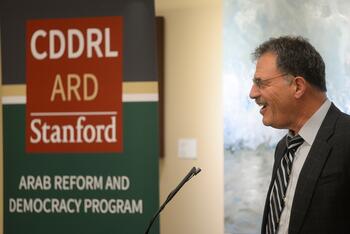
CDDRL’s Program on Arab Reform and Democracy held its annual conference at Stanford University on October 11 and 12, titled “The Struggle for Political Change in the Arab World.” The conference is an outgrowth of ARD’s efforts to support new research on the dynamics of political change in the countries of the Arab world. Scholars from across different disciplines sought to understand how social, economic, and political dynamics at the national level, as well as international and regional conflict and power rivalries, impact struggles for political and social change in the region.

Overview of Panels and Speakers

Image
larry diamond banner
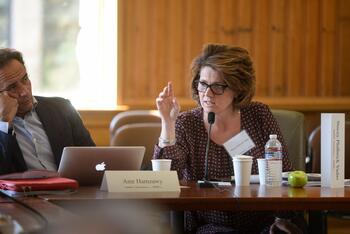
Following opening remarks by FSI Senior Fellow Larry Diamond, the first panel titled “The Boundaries of Authoritarianism post-Arab Uprisings” featured CDDRL Senior Research Scholar Amr Hamzawy. His paper examined how the regime of Abdel Fattah Al-Sisi has employed discursive strategies to discredit calls for democratic change in the country. Sean Yom, Associate Professor of Political Science at Temple University, outlined how the protest strategies of Jordanian youth have limited their effectiveness in advancing meaningful political change. University of California, Davis Scholar Samia Errazzouki discussed the failure of state-led political and economic reform in Morocco.

Chaired by Harvard University Fellow Hicham Alaoui, the second panel was titled “Popular Uprisings and Uncertain Transitions.” University of California, Santa Cruz Political Scientist Thomas Serres provided an overview of the economic disruptions that contributed to Algeria’s uprising. Lindsay Benstead, who is an Associate Professor of Political Science at Portland State University, analyzed the electoral successes of Tunisia’s Ennahda Party. Khalid Medani, Professor of Political Science at McGill University, explained how Sudanese protesters leveraged new strategies of contention to force Omar Al-Bashir out of power.

farrah al nakib and michael herb Farah Al-Nakib (right) and Michael Herb (left)
The third panel, titled “Politics, Succession and Sectarianism in the GCC States,” included Oxford University Fellow Toby Matthiesen, who discussed how Saudi Arabia and the GCC states have increasingly sought to protect their regimes by actively molding the politics of their autocratic patrons in the region, and by using new technologies to upgrade the effectiveness of their surveillance states. Georgia State University Political Scientist Michael Herb explained how the aging of the Saudi line of succession contributed to the political ascendancy of Crown Prince Mohammad Bin Salman and the decay of family rule in the country. Cal Poly Historian Farah Al-Nakib described how Kuwait’s royal family has used its sponsorship of large-scale development projects to sidestep the country’s political polarization, undermine the power of the parliament, and weaken public access to spaces of political contestation.

Image
hesham and toby matthiesen
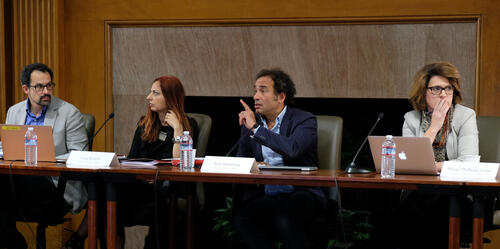
The fourth panel focused on “Social Strife and Proxy Conflict in the Middle East.” Chatham House Scholar Lina Khatib described Syria’s transformation during the civil war from a highly centralized security state to a transactional state in which the regime depends heavily on local powerbrokers. Stacey Philbrick Yadav, Associate Professor and Chair of the Department of Political Science at Hobart and William Smith Colleges, discussed differences in how local communities in Yemen have been affected by the country’s conflict. David Patel, who serves as Associate Director for Research at the Crown Center for Middle East Studies at Brandeis University, argued that Iraq’s democratic institutions have been impressively robust to a series of existential challenges, but he also highlighted a widespread feeling among the Iraqi public that its parliamentary system is failing to deliver.

Image
lisa blaydes
Finally, the fifth panel examined the topic of “International Forces in the Arab Political Arena.” Stanford University Political Scientist Lisa Blaydes suggested that China’s efforts to involve itself in the regional economy may improve its reputation among economically-frustrated Arab citizens, but that such efforts also spell trouble for democracy and human rights in the Middle East. Hamid & Christina Moghadam Director of Iranian Studies at Stanford University Abbas Milani argued that Iran’s ideological commitment to exporting the Islamic Revolution has been remarkably consistent for several decades. Colin Kahl, Co-director of the Center for International Security and Cooperation at FSI, reviewed the strategies of US administrations toward the Middle East, and posited that President Trump’s approach of pursuing maximalist objectives with minimal commitments is particularly likely to heighten instability in the region. FSI Scholar Ayca Alemdaroglu emphasized that Turkey’s neo-Ottoman foreign policy has failed to achieve its objectives in the face of mounting regional upheaval.

Common Themes of Political Change and Continuity

Image
hamzawy khatib patel stacey
Several themes emerged from conference presentations. First, across the panels, scholars discussed the lessons learned by autocrats and activists alike in the aftermath of the Arab Spring, and the ways in which these lessons have transformed regional politics. Hamzawy emphasized that the Sisi regime in Egypt has increasingly relied on intensive repression over cooptation to maintain stability, while at the same time refusing to grant even limited political openings as existed under Hosni Mubarak’s presidency. In part, this change appears to be rooted in the regime’s belief that relaxing the state’s authoritarian posture had contributed to the revolutionary upheaval of 2011. Likewise, Matthiesen suggested that Saudi Arabia and the Gulf Cooperation Council States have learned to become more aggressive in strengthening their surveillance apparatus and policing popular discourse transnationally. By contrast, Serres discussed how the Algerian military and bureaucracy have responded to mass protests not by intensifying repression, but instead by attempting to coopt anti-corruption initiatives and democratic reforms to limit political and economic change. Similarly, regarding Kuwait, Al-Nakib illustrated how the restructuring of urban spaces has proved itself a subtle but successful strategy for the royal family to rehabilitate its reputation while limiting geographic focal points for popular politics.

Image
sean yom
Activists have also learned their own lessons from the aftermath of the Arab Spring. According to Yom, Jordanian activists continue to look to the leaderless revolutions of Tunisia and Egypt as a model to be emulated. As a result, they prioritize agility and horizontality in their protests, and they forgo the organization of formal political movements. This approach has succeeded in acquiring short-term concessions from the regime but has failed to generate broader structural changes. On the other hand, activists in Sudan appear to have been more successful at using lessons from the Arab Spring to push for systematic transformations of their political system. According to Medani, Sudanese protesters developed novel tactics to avoid the repression of the coercive apparatus, and they were effective at gradually forging a counterhegemonic discourse that clearly exposed the regime’s failures to the public. Following the overthrow of Omar Al-Bashir, activists in Sudan have also insisted on dismantling the political and economic might of the deep state to avoid following Egypt’s path.

Image
hicham alaoui at conference
Second, the conference discussion indicated widespread dissatisfaction with formal political institutions across the region. For instance, Hamzawy suggested that Sisi’s regime has been relatively successful at discrediting civilian political institutions, including the legislature and civilian-led ministries. Errazzouki highlighted widespread dissatisfaction in Morocco with existing political institutions. Likewise, Yom’s discussion of activists in Jordan emphasized their lack of interest in entering formal politics. In Kuwait, the royal court has found an opening to pursue urban development projects outside of normal institutions in part because of the public’s frustration with gridlock in the legislature. Patel speculated that frustration with the parliament and muhasasa system in Iraq may finally prompt major changes to the country’s political process.

Image
thomas serres and khalid medani
Third, despite this disillusionment with formal politics, these political institutions have proved remarkably durable in countries across the region. For example, though current frustrations may finally prompt change in Iraq, Patel also highlighted the resilience of the parliamentary system in the face of a sectarian civil war, US troop withdrawal, the rise of ISIS, and a number of other major challenges. For both Algeria and Sudan, Serres and Medani stressed that militaries continue to exercise significant influence despite the popular uprisings. Meanwhile, for Egypt, Hamzawy noted the firm grip of the current military regime on power, and for Morocco, Errazzouki described the lack of systematic changes to the country’s ruling monarchy, even after years of popular pressure.

Image
stacey yadav
Fourth, this durability has not precluded a number of important shifts within existing political institutions. Regarding Syria, for instance, Khatib explained how the survival of Bashar al-Asad’s presidency has depended on moving state institutions away from a centralized security state to a transactional state reliant on local actors with a degree of independence from the regime. Herb described how the consensus-based family rule of the Saudi monarchy fell victim to deaths among the aging senior princes, which opened up opportunities for the king to appoint more officials in a manner that heightened his direct influence. Herb suggested that Mohammad Bin Salman recognized this change and knew that he would likely lose relevance upon his father’s death; as a result, he was motivated to gamble on consolidating his control while his father still held the power to issue royal decrees. In Algeria, the influence of the military and bureaucracy may remain paramount for now, but Serres also pointed out that protesters have succeeded in stripping away the civilian intermediaries who used to protect these institutions. Regarding the durability of local institutions, Yadav noted how pre-conflict and even pre-unification institutions in Yemen have continued to operate effectively in a number of local communities around the country.

Image
colin kahl with abbas and ayca
Fifth, foreign interventions will continue to destabilize the region and impede prospects for democratization or post-conflict reconstructions in the coming years. Khatib noted that Russia has positioned itself as the agenda setter who can bring the Syrian state back to its feet, but also that Russia and Iran are competing to profit off the country’s reconstruction. For Yemen, Yadav argued that fragmentation at the local level has important implications for best practices in the international community’s reconstruction efforts, but that current actors are not well positioned to understand these trends. Kahl predicted that the Middle East strategy of the Trump administration would likely contribute to further destabilization of the region because of its emphasis on empowering allies to do what they want and go after Iran while the United States maintains its distance. Meanwhile, Blaydes’ presentation on China’s regional involvement, Milani’s discussion of Iran’s efforts to export the Islamic Revolution, and Matthiesen’s observations about the GCC States’ authoritarian coordination all illustrated how intervening states are reducing prospects for democratic political change.

Image
milani with audience
Sixth, even as interventionist countries have contributed to the destabilization of the region, they have also confronted major obstacles themselves – and in some cases have failed outright to achieve their primary objectives. Khatib noted that Iran has faced backlash in Syria, while Abbas Milani and David Patel pointed to backlash against Iran in Iraq. Kahl emphasized that the Trump administration’s Middle East policy was unlikely to achieve its goals. Blaydes observed that China has not acquired greater salience in the Middle East despite its more active economic involvement, and individuals in many of the region’s countries – particularly those that are more developed – do not see China’s growth as a positive force. She also stressed the reputational risks China is taking in pursuing potentially unpopular investments through the Belt and Road Initiative. The GCC States are attempting to prop up strongmen in both Libya and Sudan, but this strategy has struggled in the face of local political dynamics; furthermore, the intervention in Yemen has been a disaster for Saudi Arabia and the UAE. Finally, Alemdaroglu stressed that Turkey’s ambitious “neo-Ottoman” foreign policy, which reflects a desire to revive Turkish influence in areas ruled by the Ottoman Empire, has largely failed. In particular, the architect of the policy, former foreign minister Ahmet Davutoglu, lost his job; the country miscalculated badly in how it handled the aftermath of the Arab Spring; and Turkey’s relations with many of its neighbors have soured.

Hero Image
group photo from annual conference
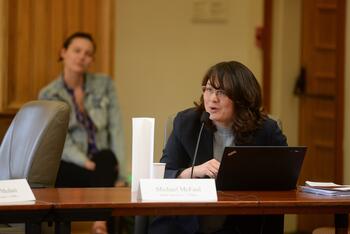
ARD 2019 Annual Conference participants. Front row (from left): Sean Yom, Stacey Philbrick Yadav, Lindsay Benstead, David Patel, Michael Herb. Middle row (from left): Colin Kahl, Lina Khatib, Hicham Alaoui, Larry Diamond, Samia Errazzouki, Lisa Blaydes, Hesham Sallam. Back row (from left): Toby Matthiesen, Ayca Alemdaroglu, Abbas Milani, Amr Hamzawy, Michael McFaul, Scott Williamson
All News button
1
-

Seminar Recording: https://youtu.be/XFFT74SvaCM


Abstract: Pro-government militias have become a regular dimension of counterinsurgency operations, serving governments in fighting rebels locally. The level of violence employed by these irregulars, which often seems to exceed that of the regular army, but also the fascination with civilian fighters, have motivated students of counterinsurgency to pay more considerable attention to such actors in recent years. Much of this body of work has focused on the battlefield and tactical utilities of pro-government militias. However, these militias have other functions, which most of the studies tend to overlook, and that are socio-political in nature. Most notably, militias serve governments in their endeavors to divide societies, mainly by playing up parochial identities, such as tribalism and sectarianism, and playing up old rivalries. This function of militias has been particularly visible in cases of “defector militias,” namely militias composed of defectors from the rebel constituency to the government ranks. At least in some cases, these socio-political functions of militias have played no less significant role in governments’ decision to employ these forces than short-term battlefield needs. My study of pro-government defector militias uses two case studies: That of Iraq under the Ba‘th regime and its counterinsurgency efforts against Kurdish separatists in the north; and that of the Sudanese governments and their war against Southern rebels during the First Sudanese Civil War. Based on extensive archival, my work seeks to substantiate the argument about the strategic socio-political function of defector militias.


Speaker's Biography:

Image
yaniv voller
Yaniv Voller is a Lecturer (Assistant Professor) in the Politics of the Middle East at the School of Politics and International Relations, University of Kent. His research focuses on counterinsurgency, rebel governance and regional diplomacy in the Middle East. His book, The Kurdish Liberation Movement in Iraq: From Insurgency to Statehood, was published in 2014. His articles have appeared in International Affairs, Democratization, the Middle East Journal and the International Journal of Middle East studies, among others. He is currently working on projects relating to militia recruitment in counterinsurgency, ethnic defection, the impact of anti-colonial ideas in shaping post-colonial separatist strategies, and the role of diaspora communities as a transnational civil society. In 2018-2019 he was a Conflict Research Fellow at the LSE-based Conflict Research Programme, funded by the Department of International Development. Before moving to the University of Kent, he taught and held fellowships at the University of Edinburgh and the London School of Economics, where he obtained his PhD in International Relations.

Yaniv Voller University of Kent
Seminars
-

*Due to space constraints, space is limited. If you have RSVP'd for this event and can no longer attend, please notify Emilie Silva (emilieds@stanford.edu).


Agenda

8:30 a.m. - 9:00 a.m.      Light pastries 


9:00 a.m. - 9:15 a.m.        Introductions


9:15 a.m. - 10:45 a.m.       The Historical Evolution of the Iraqi State

Moderator: David Patel, Brandeis University Crown Center

Panelists: Lisa Blaydes, Stanford University; Michael Brill, Princeton University; Alissa Walter, Seattle Pacific University


10:45 a.m.  - 11:00 a.m.     Break


11:00 a.m. - 12:30 p.m.     Iraqi Politics and the State

Video recording: https://youtu.be/LyXS3nbeJqM

Moderator: Marc Lynch, George Washington University

Panelists: Maria Fantappie, International Crisis Group; Samuel Helfont, Naval Postgraduate School; David Patel, Brandeis University Crown Center


Speaker Biographies

Lisa Blaydes is an Associate Professor of Political Science at Stanford University.  She is the author of Elections and Distributive Politics in Mubarak’s Egypt (Cambridge University Press, 2011).  Professor Blaydes received the 2009 Gabriel Almond Award for best dissertation in the field of comparative politics from the American Political Science Association for this project.  Her articles have appeared in the American Political Science Review, International Studies Quarterly, International Organization, Journal of Theoretical Politics, Middle East Journal, and World Politics. During the 2008-2009 and 2009-2010 academic years, Professor Blaydes was an Academy Scholar at the Harvard Academy for International and Area Studies.  She holds degrees in Political Science (PhD) from the University of California, Los Angeles and International Relations (BA, MA) from Johns Hopkins University.


Michael Brill a doctoral student in the Department of Near Eastern Studies at Princeton University, where he focuses his research on modern Iraq, investigating the Sunni Islamist opposition to the Baʿth regime and the history of Iraq’s Salafi movement. 

He previously obtained his MA in Arab Studies from Georgetown University and BA at Westfield State University. He previously obtained his MA in Arab Studies from Georgetown University and BA in History and Political Science at Westfield State University. He received two summer Critical Language Scholarships (CLS), studying Arabic in Muscat, Oman and Amman, Jordan, followed by a full-year fellowship in the Center for Arabic Study Abroad (CASA) program in Amman, Jordan.


Maria Fantappie is Senior Adviser at the International Crisis Group. Maria first joined Crisis Group in 2012.  In 2018, she was seconded by the Italian Ministry of Foreign Affairs to the EU mission in Iraq where she advised the Office of the National Security Advisor (ONSA) on the implementation of the security sector reform program with special focus on Iraq’s national security legislation.

Before joining Crisis Group, Maria was a Visiting Scholar at the Carnegie Middle East Center in Beirut and associate researcher at the Institut français du Proche-Orient (IFPO). She has taught at American University of Iraq in Suleimani and Sciences Po Paris. Maria completed her PhD at King’s College London, Department of War Studies, and earned an MA and MPhil with distinction from Sciences Po Paris, Department of Middle Eastern Studies.


Samuel Helfont is an Assistant Professor of Strategy and Policy in the Naval War College program at the Naval Postgraduate School in Monterey, California. He is also an Affiliate Scholar in the Abbasi Program in Islamic Studies at Stanford University and a Senior Fellow at the Foreign Policy Research Institute in Philadelphia. His research focuses on international history and politics in the Middle East, especially Iraq and the Iraq Wars. He is the author of Compulsion in Religion: Saddam Hussein, Islam, and the Roots of Insurgencies in Iraq (Oxford University Press, 2018). His work has been published by Foreign AffairsThe International History ReviewThe Middle East JournalOrbisThe New RepublicThe American InterestWar on the Rocks,  and the Moshe Dayan Center at Tel Aviv University among several other outlets.

Helfont holds a PhD and MA in Near Eastern Studies from Princeton University. Prior to moving to Monterey, he completed a three year post-doctoral lectureship at the University of Pennsylvania. He has served as a Visiting Assistant Professor at Haverford College, and was the recipient of US Scholar Research Support Fellowship from the Hoover Library and Archives at Stanford University. He is a veteran of the Iraq War.


Colin H. Kahl is co-director of the Center for International Security and Cooperation, the inaugural Steven C. Házy Senior Fellow at the Freeman Spogli Institute for International Studies, and a Professor, by courtesy, in the Department of Political Science at Stanford University. He is also a Strategic Consultant to the Penn Biden Center for Diplomacy and Global Engagement.

From October 2014 to January 2017, he was Deputy Assistant to the President and National Security Advisor to the Vice President. In that position, he served as a senior advisor to President Obama and Vice President Biden on all matters related to U.S. foreign policy and national security affairs, and represented the Office of the Vice President as a standing member of the National Security Council Deputies’ Committee. From February 2009 to December 2011, Dr. Kahl was the Deputy Assistant Secretary of Defense for the Middle East at the Pentagon. In this capacity, he served as the senior policy advisor to the Secretary of Defense for Egypt, Iran, Iraq, Israel and the Palestinian territories, Saudi Arabia, Syria, Yemen, and six other countries in the Levant and Persian Gulf region. In June 2011, he was awarded the Secretary of Defense Medal for Outstanding Public Service by Secretary Robert Gates.

From 2007 to 2017 (when not serving in the U.S. government), Dr. Kahl was an assistant and associate professor in the Security Studies Program at Georgetown University's Edmund A. Walsh School of Foreign Service. From 2007 to 2009 and 2012 to 2014, he was also a Senior Fellow at the Center for a New American Security (CNAS), a nonpartisan Washington, DC-based think tank. From 2000 to 2007, he was an assistant professor of political science at the University of Minnesota. In 2005-2006, Dr. Kahl took leave from the University of Minnesota to serve as a Council on Foreign Relations International Affairs Fellow in the Office of the Secretary of Defense, where he worked on issues related to counterinsurgency, counterterrorism, and responses to failed states. In 1997-1998, he was a National Security Fellow at the John M. Olin Institute for Strategic Studies at Harvard University.

Current research projects include a book analyzing American grand strategy in the Middle East in the post-9/11 era. A second research project focuses on the implications of emerging technologies on strategic stability.

He has published numerous articles on international security and U.S. foreign and defense policy in Foreign Affairs, Foreign Policy, International Security, the Los Angeles Times, Middle East Policy, the National Interest, the New Republic, the New York Times, Politico, the Washington Post, and the Washington Quarterly, as well as several reports for CNAS.

His previous research analyzed the causes and consequences of violent civil and ethnic conflict in developing countries, focusing particular attention on the demographic and natural resource dimensions of these conflicts. His book on the subject, States, Scarcity, and Civil Strife in the Developing World, was published by Princeton University Press in 2006, and related articles and chapters have appeared in International Security, the Journal of International Affairs, and various edited volumes.

Dr. Kahl received his B.A. in political science from the University of Michigan (1993) and his Ph.D. in political science from Columbia University (2000).


Marc Lynch is a professor of political science and international affairs at the George Washington University and director of the Project on Middle East Political Science. He served as the director of the Institute for Middle East Studies at GW from 2009-2015. Lynch is also a nonresident senior associate at the Carnegie Endowment for International Peace and a contributing editor at The Monkey Cage blog for the Washington Post. He is the co-director of the Blogs and Bullets project at the United States Institute of Peace. In 2016, he was named an Andrew Carnegie Fellow.

He is the author of The New Arab Wars: Anarchy and Uprising in the Middle East, (2016), The Arab Uprising: The Unfinished Revolutions of the New Middle East (2012), Voices of the New Arab Public: Al Jazeera, Iraq, and Middle East Politics Today (2006), and State Interests and Public Spheres: The International Politics of Jordan’s Identity (1999) and edited The Arab Uprisings Explained: The New Contentious Politics of the Middle East, (2014).

Lynch blogged as Abu Aardvark for seven years before joining Foreign Policy as a blogger and columnist. In 2010 Lynch, launched the Middle East Channel on Foreign Policy, which he edited until March 2014. He can now be found online at The Monkey Cage.


Brett McGurk is the Frank E. and Arthur W. Payne Distinguished Lecturer at the Freeman Spogli Institute and Center for Security and Cooperation at Stanford University.

McGurk’s research interests center on national security strategy, diplomacy, and decision-making in wartime.  He is particularly interested in the lessons learned over the presidencies of George W. Bush, Barack Obama, and Donald Trump regarding the importance of process in informing presidential decisions and the alignment of ends and means in national security doctrine and strategy.  At Stanford, he will be working on a book project incorporating these themes and teaching a graduate level seminar on presidential decision-making beginning in the fall of 2019.  He is also a frequent commentator on national security events in leading publications and as an NBC News Senior Foreign Affairs Analyst.

Before coming to Stanford, McGurk served as Special Presidential Envoy for the Global Coalition to Defeat ISIS at the U.S. Department of State, helping to build and then lead the coalition of seventy-five countries and four international organizations in the global campaign against the ISIS terrorist network.  McGurk was also responsible for coordinating all aspects of U.S. policy in the campaign against ISIS in Iraq, Syria, and globally.

McGurk previously served in senior positions in the George W. Bush and Barack Obama administrations, including as Special Assistant to President Bush and Senior Director for Iraq and Afghanistan, and then as Deputy Assistant Secretary of State for Iraq and Iran and Special Presidential Envoy for the U.S. campaign against the Islamic State under Obama.

McGurk has led some of the most sensitive diplomatic missions in the Middle East over the last decade. His most recent assignment established one of the largest coalitions in history to prosecute the counter-ISIS campaign. He was a frequent visitor to the battlefields in both Iraq and Syria to help integrate military and civilian components of the war plan. He also led talks with Russia over the Syria conflict under both the Trump and Obama administrations, initiated back-channel diplomacy to reopen ties between Iraq and Saudi Arabia, and facilitated the formation of the last two Iraqi governments following contested elections in 2014 and 2018.

In 2015 and 2016, McGurk led fourteen months of secret negotiations with Iran to secure the release of Washington Post reporter Jason Rezain, U.S. Marine Amir Hekmati, and Pastor Saad Abadini, as well as three other American citizens.

During his time at the State Department, McGurk received multiple awards, including the Distinguished Honor Award and the Distinguished Service Award, the highest department awards for exceptional service in Washington and overseas assignments.

McGurk is also a nonresident senior fellow in the Middle East Program at the Carnegie Endowment for International Peace.

McGurk received his JD from Columbia University and his BA from the University of Connecticut Honors Program.  He served as a law clerk to Chief Justice William H. Rehnquist on the U.S. Supreme Court, Judge Denis Jacobs on the U.S. Court of Appeals for the 2d Circuit, and Judge Gerard E. Lynch on the U.S. District Court for the Southern District of New York.


David Siddhartha Patel is the Associate Director for Research at the Brandeis University Crown Center for Middle East Studies. Patel’s research focuses on religious authority, social order, and identity in the contemporary Arab world. He conducted independent field research in Iraq on the role of mosques and clerical networks in generating order after state collapse, and his book, Order Out of Chaos: Islam, Information, and Social Order in Iraq, is being prepared for publication by Cornell University Press. Patel has also recently written about the Jordanian Muslim Brotherhood; ISIS in Iraq; and dead states in the Middle East. He teaches courses on Middle Eastern politics, research design, and GIS and spatial aspects of politics. Before joining the Crown Center, Patel was an assistant professor of government at Cornell University. Patel received his BA from Duke University in economics and political science and his PhD from Stanford University in political science. He studied Arabic in Lebanon, Yemen, Morocco, and Jordan.



Seminars
-

Abstract: We have learned a great deal about Iraq since the fateful decision to invade the country in 2003. Given academic research on Iraqi society and politics over the past 16 years and hard won lessons from U.S. intervention in Iraq, what what are the lessons learned for contemporary U.S. policymakers? And, crucially, what role should Iraq play in current U.S. foreign policy and its regional strategy toward the Middle East?


Seminar Recording: https://youtu.be/4OBQOshr-gs


Speakers:

Colin H. Kahl Co-director of the Center for International Security and Cooperation, the inaugural Steven C. Házy Senior Fellow at the Freeman Spogli Institute for International Studies, and a Professor, by courtesy, in the Department of Political Science at Stanford University.

Brett McGurk Frank E. and Arthur W. Payne Distinguished Lecturer at the Freeman Spogli Institute and Center for Security and Cooperation at Stanford University.

With moderator: Lisa Blaydes
Professor of Political Science at Stanford University and a Senior Fellow at the Freeman Spogli Institute for International Studies


Speaker's Biography: 

Image
colin kahl
Colin H. Kahl is co-director of the Center for International Security and Cooperation, the inaugural Steven C. Házy Senior Fellow at the Freeman Spogli Institute for International Studies, and a Professor, by courtesy, in the Department of Political Science at Stanford University. He is also a Strategic Consultant to the Penn Biden Center for Diplomacy and Global Engagement.

From October 2014 to January 2017, he was Deputy Assistant to the President and National Security Advisor to the Vice President. In that position, he served as a senior advisor to President Obama and Vice President Biden on all matters related to U.S. foreign policy and national security affairs, and represented the Office of the Vice President as a standing member of the National Security Council Deputies’ Committee. From February 2009 to December 2011, Dr. Kahl was the Deputy Assistant Secretary of Defense for the Middle East at the Pentagon. In this capacity, he served as the senior policy advisor to the Secretary of Defense for Egypt, Iran, Iraq, Israel and the Palestinian territories, Saudi Arabia, Syria, Yemen, and six other countries in the Levant and Persian Gulf region. In June 2011, he was awarded the Secretary of Defense Medal for Outstanding Public Service by Secretary Robert Gates. 

From 2007 to 2017 (when not serving in the U.S. government), Dr. Kahl was an assistant and associate professor in the Security Studies Program at Georgetown University's Edmund A. Walsh School of Foreign Service. From 2007 to 2009 and 2012 to 2014, he was also a Senior Fellow at the Center for a New American Security (CNAS), a nonpartisan Washington, DC-based think tank. From 2000 to 2007, he was an assistant professor of political science at the University of Minnesota. In 2005-2006, Dr. Kahl took leave from the University of Minnesota to serve as a Council on Foreign Relations International Affairs Fellow in the Office of the Secretary of Defense, where he worked on issues related to counterinsurgency, counterterrorism, and responses to failed states. In 1997-1998, he was a National Security Fellow at the John M. Olin Institute for Strategic Studies at Harvard University.

Current research projects include a book analyzing American grand strategy in the Middle East in the post-9/11 era. A second research project focuses on the implications of emerging technologies on strategic stability.

He has published numerous articles on international security and U.S. foreign and defense policy in Foreign Affairs, Foreign Policy, International Security, the Los Angeles Times, Middle East Policy, the National Interest, the New Republic, the New York Times, Politico, the Washington Post, and the Washington Quarterly, as well as several reports for CNAS.

His previous research analyzed the causes and consequences of violent civil and ethnic conflict in developing countries, focusing particular attention on the demographic and natural resource dimensions of these conflicts. His book on the subject, States, Scarcity, and Civil Strife in the Developing World, was published by Princeton University Press in 2006, and related articles and chapters have appeared in International Security, the Journal of International Affairs, and various edited volumes.

Dr. Kahl received his B.A. in political science from the University of Michigan (1993) and his Ph.D. in political science from Columbia University (2000).


Image
mcgurk brett holden   official dos photo copy
Brett McGurk is the Frank E. and Arthur W. Payne Distinguished Lecturer at the Freeman Spogli Institute and Center for Security and Cooperation at Stanford University.

McGurk’s research interests center on national security strategy, diplomacy, and decision-making in wartime.  He is particularly interested in the lessons learned over the presidencies of George W. Bush, Barack Obama, and Donald Trump regarding the importance of process in informing presidential decisions and the alignment of ends and means in national security doctrine and strategy.  At Stanford, he will be working on a book project incorporating these themes and teaching a graduate level seminar on presidential decision-making beginning in the fall of 2019.  He is also a frequent commentator on national security events in leading publications and as an NBC News Senior Foreign Affairs Analyst. 

Before coming to Stanford, McGurk served as Special Presidential Envoy for the Global Coalition to Defeat ISIS at the U.S. Department of State, helping to build and then lead the coalition of seventy-five countries and four international organizations in the global campaign against the ISIS terrorist network.  McGurk was also responsible for coordinating all aspects of U.S. policy in the campaign against ISIS in Iraq, Syria, and globally.

McGurk previously served in senior positions in the George W. Bush and Barack Obama administrations, including as Special Assistant to President Bush and Senior Director for Iraq and Afghanistan, and then as Deputy Assistant Secretary of State for Iraq and Iran and Special Presidential Envoy for the U.S. campaign against the Islamic State under Obama.

McGurk has led some of the most sensitive diplomatic missions in the Middle East over the last decade. His most recent assignment established one of the largest coalitions in history to prosecute the counter-ISIS campaign. He was a frequent visitor to the battlefields in both Iraq and Syria to help integrate military and civilian components of the war plan. He also led talks with Russia over the Syria conflict under both the Trump and Obama administrations, initiated back-channel diplomacy to reopen ties between Iraq and Saudi Arabia, and facilitated the formation of the last two Iraqi governments following contested elections in 2014 and 2018.

In 2015 and 2016, McGurk led fourteen months of secret negotiations with Iran to secure the release of Washington Post reporter Jason Rezain, U.S. Marine Amir Hekmati, and Pastor Saad Abadini, as well as three other American citizens.

During his time at the State Department, McGurk received multiple awards, including the Distinguished Honor Award and the Distinguished Service Award, the highest department awards for exceptional service in Washington and overseas assignments.

McGurk is also a nonresident senior fellow in the Middle East Program at the Carnegie Endowment for International Peace.

McGurk received his JD from Columbia University and his BA from the University of Connecticut Honors Program.  He served as a law clerk to Chief Justice William H. Rehnquist on the U.S. Supreme Court, Judge Denis Jacobs on the U.S. Court of Appeals for the 2d Circuit, and Judge Gerard E. Lynch on the U.S. District Court for the Southern District of New York.


Colin Kahl Stanford University
Brett McGurk Stanford University
Seminars
-

Seminar recording: https://youtu.be/A9ptoz_r0HY


Abstract:

Images of children on the battlefield or posing for a ‘last will and testament’ poster before a suicide operation suggest the extent to which ISIS has weaponized children. The use of children in terrorist propaganda has become a regular feature of their strategic messaging and has accelerated over time. While tasking children with a variety of support functions – scouts, drummers, or couriers is not new, the ways in which terrorist organizations have deployed children has evolved. The exploitation of children represents a relatively new development, both tactically and strategically. Attacks in Afghanistan, Iraq, Pakistan, and Syria show that the median age of suicide bombers is decreasing. This presentation will provide evidence that terrorist groups have increased their use of children on the front lines despite assertions to the contrary and that important variation exists across groups based on location, country of origin, and the gender of the children with a particular emphasis on ISIS in Syria and Iraq.


Speaker's Biography:

Image
mia
Mia Bloom is Professor of Communication at Georgia State University. She conducts ethnographic field research in Europe, the Middle East and South Asia and speaks eight languages. She has authored books and articles on terrorism and violent extremism including Dying to Kill: The Allure of Suicide Terror (2005), Living Together After Ethnic Killing (2007) and Bombshell: Women and Terror (2011). Bloom is a former term member of the Council on Foreign Relations and has held appointments at Princeton, Cornell, Harvard and McGill Universities. Bloom’s newest book is Small Arms: Children and Terror (2019). Bloom has a PhD in political science from Columbia University, a Masters in Arab Studies from Georgetown University and a Bachelor’s degree from McGill in Russian, Islamic and Middle Eastern Studies.

Mia Bloom Professor of Communication Georgia State University
Paragraphs

Truth to Power, the first-ever history of the U.S. National Intelligence Council (NIC), is told through the reflections of its eight Chairs in the period from the end of the Cold War until 2017. Co-editors Robert Hutchings and Gregory Treverton add a substantial introduction placing the NIC in its historical context going all the way back to the Board of National Estimates in the 1940s, as well as a concluding chapter that highlights key themes and judgments.

APARC Fellow Thomas Fingar, who chaired the NIC from 2005 to 2008, is one of the contributors to the book. In his chapter “New Mission, New Challenges”, Fingar discusses some of the challenges during his service with the agency. In particular, he reflects on two specific obstacles he faced during his tenure: executing the intelligence reforms drafted in the wake of 9/11, and repairing damage done to the NIC’s credibility by the failures of the National Intelligence Estimate (NIE) on Iraqi weapons of mass destruction (WMD).


All Publications button
1
Publication Type
Books
Publication Date
Authors
Thomas Fingar
Authors
Thomas Holme
News Type
News
Date
Paragraphs

Formed in 1979, the National Intelligence Council (NIC) works to provide policymakers with the U.S. intelligence community’s best judgments on crucial international issues. As a locus for coordinated intelligence analysis, the NIC’s work reflects the coordinated judgments of multiple agencies and departments in the broader intelligence community. But while it may be less shrouded in secrecy than many other intelligence offices, in some respects it is less well known.

In Truth to Power, published by Oxford University Press, editors Robert Hitchings and Gregory Treverton shed light on this little-understood intelligence agency. The volume provides the first-ever history of the NIC as recounted through the reflections of its eight chairs in the period from the end of the Cold War until 2017. APARC Fellow Thomas Fingar, who chaired the NIC from 2005 to 2008, is one of the contributors to the book.

In his chapter “New Mission, New Challenges”, Fingar discusses some of the challenges during his service with the agency. In particular, he reflects on two specific obstacles he faced during his tenure: executing the intelligence reforms drafted in the wake of 9/11, and repairing damage done to the NIC’s credibility by the failures of the National Intelligence Estimate (NIE) on Iraqi weapons of mass destruction (WMD).

During his tenure, Fingar wore not one but two hats; along with the NIC chairmanship, he concurrently served as deputy director of national intelligence for analysis (DDNI/A). He describes actions taken not only to restore confidence in the intelligence community, but also to effectively execute its expanded brief. For instance, having national intelligence officers take the DDNI’s seat at meetings afforded senior officials the opportunity to perceive their value and thereby rebuild confidence in the broader intelligence community.

The Council’s reforms would soon be put to the test by way of the production of an NIE on Iranian WMD. Fingar recognized that the estimate would be a strong indicator of whether the NIC had learned its lessons following the flawed 2002 Iraq WMD estimate, and that policymakers were certain to finely examine the end product for flaws (whether made unintentionally or with political purposes in mind). As such, Fingar needed to produce an NIE that was accurate, timely, and non-political, all while handling and incorporating newly received intelligence. Through the Iran NIE, Fingar found an opportunity to redress the often-fraught relationship between Congress and the intelligence community.

Fingar closes with a review of the NIC’s pathbreaking work in the area of climate change. At the behest of a U.S. senator, the NIC took on the task of producing an NIE on the strategic implications of climate change. The resulting study categorized countries according to both their vulnerabilities and ability to manage impacts, as well as the broader implications it had for U.S. national security over the next twenty years. And while policymakers ultimately did not use the report as Fingar had hoped, he takes justified comfort in pointing out how it laid the groundwork for additional reports that followed, such as the National Research Council’s 2013 report Climate Change and Social Stress: Implications for Security Analysis.


Read Fingar's Chapter

Hero Image
untitled design23
All News button
1
Authors
News Type
Commentary
Date
Paragraphs

Islamism has imitated, or colluded with, the state autocracies it claims to oppose. It has failed to suggest its own answers to economic problems, social justice, education or corruption, writes Hicham Alaoui in Le Monde diplomatique. Click here to read the full article, which is based on research that Alaoui presented at UC Berkeley and CDDRL on October 10 and 11, respectively.

Hero Image
800px supporters of president mohammed morsi at a massive rally organized by the muslim brotherhood just miles from the presidential palace
Supporters of former Egyptian President Mohammed Morsi at a Muslim Brotherhood rally. December 12, 2012.
Yuli Weeks for VOA
All News button
1
Authors
Beth Duff-Brown
News Type
News
Date
Paragraphs

Stanford Health Policy's Paul Wise — the Richard E. Behrman Professor of Child Health and Society — traveled to Iraq last year with a small delegation of physician-academics to evaluate the World Health Organization's system to treat civilians injured in the battle for Mosul. The northern city controlled by the Islamic State in 2014 was retaken by government forces last year and the team visited field hospitals to review health care on the ground and determine whether there is a better way to distribute medical aid during armed conflict.

We wrote about their visit in November.

Now, the team members have published their findings in an in-depth report put out by Johns Hopkins University's Center for Humanitarian Health.

The Lancet also has published an editorial about their research to coincide with the release of the report.

"The Battle of Mosul provides an important case study for what might be to come," the editorial board wrote. "Above all, this should be a very rare occurrence, and The Lancet echoes the evaluation's recommendation that governments, and possibly their allies, must ensure their militaries can fulfill the obligations of protection and care for wounded citizens under the Geneva Conventions. However, in modern warfare, access to the injured may increasingly be one-sided when fighting against warring factions that see health workers and civilians as acceptable targets of war. Governments should be prepared to face this eventuality. To be able to continue providing the best standards of care and saving lives, a high-level meeting must urgently be organized to examine and answer this question: are the humanitarian principles as they are defined today still relevant for this changing warfare?"

Some of the key findings of the report include: 

  • Between 1500-1800 lives, both military and civilian, may have been saved through this trauma response.
  • By attempting to apply Western military standards of trauma care and ‘moving forward’ towards the frontline to save civilians lives, WHO and its partners challenged existing humanitarian principles, particularly those of neutrality and independence.
  • The Iraqi government and its military did not have medical capacity to fulfill their obligations to protect and care for wounded civilians on the Mosul battlefield, and the U.S.-led coalition did not provide substantial medical care for wounded civilians.
  • WHO-supported field hospitals filled important gaps in trauma surgical care, while post-operative and rehabilitative care warranted greater support.
  • Successful coordination among local leaders, partners, and civilian and military officials occurred, but field coordination could have been better resourced.


Image
pablo buffer horizontal

And some of the key recommendations:

  • Warring factions, and those supporting them, need to enhance the former’s medical capacities to ensure they can fulfill their obligations under the Geneva Conventions and Additional Protocols.
  • Deliberation is needed regarding the benefits to and the moral obligations of governments who support such warring factions, like the U.S.-led coalition in the Mosul battle.
  • Humanitarians must take care to avoid being instrumentalized by governments or military in future conflicts.
  • Medical teams operating directly with a combatant force should not be identified as humanitarian;
  • Frontline medical services could be provided by specialized groups explicitly trained to work directly with combatant forces, possibly contracted as military support services focusing on providing frontline medical services for both injured soldiers and civilians.
  • Using private medical organizations (i.e., contractors) to provide humanitarian services in conflict settings needs further study. 
  • How humanitarian actors can apply standards of trauma care that compel them to move towards the frontline to save lives, and still adhere to longstanding humanitarian principles, needs debate at senior levels such as at the Inter Agency Standing Committee or at the intergovernmental level.


Hero Image
mosul old woman Carl Court/Getty Images
All News button
1
Subscribe to Iraq