Democracy promotion has been a longstanding goal of US foreign policy in the Middle East and elsewhere. President George W. Bush championed democracy promotion as a way to counter the ideology and extremism that led to the September 11, 2001 terror attacks against the United States. After Bush’s attempts ended in abject failure, President Barack Obama sought to repair relations with the Muslim world but also withdraw the US footprint in the Middle East. But Obama was forced to take a far more hands-on approach with the outbreak of the 2010-2011 uprisings known as the Arab Spring. President Donald Trump, who has displayed an almost allergic aversion to Obama’s policies, has openly embraced the region’s autocrats with little regard for their abuse of human rights or absence of attention to political or economic freedom. How the United States approaches the region matters – both for aspiring democrats and for those who wish to silence them. Despite the rise of Russia and China, the United States remains the sole superpower, with the loudest voice on the world stage. Thus, the shift from democracy promoter – albeit reluctantly at times – to authoritarian enabler has made the task of democratic political reform far more challenging for people across the Middle East. This discussion will examine the recent democracy promotion efforts of the United States, with a focus on the Obama and Trump years.
SPEAKER BIO
Image
Sarah Yerkes is a fellow in the Carnegie Endowment for International Peace’s Middle East Program, where her research focuses on Tunisia’s political, economic, and security developments as well as state-society relations in the Middle East and North Africa. She has been a visiting fellow at the Brookings Institution and a Council on Foreign Relations international affairs fellow and has taught in the Security Studies Program at Georgetown University and at the Elliott School of International Affairs at the George Washington University. Yerkes is a former member of the State Department’s policy planning staff, where she focused on North Africa. Previously, she was a foreign affairs officer in the State’s Department’s Office of Israel and Palestinian affairs. Yerkes also served as a geopolitical research analyst for the U.S. military’s Joint Staff Strategic Plans and Policy Directorate (J5) at the Pentagon, advising the Joint Staff leadership on foreign policy and national security issues.
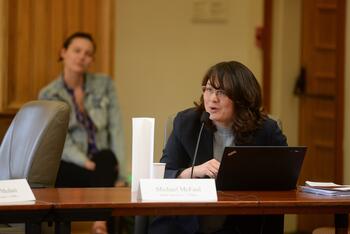
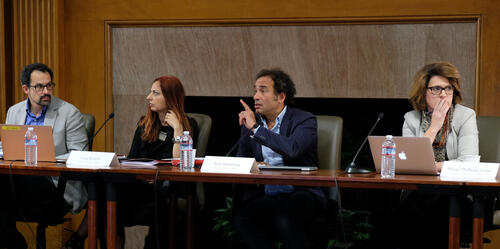
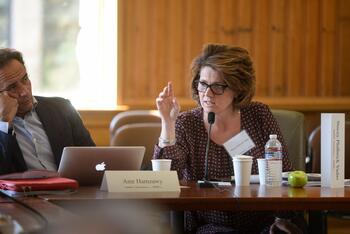
CDDRL’s Program on Arab Reform and Democracy held its annual conference at Stanford University on October 11 and 12, titled “The Struggle for Political Change in the Arab World.” The conference is an outgrowth of ARD’s efforts to support new research on the dynamics of political change in the countries of the Arab world. Scholars from across different disciplines sought to understand how social, economic, and political dynamics at the national level, as well as international and regional conflict and power rivalries, impact struggles for political and social change in the region.
Overview of Panels and Speakers
Image
Following opening remarks by FSI Senior Fellow Larry Diamond, the first panel titled “The Boundaries of Authoritarianism post-Arab Uprisings” featured CDDRL Senior Research Scholar Amr Hamzawy. His paper examined how the regime of Abdel Fattah Al-Sisi has employed discursive strategies to discredit calls for democratic change in the country. Sean Yom, Associate Professor of Political Science at Temple University, outlined how the protest strategies of Jordanian youth have limited their effectiveness in advancing meaningful political change. University of California, Davis Scholar Samia Errazzouki discussed the failure of state-led political and economic reform in Morocco.
Chaired by Harvard University Fellow Hicham Alaoui, the second panel was titled “Popular Uprisings and Uncertain Transitions.” University of California, Santa Cruz Political Scientist Thomas Serres provided an overview of the economic disruptions that contributed to Algeria’s uprising. Lindsay Benstead, who is an Associate Professor of Political Science at Portland State University, analyzed the electoral successes of Tunisia’s Ennahda Party. Khalid Medani, Professor of Political Science at McGill University, explained how Sudanese protesters leveraged new strategies of contention to force Omar Al-Bashir out of power.
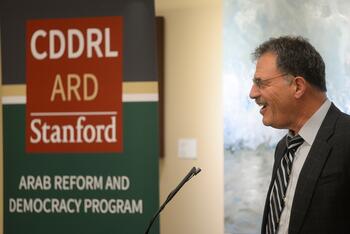
Farah Al-Nakib (right) and Michael Herb (left)
The third panel, titled “Politics, Succession and Sectarianism in the GCC States,” included Oxford University Fellow Toby Matthiesen, who discussed how Saudi Arabia and the GCC states have increasingly sought to protect their regimes by actively molding the politics of their autocratic patrons in the region, and by using new technologies to upgrade the effectiveness of their surveillance states. Georgia State University Political Scientist Michael Herb explained how the aging of the Saudi line of succession contributed to the political ascendancy of Crown Prince Mohammad Bin Salman and the decay of family rule in the country. Cal Poly Historian Farah Al-Nakib described how Kuwait’s royal family has used its sponsorship of large-scale development projects to sidestep the country’s political polarization, undermine the power of the parliament, and weaken public access to spaces of political contestation.
Image
The fourth panel focused on “Social Strife and Proxy Conflict in the Middle East.” Chatham House Scholar Lina Khatib described Syria’s transformation during the civil war from a highly centralized security state to a transactional state in which the regime depends heavily on local powerbrokers. Stacey Philbrick Yadav, Associate Professor and Chair of the Department of Political Science at Hobart and William Smith Colleges, discussed differences in how local communities in Yemen have been affected by the country’s conflict. David Patel, who serves as Associate Director for Research at the Crown Center for Middle East Studies at Brandeis University, argued that Iraq’s democratic institutions have been impressively robust to a series of existential challenges, but he also highlighted a widespread feeling among the Iraqi public that its parliamentary system is failing to deliver.
Image
Finally, the fifth panel examined the topic of “International Forces in the Arab Political Arena.” Stanford University Political Scientist Lisa Blaydes suggested that China’s efforts to involve itself in the regional economy may improve its reputation among economically-frustrated Arab citizens, but that such efforts also spell trouble for democracy and human rights in the Middle East. Hamid & Christina Moghadam Director of Iranian Studies at Stanford University Abbas Milani argued that Iran’s ideological commitment to exporting the Islamic Revolution has been remarkably consistent for several decades. Colin Kahl, Co-director of the Center for International Security and Cooperation at FSI, reviewed the strategies of US administrations toward the Middle East, and posited that President Trump’s approach of pursuing maximalist objectives with minimal commitments is particularly likely to heighten instability in the region. FSI Scholar Ayca Alemdaroglu emphasized that Turkey’s neo-Ottoman foreign policy has failed to achieve its objectives in the face of mounting regional upheaval.
Common Themes of Political Change and Continuity
Image
Several themes emerged from conference presentations. First, across the panels, scholars discussed the lessons learned by autocrats and activists alike in the aftermath of the Arab Spring, and the ways in which these lessons have transformed regional politics. Hamzawy emphasized that the Sisi regime in Egypt has increasingly relied on intensive repression over cooptation to maintain stability, while at the same time refusing to grant even limited political openings as existed under Hosni Mubarak’s presidency. In part, this change appears to be rooted in the regime’s belief that relaxing the state’s authoritarian posture had contributed to the revolutionary upheaval of 2011. Likewise, Matthiesen suggested that Saudi Arabia and the Gulf Cooperation Council States have learned to become more aggressive in strengthening their surveillance apparatus and policing popular discourse transnationally. By contrast, Serres discussed how the Algerian military and bureaucracy have responded to mass protests not by intensifying repression, but instead by attempting to coopt anti-corruption initiatives and democratic reforms to limit political and economic change. Similarly, regarding Kuwait, Al-Nakib illustrated how the restructuring of urban spaces has proved itself a subtle but successful strategy for the royal family to rehabilitate its reputation while limiting geographic focal points for popular politics.
Image
Activists have also learned their own lessons from the aftermath of the Arab Spring. According to Yom, Jordanian activists continue to look to the leaderless revolutions of Tunisia and Egypt as a model to be emulated. As a result, they prioritize agility and horizontality in their protests, and they forgo the organization of formal political movements. This approach has succeeded in acquiring short-term concessions from the regime but has failed to generate broader structural changes. On the other hand, activists in Sudan appear to have been more successful at using lessons from the Arab Spring to push for systematic transformations of their political system. According to Medani, Sudanese protesters developed novel tactics to avoid the repression of the coercive apparatus, and they were effective at gradually forging a counterhegemonic discourse that clearly exposed the regime’s failures to the public. Following the overthrow of Omar Al-Bashir, activists in Sudan have also insisted on dismantling the political and economic might of the deep state to avoid following Egypt’s path.
Image
Second, the conference discussion indicated widespread dissatisfaction with formal political institutions across the region. For instance, Hamzawy suggested that Sisi’s regime has been relatively successful at discrediting civilian political institutions, including the legislature and civilian-led ministries. Errazzouki highlighted widespread dissatisfaction in Morocco with existing political institutions. Likewise, Yom’s discussion of activists in Jordan emphasized their lack of interest in entering formal politics. In Kuwait, the royal court has found an opening to pursue urban development projects outside of normal institutions in part because of the public’s frustration with gridlock in the legislature. Patel speculated that frustration with the parliament and muhasasa system in Iraq may finally prompt major changes to the country’s political process.
Image
Third, despite this disillusionment with formal politics, these political institutions have proved remarkably durable in countries across the region. For example, though current frustrations may finally prompt change in Iraq, Patel also highlighted the resilience of the parliamentary system in the face of a sectarian civil war, US troop withdrawal, the rise of ISIS, and a number of other major challenges. For both Algeria and Sudan, Serres and Medani stressed that militaries continue to exercise significant influence despite the popular uprisings. Meanwhile, for Egypt, Hamzawy noted the firm grip of the current military regime on power, and for Morocco, Errazzouki described the lack of systematic changes to the country’s ruling monarchy, even after years of popular pressure.
Image
Fourth, this durability has not precluded a number of important shifts within existing political institutions. Regarding Syria, for instance, Khatib explained how the survival of Bashar al-Asad’s presidency has depended on moving state institutions away from a centralized security state to a transactional state reliant on local actors with a degree of independence from the regime. Herb described how the consensus-based family rule of the Saudi monarchy fell victim to deaths among the aging senior princes, which opened up opportunities for the king to appoint more officials in a manner that heightened his direct influence. Herb suggested that Mohammad Bin Salman recognized this change and knew that he would likely lose relevance upon his father’s death; as a result, he was motivated to gamble on consolidating his control while his father still held the power to issue royal decrees. In Algeria, the influence of the military and bureaucracy may remain paramount for now, but Serres also pointed out that protesters have succeeded in stripping away the civilian intermediaries who used to protect these institutions. Regarding the durability of local institutions, Yadav noted how pre-conflict and even pre-unification institutions in Yemen have continued to operate effectively in a number of local communities around the country.
Image
Fifth, foreign interventions will continue to destabilize the region and impede prospects for democratization or post-conflict reconstructions in the coming years. Khatib noted that Russia has positioned itself as the agenda setter who can bring the Syrian state back to its feet, but also that Russia and Iran are competing to profit off the country’s reconstruction. For Yemen, Yadav argued that fragmentation at the local level has important implications for best practices in the international community’s reconstruction efforts, but that current actors are not well positioned to understand these trends. Kahl predicted that the Middle East strategy of the Trump administration would likely contribute to further destabilization of the region because of its emphasis on empowering allies to do what they want and go after Iran while the United States maintains its distance. Meanwhile, Blaydes’ presentation on China’s regional involvement, Milani’s discussion of Iran’s efforts to export the Islamic Revolution, and Matthiesen’s observations about the GCC States’ authoritarian coordination all illustrated how intervening states are reducing prospects for democratic political change.
Image
Sixth, even as interventionist countries have contributed to the destabilization of the region, they have also confronted major obstacles themselves – and in some cases have failed outright to achieve their primary objectives. Khatib noted that Iran has faced backlash in Syria, while Abbas Milani and David Patel pointed to backlash against Iran in Iraq. Kahl emphasized that the Trump administration’s Middle East policy was unlikely to achieve its goals. Blaydes observed that China has not acquired greater salience in the Middle East despite its more active economic involvement, and individuals in many of the region’s countries – particularly those that are more developed – do not see China’s growth as a positive force. She also stressed the reputational risks China is taking in pursuing potentially unpopular investments through the Belt and Road Initiative. The GCC States are attempting to prop up strongmen in both Libya and Sudan, but this strategy has struggled in the face of local political dynamics; furthermore, the intervention in Yemen has been a disaster for Saudi Arabia and the UAE. Finally, Alemdaroglu stressed that Turkey’s ambitious “neo-Ottoman” foreign policy, which reflects a desire to revive Turkish influence in areas ruled by the Ottoman Empire, has largely failed. In particular, the architect of the policy, former foreign minister Ahmet Davutoglu, lost his job; the country miscalculated badly in how it handled the aftermath of the Arab Spring; and Turkey’s relations with many of its neighbors have soured.
Hero Image
ARD 2019 Annual Conference participants. Front row (from left): Sean Yom, Stacey Philbrick Yadav, Lindsay Benstead, David Patel, Michael Herb. Middle row (from left): Colin Kahl, Lina Khatib, Hicham Alaoui, Larry Diamond, Samia Errazzouki, Lisa Blaydes, Hesham Sallam. Back row (from left): Toby Matthiesen, Ayca Alemdaroglu, Abbas Milani, Amr Hamzawy, Michael McFaul, Scott Williamson
In a talk dated May 31, 2019, UC Santa Cruz scholars Muriam Haleh Davis and Thomas Serres examined Algeria’s recent uprising, which led to the resignation of President Abdelaziz Bouteflika. The talk shed light on the protests, analyzing them both in a historical lens while also addressing the future prospects for democratic change and their implications for regional geopolitics. The speakers explored the role of the war of independence (1954-1962) and civil war (1992-1999) in political contestation, questions of language and national identity, and the landscape of the current political opposition.
Islamism has imitated, or colluded with, the state autocracies it claims to oppose. It has failed to suggest its own answers to economic problems, social justice, education or corruption, writes Hicham Alaoui in Le Monde diplomatique. Click here to read the full article, which is based on research that Alaoui presented at UC Berkeley and CDDRL on October 10 and 11, respectively.
Hero Image
Supporters of former Egyptian President Mohammed Morsi at a Muslim Brotherhood rally. December 12, 2012. | Yuli Weeks for VOA
Abstract: In November 1954, French Algeria erupted in violence. Confronted with a growing nationalist revolution, French authorities turned to not only to repression, but to a radical program of social reform aimed at capturing Algerian Muslims’ hearts and minds. Why, beginning in the 1950s, did the French Army come to see its task not only as conventional combat, but also social engineering? Historians often focus on the violence employed by the French Army during the war, but in so doing, they have missed both the full scope and the novelty of the French state’s strategy of “Pacification.” Drawing on archival research and oral interviews, I show that French commanders did not simply seek to preserve colonial rule, but to radically remake Algerian society along French lines. French civil and military leaders sought to discover an alternative model of decolonization –one capable of immunizing Algeria against subversive Cold War threats and guaranteeing its future as part of France. In the process, they transformed the norms of modern warfare, and laid the foundations of the postcolonial relationships between Europe and the Muslim world.
About the Speaker: Terrence Peterson is a Postdoctoral Fellow at CISAC for 2015-2016, where he is working on the development of French and international counterinsurgency theories during the period of decolonization. He earned a PhD in History from the University of Wisconsin-Madison in 2015. Entitled “Counterinsurgent Bodies: Social Welfare and Psychological Warfare in French Algeria, 1956-1962,” his dissertation examines the French Army’s efforts to counter a nationalist revolution by combining population development projects and mass psychology techniques to ‘modernize’ Algerian Muslims and remake them in the image of Frenchmen. Fulbright grantee to France for the year of 2012-2013, his current research focuses on the intersections between the Cold War, decolonization conflicts, and the development of counterinsurgency doctrines. In addition to several articles under way, his article “The ‘Jewish Question’ and the ‘Italian Peril’: Vichy, Italy, and the Jews of Tunisia, 1940-1942” appeared in the Journal of Contemporary History in April 2015.
Abstract: Despite growing interest in the phenomenon of Third World internationalism, the post-colonial world’s contribution to modern international history is still greatly under-appreciated. Important South-South dynamics are neglected in order to privilege a North-South framework of analysis, while excessive preoccupation with the discourse of the 1955 Bandung Conference obscures the substantive and changing nature of the Third World project. However, new evidence from countries like Algeria and the former Yugoslavia now make it possible to re-examine “Third Wordlism” as a geopolitical project and diffuse ideology. This paper argues that Third Worldism evolved from a subversive transnational phenomenon into a conservative and state-centric international one. By determining the nature of decolonization—that is, the universalization of the sovereign state model—Third Worldist forces helped to reshape the entire contemporary international system. Moreover, by stoking international tensions for their own advantage (contrary to the public rhetoric of the Non-Alignment Movement), countries like Algeria played an under-appreciated role in prolonging and globalizing the Cold War.
About the Speaker: Jeffrey James Byrne studied at Yale University and the London School of Economics, and is now Assistant Professor of history at the University of British Columbia, Vancouver. He writes on the international history of the twentieth century, with a particular interest in Africa, the Middle East, decolonization, and the connections between developing countries. His work has been published in the International Journal of Middle East Studies, Diplomatic History, and numerous essay collections. His first book, Mecca of Revolution: Algeria and the Third World’s Cold War, is forthcoming from Oxford University Press in 2015.
About the Topic: Recent revelations indicate the extent to which the government has used data-mining as a tool for surveillance, and the lengths to which it used official secrecy to conceal the scope and nature of its activities, all in the name of national security. What if data-mining could also be a tool for citizens to ensure government accountability? This talk will describe new research using computational methods to explore large corpora of declassified documents. It includes efforts to detect unstudied events, identify topics deemed particularly sensitive, and measure how official secrecy shapes the official record. This work is still exploratory in nature, and the challenges to be overcome are political and ethical, and not just technical. But it is already clear that computational methods will be essential if the government is to adopt a more enlightened, risk-management approach to official secrecy.
About the Speaker: Matthew Connelly’s work seeks to offer new, more productive ways to think about the history – and future – of world politics. He works with computer scientists and statisticians to try to uncover the scope and nature of official secrecy, and venture predictions about what a fuller accounting might reveal about major global threats. His publications include A Diplomatic Revolution: Algeria's Fight for Independence and the Origins of the Post-Cold War Era (2002), and Fatal Misconception: The Struggle to Control World Population (2008). He has written research articles in Comparative Studies in Society and History; The International Journal of Middle East Studies and The American Historical Review, and published commentary for The Atlantic Monthly and The National Interest. He received his Ph.D. from Yale University in 1997.
CISAC Conference Room
Matthew Connelly
Professor of History
Speaker
Columbia University
The republican tradition continues to frame French debates on empire, as it has done since the Revolution. French republicanism and Anglophone liberalism have shared numerous features in relation to empire: both are egalitarian traditions of moral universalism, and both uphold an ideal of political emancipation that has tended to entail assimilation to a European political model. This paper explores the course of French debates over empire from the period of Napoleon through the July Monarchy — the broader context for the thought of the iconic liberal republicans Constant and Tocqueville — with particular attention to the ways in which liberal and republican registers were deployed in both support and critique of empire, and to how the articulation of liberal and republican agendas in France was affected by the Algeria conquest. It also discusses the first Algerian contribution to French public deliberation about the conquest, Hamdan Khodja’s 1833 text Le Miroir, a work that self-consciously inhabited both a liberal cosmopolitan and a Muslim perspective and that was nearly alone in French debates in making a principled argument for Algerian.
U.N. Secretary-General Ban Ki-moon on Thursday urged Stanford students to become global citizens, working together beyond borders for peace, security and a common prosperity.
"You may come from the United States or Korea, Japan or elsewhere, Arab countries, but you're now part of a global family," Ban said to a crowded auditorium during his campus visit. "Therefore, it's very important to raise your capacity as global citizens. Only then, I think we can say, we're living in a very harmoniously prosperous world."
Despite a troubling tally of crises around the world, Ban was hopeful about the future, and said he gains inspiration from the younger generation.
"Everything my life has taught me points to the power of international solidarity to overcome any obstacle," he said.
Ban's speech, sponsored by Stanford's Freeman Spogli Institute for International Studies and the Walter H. Shorenstein Asia-Pacific Research Center, kicked off a series of events celebrating the 30th anniversary of the center.
Ban was introduced by former Secretary of Defense William Perry, an FSI senior fellow, who lauded Ban for his work on women's rights, climate change, nuclear disarmament and gay rights.
Ban told the audience that the world was undergoing massive changes and outlined three ways to navigate the transition: sustainable development, empowering young people and women, and pursuing dignity and democracy.
"The level and degree of global change that we face today is far more profound than at any other period in my adult lifetime," he said.
"We have no time to lose," he added later.
California, he said, has led on clean air legislation, creating a cap-and-trade law to reduce greenhouse gas emissions.
"I am convinced national and state action can spur progress in global negotiations, creating a virtuous cycle," he said.
Sustainable development, Ban said, goes hand in hand with creating peace. Noting the problems in North Africa and the Middle East, particularly Syria, he said a country cannot be developed if there is no peace and security.
"Syria is in a death spiral," he said. He cited the toll the conflict has taken on Syria's citizens and surrounding countries since the uprising against President Bashar al-Assad began in March 2011. More than 60,000 people, mostly civilians, have been killed. Hundreds of thousands more have been displaced.
Ban spoke at Stanford as a hostage crisis also unfolded in the region.
In retaliation for military action by France in the West African nation of Mali, Islamist extremists in Algeria took several hostages at an international gas field Thursday. News organizations reported that the kidnappers and some hostages were killed in a raid by the Algerian government.
Ban spoke of the efforts by the United Nations to counter terrorism in Mali, where Islamist rebels last year took control in the north in the chaos following a military coup that ousted the elected government of President Amadou Toumani Touré.
"We must continue to work for peace," Ban said. "Our hard work cannot be reversed, especially for women and young people."
With half the world's population under the age of 25, Ban said the international community must support and empower that group.
Ban also said that fighting for equality for lesbian, gay, bisexual and transgender communities was important in advancing peace and prosperity around the world.
"I have learned to speak out for one essential reason," he said. "Lives and fundamental values are at stake."
Ban told the students to harness a spirit of hope as they confront the challenges of the world.
For him, he said, that spirit was sparked by a visit to California decades ago. He reflected on an eight-day visit to the state in 1962, when he stayed with a family, the Pattersons, in Novato on a trip sponsored by the Red Cross.
"In many ways, I still carry the same energy and enthusiasm and sense of wonder that I did when I first landed on Miss Patterson's doorstep half a century ago," he said.
"I came back knowing what I wanted to do with my life and for my country," he said.
Ban said he still keeps in touch with his host, his "American mom," 95-year-old Libba Patterson, who was in the audience and stood to applause.
"It was here in California," he reflected to the students, "that I first felt I could grab the stars from the sky."
Brooke Donald writes for the Stanford News Service.
Hero Image
U.N. Secretary-General Ban Ki-moon speaking at Stanford's Dinkelspiel Auditorium on Thursday. | L.A. Cicero


 Farah Al-Nakib (right) and Michael Herb (left)