Paragraphs

We show how exposure to partisan peers, under conditions requiring high stakes cooperation, can trigger the breakthrough of novel political beliefs. We exploit the large-scale, exogenous assignment of soldiers from each of 34,947 French municipalities into line infantry regiments during World War I. We show that soldiers from poor, rural municipalities---where the novel redistributive message of the left had previously failed to penetrate---voted for the left by nearly 45% more after the war when exposed to left-wing partisans within their regiment. We provide evidence that these differences reflect persuasive information provision by both peers and officers in the trenches that proved particularly effective among those most likely to benefit from the redistributive policies of the left. In contrast, soldiers from neighbouring municipalities that served with right-wing partisans are inoculated against the left, becoming moderate centrists instead.

All Publications button
1
Publication Type
Working Papers
Publication Date
Journal Publisher
Rockwool Foundation Berlin
Authors
Saumitra Jha
Authors
News Type
News
Date
Paragraphs

Motivation


Retaliation (or the threat thereof) is a central component of human behavior. It plays a key role in sustaining cooperation — such as in international organizations or free trade agreements — because those known to retaliate come to acquire a reputation of being hard to exploit. But how does the use and function of retaliation vary across cultures, and how does it interact with formal forms of punishment?

In “Cross-cultural differences in retaliation: Evidence from the soccer field,” Alain Schläpfer tackles these questions using data on retaliation from association football. Retaliation is simply defined in terms of fouling: player B retaliates against player A if and only if, after A fouls B, B then fouls A. Among other findings, Schläpfer shows that players from cultures emphasizing revenge are more likely to retaliate on the football field. This form of ‘informal punishment’ by players also interacts with ‘formal punishment’ by referees: retaliation by B is less likely when A is sanctioned with a yellow card. Schläpfer’s paper increases our knowledge of the causes and consequences of retaliation, while showing how informal cultural norms interact with the formal rules of football.  

Data


Schläpfer creates a data set of fouls committed over three football seasons (2016-2019) in nine of the world’s top professional men’s leagues. This includes the European leagues of Premier League (England), Serie A (Italy), Bundesliga (Germany), LaLiga (Spain), and Ligue 1 (France), as well as Série A (Brazil), Liga Profesional (Argentina), Liga MX (Mexico), and Major League Soccer (United States). The dataset comprises 9,531 games, 230,113 fouls committed by 10,928 unique perpetrators from 139 countries against 11,115 unique victims from 137 countries.

Because Schläpfer hypothesizes that being from more revenge-centric cultures explains on-field retaliation, the key independent variable is measured using a dataset from Stelios Michalopoulos and Melanie Meng Xue that identifies revenge motifs in a culture’s folklore. Examples of this include supernatural forces avenging human murders or animals avenging the death of their friends by humans. Schläpfer uses a host of other independent variables, such as country-level survey data about the desire to punish — as opposed to rehabilitate — criminals, which is also theoretically linked to revenge. As stated above, retaliation is measured in terms of fouls committed. Schläpfer shows that there is substantial variation in retaliation rates among players from different countries, from Gabon (8%) to Iceland (31%). Can the folklore in the country of origin explain the behavior of players on the field?


Image
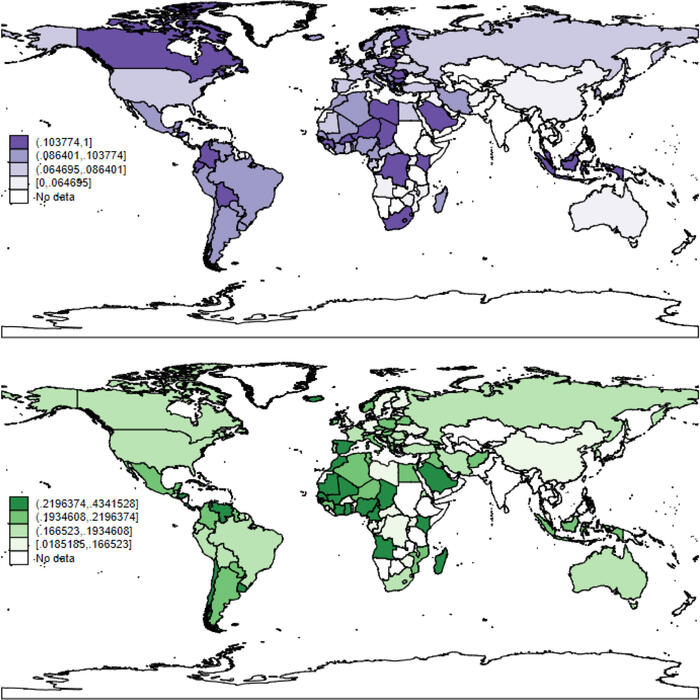
Fig. 1. The share of fouls retaliated in soccer games (top) and the prevalence of revenge motifs in folklore (bottom). Both variables tend to have higher values for players and folklore from the Middle East, Central Africa, Eastern Europe, and parts of South America.


Fig. 1. The share of fouls retaliated in soccer games (top) and the prevalence of revenge motifs in folklore (bottom). Both variables tend to have higher values for players and folklore from the Middle East, Central Africa, Eastern Europe, and parts of South America.


Findings


Retaliation:

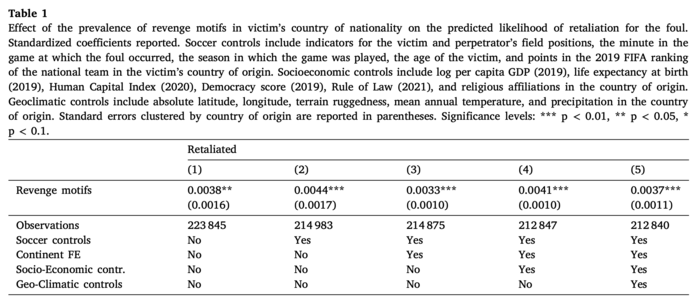
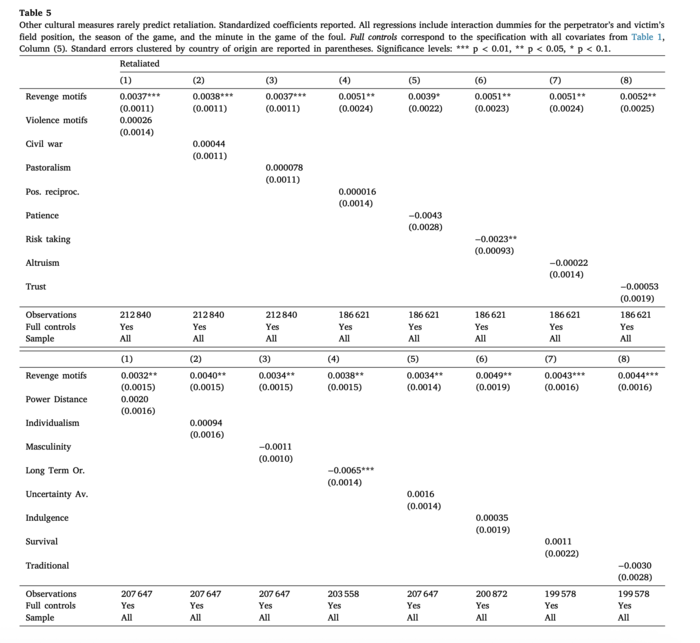
Schläpfer finds evidence that players from cultures that value revenge are indeed more likely to retaliate for fouls. However, they are not more likely to commit fouls overall, cautioning us against conflating the concepts of retaliation and violence. Indeed, Schläpfer demonstrates that motifs of violence in a culture's folklore do not predict retaliation. Players are also found to be more retaliatory early on in a game, which is consistent with its use as a signal or aspect of one’s reputation. In other words, retaliation serves to deter future fouls. Victims of fouls also retaliate quickly. Indeed, retaliation rates are stable or slightly increasing during the first 30 minutes of a game, but then fall consistently thereafter.


Image
Table 1. Effect of the prevalence of revenge motifs in victim’s country of nationality on the predicted likelihood of retaliation for the foul.


Evidence is also provided to show that retaliation deters future transgressions: perpetrators are less likely to foul again if victims retaliate for the initial foul. However, this deterrence finding is only observed when the perpetrator is from a revenge culture. In other words, for retaliation to support cooperation (the absence of fouls), players must share a similar cultural background.

Schläpfer’s findings hold even when soccer-related or socioeconomic factors are taken into account. Further, the paper considers, but finds little support for, alternative explanations of why retaliation varies. These include that some teams encourage players to retaliate more or employ more players from revenge cultures. Further, retaliation does not appear to be driven by emotions; otherwise, it would be less likely to occur after halftime when players have had a chance to cool down, but this is not the case.


Image
Table 5. Other cultural measures rarely predict retaliation. Standardized coefficients reported.


Informal and Formal Sanctioning:

Finally, Schläpfer analyzes the interaction between player retaliation and refereeing. Most importantly, retaliation is significantly less likely if a foul is sanctioned with a yellow card. This illustrates the theoretical principle of formal punishment “crowding out” informal punishment, such as religious excommunication, which carries greater weight than social shunning or police fines compared to peer pressure. Both retaliation and referee sanctioning are shown to reduce the frequency of repeated offenses by perpetrators, especially among players from revenge cultures. However, Schläpfer finds that formal sanctioning is roughly three times more effective than retaliation. This suggests that football referees are doing a better job managing conflict between players than players themselves. 

Schläpfer concludes by mentioning a few of the paper’s limitations. First of all, retaliation is measured only by what referees sanction. However, referees may miss crucial incidents for which retaliation is a response, such as Zinedine Zidane’s 2006 World Cup headbutt after a verbal insult (that was not sanctioned). This is important because individuals from revenge cultures are likely to be particularly offended by verbal insults. Second, the paper does not capture retaliation that occurs across games played by the same teams over time, particularly when rivalries and hostilities have intensified. Similarly, it does not account for preemptive retaliation that does not follow a foul. Ultimately, Schläpfer deepens our understanding of retaliation in a domain where many would expect it not to operate or to do so with minimal significance. The article impressively marshals large-scale data from both sports and cultural history to clarify the causes and consequences of retaliation.

*Research-in-Brief prepared by Adam Fefer.

Hero Image
A person in a red and blue football uniform on a field Jona Møller via Unsplash
All News button
1
Subtitle

CDDRL Research-in-Brief [4-minute read]

Date Label
Paragraphs

We compare political mobilization and support for democratic values during the French Revolution among the home bailliages and among individual members of French regiments sent with the Comte de Rochambeau to fight alongside American revolutionaries (1781-83), to others also assigned there who failed to arrive due to logistical failures and British blockade. We provide evidence for revolutionary contagion: bailliages with 10% more Rochambeau veterans were 6.4% more likely to submit grievances to the King that were “Most Strongly Democratic” in 1789. They mobilize political clubs earlier, are more likely to engage in revolt and as individuals were more likely to show loyalty to moderate democratic revolutionary reforms both within the army and the National Assembly. Other veterans mobilize too, but less so and not for democratic principles. Similarly, exposure to Enlightenment ideas has limited effects absent American veterans. We interpret these results as reflecting the complementarity between exposure to democratic ideas and organizational skills of veterans in generating contagion between two of the world’s great revolutions.

All Publications button
1
Publication Type
Working Papers
Publication Date
Journal Publisher
CDDRL Working Papers
Authors
Saumitra Jha
Paragraphs

ABSTRACT

This article presents the first reassessment of the strategic rationality and credibility of French nuclear weapons policy before 1974. Building on untapped primary material from across the world as well as technical analysis, it shows that early Cold War French nuclear weapon procurement and deployment are incompatible with a precise grand design and the requirements of strategic rationality. The first generation of French nuclear forces also lacked technical credibility, despite reliance on outside help. Several French officials knew about it, as did their allies and adversaries. These findings de-exceptionalise French nuclear history and challenge conventional wisdom about Cold War nuclear history.

Read the rest at Cold War History

All Publications button
1
Publication Type
Journal Articles
Publication Date
Subtitle
This article presents the first reassessment of the strategic rationality and credibility of French nuclear weapons policy before 1974.
Journal Publisher
Cold War History
Authors
Paragraphs

We estimate the relationship between distributed generation investments and hourly net injections to the distribution grid across over 2,000 substations in France between 2005 and 2018. A 1 MW increase in solar PV capacity has no statistically significant impact on the highest percentiles of the annual distribution of hourly net of injections to the distribution grid. A 1 MW increase in wind capacity is predicted to reduce the 99th percentile of the annual distribution of hourly net injections to the distribution grid by 0.037 MWh. In contrast, a 1 MW investment in a distributed small hydro, non-renewable thermal, or renewable thermal generation unit predicts an almost five times larger MWh reduction in the 99th percentile of the annual distribution of hourly net injections to the distribution grid. A 1 MW investment in distributed solar PV or wind capacity predicts substantial absolute changes in both extremes of the annual distribution of hourly ramp rates of net injections to the distribution grid. For the remaining three distributed generation technologies, a 1 MW capacity increase does not predict a non-zero change in any percentile of the annual distribution of hourly ramp rates of net injections to the distribution grid. These results argue that, at least for the case of France, increases in distributed solar and wind capacity are more likely to lead to increases, rather than decreases, in distribution network investments.

All Publications button
1
Publication Type
Working Papers
Publication Date
Authors
Frank Wolak
All Publications button
1
Publication Type
Journal Articles
Publication Date
Subtitle
Crop type mapping at the field level is critical for a variety of applications in agricultural monitoring, and satellite imagery is becoming an increasingly abundant and useful raw input from which to create crop type maps. Still, in many regions crop type mapping with satellite data remains constrained by a scarcity of field-level crop labels for training supervised classification models. When training data is not available in one region, classifiers trained in similar regions can be transferred, but shifts in the distribution of crop types as well as transformations of the features between regions lead to reduced classification accuracy. We present a methodology that uses aggregate-level crop statistics to correct the classifier by accounting for these two types of shifts. To adjust for shifts in the crop type composition we present a scheme for properly reweighting the posterior probabilities of each class that are output by the classifier. To adjust for shifts in features we propose a method to estimate and remove linear shifts in the mean feature vector. We demonstrate that this methodology leads to substantial improvements in overall classification accuracy when using Linear Discriminant Analysis (LDA) to map crop types in Occitanie, France and in Western Province, Kenya. When using LDA as our base classifier, we found that in France our methodology led to percent reductions in misclassifications ranging from 2.8% to 42.2% (mean = 21.9%) over eleven different training departments, and in Kenya the percent reductions in misclassification were 6.6%, 28.4%, and 42.7% for three training regions. While our methodology was statistically motivated by the LDA classifier, it can be applied to any type of classifier. As an example, we demonstrate its successful application to improve a Random Forest classifier.
Journal Publisher
Remote Sensing of Environment
Authors
David Lobell
Authors
News Type
Commentary
Date
Paragraphs

President Volodymyr Zelensky reportedly will soon travel to Paris to meet with French President Emmanuel Macron. That is a trip very much worth making. After German Chancellor Angela Merkel steps down this fall, Zelensky may find himself more dependent on Macron, both in the Normandy format and for leadership in the European Union regarding the conflict that Russia has inflicted on his country.

The sooner Zelensky gets to Paris, the better.

First, he could ask Macron to call explicitly on Vladimir Putin to deescalate the tensions Russia has caused by its large and continuing build-up of military forces near Ukraine.

On April 3, the German and French foreign ministries issued a statement calling for restraint on “all sides”—a wrongly balanced appeal given that Russian actions provoked the crisis.  Merkel corrected this on April 8, when she spoke with Putin and “demanded that this [Russian] build-up be unwound in order to de-escalate the situation.” Macron has yet to speak in such clear terms.

Second, Zelensky should strengthen Macron’s understanding of the conflict and Ukraine’s position.  The Germans and French have for six years sought to broker a settlement between the Ukrainians and Russians in the Normandy format, with Merkel playing the lead role.  Later this year, when she steps down, the leadership of that process may well pass from Berlin to Paris.

Ukrainians often express frustration with the Normandy format and the Minsk II agreement that it produced in February 2015.  The terms of the agreement were never fully implemented, and thousands of Ukrainians have since died.  Berlin and Paris have not found the key to getting Russian and Russian proxy forces to leave Donbas, to say nothing of occupied Crimea.  (In fairness, it is not clear that anyone could have.)

However, the Normandy process has kept the two large continental European powers engaged in trying to resolve the conflict. That is to Kyiv’s advantage. The Minsk II agreement has provided the basis for sustaining European Union sanctions on Russia, sanctions that have proven far more resilient than many would have predicted when EU member states first approved them in 2014.

Merkel and German diplomats deserve credit for maintaining EU unity on sanctions, despite calls from some member states to move back toward business as usual with Moscow.  She has taken a greater interest in the Russia-Ukraine conflict than Macron or his predecessor.  That reflects in part her background, having been raised in the German Democratic Republic, her understanding of Russia, and her command of Russian.

But Merkel steps down this fall after 16 years as chancellor. While the German election is still more than five months off, most predictions suggest one of two coalitions will result: a combination of the Christian Democratic Union/Christian Socialist Union and Greens Party, or a grouping of the Greens, the Social Democratic Party, and Free Democratic Party.

In the first combination, the likely candidates for chancellor are Armin Laschet and Markus Soeder.  Both come from what was West Germany.  Neither has real experience with or appears to have shown particular interest in the Russia-Ukraine conflict.  Either might question the investment that Merkel put into the Normandy discussions, given that they have not succeeded and offer little pay-off in terms of German domestic politics.

In the second combination, the chancellor likely would come from the Greens.  That could bode well for Kyiv, as the Greens are skeptical about Russia, criticize Moscow’s human rights record, and oppose the Nord Stream 2 gas pipeline.  However, the Greens have been out of government since 2005, and they might need time to get up to speed.

If the new German chancellor is uninterested in or needs time to engage in a meaningful manner, leadership within the Normandy format will move to Paris, something the Kremlin likely would welcome.  Macron has taken a less harsh tone on Russian misbehavior.  He has sought to regenerate links with Moscow.  For example, before the 2019 G7 summit in France, he hosted Putin for a bilateral meeting, seemingly seeking to make Paris a bridge between Moscow and the rest of the G7.

A pro-Russian tilt, even a small one, in the duo heading up the Normandy format process is hardly in Kyiv’s interest.  Zelensky needs to make his strongest possible case to Macron as regards the realities of the Russia-Ukraine conflict, for continuing to steward the Normandy format with Merkel’s steadiness, and for not succumbing to Putin’s blandishments, which would come at Ukraine’s expense.


Originally for Kyiv Post

Hero Image
Ukraine's President Volodymyr Zelenskiy (L) and French President Emmanuel Macron
AFP
All News button
1
Subtitle

President Volodymyr Zelensky reportedly will soon travel to Paris to meet with French President Emmanuel Macron. That is a trip very much worth making.

Authors
News Type
Q&As
Date
Paragraphs

We often think of language as a democratic field, but it is not quite the common property of its speakers, argues Jeffrey Weng, APARC’s 2020-21 postdoctoral fellow on contemporary Asia. Rather, language is a skill that must be learned, says Weng, and it creates social divisions as much as it bridges divides. 

Weng studies the social, cultural, and political nature of language, with a focus on the evolution of language, ethnicity, and nationalism in China. His doctoral dissertation investigates the historical codification of Mandarin as the dominant language of contemporary mainland China. This summer, he will begin his appointment as an assistant professor at National Taiwan University. In this interview, Weng discusses the dynamics between linguistic and social change and the implications of his research for Asian societies today.


[Subscribe to APARC's newsletters to stay informed on our scholars' research.]


What has shaped your interest and research into the study of language and linguistic dissemination?

As a first-grade student in the early 1990s attending Chinese school in central New Jersey on Saturday mornings, I learned how to write my first complete sentence in the language: “I am an overseas Chinese.” Now, this was a curious sentence to teach to a class full of American-born children of Taiwanese parents, and it’s a reminder that language is never a neutral conveyor of meaning. Language cannot but be freighted with social, cultural, and political import, a lesson reinforced in my high-school Spanish classes, in which I made my first forays into literature in a foreign language: stories by the great writers of Spain and Latin America not only spoke a wholly different language, but they told wholly different stories from those of their British and American counterparts.

Linguistic difference also is a signal of individual and social difference: my childhood visits with family in Taiwan opened my ears to a cacophonous Babel in the media and on the streets—though we spoke Mandarin at home, whenever we went out, people speaking Taiwanese were everywhere to be seen and heard. This was further amplified when I visited mainland China for the first time in my early 20s. Beijing, the supposed wellspring of the nation’s language, was bewildering—I could not understand much of the unselfconscious speech of the locals. And traveling several hundred miles in any direction would only deepen my incomprehension. And yet, on the radio and on TV, during formal events and on university campuses, there was always Mandarin to clear the way. I wanted to learn more about how this language situation came to be. For me, studying the social, cultural, and political nature of language is a way to a deeper understanding of how people are united and divided in vastly different contexts across the globe.

As you’ve looked deeper into how language shapes society and society shapes language, what is something surprising you’ve come to realize about that relationship?

People often see language as the ultimate democratic field when it comes to cultural practice. No matter how much you might tell people not to split their infinitives or end their sentences with prepositions, popular practice will always win the day. Or so we English speakers think. Ever since Merriam-Webster came out with its infamously descriptivist Third New International Dictionary in 1961, Anglophone language nerds have fought over whether dictionaries should be “prescriptive”—that is, rule-setting—or “descriptive”—reflective of popular usage. But really, these are two sides of the same coin. We take it for granted that privately-owned publishers of dictionaries spell out the supposed norms of our language. Not only that, we even think this ought to be the case. French is the usual counterexample: when government language authorities in Quebec or Paris try to stem the Anglophone tide, we think it absurd that so-called authorities would ever try to rule over something so fundamentally unruly as language.

In my research, however, I learned how fundamentally invented Mandarin as a language is—from its highly artificial pronunciation to the way its orthography has been stabilized. There used to be a lot of variability in how characters were written and how they could be used, much like English spelling before the 18th century. Mandarin, both spoken and written, was standardized only in the 1920s to facilitate mass literacy and national cohesion. So linguistic change might often follow and reflect social change, but the process can also operate in reverse—a government can change language in hopes of facilitating social change.

In your latest journal publication, you argue that language nationalization in Japan, Korea, and Vietnam between 1870-1950 was a state-led, top-down process directed at remaking society rather than the more traditional view of diffusion through trade, economics, and cultural exchange. Why is this an important distinction to make?

Again, we often see language as a democratic field, the common property of its speakers, but it isn’t really. Sociolinguists are often quick to remind us that linguistic differences reflect class differences—“proper” language is that of “educated” speakers. But language is a skill, and skills must be learned. Some people can learn skills more easily than others, whether through natural ability or, more importantly, the life circumstances they were born into. Rich people can more easily get a good education. Educational disparities are now part and parcel of today’s broader debates about inequality. But the very fact that we think this is a problem is a product of developments in the late 19th and early 20th centuries.

Before then, broad swaths of humanity were totally illiterate and had no chance at being educated, and most people did not think this was a problem. In Europe, the language of the Church and academia, even to some extent in Protestant areas, was Latin until the 18th century. Local vernaculars had gradually developed as independent media of communication in government chancelleries and popular literature since the Middle Ages, but they did not really gain ascendancy until the age of print-capitalism and nationalism in the 18th and 19th centuries. Marxian-influenced scholars have therefore concluded that the rise of national languages coincided with the rise of the bourgeoisie, whose own languages became those of the nations they constructed.

In France, for example, while revolutionaries in the 1790s advocated the use of Parisian French to unify a country divided by hundreds of local forms of speech, into the mid-19th century, even journeying 50 miles outside Paris found travelers having trouble making themselves understood to the locals. It took more than a century for French to gain a foothold in most of the country. Asia, too, was a polyglot patchwork for millennia, unified at the top by an arcane language much like Latin—Classical Chinese. This situation became politically untenable in the 19th century as European imperialism encroached on traditional sovereignties in China, Japan, Korea, and Vietnam. In order to counter the foreign threat, governments sought to strengthen their societies by educating their populations, which required making it easier to learn how to read and write. While standard languages have been described by historians and sociolinguists as “artificial” for less-privileged learners, Asia’s standard languages were artificial even to their bourgeois inventors.

Our understanding of the present is invariably colored by our interpretation of the past: if we understand a national language to be a bourgeois imposition that diffused via economic development, then we more easily see its continued imposition as a perpetuation of class prejudices. If on the other hand, we see an invented national language as a tool for bridging regional divisions and expanding economic opportunity for our children, then we feel much more positively about the spread of such languages. Both interpretations can be true at the same time, but we must remember that one is inseparable from the other.

Do you see any parallels between how language nationalization has occurred in the past to how language and society are shaping one another in the present?

The number of “standard” Mandarin speakers in the early 1930s could be counted on one hand. Today, it’s the world’s largest language by a number of “native” speakers. Though it began as an elite nationalizing project that was largely ignored by the masses of people in China, Mandarin is now more often seen as a hegemonic threat to local languages and cultures. Language can thus bridge divides, but also create new divisions. People in China are often ambivalent about the pace of change these days. When I visited cousins in rural Fujian during the Lunar New Year a few years ago, I noticed that all my nieces and nephews spoke Mandarin in almost all situations, to their parents, and especially to one another. Only my grandparents’ generation used the local Fuqing dialect as a matter of course. My parents’ generation spoke dialect to their parents, but a mix of Mandarin and dialect to their children—the cousins of my generation, who were able to speak the dialect, but were more comfortable speaking Mandarin among themselves and to their children. One of my young nieces who’d grown up in Beijing, where her parents had moved for work, even had a perfect Beijing accent. In a span of three generations, migration due to expanded opportunity had wrought enormous change in language habits. Much had been gained, but also much had been lost.

How has your time at APARC as one of our Shorenstein Postdoctoral Fellows aided your research project?

It’s certainly been a strange year to be a postdoc, given how we’ve all been operating remotely. Nevertheless, life and work have continued, and we’ve all been able to find new ways of building community and getting things done. I’ve personally benefited from the access to the vast academic resources of Stanford—library access, even online alone, is a lifeline to any researcher. Moreover, I’ve had the opportunity to chat on Zoom with Stanford faculty about research and connect with my fellow postdocs to support one another as we figure out how to move forward in our careers in these challenging times.

With your recent appointment as an assistant professor at National Taiwan University in Taipei, how do you anticipate your research interests growing and developing given the tension between Taiwan and China?

I am gratified to begin my academic career in a place of such diversity and openness as Taiwan. Language and identity are constant sites of contention in Taiwan's politics, and I look forward to expanding my on-the-ground understanding of these issues as I begin teaching in the sociology department at National Taiwan University. It is nothing short of miraculous that democracy has flourished at such an intersection of empires, colonialism, repressions, and struggles. And it is unsettling to see that flourishing takes place in such a precarious geopolitical location. NTU's sociology department is at the forefront of understanding all of these vital issues as we barrel forward into an ever more uncertain future.

Read More

Stanford campus, main quad with cloudy sky
News

APARC Offers Fellowship and Funding Opportunities to Support, Diversify Stanford Student Participation in Contemporary Asia Research

The Center has launched a suite of offerings including a predoctoral fellowship, a diversity grant, and research assistant internships to support Stanford students interested in the area of contemporary Asia.
APARC Offers Fellowship and Funding Opportunities to Support, Diversify Stanford Student Participation in Contemporary Asia Research
Spring blooms in the courtyard near History Corner, Stanford University.
News

APARC Names 2021-22 Shorenstein Postdoctoral Fellows

Political scientist Dr. Diana Stanescu and sociologist Mary-Collier Wilks will join APARC as Shorenstein postdoctoral fellows on contemporary Asia for the 2021-22 academic year.
APARC Names 2021-22 Shorenstein Postdoctoral Fellows
Hero Image
[Left] Postdoc Spotlight, Jeffrey Weng, Shorenstein Postdoctoral Fellow in Contemporary Asia, [Right] Jeffrey Weng
Jeffrey Weng's research examines the relationship between how language shapes society and society shapes language.
All News button
1
Subtitle

Shorenstein Postdoctoral Fellow in Contemporary Asia Jeffrey Weng shares insights from his research into how language and society shape one another, particularly how the historical use of Mandarin affects contemporary Chinese society and linguistics.

Paragraphs

Since November 2018, a grassroots revolt of the forgotten lower middle classes from France’s far-flung suburbs and rural areas has risen against high taxes; social injustice; and the elites, President Emmanuel Macron foremost among them. Although this “Yellow Vest” movement is not dead, it is now weakened by internal feuds, excessive violence, a takeover by the far left, and Macron’s deft handling. Yet this revolt of “la France profonde” has underscored the fragility of Macron’s narrow sociological and political base. Macron’s decisive 2017 election victory owed more to his outsider status, the collapse of the traditional political establishment, and the rejection of the far right (led by Marine Le Pen) than to his free-market and pro-European agenda. In part, the Yellow Vest version of populism was a response to the “populism of the elites” embodied by Macron in 2017. The Yellow Vest movement further illustrates the central class and polarized ideological cleavages that shape the politics of a growing number of advanced democracies.

All Publications button
1
Publication Type
Journal Articles
Publication Date
Journal Publisher
Journal of Democracy
Authors
Patrick Chamorel
Number
4
Authors
News Type
Commentary
Date
Paragraphs

In Aug. 2019, Bobby Chesney (from Strauss Center at the University of Texas at Austin) and Max Smeets (from ETH Zurich and also Stanford University’s Center for International Security and Cooperation (CISAC)) convened a workshop in Amsterdam focusing on military operations in the cyber domain, from a transatlantic perspective. The “Transatlantic Dialogue on Military Cyber Operations—Amsterdam” gathered experts from military, civilian, and academic institutions hailing from a range of countries, including the United States, United Kingdom, Germany, the Netherlands, Denmark, Estonia, and France.


Read the Rest at Lawfare Blog

Hero Image
screen shot 2019 12 18 at 8 32 53 am
All News button
1
Subscribe to France