


Rethinking illegal drug policy in Thailand
News Type
Q&As
Date
Paragraphs
In a Q&A, Stanford postdoctoral fellow Darika Saingam explains why Thailand's battle against drugs continues and what is needed to introduce good policy that works to prevent illegal drug trade and supports recovering addicts.
Despite Thailand’s decade-long crackdown on drugs, demand for illegal substances has risen. A green leaf drug known as ‘kratom’ is a symbol of this rise as young people eagerly adopt the drug for entertainment and join an older generation of laborers who chewed it to survive long hours of work in the fields—and are now heavily addicted. Curtailing substance abuse and its consequences takes good public policy and solutions must be area-specific and evidence-based, according to a Stanford postdoctoral fellow.
Darika Saingam, the 2015-16 Developing Asia Health Policy Postdoctoral Fellow, has conducted two cross-sectional surveys and more than 1,000 interviews with drug users, recovered addicts, and local public officials in an effort to better understand the evolution of substance abuse in southern Thailand.
At Stanford, she is preparing two papers that offer policy options suitable for Thailand and other developing countries in Southeast Asia. Saingam spoke with the Shorenstein Asia-Pacific Research Center (APARC) where she will give a public talk on May 17. The interview text below was edited for brevity.
For decades, Thailand has been an epicenter of drugs. Can you describe the extent of the problem today?
According to a 2014 report, 1.2 million people were involved in illegal drug activities across Thailand. The total number of drug cases saw a 41 percent increase from 2013 to 2014. New groups of drug traffickers are mobilizing while existing groups are still active. Drug users who are young become drug dealers as they get older. The number of drug users below 15 years of age has increased dramatically.
According to your research, what drives Thais toward illegal drug use and the trafficking business?
Adults in Thailand use drugs to relieve stress and counteract the effects of work. Adolescents use them for entertainment. Historically, farmers and laborers from rural areas of Thailand would use opium for pain relief. More recently, a consumable tablet known as yaba has become popular along with crystal methamphetamine and marijuana. Young people are increasingly using yaba and kratom.
Thailand is still a developing country, but it is industrializing quickly. Social and cultural norms have been shifting and people want an improved quality of life. A lot of young people are unemployed and lack social support and are therefore more likely to turn to drug trafficking for economic opportunity. The economic recession and political strife in countries bordering Thailand have exacerbated the situation.
Image
Image
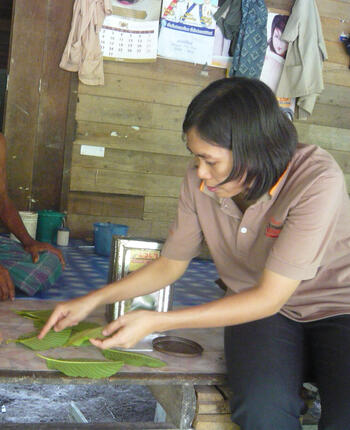
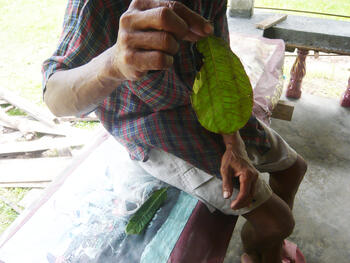
Photos (left to right): A man holds up a kratom leaf. / Saingam examines kratom leaves as part of her research to understand illegal cultivation practices.
What is kratom and why is it popular?
For nearly a century, the native people of Thailand have chewed kratom. It is a leaf that grows on trees resembling a coffee plant. Historically, kratom was used to reduce strain following physical labor, to be able to work harder and longer, and to better tolerate heat and sunlight. Kratom is also embedded in Thai culture and given as a spiritual offering in religious ceremonies. My field research in the southern province of Nakhon Si Thammarat has shown that these motivations are still true today.
Within the past seven years, kratom use has skyrocketed and people are using it in increasingly harmful ways. Chewing kratom is not immediately harmful to health, but combining it with other substances is. This is the recent trend. Users have created new ways to consume it such as in a drink known as a ‘4x100.’ It contains boiled kratom leaves, cough syrup and soft drinks. Additional methamphetamines and benzodiazepines are sometimes added to that mixture.
What strategies must be employed to control substance abuse?
The first step is to realize that the patterns of substance abuse are specific to each location therefore solving the problem must also be. Drug usage is also dynamic. Placing hard control measures on one substance often provokes the emergence of another in its place therefore a holistic approach is important.
Thailand should employ multiple strategies toward effective prevention and control of substance abuse. These strategies include examining the problem and creating policies from an economic perspective (supply and demand), an institutional perspective (national and international drug control cooperation), and a social perspective (structural supports for recovered addicts and mobilization of public participation).
What is the Thai government doing to address the drug problem, and what could they be doing better?
Politicians in Thailand must do a better job at representing the people. Government health workers are often gathering information, assessing needs, and reporting findings to politicians, but these needs are not being accurately addressed. An example of this is politicians ordering to cut down kratom trees – a public display that does not get at the root cause of the problem. The reality is that drug users will quickly find substitutes. According to my study, of the regular users that stopped using kratom, more than 50 percent turned to alcohol instead and did so on a daily basis. This is merely a shift from one substance to another.
On the upside, a crop substitution program created under King Bhumibol Adulyadej offers a successful working model. The program works to replace opium poppy farming with cash crop production. It began in 1969 and is cited for helping an estimated 100,000 people convert their drug crop production to sustainable agricultural activities. Crops cultivated can be sold for profit in nearby towns. The program has also introduced a wide variety of crops and discouraged the slash-and-burn technique of clearing land. It is win-win because it stymies drug trade and provides economic opportunity while also being ecologically sound. This type of program should continue to be scaled up.
Can this model be co-opted elsewhere? What lessons from other countries could inform Thailand’s approach?
Yes, the model could plausibly be implemented in other areas in Thailand and in other Southeast Asian nations.
I think a judicial mechanism such as the kind seen in France could benefit the rural areas in Thailand. The French government has established centers across the country that act as branches of the court that try delinquency cases of minor to moderate severity, and also recommend support services for drug users. Members of the magistrate and civil society actors manage center operations thus placing some responsibility back onto the local community.
I believe an opportunity also exists for Thailand to legalize kratom. Legalization would show a respect for the cultural tradition of chewing kratom leaves and allow the government to suggest safer ways of using it. Bolivia has created a successful model of this through its legalization of coca leaves. Coca in its distilled form is cocaine, but left as a leaf, it is not a narcotic. Indigenous peoples are allowed to chew coca leaves. The government policy is being credited for a decrease in cocaine production as well.
Hero Image

All News button
1
The Possible Approaches for Defusing Tensions in the South China Sea: A Taiwanese Perspective
-
In this talk, Wellington Shih will provide a historical and legal overview of the Republic of China’s territorial claims in the South China Sea. He will also review the latest developments in the ongoing dispute between the People’s Republic of China, the ROC on Taiwan, and other claimants in the region, including the Philippines, and discuss the South China Sea Peace Initiative proposed by the administration of President Ma Ying-jeou.
The Possible Approaches for Defusing Tensions in the South China Sea: A Taiwanese Perspective
Download pdf
Visiting scholar
Ministry of Foreign Affairs, Republic of China (Taiwan)
Lectures
Stanford student shares experiences from UN human rights training conference
News Type
Blogs
Date
Paragraphs
Lauren Wedekind is a Stanford undergraduate studying Human Biology and Democracy, Development, and the Rule of Law. Her research focuses on social medicine and the potential for telemedicine to mitigate health care coverage gaps. Lauren believes that human rights advocacy requires a two-way street of listening and communication within and across national and cultural borders—which she explores with Stanford CDDRL, UNA-USA, and WFUNA on projects involving the right to health. Wedekind received funding from CDDRL's Program on Human Rights to travel and participate in the WFUNA Human Rights Youth Training Conference in Geneva, Switzerland.
By age seventeen, Nam had been forced into marrying a stranger, bearing his child, and risking her life to be a refugee on a remote island. In April 1975, the North Vietnamese Communist Party took over the Republic of South Vietnam, and violently threatened residents of Saigon, South Vietnam’s then-capital and Nam’s hometown. Like thousands of other residents, Nam’s family desperately uprooted from their relatively comfortable living situation, only to cram like sardines into an over-capacity boat headed toward international waters, hoping to be rescued by the United Nations. With their lives in very real danger, the to-be refugees who boarded that boat did so without any guarantee that they would safely cross the passage across the Pacific Ocean. In fact, these “boat people” were held hostage, robbed, raped, and beaten on three separate occasions by pirates in the Sea of China. After the attacks, they floated aimlessly on the ocean for days, and were finally rescued by a UNHCR vessel, which guided them to refugee camps in Indonesia. One year later, Nam and her boat’s survivors—those who were not killed by violence or disease—reached the United States. The survivors who finally reached peacekeeping nations accepting refugees had often endured poverty, abuse, and posttraumatic mental and physical health issues.
 Wedekind with her cohort of training attendees in Geneva.
This summer, I was honored to be nominated by UNA-USA to attend the WFUNA High Commissioner of Human Rights Training in Geneva, in which 30 young human rights advocates representing 25 countries learned about international human rights instruments and the UN Human Rights Council. Through WFUNA’s training curriculum, and even more, through interactions with our peers, our cohort agreed on concepts of fundamental human rights—that people of all ages and backgrounds should be guaranteed: (1) Fundamental human rights and (2) The right to defend these rights. Point (2) necessitates governments exercising structural competence to guarantee the protection of human rights for all members of society. As part of Point (2), listening to many different viewpoints within society has been humbled me: As a human rights advocate, I am responsible for ensuring that I also understand the stories of the marginalized so that I can best voice collective advocacy points to others – advocacy is a two-way street.
When watching the UN Human Rights Council Emergency Session on Gaza with the Human Rights Training in July, I was first awestruck that I was able to watch a history-making decision before my eyes. As I held the wired translator earpiece to my ear for the last hour of the Session in which NGOs were stating their own perceptions of human rights violations on-the-ground, though, I realized that many stakeholders were actually leaving the assembly hall. I wondered: “How can multilateral, international organizations realistically ensure that they respect the human dignity of all members of society without each ambassador engaging with community members who directly experience conflicts on-the-ground?” I respect the major responsibilities of Ambassadors to the UN Human Rights council: (1) Developing realistic pictures of events he/she has often not directly perceived, (2) Communicating these pictures to members of his/her society, and (3) Voicing the collective opinions of his/her constituency on human rights issues in international engagements. These three actions are not simple, but when put into practice, they enable action over apathy.
Since returning to the U.S., I have asked: “How can I be most useful to my society?” After witnessing both multinational cooperation as well as largely unheard voices of NGOs in international human
 Wedekind at one of the training sessions at the UN.
In partnership with the Program on Human Rights at Stanford's Center for Democracy, Development, and the Rule of Law, Afia Khan (Economics ’16) and I are developing a student-initiated course on health and human rights advocacy, which we will launch in 2015, for intermediate school through university-level students. We hope to provide young people with a knowledge base and advocacy toolkit for young people on health and human rights, and to let them know what I have learned from UN Human Rights Council and Nam: Every single person can advocate for human rights – we must start small by exercising compassion to understand others’ experiences, and then share with others what we have learned.
Nam’s name changed to respect confidentiality.
Also see Wededkind's blog posted on the WFUNA website and on FSI Global Student Fellows' 'In The World' Blog.
Hero Image

All News button
1
Shorenstein APARC Center Overview 2013-2014
Paragraphs
Shorenstein APARC's center overviews provide detailed information about Shorenstein APARC's mission, history, faculty, financial support, organizational structure, projects, and programs.
All Publications button
1
Publication Type
Annual Reports
Publication Date
Journal Publisher
Shorenstein Asia-Pacific Research Center
Paul Schuler
Shorenstein APARC616 Serra StreetEncina Hall E301Stanford, CA 94305-6055
0
pschuler@stanford.edu
paul_schuler.jpg
Ph.D.
Paul Schuler joins the Walter H. Shorenstein Asia-Pacific Research Center as a Lee Kong Chian Southeast Asia Fellow for 2018 from the University of Arizona's School of Government and Public Policy where he is an assistant professor.
His research focuses on institutions and public opinion within authoritarian regimes, with a particular focus on Vietnam. During his fellowship, he will be completing a book project on the evolution of the Vietnam National Assembly since 1986, which he compares to the Chinese National People's Congress. During his fellowship, he will also begin projects examining public support in Vietnam for climate change mitigation policies as well as other research on the role of personality in determining regime support. For more information on these projects, see his website: www.paulschuler.me.
Schuler's other work has appeared in top-ranking journals such as American Political Science Review, Legislative Studies Quarterly, Comparative Political Studies, and the Journal of East Asian Studies. He holds a Ph.D in political science from the University of California, San Diego.
2018-2019 Lee Kong Chian NUS-Stanford Fellow on Contemporary Southeast Asia, Visiting Scholar
2014-2015 Shorenstein Postdoctoral Fellow on Contemporary on Contemporary Asia
Pham Ngoc Minh
Shorenstein APARC616 Serra StreetEncina Hall E301Stanford, CA 94305-6055
(650) 725-2507
(650) 723-6530
0
minhpham@stanford.edu
pham_ngoc_minh.jpg
Ph.D.
Pham Ngoc Minh joins the Walter H. Shorenstein Asia-Pacific Research Center (Shorenstein APARC) as the 2014-2015 Developing Asia Health Policy Fellow as a health researcher and administrator.
His main interests are public health, disease prevention and the rural-urban divide in developing countries. At Stanford, Pham will be studying epidemiological trends and policy perspectives of diabetes in Vietnam, particularly those among adults in mountainous areas of that country. Pham has more than six years of experience working as a medical lecturer at the Thai Nguyen University of Medicine and Pharmacy in Vietnam, and spent two and a half years conducting postdoctoral research in Japan. He received a Bachelor of Medicine from the Thai Nguyen University of Medicine and Pharmacy, a BA in English from Hanoi University, an MPH from the University of Melbourne, and a PhD in medical science from Kyushu University.
2014-2015 Developing Asia Health Policy Postdoctoral Fellow
Martin Hellman wonders why Tonkin Gulf incidents seem forgotten
News Type
Commentary
Date
Paragraphs
The first Tonkin Gulf incident occurred exactly 50 years ago this week, giving the United States government the legal basis for the Vietnam War. But as CISAC Affiliated Faculty Member $people1% notes in this Huffington Post commentary, there has been little coverage of the anniversary in the media.
"Given that the war cost 58,000 American lives and somewhere between 1,000,000 and 3,000,000 Vietnamese, and each of its major rationales was later shown to be false, the nation's lack of memory is stunning, and dangerous," Hellman writes.
Hero Image

All News button
1
CDDRL honors student recognized for outstanding thesis
News Type
News
Date
Paragraphs
The Center on Democracy, Development, and the Rule of Law congratulates Belinda Tang for being awarded the David M. Kennedy Honors Thesis Prize for her original research on the implementation of female quota systems in electoral districts in Lesotho. Her honors thesis entitled, "Gender, Policy-making, and Politics: Evidence from a Randomized Policy Experiment in Lesotho," explored mandated quotas for female representation in electoral districts, combining intensive fieldwork and sophisticated econometric analysis. Tang’s research was conducted under the consultation of Jeremy Weinstein, FSI senior fellow, and Pascaline Dupas, associate professor of economics.
 |
|
Belinda Tang won the David M. Kennedy Prize for her thesis work on female quota systems in local governments in Lesotho. |
Designed to address the issue of under-representation of women in local electoral districts in Lesotho - female quota systems- Tang concluded, actually decreased female favorability compared to those females who were freely elected into local seats. Tang also found that females experienced bargaining disadvantages compared to males in achieving local infrastructure projects, such as roads.
Four undergraduate Stanford students are awarded the Kennedy Prize each year for their outstanding honors theses in the humanities, social sciences, engineering and the applied sciences. Tang was recognized for her advanced and extensive research approach as well as her strong initiative in gathering and collecting data, despite several setbacks in Lesotho. After graduating this June in the department of economics, she will be working as a research associate at the National Bureau for Economic Research.
Tang is part of a cohort of eight graduating CDDRL senior honors students who were recognized for their original and outstanding theses during a recent luncheon. Many past research projects have been published in distinguished journals and have informed policy on national and international levels, receiving wide recognition. Danna Seligman received the “Best Thesis Award” for her exemplary and original research on America’s political polarization entitled, “The Origins of Political Gridlock in the United States: Modeling Institutional Gridlock as Moral Hazard in the United States Congress.”
 |
|
CDDRL recognized Danna Seligman with the "Best Thesis Award" under the CDDRL Senior Honors Program for her original work on the origins of policial gridlock in the United States Congress. She is seen here with Francis Fukuyama, advisor to the Senior Honors Program, and CDDRL Director Larry Diamond. |
The CDDRL Undergraduate Senior Honors Program trains students from any academic department at Stanford to prepare them to write a policy-relevant research thesis with global impact on a subject touching on democracy, development, and the rule of law. Honors students participate in research methods workshops, attend honors college in Washington, D.C., connect to the CDDRL research community, and write their thesis in close consultation with a faculty advisor to graduate with a certificate of honors in democracy, development, and the rule of law. The program is advised under the leadership of Olivier Nomellini Senior Fellow Francis Fukuyama.
Over the course of the year-long program, students worked in consultation with CDDRL affiliated faculty members and attended honors research workshops to develop their thesis project. Many traveled abroad to collect data, conduct interviews, and to spend time in the country they were researching. Collectively, their topics documented some of the most pressing issues impacting democracy today in sub-Saharan Africa, Sri Lanka, Vietnam, Pakistan, Lesotho, Ghana, and Nepal, among others.
A list of the 2014 graduating class of CDDRL Undergraduate Honors students, their theses advisors, and a link to their theses can be found here:
|
Meaghan Conway
|
Science, Technology & Society |
Blended Return on Investment (ROI)?: Analyzing the Economic and Social Returns of Private Equity Investment in sub-Saharan African Electricity Utilities Advisors: Francis Fukuyama and William Meehan III |
|
Mahilini Kailaiyangirichelvam
|
International Relations |
The Prolonged Threat to Food Production: The Impact of the Civil War on Food Production in Northern and Eastern Sri Lanka Advisor: Rosamond Naylor |
|
Haiy Le
|
International Relations |
Framing the Discourse: State Media and Social Media in Vietnam Advisor: Larry Diamond |
|
Devanshi Patel
|
International Relations |
Education or Prosecution: Institutional Efforts to Combat Sexual Violence in the United States Military Advisor: Francis Fukuyama |
|
Janani Ramachandran
|
International Relations |
Determinants of Anti-Americanism in Pakistan Advisor: Francis Fukuyama |
|
Danna Seligman
|
Political Science |
The Origins of Political Gridlock in the United States: Modeling Institutional Gridlock as Moral Hazard in the United States Congress Advisors: Gary Cox and Francis Fukuyama |
|
Belinda Tang
|
Economics |
Gender, Policy-making, and Politics: Evidence from a Randomized Policy Experiment in Lesotho Advisors: Pascaline Dupas and Jeremy Weinstein |
|
Aditya Todi
|
International Relations |
Democratizing Parties: Intra-Party Democracy in Political Parties in Ghana and Nepal Advisor: Larry Diamond |
Hero Image

All News button
1
US-China relations headed for “scratchy time,” says Oksenberg lecturer
News Type
News
Date
Paragraphs
The Obama administration’s policy of “re-balance” toward Asia, that began as early as 2009, is now increasingly under stress, as those in the region question American staying power and China emerges as a challenger to U.S. dominance. As the territorial disputes in the East and South China Seas in recent months have demonstrated, China’s relations with the region and the United States have become visibly strained, bringing the U.S. re-balance policy into question and raising concerns about security tensions and the danger of conflict.
U.S.-China relations are heading, for the foreseeable future, into “a very scratchy time,” predicted Kenneth Lieberthal, a respected senior China scholar at The Brookings Institution, in his keynote speech delivered at the annual Oksenberg Lecture on June 3 at the Shorenstein Asia-Pacific Research Center.
Lieberthal told a standing room audience in Encina Hall that while the U.S. attempt to temper its relations with China and others has “worked quite well over time,” now, “at a geostrategic level, we seem to be sliding with increasing speed toward an inflection point in U.S.-China relations.”
Lieberthal was joined by a panel of China experts, including Cui Liru of the China Institutes of Contemporary International Relations (CICIR), and Stanford’s Karl Eikenberry and Thomas Fingar, distinguished fellows at the Freeman Spogli Institute for International Studies, and Jean C. Oi, director of the Stanford China Program.
The discussion was part of the Oksenberg Lecture, an annual dialogue that functions as a policy workshop on U.S.-Asia relations, named in honor of late professor and senior fellow Michel Oksenberg (1938–2001). Oksenberg was a noted China specialist, who served as a senior member of the National Security Council and is credited as the architect of the normalization of relations with China under the Carter administration in the late 1970s.
Points of tension in the U.S.-China relationship have been increasingly visible. Senior American officials have assailed China for its aggressive actions toward its neighbors over the Diaoyu/Senkaku Islands and in South China Sea, including its latest altercations with Vietnam and the Philippines. The United States recently indicted five members of China’s People’s Liberation Army for carrying out cyber espionage against U.S. technology companies.
Incidents like these have prompted both countries to throw harsh words at each other, leading to a situation of brinkmanship. However, Lieberthal pointed out that tense relations between the United States and China are certainly not new. Most notably, relations took a nosedive in 1989 when China cracked down on democratization protests at Tiananmen Square, in 1999 after the accidental bombing of the Chinese Embassy in Serbia, and in 2008, in response to the global financial crisis.
The U.S.-China relationship has been riddled with periods of distrust in the past. But now, “the speed and scale of China’s economic growth, especially over the last two decades, has also increased concerns, on all sides, that the evolving distribution of power may create new frictions and suspicions,” Lieberthal said.
Yet, refusing to work with each other is not an option, the senior scholar, who also served in the Clinton administration, told the audience. Without the United States and China in conversation, progress in multilateral areas such as climate change and trade would falter, he argued. Given the two countries’ position as the world’s largest economies, the international system would effectively be constrained if the two were entrenched in long-term bitterness.
Lieberthal recognized the common admonition, “if we treat China as an enemy, it will surely become one,” saying this warning could be applied to both sides. China and the United States must make greater efforts to manage and mitigate tensions.
“The question is whether we can prevent bad things, not only specific conflicts, but the political tensions and politics that make cooperation on major issues very, very difficult at best.”
He then outlined a few steps that could help China and the United States sort out their disputes. His recommendations began with the need for strong determination on the part of top political leaders to move things forward and the importance of clear, consistent use of vocabulary when discussing issues.
As a final point, but one that was offered as a contingent factor to success, Lieberthal said U.S.-China relations and both countries’ roles in greater Asia will depend on “how effective each of us is in dealing with domestic reforms,” because, “that will determine how dynamic, how vibrant, how innovative, and how secure we feel.”
______________________________________________________
During the lecture, Ret. Lt. Gen. Karl Eikenberry shared his observations from the Shangri-La Dialogue, an inter-governmental security forum held from May 30 – June 1 in Singapore. The Dialogue has in recent years become a gathering of premiere defense ministers to discuss security issues in Track I and “quasi-track” meetings.
Afterward, Eikenberry talked with Shorenstein APARC about key highlights and implications that emerged from the Dialogue:
 Shangri-La Dialogue
Photo credit: Flickr/The International Institute for Strategic Studies
Media reported a tense environment overlaid the Dialogue. What was the general atmosphere there?
The remarks at the Shangri-La Dialogue by Japanese Prime Minister Abe and U.S. Defense Secretary Hagel on the one hand, and Chinese General Wang Guanzhong, made clear very different views on the causes for tension surrounding various maritime sovereignty claims in the East and South China Seas. Still, if you read the full text of all three speeches and the Q&As that followed, there is still great emphasis placed on dialogue and common interests. And in the many meetings that took place between national delegations on the margins of the conference events, the emphasis was on cooperation.
What revelations at the Dialogue were surprising?
I think the degree to which dissatisfaction with China’s assertive behavior in pursuing its maritime claims was expressed by many of the participants – not just the United States and Japan. Vietnam, the Philippines and India were explicit. Analysts have said the only China (through threatening behavior) could contain China by catalyzing a counterbalancing response. From the results of the Dialogue, I think this is correct.
Japanese Prime Minister Shinzo Abe emphasized values and international law throughout his keynote speech. What is your take on this?
The Prime Minister did emphasize both democracy and rule of law during his prepared remarks and answers to questions from conference participants. He was drawing an obvious distinction between Japan’s and China’s political systems and commitment to approaches to resolving territorial disputes. I think the Prime Minister is trying to establish Japan as a leader in East and Southeast Asia, and wanted to make clear what he views as important differences between the Japanese and Chinese “models.”
U.S. Defense Secretary Chuck Hagel referenced China’s suspension of the U.S.-China Cyber Working Group. What direction do you think the cybersecurity dialogue will go now?
It was unfortunate that China suspended its participation in the U.S.-China Cyber Working Group after the U.S. Government’s indictment of five People’s Liberation Army officers for alleged cyber theft. The U.S. Government has been providing the PRC Government with evidence of cyber theft being conducted by entities in China and has failed to receive any meaningful response so the indictments seem warranted. It would seem that the Cyber Working Group is precisely the forum to discuss this matter and the many related to managing the cyber domain with agreed rules and procedures. Working Groups provide a forum to address disagreement and disputes. I think China’s response was counterproductive and hope the government will indicate a willingness to resume the dialogues in the near future.
Where do you see the regional security conversation heading next?
The risk is that security dialogues will be divided into two camps – one led by the United States and its close allies and partners, and the other by China – somewhat isolated at this time but seeking to entice Asian nations to bandwagon to its side. Perhaps further regional economic integration can facilitate a more common approach to security, but this year’s Shangri-La Dialogue is perhaps a warning that trends, for now, are not heading in a positive direction.
Hero Image

All News button
1