News Type
Q&As
Date
Paragraphs

Demographic change is fast becoming one of the most globally significant trends of the 21st century. Declining fertility rates and rising life expectancy -- two of the patterns triggering demographic change -- will cause vast socioeconomic strains, especially in the Asia-Pacific region, which has some of the world's most populous countries. Stanford health researcher Karen Eggleston says comparison and cross-collaboration are needed to induce creative solutions.

In an interview with the Office of International Affairs, Eggleston discusses her research approaches and partnerships in the study of healthcare systems and health policy in the Asia-Pacific region. She leads a multiyear research initative that examines comparative policy responses to demographic change in East Asia. Eggleston says the goal is to help move global health policy to a place where everyone has an "equal opportunity for a healthier and longer life."

The Q&A may be viewed in full by clicking here.

Analyzing demographic change in China, Japan and South Korea is the focus of the book Aging Asia, an outcome of a conference between the Walter H. Shorenstein Asia-Pacific Research Center and the Stanford Center on Longevity.

Eggleston also coedited a special issue of the Journal of the Economics of Ageing with David Bloom, a professor at Harvard University, looking at a range of economic issues related to population change in China and India.

Hero Image
dsc 4402 online
Karen Eggleston (left) confers with a healthcare worker at a primary care clinic in Hangzhou, China. | Robin Yao
All News button
1
News Type
News
Date
Paragraphs

Joon Nak Choi will be the 2015-16 Koret Fellow in the Korea Program at Stanford University’s Walter H. Shorenstein Asia-Pacific Research Center (APARC), effective Jan. 1, 2016.

A sociologist by training, Choi is an assistant professor at Hong Kong University of Science and Technology. His research and teaching areas include economic development, social networks, organizational theory, and global and transnational sociology, within the Korean context.

Choi, a Stanford graduate, has worked jointly with Stanford professor Gi-Wook Shin to analyze the transnational bridges linking Asia and the United States. The research project explores how economic development links to foreign skilled workers and diaspora communities.

Most recently, Choi coauthored Global Talent: Skilled Labor as Social Capital in Korea with Shin, who is also the director of the Korea Program. From 2010-11, Choi developed the manuscript while he was a postdoctoral fellow at Shorenstein APARC.

Mark Granovetter, a professor and chair of Stanford’s sociology department, praised Choi for his work in academia.

“Joon Nak’s dissertation on social influences on hedge fund managers’ success broke important ground in our understanding of financial markets. His recent book Global Talent sheds critical new light on the challenges of Korea and other economies facing high-level labor shortages, and the potential of foreign workers to meet them. As the 2015-16 Koret Fellow, he will bring his considerable talents to bear on the study of Korean society,” Granovetter said.

During his fellowship, Choi will study the challenges of diversity in South Korea and teach a class for Stanford students. Choi’s research will buttress efforts to understand the shifting social and economic patterns in Korea, a now democratic nation seeking to join the ranks of the world’s most advanced countries.

Supported by the Koret Foundation, the fellowship brings leading professionals to Stanford to conduct research on contemporary Korean affairs with the broad aim of strengthening ties between the United States and Korea. The fellowship has expanded its focus to include social, cultural and educational issues in Korea, and aims to identify young promising scholars working on these areas.

“It will be my pleasure and honor to spend the next year at Shorenstein APARC, and have the opportunity to engage in the vibrant research community there," Choi said.

Choi holds a bachelor’s degree in economics, international relations and urban studies from Brown University, and a master’s degree and doctorate in sociology from Stanford University.

Hero Image
joon nak choi
Rod Searcey
All News button
1
Authors
News Type
News
Date
Paragraphs

For Matthew Kohrman and his students, the war against tobacco needs a new communications strategy.

After all, he noted, three times as many cigarettes are currently manufactured and sold worldwide than were in the 1960s. And the global cigarette industry is the greatest cause of preventable death on the planet today.

That’s why the Stanford associate professor of anthropology decided to teach an introductory seminar this spring, Anthro 182N, titled Smoke and Mirrors in Global Health. Kohrman led his 10 students on a journey into the “strange optics” that the global tobacco industry uses – and what to do about them.

As noted in the syllabus, “entrenched challenges” to global health require society to develop “new methods” to communicate the real truth about tobacco.

Just what are those “new methods?” At the culmination of the class, the students presented some variations on that theme. Their end-of-the-quarter projects were web-based efforts profiling various features of global tobacco. They included exposés on how academicians in China assist the industry in that country, humorous parodies and critiques of Philip Morris, and flawed approaches to tobacco control in South Korea.

They tackled big-picture questions, Kohrman said. For example, they asked what exactly constitutes cigarette manufacturing and how new strategies could help slow the spread of tobacco-related diseases worldwide.

Kohrman, the director of Stanford’s Cigarette Citadels project, envisioned his class as a way for students to offer some thought-provoking and original ideas grounded in solid data. After viewing the student projects, he was astounded – and proud.

“My overall impression has been a feeling of awe,” he said. “Mostly freshmen and sophomores, the students who enrolled in this new course quickly synthesized complex intellectual concepts introduced early in the quarter, conceived their own innovative project ideas, collected relevant data, generously worked with each other, designed apt strategies for evocatively visualizing their messages, and chose and implemented strong interactive media tools – most of which were utterly new to me.”

One of those students was Minkee Sohn, a communication major, who created a video, “Fresh Recruits,” to highlight what he believes is the hypocrisy in the language of some cigarette manufacturers’ recruitment efforts.

“While cigarette manufacturers,” Sohn said, “often frame smoking as an act of free choice, that choice is just an illusion. Free choice is denied to people in all stages of cigarette manufacturing and consumption.”

For example, he explained that children in the African country of Malawi are coerced to work with their families in tobacco fields. “It’s deeply disturbing to hear companies associate freedom with high-paying jobs in cigarette manufacturing.”

For biology major Annabel Chen, the most important thing she learned was to analyze information skeptically. “Industries like big tobacco have influences in unexpected places, so you always need to do sleuthing to find out the truth,” she said.

She chose to examine the links between tobacco and academic research in China. “Seeing as China is the biggest tobacco market in the world, this was a problem we needed to address.”

Kohrman appreciates how students like Sohn and Chen were willing to try an experimental course, never taught before, and which for many was outside of their comfort zone. He said the course will be taught again in 2015-16.

“Looking back, it was the perfect-size group for all the work and one-on-one teaching we did,” he said.

The course was a classic collaboration, according to Kohrman, who also credits Claudia Engel, a lecturer in the Anthropology Department who helped with the technology and his own experiences mentoring undergraduate research, all of which proved instrumental to designing Smoke and Mirrors in Global Health.

“It was a great success today,” he said after seeing the student projects on the last day of class. Tom Glynn, a top adviser to the American Cancer Society, was on hand to see the presentations.

Kohrman added, “Students got tremendous feedback, and there was lots of enthusiasm about how this experimental course unfolded.”

Clifton Parker is a writer for the Stanford News Service.

Hero Image
flickr shizhao smokingarea
Smoking area sign. | Flickr/Shizhao
All News button
1
Paragraphs
anti americanism cover

Americans think of South Korea as one of the most pro-American of countries, but in fact many Koreans hold harsh and conspiratorial views of the United States. If not, why did a single U.S. military traffic accident in 2002 cause hundreds of thousands of Koreans to take to the streets for weeks, shredding and burning American flags, cursing the United States, and harassing Americans? Why, too, the death threats against American athlete Apolo Ohno and massive cyberattacks against the United States for a sports call made at the Utah Winter Olympics by an Australian referee? 

These are just two of the incidents detailed in David Straub’s book, the story of an explosion of anti-Americanism in South Korea from 1999 to 2002. Straub, a Korean-speaking senior American diplomat in Seoul at the time, reviews the complicated history of the United States’ relationship with Korea and offers case studies of Korean anti-American incidents during the period that make clear why the outburst occurred, how close it came to undermining the United States’ alliance with Korea, and whether it could happen again.   

Anti-Americanism in Democratizing South Korea is recommended reading for officials, military personnel, scholars, students, and business people interested in anti-Americanism, U.S.-Korean relations, and U.S. foreign policy and military alliances.

David Straub has been associate director of the Korea Program at Stanford University’s Walter H. Shorenstein Asia-Pacific Research Center since 2008, following a thirty-year diplomatic career focused on U.S. relations with Korea and Japan.

Desk, examination, or review copies can be requested through Stanford University Press.

All Publications button
1
Publication Type
Books
Publication Date
Authors
David Straub
Book Publisher
Shorenstein APARC
-
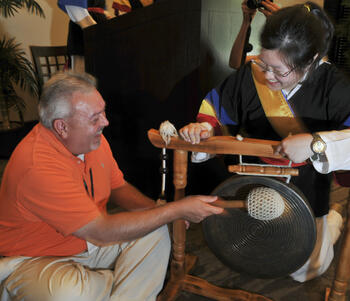
rsd14 054 0263acrop A Hana Academy student introduces an American high school teacher to "Jing."

The fourth annual Hana-Stanford Conference on Korea for U.S. Secondary School Teachers takes place this summer, from July 27 to 29, at Stanford. It will bring together secondary school educators from across the United States as well as a cadre of educators from Korea for intensive and lively sessions on a wide assortment of Korean studies-related topics ranging from U.S.-Korea relations to history, and religion to popular culture. In addition to scholarly lectures, the teachers will take part in curriculum workshops and receive numerous classroom resources developed by Stanford Program on International and Cross-Cultural Education (SPICE).

During the conference, the Sejong Korean Scholars Program(SKSP), a distance-learning program on Korea, will also honor high school students for their exceptional performance in the SKSP program. The finalists will be chosen based on their final research papers, and their overall participantion and preformance in the online course. The SKSP honorees will be presenting their research essays at the conference. The SKSP program is generously supported by the Korea Foundation. 

For more information about the conference, please visit the conference site at SPICE.


Paul Brest Hall West

555 Salvaterra Walk, Stanford University

Conferences
News Type
News
Date
Paragraphs


Sponsored by the Korea Program and the Center for East Asian Studies, the Korean Studies Program Prize for Writing in Korean Studies recognizes and rewards outstanding examples of writing by Stanford students in an essay, term paper or thesis produced during the current academic year in any discipline within the area of Korean studies, broadly defined. The competition is open to both undergraduate and graduate students. 

Benjamin Pham has won the 4th Annual Korean Studies Writing Prize for his paper titled "How and why did South Korea transition to an economic model of export-led industrialization?" Benjamin, a junior, will complete his undergraduate degree at Stanford in political science in spring 2016.

For more details about the prize, please visit the Center for East Asian Studies.

All News button
1
-

In this fourteenth session of the Strategic Forum, former senior American and South Korean government officials and other leading experts will discuss current developments in the Korean Peninsula and North Korea policy, the future of the U.S.-South Korean alliance, and a strategic vision for Northeast Asia. The session is hosted by the Korea Program at the Shorenstein Asia-Pacific Research Center, in association with Korea National Diplomatic Academy, a top South Korean think tank.

Bechtel Conference Center

Encina Hall, Stanford University

Conferences
News Type
News
Date
Paragraphs

Writing for NK News, Rob York reviewed Crossing Heaven’s Border (Shorenstein APARC, 2015), a book written by Hark Joon Lee, a South Korean journalist and filmmaker.

A project that began in 2007, the book is a firsthand account of the challenges facing North Korean defectors. Lee, reporting for the Korean newspaper Chosun Ilbo, initially published the stories as articles, and later as a documentary on the Public Broadcasting Service in 2009.

“Lee has written a gripping account of his time among the escapees, seeing sights few people will and seeing through a lengthy stint (from 2007 to 2011) in which the possibility of arrest – and even death – were distinctly possible," York writes.

The book, now available in English, details the experiences of North Korean defectors in China as illegal immigrants seeking news lives and in South Korea as new citizens navigating unfamiliar territory, and would-be defectors who remain in North Korea finding ways to survive.

“Lee’s lengthy account…presents a full range of humanity among these refugees,” York writes.

The review is available on the NK News website.

Hero Image
chinank railwaybordercrossing
A railway border crossing between China and North Korea. | Flickr/Robert Pratten
All News button
1
News Type
News
Date
Paragraphs

Kathleen Stephens, a former U.S. ambassador to the Republic of Korea, will join Stanford University’s Walter H. Shorenstein Asia-Pacific Research Center (APARC) as the William J. Perry Distinguished Fellow in the Korea Program.

Her fellowship, made possible through the generous support of Jeong and Cynthia Kim, is effective Sept. 1, 2015.

Ambassador Stephens will be housed at Shorenstein APARC, the center in the Freeman Spogli Institute for International Studies working on policy-relevant interdisciplinary research related to the Asia-Pacific.

“Kathy Stephens brings exceptional diplomatic experience on a global scale to Shorenstein APARC. Equally impressive, she has four decades of experience in Korean affairs, first as a Peace Corps volunteer in rural Korea in the 1970s, and in ensuing decades as a diplomat and as U.S. ambassador in Seoul,” said Shorenstein APARC Director Gi-Wook Shin.

"She is often cited as one of the most popular American envoys ever to South Korea. Her ability to deal with tough issues like North Korea and the U.S.-South Korean free trade agreement -- and to connect with everyday Koreans -- speaks to her deep expertise.”

Stephens came to Stanford previously as the 2013-14 Koret Fellow after 35 years as a foreign service officer in the U.S. Department of State. At Stanford, she taught a course on U.S.-Korea relations and contributed extensively to center activities, including a Koret Workshop focused on inter-Korean relations and the biannual Korea-U.S. West Coast Strategic Forum. Her time at Stanford, though, was cut short when she was recalled to the diplomatic service to lead the U.S. mission in India as charge d'affaires during the first seven months of the new administration led by Narendra Modi.

Stephens' diplomatic career included serving as acting under secretary of state for public diplomacy and public affairs in 2012; U.S. ambassador to the Republic of Korea from 2008 to 2011; principal deputy assistant secretary of state for East Asian and Pacific affairs from 2005 to 2007; and deputy assistant secretary of state for European and Eurasian affairs from 2003 to 2005.

She also served in numerous positions in Asia, Europe and Washington D.C., including as U.S. consul general in Belfast, Northern Ireland from 1995 to 1998, during the negotiation of the Good Friday Agreement, and as director for European affairs at the White House during the Clinton Administration.

“I am delighted and honored to return to Stanford,” Stephens said. “Shorenstein APARC is an incredibly stimulating place – an opportunity to be immersed in one of the world’s leading community of scholars working on U.S.-Asia-Pacific affairs.”

Stephens holds a bachelor’s degree in East Asian studies from Prescott College and a master’s of public administration from Harvard University, in addition to honorary degrees from Chungnam National University and the University of Maryland. As an undergraduate, she studied at the University of Hong Kong and was an Outward Bound instructor in Hong Kong. She was previously a senior fellow at Georgetown University's Institute for the Study of Diplomacy.

Stephens' awards include the Presidential Meritorious Service Award (2009), the Sejong Cultural Award, and Korea-America Friendship Association Award (2013). She is a trustee at The Asia Foundation, and on the boards of The Korea Society and Pacific Century Institute.

She tweets at @AmbStephens.

Hero Image
stephens shin photo 2
Ambassador Kathleen Stephens pictured with Shorenstein APARC Director Gi-Wook Shin. | Shorenstein APARC
All News button
1
News Type
Commentary
Date
Paragraphs

In a recent interview with Korea Daily, Gi-Wook Shin, director of the Shorenstein Asia-Pacific Research Center, said that South Korea needs to be more strategic in its approach to its foreign policy agenda. The country’s leadership must aim to be more proactive in handling current diplomatic issues.

Shin suggested that South Korea should separate wartime history issues from other diplomatic priorities such as trade and security. This type of organization would allow each issue to receive the focused attention and expertise needed to understand and work toward resolution.

Recently, Japan provided a successful model for this, Shin said, referencing Japanese Prime Minister Shinzo Abe’s official state visit to the United States. Abe visited many major U.S. regions including Silicon Valley. He spoke mainly about the U.S.-Japan alliance and economic development as policy priorities for Japan. He did not address at length issues of the wartime past since the focus of his visit was U.S.-Japan relations and the economy.

Shin said he thinks it is important that South Korean President Park Geun-hye delivers a concrete foreign policy vision in her June visit to the United States. For the long-term, South Korea should find ways to boost its public diplomacy efforts to shore up support for that vision.

The full article is in Korean and available by clicking here.

Hero Image
obama park
U.S. President Barack Obama and President Park Geun-hye of the Republic of Korea walk on the Colonnade of the White House in May 2013. | White House
All News button
1
Subscribe to South Korea