News Type
News
Date
Paragraphs
Stanford Korean studies expert Gi-Wook Shin has been named the William J. Perry Professor of Contemporary Korea, an endowed professorship established jointly by the Freeman Spogli Institute for International Studies (FSI) and the School of Humanities and Sciences (H&S). Shin is a professor in the Department of Sociology, senior fellow at FSI, director of the Walter H. Shorenstein Asia-Pacific Research Center (APARC) at FSI, and the founding director of the Korea Program within APARC.
 
“Gi-Wook is richly deserving of this appointment,” said FSI Director Michael McFaul. “He is a remarkable colleague and scholar who established a unique Korean studies program at Stanford and, within a relatively short period of time, built it into a leading research hub on contemporary Korea and U.S.-Korea relations. Grounded in the social sciences, the program’s approach to exploring issues of vital importance to policymaking in the United States and Korea from cross-regional and comparative perspectives is at the forefront of FSI’s efforts to foster global engagement through research and teaching.”
 
The William J. Perry professorship of contemporary Korea was established thanks to a generous gift from Jeong H. Kim, a technology entrepreneur passionate about education and public service, in honor of Professor William Perry, his mentor and friend, who played a significant role in encouraging Kim’s entrepreneurship. Perry is the Michael and Barbara Berberian Professor (emeritus) at Stanford and senior fellow at FSI. An expert in U.S. foreign policy, national security, and arms control, Perry was the 19th U.S. Secretary of Defense, serving during the 1994 crisis on the Korean peninsula. He has long worked inside and outside of government toward a peaceful resolution to the conflict on the Korean peninsula, an effort that he continues today as director of the Preventive Defense Project at FSI. Having witnessed the growth of the Korea Program under Gi-Wook Shin’s leadership, Kim decided to endow a professorship on contemporary Korea, which was named after Perry upon his retirement.
 
A prolific scholar, Shin is the author and editor of more than twenty books and numerous articles. Some of his recent books include Strategic, Policy and Social Innovation for a Post-Industrial Korea: Beyond the Miracle (2018); Superficial Korea (2017); Divergent Memories: Opinion Leaders and the Asia-Pacific War (2016); Global Talent: Skilled Labor as Social Capital in Korea (2015); and Troubled Transition: North Korea’s Politics, Economy, and External Relations (2013). Due to the wide popularity of his publications, many of them have been translated and distributed to Korean audiences. He frequently contributes expert commentary and analysis on the two Koreas and U.S.-Korea relations in both American and Korean news outlets. 
 
Shin is currently leading a multi-year research cluster that advocates for a “New Asia” of social, cultural, and economic maturity. It includes several projects that analyze a host of issues, such as flows of talent across national boundaries and talent management practices and policies harnessed by leading Asia-Pacific countries to compete in the new global knowledge economy; migration and diversity programs and policies of Asia-Pacific universities, corporations, and governments, and their impact on innovation and creativity; and the interests and policy environments of the two Koreas and their neighbors in relation to the North Korean nuclear problem, the U.S.-DPRK dialogue, the U.S.-ROK alliance, the rise of China, and Korean reunification.
 
“I am honored to become the William J. Perry Professor of Contemporary Korea,” said Shin. “As a Korean American scholar, my mission has been to strengthen the bonds between the two countries to which I am most attached. It has been a blessing to work together with collogues, friends, and partners at Stanford and in the United States and Korea to deliver on that mission through the Korea Program research, education, and outreach. I am proud of our accomplishments to date and look forward to addressing the challenges ahead and building on our record of achievement.”
 
Previously Shin held the Tong Yang, Korea Foundation, and Korea Stanford Alumni Chair of Korean Studies. His appointment as the William J. Perry Professor of Contemporary Korea concludes a long search for a candidate to fill the position. “We are thankful to Gi-Wook for his patience throughout the search process,” said McFaul. “This professorship is especially important at a time when changing regional relations and geopolitical developments around the Korean peninsula are front and center to U.S. and international interests.”
 

Media contact:
Noa Ronkin, Associate Director for Communications and External Relations
Walter H. Shorenstein Asia-Pacific Research center


Hero Image
Portrait of Gi-Wook Shin
Rod Searcey
All News button
1
Authors
Noa Ronkin
News Type
News
Date
Paragraphs
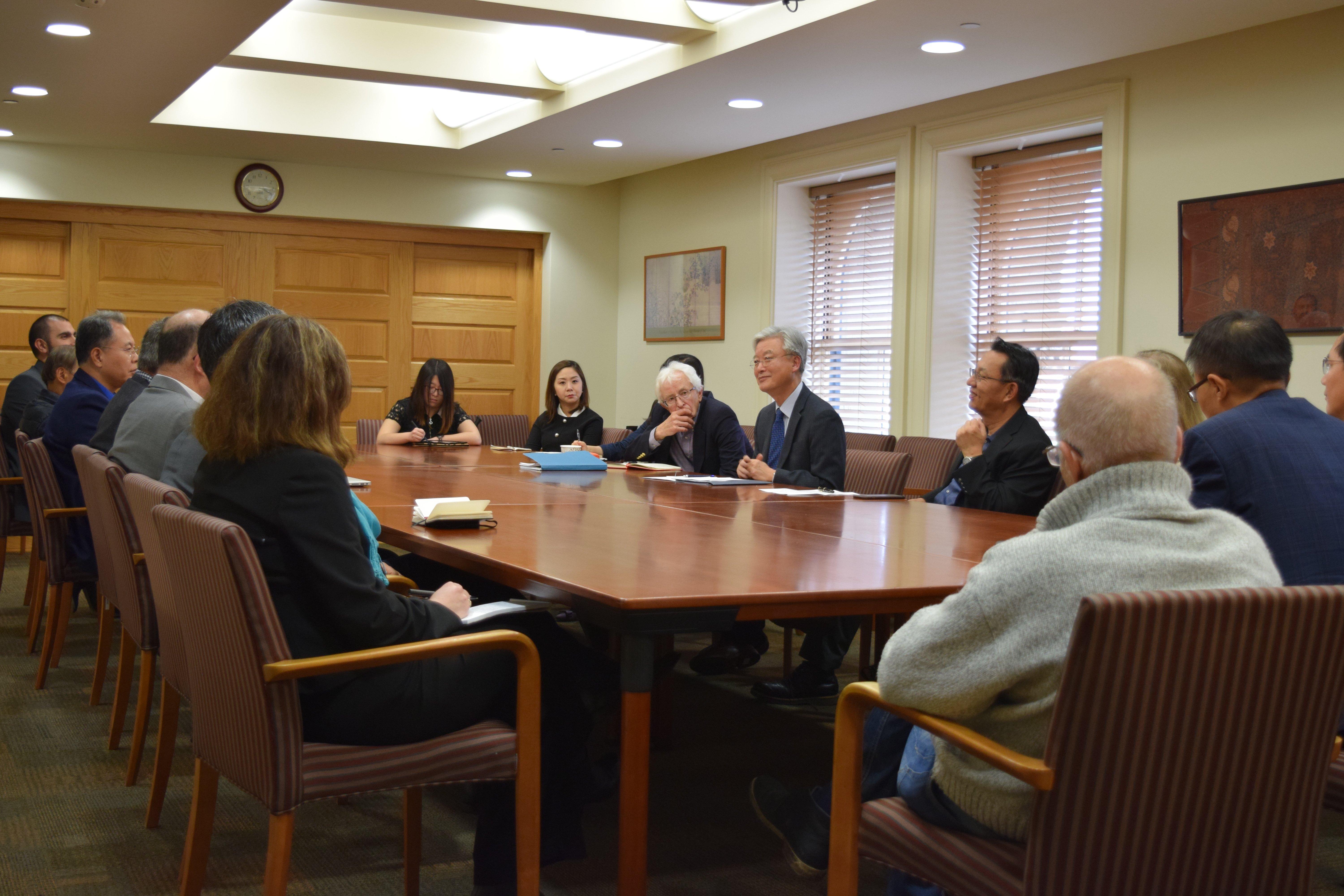
On November 29, the Korea Program at the Walter H. Shorenstein Asia-Pacific Research Center ( APARC ) welcomed the Ambassador of the Republic of Korea to the United States, Cho Yoon-je , who joined faculty members from the Freeman Spogli Institute for International Studies and other Stanford experts for a roundtable discussion about North Korea diplomacy and U.S.-ROK relations. 
 
“We were delighted to host Ambassador Cho,” said Gi-Wook Shin , director of APARC and of the Korea Program. “The candid conversation enabled us to learn from the Ambassador about the latest developments in the North Korea denuclearization talks and to offer our perspectives and policy recommendations. Convenings of academics and government officials, which Shorenstein APARC frequently organizes, are an excellent venue for advancing dialogue with U.S. counterparts in Asia and for bringing our research to bear on pressing policy issues.”
 

Rountable participants and Ambassador Cho Rountable participants and Ambassador Cho at Shorenstein APARC. Photo: Thom Holme.

 
Ambassador Cho recently marked his first year since taking office at the height of the 2017 tensions between North Korea and the United States, when the North conducted a sixth nuclear test and several tests of intercontinental ballistic missiles with the potential to reach the U.S mainland. President Trump threatened to “totally destroy” the regime and the North Korean leader responded in kind. Then renewed inter-Korean discussions paved the way for an unprecedented U.S.-DPRK summit and following diplomatic engagement. 
 
Ambassador Cho and the roundtable participants discussed recent reports pointing that diplomacy has stagnated in the months since the summit. The Ambassador expressed South Korea’s determination to seize the opportunity for rapprochement with the North and its commitment to the ROK alliance with the United States.
 
A specialist in international finance and economics, Ambassador Cho earned his MA and PhD in economics from Stanford University. Throughout his career he has held leadership positions that span both public service and academia. His former roles include the ROK Ambassador to the United Kingdom; Special Envoy to the European Union and to Germany; Senior Counselor to the Deputy Prime Minister and Minister of Finance and Economy of the ROK; Vice President of the Korea Institute of Public Finance; Senior Economist at the World Bank; Economist at the International Monetary Fund; and Director of Sogang University’s Institute for Area Studies.
 
Hero Image
From left to right: FSI Senior Fellow Siegfried Hecker, ROK Ambassador Cho Yoon-je, and APARC Director Gi-Wook Shin.
From left to right: FSI Senior Fellow Siegfried Hecker, ROK Ambassador Cho Yoon-je, and APARC Director Gi-Wook Shin. | Thom Holme, APARC
All News button
1
News Type
News
Date
Paragraphs

Shorenstein APARC's annual overview of the Center's 2017-18 activities  is now available to download

Feature sections look at the Center's seminars, conferences, and other activities in response to the North Korean crisis, research and events related to China's past, present, and future, and several Center research initiatives focused on technology and the changing workforce.

The overview highlights recent and ongoing Center research on Japan's economic policies, innovation in Asia, population aging and chronic disease in Asia, and talent flows in the knowledge economy, plus news about Shorenstein APARC's education and policy activities, publications, and more.

Hero Image
2017 18 center overview full
All News button
1
News Type
Commentary
Date
Paragraphs


Gi-Wook Shin, director of APARC, was quoted in South China Morning Post. “These young people spend the first 25 to 30 years of their life studying for exams, and when they finally move out of their shell into the real world and realise life is not a multiple choice test, and there isn’t always a clear-cut answer to every problem, that’s already a mid-life crisis for them in a way,” he said. “It is both physically draining and mentally not healthy to spend one’s young adulthood studying for exams after exams.”

All News button
1
Paragraphs

This paper examines the relationship between modern management practices and the demand for different occupational skills utilizing a unique context in South Korea after the Asian financial crisis. Management practices in South Korea had traditionally emphasized the organizational harmony over individual performance, and firm growth over short-term profits. However, as South Korea opened up to foreign firms after the financial crisis, domestic firms started to adopt western or more "modern" management practices. Using the industry level variation in management practices generated by the average industry management index of five advanced economies (the US, Britain, France, Germany, and Italy), Lee finds that modern management increases the demand for technical skill. Moreover, modern management practices help achieve various organizational changes that utilize information technology. He also finds that performance measured as the return on asset increases with modern management practices, and document the complementarity between modern management practices and technical workers in increasing the return on assets. In short, this paper finds that modern management practices may increase the earnings difference between skilled - in particular, technically skilled - and unskilled workers.

All Publications button
1
Publication Type
Journal Articles
Publication Date
Journal Publisher
Labor Economics
Authors
Yong Suk Lee
Authors
Noa Ronkin
News Type
News
Date
Paragraphs

hallenges and Possibilities of Korean Studies in North America — Social Science panel
Future Visions: Challenges and Possibilities of Korean Studies in North America — Social Science panel. From left to right: UC Berkeley's Laura Nelson, University of Michigan's Jordan Siegel, Stanford's Yong Suk Lee, USC's David Kang, Harvard's Paul Chang.


How can Korean studies faculty cultivate supportive and critical scholarly communities with graduate students? What can be done to overcome the severe constraints on Korean language training in North America? Why is there a dearth of Korea scholarship in academic literature? And how should Korean studies librarians prepare for the future in the light of new technologies and young researchers’ increasing interest in digital scholarship?

These were some of the questions examined at a two-day conference, “Future Visions: Challenges and Possibilities of Korean Studies in North America,” convened by the Korea Program of Stanford’s Shorenstein Asia-Pacific Research Center (APARC) on November 1-2. Co-sponsored by the Seoul-based Foundation Academia Platonica, the conference, the first of its kind, gathered distinguished Korean studies scholars from twelve North American institutions to consider the state of the field, assess its challenges, and carry forward a vision for its future direction and potential. Its six unique panels focused not only on the major disciplines of Korean studies—history, literature, and the social sciences—but also on language education, library collections and services, and Korean Wave.

“The presentations and discussions by our fellow experts reflected the breadth and depth of Korean studies in North America,” says APARC Director and the Korea Program Director Gi-Wook Shin. “Our program was established at Stanford in 2001 and has since become a leader in Korean studies in North America, so it is a special privilege for us to bring together colleagues from eminent institutions around the continent to further advance Korean studies education and research in the academic and policy worlds, and to build upon our track record of action and achievements.”

“The field of Korean studies, however,” notes Shin, “has significantly changed over the past seventeen years and it isn’t without its challenges. This is our opportunity to consider frankly where we go next and how we could explore the path ahead together.”

Conference participants indeed engaged in deep conversations and shared ideas and dilemmas regarding teaching in the different disciplines of Korean studies in North America. Harvard sociologist Paul Chang listed three types of challenges facing the field: publication, academic, and professional challenges. David C. Kang, professor of international relations and director of the Korean Studies Institute at the University of Southern California, emphasized the publication challenge: why is it, asked Kang, that top academic journals in the discipline of political science and international relations publish so much more scholarship about Europe than they do about Korea and Asia at large, even while the rise of Asian nations is surely one of the most consequential issues of the twenty-first century? The onus, Kang argued, comes back to East Asia scholars “to produce better and more compelling scholarship, and to better train graduate students.”

University of British Columbia's Ross King and conference participants.

Yet complex issues surround the question of how to broaden graduate coursework—and whether to do so. Korean language and linguistics expert Ross King, head of the department of Asian Studies at the University of British Columbia in Vancouver, Canada, was one of several panelists who considered the obstacles to graduate training, among different aspects of academic challenges facing the field of Korean studies. King probed into how Sinocentrism and what he called the “Mandarin conceit”—that is, the notion that training in Literary Sinitic should be predicated on a near-native proficiency in modern Mandarin Chinese—are emerging as a major stumbling block to the study of premodern Korean literary culture. He also pointed to the constraints on language training in both Korean and hanmun in North America, which, he claimed, is why we can probably anticipate continued decrease in the number of ethnically non-Korean (non-Korea-educated) graduate students undertaking graduate study in Korean literature.

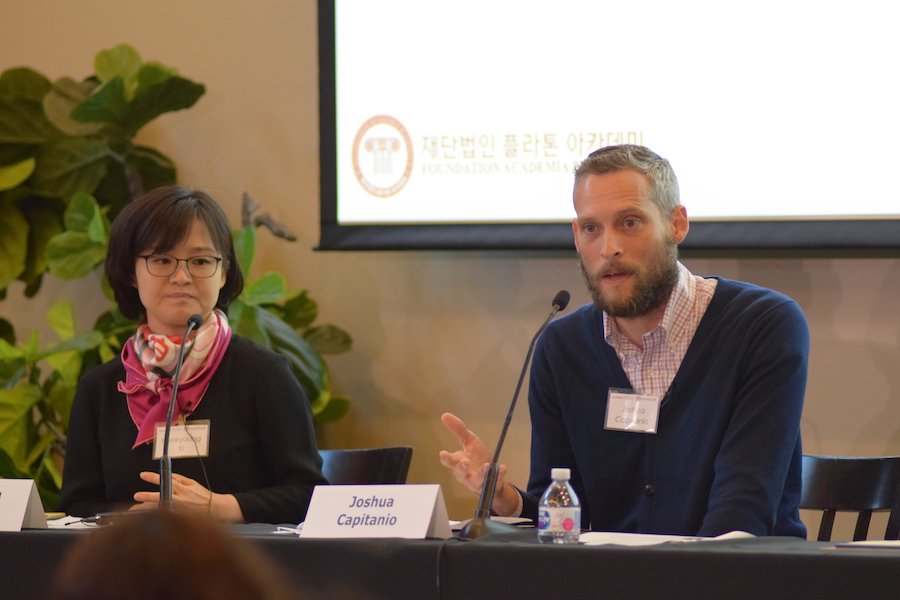
University of Washington's Hyokyoung Yi (left) and Stanford's Joshua Capitanio at a panel on library collections and service.

Sung-Ock Sohn, who coordinates the Korean language program in the department of Asian languages and cultures at the University of California – Los Angeles, further shed light on King’s prediction. She explained that while enrollments in Korean language classes have shown a sharp increase in American higher education institutions in the past decade, particularly at the introductory level and among ethnically non-Korean students, there is a high attrition rate of students from an introductory to advanced Korean classes nationwide.

How should the field move forward?

Participants proposed a host of ideas to that end. These included helping graduate students collaborate with colleagues in Korea; dedicating funding for junior faculty to spend periods of time before tenure conducting research and honing language skills in Korea at appropriate institutions, and for mid-career scholars to spend a year in Korea; emphasizing the application of social science theories and methods to premodern and modern East Asia; motivating scholars to apply a comparative lens to the study of the historical and contemporary experience of East Asia; and integrating linguistic and cultural diversity in Korean language classes by, for example, incorporating service learning in authentic contexts and extending the content spectrum to include topics such as Korean popular culture.


Image
K-pop star Siwon Choi (left) highlights closing panel on Korean Wave.

K-pop star Siwon Choi (left) highlights closing panel on Korean Wave.

Korean Wave was the focus of the conference’s widely attended closing panel that featured K-pop star Siwon Choi, a member of Korean boy band Super Junior, and multi-platinum music producer Dominique Rodriguez, managing director of SM Entertainment USA. They spoke about the global reach of Korean pop music and some of the ways in which Korean popular culture could stimulate interest in Korean studies. Dafna Zur, assistant professor in Stanford’s department of East Asian languages and cultures, who chaired the panel, challenged her students to consider “what it means not just to monetize culture but to design culture with specific markets and audience in mind.” The Stanford Daily published a detailed article on the panel.

“We are grateful to Foundation Academia Platonica for its generous support of Stanford’s Korea Program at Shorenstein APARC and for making this conference possible through our shared vision for the future of Korean studies in North America,” said Gi-Wook Shin. “Our thanks also go to our many other friends and partners, including the Korea Foundation that has helped achieve great results through its commitment to promoting understanding of Korea in academia and beyond and its support of the overseas Korean Studies Program since its establishment in 1991.”

South Korean TV company SBS NBC filmed the conference that will be featured in an upcoming documentary about Korean studies in the United States.

Read the conference report or listen to the audio recordings of the sessions, below.

Hero Image
Audience listens to panel during the conference "Future Visions: Challenges and Possibilities of Korean Studies in North America"
Thom Holme, APARC
All News button
1
News Type
News
Date
Paragraphs

On November 2, the Korea Program’s Future Visions conference closed with a panel featuring Siwon Choi — a member of Korean boy band Super Junior — and SM Entertainment USA director and music producer Dominique Rodriguez. Panelists spoke about the global reach of Korean pop music (K-pop) and how it could be a key stimulator of Korean studies in America and the rest of the West.

A recap of the panel by The Stanford Daily is now available online.

Hero Image
Siwon Choi speaks at panel as part of Future Visions conference.
Siwon Choi speaks at panel as part of Future Visions conference. | Nicole Feldman
All News button
1
News Type
News
Date
Paragraphs

October 16, 2018
FOR IMMEDIATE RELEASE

STANFORD, CA The Korea Program at Stanford University’s Walter H. Shorenstein Asia-Pacific Research Center (APARC) is pleased to announce it will convene distinguished Korea scholars from across North America at the conference “Future Visions: Challenges and Possibilities of Korean Studies in North America” on November 1-2, 2018. Participants will gather at Stanford to discuss how the field has evolved over time, the challenges and opportunities it faces, and its future direction and potential.

“The panels and panelists at this conference represent the quality and depth of Korean Studies in North America,” says APARC Director and the Korea Program Director Gi-Wook Shin. “This is our opportunity to take stock of our achievements in nurturing Korean studies to date, while also considering frankly where we go next and how we might go there together as peers.”

Six unique panels are scheduled over the course of the two-day conference, on themes including literature, language education, social sciences, history, and library collections and services. Each section will consist of three or four panelists who will discuss the state of the discipline.

Stanford faculty will be joined by scholars from twelve North American institutions, including Harvard University, University of Chicago, University of Michigan, University of British Columbia, University of California-Los Angeles, and the University of California-Berkley. They will consider issues such as the research trends in each discipline, the challenges and possibilities for graduate student training, and what intuitional structures may better support faculty.

Additionally, a closing panel discussion on the rise of K-Pop (“Korean Wave”) will be headlined by two prominent artists of Korean Wave, Dominique Rodriguez, Director of SM Entertainment USA, and CHOI Si-Won of Super Junior.  

“We’ve only just begun to examine Korean popular culture through a more rigorous academic lens,” notes Shin. “This conference can serve as a significant first step in exploring what our intersecting disciplines can learn from K-Pop, as well as the other cultural forms that comprise Korean Wave.”

Serving as cosponsor of the conference is Foundation Academia Platonica. Based in Seoul, Korea, the Academy supports the development of research in the humanities. The Foundation endowed a senior fellow in Korean studies position at FSI/APARC and supports research at the Korea Program.

“Foundation Academia Platonica is honored to be involved in this conference,” says Chairman of the Foundation Academia Platonica Chang Won Chey. “We share similar commitments to those of the Korea Program, and agree with them on the great importance this event holds for the future of Korea studies.”

The Korea Program at APARC is proud to partner with the academy and looks forward to future collaborations

For more information about the conference and to view the complete agenda (including the scheduled panelists), visit stanford.io/2ygFxih.

About the Korea Program
The Korea Program at Stanford’s Shorenstein Asia-Pacific Research Center, directed by Gi-Wook Shin, conducts multidisciplinary, social science-oriented research on policy-relevant Korea topics and supports teaching and outreach on Korean issues through courses, fellowships, seminars, and conferences. For more information, visit aparc.fsi.stanford.edu/korea.

About the Walter H. Shorenstein Asia Pacific Center

The Shorenstein Asia-Pacific Research Center is dedicated to the study of critical issues affecting the countries of Asia and their regional and global relations. Our scholar community is comprised of distinguished academics and practitioners in government, business, and civil society. Through policy-relevant research, publications, education, public programs, and international collaborations, we address pressing challenges in a world in which Asia plays an increasingly central role. For more information, visit aparc.fsi.stanford.edu.

About Foundation Academia Platonica

Foundation Academia Platonica, the first foundation dedicated to support humanities studies in Korea, was established in November, 2010, with an ambitious mission; “To develop and spread the ‘Humanities of soul-searching’ which aims to see the universal progress of the human-spirit and pursue Arete(excellence in virtue).” For more information, visit www.platonacademy.org

Media Contact
Noa Ronkin, DPhil
noa.ronkin@stanford.edu

For more information about the conference, visit: https://stanford.io/2ygFxih, or contact the Korea Program Manager
Shorenstein Asia-Pacific Research Center
Stanford University
hjahn@stanford.edu 



All News button
1
-

We are sorry that the registration is now closed. It has reached the limit of the room capacity.


This event is one of the sessions in a 2-day conference, "Future Visions: Challenges and Possibilities of Korean Studies in North America," held November 1~2 at Stanford University.

If you are interested in attending other sessions of the conference, please click here to register.

The 2-day conference agenda is available.

Paul Brest Hall

555 Salvatierra Walk, Stanford University

Panel Discussions
News Type
News
Date
Paragraphs

Sungmoon Lim (BA '18 Urban Studies) has won the 7th annual Korea Program Prize for Writing in Korean Studies for her paper, "Urban Design in the Age of Globalization: An Analysis of the Global Reception of Seoul’s Cheonggyecheon Stream Restoration Project." Gi-Wook Shin, director of the Korea Program at Shorenstein APARC, says, "Sungmoon's paper is superb. Her work is original and ambitious and her thesis will make an excellent contribution to various fields and sub-fields, including urban studies, globalization, and Korean studies." The award announcement may be viewed here.

Sponsored by the Korea Program and the Center for East Asian Studies, the writing prize recognizes and rewards outstanding examples of writing by Stanford students in an essay, term paper or thesis produced during the current academic year in any discipline within the area of Korean studies, broadly defined. The competition is open to both undergraduate and graduate students.

Past Recipients:

6th Annual Prize (2017)


All News button
1
Subscribe to South Korea