From atomic bombs to harsh military occupations in the World War II period, the past is very much the present in the Asia Pacific region.
Stanford scholars are striving to help heal these wounds from yesteryear. Helping old enemies better understand each other today is the aim of the Divided Memories and Reconciliation project, a multi-year comparative study of the formation of historical memory regarding the wartime period in countries such as China, Japan, South Korea, Taiwan and the United States.
Left unattended, misguided wartime narratives may exacerbate current disputes to the point of armed conflict, said Daniel Sneider, associate director of research at Stanford's Shorenstein Asia-Pacific Research Center. He leads the Divided Memories project along with Gi-Wook Shin, a Stanford sociology professor and the Shorenstein center director.
Sneider points out the critical importance of textbooks and what is taught in schools – especially given the rise of nationalism among youth in China, Japan, Taiwan and South Korea.
"Dialogue among youth of the different nations is needed, along with an appreciation for the diversity of views and the complexity of history," he said.
Shin said, "Each nation in northeast Asia and even the U.S. has selective or divided memories of the past, and does not really understand the views of the other side."
Education and history
Launched in 2006, the Divided Memories project has published research findings, issued recommendations and convened conferences. In the early days, the researchers examined high school history textbooks in China, Japan, Korea, Taiwan and America.
The outcome was the project's first book in 2011,
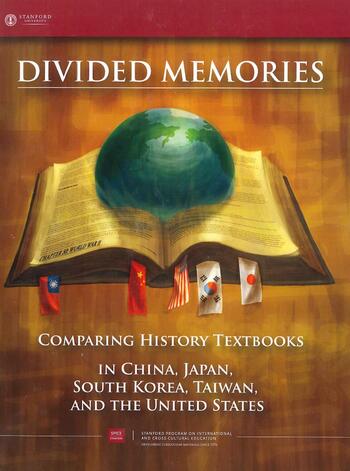
History Textbooks and the Wars in Asia: Divided Memories, which suggests that an "introspective effort" to understand national narratives about WWII has the potential to bring about historical reconciliation in the region. Sneider describes it as the first comparative study of textbooks in the countries involved; it soon evolved into a classroom supplemental
textbook published by the
Stanford Program on International and Cross-Cultural Education.
"Formal education is a powerful force in shaping our historical understandings," Sneider noted. "We wanted to look at the textbooks that have the most impact and usage."
A 2014 book, Confronting Memories of World War II: European and Asian Legacies, which was co-edited by Shin, Sneider and Daniel Chirot, a sociologist with the University of Washington, compared successful European WWII reconciliations with lagging Asian efforts. Another book, Divided Lenses, published earlier this year, examined the impact of dramatic film and other forms of popular culture on wartime memory. A new book is due out this summer, Divergent Memories: Opinion Leaders and the Asia-Pacific War, which focuses on leaders in politics, the media and academia in Japan, China, South Korea and the U.S.
The Divided Memories project aims to generate discussions and collaborations among those who create "historical memories" – educators, policymakers and government leaders. One report that grew out of such dialogues included suggestions for reconciliation:
- Create supplementary teaching materials on the issue.
- Launch dialogues among Asian, American and European historians.
- Offer educational forums for journalists, policymakers and students.
- Conduct museum exchanges and create new museums, such as one wholly dedicated to WWII reconciliation in Asia.
- Increase student exchanges among all the countries involved.
History is reflected in today's geopolitics, as noted in the revived disputes by these nations over rival claims to islands in the South China Sea and elsewhere. Without resolution, these disagreements can flare up into military conflicts, Sneider wrote.
"The question of history taps into sensitive and deeply rooted issues of national identity," he noted.
Whether recounting Japanese atrocities in China, China's exaggerated account of its Communist fighters' role in World War II, or the U.S. decision to drop atomic bombs on Japan, no nation is immune to re-creating the past to further its own interests today, Sneider wrote.
For example, Divided Memories research on Chinese textbooks shows how the Chinese government in recent decades embarked on a "patriotic education" campaign to indoctrinate young people by exaggerating its role in Japan's WWII defeat. This narrative suits the nationalistic desires of a Chinese government no longer exclusively motivated by communist ideology, Sneider said.
One project of APARC and its Japan Program that was also an outgrowth of Divided Memories involved Stanford scholars urging Japanese Prime Minister Shinzo Abe to show "clear, heartfelt remorse" in a 2015 speech on the 70th anniversary of the end of WWII. A 15-page report featured hypothetical statements suggesting what Abe might say to make amends for Japanese actions in China and Korea.
"While we cannot claim to have directly influenced the prime minister, his statement did go further in the direction of an expression of remorse over the war and the need to continue to look clearly and honestly at the past than many expected," said Sneider.
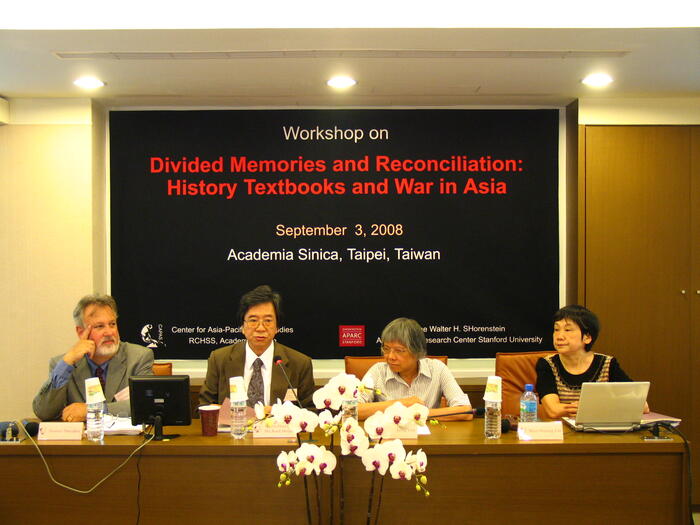
A workshop on history textbooks co-hosted by Shorenstein APARC and Academia Sinica's Center for Asia-Pacific Area Studies takes places in Taipei, Sept. 3, 2008.
Generations and grievances
Consciousness-raising on other fronts, however, is getting results, thanks to Stanford's Divided Memories project. A 2015 landmark agreement between Japan and South Korea over the WWII "comfort women" dispute was reached due to extensive U.S. involvement. Comfort women were women and girls who were forced into sexual slavery by the Imperial Japanese Army in occupied territories before and during World War II.
In an article, Sneider explained how the U.S. perceived that the dysfunctional relationship between South Korea and Japan over this issue, among others, threatened to undermine American strategic interests in Asia.
Shin highlights the importance of U.S. involvement. "The U.S. is not just an outsider to historical and territorial disputes in the region," he said. "From a geopolitical perspective, the U.S. has done a wonderful job in reviving the devastated region into a prosperous one after 1945, but from a historical reconciliation perspective, the U.S. has done a poor job."
He suggests that America should "play a constructive role in promoting historical reconciliation" among the countries involved. And so, the Divided Memories project has included the United States in its efforts.
According to Sneider, Divided Memories is unique among all reconciliation projects for its emphasis on the inclusion of the U.S.; comparative analyses across countries; and real-world policy impacts. As part of the Shorenstein research center, it is housed within Stanford's Freeman Spogli Institute for International Studies.
"This project reflects what Stanford, our center and the Freeman Spogli Institute are all about – true interdisciplinary research and engagement," Sneider said.
Clifton Parker is a writer for the Stanford News Service.