Authors
Noa Ronkin
News Type
News
Date
Paragraphs
On November 29, the Korea Program at the Walter H. Shorenstein Asia-Pacific Research Center ( APARC ) welcomed the Ambassador of the Republic of Korea to the United States, Cho Yoon-je , who joined faculty members from the Freeman Spogli Institute for International Studies and other Stanford experts for a roundtable discussion about North Korea diplomacy and U.S.-ROK relations. 
 
“We were delighted to host Ambassador Cho,” said Gi-Wook Shin , director of APARC and of the Korea Program. “The candid conversation enabled us to learn from the Ambassador about the latest developments in the North Korea denuclearization talks and to offer our perspectives and policy recommendations. Convenings of academics and government officials, which Shorenstein APARC frequently organizes, are an excellent venue for advancing dialogue with U.S. counterparts in Asia and for bringing our research to bear on pressing policy issues.”
 

Rountable participants and Ambassador Cho Rountable participants and Ambassador Cho at Shorenstein APARC. Photo: Thom Holme.

 
Ambassador Cho recently marked his first year since taking office at the height of the 2017 tensions between North Korea and the United States, when the North conducted a sixth nuclear test and several tests of intercontinental ballistic missiles with the potential to reach the U.S mainland. President Trump threatened to “totally destroy” the regime and the North Korean leader responded in kind. Then renewed inter-Korean discussions paved the way for an unprecedented U.S.-DPRK summit and following diplomatic engagement. 
 
Ambassador Cho and the roundtable participants discussed recent reports pointing that diplomacy has stagnated in the months since the summit. The Ambassador expressed South Korea’s determination to seize the opportunity for rapprochement with the North and its commitment to the ROK alliance with the United States.
 
A specialist in international finance and economics, Ambassador Cho earned his MA and PhD in economics from Stanford University. Throughout his career he has held leadership positions that span both public service and academia. His former roles include the ROK Ambassador to the United Kingdom; Special Envoy to the European Union and to Germany; Senior Counselor to the Deputy Prime Minister and Minister of Finance and Economy of the ROK; Vice President of the Korea Institute of Public Finance; Senior Economist at the World Bank; Economist at the International Monetary Fund; and Director of Sogang University’s Institute for Area Studies.
 
Hero Image
From left to right: FSI Senior Fellow Siegfried Hecker, ROK Ambassador Cho Yoon-je, and APARC Director Gi-Wook Shin.
Thom Holme, APARC
All News button
1
Authors
Siegfried S. Hecker
News Type
Commentary
Date
Paragraphs

My reply to the frequently asked question if Kim Jong Un will ever give up North Korea’s nuclear weapons is, “I don’t know, and most likely he doesn’t know either. But it is time to find out.” However, insisting that Kim Jong Un give a full declaration of his nuclear program up front will not work. It will breed more suspicion instead of building the trust necessary for the North to denuclearize, a process that will extend beyond the 2020 US presidential election.

However, the time it will take to get to the endpoint should not obscure the progress that has already been made. Since this spring, Kim Jong Un has taken significant steps to reduce the nuclear threat North Korea poses. He has declared an end to nuclear testing and closed the nuclear test tunnels by setting off explosive charges inside the test tunnel complex. He also declared an end to testing intermediate- and long-range missiles including intercontinental ballistic missiles (ICBMs). I consider these as two of the most important steps toward reducing the threat North Korea poses and as significant steps on the path to denuclearization.

Whereas the North still poses a nuclear threat to Japan and South Korea as well as US military forces and citizens in the region, the threat to the United States has been markedly reduced. In my opinion, North Korea needs more nuclear and ICBM tests to be able to reach the United States with a nuclear-tipped missile. Freezing the sophistication of the program is a necessary precursor to rolling it back in a step-by-step process.

At the September 2018 inter-Korean summit in Pyongyang, Kim also told President Moon that he would commit to dismantling the Yongbyon nuclear complex if the US takes commensurate measures—unspecified, at least in public. The Yongbyon complex is the heart of North Korea’s nuclear program. Shutting it down and dismantling it would be a very big deal because it would stop plutonium and tritium production (for hydrogen bombs) and significantly disrupt highly enriched uranium production.

Yet, Kim’s actions have been widely dismissed as insignificant or insincere by both the left and the right of the American political spectrum. In many of these quarters, the sincerity of Kim’s denuclearization promise is judged by whether or not he is willing to provide a full and complete declaration and to agree on adequate verification measures. But Kim’s willingness to provide a full declaration at this early stage tells us little about his willingness to denuclearize. Moreover, I maintain that insisting on this approach is a dead end, certainly as long as Washington continues to apply “maximum pressure” instead of moving to implement the steps on normalizing relations that President Trump agreed to in the June Singapore statement.

A full declaration is a dead end because it is tantamount to surrender, and Kim has not surrendered, nor will he. A complete account of North Korea’s nuclear weapons, materials, and facilities would, in Kim’s view, likely be far too risky in that it would essentially provide a targeting list for US military planners and seal the inevitable end of the nuclear program and possibly his regime.

Furthermore, a declaration must be accompanied by a robust verification protocol. That, in turn, must allow inspections and a full accounting of all past activities such as production and procurement records as well as export activities. And, once all these activities are complete, an inspection protocol must provide assurances that activities that could support a weapons program are not being reconstituted. This would be a contentious and drawn-out affair.

It is inconceivable that the North would declare all of its nuclear weapons, their location, and allow inspections of the weapons or of their disassembly up front. But in addition to the weapons themselves, a nuclear weapon program consists of three interlocking elements: 1) the nuclear bomb fuel, which depending on the type of bomb includes plutonium, highly enriched uranium (HEU), and forms of heavy hydrogen—deuterium and tritium; 2) weaponization—that is, designing, building and testing weapons, and; 3) delivery systems, which in the case of North Korea appear to be missiles, although airplane or ship delivery cannot be ruled out. Each of these elements involves dozens of sites, hundreds of buildings, and several thousand people.

Let me give an example of what is involved just for verification of plutonium inventories and means of production. Plutonium is produced in reactors by the fission of uranium fuel. We estimate that most of the North’s plutonium has been produced in its 5 MWe (electric) gas-graphite reactor at the Yongbyon complex. A complete declaration must provide for the entire operations history (along with its design and operational characteristics) going back to its initial operation in 1986 to correctly estimate how much plutonium was produced.

In addition, North Korea has operated the Soviet-supplied IRT-2000 research reactor at the Yongbyon site since 1967. Although little plutonium has likely been produced there, this would have to be verified by providing the complete operating history along with performance characteristics since its initial operation. North Korea has also constructed an experimental light water reactor (ELWR) that is likely not yet operational. Its status would have to be checked to see if it was configured to favor weapon-grade plutonium production. Finally, North Korea began to build but never completed 50 MWe and 200 MWe gas-graphite reactors, whose construction operations were stopped by the Agreed Framework in 1994. Their status would have to be verified.

The 5 MWe reactor fuel consists of natural uranium metal alloy fuel elements. Tracking the entire history of fuel fabrication would be an important verification step for plutonium production. It starts with uranium ore mining, milling and conversion to uranium oxide. This is followed by a few additional steps to produce the uranium metal that is formed into fuel elements for the reactor to produce plutonium. Some of these same steps would also be used, but then complemented by turning the uranium into a compound that serves as the precursor gas (uranium hexafluoride) for centrifuge enrichment to produce low enriched uranium for light water reactors or highly enriched uranium for bombs.

A complete and accurate accounting of fuel produced would also likely show a discrepancy that indicates that more fuel was produced at Yongbyon than was consumed. The difference could be accounted for by the fuel that North Korea produced for the gas-graphite reactor it built in Syria, a project that was terminated by Israel’s air raid on the Al Kibar site in September 2007. North Korea is unlikely to acknowledge the illicit construction of the Syrian reactor as part of its own plutonium declaration.

Once produced in the reactor, plutonium has to be extracted from the used or spent fuel after a sufficient period of time that allows the spent fuel to cool thermally and radioactively. The extraction or separations process is accomplished in a reprocessing facility using mechanical and chemical methods. The North’s reprocessing facility became operational in the early 1990s. All of its operations records would have to be examined and verified. In addition, it is likely that some small amount of plutonium that may have been produced in the IRT-2000 reactor was separated in the hot cell facilities in that complex. Its records would have to be examined and verified.

After plutonium is separated, it must be purified, alloyed, cast and machined into final bomb components. Each of these steps generates residue and waste streams that must be monitored and assessed for their plutonium content. Based on my visits to Yongbyon and discussions with the North’s technical staff, I believe that the steps beginning with delivery of yellowcake to Yongbyon (from the uranium mining and milling sites), plus all steps for fuel fabrication, reactor production of plutonium, spent fuel cooling, reprocessing, plutonium purification and alloying into metal ingots are conducted at Yongbyon.

During my visits to Yongbyon, I was told that the plutonium ingots are then taken off site (of an undeclared location) in which the plutonium is cast into bomb components—which would then be followed by machining and assembling into pits, the plutonium cores of the weapons. In 2010, I was also told that all plutonium residues and wastes from reprocessing and plutonium metal preparation were still stored at Yongbyon (under questionable safety conditions). Very little had been done to prepare the spent fuel waste for final disposition. This is likely still the case and, hence, most of the reprocessing facility must remain operational after the rest of Yongbyon is shut down in order to prepare the hazardous waste for safe, long-term disposition. This will also complicate the plutonium inventory verification.

A complete declaration must also include how much plutonium was used during underground testing. In addition to the six known tests at Punggye-ri, North Korea also claims to have conducted “subcritical” experiments (stopping just short of a nuclear detonation), which I consider to be unlikely. If it did, however, North Korea would have to declare the amount of plutonium used and its current state, particularly since such experiments could leave plutonium in a usable form unlike the case for nuclear detonations. To verify the nuclear test history of plutonium, as well as for highly enriched uranium, it would be necessary to provide information or allow drill-back inspections into the test tunnels at Punggye-ri to ascertain the type and amount of nuclear material used in the test.

To complicate matters even further, if one or more of the North’s test devices failed to produce a nuclear explosion, then plutonium (or HEU) could still be resident in the tunnels. Both the United States and Russia experienced such test failures. This is also possibly the case for North Korea because there is still some uncertainty as to whether or not a nuclear test was conducted in May 2010 when a faint seismic signal was observed from the test area. For the most part, the jury is still out on that event, but the North would now have to allow inspections and verification.

It should be apparent that the declaration plus commensurate verification of the amount of plutonium North Korea possesses, which I believe is only between 20 and 40 kilograms, will be an enormous job. I cannot see it being accomplished in the current adversarial environment and certainly not within the timeframe that has been specified by the US government.

A similar sequence of declarations, inspections, and verification measures would have to be developed for the other bomb fuels, namely HEU and the hydrogen isotopes, deuterium and tritium. Verification of HEU inventories and means of production will be particularly contentious because very little is known about the centrifuge facility at the Yongbyon site. As far as we know, my Stanford colleagues and I are the only foreigners to have seen that facility, and then only in a hurried walk-through in 2010. In addition, there exists at least one other covert centrifuge site.

The situation is even more problematic for the second element of the North’s nuclear program, that of weaponization, which includes bomb design, production, and testing because we know nothing about these activities or where they are performed. Although we have some information regarding the nuclear test site at which six nuclear tests were conducted, we do not know if there are other tunnel complexes that have been prepared for testing.

The third element includes all of the North’s missiles and its production, storage and launch sites and complexes. These will also represent a major challenge for complete and correct declarations, inspections and verification.

Once all of the elements have been declared and the dismantling begins, then the focus will have to change to verifying the dismantlement and assessing the potential reversibility of these actions—a challenge that is not only difficult, but one that must be ongoing.

Verification was one of the sticking points during the 2007-2008 diplomatic initiative pursued late in the George W. Bush administration. In 2008, the North turned over copies of 18,000 pages of operating records of the reactor and reprocessing facilities in Yongbyon. The veracity of that disclosure has never been established because diplomatic efforts fell apart when the United States insisted on more declarations up front and North Korea accused Washington of having moved the goal posts. That declaration constituted only a small part of what I outlined above as being necessary for a full accounting of plutonium, not to mention the other components of North Korea’s nuclear program. That was 10 years ago, and much has happened since to make future declarations and verification much more problematic.

At this time, the level of trust between Pyongyang and Washington required for North Korea to agree to a full, verifiable declaration up front does not exist. Hence, my colleagues Robert Carlin and Elliot Serbin and I have suggested a different approach. Negotiations should begin with an agreed end state: North Korea without nuclear weapons or a nuclear weapon program. Civilian nuclear and space programs would remain open for negotiation and possible cooperation. But all facilities and activities that have direct nuclear weapons applicability must eventually be eliminated.

Rather than insisting on a full declaration up front, the two sides should first agree to have the North take significant steps that reduce the nuclear threat it poses in return for commensurate movements toward normalization—the details of which would have to be worked out during negotiations. A good next step for the North would be the destruction of the 5 MWe plutonium production reactor, which would be part of the package that Kim proposed to Moon at the Pyongyang Summit. If these actions are matched by US steps toward normalization as pledged in the Singapore statement, they will serve to build the trust required for the North to initiate a phased declaration process that initially covers operations in Yongbyon and eventually includes the entire nuclear program discussed above.

Unfortunately, the strategic opening created by the Singapore and North-South summits has not been followed by such tactical steps to get the negotiation process off the ground. The North and the South are ready to create a commonly acceptable path forward, but we have the worst of environments in Washington. The Trump team claims progress is being made but insists on maintaining maximum pressure. The North’s Foreign Ministry has pointed outthat the “improvement of relations and sanctions are incompatible.” Also, most US North Korea watchers are either wedded to old think that you can’t negotiate with Pyongyang or they are determined to prove President Trump’s claims on North Korea wrong.

With nuclear tensions on the Korean Peninsula dramatically reduced, it is time to find out if Kim’s drive to improve the economy will eventually lead to denuclearization. He may determine that his nuclear arsenal poses a significant hindrance to economic development that outweighs the putative benefits it confers. Washington and Seoul should work together to encourage rather than inhibit this potential shift.


Hero Image
hecker2
All News button
1
News Type
News
Date
Paragraphs

Shorenstein APARC's annual overview of the Center's 2017-18 activities  is now available to download

Feature sections look at the Center's seminars, conferences, and other activities in response to the North Korean crisis, research and events related to China's past, present, and future, and several Center research initiatives focused on technology and the changing workforce.

The overview highlights recent and ongoing Center research on Japan's economic policies, innovation in Asia, population aging and chronic disease in Asia, and talent flows in the knowledge economy, plus news about Shorenstein APARC's education and policy activities, publications, and more.

Hero Image
2017 18 center overview full
All News button
1
Authors
Thomas Holme
News Type
News
Date
Paragraphs

“I learned long ago to never predict anything about North Korea.”

So began the keynote address by Anna Fifield, veteran journalist and winner of the 2018 Shorenstein Journalism Award. Speaking at the Award’s seventeenth annual panel discussion “How North Korea Is, and Isn’t, Changing under Kim Jong Un,” Fifield, the Beijing bureau chief for The Washington Post , shared some of the many observations she has made since she first began covering North Korea in 2004.

Two other North Korea experts joined Fifield at the panel: Barbara Demick, New York correspondent of the Los Angeles Times, formerly head of the bureaus in Beijing and Seoul, and the 2012 Shorenstein award winner; and Andray Abrahamian, the 2018-2019 Koret Fellow, whose previous role as executive director of Choson Exchange and other projects took him to the DPRK nearly 30 times. Yong Suk Lee, deputy director of the Korea Program at Shorenstein APARC, chaired the panel.

The presence of another person—the Dear Respected Comrade himself—was also very much felt in the room, if only in spirit.

Barbara Demick (center) speaks at 2018 Shorenstein Journalism Award.

Survival at any cost

At various points throughout its 70-year history, experts have predicted the demise of the "Hermit Kingdom." Fifield herself admitted to occasionally thinking along such terms.

And yet the country continues to prove them wrong.

“[D]uring my first stint covering North Korea, [I] just couldn’t envisage any way that this regime could survive the death of the second-generation leader and the transition to a third generation,” she said. “Kim Il Sung had created a myth of revolutionary heroism around himself, and a myth of divine selection around his son, Kim Jong Il. How could the North Korean people, who no longer live in a Hermit Kingdom, tolerate a third leader called Kim, let alone one who had no highly exaggerated or plain fictional back story?”

“Yet," Fifield continued, "here we are. Next month, Kim Jong Un will celebrate seven years in charge of North Korea.”

One prominent reason for the nation's recent survival, and an idea put forward by Fifield and supported by her co-panelists, was the development of markets in the communist state.

For decades, North Korea operated under the centrally-planned communist model. Even as China pursued reform and as the Soviet Union collapsed, the North Korean state maintained its central position in the economy.

However, following the famines of the 1990s, the state had no choice but to allow market activity to develop. Under the third Kim markets have continued to grow.

“There are now more than 400 established, state-sanctioned markets in North Korea,” said Fifield. “That’s more than double the number that existed when Kim Jong Un took over at the end of 2011.”

A side effect of this nascent market economy has been the emergence of new elites in the purported “classless” society. Fifield described the development of a capital within the capital—“Pyonghattan”—where newfound elites purchase clothes from western retailers and undergo plastic surgery for their eyelids.

Abrahamian concurred, noting that Kim Jong Un made sure to coddle this upper middle and upper class in Pyongyang. "The old way of doing that under Kim Jong Il and his father, Kim Il Sung, was very much through a loyalty and gift economy," Abrahamian said. "Money was not necessary in the old North Korea. Now it is. You do need it to get your daily necessities, and if you’re lucky enough, the products [from the “outside world”] help you to have a more pleasurable life through the market.”

At the other end of the spectrum, North Koreans turn to the markets not out of entrepreneurial zeal, but out of a need to survive. As an example, Fifield described meeting a mother and daughter living near the border with China. The mother took her daughter out of school in order to raise pigs and make tofu. Before dawn, they trekked into the mountains to tend crops of corn. It was a back-breaking existence. "If they were lucky, they made enough money each day to buy food for themselves," Fifield said. "Many days, they did all this to break even."

Andray Abrahamian responds to a question from the audience.

A smart tyrant not to be underestimated

The panel continued to focus on the man currently at the helm in North Korea.

“When I returned for my second go at covering the Koreas, I wanted to figure out how he’d done it," said Fifield. "How had this podgy young upstart with no qualifications other than being born into this family managed to take control of this regime…? How had he managed to keep intact this anachronistic system that should have died years, even decades, before?”

Fifield emphasized that her comments did not equate to admiration for Kim Jong Un. “He’s a tyrant,” she reminded the room. “But he’s a smart tyrant who’s been operating in a calculating way. To treat him as a joke or a madman is to underestimate the threat of him.”

“Kim Jong Un has not allowed these markets to flourish because he cares about the people and their wellbeing,” Fifield continued. “He has demonstrated time and time again that he doesn’t care at all about the people.”

“There’s only one thing he cares about and that is staying in power.” 

Demick cautioned further against over-estimating the positive impact of market development on life in North Korea. “The people Anna interviewed for her groundbreaking series in 2017 in The Washington Post were disgusted with the system,” said Demick. “With the income inequality, with the corruption, with the controls.”

“For them, what’s the worst thing about North Korea? Simply being born there.”

The panelists participated in a lively audience Q & A.

A celebration of journalism

The Shorenstein Journalism Award, which carries a cash prize of $10,000, recognizes accomplished journalists committed to critical reporting on and exploring the complexities of Asia through their writing. It alternates between honoring recipients from the West, who mainly address American audiences, and recipients from Asia, who pave the way for freedom of the press in their countries. Established in 2002, the award honors the legacy of APARC benefactor Mr. Walter H. Shorenstein. A visionary businessman, philanthropist, and champion of Asian-American relations, Shorenstein was dedicated to promoting excellence in journalism and a deeper understanding of Asia.

While the reporting of each year's recipient focuses on different regions and areas of interest, the award consistently recognizes quality journalism. In his welcome remarks, panel chair Yong Suk Lee stated, “In the face of current attacks on journalists and on the truth in the United States and the world, [Shorenstein APARC is] even more committed to excellence in journalism, and to defending independent and free media."

Fifield’s co-panelists spoke at length about how deserving she was of the award. Before their first meeting in Seoul, Abrahamian confessed to harboring skepticism about Fifield. “I had read some of her work before and knew she had analytical chops, but thought to myself that journalists are always fighting for the next scoop.” However, after talking to Fifield for only a few minutes, Abrahamian readily dropped his guard. “I told myself, 'This is a special journalist; she's got something.’"

A previous recipient of the Shorenstein Journalism Award herself, Demick was equally enthusiastic in her praise of Fifield. “For the last four years, [Anna] had owned the North Korea story like no other journalist I’ve met, including myself.”

Fifield was presented with the Shorenstein award and prize at a private evening ceremony.

Watch Fifield’s keynote speech below. An audio version is availalbe on our SoundCloud channel.

Hero Image
 Shorenstein Journalism Award winner Anna Fifield (right) speaks at award panel
Panel chair Yong Suk Lee (left) listens as 2018 Shorenstein Journalism Award winner Anna Fifield speaks to audience.
Rod Searcey
All News button
1
News Type
News
Date
Paragraphs

On November 14, APARC honored the 2018 Shorenstein Journalism Award recipient, Washington Post Beijing bureau chief Anna Fifield. At a Stanford event, Fifield joined a panel discussing economic changes in North Korea, as well as the country’s position in global diplomacy under the leadership of Kim Jong Un.

A recap of the panel by The Stanford Daily is now available online.

Hero Image
Anna Fifield speaks at Shrenstein Journalism Awad Panel Rod Searcey
All News button
1
Authors
Noa Ronkin
News Type
News
Date
Paragraphs

hallenges and Possibilities of Korean Studies in North America — Social Science panel
Future Visions: Challenges and Possibilities of Korean Studies in North America — Social Science panel. From left to right: UC Berkeley's Laura Nelson, University of Michigan's Jordan Siegel, Stanford's Yong Suk Lee, USC's David Kang, Harvard's Paul Chang.


How can Korean studies faculty cultivate supportive and critical scholarly communities with graduate students? What can be done to overcome the severe constraints on Korean language training in North America? Why is there a dearth of Korea scholarship in academic literature? And how should Korean studies librarians prepare for the future in the light of new technologies and young researchers’ increasing interest in digital scholarship?

These were some of the questions examined at a two-day conference, “Future Visions: Challenges and Possibilities of Korean Studies in North America,” convened by the Korea Program of Stanford’s Shorenstein Asia-Pacific Research Center (APARC) on November 1-2. Co-sponsored by the Seoul-based Foundation Academia Platonica, the conference, the first of its kind, gathered distinguished Korean studies scholars from twelve North American institutions to consider the state of the field, assess its challenges, and carry forward a vision for its future direction and potential. Its six unique panels focused not only on the major disciplines of Korean studies—history, literature, and the social sciences—but also on language education, library collections and services, and Korean Wave.

“The presentations and discussions by our fellow experts reflected the breadth and depth of Korean studies in North America,” says APARC Director and the Korea Program Director Gi-Wook Shin. “Our program was established at Stanford in 2001 and has since become a leader in Korean studies in North America, so it is a special privilege for us to bring together colleagues from eminent institutions around the continent to further advance Korean studies education and research in the academic and policy worlds, and to build upon our track record of action and achievements.”

“The field of Korean studies, however,” notes Shin, “has significantly changed over the past seventeen years and it isn’t without its challenges. This is our opportunity to consider frankly where we go next and how we could explore the path ahead together.”

Conference participants indeed engaged in deep conversations and shared ideas and dilemmas regarding teaching in the different disciplines of Korean studies in North America. Harvard sociologist Paul Chang listed three types of challenges facing the field: publication, academic, and professional challenges. David C. Kang, professor of international relations and director of the Korean Studies Institute at the University of Southern California, emphasized the publication challenge: why is it, asked Kang, that top academic journals in the discipline of political science and international relations publish so much more scholarship about Europe than they do about Korea and Asia at large, even while the rise of Asian nations is surely one of the most consequential issues of the twenty-first century? The onus, Kang argued, comes back to East Asia scholars “to produce better and more compelling scholarship, and to better train graduate students.”

University of British Columbia's Ross King and conference participants.

Yet complex issues surround the question of how to broaden graduate coursework—and whether to do so. Korean language and linguistics expert Ross King, head of the department of Asian Studies at the University of British Columbia in Vancouver, Canada, was one of several panelists who considered the obstacles to graduate training, among different aspects of academic challenges facing the field of Korean studies. King probed into how Sinocentrism and what he called the “Mandarin conceit”—that is, the notion that training in Literary Sinitic should be predicated on a near-native proficiency in modern Mandarin Chinese—are emerging as a major stumbling block to the study of premodern Korean literary culture. He also pointed to the constraints on language training in both Korean and hanmun in North America, which, he claimed, is why we can probably anticipate continued decrease in the number of ethnically non-Korean (non-Korea-educated) graduate students undertaking graduate study in Korean literature.

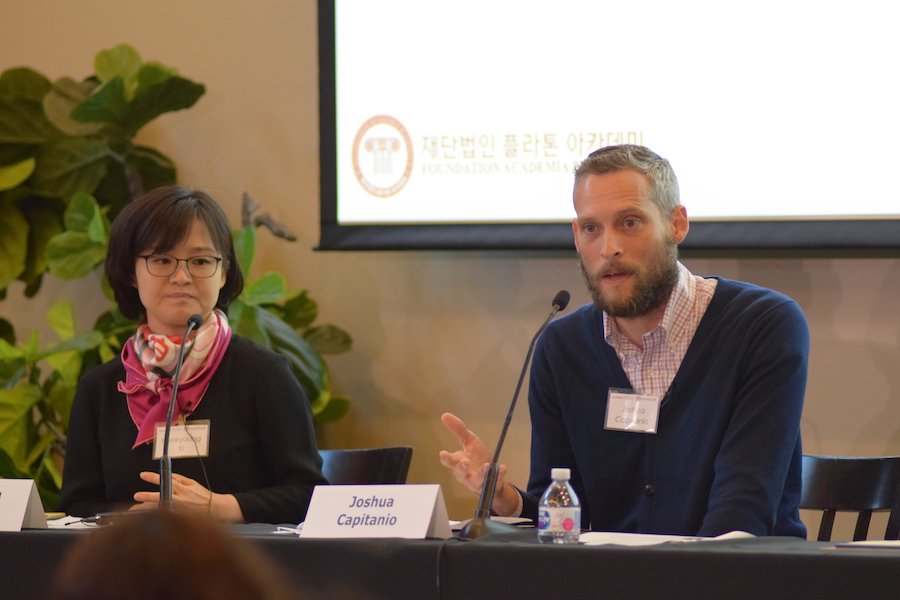
University of Washington's Hyokyoung Yi (left) and Stanford's Joshua Capitanio at a panel on library collections and service.

Sung-Ock Sohn, who coordinates the Korean language program in the department of Asian languages and cultures at the University of California – Los Angeles, further shed light on King’s prediction. She explained that while enrollments in Korean language classes have shown a sharp increase in American higher education institutions in the past decade, particularly at the introductory level and among ethnically non-Korean students, there is a high attrition rate of students from an introductory to advanced Korean classes nationwide.

How should the field move forward?

Participants proposed a host of ideas to that end. These included helping graduate students collaborate with colleagues in Korea; dedicating funding for junior faculty to spend periods of time before tenure conducting research and honing language skills in Korea at appropriate institutions, and for mid-career scholars to spend a year in Korea; emphasizing the application of social science theories and methods to premodern and modern East Asia; motivating scholars to apply a comparative lens to the study of the historical and contemporary experience of East Asia; and integrating linguistic and cultural diversity in Korean language classes by, for example, incorporating service learning in authentic contexts and extending the content spectrum to include topics such as Korean popular culture.


Image
K-pop star Siwon Choi (left) highlights closing panel on Korean Wave.

K-pop star Siwon Choi (left) highlights closing panel on Korean Wave.

Korean Wave was the focus of the conference’s widely attended closing panel that featured K-pop star Siwon Choi, a member of Korean boy band Super Junior, and multi-platinum music producer Dominique Rodriguez, managing director of SM Entertainment USA. They spoke about the global reach of Korean pop music and some of the ways in which Korean popular culture could stimulate interest in Korean studies. Dafna Zur, assistant professor in Stanford’s department of East Asian languages and cultures, who chaired the panel, challenged her students to consider “what it means not just to monetize culture but to design culture with specific markets and audience in mind.” The Stanford Daily published a detailed article on the panel.

“We are grateful to Foundation Academia Platonica for its generous support of Stanford’s Korea Program at Shorenstein APARC and for making this conference possible through our shared vision for the future of Korean studies in North America,” said Gi-Wook Shin. “Our thanks also go to our many other friends and partners, including the Korea Foundation that has helped achieve great results through its commitment to promoting understanding of Korea in academia and beyond and its support of the overseas Korean Studies Program since its establishment in 1991.”

South Korean TV company SBS NBC filmed the conference that will be featured in an upcoming documentary about Korean studies in the United States.

Read the conference report or listen to the audio recordings of the sessions, below.

Hero Image
Audience listens to panel during the conference "Future Visions: Challenges and Possibilities of Korean Studies in North America" Thom Holme, APARC
All News button
1
News Type
Commentary
Date
Paragraphs

Two women working at a bottling plant in Kangso, P'yongan-namdo, North Korea. Photo Credit: NViktor via Flickr/Creative Commons

“Prices for some products [in North Korea] have fluctuated slightly, but shortages are not reported, and consumption still continues, " writes Andray Abrahamian for 38 North following a visit to North Korea for the 8th International Rason Trade Fair. "Still, sanctions have caused enough problems that expressions of hope for the success of this year’s summit diplomacy are universal among North Koreans in Rason and elsewhere.”
 
 
Hero Image
Two women working at a bottling plant in Kangso, P'yongan-namdo, North Korea
NViktor, Flickr/Creative Commons
All News button
1
-

The evidentiary weight of North Korean defectors’ testimony depicting crimes against humanity has drawn considerable attention from the international community in recent years. Despite the ramped-up attention to North Korean human rights, what remains unexamined is the rise of the transnational advocacy network which drew attention to the issue in the first place. In their new book, North Korean Human Rights: Activists and Networks, Andrew Yeo and Danielle Chubb lead a team of scholars in tracing the emergence and evolution of North Korean human rights activism. Together they challenge existing conceptions of transnational advocacy, how they operate, and why they provoke a response from even the most recalcitrant regimes. In this event, Professor Yeo draws particular attention to the politics of North Korean human rights in both domestic and international contexts. He explains the relevance and importance of human rights even as the diplomatic environment on the Korean Peninsula shifts from pressure towards engagement.

Image
andrew yeo
Andrew Yeo is Associate Professor of Politics and Director of Asian Studies at The Catholic University of America in Washington DC. He is the author of the forthcoming book, Asia's Regional Architecture: Alliances and Institutions in the Pacific Century (Stanford University Press 2019) and has written or co-edited three other books: North Korean Human Rights: Activists and Networks (Cambridge University Press 2018);  Living in an Age of Mistrust:An Interdisciplinary Study of Declining Trust and How to Get it Back (Routledge Press 2017); and Activists, Alliances, and Anti-U.S. Base Protests (Cambridge University Press 2011). His  research and teaching interests include international relations theory; East Asian regionalism; Asian security; narratives and discourse; the formation of beliefs, ideas, and worldviews; civil society; social and transnational movements, overseas basing strategy and U.S. force posture; Korean politics; and North Korea. He is a former term member of the Council on Foreign Relations and the recipient of Catholic University's Young Faculty Scholar's Award in 2013. He received his Ph.D. in Government from Cornell University, and BA in Psychology and International Studies from Northwestern University. 


Philippines Conference Room
Encina Hall, 3rd Floor
616 Serra Mall, Stanford, CA 94305

Andrew Yeo <i>Associate Professor of Politics, The Catholic University of America</i>
Seminars
Paragraphs

This third volume in the Japan Decides series remains the premier venue for scholarly research on Japanese elections. Spotlighting the 2017 general election, the contributors discuss the election results, party politics, coalition politics with Komeito, the cabinet, constitutional revision, new opposition parties, and Abenomics. Additionally, the volume looks at campaigning, public opinion, media, gender issues and representation, North Korea and security issues, inequality, immigration and cabinet scandals. With a topical focus and timely coverage of the latest dramatic changes in Japanese politics, the volume will appeal to researchers and policy experts alike, and will also make a welcome addition to courses on Japanese politics, comparative politics and electoral politics.

Chapter 15, Abenomics' Third Arrow: Fostering Future Competitiveness?, was written by Shorenstein APARC Research Scholar, Kenji Kushida.

All Publications button
1
Publication Type
Books
Publication Date
Authors
Kenji E. Kushida
616 Serra StreetEncina Hall E301Stanford, CA94305-6055
0
eun_young_park.jpg J.S.D., L.L.M.
Eun Young Park joins the Walter H. Shorenstein Asia-Pacific Research Center (Shorenstein APARC) during the 2018-2019 academic year from the law firm of Kim & Chang where he serves as a partner and co-chair of international arbitration and litigation practice group.  Dr. Park has served as Judge in the Seoul District Court during the Kim Young Sam government. After joining Kim & Chang he has focused on international dispute resolution including trade sanctions, transnational litigation, and international arbitration. He was appointed to Vice-President of the London Court of International Arbitration and a Member of the Court of Arbitration of the Singapore International Arbitration Centre. He has taught in many universities including SKK University School of Law as an adjunct professor. His research focuses on the possibility of establishing dispute resolution mechanism in the transition of East Asian countries. The research interests encompass decisions from international tribunal arising out of international and transnational disputes of various areas including boundaries, economic disputes, and reparation arising out of transitional justice; trends and efforts to establish an independent judicial body to cope with conflicts and disputes in the region. Dr. Park is an editor of Korean Arbitration Review and has published articles including "Appellate Review in Investor State Arbitration," Reshaping the Investor-State Dispute Settlement System: Journeys for the 21st Century and "Rule of Law in Korea," Taiwan University Journal of Law. He is an author of a book entitled "The Analysis of the Iran Sanctions Act of the United States and the Strategy of the Overseas Construction Project” (in Korean). 

He holds a J.S.D. and LL.M. from NYU School of Law and M. Jur. and B. Jur. from Seoul National University.

Visiting Scholar at APARC
Subscribe to North Korea