Policy Roundup: April 2026
All Publications button
1
Publication Type
Policy Briefs
Publication Date


The content, consistency, and predictability of U.S. policy shaped the global order for eight decades, but these lodestars of geopolitics and geoeconomics can no longer be taken for granted. What comes next will be determined by the ambitions and actions of major powers and other international actors.
Some have predicted that China can and will reshape the global order. But does it want to? If so, what will it seek to preserve, reform, or replace? Choices made by China and other regional states will hinge on their perceptions of future U.S. behavior — whether they deem it more prudent to retain key attributes of the U.S.-built order, with America playing a different role, than to move toward an untested and likely contested alternative — and how they prioritize their own interests.
This year’s Oksenberg Conference will examine how China and other Indo-Pacific actors read the geopolitical landscape, set priorities, and devise strategies to shape the regional order amid uncertainty about U.S. policy and the future of global governance.
Moderator
Thomas Fingar
Shorenstein APARC Fellow, Freeman Spogli Institute for International Studies, Stanford University
Panelists
Da Wei
Professor and Director, Center for International Security and Strategy, Tsinghua University
Mark Lambert
Retired U.S. Department of State Official, Formerly China Coordinator and Deputy Assistant Secretary
Susan Shirk
Research Professor, School of Global Policy and Strategy, University of California San Diego
Moderator
Laura Stone
Retired U.S. Ambassador and Career Foreign Service Officer; Inaugural China Policy Fellow at APARC, Stanford University
Panelists
Victor Cha
Distinguished University Professor, D.S. Song-KF Chair, and Professor of Government, Georgetown University
Katherine Monahan
Visiting Scholar and Japan Program Fellow 2025-2026, APARC, Stanford University
Kathryn Stoner
Satre Family Senior Fellow, Freeman Spogli Institute for International Studies, Stanford University
Emily Tallo
Postdoctoral Fellow, Center for International Security and Cooperation, Stanford University
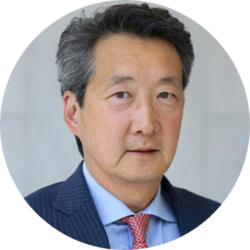
Victor Cha is Distinguished University Professor at Georgetown University and President of the Geopolitics and Foreign Policy Department at the Center for Strategic and International Studies in Washington, D.C. He previously served on the Defense Policy Board for the Biden administration and on the National Security Council for the George W. Bush administration. He is the award-winning author of nine books including The Black Box: Demystifying the Study of Korean Unification and North Korea (Columbia, 2025). His newest book is China’s Weaponization of Trade: Resistance Through Collective Resilience(Columbia, January 2026) with E. Kim and A. Lim. Dr. Cha received his PhD, MIA, and BA from Columbia University and a BA with honors from Oxford University.
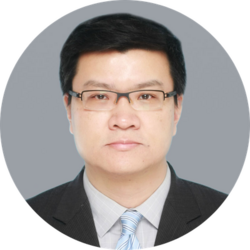
Da Wei is the director of the Center for International Security and Strategy (CISS) at Tsinghua, and professor of department of International Relations, school of Social Science, Tsinghua University. Dr. Da ’s research expertise covers China-US relations and US security & foreign policy. Da Wei has worked in China’s academic and policy community for more than 2 decades. Prior to current positions, Dr. Da Wei was the assistant president of University of International Relations (2017-2020), director of the Institute of American Studies, China Institutes of Contemporary International Relations (2013-2017). He has written hundreds of policy papers to Chinese government, and published dozens of academic papers on journals in China, the US and other countries.
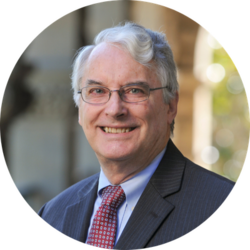
Thomas Fingar is a Shorenstein APARC Fellow in the Freeman Spogli Institute for International Studies at Stanford University. He was the inaugural Oksenberg-Rohlen Distinguished Fellow from 2010 through 2015 and the Payne Distinguished Lecturer at Stanford in 2009.
From 2005 through 2008, he served as the first deputy director of national intelligence for analysis and, concurrently, as chairman of the National Intelligence Council. Fingar served previously as assistant secretary of the State Department’s Bureau of Intelligence and Research (2000-01 and 2004-05), principal deputy assistant secretary (2001-03), deputy assistant secretary for analysis (1994-2000), director of the Office of Analysis for East Asia and the Pacific (1989-94), and chief of the China Division (1986-89). Between 1975 and 1986, he held several positions at Stanford University, including senior research associate in the Center for International Security and Arms Control.
Fingar is a graduate of Cornell University (A.B. in Government and History, 1968) and Stanford University (M.A., 1969, and Ph.D., 1977, both in political science). His numerous publications include the most recent book, From Mandate to Blueprint: Lessons from Intelligence Reform (Stanford University Press, 2021).
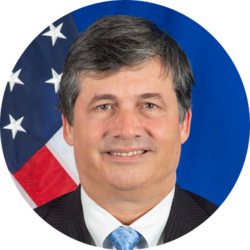
Mark Lambert is a retired State Department official. He served as China Coordinator and Deputy Assistant Secretary in the Bureau of East Asia and Pacific Affairs. He oversaw the Office of China Coordination and the Office of Taiwan Coordination. Mark has extensive experience in China, cross-Strait, and Asia Pacific affairs. He served as Deputy Assistant Secretary with responsibility for Japan, Korea, Mongolia, Australia, New Zealand, and the Pacific Islands. Earlier he established the International Organizations Bureau’s office aimed at protecting UN integrity from authoritarianism and served as Special Envoy for North Korean Affairs. Previously, he was named the State Department’s human rights officer of the year for devising a strategy to release Chinese political prisoners and promote religious freedom.
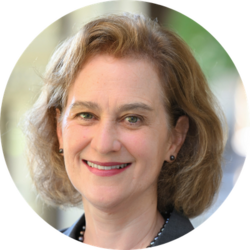
Katherine Monahan is a visiting scholar and Japan Program Fellow for the 2025-26 academic year. Ms. Monahan has completed 16 assignments on four continents during her 30 years as a Foreign Service Officer with the U.S. Department of State. She recently returned from Tokyo, where she was Deputy Chief of Mission at the U.S. Embassy in Japan, following roles as Charge d’affaires for Papua New Guinea, Solomon Islands, and Vanuatu, and Deputy Chief of Mission to New Zealand, Samoa, Cook Islands, and Niue. She was Director for East Asia at the National Security Council from 2022 to 2023. Previously, she worked for the U.S. Department of the Treasury in Tokyo as Economic, Trade and Labor Counselor in Mexico City, Privatization Lead in Warsaw after the fall of the Berlin Wall, Advisor to the World Bank, and Deputy Executive Director of the Secretary of State’s Global Health Initiative, among other roles. As lead of UNICEF’s International Financial Institutions office, Ms. Monahan negotiated over $1 billion in funding for children. A member of the Bar in California and Washington, D.C., Ms. Monahan began her career as an attorney in Los Angeles.
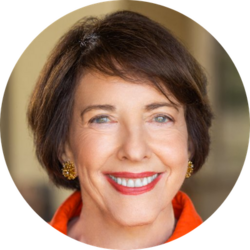
Susan Shirk is a research professor at the UC San Diego School of Global Policy and Strategy and director emeritus of its 21st Century China Center. She is one of the most influential experts working on U.S.-China relations and Chinese politics. She is also director emeritus of the UC Institute on Global Conflict and Cooperation (IGCC). Susan Shirk first visited China in 1971 and has been teaching, researching and engaging China diplomatically ever since. From 1997-2000, Shirk served as Deputy Assistant Secretary of State in the Bureau of East Asia and Pacific Affairs, with responsibility for China, Taiwan, Hong Kong and Mongolia. Her current book is "Overreach: How China Derailed Its Peaceful Rise". Other books include "China: Fragile Superpower," which helped frame the policy debate on China in the U.S. and other countries. Her other publications include "The Political Logic of Economic Reform in China"; "How China Opened its Door"; "Competitive Comrades: Career Incentives and Student Strategies in China"; and her edited book, "Changing Media, Changing China."
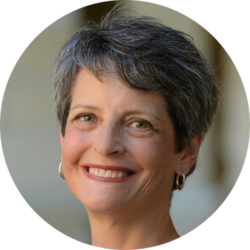
Laura Stone is a retired Ambassador and career foreign service officer. She was APARC's inaugural China Policy Fellow and a Lecturer at the Center for East Asian Studies. She previously served as the Deputy Coordinator of the Secretary of State's Office of COVID Response and Health Security, responsible for assisting in coordinating the global diplomatic response to the COVID pandemic; the Deputy Assistant Secretary for South Asia overseeing U.S. policy towards and relations with India, Nepal, Sri Lanka, Bangladesh, Maldives, and Bhutan; Special Advisor to the Undersecretary of State for Economic Growth; and the designated Deputy Assistant Secretary for China, Taiwan, Hong Kong, and Mongolia. She has worked as the Director of the Office of Chinese and Mongolian Affairs; Director of the Economic Policy Office in the Bureau of East Asia and Pacific Affairs; and Economic Counselor in Hanoi, Vietnam. She served three tours in Beijing as well as tours in Bangkok, Tokyo, the Public Affairs Bureau, the Office of the Secretary of Defense, and the Bureau of Intelligence and Research.

Kathryn Stoner is the Mosbacher Director of the Center on Democracy, Development, and the Rule of Law (CDDRL), and a Senior Fellow at CDDRL and the Center on International Security and Cooperation at FSI. From 2017 to 2021, she served as FSI's Deputy Director. She is Professor of Political Science (by courtesy) at Stanford and she teaches in the Department of Political Science, and in the Program on International Relations, as well as in the Ford Dorsey Master's in International Policy Program. She is also a Senior Fellow (by courtesy) at the Hoover Institution. Prior to coming to Stanford in 2004, she was on the faculty at Princeton University for nine years, jointly appointed to the Department of Politics and the Princeton School for International and Public Affairs (formerly the Woodrow Wilson School). At Princeton she received the Ralph O. Glendinning Preceptorship awarded to outstanding junior faculty. She also served as a Visiting Associate Professor of Political Science at Columbia University, and an Assistant Professor of Political Science at McGill University. She has held fellowships at Harvard University as well as the Woodrow Wilson Center in Washington, DC.
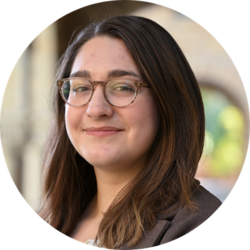
Emily Tallo is the India-U.S. Security Fellow at the Center for International Security and Cooperation. Before coming to CISAC, Emily was a PhD candidate in political science at the University of Chicago specializing in international relations. Prior to starting her Ph.D., she was a research assistant in the Stimson Center’s South Asia program. Emily's research agenda stems from a deep interest in how political elites influence foreign policy through their interactions with other elites. Although leaders make the final decisions in international politics, they must contend with the interests of foreign policy elites such as advisers, politicians, and bureaucrats. Her book project explores how political leaders shape foreign policymaking institutions, rules, and norms to achieve their policy objectives despite real or anticipated resistance from the foreign policy bureaucracies. Emily's other projects relate to how political elites structure foreign policy debates in democratic countries, especially in India.
We are pleased to share the publication of a new volume, Cold War Refugees: Connected Histories of Displacement and Migration across Postcolonial Asia, edited by the Korea Program's Yumi Moon, associate professor in Stanford's Department of History.
The book, now available from Stanford University Press, revisits Cold War history by examining the identities, cultures, and agendas of the many refugees forced to flee their homes across East, Southeast, and South Asia due to the great power conflict between the US and the USSR. Moon's book draws on multilingual archival sources and presents these displaced peoples as historical actors in their own right, not mere subjects of government actions. Exploring the local, regional, and global contexts of displacement through five cases —Taiwan, Vietnam, Korea, Afghanistan, and Pakistan — this volume sheds new light on understudied aspects of Cold War history.
The book's chapters — written by Phi-Vân Nguyen, Dominic Meng-Hsuan Yang, Yumi Moon, Ijlal Muzaffar, Robert D. Crews, Sabauon Nasseri, and Aishwary Kumar — explore Vietnam's 1954 partition, refugees displaced from Zhejiang to Taiwan, North Korean refugees in South Korea from 1945–50, the Cold War legacy in Karachi, and Afghan refugees.
Purchase Cold War Refugees at www.sup.org and receive 20% off with the code MOON20.

The new volume, edited by Stanford historian Yumi Moon, examines the experiences of Asian populations displaced by the conflict between the United States and the Soviet Union.

A potential historic trilateral appearance by Xi Jinping, Kim Jong Un, and Vladimir Putin at Moscow's May 9 Victory Day parade would signal powerful solidarity against U.S. pressure, following the June 2024 'Comprehensive Strategic Partnership' treaty between Pyongyang and Moscow.
Join our expert panel as we analyze this unprecedented geopolitical alignment amid intensifying U.S.-China rivalry. We'll examine covert arms exchanges trading North Korean missiles for Russian defense systems, North Korean troops in Ukraine honing combat skills, and China's evolving role as it perceives American decline and builds its own alliance network.
Could this potential summit herald a new Cold War framework? We'll explore the profound implications for international relations, strategic partnerships, and regional security in what may become a defining moment in 21st-century global politics.
Speakers:

Seong-Hyon Lee is a Senior Fellow at the George H. W. Bush Foundation for U.S.-China Relations and an Associate in Research at Harvard University's Asia Center. A China scholar, Lee gained unique insights during his 11 years residing in China; after completing his Harvard degree, he worked in Beijing as a U.N. consultant and foreign correspondent before earning his Ph.D. from Tsinghua University – President Xi Jinping's alma mater – as the sole international student in his cohort. His connection to Stanford includes previously serving as the Pantech Fellow at the Shorenstein APARC following his time in China.
Lee is the author of two books on U.S.-China relations and their impact on the Korean Peninsula, with his latest publication being The New Cold War: U.S.-China Rivalry and the Future of Global Power. His research spans East Asian international relations, specializing in Chinese domestic politics and foreign policy, U.S.-China relations, North Korea, nuclear weapons, and techno-economic competition. His prior roles include serving as China Director at a Seoul-based think tank advising the South Korean government, holding an Assistant Professorship at Japan’s Kyushu University, and being a Visiting Scholar at the Harvard Fairbank Center for Chinese Studies.

Joseph Torigian is a research fellow at the Hoover Institution; an associate professor at the School of International Service at American University in Washington, DC; a Global Fellow in the History and Public Policy Program at the Wilson Center; and a Center Associate of the Lieberthal-Rogel Center for Chinese Studies at the University of Michigan.
Torigian was previously a visiting fellow at the Australian Center on China in the World at Australian National University; a Stanton Fellow at the Council on Foreign Relations; a postdoctoral fellow at the Princeton-Harvard China and the World Program; a postdoctoral (and predoctoral) fellow at Stanford’s Center for International Security and Cooperation; a predoctoral fellow at George Washington University’s Institute for Security and Conflict Studies; an IREX scholar affiliated with the Higher School of Economics in Moscow; and a Fulbright Scholar at Fudan University in Shanghai.
His book Prestige, Manipulation, and Coercion: Elite Power Struggles in the Soviet Union and China after Stalin and Mao was published in 2022 by Yale University Press. His biography on Xi Jinping’s father, The Party’s Interests Come First: The Life of Xi Zhongxun, Father of Xi Jinping, will be published in June 2025 with Stanford University Press. He studies Chinese and Russian politics and foreign policy.
Moderator:

Ria Roy is a Kleinheinz Fellow at the Hoover Institution, is a specialist in the history of modern Korea and East Asia. Her doctoral dissertation, which she is currently turning into a book, examines the intellectual and cultural history of North Korea in the context of the Japanese Empire’s legacy as well as the influence of the revolutionary bloc. In particular, she explores the history and development of the leadership succession in North Korea, focusing on the role of intellectuals and their ideas in the generation of the unique North Korean model of leadership. More broadly, she is interested in the intellectual interplay between East and West and how it paved the way for a transition to an illiberal modernity.
Roy received her PhD from the Faculty of Asian and Middle Eastern Studies at the University of Cambridge as a Gates Cambridge Scholar. She previously received her MA from Harvard University and her BA from Waseda University in Japan.
Philippines Conference Room (C330)
Encina Hall, 3rd Floor
616 Jane Stanford Way, Stanford, CA 94305

To understand the transformation of Korean food from an “ethnic curiosity” into one of the world’s hottest cuisines, the Korea Program at Shorenstein APARC brought together culinary experts and academics at the conference “Korean Cuisine Gone Global.” Held on April 11, 2024, the scholars offered insights into the transformation of Korean cuisine, the role of race and place in its success story, and new directions in studying food and Korean culture. Their papers are collected in this volume.
The conference also featured celebrity chef Judy Joo, a renowned television star, an international restaurateur, and owner of the famed Seoul Bird, and Ryu Soo-young, an acclaimed actor turned culinary maestro.
Rebecca Jo Kinney is an interdisciplinary teacher and scholar of American Studies and Ethnic Studies, and an associate professor at the School of Cultural Studies at Bowling Green State University. Kinney’s award-winning first book, Beautiful Wasteland: The Rise of Detroit as America’s Postindustrial Frontier (University of Minnesota Press, 2016), argues that contemporary stories told about Detroit’s potential for rise enable the erasure of white supremacist systems. Her research has appeared in American Quarterly, Food, Culture & Society, Verge: Studies in Global Asia, Radical History Review, and Race&Class, among other journals. Her second book, Mapping AsiaTown Cleveland: Race and Redevelopment in the Rust Belt, is forthcoming from Temple University Press in 2025. She is working on a third book, Making Home in Korea: The Transnational Lives of Adult Korean Adoptees, based on research undertaken while a Fulbright Scholar in South Korea.
Robert Ji-Song Ku is an associate professor of Asian and Asian American Studies at Binghamton University (SUNY) and the managing editor of Foundations and Futures: Asian American and Pacific Islander Multimedia Textbook of the Asian American Studies Center at UCLA. His teaching and research interests include Asian American studies, food studies, and transnational and diasporic Korean popular culture. Prior to Binghamton, he taught at Cal Poly, San Luis Obispo, and Hunter College (CUNY). He is the author of Dubious Gastronomy: Eating Asian in the USA (University of Hawai‘i Press, 2014) and co-editor of Eating More Asian America: A Food Studies Reader (NYU Press, forthcoming 2025), the sequel to Eating Asian America (NYU Press, 2013). He is also co-editor of Pop Empires: Transnational and Diasporic Flows of India and Korea (University of Hawai‘i Press, 2019) and Future Yet to Come: Sociotechnical Imaginaries in Modern Korea (University of Hawai‘i Press, 2021), as well as the Food in Asia and the Pacific series for the University of Hawai‘i Press. Born in Korea, he grew up in Hawai‘i and currently lives in Culver City, California.
Jooyeon Rhee is an associate professor of Asian Studies and Comparative Literature and director of the Penn State Institute for Korean Studies. She specializes in modern Korean literature and culture. Her main research concerns Korean popular literature, with particular emphasis on transnational literary exchanges and interactions. Currently, she is writing her second book on cultural imaginations of crime and deviance manifested in late colonial Korean detective fiction. Her other research interests include diasporic art and literature and food studies.
Dafna Zur (editor) is an associate professor of Korean literature and culture in the Department of East Asian Languages and Cultures and director of the Center for East Asian Studies at Stanford. Her first book, Figuring Korean Futures: Children’s Literature in Modern Korea (2017), interrogates the contradictory political visions made possible by children’s literature in colonial and postcolonial Korea. Her second project explores sound, science, and space in the children’s literature of North and South Korea. She has published articles on North Korean popular science and science fiction, translations in North Korean literature, the Korean War in children’s literature, childhood in cinema, children’s poetry and music, and popular culture. Zur’s translations of Korean fiction have appeared in wordwithoutborders.org, Modern Korean Fiction : An Anthology, and the Asia Literary Review.
Papers from Shorenstein APARC’s Korea Program Conference
Donald Trump’s decisive victory in the 2024 U.S. presidential election has reignited debates about the United States' role in a world increasingly defined by geopolitical tensions, economic uncertainty, and democratic recession. The return of Trump to the White House will have profound implications for Asia. To assess the stakes for the region, APARC convened a panel of experts who weighed in on the potential risks and opportunities the second Trump administration’s policies may pose for Asian nations and how regional stakeholders look at their future with the United States. Another panel, organized by APARC’s China Program, focused on what’s ahead for U.S.-China relations.
APARC’s panel, The 2024 U.S. Presidential Elections: High Stakes for Asia, examined how the return of Trump’s political ideology and the macroeconomic effects of his foreign policy will affect Asia.
“We are witnessing the solidification of Trumpism as an influential political ideology,” stated APARC and Korea Program Director Gi-Wook Shin at the opening of the discussion, “one that has begun to transcend traditional American conservatism. Trumpism — marked by a blend of economic nationalism, nativism, and a strongman approach to leadership —could have a huge impact not only in American society but also on the liberal global order.”
According to Shin, Trump’s policies, particularly his focus on unilateralism and economic self-interest, could significantly alter the political and economic dynamics of the Asia-Pacific region.
Political scientist Francis Fukuyama, the Olivier Nomellini Senior Fellow at the Freeman Spogli Institute, argued that Trump’s victory was no longer an anomaly but part of a larger trend of working-class voters shifting allegiance from the Democratic to the Republican Party. Fukuyama expressed concerns about Trump’s aggressive economic policies, including imposing broad tariffs on allies and adversaries alike, and warned that such policies could result in inflation, trade tensions, and long-term economic instability. In addition, he asserted that Trump’s reluctance to engage in foreign conflicts could undermine the United States’ commitments to security alliances, particularly in Asia.
APARC Deputy Director and Japan Program Director Kiyoteru Tsutsui emphasized the broader geopolitical implications of Trump’s policies, noting that Trump’s "America First" approach could further erode the international liberal order. He suggested that Japan would face significant challenges navigating the unpredictability of Trump’s foreign policies. According to Tsutsui, “There might be greater pressure to line up with the United States in dealing with China economically, which would put a great deal of strain on the Japanese economy.” Such an alignment might also muddle Japan’s own diplomatic and security interests.
Gita Wirjawan, a visiting scholar with Stanford's Precourt Institute for Energy and former visiting scholar at APARC, focused on the stakes for Southeast Asia. Wirjawan argued that Trump’s economic policies, such as protectionism and prioritizing economic growth over democratic principles, could embolden right-wing populist movements in Southeast Asia. He suggested that parts of Southeast Asia could be a natural beneficiary of a reallocation of financial capital from the U.S. as companies diversify supply chains by establishing operations outside China in response to Trump’s planned tariffs. Yet, growing economic inequality in Southeast Asia, particularly in urban areas, could fuel the rise of similar nationalist policies, undermining efforts to promote inclusive, democratic development.
Shin highlighted the challenges South Korea might face under a second Trump presidency. Trump will likely demand higher defense payments from South Korea, potentially straining the U.S.-ROK alliance. This could put President Yoon in a tough spot, especially as trilateral U.S.-Japan-Korea cooperation has been progressing well but faces uncertainty. Economically, South Korean firms may struggle if U.S. policies like the Inflation Reduction Act and CHIPS Act are rolled back, as subsidies were crucial for their investments in the U.S. On North Korea, Shin noted that Trump may resume summit diplomacy with Kim Jong Un, leaving South Korea sidelined and potentially sparking an arms race in Northeast Asia.
The panelists all emphasized that Asia, with its diverse political landscapes, would need to navigate a new era of economic nationalism and geopolitical unpredictability, with potential challenges to economic stability and democratic norms.
The second panel, "Crossroads of Power: U.S.-China Relations in a New Administration," focused specifically on the evolving dynamics of U.S.-China relations in the wake of the election. Moderated by APARC China Program Director Jean Oi, the discussion featured Shorenstein APARC Fellow Thomas Fingar, and Peking University's Yu Tiejun, the APARC's China Policy Fellow during fall 2024. The panelists analyzed the potential trade, security, and diplomacy shifts between the two global superpowers, particularly in light of Washington's bipartisan consensus on China.
Central to the discussion was the continuity of U.S. policy toward China under the first Trump administration and the Biden administration. Examples of this continuity included recent tariff increases on Chinese imports, a new U.S. Department of the Treasury program to screen U.S. outbound foreign investments in key sectors, and tighter export controls on critical technologies like quantum computing and advanced semiconductors. The panelists explored the economic and strategic ramifications, noting that these policies could disrupt existing trade patterns.
Another area of concern was China’s uneven implementation of the 2020 Phase One trade deal it negotiated with the U.S., in which China had committed to domestic reforms and $200 billion of additional U.S. imports. This failure could buttress the new administration’s plan to increase tariffs, complicating diplomatic efforts between Washington and Beijing. Fingar noted that while China has made efforts to diversify its supply chains, these changes might not be enough to shield it from the effects of U.S. economic policies, which could include escalating tariffs or additional restrictions on Chinese exports.
The conversation also touched on broader geopolitical considerations, particularly concerning China’s role in the ongoing war in Ukraine. The panelists discussed the potential for cooperation or de-escalation in U.S.-China relations, with China’s positioning on the war serving as both a point of contention and a possible avenue for diplomatic engagement.
Underscoring the deepening complexities in U.S.-China relations post-election, the panelists highlighted the uncertainty surrounding U.S. foreign policy under a second Trump administration, particularly regarding the role of people-to-people exchanges in fostering mutual understanding.
Both events emphasized the multifaceted consequences of Trump’s return to power for Asia and the global international order. While the discussions highlighted the challenges posed by the rise of economic nationalism, trade tensions, and shifting security priorities, they also pointed to potential areas of cooperation and the evolving dynamics of global diplomacy.
From Center Fellow Oriana Skylar Mastro:
What a Second Trump Term Means for the World
OnPoint – WBUR, Nov 12 (interview)
Race to the White House: How the US Election Will Impact Foreign Policy
UBS Circle One, October 23 (interview)
From Visiting Scholar Michael Beeman:
On Korea-U.S. Economic Cooperation in the Era of Walking Out
Yonhap News, Nov 20 (featured)
Trump Looking for Trade 'Reset' with Most Countries: Ex-USTR Official
Nikkei, Nov 16 (interview)
How Southeast Asia Can Weather the Trump Trade Typhoon
The Economist, Nov 14 (quoted)

APARC recently hosted two panels to consider what a second Trump presidency might mean for economic, security, and political dynamics across Asia and U.S. relations with Asian nations.
Stanford University seeks candidates for three faculty positions in Asian Studies. All three appointments will be at the Freeman Spogli Institute for International Studies (FSI) and affiliated with the Walter H. Shorenstein Asia-Pacific Research Center (APARC). The deadline for submissions is November 30, 2024. Read on for more information about each position. Candidates should submit their applications via the Stanford Faculty Positions website.
Stanford University seeks candidates for a new faculty position in the politics and foreign policy of Japan. The successful candidate will have expertise in politics, policy studies, diplomacy, security studies, international relations, or global affairs relating to Japan and the Indo-Pacific region, and will be expected to advance research and education on Japanese politics and foreign policy, in the Japan Program of APARC. This is an open-rank search.
The new faculty member will be appointed as a Senior Fellow or Center Fellow in FSI, affiliated with APARC. Senior Fellows at Stanford University are full members of the Professoriate and Academic Council, with a rank equivalent to tenured associate or full professor. Center Fellows at Stanford University are also members of the Professoriate and the Academic Council, with a rank equivalent to tenure-track assistant professor. Center Fellows are appointed for a fixed term of years with the possibility of promotion to Senior Fellow.
For more information and to apply, view the job posting on the Stanford Faculty Positions website >
Stanford University seeks candidates for a faculty position in Korean Studies. The successful candidate will be expected to advance research and education on Korea, in the Korea Program of APARC.
The new faculty member will be appointed as Center Fellow in FSI, affiliated with APARC. Center Fellows at Stanford University are the equivalent rank of tenure-track assistant professor. They are members of the Professoriate and the Academic Council, eligible to serve as principal investigators, and accrue sabbatical. Center Fellows are appointed for a fixed term of years with the possibility of promotion to Senior Fellow.
For more information and to apply, view the job posting on the Stanford Faculty Positions website >
Stanford University seeks candidates for a new faculty position on Taiwan. The successful candidate will have expertise in policy studies, social sciences, international relations, or global affairs relating to Taiwan, and will be expected to advance research and education on Taiwan studies, in the newly established Taiwan Program of APARC. This is an open-rank search.
The new faculty member will be appointed as a Senior Fellow or Center Fellow in FSI, affiliated with APARC. Senior Fellows at Stanford University are full members of the Professoriate and Academic Council, with a rank equivalent to tenured associate or full professor. Center Fellows at Stanford University are also members of the Professoriate and the Academic Council, with a rank equivalent to tenure-track assistant professor. Center Fellows are appointed for a fixed term of years with the possibility of promotion to Senior Fellow.
For more information and to apply, view the job posting on the Stanford Faculty Positions website >

Stanford University seeks candidates for a new faculty position in Japanese politics and foreign policy, a faculty position in Korean Studies, and a new faculty position on Taiwan. All three appointments will be at the Freeman Spogli Institute for International Studies and affiliated with Shorenstein APARC.

This talk will discuss the historical and contemporary foreign policy objectives and dynamics of the North Korean government.
Benjamin R. Young will examine the foreign policy shifts undertaken by North Korea under the leadership of Kim Il Sung, Kim Jong Il, and Kim Jong Un. He will explore how the Kim family regime has pivoted away from its previous emphasis on solidarity with "small countries" and the Third World, instead reasserting North Korea's focus on building stronger ties with the "big countries," particularly Russia. Young will analyze the motivations behind this strategic reorientation, the implications for North Korea's regional and global positioning, and the broader geopolitical dynamics that have shaped this foreign policy transformation under Kim Jong Un’s rule.
Yong Suk Lee will examine the key foreign policy lessons learned by North Korea over the past three decades, from the four-party talks in the late 1990s to the Hanoi Summit in 2019 and beyond. Drawing on his observations and analyses from his senior leadership position within the CIA, Lee will provide insights into the evolution of US-North Korea relations, North Korea’s engagement with China, and the dynamics of the inter-Korean relationship. By reflecting on North Korea's diplomatic maneuvers, Lee will offer a nuanced understanding of the driving forces and strategic calculations behind Pyongyang's foreign policy decision-making during this pivotal period.
Ria Roy, a Hoover Fellow at the Hoover Institution, will lead the discussion.
SPEAKERS:

Mr. Yong Suk Lee is the Director of Global Risk Analysis for Google’s Global Security & Resilience Services. Mr. Lee leads analytic teams based in Boulder, Dubai, London, New Delhi, New York, São Paulo, Singapore, Washington DC, and Zurich. He is currently a Visiting Scholar, Hoover Institution, Stanford University; Senior Fellow for Asia, Foreign Policy Research Institute; and a Fellow, National Security Institute, George Mason University. Before joining Google, Mr. Lee served for 22 years in various senior leadership positions with the Central Intelligence Agency as a member of the Senior Intelligence Service. His key assignments included service as the Deputy Assistant Director of CIA for the Korea Mission Center, Chief of Korea Department, and as a Briefer on the President’s Daily Briefing staff. Mr. Lee joined the CIA in 1997 as a North Korea analyst. He has a BA from the University of Colorado and an MA from Ohio University.

Benjamin R. Young is currently an assistant professor of homeland security and emergency preparedness at Virginia Commonwealth University. In August 2024, he will be a Stanton Foundation Nuclear Security Fellow at the RAND Corporation. He is the author of the book, Guns, Guerillas, and the Great Leader: North Korea and the Third World (Stanford University Press, 2021). Previously, he taught at Dakota State University and the U.S Naval War College. He has published more than a dozen peer-reviewed articles on various aspects of North Korean history, international security, and U.S-Asia relations. He was a 2018-2019 CSIS/USC NextGen US-Korea Scholar and has also written journalistic pieces for The Washington Post, The Diplomat, Nikkei Asia, The National Interest, and NKNews.org.

DISCUSSANT: Ria Roy, a Hoover Fellow at the Hoover Institution, is a specialist in the history of modern Korea and East Asia. Her doctoral dissertation, which she is currently turning into a book, examines the intellectual and cultural history of North Korea in the context of the Japanese Empire’s legacy as well as the influence of the revolutionary bloc. In particular, she explores the history and development of the leadership succession in North Korea, focusing on the role of intellectuals and their ideas in the generation of the unique North Korean model of leadership. More broadly, she is interested in the intellectual interplay between East and West and how it paved the way for a transition to an illiberal modernity. Roy received her PhD from the Faculty of Asian and Middle Eastern Studies at the University of Cambridge as a Gates Cambridge Scholar. She previously received her MA from Harvard University and her BA from Waseda University in Japan.
All media representatives interested in covering the event or accessing the event site should contact aparc-communications@stanford.edu by 5 PM Pacific Time, Monday, May 6.
The Korean Peninsula stands at a perilous crossroads. Recent missile tests and provocations, coupled with historical trends, paint a worrisome picture of the current state of affairs, prompting some analysts to warn of a looming conflict. The Korea Program at Shorenstein APARC recently hosted two events to analyze these escalating tensions that have sparked global concern.
On February 21, the seminar “Slow Boil: What to Expect from North Korea in 2024,” featured Victor Cha, D.S. Song-KF Chair, Professor of Government at Georgetown University, and Senior Vice President for Asia and Korea Chair at the Center for Strategic and International Studies. Cha discussed historical behavioral patterns of North Korean missile tests, military provocations, and weapons demonstrations, and what all these might mean for security on the Korean peninsula.
The following week, on March 7, at the seminar “Is North Korea Preparing for War?,” we were joined by Robert Carlin, a non-resident scholar at the James Martin Center for Nonproliferation Studies, Middlebury Institute of International Studies at Monterey and Siegfried Hecker, a professor of practice at the James Martin Center for Nonproliferation Studies, Middlebury Institute of International Studies at Monterey, and in the Department of Nuclear Engineering at Texas A&M University. Carlin and Hecker, both formerly our colleagues at the Stanford Center for International Security and Cooperation, discussed their recent 38 North article, “Is Kim Jong Un Preparing for War?,” which posits that Pyongyang has already made the strategic decision to go to war.
The speakers at both events delved into the various rationales behind North Korea's actions and provided contrasting viewpoints on the trajectory of the situation. While Carlin and Hecker painted a grim picture of North Korea's intentions to engage in warfare and advocated for robust security measures, Cha argued that, while 2024 will be a challenging year, established approaches such as diplomacy and deterrence will remain effective in managing relations with Pyongyang.
Carlin and Hecker provided a grave assessment, suggesting that “Kim Jong Un has made a strategic decision to go to war,” akin to his grandfather's stance in 1950. Hecker provided historical context, indicating that despite attempts at normalization with the United States, each North Korean leader has simultaneously explored the development of its nuclear weapons arsenal and accumulation of its conventional armaments. Hecker argued, "The Korean War was never settled, it was an armistice, and so, more or less, North Korea has been preparing for war, but this is different and we are really concerned.”
Carlin noted a shift that occurred at the Workers’ Party plenum at the end of 2022, in which “Pyongyang announced new measures that demonstrated that the old policy with the U.S. was over and that they were going to move much more towards the Russians.” The plenum also marked a rhetorical shift where Kim Jong Un introduced the phrase “war preparations.” “Some people say, ‘Oh that's normal North Korean rhetoric’ — it's not normal. They had not been talking at that level to their own people about war preparations […] they talked a lot about deterrence which meant building up, but not war preparations,” said Carlin.
According to Carlin, Pyongyang has “primed the pan for a clash in the Yellow Sea […] everything we have seen in the last year suggests very strongly that this is a decision the regime has made, and that it will patiently move in this direction.”
The speakers both argued that Kim's shift stems from a perceived failure of past diplomatic endeavors and a traumatic setback at the 2019 Hanoi summit, when, as Hecker indicated, the North Koreans decided to abandon the 30-year policy of seeking normalization with the United States. “This is a more dangerous time than any time since the start of the Korean War,” Hecker warned.

In contrast, Cha’s assessment of the situation is more cautiously optimistic, anticipating a surge in North Korean provocations in 2024 but attributing it to historical patterns rather than a definitive strategic shift. According to Cha, we should expect North Korean belligerence to increase in 2024, while dialogue looks unlikely.” He highlighted North Korea's tendency to ramp up provocations during U.S. election years, produced data on the increasing number of provocations since the 1990s, and emphasized Kim's repeated rejections of dialogue with the Biden administration.
Cha also provided four reasons why he does not expect a war with North Korea in 2024: “First, Pyongyang is not confident enough in its capability to deter U.S. and South Korean retaliation […] Second, the uptempo in U.S.-ROK and U.S.-ROK-Japan exercising […] Third, if North Korea were ready to go to war, they would not be selling all their ammunition to Russia […] and fourth, if North Korea were really ready to go to war, they would not be decoupling from South Korea.”
Cha suggested that, while war is unlikely, “coercion, particularly against South Korea, and North Korea-Russia relations are only going to grow.” He described North Korea’s transfer of armaments from Najin to Dunai in Russia to three munition storage facilities near the Ukrainian front. Cha sees a possible change in the U.S. North Korea policy approach from focusing on denuclearization to curtailing and disincentivizing this behavior.
Whether or not the escalating tensions since the 2019 Hanoi Summit mean that Pyongyang is headed to war, its increased belligerence is a clear signal that Kim’s government has shifted its efforts. North Korea is now pursuing its security and economic agendas without any indication of attempting to normalize relations with the United States or South Korea. Furthermore, it continues to strengthen its partnership with the China-Russia bloc. The assessment of continued tensions on the Korean Peninsula is undisputed.
Ultimately, both perspectives shared by the speakers highlight the need for vigilance, strategic coordination, and innovative policy solutions to address the escalating tensions in the region.

Amid North Korea’s increasing provocations, APARC’s Korea Program hosted three experts — Robert Carlin, Victor Cha, and Siegfried Hecker — to consider whether Pyongyang plans to go to war.

This event is available to in-person attendees and will not be livestreamed.
In this talk, Carlin and Hecker will discuss the answer to the question posed in their recent article Is Kim Jong Un Preparing for War? and share its background and the reactions to it.
About the Speakers:

Robert Carlin, a longtime analyst of North Korea and frequent visitor to the DPRK, is currently a non-resident scholar at the James Martin Center for Nonproliferation Studies, Middlebury Institute of International Studies at Monterey. From 2006-2022, he was a consultant at the Center for International Security and Cooperation (CISAC) at Stanford University. Before that, he was a political advisor at the Korean Economic Development Organization (KEDO), a multinational consortium organized to carry out key provisions of the 1994 US-DPRK Agreed Framework. From 1989, Carlin was in the State Department’s Bureau of Intelligence and Research, concurrently taking part as an intelligence advisor in a range of negotiations with the DPRK. In various capacities, Carlin has visited North Korea over 30 times. He is the co-author with Don Oberdorfer of The Two Koreas, third edition, 2014.

Siegfried Hecker is an internationally recognized expert in plutonium science, global threat reduction, and nuclear security. He is currently a professor of practice at the James Martin Center for Nonproliferation Studies, Middlebury Institute of International Studies at Monterey, and in the Department of Nuclear Engineering at Texas A&M University. Hecker served at the Los Alamos National Laboratory for 34 years, including 12 years as director from 1986 through 1997. He was affiliated with Stanford University for 17 years, including 6 years as co-director of the Center for International Security and Cooperation (CISAC). At Stanford, he was a professor (research) in the Department of Management Science and Engineering and a senior fellow at CISAC. Dr. Hecker is the editor of Doomed to Cooperate (2016), two volumes documenting the history of Russian-U.S. laboratory-to-laboratory cooperation, and Hinge Points: An Inside Look at North Korea’s Nuclear Program (2023) written with Elliot Serbin.
All media representatives interested in covering the event or accessing the event site should contact aparc-communications@stanford.edu by 5 PM Pacific Time, Tuesday, March 5.
A related event by the speakers held at APARC in 2020 is available to view at https://fsi.stanford.edu/news/experts-korea-discuss-future-north-korea-amidst-escalations.


