-

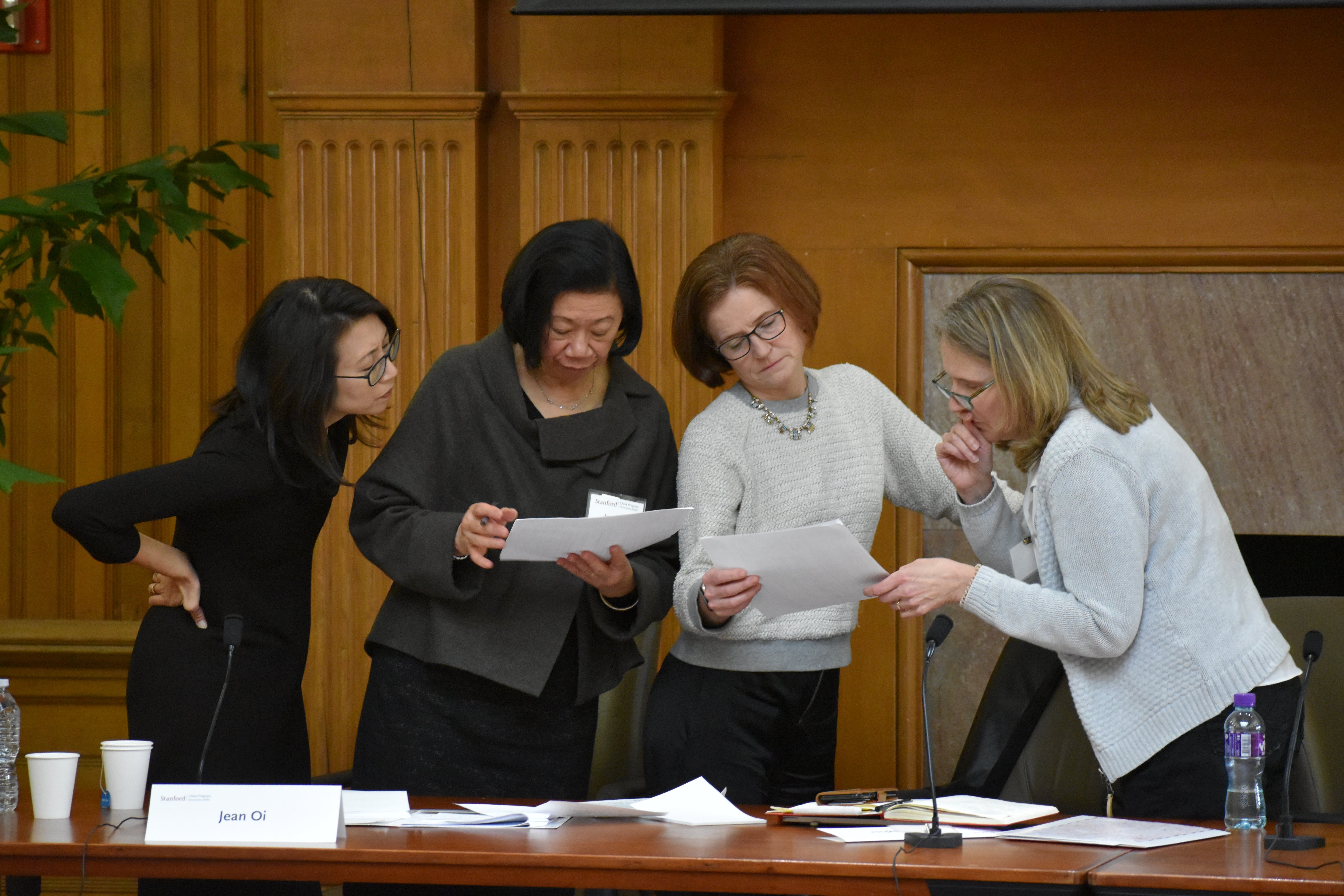
In 2015, Beijing issued a set of Guiding Opinions as part of a program to reform China’s state-owned enterprises (SOEs). The new policy requires SOEs to amend their corporate charters to formalize and elevate the leadership role of the Chinese Communist Party in their corporate governance. To better grasp the contours of political conformity in Chinese corporate governance, Curtis Milhaupt will empirically examine the patterns of “party-building” (dangjian) charter amendments adopted in response to this policy by all listed nonfinancial Chinese firms in the four-year period from 2015-2018. He will also analyze the wide, substantive variation in the adoption of this dangjian policy within and across firm types, including privately-owned enterprises.

Image
Portrait of Curtis Millhaupt
Curtis J. Milhaupt is the William F. Baxter-Visa International Professor of Law, Stanford Law School and a Senior Fellow, by courtesy, Freeman Spogli Institute for International Studies.  He is a Research Associate of the European Corporate Governance Institute and a member of the American Law Institute.  His research and teaching interests include comparative corporate governance, the legal systems of East Asia, and state capitalism.  In addition to numerous scholarly articles, he has co-authored or edited seven books, including Regulating the Visible Hand? The Institutional Implications of Chinese State Capitalism (Oxford, 2016), Law and Capitalism: What Corporate Crises Reveal about Legal Systems and Economic Development Around the World (Chicago, 2008) and Transforming Corporate Governance in East Asia (Routledge, 2008).  Prior to Stanford, Professor Milhaupt held chaired professorships in comparative corporate law and Japanese law at Columbia Law School, where he served on the faculty for nearly two decades.  Before entering academia, Professor Milhaupt practiced corporate law in New York and Tokyo with a major law firm.  He holds a J.D. from Columbia Law School and a B.A. from the University of Notre Dame, and conducted graduate studies in law and international relations at the University of Tokyo.

Curtis J. Milhaupt William F. Baxter-Visa International Professor of Law, Stanford Law School
Seminars
Authors
News Type
News
Date
Paragraphs

Shall I tell you why we have brought you here? To cure you! To make you sane! Will you understand, Winston, that no one whom we bring to this place ever leaves our hands uncured? We are not interested in those stupid crimes that you have committed. The Party is not interested in the overt act: the thought is all we care about. We do not merely destroy our enemies, we change them. – George Orwell, 1984

Shorenstein APARC convened a multidisciplinary panel of experts on October 24, 2019, to provide historical context and critical social science analysis to the unfolding horrors in Xinjiang Uyghur Autonomous Region (XUAR). Displaying the above quote from George Orwell’s 1984, Gardner Bovingdon, associate professor in the Central Eurasian Studies Department at Indiana University, characterized the mass detentions in XUAR as “one of the great, state-engineered human rights disasters of our time” and proceeded to describe the camps in Xinjiang as both “Orwellian and Kafkaesque.”

Over ten million Muslim minorities in the region are under lock-down control, and over one million Uyghurs and other Turkic Muslims have allegedly disappeared into internment camps. Beijing has characterized the camps as vocational training centers to fight Islamic extremism and recently claimed that most of the detainees have been released. Recent New York Times exposé based on an unprecedented leak of over 400-pages of internal Party documents made clear, however, that the camps are anything but job-training centers.

Broad Assault on Non-Han Culture

James Millward, professor of inter-societal history at Walsh School of Foreign Service, Georgetown University, gave a quick overview of the worsening political situation in the XUAR, especially since 2009, when violent race riots broke out in Urumqi, ignited by a conflict between Uyghur and Han workers in Guangdong. The bloody incident marked a major turning point in Han-Uyghur relations, and Beijing’s own recalibration of its own policies towards the Uyghurs. When in early 2010 and, again, in 2013-2015, jihadist-style terrorist acts broke out in XUAR, Beijing’s response in 2014 was to launch an all-out “strike hard campaign.”

That same year, Xi Jinping also called an important Central Ethnic Work Conference where the leadership adopted a new approach to ethnic dissent in the XUAR. Instead of relying, as before, on material improvements and economic developments to placate the Uyghurs and other Turkic Muslims in the XUAR, Xi Jinping now also prescribed the need for “spiritual or psychological” means (jingshenshangde (精神上的)) to manage ethnic strife. What followed, Millward described, were new national security laws and national counterterrorism laws with vague, broad language that allowed all types of measures to be implemented. Then, in 2016, Chen Quanguo, former Party Secretary in Tibet Autonomous Region from 2011-2016, was transferred to the XUAR to apply the same draconian securitization and surveillance system he had put in place in Tibet. Millward described 2016 as a “watershed moment,” a turning point in the crack-down on ethnic dissent in XUAR. The number of criminal prosecutions in Xinjiang suddenly skyrocketed over thirteen-fold from just 27,000 to 363,000 cases between 2016-2018. The number of new security facilities, including camps, prisons and even kindergartens, also spiked in the XUAR during the same period.

In addition to such judicial and extra-judicial methods of repression in the XUAR, this all-encompassing campaign also included draconian assaults on non-Han, Islamic culture. Beginning in the early 2000s, that assault has included the razing of old Kashgar; the illegalizing of any Islamic symbols such as women’s headgear, men’s beards; prayer, and fasting on Ramadan. What earlier started as official discouragement “turned into de facto laws,” he explained: “[Y]ou get locked up in a camp for this kind of behavior.” This “broad, broad attack” on the “symbols and central aspects of Uyghur culture” has also included the erasure of Uyghur script in public places; the disappearance of Uyghur intellectual and cultural leaders, including Rahile Dawut, a renowned anthropologist; and Tashpolat Tiyip, an internationally-recognized geographer and former President of Xinjiang University. One million Han Party members and officials have also been sent to southern Xinjiang to stay in Uyghur homes to spot signs of “extremism,” such as copies of the Quran, religious DVDs, etc.

Totalitarian Politics of Land

Lauren Hansen Restrepo, assistant professor in growth and structure of cities at Bryn Mawr College and an expert on urbanization in Xinjiang next spoke from the panel. She used the lens of urban planning to describe two significant shifts in Beijing’s techniques of governance over the Uyghur population in the XUAR. From 2000-2009, before the Urumqi riots, the guiding principle for spatial development in Urumqi was that of a “dual-centered city” (shuangzhongxin; 双中心) – a relatively balanced vision with one development center located in the Uyghur heartland (Tianshan) and the other, in the Han super-majority region (Xinshi). This dual model of growth for Urumqi was abandoned in 2010, however, and a new spatial development policy called nankongbeikuo 南控北扩 or “control the south, develop the north” took its place. Construction halted in southern Urumqi where Uyghurs make up a majority of the population, and all resources were basically channeled to the northern part of the city.

In the wake of the 2014 Central Ethnic Work Conference, however, the “logic of total security” took over and there began a precipitous move towards what Restrepo called “a totalitarian politics of land.” The central government took control and began to more directly govern how development worked in XUAR. “Regional planning has broken every logic of urban planning in China,” she stated, resulting in the isolation and even greater marginalization of Uyghur-dominated urban centers. According to Restrepo, cities and larger regions in XUAR are being reconfigured to come under the direct management of central ministry-level powers and quasi-military entities called the bingtuan, respectively.

Open Air Prisons

Next, Darren Byler, an anthropologist who had recently received his Ph.D. from the University of Washington, focused on Uyghur dispossession and “terror capitalism” in the city of Urumqi. He first described the mass migration of Han people in the 1990’s into the XUAR, which caused increasing tensions with the Uyghurs.

With economic development, however, also came communications infrastructure, and in 2010, with the installment of 3G networks in Xinjiang, smartphone use began to spread. By 2012, nearly 40-50 percent of XUAR’s population were also on WeChat, China’s most popular messaging app. Uyghurs formed a vibrant, virtual public sphere on WeChat where they often formed networks centered on their religious identity. According to Byler, Uyghurs mainly focused on personal piety, rather than on political/radical forms of Islam. But after the violent jihadi-style attacks in 2013-2015, the Chinese state increasingly collapsed Islamism with radicalism extremism and equated visible signs of religiosity like beards on men, women’s veils and regular prayer with pre-terrorist tendencies. The impetus for this intense politicization of Islamism by the authorities, Byler also explained, originated with the U.S.’ war on terror.

The XUAR is a key zone of the Belt and Road Initiative and a region rich in natural resources, Byler pointed out, and control over this Northwestern area is essential to Xi Jinping’s ambitions. Byler described extensive use of cameras, digital media and biometric checkpoints, prisons, internment camps and, more recently, coerced labor to accomplish tight control over the Uyghurs. Byler also explained how, since the spring of 2017, the local police instituted a point-based ranking system for Uyghurs that assessed, for example, whether he or she owned religious tracts, his/her daily prayer practices, and ties to foreign countries.

In the internment camps themselves, the detainees undergo boot camp-style ideological and Chinese language training in conditions akin to medium security prisons. Pictures of blindfolded captives with their hands tied behind their backs, guards with tasers and weapons, all belied the Chinese government’s characterization of these camps as benign, vocational training centers. And, now, Byler described, in factories, such as textile factories, associated with these camps, detainees are coerced to provide low-cost labor at a time when average labor costs in China are rising. In a grim conclusion, Byler stated, “what's being built through this is . . . open air prisons. The whole space [of XUAR] is prison, it’s camps all the way down . . . . You can't move . . . without showing your I.D. and having your face scanned, and so it's just impossible to escape.”

State-engineered Human Rights Disaster

Indiana University’s Gardner Bovingdon, whose research focuses on politics in contemporary Xinjiang and the region’s modern history, was the last panelist to speak at the event. He first situated this “great, state-engineered human rights disaster[ ]” within the CCP’s framework of “minzu regional autonomy,” which the Party-state had established after 1949. Minzu being variously translated as “nationality” or “ethnicity,” the framework formally recognized and accorded some measure of political autonomy to people who are culturally different. In fact, however, communist ideology, Bovingdon noted, has always faced tensions between (i) “the goal of respecting and protecting cultural difference” and (ii) “the goal of integrating the land and the peoples into a unified polity.”

According to Bovingdon, prior to 2009, commercialization of Uyghur culture through tourism and consumption seemed to be the Party’s preferred way of dealing with the securitization problem in the XUAR. But the CCP’s ever-shifting attitude towards the nation’s multi-ethnicity issue went all the way back to the Soviet collapse in 1991. The paramount concern of the Chinese Communist Party ever since has been to avert the outcome that had felled their erstwhile communist neighbor and preserve the Party and the nation. Scholarly responses to the Soviet collapse in the 1990’s included an analysis that exhorted the government to “weaken the concept of minzu and minzu consciousness”; lessen “minzu centrism” and vitiate the notion of minzu independence. Exhortations to “de-politicize and culturalize” the problem of ethnic minorities continued into the 2000’s. Then, more recently, scholars have proposed moving away from policies that mimic those of the former Soviet Union and adopting “second generation minzu policies” that promote “fusion and collective flourishing” of the various peoples.

Regardless of the official academic discourse, however, Bovingdon asserted that the best explanation for policy changes in the XUAR remained the transfer of Chen Quanguo as Party Secretary from Tibet to Xinjiang in 2016. Under him, the Chinese Communist Party transported and scaled-up a set of policies that had previously been applied to the unrest in Tibet. These policies do not “weaken” minzu consciousness, Bovingdon suggested, but rather intensifies them. These policies are, in fact, “signs of a flailing, terrified Party,” Bovingdon asserted, “that doesn’t know what to do with the Uyghurs, but also feels no constraints from the international community on its behavior. And so the biggest problem now is to find a way to put constraints on a system that has operated untrammeled with devastating consequences.”

Hero Image
A mix of ethnic Uyghur and Han shopkeepers hold large wooden sticks as they are trained in security measures on June 27, 2017 next to the old town of Kashgar, in the far western Xinjiang province
A mix of ethnic Uyghur and Han shopkeepers hold large wooden sticks as they are trained in security measures on June 27, 2017 next to the old town of Kashgar, in the far western Xinjiang province, China.
Kevin Frayer/Getty Image
All News button
1
Paragraphs
We estimate the rates of return to education in rural China using primary survey data collected in 2016. Estimated average returns to education are 3.1 per cent. However, careful statistical analysis is required when estimating the returns to education. The paper demonstrates that when employment interruptions are accounted for, the measured returns to education rise. Our results also confirm that mismeasurement of the wage rate by using an hourly wage rate (versus daily or monthly earnings) raises the estimation of rates of return to education. Finally, our results suggest that the return to education is nonlinear in education levels but only when it reaches the tertiary level.
 
All Publications button
1
Publication Type
Journal Articles
Publication Date
Journal Publisher
The Australian Journal of Agricultural and Resource Economics
Authors
Scott Rozelle
Authors
Noa Ronkin
News Type
News
Date
Paragraphs

As a U.S.-China trade deal hangs in the balance and the world’s two largest economies are locked in a race for technological supremacy, concerns have arisen about China’s counterintelligence threat to the United States. In July 2019, FBI Director Christopher Wray told members of the U.S. Senate Judiciary Committee that China poses the most severe counterintelligence threat to the United States than any other country, and described that national security and economic espionage threat as “deep and diverse and wide and vexing.” He noted that the FBI has to contend not only with Chinese officials but also with “nontraditional collectors,” including Chinese scientists and students who are looking to steal American innovation. There are currently multiple legislative proposals in Congress, all of which, in one way or another, are aimed at limiting university collaboration with Chinese nationals and the education of Chinese nationals in “strategic” research fields by U.S. higher education institutions.

These legislative endeavors, however, argues Arthur Bienenstock, co-chair of the American Academy of Arts and Sciences’ Committee on International Scientific Partnerships, may endanger the U.S. science and technology workforce and limit the effectiveness of U.S. academic research, thus weakening the very fields the nation is most anxious to protect.

Bienenstock is also a member of the National Science Board, the governing body of the National Science Foundation, and former associate director for science of the White House Office of Science and Technology Policy. At Stanford, he is special assistant to the President for federal research policy, associate director of the Wallenberg Research Link, and professor emeritus of photon science. At a recent lecture hosted by APARC’s China Program, Bienenstock discussed some of the proposed legislation and federal acts regarding international scientific collaboration with China and their implications for the U.S. scientific workforce. He cautioned U.S policymakers against an expansive interpretation of what constitutes “sensitive research” in strategic areas, such as artificial intelligence and quantum science, and offered a framework for determining when scientific research should be subject to greater control.

[To get more stories like this delivered to your inbox sign up for APARC newsletters]

Image
Arthur Bienenstock and Gi-Wook Shin seated at a conference room.
Indeed, said Bienenstock, “China is the only nation in the world that can and plans to challenge U.S. economic, military and ideological leadership” – a challenge that is partly based on its becoming a major scientific and technological power. He agreed that the concerns of FBI Director Wray and others are valid and must be considered carefully, but noted, based on his observations at informative sessions and a meeting with an FBI officer, that the overall number of documented misdeeds involving Chinese nationals is over 100 – far from a deep and wide threat – and that he has not seen evidence of significant student participation in those misdeeds.

We must come to terms with reality, claimed Bienenstock, presenting evidence that the United States is no longer the dominant funder of science and technology research; that Chinese nationals constitute a very significant portion of the U.S. workforce in computer science, engineering, and mathematics; and that the U.S. science and technology workforce is highly dependent on Chinese graduate students.

The United States must maintain and strengthen its scientific and technological efforts if it is to maintain a leadership position, Bienenstock said. To do so, he emphasized, U.S. universities must maintain their openness, and lawmakers, in turn, must thoughtfully understand the benefits of collaboration with Chinese scientists and engineers as well as keep the country attractive for Chinese students.

Listen to highlights from Bienenstock’s presentation on our SoundCloud channel. A transcript is available below.

Photo: Arthur Bienenstock (right) and APARC DIrector Gi-Wook Shin (credit: Andrea Brown).

Hero Image
Concept of U,S.-China technology competition: brain-shaped boxing gloves covered in U.S. and China flags facing against each other on a background of a motherboard Just Super/ Getty Images
All News button
1
Paragraphs

We find that rapid worker turnover significantly disrupts the productivity of responsive manufacturers. Our study uses a uniquely rich dataset drawn from China-based FATP (final assembly, testing, and packaging) facilities that produce millions of units of consumer electronic goods weekly yet exhibit high worker turnover exceeding 300% annually. The data cover the firm's weekly production plans, 52,214 workers' compensations and assignments, and assembly station productivity. To study managerial prescriptions, we extend the classical production planning problem to include endogenous worker turnover as an Experience-Based Equilibrium and use advances in reinforcement learning and approximate dynamic programming to estimate and simulate our model. Our empirical analyses exploit instrumental variables, including the firm's demand forecasts as demand shifters". We find that turnover's impact on yield waste is conservatively $146-178M, and that a well-calibrated wage increase reduces the manufacturer's variable production costs (including wages) by up to 21%, or $594M for the product we study. The wage increase reduces the firm's reliance on a larger workforce and overtime to hedge against yield disruptions from turnover; it stabilizes a leaner workforce and improves both production reliability and exibility. In settings where performance depends on workers repeating known tasks in coordinated groups, our results suggest that firms responsively matching supply to demand can pay a steep price for a disruptively turnover-prone workforce.


All Publications button
1
Publication Type
Working Papers
Publication Date
Authors
James Chu
Prashant Loyalka
-

Panelists:

Young-Sun Ha, Chairman, East Asia Institute, South Korea; Professor emeritus, Political Science and International Relations, Seoul National University

Wang Hwi Lee, Professor, Political Science, Ajou University, South Korea

Thomas Fingar, Shorenstein APARC Fellow, Freeman Spogli Institute for International Studies, Stanford University

Gi-Wook Shin (moderator), Director, Shorenstein APARC;  William J. Perry Professor of Contemporary Korea, Stanford University


Panel Discussions
Paragraphs
BACKGROUND
Childhood malnutrition is commonplace among poor rural communities in China. In 2012, China launched its first nationwide school‐feeding program (SFP) to address this problem. This study examines the prevalence of malnutrition before and after the SFP and identifies possible reasons for the trends observed.
 
METHODS
Ordinary least squares regression and propensity score matching were used to analyze data from 2 cross‐sectional surveys of 100 rural primary schools in northwestern China. Participants were fourth‐and fifth‐grade students. Outcome measures include anemia rates, hemoglobin levels, body mass index, and height for age Z scores.
 
RESULTS
Three years after implementation of the SFP, malnutrition rates among sample students had not fallen. The SFP had no statistically significant effect on either anemia rates or BMI, but was linked to an increase in the proportion of students with below normal height for age Z scores. Meals provided to students fell far short of national recommendations that the SPF should provide 40% of the recommended daily allowance of micronutrients.
 
CONCLUSIONS
Despite significant budgetary outlays between 2012 and 2015, China's SFP has not reduced the prevalence of malnutrition among sample students. To make the SFP more effective, funding and human resources both need to be increased.
All Publications button
1
Publication Type
Journal Articles
Publication Date
Journal Publisher
Journal of School Health
Authors
Huan Wang
Matthew Boswell
Scott Rozelle
-
Conferences
Paragraphs

In the 2019 fourth quarter edition of the Milken Institute Review, Asia Health Policy Program director Karen Eggleston discusses the progress China has made since the 2009 reforms to its healthcare, which brought basic coverage to all and reduced patients' share of costs, and explains the many challenges that remain, including increasing the system's efficiency to ensure its sustainability and addressing the disparities in healthcare that echo the "yawning gap in living standards between China's rising middle class and its poorest citizens."

All Publications button
1
Publication Type
Journal Articles
Publication Date
Journal Publisher
Milken Institute Review
-
Conferences
Subscribe to China