Authors
Denise Masumoto
News Type
News
Date
Paragraphs
As the new academic year gets underway, the Shorenstein Asia-Pacific Research Center’s Corporate Affiliate Program is excited to welcome its new class of fellows to Stanford:
 
  • Muthukrishnan Anantharamakrishnan, Reliance LIfe Sciences
  • Hareendra Bhaskaran, Reliance LIfe Sciences
  • Takayuki Hayakawa, Japan Patent Office
  • Hirotaka Ishii, Ministry of Economy, Trade & Industry, Japan
  • Hui Liu, PetroChina
  • Rui Minowa, Development Bank of Japan
  • Hiroki Morishige, Shizuoka Prefectural Government
  • Daisuke Nakaya, Japan Air Self Defense Force
  • Hidenori Nishita, Ministry of Economy, Trade & Industry, Japan
  • Kanjiro Onishi, Ministry of Finance, Japan
  • Akihiko Sado, The Asahi Shimbun
  • Yohei Saito, Future Architect, Inc.
  • Aki Takahashi, Nissoken
  • Zhuoyan Wang, PetroChina
  • Kensaku Yamada, Mitsubishi Electric
  • Shaofeng (Sean) Zhang, PetroChina
  • Xuan (James) Zhang, Beijing Shanghe Shiji Investment Company
 
During their stay at Stanford, the fellows will audit classes, work on English skills, and conduct individual research projects; at the end of the year they will make a formal presentation on the findings from their research. During their stay at the center, they will have the opportunity to consult with Shorenstein APARC's scholars and attend events featuring visiting experts from around the world. The fellows will also participate in special events and site visits to gain a firsthand understanding of business, society and culture in the United States.


Hero Image
rsd16 068 0011a Rod Searcey
All News button
1
News Type
News
Date
Paragraphs

The Shorenstein Asia-Pacific Research Center (APARC) at Stanford is now accepting applications for the Shorenstein Postdoctoral Fellowship in Contemporary Asia, an opportunity made available to two junior scholars for research and writing on Asia.

Fellows conduct research on contemporary political, economic or social change in the Asia-Pacific region, and contribute to Shorenstein APARC’s publications, conferences and related activities. To read about this year’s fellows, please click here.

The fellowship is a 10-mo. appointment during the 2017-18 academic year, and carries a salary rate of $52,000 plus $2,000 for research expenses.

For further information and to apply, please click here. The application deadline is Dec. 16, 2016.

Hero Image
27193530153 58630c4828 o
All News button
1
-

In this sixteenth session of the Strategic Forum, former senior American and South Korean government officials and other leading experts will discuss current developments in the Korean Peninsula and North Korea policy, the future of the U.S.-South Korean alliance, and a strategic vision for Northeast Asia. The session is hosted by the Korea Program in association with The Sejong Institute, a top South Korean think tank.

Workshops
News Type
News
Date
Paragraphs

The Koret Foundation of San Francisco has extended its gift to Stanford’s Shorenstein Asia-Pacific Research Center (APARC) in support of contemporary Korean studies.

Two more years have been added to a three-year gift awarded to the Center in 2015, totaling to 12 years of lifetime support from the Foundation, whose mission is to endow scholarly solutions to community problems and to invest in leading institutions that serve as levers for achieving impact.

The gifts have allowed the Center to bring eminent professionals from Asia and the United States to Stanford for an annual fellowship and an annual international conference known as the Koret Workshop, all of which aims to promote greater understanding and closer ties between Korea and the United States.

“The Koret Foundation’s gift represents its commitment to strengthening research and finding solutions to challenges in Korea and the United States,” said Shorenstein APARC Director Gi-Wook Shin. “Their support over the past eight years has enabled our Korea Program to invite numerous visiting scholars, offer new courses to students, and foster important conversations in the Bay Area community and beyond. We greatly value our relationship with the Foundation and thank them for their enduring generosity.”

Since 2008, eight Koret fellows have conducted research at the Center, many public seminars have been held, and each workshop has yielded a book published by Shorenstein APARC and the Brookings Institution Press.

Hero Image
uskorea flags
All News button
1
News Type
Q&As
Date
Paragraphs

Stanford University’s Center on Democracy, Development and the Rule of Law (CDDRL) is proud to announce our four incoming fellows who will be joining us in the 2016-2017 academic year to develop their research, engage with faculty and tap into our diverse scholarly community. 

The pre- and postdoctoral program will provide fellows the time to focus on research and data analysis as they work to finalize and publish their dissertation research, while connecting with resident faculty and research staff at CDDRL. 

Fellows will present their research during our weekly research seminar series and an array of scholarly events and conferences.

Topics of the incoming cohort include electoral fraud in Russia, how the elite class impacts state power in China, the role of emotions in support for democracy in Zimbabwe, and market institutions in Nigeria. 

Learn more in the Q&A below.


Image
natalia embedded
Natalia Forrat

CDDRL Pre-Doctoral Fellow

Hometown: Tomsk, Russia

Academic Institution: Northwestern University

Discipline and expected date of graduation: Sociology, April 2017

Research Interests: authoritarianism, state capacity, social policy, civil society, trust, Russia and post-communist countries

Dissertation Title: The State that Betrays the Trust: Infrastructural State Power, Public Sector Organizations, and Authoritarian Resilience in Putin's Russia

What attracted you to the CDDRL Pre/post-doctoral program? I study the connection between state capacity and political regimes - the topic that is at the core of many research initiatives at CDDRL. Learning more about this work and receiving feedback for my dissertation will enrich and sharpen my analysis, while helping me to place it into a comparative context. I am looking forward to discussing my work with the faculty who study the post-Soviet region. I also will explore policy implications of my work with the help of policy experts at CDDRL.

What do you hope to accomplish during your nine-month residency at the CDDRL? Besides finishing writing my dissertation, I will workshop three working papers to prepare them for publication. The first one argues that Putin's regime used the school system to administer a large-scale electoral fraud in 2012 presidential elections; the second one shows how the networks of social organizations were used by subnational autocrats to strengthen the regime; and the third one will look at the factors that make the abuse of such organizations more difficult in some regions. In addition to these papers I will continue developing my post-graduation research project exploring the relationship between social trust and distrust, institutions, political competition, and democratization.

Fun fact: I have spent 25 years of my life in Siberia, and I can tell you: Chicago winters are worse!


Image
shelby embedded
Shelby Grossman

CDDRL Postdoctoral Fellow

Hometown: Reading, MA

Academic Institution: Harvard University

Discipline & Graduation Date:  Government, Summer 2016

Research interests: political economy of development, private governance, market institutions, Sub-Saharan Africa, survey methods

Dissertation Title: The Politics of Order in Informal Markets: Evidence from Lagos

What attracted you to the CDDRL post-doctoral program? I was attracted to CDDRL largely for its community of scholars. Affiliated faculty work on the political economy of development and medieval and modern market institutions, topics that are tied to my own interests.

What do you hope to accomplish during your nine-month residency at the CDDRL? I plan to prepare a book manuscript based on my dissertation, a project that explains variation in the provision of pro-trade institutions in private market organizations through the study of physical marketplaces in Nigeria. In addition, I will continue to remotely manage an on-going project in Nigeria (with Meredith Startz) investigating whether reputation alleviates contracting frictions. I also plan to work on submitting to journals a few working papers, including one on the politics of non-compliance with polio vaccination in Nigeria (with Jonathan Phillips and Leah Rosenzweig). 

Fun fact: Contrary to popular belief, not all cheese is vegetarian. I have a website to help people determine if a cheese is vegetarian or not: IsThisCheeseVegetarian.com. 


Image
daniel embedded
Daniel Mattingly

CDDRL Postdoctoral Fellow

Hometown: Oakland, California

Academic Institution: University of California, Berkeley

Discipline & Graduation Date: Political Science, Summer 2016

Research Interests: Governance, rule of law, state building, authoritarian politics, Chinese politics

Dissertation Title: The Social Origins of State Power: Democratic Institutions and Local Elites in China

What attracted you to CDDRL?  The Center has a fantastic community of scholars and practitioners who work on the areas that I'm interested in, including governance and the rule of law. I'm excited to learn from the CDDRL community and participate in the Center's events. The fellowship also provides me with valuable time to finish my book manuscript before I start teaching.

What do you hope to accomplish during your nine-month residency at the CDDRL? While at CDDRL, I plan to prepare my book manuscript and to work on some related projects on local elites and state power in China and elsewhere. 

Fun fact: I grew up on an organic farm in Vermont.


Image
lauren embedded
Lauren E. Young

CDDRL Postdoctoral Fellow

Hometown: Saratoga, CA

Academic Institution: Columbia University 

Discipline & Graduation Date: Political Science (Comparative Politics, Methods), May 2016 (defense), Oct 2016 (degree conferral)

Research Interests: political violence, political economy of development, autocratic persistence, democratization, protest, electoral violence

Dissertation Title: The Psychology of Repression and Dissent in Autocracy

What attracted you to the CDDRL post-doctoral program? As a graduate of the CISAC honors program when I was an undergraduate at Stanford, I have seen first-hand how intellectually stimulating, collaborative, and plugged into policy CDDRL is. While at the center I will be revising my dissertation work on the political psychology of participation in pro-democracy movements in Zimbabwe for submission as a book manuscript, and moving forward new projects that similarly seek to understand how different forms of violence by non-state actors affects citizens' preferences and decision-making. Because of its deep bench of experts on autocracy, narco-trafficking, and insurgency, CDDRL will add enormous value to these projects.

What do you hope to accomplish during your nine-month residency at the CDDRL?  During my fellowship year, my primary goal is to revise my research on Zimbabwe into a book manuscript. I defended my dissertation as three stand-alone articles, including two experiments showing that emotions influence whether opposition supporters in Zimbabwe express their pro-democracy preferences and a descriptive paper showing that repression has a larger effect on the behavior of the poor. To prepare the book manuscript during my fellowship, I will bring in additional quantitative and qualitative descriptive evidence and tie the three papers together into a cohesive argument about how opposition supporters make decisions about participation in protest, why emotions have such a large effect on these decisions, and how this affects variation across individuals and the strategic choices of autocrats and activists.

Fun fact: During my fieldwork I took an overnight train from Victoria Falls to a southern city in Zimbabwe and hitch-hiked into a national park. It got a little nerve-wracking when night started to fall, but ended with  an invitation to a barbecue! 



Hero Image
cddrl fellows 2016 logo
All News button
1
616 Serra StreetEncina Hall E301Stanford, CA94305-6055
(650) 723-9741 (650) 723-6530
1
Hirofumi Takinami.jpg
Hirofumi Takinami, aged 44, is a member of the House of Councillors, Japan, corresponding to a Senator in the U.S.. He was first elected to this upper house of Japan by gaining over 70 percent of the votes at the Fukui District that comprises entire Fukui Prefecture as the candidate of ruling LDP (Liberal Democratic Party) in his very first run for an election in 2013. Representing the Fukui Prefecture known as the most gathering place of nuclear power plants in Japan, he has been notably engaging in Japan’s energy policy as a member of the Committee on Economy and Industry as well as the Special Committee on Nuclear Power Issues. Now he is the Director of both Committees at the House.  At the Party, he is undertaking the Deputy Director of the Treasury and Finance Division, the Economy, Trade and Industry Division, the Environmental Division, as well as the Youth Division. His policy making coverage is very wide including, not only finance, energy, environment, but also women empowerment, law enforcement, infrastructure, welfare for disabled etc.. Before starting his political career, he was a Director, Ministry of Finance. During his about-20-years’ service at the Ministry, he was once dispatched to Stanford University as a Visiting Fellow for 2009-11. He undertook a comparative research on the political economy of financial crises in Japan and the U.S. under the guidance of Ambassador Mike Armacost, and published a collaborative article in a journal with Professor Phillip Lipscy, Department of Political Science, Stanford University. As a Japanese government official, he has served, among others, in policy coordination and management positions notably in the public finance area, including Public Relations Director, Director for Office of Planning and Personnel Management, Deputy Budget Examiner on social security expenditures at the Ministry of Finance; Deputy Cabinet Counselor in charge of coordinating domestic and economic policies at the Cabinet Secretariat. In addition to positions related to domestic policy, Takinami also worked internationally, attending as one of Japanese delegates to meetings, including Ministerial-level, of Asia-Pacific Economic Cooperation (APEC) and the Asia Europe Meeting (ASEM). While sent to the Ministry of Justice, he served as Special Advisory Staff to the Director-General of Criminal Affairs Bureau, addressing international economic crimes. Takinami graduated from the University of Tokyo in 1994, earning a Bachelor of Law.  In his first dispatch to the United States by the Ministry of Finance, he received a Master of Public Policy (MPP) from the University of Chicago in 1998 with a major in finance and public finance. He and his wife were classmates at the University of Chicago, and both of them hold US CPA (Certified Public Accountant), Illinois. Takinami was born and raised in Fukui Prefecture, located next to Kyoto, known also for producing many CEO's in Japan. He is proud of inheriting the virtues of "diligence, honesty and gratitude" of this snowy country. 
Visiting Scholar
616 Serra StreetEncina Hall E301Stanford, CA94305-6055
(650) 723-9741 (650) 723-6530
0
yusuke_asakura.jpg

Yusuke Asakura is a Visiting Scholar at the Walter H. Shorenstein Asia-Pacific Research Center.  He is also co-founder of Tokyo Founders Fund, an angel network composed of eight entrepreneurs, which invests in pre-seed and seed stage startup companies globally.

Prior to coming to the US, Asakaura was the CEO of mixi, a public company which runs the largest Social Networking Service in Japan.  At mixi, he led turnaround strategy by diversification of its business and increased its market cap from $200M to $4B in one year.

Prior to mixi, he was the founder and CEO of mobile tech startup, Naked Technology.  The company was acquired by mixi in 2011.

Asakura earned his bachelors degree in Law from the University of Tokyo in 2007.

Visiting Scholar
News Type
Commentary
Date
Paragraphs

Japanese Prime Minister Shinzo Abe and his Liberal Democratic Party won by a landslide in the national election for the upper house of parliament on July 10. Writing for Toyo Keizai, Shorenstein APARC Associate Director for Research Daniel Sneider said American policymakers hope the Prime Minister will use the fresh mandate to kick-start stalled economic reforms and to move ahead on implementation of Japan’s new security legislation. Read the article here.

Hero Image
japan election ldp shinzo abe
Japanese Prime Minister and ruling Liberal Democratic Party leader Shinzo Abe places a red paper rosette on an LDP candidate's name to indicate an election victory at the party's headquarters, Tokyo, July 10, 2016.
All News button
1
Authors
News Type
News
Date
Paragraphs

A new course jointly taught by Stanford and Peking University brought together students and scholars in China and the United States in dialogue using videoconferencing.

Each week during the past spring quarter, students at Stanford and Peking University (PKU) gathered in a classroom to learn, just as they would for any other course. The only difference was these students were neither in the same classroom nor on the same continent.

Despite being separated by nearly 6,000 miles, 18 students in Palo Alto and 28 students in Beijing held ‘face-to-face’ conversations via high definition videoconference in a course taught by American and Chinese scholars. On each side, they sat in a three-rowed amphitheater and looked directly ahead – not at a whiteboard – but at a screen that projects a video ‘wall’ of their colleagues at the other campus. The venue, known as a ‘Highly Immersive Classroom,’ enabled the distance learning experience between the two universities, using advanced software to create a cross-Pacific virtual classroom. The course titled The United States, China, & Global Security, led by former U.S. Ambassador to Afghanistan Karl Eikenberry and PKU professor Fan Shiming, was organized under the auspices of the U.S.-Asia Security Initiative whose research focuses on security challenges in Asia with teaching as one of its core activities.

“We set out to host a course that addressed topics critical to China and the United States in a new type of classroom format,” said Eikenberry, the Oksenberg-Rohlen Distinguished Fellow in the Shorenstein Asia-Pacific Research Center and director of the Initiative. “What resulted was a truly unique academic exchange that considered topics even beyond the bilateral relationship and carried a certain ‘Silicon Valley spirit’ being divided by an ocean yet connected through technology.”

“I loved the cybersecurity class because there was a lot of candor on both sides.”

-Shan Jee Chua, PKU graduate student

Over eight weeks, a select group of graduate students from the two universities explored a wide array of subjects related to international security, ranging from terrorism to trade and energy and the environment. The course aimed to provide students with a forum to discuss current issues in U.S.-China relations and to analyze areas that could be applied to other case studies. 

“Because each week was a different topic, it didn’t feel like I was just thinking about the United States and China again every Wednesday night,” said Sam Ide, a Stanford graduate student who studies China’s relations with Central Asia. “Each session was very interesting to me in a different way.”

Guest-taught by prominent scholars and former senior government officials from the United States and China, the course sessions allocated thirty minutes for each lecturer to present, followed by a thirty minute question-and-answer period in which students were given the opportunity to interact with the lecturers and their peers on the other campus. Lecturers from Stanford included nuclear scientist Siegfried Hecker, former U.S. Secretary of Energy Steven Chu, and Thomas Fingar, a former deputy director at the U.S. Office of the Director of National Intelligence; and from PKU, Dean of the School of International Studies Jia Qingguo, and arms control and disarmament expert Han Hua. All discussions were off-the-record to encourage candid exchange of ideas. 


Image
course 3

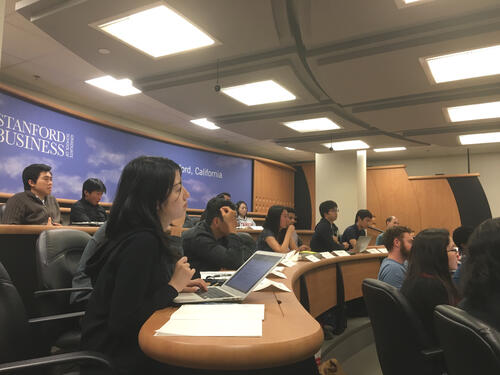
At Stanford's Highly Immersive Classroom in Palo Alto, students look ahead at their counterparts in Beijing.


One course session in particular resonated with students. The session, taught by Zha Daojiong, a professor of political economy at PKU and Herbert Lin, a senior research scholar at Stanford’s Freeman Spogli Institute for International Studies, focused on the changing nature and future of cybersecurity relations between China and the United States.

“I loved the cybersecurity class because there was a lot of candor on both sides,” PKU student Shan Jee Chua recalled.

Kimberly Chang, a second year Stanford graduate student in management science and engineering, noted that it was beneficial to hear the Chinese view on cyber “because most of the talk within the United States has been from an American perspective.”

“Hopefully, I'll be able to meet some of these people in real life who I've met on the 'wall.'”

-Sam Ide, Stanford graduate student

The course revealed a broader range of perspectives and provided a chance to interact first-hand with international colleagues while remaining at their home campus. Discussion amongst peers uncovered the “behind the scenes stories” and added context to media reports found online or in print, said Seung Kim, a student in Stanford’s East Asian studies program.

Besides the technology, a unique aspect of the course was its diversity. More than half of the course participants were international, representing 15 countries beyond China and the United States. That setting encouraged debate and reinforced the notion that “neither the United States nor China is the center of the universe,” said Zhu Jun Zhao, a PKU international relations student.

When students were asked what could bring about better understanding between China and the United States, continued dialogue was a common answer. The future of U.S.-China relations rests in the hands of people talking to one another: “I think we need more honest conversations,” Chang said.

And for some students, an opportunity to hold those conversations in-person may be close. Ide said he anticipates traveling to Beijing over the summer and plans to try and meet with a few of his counterparts whom he met through the course.

“Hopefully, I’ll be able to meet some of these people in real life who I’ve met on the ‘wall.’”

Related Links:

Video showcases SCPKU's Highly Immersive Classroom enabling co-teaching across the Pacific

Hero Image
course 2
At the Stanford Center at Peking University in Beijing, Peking University professor Fan Shiming presents his remarks during a session of "The United States, China, & Global Security," a joint course taught by Stanford and Peking University via videoconference; Palo Alto, May 2016.
All News button
1
Subscribe to Northeast Asia