Authors
Noa Ronkin
News Type
News
Date
Paragraphs

In 2008, the U.S. National Intelligence Council (NIC) published the fourth installment in its effort to identify “megatrends” likely to shape world events a decade or more into the future. Shorenstein APARC Fellow and China expert Thomas Fingar, the then chairman of the NIC, oversaw that report, Global Trends 2025. The unclassified report uses scenarios to illustrate some of the ways in which the factors driving world events – from climate change to demographic decline to changing geopolitical powers – may interact to generate challenges and opportunities for future decisionmakers. One of these scenarios is the emergence of a global pandemic that bears a chilling resemblance to COVID-19.

We sat down with Fingar for an online conversation about the NIC report and its pandemic scenario, the government action it spurred, the United States’ failed initial response to the COVID-19 outbreak, and the implications of the current crisis for U.S.-China relations. Watch:

Twelve years after its publication, the NIC’s "Potential Emergence of a Global Pandemic" scenario (p. 75) has proven to be woefully accurate:

“The emergence of a novel, highly transmissible, and virulent human respiratory illness for which there are no adequate countermeasures could initiate a global pandemic. If a pandemic disease emerges by 2025, […] it probably will first occur in an area marked by high population density and close association between humans and animals, such as many areas of China and Southeast Asia […] Slow public health response would delay the realization that a highly transmissible pathogen had emerged […] Despite limits imposed on international travel, travelers with mild symptoms or who were asymptomatic could carry the disease to other continents. Waves of new cases would occur every few months. The absence of an effective vaccine and near-universal lack of immunity would render populations vulnerable to infection.”

[To get more stories like this delivered to your inbox sign up for our newsletters]

It was not a prediction, recalls Fingar, but rather an attempt to urge policymakers to think “beyond tomorrow,” past the end of their administration, and to stimulate strategic thinking about how to reinforce positive trends and change or ameliorate negative ones. If the report and its global pandemic scenario are precise, he notes, it is because the NIC’s effort involved the best specialists within the U.S. intelligence community and engaged numerous and varied groups of non-U.S. Government experts.

Yet the United States has been unprepared for the COVID-19 pandemic and the crisis is now worsening U.S.-China tensions. To address the crisis, however, argues Fingar, both countries must cooperate in the international fora. “Let that be the way that builds towards a better bilateral relationship.”

Headshot of Thomas Fingar
Thomas Fingar is a Shorenstein APARC Fellow in the Freeman Spogli Institute for International Studies at Stanford University. From 2005 through 2008, he served as the first deputy director of national intelligence for analysis and, concurrently, as chairman of the National Intelligence Council. His forthcoming edited volume is 'Fateful Decisions: Choices That Will Shape China's Future' (Stanford University Press, May 2020).
Full Biography

Read More

BEIJING, CHINA - Workers sit near a CRH (China Railway High-speed) "bullet train" at the Beijing South Railway Station under reconstruction.
News

High-Speed Rail Holds Promise and Problems for China, Explains David M. Lampton

In a new audio interview, Lampton discusses some of the challenges, uncertainties, and decisions that loom ahead of China's Belt and Road Initiative.
High-Speed Rail Holds Promise and Problems for China, Explains David M. Lampton
Quote from Thomas Fingar and Jean Oi from, "China's Challeges: Now It Gets Much Harder"
Commentary

Now It Gets Much Harder: Thomas Fingar and Jean Oi Discuss China’s Challenges in The Washington Quarterly

Now It Gets Much Harder: Thomas Fingar and Jean Oi Discuss China’s Challenges in The Washington Quarterly
Adam Segal lectures at APARC
News

Technology Tensions Redefining U.S.-China Relations, Says Security Expert Adam Segal

Technology Tensions Redefining U.S.-China Relations, Says Security Expert Adam Segal
Hero Image
An empty Pennsylvania Avenue in Washington, D.C. seen with the United States Capitol  in the background.
Vehicle traffic is almost non-existent on Pennsylvania Avenue as the United States Capitol is reflected in a rainwater puddle during the novel coronavirus pandemic April 13, 2020 in Washington, DC. COVID-19 has sent lawmakers home and brought the business of the nation’s capital to a near-total halt.
Chip Somodevilla/ Getty Images
All News button
1
Subtitle

In our online conversation, Fingar discusses the 2008 National Intelligence Council report he oversaw and that urged action on coronavirus pandemic preparedness, explains the U.S. initial failed response to the COVID-19 outbreak, and considers the implications of the current crisis for U.S.-China relations.

Authors
News Type
Commentary
Date
Paragraphs

Former Russian President Dmitry Medvedev, who signed the New Strategic Arms Reduction Treaty (New START) with Barack Obama on April 8, 2010, called last week for the United States to agree to extend the treaty. On Friday, a Department of State spokesperson told the Russian news agency TASS in response:  “The President has directed us to think more broadly than New START…  We stand ready to engage with both Russia and China on arms control negotiations that meet our criteria.”

Unfortunately, nothing suggests President Trump will achieve anything on nuclear arms control.


Read full article at The Hill.

Hero Image
trumpdonald putinvladimir 020720getty split arms
All News button
1
-

This is a virtual event. Please click here to register and generate a link to the talk. 
The link will be unique to you; please save it and do not share with others.

Much recent commentary on US relations with China claims that the policy of “Engagement” was a foolish and failed attempt to transform the People’s Republic into an American style democracy that instead created an authoritarian rival. This narrative mocks the policies of eight US administrations to justify calls for “Decoupling” and “Containment 2.0.” Fingar’s talk will challenge this narrative by examining the origins, logic, and achievements of Engagement and explain why Decoupling is neither wise nor attainable.

Image
Dr. Thomas Fingar
Thomas Fingar is a Shorenstein APARC Fellow in the Freeman Spogli Institute for International Studies at Stanford University. He was the inaugural Oksenberg-Rohlen Distinguished Fellow from 2010 through 2015 and the Payne Distinguished Lecturer at Stanford in 2009. From 2005 through 2008, he served as the first deputy director of national intelligence for analysis and, concurrently, as chairman of the National Intelligence Council. Fingar served previously as assistant secretary of the State Department’s Bureau of Intelligence and Research (2000-01 and 2004-05), principal deputy assistant secretary (2001-03), deputy assistant secretary for analysis (1994-2000), director of the Office of Analysis for East Asia and the Pacific (1989-94), and chief of the China Division (1986-89). Between 1975 and 1986 he held a number of positions at Stanford University, including senior research associate in the Center for International Security and Arms Control.

Fingar is a graduate of Cornell University (A.B. in Government and History, 1968), and Stanford University (M.A., 1969 and Ph.D., 1977 both in political science). His most recent books are The New Great Game: China and South and Central Asia in the Era of Reform, editor (Stanford, 2016), Uneasy Partnerships: China and Japan, the Koreas, and Russia in the Era of Reform (Stanford, 2017), and Fateful Decisions: Choices that will Shape China’s Future, co-edited with Jean Oi (Stanford, 2020).

Via Zoom Webinar. Register at: https://bit.ly/3ecduEe

Thomas Fingar Shorenstein APARC Fellow, Stanford University
Seminars
Authors
Herbert Lin
News Type
Commentary
Date
Paragraphs

On Feb. 12, White House National Security Adviser Robert O’Brien announced that the U.S. government has “evidence that Huawei has the capability secretly to access sensitive and personal information in systems it maintains and sells around the world.” This represents the latest attempt by the Trump administration to support an argument that allied governments—and the businesses they oversee—should purge certain telecommunications networks of Huawei equipment. The position reflects the preferred approach in the United States, which is to issue outright bans against select companies (including Huawei) that meet an as-yet-unknown threshold of risk to national security.


Read the rest at Lawfare Blog


Hero Image
lin herbert
All News button
1
News Type
News
Date
Paragraphs

Stanford e-Japan is an online course that teaches Japanese high school students about U.S. society and culture and U.S.–Japan relations. The course introduces students to both U.S. and Japanese perspectives on many historical and contemporary issues. It is offered biannually by the Stanford Program on International and Cross-Cultural Education (SPICE). Stanford e-Japan is currently supported by the Yanai Tadashi Foundation. The Fall 2019 cohort was the ninth group of students to complete Stanford e-Japan.


In Summer 2020, three of the top students of the Fall 2019 Stanford e-Japan distance-learning course will be honored at an event at Stanford University. The three Stanford e-Japan Day honorees—Ayano Hirose (Okayama Sozan High School), Chisaki Sano (Gunma Kokusai Academy), and Natsumi Shindo (Keio Girls Senior High School)—will be recognized by Stanford e-Japan Instructor Meiko Kotani for their coursework and exceptional research essays that focused respectively on “Three Basic Ways to Promote Cross-Cultural Understanding in Japanese Education,” “U.S.–Japan Relations: Economic Interdependence Seen in 7-Eleven Operations,” and “The U.S.–Japan Security Alliance: Its Preservation and the Responsibilities of Both Countries.”

Yuta Myojo (Rikkyo Ikebukuro High School) received an Honorable Mention for his coursework and research paper on “How Could Japanese Society Achieve Increased Biculturalism: From the Aspects of Education Reform and Self-Awareness.”

In the Fall 2019 session of Stanford e-Japan, students from the following schools successfully completed the course: Aiko Gakuen (Ehime), Gunma Kokusai Academy (Gunma), Hiroshima High School (Hiroshima), Hiroshima Prefectural Hiroshima Junior/Senior High School (Hiroshima), Hitachi First Senior High School (Ibaraki), Ichikawa Junior and Senior High School (Chiba), Keio Girls Senior High School (Tokyo), Keio Senior High School (Kanagawa), Mita International High School (Tokyo), Nishiyamato Gakuen High School (Nara), Okayama Prefecture Asahi Senior High School (Okayama), Okayama Sozan High School (Okayama), Rikkyo Ikebukuro High School (Tokyo), Ritsumeikan Uji High School (Kyoto), Sendai Shirayuri Gakuen (Miyagi), Senior High School at Otsuka, University of Tsukuba (Tokyo), Senior High School at Kyoto University (Kyoto), Shibuya Kyouiku Gakuen Shibuya Senior High School (Tokyo), Shibuya Makuhari Senior High School (Chiba), Shirayuri Gakuen Senior High School (Tokyo), Takada High School (Mie), Takatsuki Senior High School (Osaka), Tokyo City University Senior High School (Tokyo), Waseda University Senior High School (Tokyo), Yokohama Science Frontier High School (Kanagawa), and Zushi Kaisei High School (Kanagawa).

For more information about the Stanford e-Japan Program, please visit stanfordejapan.org.

To stay informed of news about Stanford e-Japan and SPICE’s other programs, join our email list and follow us on Facebook, Twitter, and Instagram.


SPICE offers separate online courses for U.S. high school students. For more information, please see the Reischauer Scholars Program (online course about Japan), Sejong Scholars Program (online course about Korea), and China Scholars Program (online course about China).


Related articles:


Hero Image
Stanford e-Japan student Ayano Hirose giving her final presentation
Fall 2019 Stanford e-Japan honoree Ayano Hirose giving her final presentation at school. Courtesy of Ayano Hirose.
All News button
1
Authors
Callista Wells
News Type
News
Date
Paragraphs

The Stanford Center at Peking University (SCPKU), the Center on Democracy, Development and the Rule of Law (CDDRL), and the APARC China Program jointly hosted a workshop on China’s Belt and Road Initiative (BRI) in early March. The workshop, held on March 2 and 3, welcomed researchers from around the world with expertise in the Initiative. Unfortunately, because of the rapidly developing health emergency related to the coronavirus, participants from not only China, but also Japan, were prevented from attending. As described by Professor Jean Oi, founding director of SCPKU and the China Program, and Professor Francis Fukuyama, director of CDDRL and the Ford Dorsey Master's in International Policy, who co-chaired the workshop, the meeting aimed to provide a global perspective on the BRI, consolidate knowledge on this opaque topic, and determine the best method and resources for future research.  

The workshop began with presentations from several of the invited guests. Dr. Atif Ansar from the University of Oxford’s Saïd Business School kicked off the first day by describing not only the tremendous opportunity that the BRI presents to developing economies, but also the serious pitfalls that often accompany colossal infrastructure projects. Pointing out the poor returns on investment of mega infrastructure projects, Ansar examined the frequest cost and schedule overruns, random disasters, and environmental degradation that outweigh the minimal benefits that they generally yield. China’s own track record from domestic infrastructure projects does little to mitigate fear of these risks, Ansar claimed. In response, he urged professional management of BRI investments, institutional reforms, and intensified deployment of technology in BRI projects. Dr. Ansar was followed by Dr. Xue Gong of the S. Rajaratnam School of International Studies, Nanyang Technological University, Singapore. Dr. Gong’s analysis centered on the extent to which China’s geopolitical motivations influenced its outward foreign direct investments (OFDI). Although her research was still in the early stages, her empirical analysis of China’s OFDI inflows into fifty BRI recipient countries from 2007-2018 nevertheless revealed that geopolitical factors often outweigh economic factors when it comes to China’s OFDI destinations.

Image
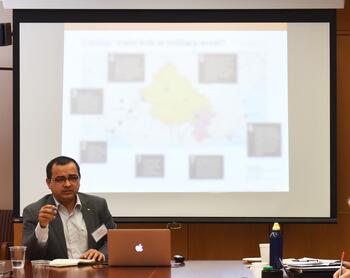
Amit Bhandari of Gateway House: Indian Council on Global Relations presents his research at the Belt and Road Workshop.
Participants then heard presentations from Amit Bhandari of Gateway House: Indian Council on Global Relations and Professor Cheng-Chwee Kuik of the National University of Malaysia. Mr. Bhandari’s talk focused on Chinese investments in India’s six neighboring countries, which tend to center more on energy rather than connectivity projects. He first found that the investments are generally not economical for the host countries because they come with high costs and high interest rates. Secondly, he argued that these projects often lacked a clear economic rationale, appearing instead to embed a geopolitical logic not always friendly to India. Professor Kuik, by contrast, provided a counterexample in his analysis of BRI projects in Southeast Asia. He described how, in Southeast Asia, host countries’ reception of the BRI has varied substantially; and how various stakeholders, including states, sub-states and other entities, have used their leverage to shape outcomes more or less favorable to themselves. Kuik’s analysis injected complexity into the often black-and-white characterizations of the BRI. He highlighted the multidimensional dynamics that play out among local and state-level players in pursuit of their goals, and in the process of BRI implementation.

Professor Curtis J. Milhaupt and Scholar-in-Residence Jeffrey Ball, both at Stanford Law School, followed with individual presentations on the role of State-Owned Enterprises (SOEs) in the BRI and the emissions impact of the BRI on climate change, respectively. Professor Milhaupt  characterized Chinese SOEs as both geopolitical and commercial actors, simultaneously charged with implementing Party policies and attaining corporate profits. Chinese SOEs are major undertakers of significant overseas BRI projects, acting not only as builders but also as investors, partners, and operators. This situation, Milhaupt asserted, carries significant risks for SOEs because these megaprojects often provide dismal returns, have high default rates, and can trigger political backlash in their localities. Milhaupt highlighted the importance of gathering firm-level data on businesses actually engaged in BRI projects to better infer geostrategic, financial, or other motivations. Jeffrey Ball turned the discussion to carbon emissions from BRI projects and presented preliminary findings from his four-country case studies. He concluded that, on aggregate, the emissions impact of the BRI is still “more brown than green.” Twenty-eight percent of global carbon emissions may be accounted for by BRI projects, Ball asserted, underscoring the importance of the BRI to the future of global climate change.

The day concluded with presentations by  Michael Bennon, Managing Director at the Stanford Global Projects Center, and Professor David M. Lampton, Oksenberg-Rohlen Fellow at the Freeman Spogli Institute for International Studies. Bennon first presented findings from two empirical case studies of BRI projects and then went on to describe how the BRI is now practically the “only game in town” for infrastructure funding for developing countries. Lengthy environmental review processes at Western multilateral banks have turned the World Bank, for example, from a lending bank into a “knowledge bank,” he argued. He also highlighted that, in general, economic returns on BRI projects for China are very poor, even though recipient countries may accrue macroeconomic benefits from these projects. Finally, Professor Lampton turned the discussion back to Southeast Asia, where China is currently undertaking massive cross-border high-speed rail projects through eight ASEAN countries. He described how each host country had varying capacity to negotiate against its giant neighbor, and how the sequential implementation of these cross-border rail projects also had varying impacts on the negotiating positions of these host countries. BRI played out differently in each country, in other words, eliciting different reactions, push-backs and negotiated terms.

The second day of the workshop was dedicated to working toward a collaborative approach to future BRI research. The group discussed the key gaps in the existing research, including how to know what China’s true intentions are, how to measure those intentions, who the main players and their interests in both China and the host countries are, and even what the BRI is, exactly. Some cautioned that high-profile projects may not be representative of the whole. Participants brainstormed about existing and future sources of data, and stressed the importance of diversifying studies and seeking empirical evidence.

Hero Image
Participants in the Belt and Road Initiative Workshop at Stanford University, March 2-3, 2020.
All News button
1
Authors
Gary Mukai
News Type
Blogs
Date
Paragraphs

Following the 1989 Loma Prieta earthquake, I recall being astounded that the iconic arches and pillars of Stanford University—though damaged—didn’t collapse or fall during the powerful earthquake. Wooden supports were inserted below the arches and remained for years while retrofitting took place. Since then, the arches and pillars have symbolized for me the stability and the security of the foundation of Stanford University. During yet another unstable time in 2020, this symbolism has once again taken on critical significance here and abroad.

In 1989, the World Wide Web was yet to be born, so obviously SPICE did not offer online classes to students in the United States, let alone to students abroad. SPICE’s first online course, the Reischauer Scholars Program, was launched in 2004. RSP Instructor Naomi Funahashi introduces topics related to Japan and U.S.–Japan relations to high school students in the United States. In 2015, SPICE launched Stanford e-Japan, an online course on U.S. society and culture and U.S.–Japan relations that Waka Takahashi Brown and Meiko Kotani offer to high school students in Japan. Since then, several other regional classes have been launched, including Stanford e-Kawasaki in 2019.


[[{"fid":"240970","view_mode":"crop_870xauto","fields":{"format":"crop_870xauto","field_file_image_description[und][0][value]":"Kawasaki City logo","field_file_image_alt_text[und][0][value]":"Kawasaki City logo","field_file_image_title_text[und][0][value]":"Kawasaki City logo","field_credit[und][0][value]":"","field_caption[und][0][value]":"Kawasaki City logo","thumbnails":"crop_870xauto"},"link_text":null,"type":"media","field_deltas":{"2":{"format":"crop_870xauto","field_file_image_description[und][0][value]":"Kawasaki City logo","field_file_image_alt_text[und][0][value]":"Kawasaki City logo","field_file_image_title_text[und][0][value]":"Kawasaki City logo","field_credit[und][0][value]":"","field_caption[und][0][value]":"Kawasaki City logo","thumbnails":"crop_870xauto"}},"attributes":{"alt":"Kawasaki City logo","title":"Kawasaki City logo","style":"float: right; margin: 5px; height: 150px; width: 256px;","class":"media-element file-crop-870xauto","data-delta":"2"}}]]

Stanford e-Kawasaki is an online course for high school students in Kawasaki City that is jointly offered by Kawasaki City and SPICE. Stanford e-Kawasaki Instructor Maiko Tamagawa Bacha provides students with an introduction to diversity and entrepreneurship in the United States and equips students with substantive knowledge about U.S. culture and society that may have a significant impact on their future choice of study and career.


The inaugural Stanford e-Kawasaki course began in October 2019 and culminated this month with presentations of final research projects by students from Tachibana High School and Kawasaki High School, the two participating schools in the inaugural course. Leading scholars from Stanford University and Silicon Valley entrepreneurs—including Dr. Stephen Murphy-Shigematsu from Stanford and Silicon Valley entrepreneurs Sukemasa Kabayama, CEO and Co-Founder of Uplift, and Rika Nakazawa, VP Strategy and Business Development at Atheer—led online class discussions and not only encouraged students to critically think about diversity and entrepreneurship in the United States but also in Japan. These discussions helped students to conceptualize topics for their final research projects.

The research projects were varied and included a comparative analysis of college admissions in the United States and Japan, an examination of psychological issues affecting youth in the United States and Japan, and a discussion about whether a Silicon Valley-type ecosystem can be created in Japan. The students’ presentations were not only content rich and creative but also effectively engaged the audience, which included Vice Principal Akihiro Igarashi of Tachibana High School, Miyuki Kitamura of Kawasaki City, SPICE Instructors Carey Moncaster, Rylan Sekiguchi, and Kasumi Yamashita, Bacha, teachers from both high schools, and me. Bacha reflected, “Though my students were not able to make their presentations physically in front of audiences [as originally planned] due to the current COVID-19 pandemic, I was grateful to have had the chance to virtually observe all of the presentations from Colorado along with my colleagues in California, Hawai‘i, and Washington. I was especially impressed with my students’ demonstrated growth in their English-speaking abilities and confidence. Especially gratifying was to witness students asking each other questions.”

Vice Principal Igarashi noted, “I am deeply grateful for the opportunity given to the Tachibana High School students to join online class discussions led by leading scholars in the United States… As I watched them passionately delivering their final research presentations that they worked hard on, I could tell that they gained unique experiences which they cannot experience in regular school classes. By comparing Japan and the United States in their research projects, I am sure that they discovered new things about their own country, Japan… I believe from the bottom of my heart that the online classes and assignments given by this course will empower the youth of the future.”

While listening to the presentations, I was struck by how well the students engaged the audience. In my final comments, I commended their use of several effective presentation techniques, such as the following.

  • Emphasis on interdisciplinarity in their research
  • Incorporation of multiple perspectives
  • Voice projection
  • Use of images, including photos, drawings, statistics, and graphs
  • Signposting
  • Embedding questions for the audience in the presentation, e.g., Can we create a Silicon Valley in Japan?
  • Providing historical context
  • Definition of complex terms

In addition, for the first time since SPICE launched online courses, I felt a deep sense of satisfaction from knowing that we could bring some stability and security to the lives of students who could no longer physically go to school. The students gushed with enthusiasm despite their nervousness.

Mizuho Toyama, a Teacher of the English Department at Kawasaki High School noted, “We were so excited about our students’ online presentations this morning. What they did was tremendous and the experience they went through—I am sure—has become their priceless treasure… They learned not only English as a foreign language but also, more importantly, stepping out of their ‘comfort zone’ to seek advanced levels of learning. Raising cultural awareness with peers and also sharing thoughts without racial biases is an excellent source of learning. I am thankful for this program for encouraging students to be more openminded.”

Erica Oh, an American Assistant Language Teacher of English at Kawasaki High School, also commented on Bacha’s course. “Again, thank you and your staff, especially Maiko Tamagawa Bacha, for the awesome opportunity you have given our students to learn more and think outside their cultural box. It was an absolute delight for me to be able to witness their growth. I hope Stanford and Kawasaki stay in partnership and that this program continues.” For one of the online classrooms that focused on diversity, Bacha invited former Japan Exchange and Teaching (JET) Program Assistant Language Teachers—John Branderhorst, Jeffrey Fleischman, Ryan Moore, and Cerell Rivera—to share their perspectives. “Bringing Americans and Japanese together—albeit virtually—at a time like this is invaluable,” commented Bacha.  

Students who successfully completed the course will earn a Certificate of Completion from SPICE/Stanford University on March 26, 2020 during a virtual closing ceremony. Mayor Norihiko Fukuda will make opening comments. In addition to SPICE staff, others who will be in attendance are Hisashi Katsurayama from the Kawasaki Board of Education and Katsuyoshi Abe, Yoshitaka Tsuchihama, and Miyuki Kitamura of Kawasaki City, all of whom have been unwavering in their support of Stanford e-Kawasaki.

When SPICE launched its online courses, I never imagined that the SPICE instructors would be reaching many students whose school lives were disrupted by a pandemic. I feel indebted to FSI Director Dr. Michael McFaul and FSI Deputy Director Dr. Kathryn Stoner for their support during this unstable time and enabling SPICE to help add some stability and security to students’ lives.


To stay informed of SPICE-related news, join our email list and follow us on FacebookTwitter, and Instagram.


Related article:


Hero Image
Archways and pillars in Stanford University's Main Quad
Rylan Sekiguchi
All News button
1
News Type
Q&As
Date
Paragraphs

Living and studying all over East Asia, some of Hannah Kim’s most favorite activities were to meet and talk to diverse people from different backgrounds. Those conversations sparked her interest in how public opinion and perceptions of democracy differ across societies — a question that turned into the focus of her doctoral dissertation, which she completed last year at the University of California, Irvine.

Image
Dr. Hannah June Kim
Hannah is spending the 2019-20 academic year at APARC as a Shorenstein Postdoctoral Fellow in Contemporary Asia. While here, she has been researching material for a forthcoming book about the relationship between the middle class and democratic ideals in different Asian societies. Her work has been published in The Journal of Politics, PS: Political Science & Politics, and the Japanese Journal of Political Science.

We sat down with Hannah to talk about her current work and her plans for future projects.


Q: As you’ve been here at APARC researching your book, what kinds of relationships have you found between the middle classes of East Asia and their perceptions of a democratic society?

Middle-class groups in many East Asian countries are significantly different than those in other regions because they are newer and smaller. They also tend to be much more dependent on the state, and this state dependency has led to fundamentally different views of democracy than we see in other places.

Modernization theory — which is one of the most prominent theories in comparative politics — contends that higher levels of economic growth lead to a rise of a middle class. This middle class then becomes a driving force for democracy. In East Asian countries, however, state-led economic growth played a central role in the creation and development of middle-class groups, which fostered a dependent and mutually supportive relationship between middle-class groups and the state. This suggests that middle-class groups may prefer a stronger role of the state and be less likely to support liberal democracy relative to other groups.

Q: What research findings surprised you about the relationship between the middle class and democracy?

There have been a number of unexpected results. For one, middle-class East Asians are more likely to support good governance ahead of freedom and liberty, which is often reversed among middle-class groups in Western democracies. I’ve found that many East Asian middle-class citizens view democracy more illiberally and prefer a political system that has a mix of democratic and autocratic properties — a hybrid regime — rather than a liberal democracy.

For example, the most recent wave of the World Values Survey (2010-14) shows that 62% of Taiwanese respondents, 31% of Chinese respondents, 29% of Japanese respondents, and 49% of South Korean respondents stated that it is “Very good” or “Fairly good” to have a strong leader who does not have to bother with parliament and elections. This indicates a culture of implicit support for an authoritarian-like leader. Recent studies also show that there is a negative correlation between the middle class and support for democracy in China.

Q: You have also been doing work that looks at democratization and gender in East Asia. How do gender, gender roles, and traditional culture impact the progress and perception of democratization?

Even though there are three full-fledged democracies in East Asia – namely, Japan, South Korea, and Taiwan – their citizens’ views on gender equality remain far from liberal. A majority of respondents to surveys in those democracies support the ideas that men should have more employment and education opportunities than women, and that men make better political and business leaders than women. This may be in part due to the historically patriarchal culture that continues to legitimize these views. However, in my study, I suggest that culturally democratic citizens are more likely to break away from these traditional patriarchal norms and challenge gendered practices within these societies. Increasing democratic citizenship, therefore, may enhance support for gender equality and other liberal values.

Q: What pressing challenges do you see facing Asia’s democratic societies?

The last ten years have been described as a decade of decline for liberal democracies worldwide and public opinion data further shows that support for democracy is rapidly declining. East Asian democracies, many of which democratized during the so-called second and third waves of that trend in the late twentieth century, are no exception to this democratic recession. While there are many institutional limitations, the biggest challenge for East Asian democracies may come from authoritarian legacies that encourage middle-class citizens to support traditional values that often go against liberal democracy. While East Asian democracies may not necessarily evolve towards autocracy, it may be a while before the middle class and the general public in East Asian countries fully support liberal democratic values and help democracies overcome this democratic recession.

Q: What’s next on your research agenda?

After my fellowship with APARC concludes, I will be moving to Omaha, Nebraska, where I’ll be working as an assistant professor of political science at the University of Nebraska. I’m scheduled to teach Asian politics there this coming fall, which I am really looking forward to. My immediate research goal is to continue working on my book, but I would also like to start pursuing research on gender and political behavior in South Korea.

Hero Image
Hannah June Kim
All News button
1
-

CISAC will be canceling all public events and seminars until at least April 5th due to the ongoing developments associated with COVID-19.

------------------------------------------------------------------------------------------------------------------------------------------------------


About this Event: The Trump administration's National Security Strategy, released in December 2017, put the economic, military and political challenges posed by peer competitors--Russia and China--at the top of its list of national security concerns.  What was the process that led the Trump administration to this conclusion, particularly regarding Russia, and what policies did the National Security Strategy advocate that the United States accordingly pursue toward Russia?  Our speaker, Nadia Schadlow, served on the National Security Council from 2017 to 2018 and was the principal author of the National Security Strategy.


About the Speaker: Dr. Nadia Schadlow has served in leadership positions in government and the private sector for over 25 years. Dr. Schadlow’s U.S. government experience includes senior leadership positions at the National Security Council and the Department of Defense. She was the principal author of the Trump Administration’s National Security Strategy (NSS) which  identified the return of great power rivalry as a central feature of global geopolitics.

Prior to her most recent  government service,  Dr. Schadlow served as a Senior Program Officer at the Smith Richardson Foundation where she invested in  research and policy solutions to improve the security and strategic competitiveness of the United States. Dr. Schadlow has written frequently on national security matters.  Her 2017  book, War and the Art of Governance, addressed the problems of political and economic consolidation during and following war. Dr. Schadlow received a B.A. degree in Government and Soviet Studies from Cornell University, and M.A. and Ph.D. degrees from the John Hopkins School of Advanced International Studies (SAIS).


Nadia Schadlow Hoover Institution
Seminars
News Type
News
Date
Paragraphs

The Stanford University Scholars Program for Japanese High School Students or “Stanford e-Japan” is an online course sponsored by the Yanai Tadashi Foundation and the Stanford Program on International and Cross-Cultural Education (SPICE), Stanford University. This online course teaches Japanese high school students about U.S. society and underscores the importance of U.S.–Japan relations. Through Stanford e-Japan, ambassadors, top scholars, and experts throughout the United States provide web-based lectures and engage Japanese high school students in live discussion sessions called “virtual classes.” Stanford e-Japan is now in its 6th year and 10th session overall.


On January 24, 2020, 29 high school students across Japan were notified of their acceptance to the Spring 2020 Stanford e-Japan Program. The 10th session of the online course kicks off today and runs until June 30, and will include students representing the following prefectures: Chiba, Fukuoka, Fukushima, Hiroshima, Hyogo, Ibaraki, Kanagawa, Okayama, Osaka, Saitama, Shizuoka, Tokyo, and Yamagata. In addition to a diverse geographical representation within Japan, the students themselves bring a diverse set of experiences to the program, many having lived overseas in places such as Myanmar, Thailand, Mexico, and the United States.

The selected Stanford e-Japan high school students will listen to lectures by renowned experts in the field including Professor Emeritus Peter Duus, Professor Kathryn Gin Lum, and Dr. Kenji Kushida (all at Stanford University) on topics such as, “The Atomic Bombings of Japan,” “The Attack on Pearl Harbor,” “Religion in the U.S.,” and “Silicon Valley and Entrepreneurship.” Live virtual classes include guest speakers such as Ms. Suzanne Basalla (Toyota Research Institute), Ms. Maiko Cagno (U.S. Consulate, Fukuoka), and Dr. Makiko Oku (Co-Founder, KiKO Japan).

Many Stanford e-Japan students in the current cohort (as well as past ones) have mentioned their desire to study in the United States. The Stanford e-Japan Program equips many students with the motivation and confidence to do so, in addition to many of the skills they will need to study at U.S. universities and colleges. In addition to weekly lectures, assignments, discussion board posts, and virtual classes, the program participants will complete a final research paper on a topic concerning U.S. society or the U.S.–Japan relationship.

“I’ve encouraged my students to seriously consider undergraduate studies in the United States and to look into opportunities like the Yanai Tadashi Foundation Scholarships,” commented Stanford e-Japan Instructor Waka Brown. “Many e-Japan alumni have gone on to study in the United States, either for their entire college experience or for shorter overseas study opportunities. A couple of them received full scholarships, thanks to The Yanai Tadashi Foundation.”

Stanford e-Japan is one of several online courses for high school students offered by SPICE, Stanford University, including the Reischauer Scholars Program, the China Scholars Program, the Sejong Korean Scholars Program, and Stanford e-China. For more information about Stanford e-Japan, please visit stanfordejapan.org.

To be notified when the next Stanford e-Japan application period opens, join our email list or follow us on Facebook, Twitter, and Instagram.


Related articles:


Hero Image
Stanford e-Japan student honorees (spring 2018 session)
Spring 2018 Stanford e-Japan student honorees Naoya Chonan, Luana Ichinose, and Miki Fujito
Rylan Sekiguchi
All News button
1
Subscribe to Northeast Asia