A New World: Korea's Mountains and American Waters
Kim Jiha is a South Korean poet and playwright whose early poetry theme was in political resistance. After having written poems including Five Thieves criticizing President Park Chung-Hee's dictatorship he was sentenced to death in 1974 for orchestrating an anti-government movement, and then to life imprisonment. His sentence was suspended following Park's assassination. On January 4, 2013, 39 years after the death sentence, Kim was cleared of sedition charges by a Seoul court.
Since 1980s Kim's view of human condition has evolved to incorporate Korean traditional Dong-hak and other eastern and western philosophies into a theory of life, seeking balance and harmony in the nation and ultimately in the world.
Kim metaphorically refers to mountains and waters to indicate the relations between Korea and the United States.
Kim was born in Mokpo, South Cholla Province, in 1941 and received a BA in Aesthetics from Seoul National University in 1966.
Philippines Conference Room
Rustin Crandall
Stanford Graduate School of Business
Knight Management Center
Stanford University
655 Knight Way
McClelland Building
Stanford, CA 94305-7298 USA
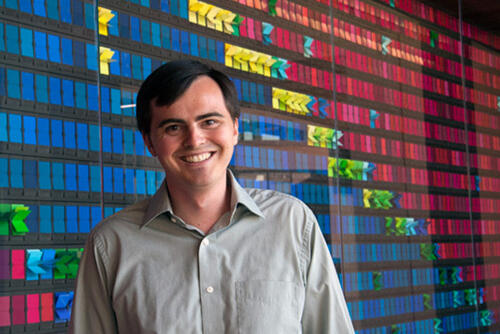
Rustin Crandall joined the Stanford Graduate School of Business as a full-time Administrative Associate in February 2013. Prior to coming to Stanford, he worked as an IT Coordinator for the Peace Corps in Guyana, a Program Coordinator for an international education and technology non-profit in New York, and a Product Manager for an Internet firm in the Philippines. Rustin will be supporting the Silicon Valley and China 2.0 projects through his communications, organization, and IT expertise.
Rustin holds a BA from UCLA and an MA from George Mason University.
SPRIE welcomes new staff member
Prior to coming to Stanford, Rustin worked as an IT Coordinator for the Peace Corps in Guyana, a Program Coordinator for an international education and technology non-profit in New York, and a Product Manager for an Internet firm in the Philippines. Rustin holds a BA from UCLA and an MA from George Mason University.
You can reach Rustin at rustin.crandall@gsb.stanford.edu or 650.725.3703.
The New Geography of Jobs
SPEAKER
Enrico Moretti - Professor of Economics at the University of California, Berkeley
ABOUT THE SEMINAR
"The New Geography of Jobs"
Enrico Moretti, Professor of Economics, UC Berkeley
Wednesday, April 17, 12:00-1:15 pm.
Venue: McClelland Building, Room M109 - Stanford Graduate School of Business.
As part of a seminar series hosted by SPRIE's Silicon Valley Project, Enrico Moretti, UC Berkeley Professor of Economics, will share findings from his recent work, The New Geography of Jobs, described by Forbes as "easily the most important read of 2012." He will discuss the tectonic shifts that are reshaping America’s labor market—from globalization and income inequality to immigration and technological progress, including their implications for Silicon Valley.
More specifically, he will discuss his hypothesis that America’s new economic map shows growing differences between communities in the US dominated by manufacturing and innovation, which have been growing apart at an accelerating rate. This divergence is one the most important recent developments in the United States and is causing growing geographic disparities in other aspects of our lives, from health and longevity to family stability and political engagement. Professor Moretti will also discuss the ramifications of this findings on jobs, such as a multiplier effect by which each new job created in one sector results in the creation of new jobs in other sectors. He found that "the innovation sector has the largest multiplier of all: about three times larger than that of manufacturing."
This talk is part of a seminar series hosted by the Silicon Valley Project at Stanford Program on Regions of Innovation and Entrepreneurship.
ABOUT THE SPEAKER
Professor Enrico Moretti
His new book, THE NEW GEOGRAPHY OF JOBS, is now available in bookstores.
M109, First Floor, McClelland Building
Stanford Graduate School of Business
Knight Management Center
655 Knight Way
Stanford, CA 94305-7298
Corn getting thirstier with climate change
We have read the headline a number of times now warning us that increasing temperatures are threatening global crop production. One need only to recall the drought and heat wave that hit the mid-western United States last summer, damaging corn and soybean production. Higher temperatures are certainly part of the problem, but a new study led by FSE associate director David Lobell finds its impacts in the U.S. are more indirect. Water stress may be the main culprit.
To validate this hypothesis and to help differentiate the different mechanisms impacting crop yields at higher temperatures, the research team used a model known as an Agricultural Production Systems Simulator (APSIM). High temperatures had a strong negative effect on corn yield response in the United States, in agreement with the data, but the predominate effect of heat in the model was via increased water stress.
As temperatures increase, plants transpire more water into the atmosphere, just as people sweat more on hotter days. With more hot days, the corn plant finds it harder to maintain growth rates, and at the same time loses more water, which sets up the risk of even more drought stress later in the season.
“APSIM computes daily water stress as the ratio of water supply to demand, and during the critical month of July this ratio is three times more responsive to 2 ºC warming than to a 20 percent precipitation reduction,” writes Lobell and co-authors in a new paper published in Nature Climate Change. “Water stress during July is particularly important for overall biomass growth and final yield, with July being the month with the most total biomass growth.”
Direct heat stress on the plant, such as happens on extremely hot days, played a more minor role in determining final yield. The study suggests that increased CO2 may reduce crop sensitivity to extreme heat by increasing water use efficiency, but gains are likely to be no more than 25 percent.
“The APSIM model has been valuable in its ability to discriminate the importance of these factors,” said Lobell. “Models like these are useful for guiding efforts to develop crops with greater tolerance to increased temperatures, an important component of most adaptation strategies in agriculture, and helping to identify which processes are critical for modeling efforts to consider when projecting climate change impacts.”
The researchers project sensitivity to extreme heat will remain a severe constraint to crop production in the foreseeable future, especially as the region warms. They are now using the models to evaluate different strategies for developing new varieties of corn that can better handle the heat.
International banking standards in the US, Japan, and the EU
Conscious Capitalism & Social Innovation Salon
The Stanford Program on Regions of Innovation and Entrepreneurship (SPRIE)
with the Center for Social Innovation
invite you to a Stanford salon on Monday, March 11th on
Conscious Capitalism & Social Innovation
with John Montgomery, Jeff Klein & you!
John Montgomery, Silicon Valley Corporate attorney and author of Great from the Start, and Jeff Klein, a director of Conscious Capitalism and producer of Conscious Capitalism 2013, will share their insights and facilitate inquiry and conversation with salon participants.
This salon is designed to provide a taste of the Conscious Capitalism 2013 experience, and to engage participants in a conversation about the emerging Conscious Capitalism movement and Social Innovation.
For more details and to register, please visit the event page on Eventbrite:
http://ccstanford.eventbrite.com/
This event is for Stanford students, alumni, faculty, and staff only.
About the speakers:
John Montgomery
John Montgomery is a corporate attorney, entrepreneur, executive coach and writer. He is the founder of Montgomery & Hansen, LLP, a Silicon Valley based corporate law firm. He is also the founder of Startworks, a technology incubator. He works primarily with high-potential entrepreneurial teams to help them translate their visions into successful companies.
John recently received a California Lawyer of the Year award from California Lawyer magazine for his work as a co-chair of the legal working group behind California’s new benefit corporation law. A frequent speaker on venture capital, he has produced professional education programs for the State Bar on benefit corporations and for SmartPros/Cognistar: Understanding the Venture Capital Term Sheet Process and Introduction to Venture Capital Financing Agreements. Prior to founding Montgomery & Hansen in 2003, John was co-chairman of the venture capital practice at Brobeck, Phleger & Harrison, LLP. John is a student of non-dual philosophical systems, neuroscience, developmental theory and organizational development. In 2010, he co-founded Chrysallis, a human development company that aims to change the human development paradigm and support healthy, full, productive lives for billions of people. His book, Great from the Start: How Conscious Corporations Attract Success, was published in May 2012. Montgomery has a BA (Studio Art) from Stanford University and a JD from Northwestern College of Law.
Jeff Klein
As CEO of Working for Good, Jeff Klein activates, produces and facilitates mission-based, Stakeholder Engagement Marketing™ campaigns and Conscious Culture development programs.
Jeff is a trustee and member of the executive team of Conscious Capitalism, Inc. and producer of Conscious Capitalism events. He authored the award-winning book, Working for Good: Making a Difference While Making a Living and hosts a weekly radio program called It's Just Good Business. Jeff serves as Executive Director of BeingHuman.org and producer of Being Human events.
For more information visit workingforgood.com
Room Z-301
Knight Management Center
655 Knight Way
Stanford, CA 94305-7298
The critical role of extreme heat for maize production in the United States
Statistical studies of rainfed maize yields in the United States and elsewhere have indicated two clear features: a strong negative yield response to accumulation of temperatures above 30 °C (or extreme degree days (EDD)), and a relatively weak response to seasonal rainfall. Here we show that the process-based Agricultural Production Systems Simulator (APSIM) is able to reproduce both of these relationships in the Midwestern United States and provide insight into underlying mechanisms. The predominant effects of EDD in APSIM are associated with increased vapour pressure deficit, which contributes to water stress in two ways: by increasing demand for soil water to sustain a given rate of carbon assimilation, and by reducing future supply of soil water by raising transpiration rates. APSIM computes daily water stress as the ratio of water supply to demand, and during the critical month of July this ratio is three times more responsive to 2 °C warming than to a 20% precipitation reduction. The results suggest a relatively minor role for direct heat stress on reproductive organs at present temperatures in this region. Effects of elevated CO2 on transpiration efficiency should reduce yield sensitivity to EDD in the coming decades, but at most by 25%.
Simulated hydroclimatic impacts of projected Brazilian sugarcane expansion
Sugarcane area is currently expanding in Brazil, largely in response to domestic and international demand for sugar-based ethanol. To investigate the potential hydroclimatic impacts of future expansion, a regional climate model is used to simulate 5 years of a scenario in which cerrado and cropland areas (~1.1E6 km2) within south-central Brazil are converted to sugarcane. Results indicate a cooling of up to ~1.0°C during the peak of the growing season, mainly as a result of increased albedo of sugarcane relative to the previous landscape. After harvest, warming of similar magnitude occurs from a significant decline in evapotranspiration and a repartitioning toward greater sensible heating. Overall, annual temperature changes from large-scale conversion are expected to be small because of offsetting reductions in net radiation absorption and evapotranspiration. The decline in net water flux from land to the atmosphere implies a reduction in regional precipitation, which is consistent with progressively decreasing simulated average rainfall for the study period, upon conversion to sugarcane. However, rainfall changes were not robust across three ensemble members. The results suggest that sugarcane expansion will not drastically alter the regional energy or water balance, but could result in important local and seasonal effects.