Authors
News Type
Commentary
Date
Paragraphs

Douglas Rutzen, president and CEO of the International Center for Not-for-Profit Law (ICNL), and adjunct professor of law at Georgetown University in Washington, D.C., gave a talk on defending civil society for the Stanford Program on Human Rights’ Winter Speaker Series, “U.S. Human Rights NGOs and International Human Rights,” on January 7, 2015.

Rutzen sounded the alarm of today’s disturbing trend of governments around the world using the rule of law to restrict civic spaces of congregation and protestation. Highlighting that national governments are constitutionally committed to a rule of law, Rutzen claimed this is not being applied in the interests of the citizen but rather to restrict citizens’ criticism of government. Rutzen emphasized that this misuse of the rule of law to restrict civil society is a tool of manipulation utilized not just by nations with a history of civic control, such as Cuba and Russia, but also by liberal democracies, including the United States.

Rutzen noted that the Millennium Development Goals (MDG) established in 2000 were dramatically altered by the attacks of September 11, 2001. NGOs were targeted as potential terrorist organizations, while at the same time recognized for their potential to fight terrorism. This contradiction shows the tension in the role of NGOs in civil society. The challenge now lies in a long-term transformation of the relationship between NGOs representing civil society and national governments.

The talk continued with a discussion with Helen Stacy, director of the Program on Human Rights, and Rutzen. Stacy posed provocative questions that challenged Rutzen to defend his stance with questions on U.S. cultural imperialism; “good” and “bad” civil society groups; and the need to understand domestic civil society engagement with human rights issues as part of international human rights activism. 

-Dana Phelps, Program Associate, Program on Human Rights


Hero Image
dsc 0433
Dana Phelps
All News button
1
Authors
News Type
News
Date
Paragraphs


The White House announced it will host a Summit on Cybersecurity and Consumer Protection at Stanford on Feb. 13, convening major stakeholders to help shape public and private sector efforts to protect consumers and companies from growing network threats.

The all-day event will include senior leaders from the White House and across federal government; CEOs from a wide range of industries including financial services, technology, retail and communications companies; law enforcement officials; and consumer advocates. Stanford faculty members and students currently researching cybersecurity issues will be involved throughout the summit.

"We are honored to host this White House summit at Stanford University and are excited to play a pivotal role in convening experts from government, industry and academia," said Amy Zegart, co-director of the Center for International Security and Cooperation at Stanford. "Stanford is very engaged in studying cyber-related issues, and we look forward to enhancing this work by sharing our expertise on the cybersecurity issues that are so critical for the United States, its consumers and its businesses."

Topics at the summit will include "increasing public-private partnerships and cybersecurity information sharing, creating and promoting improved cybersecurity practices and technologies, and improving adoption and use of more secure payment technologies," the White House said in a statement.

Stanford announced a major Cyber Initiative in November that will apply broad campus expertise to the diverse challenges cyber-technologies pose for virtually every facet of our personal, governmental and economic lives. Funded with a $15 million grant from the William and Flora Hewlett Foundation, the Stanford Cyber Initiative draws upon Stanford's experience with multi-disciplinary, university-wide initiatives to focus research on the core themes of trustworthiness, governance and the unexpected impacts of technological change.

"Stanford has tremendous depth in the information security field, which is playing a deepening role in every facet of our lives," said Stanford Law Professor George Triantis, who chairs the Cyber Initiative. "Stanford is conducting extensive research into Internet security across a wide swath of disciplines – computer science, law, engineering, medicine, political science, economics and education. Collaborations with industry and government are vital, and we applaud the White House for drawing us all together here at Stanford."

Cybersecurity is expected to be raised as a key priority by President Obama in his State of the Union address next week. The White House Summit is also the next step in the President's BuySecure Initiative, which was launched in November 2014, and will help advance national efforts the government has led over the last two years with executive orders on consumer financial protection and critical cybersecurity infrastructure.

Details are still being finalized for the summit at Stanford, which will feature keynote speeches, panel discussions, and small group workshops, allowing participants to build on efforts in the public and private sectors to further improve cybersecurity practices.

Stanford units expected to be involved in the summit include the Freeman Spogli Institute for International Studies, the Stanford Cyber Initiative, the Center for International Security and Cooperation, the Hoover Institution and the schools of Engineering, Law, Business, Medicine and Education, among others.

Hero Image
obama cyber
President Barack Obama talks next to Secretary of Homeland Security Jeh Johnson at the National Cybersecurity and Communications Integration Center in Arlington, Virginia, Jan. 13, 2015. | Reuters
All News button
1
-


The Stanford Silicon Valley-New Japan Project
Public Forum Series with Networking
 

Speaker: Robert Cole (Bio)

Image
cole robert ashx

Tuesday, January 27, 2015
5:00 – 5:30 pm Networking
5:30pm - 7:00pm Lecture
Cypress Semiconductor Auditorium (CISX Auditorium)

Public Welcome • Light Refreshments

The Silicon Valley - New Japan Project


Cypress Semiconductor Auditorium (CISX Auditorium)
Paul G. Allen Building, Stanford University
330 Serra Mall, Stanford CA 94305
https://www.google.com/maps?q=CISX+Cypress+Semiconductor+Auditorium@37.4295793,-122.1748332

Robert Cole Professor Emeritus, Haas School of Business, University of California Berkeley
Seminars
-

This event has been cancelled. We will update our website once the new date has been determined.

Encina Hall, C148
616 Jane Stanford Way
Stanford, CA 94305

0
Olivier Nomellini Senior Fellow at the Freeman Spogli Institute for International Studies
Director of the Ford Dorsey Master's in International Policy
Research Affiliate at The Europe Center
Professor by Courtesy, Department of Political Science
yff-2021-14290_6500x4500_square.jpg

Francis Fukuyama is the Olivier Nomellini Senior Fellow at Stanford University's Freeman Spogli Institute for International Studies (FSI), and a faculty member of FSI's Center on Democracy, Development and the Rule of Law (CDDRL). He is also Director of Stanford's Ford Dorsey Master's in International Policy, and a professor (by courtesy) of Political Science.

Dr. Fukuyama has written widely on issues in development and international politics. His 1992 book, The End of History and the Last Man, has appeared in over twenty foreign editions. His book In the Realm of the Last Man: A Memoir will be published in fall 2026.

Francis Fukuyama received his B.A. from Cornell University in classics, and his Ph.D. from Harvard in Political Science. He was a member of the Political Science Department of the RAND Corporation, and of the Policy Planning Staff of the US Department of State. From 1996-2000 he was Omer L. and Nancy Hirst Professor of Public Policy at the School of Public Policy at George Mason University, and from 2001-2010 he was Bernard L. Schwartz Professor of International Political Economy at the Paul H. Nitze School of Advanced International Studies, Johns Hopkins University. He served as a member of the President’s Council on Bioethics from 2001-2004. He is editor-in-chief of American Purpose, an online journal.

Dr. Fukuyama holds honorary doctorates from Connecticut College, Doane College, Doshisha University (Japan), Kansai University (Japan), Aarhus University (Denmark), the Pardee Rand Graduate School, and Adam Mickiewicz University (Poland). He is a non-resident fellow at the Carnegie Endowment for International Peace. He is a member of the Board of Trustees of the Rand Corporation, the Board of Trustees of Freedom House, and the Board of the Volcker Alliance. He is a fellow of the National Academy for Public Administration, a member of the American Political Science Association, and of the Council on Foreign Relations. He is married to Laura Holmgren and has three children.

(October 2025)

CV
Date Label
Olivier Nomellini Senior Fellow at the Freeman Spogli Institute for International Studies (FSI); Resident in FSI's Center on Democracy, Development, and the Rule of Law; Professor, by courtesy, of Political Science Speaker Stanford University
Seminars
News Type
News
Date
Paragraphs


Karl Eikenberry, a William J. Perry Fellow in International Security at FSI, believes the humanities belong at the center of American foreign policy. The retired U.S. Army lieutenant general and former ambassador to Afghanistan put cultural ventures, such as the Turquoise Mountain project, at the heart of his diplomacy.

Eikenberry continues his advocacy through his leadership on the congressionally commissioned report "The Heart of the Matter: The Humanities and Social Sciences for a Vibrant, Competitive, and Secure Nation." You can listen to him in conversation with Jerome McDonnell, long-time host of Worldview, the global affairs program on WBEZ public radio in Chicago. The program, recorded on Nov. 8, 2014, was presented in partnership with the American Academy of Arts & Sciences, as part of the 25th Anniversary Chicago Humanities Festival, Journeys.


Hero Image
Karl Eikenberry
Rod Searcey
All News button
1
Authors
News Type
News
Date
Paragraphs

To predict how agriculture will be affected by future climate change, scientists often rely on a single crop model – a computer simulation of how a specific crop’s yield responds to temperature changes. By combining 30 such models into a single study, and comparing each model against data from existing experimental wheat fields around the world, a team of researchers including Stanford professor David Lobell have developed a more powerful and accurate way to predict future wheat yields.

In a new analysis published in Nature Climate Change, the team’s results support previous work suggesting that wheat yields around the world are sensitive to rising temperatures. Using the new method of analysis, the team estimates an average six percent future yield loss for every one degree Celsius rise in global mean temperature.

“Combining 30 models gives us a much greater ability to predict future impacts and understand past impacts,” said Lobell. “This is a clear step forward.”

Lobell is professor of environmental earth system science in the School of Earth Science at Stanford and the deputy director of the Center on Food Security and the Environment. He is a senior fellow at the Stanford Woods Institute for the Environment and at the Freeman Spogli Institute for International Studies.

The estimated six percent yield loss for every degree increase is equivalent to about a quarter of the current volume of wheat traded globally in 2013. Yields at some sites, notably those in Mexico, Brazil, India and Sudan, show simulated wheat yield losses of more than 20 percent - in Sudan’s case, more than 50 percent - under a scenario in which global mean temperature rises by two degrees Celsius.

With higher temperatures also comes an increase in the variability of wheat yields, both by location and between years. More fluctuation in wheat yields could mean greater global price volatility for the staple crop.

Approximately 70 percent of the wheat produced today is grown either on irrigated plots or in rainy regions. The research team accounted for this factor by focusing its simulations on multiple regional-specific varieties of wheat that are commonly grown under these conditions.

The new paper includes several suggestions for avoiding some of the predicted yield losses. For example, some varieties of wheat are more heat tolerant than others, and farmers in the places hardest hit by rising temperatures could switch varieties to capitalize on this heat resistance. The effects of rising temperatures could also be managed, in part, by adjusting sowing and harvesting dates, or changing the way fertilizers are applied to crops.


Contact: David Lobell, dlobell@stanford.edu

Hero Image
wheat closeup
All News button
1
-

This event is open to Stanford undergraduate students only. 

The Center on Democracy, Development, and the Rule of Law (CDDRL) is currently accepting applications from eligible juniors due February 27, 2015 who are interested in writing their senior thesis on a subject touching upon democracy, economic development, and rule of law (DDRL) from any university department. CDDRL faculty and current honors students will be present to discuss the program and answer any questions.

For more information on the CDDRL Senior Honors Program, please click here.


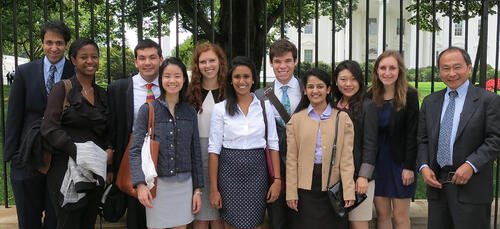
CDDRL Class of 2015 Class of 2015 in front of the White House with Francis Fukuyama.


[[{"fid":"217337","view_mode":"crop_870xauto","fields":{"format":"crop_870xauto","field_file_image_description[und][0][value]":"SHP15 Info Session Flyer","field_file_image_alt_text[und][0][value]":"","field_file_image_title_text[und][0][value]":"","field_credit[und][0][value]":"","field_caption[und][0][value]":"SHP15 Info Session Flyer","field_related_image_aspect[und][0][value]":"","thumbnails":"crop_870xauto","pp_lightbox":false,"pp_description":false},"type":"media","attributes":{"height":1056,"width":870,"class":"media-element file-crop-870xauto"}}]]

Encina Hall, C148
616 Jane Stanford Way
Stanford, CA 94305

0
Olivier Nomellini Senior Fellow at the Freeman Spogli Institute for International Studies
Director of the Ford Dorsey Master's in International Policy
Research Affiliate at The Europe Center
Professor by Courtesy, Department of Political Science
yff-2021-14290_6500x4500_square.jpg

Francis Fukuyama is the Olivier Nomellini Senior Fellow at Stanford University's Freeman Spogli Institute for International Studies (FSI), and a faculty member of FSI's Center on Democracy, Development and the Rule of Law (CDDRL). He is also Director of Stanford's Ford Dorsey Master's in International Policy, and a professor (by courtesy) of Political Science.

Dr. Fukuyama has written widely on issues in development and international politics. His 1992 book, The End of History and the Last Man, has appeared in over twenty foreign editions. His book In the Realm of the Last Man: A Memoir will be published in fall 2026.

Francis Fukuyama received his B.A. from Cornell University in classics, and his Ph.D. from Harvard in Political Science. He was a member of the Political Science Department of the RAND Corporation, and of the Policy Planning Staff of the US Department of State. From 1996-2000 he was Omer L. and Nancy Hirst Professor of Public Policy at the School of Public Policy at George Mason University, and from 2001-2010 he was Bernard L. Schwartz Professor of International Political Economy at the Paul H. Nitze School of Advanced International Studies, Johns Hopkins University. He served as a member of the President’s Council on Bioethics from 2001-2004. He is editor-in-chief of American Purpose, an online journal.

Dr. Fukuyama holds honorary doctorates from Connecticut College, Doane College, Doshisha University (Japan), Kansai University (Japan), Aarhus University (Denmark), the Pardee Rand Graduate School, and Adam Mickiewicz University (Poland). He is a non-resident fellow at the Carnegie Endowment for International Peace. He is a member of the Board of Trustees of the Rand Corporation, the Board of Trustees of Freedom House, and the Board of the Volcker Alliance. He is a fellow of the National Academy for Public Administration, a member of the American Political Science Association, and of the Council on Foreign Relations. He is married to Laura Holmgren and has three children.

(October 2025)

CV
Date Label
Honors Program Director

Encina Hall, C150
616 Jane Stanford Way
Stanford, CA 94305

0
Center Fellow, Freeman Spogli Institute for International Studies
didi_kuo_2023.jpg

Didi Kuo is a Center Fellow at the Freeman Spogli Institute for International Studies (FSI) at Stanford University. She is a scholar of comparative politics with a focus on democratization, corruption and clientelism, political parties and institutions, and political reform. She is the author of The Great Retreat: How Political Parties Should Behave and Why They Don’t (Oxford University Press) and Clientelism, Capitalism, and Democracy: the rise of programmatic politics in the United States and Britain (Cambridge University Press, 2018).

She has been at Stanford since 2013 as the manager of the Program on American Democracy in Comparative Perspective and is co-director of the Fisher Family Honors Program at CDDRL. She was an Eric and Wendy Schmidt Fellow at New America and is a non-resident fellow with the Carnegie Endowment for International Peace. She received a PhD in political science from Harvard University, an MSc in Economic and Social History from Oxford University, where she studied as a Marshall Scholar, and a BA from Emory University.

Date Label
Mentor
-

If we are to feed by 2050 a growing population that is increasingly adopting western style diets we will  have to intensify food production - producing more but on the same amount or less of land and with the same  amount or less of water. Moreover this has to be done in a sustainable manner, i.e. with much lower environmental impact and greater resilience. We can do this with ecological approaches, genetic approaches and socio-economic approaches. Each has its pros and cons.

Sir Gordon Conway is a Professor of International Development at Imperial College, London and Director of Agriculture for Impact, a grant funded by the Bill & Melinda Gates Foundation, which focuses on European support of agricultural development in Africa.

From 2005-2009 he was Chief Scientific Adviser to the Department for International Development. Previously he was President of The Rockefeller Foundation and Vice-Chancellor of the University of Sussex. 

He was educated at the Universities of Wales (Bangor), Cambridge, West Indies (Trinidad) and California (Davis).  His discipline is agricultural ecology.  In the early 1960's, working in Sabah, North Borneo, he became one of the pioneers of sustainable agriculture.

He was elected a Fellow of the Royal Society in 2004 and an Honorary Fellow of the Royal Academy of Engineering in 2007. He was made a Knight Commander of the Order of Saint Michael and Saint George in 2005.  He was recently President of the Royal Geographical Society.

He has authored The Doubly Green Revolution: Food for all in the 21st century (Penguin and University Press, Cornell) and co-authored Science and Innovation for Development (UK Collaborative on Development Sciences (UKCDS)).  His most recent book One Billion Hungry: Can we Feed the World? was published in October 2012. 

Can Sustainable Intensification Feed the World?
Download pdf

Oksenberg Conference Room
Encina Hall, 3rd floor
616 Serra St.
Stanford University
Stanford, CA 94305

Directions and parking information are available here

Professor Sir Gordon Conway Speaker
(650) 723-5697
0
Senior Fellow, Emerita, Stanford Woods Institute and Freeman Spogli Institute for International Studies,
William Wrigely Professor, Emerita, Department of Environmental Social Sciences
Roz_low_res_9_11_cropped.jpg PhD

Rosamond (Roz) Naylor is the William Wrigley Professor, Emerita, of Global Environmental Policy in the Doerr School of Sustainability; and founding Director of the Center on Food Security and the Environment (FSE) at Stanford University. Her research focuses on policies and practices to improve global food security and protect the environment on land and at sea. She has been involved in numerous field-level research projects around the world with her students and has published widely on issues related to global food systems, food policy, and aquaculture. She is the co-chair of The Blue Food Assessment, an international initiative aimed at providing a comprehensive scientific evaluation of the sustainability, nutrition, equity, and justice dimensions of aquatic foods cultured and captured in freshwater and marine environments within the global food system. She is a Member of the National Academy of Sciences, a Fellow of the American Association for the Advancement of Science (AAAS), Fellow of the Ecological Society of America (ESA), a Pew Marine Fellow, and a Leopold Leadership Fellow. She is also the Chair of the Board of Directors for the Aspen Global Change Institute and a member of the Scientific Advisory Committee for Oceana. At Stanford, she teaches courses on The World Food Economy, Human Society and Environmental Change, and Food and Security.
 

CV
Date Label
Rosamond L. Naylor Chair

Energy and Environment Building
473 Via Ortega
Stanford CA 94305

(650) 721-6207
0
Professor, Earth System Science
Senior Fellow at the Freeman Spogli Institute for International Studies
Senior Fellow at the Stanford Woods Institute for the Environment
Senior Fellow at the Stanford Institute for Economic Policy Research (SIEPR)
Affiliate, Precourt Institute of Energy
shg_ff1a1284.jpg PhD

David Lobell is the Benjamin M. Page Professor at Stanford University in the Department of Earth System Science and the Gloria and Richard Kushel Director of the Center on Food Security and the Environment. He is also the William Wrigley Senior Fellow at the Stanford Woods Institute for the Environment, and a senior fellow at the Freeman Spogli Institute for International Studies (FSI) and the Stanford Institute for Economic Policy and Research (SIEPR).

Lobell's research focuses on agriculture and food security, specifically on generating and using unique datasets to study rural areas throughout the world. His early research focused on climate change risks and adaptations in cropping systems, and he served on the Intergovernmental Panel on Climate Change (IPCC) Fifth Assessment Report as lead author for the food chapter and core writing team member for the Summary for Policymakers. More recent work has developed new techniques to measure progress on sustainable development goals and study the impacts of climate-smart practices in agriculture. His work has been recognized with various awards, including the Macelwane Medal from the American Geophysical Union (2010), a Macarthur Fellowship (2013), the National Academy of Sciences Prize in Food and Agriculture Sciences (2022) and election to the National Academy of Sciences (2023).

Prior to his Stanford appointment, Lobell was a Lawrence Post-doctoral Fellow at Lawrence Livermore National Laboratory. He holds a PhD in Geological and Environmental Sciences from Stanford University and a Sc.B. in Applied Mathematics from Brown University.

CV
Date Label
David Lobell Moderator
Lectures
Authors
News Type
News
Date
Paragraphs


China is building more nuclear power plants than any other country today, with 21 plants up and running, 28 under construction and another 58 planned for development. The world’s most populous country is anxious to reduce its reliance on air-polluting fossil fuels and focus on alterative sources for a growing middle-class that is consuming more energy.

This rapid expansion in the number of nuclear power plants and associated nuclear fuel-cycle operations, such as fuel fabrication, possible fuel recycling and waste disposal, pose enormous nuclear safety and security challenges. Safety concerns were exacerbated by the 2011, tsunami-induced Fukushima Daiichi nuclear disaster in Japan.

Security concerns also stem from the fact that nuclear materials must be safeguarded to stay out of the hands of non-state actors and the facilities protected from potential terrorist attacks. These issues are of great concern to Chinese and Americans, so it stands to reason that China and the United States should want to join forces.

Four CISAC scholars – including veterans of Track II diplomacy, Siegfried Hecker and Chaim Braun – are working behind the scenes trying to get both sides to do just that.

The four traveled in October to China for meetings with Chinese scientists and policy analysts to discuss new approaches to nuclear security at a weeklong conference in Hangzhou and a one-day workshop in Beijing. The conference hosted top international nuclear energy and security experts. It was one in a continuing series featuring CISAC scholars and colleagues from several Chinese nuclear institutes and think tanks.

“We’re certainly back on a very positive slope with the Chinese,” said Hecker, a senior fellow at CISAC who first began visiting his counterparts in China in 1994 as head of the Los Alamos National Laboratory. “They are very keen to foster continued cooperation on all things nuclear. It’s important in terms of national security – and it’s of great benefit to both sides.”

The Chinese have been a nuclear weapon state for decades, but are relative latecomers to nuclear electricity. While it only produces some 3 percent of the world’s nuclear energy today, China is on its way to become a world leader in nuclear power production and technology exports by 2020.

“The Chinese are taking a really pragmatic view of nuclear power,” said Jason Reinhardt, a MacArthur Nuclear Security Fellow at CISAC and national security systems analyst at Sandia National Laboratories. He traveled with Hecker and Braun to attend the conference, along with Larry Brandt, a visiting scholar at the center.

“All of us are better off if countries like China and Russia and the U.S. work together on nuclear proliferation and terrorism issues,” Reinhardt said. “So part of that is just going over there and seeing what they want to do and how they want to collaborate.”


Reinhardt is working on his Ph.D. at Stanford in decision and risk analysis with advisor Elisabeth Paté-Cornell, a professor of engineering and CISAC affiliated faculty member. He believes systems analysis can provide insights to improve capabilities to counter nuclear terrorism, facilitate nuclear agreements and reduce the risks of nuclear accidents.

“I think that the way policies are formed and the way technical information is used to inform policies is very different in China, as a matter of history and culture,” Reinhardt said. “So I’m trying to create a compelling story as to why systems analysis is a great way to collaborate between countries.”

Reinhardt said China and the United States have different priorities and approaches to nuclear security, with Beijing placing a high priority on preventing radiological and power plant attacks. The United States has done much since 9/11 to protect its nuclear power plants. Washington’s concerns are focused more on terrorist attacks with nuclear bombs and the potential of radiological, dirty bomb attacks. 


What is systems and risk analysis with regard to nuclear security?

Systems analysis is a structured scientific approach to tough problems, used to inform decision-making, Reinhardt said. One of the best sets of tools available – particularly when there is a lot of uncertainty – is decision and risk analysis.

And nuclear security is rife with uncertainty. What might an attack look like? Who are the attackers? What would the consequences be? How might the attackers change their strategy given our investments in countermeasures?

The questions are many and the connections complex. Risk analysis can borrow from probability theory, game theory and economics to bring some order to this chaos and provide insights that can inform policymakers.

“Systems analysis is using science and engineering techniques to answer policy questions for government,” said Reinhardt, whose work at Sandia includes projects with the U.S. Department of Homeland Security focusing on countering nuclear terrorism, promoting international engagement, and strengthening border security.

“We talk about concepts and taxonomies and ways to organize thinking, then mathematical models to help explore trade-offs – and then there are physical models and we go out in the field and experiment to try and get smarter,” Reinhardt said. “All of these help us understand the implications of proposed policies.”


Image
china dinner


Reinhardt gave a presentation in China in which he proposed a joint study to develop a common framework. Moving forward, the study would primarily be academically focused in an effort to inform policymakers – not to set policy.

“I said that building a common framework for analysis and exercising those together would be a really powerful tool for creating collaboration at a very high level,” he said. “The United States and China have cooperated in areas of nuclear security in the past. These new efforts will build on that success and take them to a new cooperative level.”

He suggested they begin to work together to create a model that would:


  1. Develop a list of potential attack scenarios, compile a list of potential perpetrators, and estimate probabilities of attack;
  2. Compare the efficacies of different types counterterrorism measures to ward off radiological terrorism attacks;
  3. Determine which countermeasures can and should be the focus of collaborative technical research;
  4. And determine the next steps to develop Chinese and U.S. collaborations on countermeasures.    


The CISAC team will follow up with their Chinese colleagues during a visit in February and work to bring a young Chinese researcher to the center during the first half of the academic year.

“They’re trying to understand what they can implement to reduce internal and regional nuclear risks,” he said. “This requires that you first consider how to understand, assess, and measure these risks. Doing that together, I think we can come up with some answers that are valuable to both countries.”


A Growing Focus on Nuclear Power and Climate Change

The meetings in China came just as Washington and Beijing announced a landmark pact to significantly cut greenhouse gas emissions by the world’s two largest consumers of energy. China is increasingly turning to nuclear power to address the adverse consequences of fossil fuels. As China expands its research and dependence on nuclear power – which in turn will cut down on greenhouse gas emissions – CISAC intends to help the Asian powerhouse protect its nuclear energy resources from potential accidents and deliberate attacks.


Image
chaim china


Braun, a consulting professor at CISAC and an expert on nuclear proliferation smuggling rings and power plants around the world, also attended the conference and was invited along with Hecker to visit the Qinshan Nuclear Station about 50 miles southwest of Shanghai.

“For me, the visit to Qinshan’s Phase 3 plant was especially exciting, as I worked on the early phases of the construction of Qinshan Phase 3 while at Bechtel,” said Braun, who earlier in his career belonged to the Bechtel Power Corporation’s Nuclear Management Group and led studies on plant performance and maintenance.

Braun said Qinshan Phase 3 is now used as an experimental station to explore reprocessed uranium recycling and experiment with an alternate nuclear fuel, namely thorium.

According to the Pew Charitable Trusts, China leads the global clean-energy race, and last year attracted $54.2 billion in investment for alternative energies. That includes exporting safe, reliable nuclear technology to other countries that want to do the same.

“Russia and China are the two most important technological relationships we should be building right now,” Reinhardt said. "Any prospects for the future of arms control and reductions are all predicated on continued relationships with Russia and China.”

 

Hero Image
china power plant
A view shows the 4th unit of Tianwan Nuclear Power Plant under construction after its ground-breaking ceremony in Lianyungang, Jiangsu province Sept. 27, 2013. | Reuters
All News button
1
Subscribe to The Americas