-

Abstract:

Low-income countries are less productive than their high-income counterparts. Is one reason because labor in high-income countries can more easily move to where it is most productive? We use detailed individual data combined with a spatial general equilibrium model of worker selection to study the determinants of labor productivity growth in Indonesia and the United States over the last 40 years. We find that while improvements in in situ labor productivity and the spatial allocation of human capital resources account for about 55% of Indonesian labor productivity growth, improvements in spatial mobility, due to lower costs of movement and improvements in the amenity of high productivity locations, account for nearly as much: 45%. In a comparison to the US, higher costs of movement in Indonesia account for 10% of the labor productivity gap between the two countries. These results suggest an important role of migration to explain aggregate productivity gaps both across and within countries.
 

Speaker Bio:

Image
melanie morten

Melanie Morten is an Assistant Professor of Economics at Stanford University. Her research focuses on migration in developing countries, including analyzing how migration changes informal financial safety nets and understanding the costs and potential productivity benefits of migration. She has worked on projects in India, Brazil, and Indonesia. She has a PhD in economics from Yale University.

Melanie Morten Assistant Professor, Department of Economics, Stanford University
Seminars
-

Abstract:

American government is incapable of dealing effectively with the challenges of modern society. Why the dysfunction? The usual suspects include polarization and the rise in campaign spending. But William Howell and Terry Moe argue—in their new book, Relic—that the roots of dysfunction go much deeper: to the Constitution itself. The framers designed the Constitution some 225 years ago for a simple agrarian society. But the government they created, a separation of powers system with a parochial Congress at its center, is ill-equipped to address the serious social problems that inevitably arise in a complex post-industrial nation. We are prisoners of the past. The solution is to update the Constitution for modern times. A promising step forward, the authors argue, is a simple reform that pushes Congress and its pathologies to the periphery of policymaking, and brings presidents to center stage.


Speaker Bio:

Image
terry moe
Terry M. Moe is the William Bennett Munro Professor of Political Science at Stanford University and a senior fellow at the Hoover Institution. He has written extensively on public bureaucracy and the presidency, as well as the theory of political institutions more generally. His articles include "The New Economics of Organization," "The Politicized Presidency," "The Politics of Bureaucratic Structure," "Political Institutions: The Neglected Side of the Story," "Presidents, Institutions, and Theory," “The Presidential Power of Unilateral Action” (with William Howell), “Power and Political Institutions,” “Political Control and the Power of the Agent,” and “Do Politicians Use Policy to Make Politics? The Case of Public Sector Labor Laws” (with Sarah F. Anzia). His most recent work is Relic: How Our Constitution Undermines Effective Government--And Why We Need a More Powerful Presidency (with William Howell, 2016)." He has also written extensively on the politics of American education. His newest books are The Comparative Politics of Education: Teachers Unions and Education Systems Around the World (edited with Susanne Wiborg, forthcoming 2017) and Special Interest: Teachers Unions and America’s Public Schools (2011). His past work on education includes Politics, Markets, and America's Schools (1990) and Liberating Learning: Technology, Politics, and the Future of American Education (2009), both with John E. Chubb, and Schools, Vouchers, and the American Public (2001).

Terry M. Moe William Bennett Munro Professor of Political Science at Stanford University
Seminars

616 Jane Stanford Way
Encina Hall, E005
Stanford, CA 94305-6060

0
grace_bio-headshotoriginal.jpeg PhD

Grace is a Curriculum Consultant for the Stanford Program on International and Cross-Cultural Education (SPICE). Prior to joining SPICE in 2012, she worked at a California public school. She taught six different English courses for grades 9–12. In addition to seven years as a high school teacher, Grace’s teaching experience includes elementary school, middle school, and undergraduate and graduate level courses. She has been a recipient of the Outstanding Graduate Student Instructor Award from the University of California, Berkeley. She is a 2016-2018 Cultivating New Voices Fellow for the National Council of Teachers of English.

Grace’s academic interests include literacy, language, cultural studies, and twenty-first century pedagogies. She received a BA with a double major in Rhetoric and Art History from the University of California, Berkeley, and a MA in Education and Single Subject Teaching Credential in English from Stanford University. She is currently a PhD candidate in the Graduate School of Education at the University of California, Berkeley. Her research has been published in peer-reviewed journals and presented nationally and internationally.

Grace co-authored the SPICE curriculum units, Dynamics of the Korean-American ExperienceTraditional and Contemporary Korean Culture, and Economic Development: The Case of South Korea. She is currently contributing to SPICE’s curriculum unit, Road to Tokyo.  She has presented teacher seminars for the National Council for the Social Studies, St. Louis, MO; Hana-Stanford Conference on Korea for Secondary School Teachers, Stanford, CA; and the National Association for Multicultural Education, Oakland, CA. In 2013, 2014, 2015, and 2016, she facilitated the annual Hana-Stanford Conference on Korea for Secondary School Teachers held at Stanford University.

Curriculum Consultant
Authors
News Type
News
Date
Paragraphs

Ponte a prueba. Put yourself to the test.

As he explained during the recent Rosenkranz Prize Symposium, Stefano M. Bertozzi used this slogan to promote health reform in the Mexico City prison system. By encouraging inmates to step up and get themselves tested for HIV and other chronic illnesses, Bertozzi, dean and professor of health policy and management at the UC Berkeley School of Public Health, was able to decrease the spread of illnesses in Mexican prisons and the surrounding communities.

The Rosenkranz Prize Symposium celebrated research projects that—like Bertozzi’s—address the health care needs of the world’s most vulnerable populations. With support from the Rosenkranz Prize for Health Care Research in Developing Countries, Stanford scholars have stepped up to tackle health issues in regions in need.

Since 2010, the award has funded six young Stanford researchers who aim to improve health in developing countries. The symposium celebrated their achievements.

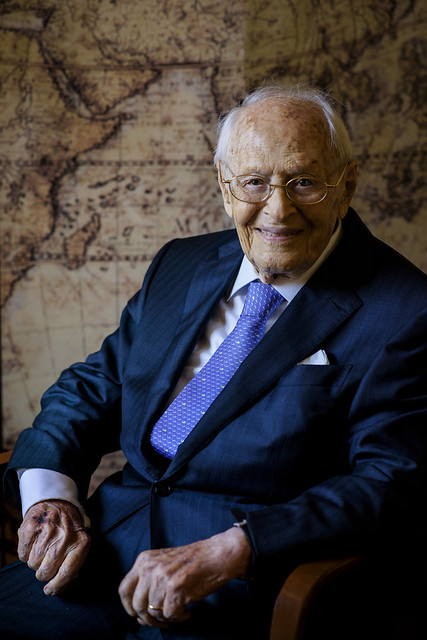
The award honors the work of Dr. George Rosenkranz who spent his career reducing health disparities around the globe. Rosenkranz, who was the first to synthesize cortisone and the active ingredient in the first oral contraceptive, also celebrated his 100th birthday at the symposium.

Producing research that will increase care for vulnerable populations globally is the ultimate goal of the Rosenkranz Prize.

Andrés Moreno-Estrada, the 2012 winner, has used the award to study genetics in Latin American and Caribbean populations, aiming to increase knowledge of potential genetic illnesses. He said, “The Rosenkranz Prize is a clear, important step forward to demonstrate that we can do cutting edge science in developing countries that is of international relevance.”

Other winners include Eran Bendavid, Sanjay Basu, Marcella Alsan, Jason Andrews and Ami Bhatt. Their projects range from the effect of AIDS relief efforts on health care delivery to the treatment of diabetes in India to low-cost diagnostic tools for regions lacking infrastructure.

“I can’t think of a better way to celebrate (my father’s) birthday than listening to the bright future of science,” said Ricardo T. Rosenkranz, son of Dr. George Rosenkranz and a prize donor. “We can’t wait to hear what the next Rosenkranz Prize winners tell us.”


Click below for event photo gallery:

Rosenkranz Prize Symposium 2016

Hero Image
001 20160820 rosenkranz prize symposium
Dr. George Rosenkranz celebrated his 100th birthday at the symposium. The first to synthesize cortisone as well as the active ingredient in the first oral contraceptive, Rosenkranz spent his life reducing health disparities around the globe. | Ryan Zhang
All News button
1
News Type
News
Date
Paragraphs

The 12th annual Draper Hills Summer Fellows Program gathered 25 democracy leaders from around the developing world for a three-week training program on democracy, good governance, and the rule of law reform. Selected from a large pool of applicants, the fellows have diverse backgrounds across sectors and geographies, working in civil society, public service, social enterprise, media and technology.

Fellows were instructed by an all-star roster of Stanford scholars and policy experts, including former U.S. Secretary of State Condoleezza Rice; FSI Director and former U.S. Ambassador to Russia Michael McFaul; CDDRL Mosbacher Director Francis Fukuyama and Larry Diamond, senior fellow at the Freeman Spogli Institute for International Studies. Fellows also met industry leaders such as Eric Schmidt of Google, democracy leaders such as Carl Gershman of the National Endowment for Democracy and others. During the program, they shared their personal stories about the struggle in their home countries, but also stories of their fight for justice, equality, and democracy, stories of optimism and endurance.

You can find some of their talks below and for more videos visit our YouTube channel


Kasha Nabagesera (Uganda)

The founding member of Uganda's LGBTI Movement

"I am the only founding member of Uganda's LGBTI movement who is still based in the country"


Kasha Nabagesera is the executive director of Kuchu Times Media Group, the first LGBTI media platform in Africa. She is known as the “founding mother” of the LGBTI movement in Uganda - where homosexuality is illegal - advocating for equal rights and the eradication of all forms of discrimination based on sexual orientation. Listen to her story about big losses and big wins, everyday dangers and hope.


Rafael Marques de Morais (Angola)

Investigative reporter, MakaAngola

"Why the government is after you when you are sleeping so much?"

Rafael Marques de Morais is an award-winning journalist and human rights activist in Angola, working to investigate corruption and abuse of power by the country’s ruling family. He founded Makaangola, a watchdog website dedicated to exposing corruption and human rights abuses in Angola. Find out why his son thinks that his father is harmless for the government.


Belabbes Benkredda (Algeria)

The founder of Munathara Initiative

"Debate is the central part of the democratic equation."

Belabbes Benkredda is an award-winning social innovator and the founder of the Munathara Initiative, the Arab world’s largest online and television debate forum highlighting voices of youth, women, and marginalized communities. Operating in 11 Arab countries, Munathara’s monthly prime-time TV debates are the only civil society-run, independent political talk program on Arabic television. Munathara Initiative organized over 650 workshops with more than 10 thousand participants from 12 countries. They have around 90 thousand of registered users. More importantly, Munathara Initiative provided safe public space for young women to voice their opinions and mark their presence in public, traditionally dominated by the middle-aged men.  


Hero Image
dhsf16collagesmall01
All News button
1
-

Co-sponsor by Stanford in Government (SIG)

Abstract:

Image
elaine kamarck
From the botched attempt to rescue the U.S. diplomats held hostage by Iran in 1980 under President Jimmy Carter and the missed intelligence on Al Qaeda before 9-11 under George W. Bush to, most recently, the computer meltdown that marked the arrival of health care reform under Barack Obama, the American presidency has been a profile in failure. In Why Presidents Fail and How They Can Succeed Again, Elaine Kamarck surveys these and other recent presidential failures to understand why Americans have lost faith in their leaders—and how they can get it back. Kamarck argues that presidents today spend too much time talking and not enough time governing, and that they have allowed themselves to become more and more distant from the federal bureaucracy that is supposed to implement policy. After decades of “imperial” and “rhetorical” presidencies, we are in need of a “managerial” president. This White House insider and former Harvard academic explains the difficulties of governing in our modern political landscape, and offers examples and recommendations of how our next president can not only recreate faith in leadership but also run a competent, successful administration.


Speaker Bio:

Image
elaine kamarck cr
Elaine C. Kamarck is a Senior Fellow in the Governance Studies program as well as the Director of the Center for Effective Public Management at the Brookings Institution. She is an expert on American electoral politics and government innovation and reform in the United States, OECD nations, and developing countries. Kamarck is also a Lecturer in Public Policy at the Harvard Kennedy School of Government. She has been a member of the Democratic National Committee and the DNC’s Rules Committee since 1997. She has participated actively in four presidential campaigns and in ten nominating conventions—including two Republican conventions. In the 1980s, she was one of the founders of the New Democrat movement that helped elect Bill Clinton president. She served in the White House from 1993 to 1997, where she created and managed the Clinton Administration's National Performance Review, also known as the “reinventing government initiative.” At the Kennedy School, she served as Director of Visions of Governance for the Twenty-First Century and as Faculty Advisor to the Innovations in American Government Awards Program. In 2000, she took a leave of absence to work as Senior Policy Advisor to the Gore campaign. Kamarck received her Ph.D. in political science from the University of California, Berkeley.

Elaine Kamarck Senior Fellow in the Governance Studies program as well as the Director of the Center for Effective Public Management at the Brookings Institution
Seminars
Authors
Beth Duff-Brown
News Type
News
Date
Paragraphs

An independent panel of medical experts has updated 20-year-old guidelines for evaluating cost-effectiveness in health and medicine, in an effort to help everyone from policymakers to patients make more informed decisions about tests and treatments.

Released in a special communication in the Journal of the American Medical Association, the panelists spent more than three years building on the work of the 1996 Panel on Cost-Effectiveness in Health and Medicine, originally convened by the U.S. Public Health Service. They developed recommendations by consensus.

The new recommendations are intended to guide decision-makers in using new methods for analyzing evidence, reporting standardized results, incorporating both health-care system and societal perspectives, as well as weighing ethical issues in the use of cost-effectiveness analysis (CEA).

“Some people question the use of economic analyses in health care, but cost-effective analysis is a way to ensure that we are proving high-value care,” said Stanford Health Policy’s Douglas K. Owens, a professor of medicine and senior investigator of the VA Palo Alto Heath Care System, who sat on the panel.

“If we do interventions without understanding their value, we may well spend money on something that may not really be worth it,” said Owens. “Cost effectiveness analysis is one approach to understanding how we can help control health-care costs and provide high-value health care.”

Image
teaching owens

The panel was led by co-chairs Gillian D. Sanders, Professor in the Department of Medicine and a member of both the Duke Clinical Research Institute and the Duke-Margolis Center for Health Policy, and Peter J. Neumann, Director, Center for the Evaluation of Value and Risk in Health at the Institute for Clinical Research and Health Policy Studies at Tufts Medical Center and Professor of Medicine at Tufts University.

Sanders said CEA could help inform decisions about how to apply new or existing medical tests, therapies, and prevention techniques so that decision-makers use health-care resources wisely.

“As health-care costs continue to rise at unsustainable rates, these recommendations provide a framework for comparing the relative value of different health-care interventions, and help decision-makers across the spectrum from policymakers to patients sort through alternatives and decide what tests and treatments make sense,” she said.

Neumann noted that in the 20 years since the original panel’s report, the field of cost-effectiveness analysis has advanced, as has the need to deliver health-care efficiently.

“Updating the guidelines provides an opportunity to reflect on the evolution of cost-effectiveness analysis and to provide guidance for the next generation of practitioners and consumers,” he said.

Primarily funded by grants from the Robert Wood Johnson Foundation and the Bill & Melinda Gates Foundation, the panel recommends several key changes to the guidelines, while confirming other principles from the first panel, including:

  1. Broadening the scope and number of reference cases in a cost analysis, which describe standard methodology that should be followed to ensure quality analysis by creating comparable measurements. The panel is recommending that all CEAs should not report two reference cases: one based on a health-care sector perspective and another based on a societal perspective.
  2. Using an “impact inventory” that lists the health and non-health effects of a health-care intervention to ensure that all consequences are considered, including those to patients, caregivers, social services and others outside the health-care sector. This tool also allows analysts to look at categories of impacts that may be most important to stakeholders.
  3. Measuring health effects in terms of quality adjusted life years, a common measure used by health researchers that includes both the quality and quantity of life lived.
  4. Including both costs reimbursed by third-party payers and those paid for out-of-pocket by patients in health-care sector analyses.
  5. Including a reporting checklist and guidelines for transparency that includes assumptions in any analysis and the disclosure of potential conflicts of interest.

The complete report of the so-called Second Panel will be published in October.

The panelists noted that the field of CEA has emerged dramatically since the last guidelines 20 years ago. For example, the Advisory Committee for Immunization Practices, which establishes national immunization policy recommendations on behalf of the Centers for Disease Control and Prevention, now uses CEA in its calculations.

“The need to deliver health-care efficiently and the importance of using analytic techniques to understand clinical and economic consequences of strategies to improve health, have only increased,” the Second Panel authors wrote in the JAMA paper.

Health-care spending in the United States comprised 13 percent of GDP in 1995; today it approaches 18 percent. And the total national health expenditures have tripled during that period, jumping to more than $3 trillion in 2014, according to the Kaiser Family Foundation.

“The goal of the Second Panel is to promote the continued evolution of CEA and its use to support judicious, efficient, and fair decisions regarding the use of health-care resources,” the experts wrote in the JAMA article.

 

Hero Image
analysis
All News button
1
Authors
News Type
Blogs
Date
Paragraphs

Imagine there’s a new pill on the market. It promises you a one in 200 chance of avoiding a heart attack, stroke, heart failure or death over the next year — if you take it religiously.

It also promises a one in 60 chance of landing you in the hospital for some serious complication: Maybe you passed out. Maybe the pill affected your kidney function. Maybe you developed a severe electrolyte imbalance.

Would you take it? How would you decide?

This question is confronting some patients with hypertension as well as their health-care providers who, like me, help manage their blood pressure. The “pill” is not a pill per se, but a treatment strategy.

In November of 2015, researchers published results of a large NIH-sponsored trial known as SPRINT, which compared two systolic blood pressure treatment targets for hypertensive adults: a higher, conventional target of 140 mm mercury compared to a more stringent target of 120.  Participants in the trial were older, did not have diabetes, and were generally at high risk of developing cardiovascular disease. They were prescribed commonly used blood pressure medications, which were carefully adjusted by investigators to achieve target blood pressures.

The trial demonstrated a large relative benefit: Those in the lower target group had about a 25 percent reduction in the rate of cardiovascular disease or death. The absolute benefit, though, was small, with only about one in 200 patients avoiding cardiovascular disease or death as a result of treatment. The trial also showed that complications in the lower target group were relatively common.

As a physician, I’d love to be able to tell the patient in my exam room whether she will be the lucky one out of 200 who will benefit. That dream is still a few years off. I can, though, answer a related question. If I treat a large group of patients, on the whole, will my patients benefit? Or will the harms of treatment outweigh the benefits? And if the treatment is overall beneficial, what investment will we need to achieve this gain in health?

Image
Ilana B. Richman

To answer this question, I teamed up with a group of researchers at Stanford. Our team included experts in cost-effectiveness analysis as well as students developing clinical and analytic expertise in this area. We used data from SPRINT along with other published sources to project the expected benefits, harms and costs from targeting a lower or higher blood pressure over the course of a lifetime.

Results of our study were published this week in JAMA Cardiology. We found that targeting a lower blood pressure results in a substantial net benefit, even after accounting for harms from common, serious adverse events. This net benefit, though, doesn’t come free: An investment of about $23,777 is required for every year of life gained from this strategy.

Is $23,777 “worth it?” It’s a hard question to answer and it depends, in part, on who is paying. But in the spectrum of medical interventions that we routinely use here in the United States, this would be considered a good deal, a bargain even.

So should we go all in? Should we push stringent blood pressure targets for everyone?

No. There are a number of other considerations. SPRINT answered a specific question about hypertension treatment in a specific group of patients. Whether other groups of patients, like those at lower risk of cardiovascular disease, would benefit is unclear. There were also methodological quirks that have left the trial open to criticism.

But if we believe that the findings from SPRINT are generally correct, a lower blood pressure target seems to provide significant health gains for a reasonable cost in patients who are at high risk of developing cardiovascular disease.


Ilana B. Richman, MD, is a VA Health Services Research and Development Fellow at Stanford Health Policy.


Hero Image
blood pressure
All News button
1
-

Korea Society president Thomas Byrne, retired General Walter "Skip" Sharp, former U.S. commander in Korea, and Kathleen Stephens, former U.S. ambassador to Korea and William J. Perry Distinguished Fellow in the Korea Program at Stanford's Shorenstein APARCengage in discussion about the new U.S. president and political, economic and security options on Korea and East Asia.

Panelists:

Thomas J. Byrne joined The Korea Society as its president in 2015. He came to the Society from Moody's Investor Services, where he was Senior Vice President, Regional Manager, Spokesperson, and Director of Analysis for the Sovereign Risk Group in the Asia-Pacific and Middle East regions. Before moving to Moody's in 1996, he was the Senior Economist of the Asia Department at the Institute of International Finance in Washington, D.C. Byrne holds a master’s degree in international relations with an emphasis on economics from the Johns Hopkins’ School of Advanced International Studies. Before his graduate work, he served in South Korea for three years as a U.S. Peace Corps volunteer. He teaches a graduate-level course, Sovereign Risk, at Columbia University’s School of International and Public Affairs in Fall 2016.

General Walter “Skip” Sharp was commander of the United Nations Command, ROK-U.S. Combined Forces Command and U.S. Forces in Korea from 2008 to 2011. He also commanded troops in Operations Desert Shield and Desert Storm, Operation Uphold Democracy in Haiti and the Multinational Division (North) of the NATO-led Stabilization Force in Bosnia. He previously had four assignments at the Pentagon on the Joint Staff. He was the deputy director, J5 for Western Hemisphere/Global Transnational Issues; vice director, J8 for Force Structure, Resources, and Assessment; director for Strategic Plans and Policy, J5; and the director of the Joint Staff.

Born in Morgantown, West Virginia, while his father was fighting in the Korean War, General Sharp graduated from West Point in 1974 and was commissioned as an armor officer.  He earned a master’s degree in operations research and system analysis from Rensselaer Polytechnic Institute and is a graduate of the Army War College. He is consulting for and on the board of directors of several U.S. and Korean companies and The Korea Society. He is involved in Northeast Asia and especially Korea strategy and policy discussions at several think tanks in the Washington, D.C. area.

Kathleen Stephens, a former U.S. ambassador to the Republic of Korea, is the William J. Perry Distinguished Fellow in the Korea Program at Stanford’s Shorenstein Asia-Pacific Research Center. She has four decades of experience in Korean affairs, first as a Peace Corps volunteer in rural Korea in the 1970s, and in ensuing decades as a diplomat and as U.S. ambassador in Seoul. She came to Stanford previously as the 2013-14 Koret Fellow after 35 years as a foreign service officer in the U.S. Department of State.

Stephens' diplomatic career includes chargé d’affaires to India in 2014; acting under secretary of state for public diplomacy and public affairs in 2012; U.S. ambassador to the Republic of Korea from 2008 to 2011; principal deputy assistant secretary of state for East Asian and Pacific affairs from 2005 to 2007; and deputy assistant secretary of state for European and Eurasian affairs from 2003 to 2005.

Philippines Conference Room
Encina Hall, 3rd Floor
616 Serra St.
Stanford, CA 94305

-

Abstract:

China's government alternately appears in western scholarship as an idealized meritocracy or a corrupt cohort of venal officials. Yet empirical attempts to place China's government in comparative perspective are limited. We develop and exploit a new empirical source--survey testimony from political insiders--to measure three Weberian qualities of Chinese bureaucracy: meritocracy, autonomy, and morale. By translating questions from a major survey of U.S. officials, we place the responses of Chinese officials in comparative perspective. In contrast to claims that political connections dominate official promotions in China, Chinese bureaucrats are markedly more likely than U.S. bureaucrats to report that their agencies recruit people with the right skills and promote people based on performance. Responses from municipal governments in China resemble those of high-performing federal bureaucracies in the United States, such as NASA and the Nuclear Regulatory Commission. However, the Chinese advantage shrinks in autonomy and nearly disappears in workplace morale.


Speaker(s) Bio:

Image
francis fukuyama

Francis Fukuyama is the Olivier Nomellini Senior Fellow at the Freeman Spogli Institute for International Studies (FSI) and the Mosbacher Director of FSI's Center on Democracy, Development, and the Rule of Law (CDDRL).  He is also a professor by courtesy in the Department of Political Science. He was previously at the Paul H. Nitze School of Advanced International Studies (SAIS) of Johns Hopkins University, where he was the Bernard L. Schwartz Professor of International Political Economy and director of SAIS' International Development program.


Image
greg distellhorst

Greg Distelhorst is the Mitsubishi Career Development Professor and an Assistant Professor of Global Economics and Management at the MIT Sloan School of Management. He studies contemporary Chinese politics and public policy, as well as the social impacts of multinational business. He was a CDDRL Predoctoral Fellow in 2012-2013.


Image
margaret boittin


Margaret Boittin is Assistant Professor at Osgoode Hall Law School, York University, Canada. She studies Chinese law and politics. She was a predoctoral and postdoctoral fellow at CDDRL (2012-2015).

Encina Hall, C148
616 Jane Stanford Way
Stanford, CA 94305

0
Olivier Nomellini Senior Fellow at the Freeman Spogli Institute for International Studies
Director of the Ford Dorsey Master's in International Policy
Research Affiliate at The Europe Center
Professor by Courtesy, Department of Political Science
yff-2021-14290_6500x4500_square.jpg

Francis Fukuyama is the Olivier Nomellini Senior Fellow at Stanford University's Freeman Spogli Institute for International Studies (FSI), and a faculty member of FSI's Center on Democracy, Development and the Rule of Law (CDDRL). He is also Director of Stanford's Ford Dorsey Master's in International Policy, and a professor (by courtesy) of Political Science.

Dr. Fukuyama has written widely on issues in development and international politics. His 1992 book, The End of History and the Last Man, has appeared in over twenty foreign editions. His book In the Realm of the Last Man: A Memoir will be published in fall 2026.

Francis Fukuyama received his B.A. from Cornell University in classics, and his Ph.D. from Harvard in Political Science. He was a member of the Political Science Department of the RAND Corporation, and of the Policy Planning Staff of the US Department of State. From 1996-2000 he was Omer L. and Nancy Hirst Professor of Public Policy at the School of Public Policy at George Mason University, and from 2001-2010 he was Bernard L. Schwartz Professor of International Political Economy at the Paul H. Nitze School of Advanced International Studies, Johns Hopkins University. He served as a member of the President’s Council on Bioethics from 2001-2004. He is editor-in-chief of American Purpose, an online journal.

Dr. Fukuyama holds honorary doctorates from Connecticut College, Doane College, Doshisha University (Japan), Kansai University (Japan), Aarhus University (Denmark), the Pardee Rand Graduate School, and Adam Mickiewicz University (Poland). He is a non-resident fellow at the Carnegie Endowment for International Peace. He is a member of the Board of Trustees of the Rand Corporation, the Board of Trustees of Freedom House, and the Board of the Volcker Alliance. He is a fellow of the National Academy for Public Administration, a member of the American Political Science Association, and of the Council on Foreign Relations. He is married to Laura Holmgren and has three children.

(October 2025)

CV
Date Label
Mosbacher Director of the Center on Democracy, Development, and the Rule of Law

Encina Hall
616 Serra Street
Stanford, CA 94305-6055

0
Research Affiliate
Distelhorst_HS.jpg

Greg Distelhorst is a Ph.D. candidate in the MIT Department of Political Science and a predoctoral fellow at Stanford University's Center on Democracy, Development, and the Rule of Law. His dissertation addresses public accountability under authoritarian rule, focusing on official responsiveness and citizen activism in contemporary China. This work shows how citizens can marshal negative media coverage to discipline unelected officials, or "publicity-driven accountability." These findings result from two years of fieldwork in mainland China, including a survey experiment on tax and regulatory officials. A forthcoming second study measures the effects of citizen ethnic identity on government responsiveness in a national field experiment. His dissertation research has been funded by the U.S. Fulbright Program, the Boren Fellowship, and the National Science Foundation. A second area of research is labor governance under globalization, where he has examined private initiatives to improve working conditions in the global garment, toy, and electronics supply chains.

For more on Greg's research, please visit:
Governance Project Pre-doctoral Fellow 2012-2013
Assistant Professor of Global Economics and Management at the MIT Sloan School of Management

Encina Hall
616 Serra Street
Stanford, CA 94305-6055

0
The Governance Project Postdoctoral Fellow, 2013-15
Boittin_HS.jpg

Margaret Boittin has a JD from Stanford, and is completing her PhD in Political Science at UC Berkeley. Her dissertation is on the regulation of prostitution in China. She is also conducting research on criminal law policy and local enforcement in the United States, and human trafficking in Nepal.

The Governance Project Postdoctoral Fellow, 2013-15
CV
Assistant Professor at Osgoode Hall Law School, York University, Canada
Seminars
Subscribe to The Americas