Civil Wars, Global Disorder, and the Future of the International System
Join Amb. Karl Eikenberry, Prof. Stephen Krasner, and FSI senior scholars for a discussion of the new volume of Daedalus, the journal of the American Academy of Arts and Sciences and a product of the Academy's Civil Wars, Violence and International Responses Project.
More than 30 countries around the world today are engulfed in civil wars, and the consequences are global. From policy to pandemics, the impacts of internal conflict reverberate across oceans and generations.
To introduce the latest volume of Daedalus, co-edited by Amb. Eikenberry and Prof. Krasner, the Freeman Spogli Institute for International Studies is pleased to join the Academy in hosting a panel discussion featuring seven of the eight FSI co-authors on the volume. FSI director Michael McFaul, former US ambassador to Russia, will introduce the panel.
A reception will follow the panel at 5:30 p.m.
Featuring:
Ambassador Michael McFaul (Director of the Freeman Spogli Institute for International Studies, Stanford University), Opening
Dr. Michele Barry (Senior Associate Dean for Global Health, Stanford School of Medicine), Featured Author
Ambassador Karl W. Eikenberry (Oksenberg-Rohlen Distinguished Fellow, Shorenstein Asia-Pacific Research Center at Stanford; Freeman Spogli Institute for International Studies; Center for International Security and Cooperation; Faculty Member, Stanford University), Featured Author
Professor James D. Fearon (Theodore and Frances Geballe Professor in the School of Humanities and Sciences, Stanford University), Featured Author
Dr. Francis Fukuyama (Olivier Nomellini Senior Fellow, Freeman Spogli Institute for International Studies), Featured Author
Professor Stephen D. Krasner (Graham H. Stuart Professor of International Relations, Stanford University; Senior Fellow, Hoover Institution, Stanford University), Featured Author
Professor Stephen Stedman (Senior Fellow, Freeman Spogli Institute for International Studies, Stanford University), Featured Author
Dr. Paul Wise (Richard E. Behrman Professor of Child Health and Society, Stanford University), Featured Author
The Stanford Faculty Club, The Gold Lounge
439 Lagunita Drive
Stanford, CA
Michael A. McFaul
Encina Hall
616 Jane Stanford Way
Stanford, CA 94305-6055
Michael McFaul is the Ken Olivier and Angela Nomellini Professor of International Studies in Political Science, Senior Fellow at the Freeman Spogli Institute for International Studies, and the Peter and Helen Bing Senior Fellow at the Hoover Institution, all at Stanford University. He joined the Stanford faculty in 1995 and served as FSI Director from 2015 to 2025. He is also an international affairs analyst for MSNOW.
McFaul served for five years in the Obama administration, first as Special Assistant to the President and Senior Director for Russian and Eurasian Affairs at the National Security Council at the White House (2009-2012), and then as U.S. Ambassador to the Russian Federation (2012-2014).
McFaul has authored ten books and edited several others, including, most recently, Autocrats vs. Democrats: China, Russia, America, and the New Global Disorder, as well as From Cold War to Hot Peace: An American Ambassador in Putin’s Russia, (a New York Times bestseller) Advancing Democracy Abroad: Why We Should, How We Can; and Russia’s Unfinished Revolution: Political Change from Gorbachev to Putin.
He is a recipient of numerous awards, including an honorary PhD from Montana State University; the Order for Merits to Lithuania from President Gitanas Nausea of Lithuania; Order of Merit of Third Degree from President Volodymyr Zelenskyy of Ukraine, and the Dean’s Award for Distinguished Teaching at Stanford University. In 2015, he was the Distinguished Mingde Faculty Fellow at the Stanford Center at Peking University.
McFaul was born and raised in Montana. He received his B.A. in International Relations and Slavic Languages and his M.A. in Soviet and East European Studies from Stanford University in 1986. As a Rhodes Scholar, he completed his D. Phil. in International Relations at Oxford University in 1991.
International Working Group on Russian Sanctions
Global Populisms
James D. Fearon
CISAC
Stanford University
Encina Hall
Stanford, CA 94305-6165
James Fearon is the Theodore and Frances Geballe Professor in the School of Humanities and Sciences and a professor of political science. He is a Senior Fellow at FSI, affiliated with CISAC and CDDRL. His research interests include civil and interstate war, ethnic conflict, the international spread of democracy and the evaluation of foreign aid projects promoting improved governance. Fearon was elected to the National Academy of Sciences in 2012 and the American Academy of Arts and Sciences in 2002. Some of his current research projects include work on the costs of collective and interpersonal violence, democratization and conflict in Myanmar, nuclear weapons and U.S. foreign policy, and the long-run persistence of armed conflict.
Francis Fukuyama
Encina Hall, C148
616 Jane Stanford Way
Stanford, CA 94305
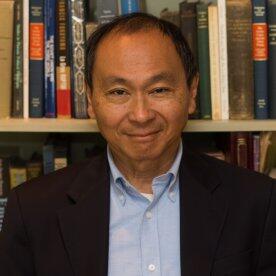
Francis Fukuyama is the Olivier Nomellini Senior Fellow at Stanford University's Freeman Spogli Institute for International Studies (FSI), and a faculty member of FSI's Center on Democracy, Development and the Rule of Law (CDDRL). He is also Director of Stanford's Ford Dorsey Master's in International Policy, and a professor (by courtesy) of Political Science.
Dr. Fukuyama has written widely on issues in development and international politics. His 1992 book, The End of History and the Last Man, has appeared in over twenty foreign editions. His book In the Realm of the Last Man: A Memoir will be published in fall 2026.
Francis Fukuyama received his B.A. from Cornell University in classics, and his Ph.D. from Harvard in Political Science. He was a member of the Political Science Department of the RAND Corporation, and of the Policy Planning Staff of the US Department of State. From 1996-2000 he was Omer L. and Nancy Hirst Professor of Public Policy at the School of Public Policy at George Mason University, and from 2001-2010 he was Bernard L. Schwartz Professor of International Political Economy at the Paul H. Nitze School of Advanced International Studies, Johns Hopkins University. He served as a member of the President’s Council on Bioethics from 2001-2004. He is editor-in-chief of American Purpose, an online journal.
Dr. Fukuyama holds honorary doctorates from Connecticut College, Doane College, Doshisha University (Japan), Kansai University (Japan), Aarhus University (Denmark), the Pardee Rand Graduate School, and Adam Mickiewicz University (Poland). He is a non-resident fellow at the Carnegie Endowment for International Peace. He is a member of the Board of Trustees of the Rand Corporation, the Board of Trustees of Freedom House, and the Board of the Volcker Alliance. He is a fellow of the National Academy for Public Administration, a member of the American Political Science Association, and of the Council on Foreign Relations. He is married to Laura Holmgren and has three children.
(October 2025)
Global Populisms
Stephen D. Krasner
CDDRL
Stanford University
Encina Hall
Stanford, CA 94305-6055
Stephen Krasner is the Graham H. Stuart Professor of International Relations. A former director of CDDRL, Krasner is also an FSI senior fellow, and a fellow of the Hoover Institution.
From February 2005 to April 2007 he served as the Director of Policy Planning at the US State Department. While at the State Department, Krasner was a driving force behind foreign assistance reform designed to more effectively target American foreign aid. He was also involved in activities related to the promotion of good governance and democratic institutions around the world.
At CDDRL, Krasner was the coordinator of the Program on Sovereignty. His work has dealt primarily with sovereignty, American foreign policy, and the political determinants of international economic relations. Before coming to Stanford in 1981 he taught at Harvard University and UCLA. At Stanford, he was chair of the political science department from 1984 to 1991, and he served as the editor of International Organization from 1986 to 1992.
He has been a fellow at the Center for Advanced Studies in the Behavioral Sciences (1987-88) and at the Wissenschaftskolleg zu Berlin (2000-2001). In 2002 he served as director for governance and development at the National Security Council. He is a fellow of the American Academy of Arts and Sciences and a member of the Council on Foreign Relations.
His major publications include Defending the National Interest: Raw Materials Investment and American Foreign Policy (1978), Structural Conflict: The Third World Against Global Liberalism (1985), Sovereignty: Organized Hypocrisy (1999), and How to Make Love to a Despot (2020). Publications he has edited include International Regimes (1983), Exploration and Contestation in the Study of World Politics (co-editor, 1999), Problematic Sovereignty: Contested Rules and Political Possibilities (2001), and Power, the State, and Sovereignty: Essays on International Relations (2009). He received a BA in history from Cornell University, an MA in international affairs from Columbia University and a PhD in political science from Harvard.
Stephen J. Stedman
CDDRL
Encina Hall, C152
616 Jane Stanford Way
Stanford, CA 94305-6055
Stephen Stedman is a Senior Fellow at the Freeman Spogli Institute for International Studies (FSI) and the Center on Democracy, Development and the Rule of Law (CDDRL), an affiliated faculty member at CISAC, and professor of political science (by courtesy) at Stanford University. He is director of CDDRL's Fisher Family Honors Program in Democracy, Development and Rule of Law, and will be faculty director of the Program on International Relations in the School of Humanities and Sciences effective Fall 2025.
In 2011-12 Professor Stedman served as the Director for the Global Commission on Elections, Democracy, and Security, a body of eminent persons tasked with developing recommendations on promoting and protecting the integrity of elections and international electoral assistance. The Commission is a joint project of the Kofi Annan Foundation and International IDEA, an intergovernmental organization that works on international democracy and electoral assistance.
In 2003-04 Professor Stedman was Research Director of the United Nations High-level Panel on Threats, Challenges and Change and was a principal drafter of the Panel’s report, A More Secure World: Our Shared Responsibility.
In 2005 he served as Assistant Secretary-General and Special Advisor to the Secretary- General of the United Nations, with responsibility for working with governments to adopt the Panel’s recommendations for strengthening collective security and for implementing changes within the United Nations Secretariat, including the creation of a Peacebuilding Support Office, a Counter Terrorism Task Force, and a Policy Committee to act as a cabinet to the Secretary-General.
His most recent book, with Bruce Jones and Carlos Pascual, is Power and Responsibility: Creating International Order in an Era of Transnational Threats (Washington DC: Brookings Institution, 2009).
Paul H. Wise
Dr. Paul Wise is dedicated to bridging the fields of child health equity, public policy, and international security studies. He is the Richard E. Behrman Professor of Child Health and Society and Professor of Pediatrics, Division of Neonatology and Developmental Medicine, and Health Policy at Stanford University. He is also co-Director, Stanford Center for Prematurity Research and a Senior Fellow in the Center on Democracy, Development, and the Rule of Law, and the Center for International Security and Cooperation, Freeman Spogli Institute for International Studies, Stanford University. Wise is a fellow of the American Academy of Arts and Sciences and has been working as the Juvenile Care Monitor for the U.S. Federal Court overseeing the treatment of migrant children in U.S. border detention facilities.
Wise received his A.B. degree summa cum laude in Latin American Studies and his M.D. degree from Cornell University, a Master of Public Health degree from the Harvard School of Public Health and did his pediatric training at the Children’s Hospital in Boston. His former positions include Director of Emergency and Primary Care Services at Boston Children’s Hospital, Director of the Harvard Institute for Reproductive and Child Health, Vice-Chief of the Division of Social Medicine and Health Inequalities at the Brigham and Women’s Hospital and Harvard Medical School and was the founding Director or the Center for Policy, Outcomes and Prevention, Stanford University School of Medicine. He has served in a variety of professional and consultative roles, including Special Assistant to the U.S. Surgeon General, Chair of the Steering Committee of the NIH Global Network for Women’s and Children’s Health Research, Chair of the Strategic Planning Task Force of the Secretary’s Committee on Genetics, Health and Society, a member of the Advisory Council of the National Institute of Child Health and Human Development, NIH, and the Health and Human Secretary’s Advisory Committee on Infant and Maternal Mortality.
Wise’s most recent U.S.-focused work has addressed disparities in birth outcomes, regionalized specialty care for children, and Medicaid. His international work has focused on women’s and child health in violent and politically complex environments, including Ukraine, Gaza, Central America, Venezuela, and children in detention on the U.S.-Mexico border.