
News Type
News
Date
Paragraphs

Ten years after the terrorist attacks, five leading experts weigh in on the state of the jihadist movement, U.S. intelligence, and the cost of safety.

Martha Crenshaw It depends on what we mean by safer. If we're asking how likely it is that we'll experience an attack of the magnitude of 9/11, I don't that it's likely. Our awareness of the possibility is so much greater. Khalid Sheikh Mohammed, the mastermind of the attack, is in custody. Other major players are dead or under arrest. Osama Bin Laden is gone. The drone strikes in Pakistan have been very effective. However, we're not entirely safe from the threat of terrorism against U.S. interests and citizens abroad. We're still vulnerable in many ways. Al-Qaeda in the Islamic Maghreb and Al-Qaeda in the Arabian Peninsula are still threats. They've inherited anti-Americanism from the original Al-Qaeda, and while Al-Qaeda central is weakened, these affiliated groups will likely become stronger because of the power vacuum that's left in the jihadist movement. These different factions could unite. Al Qaeda itself was a merger of different national movements. This could happen again -- they could reconstitute themselves into a very powerful organization.

Mariano-Florentino Cuéllar We are safer -- up to a point. In 2003 I wrote that there was little reason to think we were safer than we were on Sept. 11, 2001, and that in order to improve our security we would need to invest in meaningful long-term changes rather than focusing on quick fixes. Much has changed today. American attacks have been devastating to al-Qaeda, showing how 9/11 was perhaps a tactical success for the group but almost certainly a strategic miscalculation. Americans have forged alliances with countries throughout the world, sharing financial intelligence and pooling efforts to disrupt terrorist mobility. Many communities have made important strides in safeguarding airports and chemical plants. Federal lawmakers enacted landmark, bipartisan food safety legislation to bolster the safety of the food supply, and doctors working with public health authorities have enhanced their capacity to respond to infections and biosecurity threats such as the H1N1 virus. Meanwhile, pressing issues like cyber-security and emergency preparedness are starting to receive much-needed attention.

But Americans continue to face profound challenges, too. We must work to enhance the infrastructure that protects our public health, cyber-security, and emergency response.  The Sept. 11 attacks starkly show the need to reconcile security goals with laws and constitutional principles. Policy makers and the public must focus attention on strengthening the economic and social foundations supporting America’s long-term position in the world. At the same time, the nation must remain determined, creative, and vigilant in confronting the continuing threats posed by non-state actors and failed states.

Karl Eikenberry If we talk about the defense of the homeland, we are clearly safer against the international terrorist threat. Our level of awareness is much higher. We were asleep when we got hit. And the systems that we've established, I think have made us safer. Now, that's very specifically against the terrorist threat. Is the United States of America stronger on a relative basis than on 9/11/2001 -- are we a stronger nation? I think the answer is no. I think that our economic strength has declined. And I think there's been a degree of militarization of our foreign policy over the last decade that’s made us less attractive globally.

Thomas Fingar We are safer with respect to the danger of a major terrorist attack than we were 10 years ago but not with respect to other risks that endanger more of our citizens and are more likely to occur. We have spent billions of dollars to detect, prevent, and respond to terrorist threats from abroad and we have reduced the already low probability of death or injury from terrorist attacks to even lower levels. These gains have had a high opportunity cost because achieving them was at the expense of efforts to reduce other dangers. Far more Americans continue to die from inadequate hospital procedures, unsafe food, drunk drivers, and other well-known dangers than have died in terrorist attacks. We will not be much safer until we address these and similar problems, repair and replace our aging infrastructure, and do more to prepare for the more severe weather that will result from climate change. 

Amy Zegart Osama bin Laden is dead. Yet 10 years after 9/11, it would be dangerous and wrong to think that the terrorist threat is behind us. Violent Islamist extremism comes from many places, not just the 50 to 100 core al Qaeda fighters holed up along the Af/Pak border. The years 2009 and 2010 have seen a spike in plots against the U.S. homeland. Nearly all of them have come from radicalized homegrown terrorists or “franchise” groups with loose and murky ties to the core al Qaeda organization.

In addition, WMD terrorism remains a haunting future possibility. And the FBI has not made the leap from crime fighting to intelligence. FBI analysts, whose work is vital to connect dots and protect lives, are still treated like second class citizens -- labeled “support staff” alongside janitors and secretaries, and relegated to middle and lower rungs of the bureaucracy. So long as FBI analysts are treated like second-class citizens, Americans will get second-class security. These three factors -- diversification of the terrorist threat, the potential to combine destructive motives with devastating weapons, and the FBI's continued weaknesses -- suggest that the future may not be any safer than the past.

Hero Image
9 11 memorial photologo
All News button
1

Walter H. Shorenstein
Asia-Pacific Research Center
616 Serra St C302-3
Stanford University
Stanford, CA 94305-6055

(650) 561-5235 (650) 723-6530
0
Visiting Scholar
2011_Xiaochun_Huang_2.jpg PhD

Xiaochun Huang joins the Walter H. Shorenstein Asia-Pacific Research Center (Shorenstein APARC) during the 2011–12 academic year from the department of sociology at Shanghai University. His main area of research is on local governance reform in contemporary China, focusing on urban grassroots governance and state-society relationships. He received his BA, MA, and PhD in sociology from Shanghai University.

Huang's research project at Shorenstein APARC is a study of the performing mechanisms of e-government in China. His research will focus on the following question: When new forms of information technology that are characteristic of de-bureaucratization suddenly encounter China’s traditional government structure, what complex and compound interactive mechanisms are produced?

Huang’s most recent publication is the article “Understanding China's Information Revolution: The Structural Force that Drives Social Transformation” (Studies in Science of Science, 2010).

-

KSP's 2011–12 Koret Fellow, recently retired Korean senior career diplomat Ambassador Joon-woo Park, will discuss the U.S. role in current territorial disputes in East Asia. The disputes, which threaten peace and stability in the region and could result in conflict among major powers, have their origin in the incomplete settlement of the Pacific War overseen by the United States. Ambassador Park argues that the United States thus shares responsibility for the current situation. He will review the status of the major territorial disputes in East Asia and explain why the United States has a significant role to play in their peaceful resolution and in promoting cooperative and friendly relations among the countries of the region.

As a career diplomat, Ambassador Park served in numerous key posts, including those of ambassador to the EU and to Singapore and presidential advisor on foreign affairs. Park worked closely for over twenty years with Ban Ki-moon, the former Korean diplomat who is now the United Nations secretary-general.

Ambassador Park also served for seven years at the Korean embassies in Tokyo and Beijing. During his tenure as director general of the Korean foreign ministry’s Asian and Pacific Affairs Bureau, he handled sensitive, longstanding issues relating to regional history, such as the depiction of historical events in Japanese textbooks and the treatment of the history of the Goguryeo kingdom in China’s Northeast Project.

The Koret Fellowship has been made possible by the generous support of the Koret Foundation. The Fellowship’s purpose is to promote intellectual diversity and breadth in KSP by bringing leading professionals in Asia and the United States to Stanford to study U.S.-Korea relations. Fellows conduct their own research on the bilateral relationship, with an emphasis on contemporary relations, with the broad aim of fostering greater understanding and closer ties between the two countries.

Philippines Conference Room

Joon-woo Park 2011-2012 Koret Fellow, former ambassador to the EU Speaker
Seminars
-

Event Overview:

In the US, entrepreneurship is the engine that drives economic growth. Especially in Silicon Valley, people understand how this engine works: how entrepreneurs behave, how they view risk, where they get their funding, how their successes are rewarded, and what happens when their ventures fail. What about their Japanese counterparts? The conventional wisdom in the US is that Japanese entrepreneurship is not only different from the American variety but is also less vibrant, less well-funded, more risk-averse, and generally a less important "engine" for overall economic growth.  Is this conventional wisdom generally correct? Or are the perceived shortcomings of the Japanese entrepreneurial system (for example, the vastly lower venture capital investment figures routinely quoted) just that -- "perceived" rather than real? What business and cultural factors could explain such misperceptions, and what are the implications for cross-border entrepreneurial opportunities?  Join our panelists, Robert Eberhart, Kenji Kushida, and Lisa Katayama, as they discuss the myths, reality and promise of Japanese entrepreneurship and its impact on the overall Japanese economy.

Keizai Society’s theme for the remainder of 2011 is “Recovery and Renewal – Toward a New Japan of Compassion and Growth.” Going forward, all 2011 programs of Keizai Society will be dedicated to building awareness of the crisis in Japan and sustaining Japan’s recovery efforts. Also proceeds from these programs shall be donated to Keizai’s Japan Relief Fund. Please come and find out what the real impact of the disaster is and where we go from here to recover, renew and grow again.

Panelist Bio:

Mr. Robert Eberhart is a researcher at Stanford’s Program on Regions of  Innovation and Entrepreneurship where he leads the Stanford Project on Japanese Entrepreneurship.  His research focuses on comparative corporate governance of growth companies with special emphasis on Japan and the role of Japanese institutions in fostering entrepreneurship.  He is a member of the Academy of Management, the International Society for New Institutional Economics, on the board of advisors to Japan’s Global Entrepreneurship Week, and an advisor to Japan’s Board of Director’s Training Institute.  He serves as an academic advisor to the American Chamber of Commerce’s Task Force on New Growth Strategies and is a frequent speaker and guest lecturer in various programs at Stanford and Japan.  Mr. Eberhart received a Master’s degree in Economics from the University of Michigan after undergraduate studies in Finance at Michigan State University.  He is a doctoral candidate in Stanford’s department of Management Science and Engineering.  

Dr. Kenji Kushida is a research associate at the Shorenstein Asia-Pacific Research Center at Stanford University.  He is also an affiliated researcher with the Berkeley Roundtable on the International Economy (BRIE) at the University of California Berkeley.  He completed his PhD in Political Science at the University of California Berkeley, and holds Masters and Bachelors Degrees from Stanford University in East Asian Studies and Economics.  Dr. Kushida’s ongoing research interests are focused on politics, institutions, and markets, mainly in Japan, Korea, and the United States. His publications include analyses of how Information Technologies are transforming services activities, understanding the emerging Cloud Computing markets, and the political economies of broadband and mobile in Japan and South Korea. He recently completed a study on entrepreneurship in Japan’s ICT sector, and plays an active role in facilitating exchange between Japanese startups and Silicon Valley. He has also authored two books in Japanese: “Baikaruchaa to nihonjin [Biculturalism and the Japanese:  Beyond English Linguistic Capabilities]” and “International school nyumon [International Schools, an Introduction]”.

Ms.  Lisa Katayama is a San Francisco-based journalist who writes about Japanese culture, technology, and entrepreneurship for Wired, Popular Science, Fast Company, and The New York Times Magazine. She is also the founder of The Tofu Project, a highly curated boutique program that will bring 10 of the most successful, innovative young entrepreneurs from Japan to SF for a 7-day design and out of the box thinking crash course at the end of October.    

She is also a producer for PRI's Studio360 radio show, the author of a book called Urawaza: Secret Everyday Tips and Tricks from Japan, and a correspondent for Boing Boing, one of Time Magazine's five most essential blogs of 2010, and has spoken about Japanese web culture to the BBC, CNN, ABC, Martha Stewart Radio, and at venues like O'Reilly's ETech conference and the Foreign Correspondents Club of Japan. Her personal web site, TokyoMango, was a runner up for the Weblog Awards in 2009. She has a BA in International Relations and French from Tufts University and a MA in Human Rights from Columbia University. When she's not working, she rock climbs, does triathlons, and plays the ukulele to her two dogs.


Online live cast provided via Ustream

FEES:  FREE for those who rsvp before 9/19/2011 at 5:00 p.m. (PDT)

Log-in instructions for the live cast will be sent on 9/20/2011 to those who registered

Fenwick & West LLP, 801 California St., Mountain View, CA

Robert Eberhart SRIE Researcher Panelist Stanford Project on Japanese Entrepreneurship
0
Former Research Scholar, Japan Program
kenji_kushida_2.jpg MA, PhD
Kenji E. Kushida was a research scholar with the Japan Program at the Walter H. Shorenstein Asia-Pacific Research Center from 2014 through January 2022. Prior to that at APARC, he was a Takahashi Research Associate in Japanese Studies (2011-14) and a Shorenstein Postdoctoral Fellow (2010-11).
 
Kushida’s research and projects are focused on the following streams: 1) how politics and regulations shape the development and diffusion of Information Technology such as AI; 2) institutional underpinnings of the Silicon Valley ecosystem, 2) Japan's transforming political economy, 3) Japan's startup ecosystem, 4) the role of foreign multinational firms in Japan, 4) Japan's Fukushima nuclear disaster. He spearheaded the Silicon Valley - New Japan project that brought together large Japanese firms and the Silicon Valley ecosystem.

He has published several books and numerous articles in each of these streams, including “The Politics of Commoditization in Global ICT Industries,” “Japan’s Startup Ecosystem,” "How Politics and Market Dynamics Trapped Innovations in Japan’s Domestic 'Galapagos' Telecommunications Sector," “Cloud Computing: From Scarcity to Abundance,” and others. His latest business book in Japanese is “The Algorithmic Revolution’s Disruption: a Silicon Valley Vantage on IoT, Fintech, Cloud, and AI” (Asahi Shimbun Shuppan 2016).

Kushida has appeared in media including The New York Times, Washington Post, Nihon Keizai Shimbun, Nikkei Business, Diamond Harvard Business Review, NHK, PBS NewsHour, and NPR. He is also a trustee of the Japan ICU Foundation, alumni of the Trilateral Commission David Rockefeller Fellows, and a member of the Mansfield Foundation Network for the Future. Kushida has written two general audience books in Japanese, entitled Biculturalism and the Japanese: Beyond English Linguistic Capabilities (Chuko Shinsho, 2006) and International Schools, an Introduction (Fusosha, 2008).

Kushida holds a PhD in political science from the University of California, Berkeley. He received his MA in East Asian Studies and BAs in economics and East Asian Studies with Honors, all from Stanford University.
Kenji Kushida Research Associate in Japanese Studie Panelist Stanford University APARC; Affiliated Researcher, BRIE
Lisa Katayama Journalist and Founder of the Tofu Project Panelist
Panel Discussions
-

Organized by the Stanford Project on Japanese Entrepreneurship (STAJE) at SPRIE, Stanford Graduate School of Business, this panel discussion will talk about the Japanese government, METI's and U.S. Embassy's efforts to promote cross border investments between U.S. and Japan.

A particular interest in the discussion will be the "fly over phenomenon", which is the tendency of U.S. based venture capital firms to fly from Silicon Valley, over Japan, and land into China.

The panel will consist an elite group of experts, Michael Alfant, CEO of Fusion Systems, Martin Kenney, Professor at UC Davis, Allen Miner, CEO of SunBridge Corporation, and a venture capitalist to be named.


About the speakers

Mr. Robert Eberhart is a researcher at Stanford’s Program on Regions of Innovation and Entrepreneurship where he leads the Stanford Project on Japanese Entrepreneurship.  His research focuses on comparative corporate governance of growth companies with special emphasis on Japan and the role of Japanese institutions in fostering entrepreneurship. Mr. Eberhart received a Master’s degree in Economics from the University of Michigan after undergraduate studies in Finance at Michigan State University.  He is a doctoral candidate in Stanford’s department of Management Science and Engineering.  

Michael Alfant is the Group President and CEO of Fusions Systems Co., Ltd., headquartered in Tokyo, with offices in Shanghai, Hong Kong and Singapore. Fusion Systems is one of Asia's fastest growing leaders in Business Technology and Systems Consulting.  Michael started an IT solutions company named Fusion Systems Japan in 1992. Mr. Alfant is the President of the American Chamber of Commerce in Japan, a frequent speaker at US and Japanese Universities, and a member of the Board of Directors of listed firms in both America and Japan. Michael Alfant graduated from the City University of NY with a BS in Computer Science.

Martin Kenney is a Professor in the Department of Human and Community Development at University of California, Davis and Senior Project Director of Berkeley Roundtable on the International Economy (BRIE) at the University of California, Berkeley. He is the author and/or editor of five books and 120 articles examining venture capital, high technology and regional development, and university-industry relations. He is an editor at Research Policy and for a Stanford University Press book series on innovation in the global economy. Martin has also been a visiting researcher at the Copenhagen Business School, and Cambridge Hitotsubashi, Kobe, Stanford, and Tokyo Universities.

Allen Miner is a founder/General Partner of SunBridge Partners and the founder/CEO of SunBridge Corporation. Allen has significant experience in Internet, enterprise and open-source software, entrepreneurship, and international technology transfer.  Allen has been actively involved in each of the firm’s investments resulting in numerous successful IPOs, including Salesforce.com, MacroMill, ITMedia and G-Mode, among others. Allen is currently a member of the Board of Directors of Salesforce Japan.

Scott Ellman is CEO and Co-Founder of USAsia Venture Partners. He has over twenty years of experience in strategic alliances, marketing, and business development. Scott has held senior positions at high technology pioneers Silicon Graphics (SGI) and VMware where, among other things, he managed some of the companies' most important alliances such as those with Hitachi, Toshiba, Oracle, NEC, Dell, IBM, and HP. Scott is a strategic advisor to several technology companies as well as the Keizai Society and a member of the Japan-US Innovation in Business and Technology Advisory Council. He holds an MBA from the Stanford Graduate School of Business and a BS in Applied Mathematics and Economics from Brown University.

Quaeed "Q" Motiwala joined JAIC US in 2008 and brings 14 years of product and business development experience, working extensively across US, Japan, South Korea and India.  At DFJ JAIC, he specializes in Mobile, B2B Software and Cleantech sectors in the US. Prior to JAIC, Q spent 11 years at Qualcomm in various ASIC product development and business leadership roles that included deploying 3G EV-DO in Korea, Japan and U.S, leading the initiative to embed wireless in notebooks and automobiles and leading business efforts at the Indian wireless carriers.  He was also part of two mobile software startups - SKY MobileMedia and Azteq Mobile. Q holds 5 patents in wireless telecom, has an MBA from Anderson School of Management, UCLA, an M.S.E.E from Virginia Tech and a B.E. (Electronics) from University of Bombay. Q serves as a Board of Director at Tradescape, Innopath Software, and Vitriflex.  

William F. Miller is Herbert Hoover Professor of Public and Private Management Emeritus; Professor of Computer Science Emeritus; President Emeritus, SRI International; Chairman Emeritus, Borland Software Corporation; and Chairman/Founder of Nanostellar, Inc. Professor Miller has carried out research on atomic and nuclear physics, computer graphic systems and languages, computer systems architecture, and the computer industry. His current research interests are on industrial development with special interest in local and regional industrial development, the evolution of regions of innovation and entrepreneurship, the “habitat” for entrepreneurship, and the globalization of R&D. His international industrial development studies have focused on Japan, Korea, China, Taiwan, and Malaysia.


Directions

Map of Knight Management Center:
http://www.gsb.stanford.edu/news/packages/PDF/GSB-kmc-campus-map-Final.pdf

Directions to Stanford Graduate School of Business:
http://www.gsb.stanford.edu/about/directions.html


Presented by the Stanford Program on Regions of Innovation and Entrepreneurship-Stanford Project on Japanese Entrepreneurship (SPRIE-STAJE) at the Stanford Graduate School of Business. Parking on the Stanford University campus can be challenging, so please consider arriving early. Parking is free after 4PM. Parking spaces may be available at the new Knight Management Center, Stanford Graduate School of Business:
http://www.gsb.stanford.edu/about/gsbvisitors.html

C102, MBA Class of 1968 Building
Stanford Graduate School of Business
Knight Management Center
655 Knight Way
Stanford, CA 94305-7298

Robert Eberhart Researcher Moderator SPRIE, Stanford University
Michael Alfant CEO Panelist Fusion Systems

Shorenstein APARC
Stanford University
Encina Hall E301
Stanford, CA 94305-6055

(650) 724-6404 (650) 723-6530
0
Visiting Scholar, 2008-09
Martin Kenney Professor Panelist UC Davis
Allen Miner CEO Panelist SunBridge Corp.
Scott Ellman CEO Panelist USAsia Venture Partners
Quaeed ‘Q’ Motiwala Managing Director Panelist DFJ JAIC
William F. Miller Faculty and Co-director Panelist SPRIE, Stanford University
Panel Discussions
News Type
News
Date
Paragraphs

The Stanford Program on International and Cross-Cultural Education (SPICE) honored two of the top students of the 2011 Reischauer Scholars Program (RSP) at a Japan Day event at Stanford University on August 19, 2011. The RSP, an online course on Japan and U.S.–Japan relations that is offered to high school sophomores, juniors, and seniors across the United States, recognized the students based on their coursework and exceptional research essays.

Japan Day featured welcoming comments by Professor Coit D. Blacker, FSI Director; an overview of the RSP by Naomi Funahashi, RSP Coordinator and Instructor; opening remarks on Japan and U.S.–Japan relations by Consul General Hiroshi Inomata, Consulate General of Japan in San Francisco; and a lecture on post-earthquake Japan by Professor Emeritus Nisuke Ando, Kyoto University and Doshisha University. The program was highlighted by presentations by student honorees Lindsey Henderson and Mathieu Rolfo, who wrote research essays on Japan’s use of stories to construct a national identity, and on Okinawa’s role post-World War II, respectively. Professor Emeritus Daniel I. Okimoto and Professor Phillip Lipscy commented on the students’ essays. Gary Mukai, SPICE Director, facilitated the event.

Named in honor of former U.S. Ambassador to Japan Edwin O. Reischauer, a leading educator and noted scholar of Japanese history and culture, the RSP annually selects 25–30 exceptional high school students from throughout the United States to engage in intensive study of Japan. Through Internet-based lectures and discussions, the program provides students with a broad overview of Japan, with a special focus on the U.S.–Japan relationship. Prominent scholars affiliated with Stanford University, the University of Tokyo, the University of Hawaii, and other institutions provide lectures and engage students in online dialogue. The RSP received funding for the first three years (2004–06) of the program from the United States-Japan Foundation. Funding for 2007 and 2008 was provided by the Center for Global Partnership, the Japan Foundation. Funding since 2009 has been provided by the Japan Fund, FSI, Stanford University.

The RSP is currently accepting applications for the 2012 program. For more information about the RSP, visit www.reischauerscholars.org or contact Gary Mukai, RSP Coordinator and Instructor, at nfunahashi@stanford.edu.

Hero Image
japanday5
Left to right: Professor Phillip Lipscy, Professor Emeritus Daniel Okimoto, Michiko Okimoto, Lindsey Henderson, Mathieu Rolfo, Former Ambassador Michael H. Armacost, Professor Emeritus Nisuke Ando, and Consul General Hiroshi Inomata
All News button
1
Subtitle

SPICE honored two of the top students of the 2011 Reischauer Scholars Program (RSP) at a Japan Day event at Stanford University on August 19, 2011.

Date Label
Display Hero Image Wide (1320px)
No

Walter H. Shorenstein
Asia-Pacific Research Center
616 Serra St C331
Stanford University
Stanford, CA 94305-6055

(650) 724-5656 (650) 723-9741
0
Shorenstein Fellow (2011-2012)
MenchikJeremy.jpg PhD

Jeremy Menchik joins the Walter H. Shorenstein Asia-Pacific Research Center (Shorenstein APARC) from the Department of Political Science at the University of Wisconsin-Madison. His research is in the area of comparative politics and international relations with a focus on religion and politics in the Muslim world, especially Indonesia. At Shorenstein APARC, he is preparing his dissertation for publication as a book titled, Tolerance Without Liberalism: Islamic Institutions in Twentieth Century Indonesia, and developing related projects on the origins of intolerance, the relationship between religion and nationalism, and political symbolism in democratic elections.

Menchik holds an MA and a PhD in political science from UW-Madison and a BA, also in political science, from the University of Michigan. He will be an assistant professor in international relations at Boston University beginning in 2013.

Walter. H. Shorenstein
Asia-Pacific Research Center
616 Serra St C331
Stanford University
Stanford, CA 94305-6055
Walter. H. Shorenstein
Asia-Pacific Research Center
616 Serra St C331
Stanford University
Stanford, CA 94305-6055

(650) 724-9747 (650) 723-6530
0
Shorenstein Fellow (2011-2012)
ChangCrystal_Profile.jpg

Crystal Chang joins the Walter H. Shorenstein Asia-Pacific Research Center (Shorenstein APARC) from the department of political science at the University of California, Berkeley. Her doctoral dissertation research focuses on China's growing independent automotive industry, examining Chinese automakers alongside historical case studies from Japan and Korea.

During her time at Shorenstein APARC, she will expand her dissertation to include a comparative study of India's contemporary automotive industry, which, like China's, has experienced domestic and international success. She will also continue research that she is currently conducting about China's private energy sector, with a focus on the solar power industry.

Chang holds an MPIA degree in international management from the University of California, San Diego, and a BA in international relations from Stanford University.

-

The SPRIE conference on "China 2.0: Transforming Media and Commerce" was held at the Graduate School of Business at Stanford University, in the heart of Silicon Valley, on Friday, September 30, 2011. The conference focused on the driving forces and global implications of the rapid growth of China's internet industry.

China is home to nearly half a billion internet users, twice the online population in the US. Already home to two of the world’s top five internet firms by market valuation, China is giving birth to innovative start-ups and powerhouse billion dollar firms in social networking, games, media, and e-commerce. These companies thriving in China are increasingly impacting the global digital economy. Fueling the rise of China’s internet firms are venture capitalists who are leading new investment models and strategies which are shaping the VC industry and the most dynamic—and profitable—internet sectors in China.

Featured speakers included internet pioneers, trailblazer investors across the Pacific, and young entrepreneurs who are shaping the rise of China 2.0.

Keynotes

Jack Ma - Chairman and CEO of Alibaba Group, delivered the closing keynote address. Alibaba Group includes online marketplace Alibaba ($4.8 billion market cap,ticker 1688:HK), retail and payment platforms (Taobao, Alipay), cloud computing services, China Yahoo, etc. In 2009, Jack Ma was recognized as one of the "TIME 100: The World's Most Influential People" by TIME, one of "China's Most Powerful People" by BusinessWeek and one of the "Top 10 Most Respected Entrepreneurs in China" by Forbes Chinese edition.


Joseph Chen (MBA '99) - Chairman and CEO of Renren Inc. offered a keynote speech. Renren.com is one of China’s leading social networking sites, which completed its IPO on the NYSE (ticker: RENN) in May 2011 and now has a market cap of $2.6 billion. Joseph Chen is a pioneer of China's internet industry. Before founding Renren Inc., he was the co-founder, chairman and chief executive officer of ChinaRen.com, a first-generation SNS in China and one of China's most visited websites in 1999.


China 2.0 Conference Co-Chairs shared sprie's research preview:

Duncan Clark is Senior Advisor for the China 2.0 Project at SPRIE and Chairman of BDA China, a company he founded in Beijing in 1994. An expert on the Internet, e-commerce and telecom sectors in China, he has guided BDA to become the leading technology and media advisory firm in China, with a team of 70 in Beijing serving financial institutions and corporations investing in high-growth sectors in China and neighboring markets.


Marguerite Gong Hancock is the Associate Director of SPRIE where co-leads overall programs and also directs research initiatives on "China 2.0" and "Smart Green Cities". Since joining Stanford in 1987, she has led international research programs at the intersection of business, technology, and policy at the Graduate School of Business and the Shorenstein Asia Pacific Research Center. She is an expert on innovation and entrepreneurship for high technology regional development and has co-edited four books and co-directs an executive education program for international policymakers.


Panel discussion on "china new media & E-commerce investment outlook"

Tim Chang, Managing Director of Mayfield Fund
Tim Chang (MBA '01), Managing Director of Mayfield Fund. Tim is a proven venture investor and experienced global executive.  He was named on the 2011 Forbes Midas List of Top 100 Dealmakers, was featured by The Deal as one of five emerging VCs to watch and by the AlwaysON Hollywood IT List recognizing technology leaders in the digital entertainment industry. 


David Chao, Co-Founder and General Partner of DCM
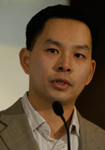
David Chao (MBA '93), Co-Founder and General Partner of DCM. He has been active in the information technology industry since the 1980s, participating in the fastest growing sectors of computers, communication and the Internet. David serves on the Boards of 51job, 99Bill, BitTorrent, Lumi, Renren.com, RockYou and Translattice. He is also responsible for the investments in Clearwire, eDreams, Fortinet, kabu.com and Sling Media.


Paul Kwan, Managing Director, Morgan Stanley
Paul Kwan (BAS '96), Managing Director, Morgan Stanley. Paul leads the global Internet and software banking effort at Morgan Stanley. In China, Paul and his team have led the IPOs for Renren, 21Vianet, Phoenix New Media, 51job.com and others. Morgan Stanley has also been the lead left bookrunner on the recent IPOs for LinkedIn, Pandora, Yandex, and Homeaway. In M&A, Paul has been particularly focused on the convergence of internet advertising, commerce and technology, and advised Omniture on its $1.8Bn sale to Adobe, ATG on its $1.0Bn sale to Oracle, aQuantive on its $6.1Bn sale to Microsoft, DoubleClick on its $3.1Bn sale to Google, and Zappos on its $1.1Bn sale to Amazon.


Richard Lim (MBA '88), Managing director and co-founder of GSR Ventures, the premier early-stage venture capital firm in China. Mr. Lim focuses on investments in the Internet, digital media and green technology sectors. In the Internet sector, some of the boards where Mr. Lim serves are AdChina, Baihe, Lashou, LightInTheBox and Qunar.


Panel discussion on "China internet entrepreneurs"

Fritz Demopoulos, Founder of Queens Road Capital, Qunar, Shawei
Fritz Demopoulos, Co-Founder and Former CEO of Qunar.com. Fritz Demopoulos has been involved in the Chinese internet and media industries for over a decade. He was recently the co-founder and CEO of Qunar.com, China's largest travel website and venture backed by GSR, Mayfield, Granite and Tenaya. Qunar sold a majority stake to Baidu earlier this year, which was the largest trade sale in the history of the Chinese internet space.


Grace Huang, Founder and CEO of iPinYou.com
Grace Huang, Founder and CEO of iPinYou Interactive Advertising Co. She started her career at P&G as brand manager and was an ex-McKinsey consultant focusing on marketing. She obtained her MBA degree from ULCA business school. She has profound knowledge in brand marketing and internet advertising, especially targeting advertising.


Jianshuo Wang, Founder and CEO of Baixing.com
Jianshuo Wang, CEO of Baixing.com. He founded Hotales.net in college, an online marketing site. After six years at Microsoft he launched Kijiji, eBay's classified-advertising business in China in 2005. Three years later Mr. Wang spun off Baixing.com, an online community with listings for houses, jobs and second-hand goods.


Nick Yang, Founder and CEO, Wukong.com; Founder, ChinaRen.com and KongZhong
Nick Yang (MS '99), Founder and CEO, Wukong.com; Co-Founder, ChinaRen.com and KongZhong. He is one of China's most successful digital media entrepreneurs. He started his third venture Wukong in 2008, a mobile internet operation support company for telecom operators and mobile internet distribution network. Mr. Yang is an active Angel investor and involved in many internet and media companies in China. He graduated from Stanford University, master’s degree in electrical engineering in 1999.


Presentation and Discussion Topics

  • How are internet entrepreneurs transforming China’s technology sectors?  Are there any lessons from firms in China for the Valley beyond?  What is the future for US-based internet firms in China?

  • Is China giving birth to truly innovative technologies, processes or business models?  If so, are any of these innovations exportable?

  • How is the Venture Capital /Private Equity industry evolving in China? What patterns, strategies and practices distinguish the most active (and successful) investors?

  • What are the most interesting new developments that will impact the future of China’s internet?  Who comprise the next generation of 2.0 start-ups in China?

  • How is the landscape changing? What are the current key challenges and opportunities?

Conference sponsors

BDA China logo


Best Buy logo


Cypress River Advisors logo

CEMEX Auditorium
Knight Management Center
Stanford Graduate School of Business

Conferences
Subscribe to Asia-Pacific