Regional conflicts present their own set of unique challenges to the international community. These conflicts may be political, economic, environmental, or social in nature, but are deeply tied to a sense of place. These conflicts can only be resolved with multiple nations involved. 

This research area includes issues as diverse as China-Taiwan military competition, nuclear nonproliferation on the Korean Peninsula and South Asia, and political instability in the Middle East and North Africa. 

The Empirical Studies of Conflict Project (ESOC) addresses critical challenges to international security through methodologically rigorous, evidence-based analyses of insurgency, civil war and other sources of politically motivated violence. The project is comprised of leading scholars from across the country from a variety of academic disciplines. ESOC aims to empower high quality of conflict analysis by creating and maintaining a repository of micro-level data across multiple conflict cases and making these data available to a broader community of scholars and policy analysts.

Authors
Gi-Wook Shin
David Straub
News Type
Commentary
Date
Paragraphs

In eliminating his uncle Jang Song-taek, North Korea’s young leader Kim Jong Un acted like a character out of a Shakespearian drama with Stalinist characteristics. Whether Jang’s show trial and summary execution will help to consolidate or undermine Kim’s power remains to be seen. But the statement on Jang’s indictment confirms—apparently unwittingly—the enormous economic, political, and social problems facing his regime. This stunning contradiction by North Korea itself of decades of official bravado about the unity of the leadership and people and its narrative of steady progress on all fronts may or may not have serious consequences in North Korea, but it certainly will abroad.

In attempting to transfer blame for all the country’s economic troubles to Jang, the statement reports that his alleged confession referred to “the present regime … not tak[ing] any measures despite the fact that the economy and the country and people’s living are driven into catastrophe” and that “the [standard of] living of the people and service personnel may further deteriorate [italics added] in the future.” The statement also implicitly acknowledges that the botched currency re-denomination in 2009 was responsible for “sparking off serious economic chaos and disturbing the people’s mind-set.” Jang is accused of undermining Kim’s pet project of dressing up the capital of Pyongyang through massive apartment and other construction projects for the elite there at the expense of ordinary people in the rest of the country. Without citing China by name, the statement blasts Jang for making cozy deals with that country for the sale of North Korean minerals and for Chinese investment in North Korea’s special economic zones.

The regime’s leaders may have felt that releasing this statement and punctuating it with Jang’s execution were necessary for their purposes at home, but they clearly must not have understood the consequences it will have abroad. For example, whether or not it signals that the regime itself plans to backtrack on economic deals with China, PRC leaders will be further angered by the regime’s disrespect of Chinese interests. They will be more cautious about economic engagement with Pyongyang, and they will be more amenable to increasing sanctions against North Korea when it engages in its next provocation. North Korea leaders apparently are uneasy about their extreme reliance on China for economic support and hope to diversify their economic engagement. But for the rest of the world, too, Jang’s execution and this statement will only underline for a long time to come the extremely high political risk of economic dealings with Pyongyang.

U.S. and South Korean officials will look closely at the assertion that Jang intended to “grab the supreme power of the party and state by employing all the most cunning and sinister means and methods, pursuant to the ‘strategic patience’ policy and ‘waiting strategy’ of the U.S. and the south Korean puppet group of traitors [italics added].” Already determined to maintain sanctions pressure on Pyongyang to force it to abandon its pursuit of nuclear weapons, U.S. and South Korean officials will take this as an acknowledgement by the North Koreans themselves of the efficacy of their policy and double down on it.

In the wake of Jang’s execution, Pyongyang, predictably, is trying to send signals to the outside world that all is well. A North Korean ambassador reiterated that North Korea is open for all kinds of talks with foreign countries to reduce tensions, and the regime has invited South Korea to talks about their joint industrial park in North Korea. Kim Jong Un may now seek to increase economic exchanges with Seoul to reduce his dependence on Beijing. South Korea is not opposed to economic engagement with North Korea, but President Park Geun-hye will insist on international standards and transparency, something that Kim Jong Un will find very hard to swallow.  

Earlier this year, Kim declared his fundamental policy to be byeongjin, that is, “parallel progress” in developing nuclear weapons and growing the economy. Jang’s execution and especially Kim’s explanation for it will make it that much harder for Kim to accomplish either goal. The North Koreans do not seem to understand that Jang’s execution alone would likely not have had a large lasting impact abroad but that issuing this kind of a statement will. It has underlined the brutal and anachronistic nature of the North Korean regime to governments and peoples throughout the world, which will now view the regime with even more skepticism for a long time to come. Moreover, Washington and Seoul must now prepare for an increased possibility that Kim will stage another sneak attack on South Korea to rally support at home.

It’s hard to find reasons for optimism at this point, but if there is any glint of a silver lining, it is that the regime itself has unintentionally revealed its desperate need to find remedies for its domestic political and economic troubles. Working together, the United States, South Korea, and China should take this as an opportunity to induce the young and inexperienced North Korea leader to give up nuclear weapons and join the international community by increasing both the pressure on his regime and the credibility of their offer of incentives for finally taking the right course. 

Gi-Wook Shin is director of Stanford University’s Shorenstein Asia-Pacific Research Center. David Straub is associate director of Stanford’s Korean Studies Program and a former State Department Korean affairs director.

A later version of this article was published by the Christian Science Monitor, a joint initiative of two academic research networks, the East Asia Bureau of Economic Research and the South Asian Bureau of Economic Research.

Shin was interviewed in NK News on Jang’s removal from power, the article is available in Korean only. Straub analyzed the execution with three other experts in an article in East Asia Forum, a news agency at the forefront of North Korean news coverage. Straub was also quoted in the CBC News and the MK News.

Hero Image
kim jang photo
All News button
1
-
The Year of the Horse will run (so to speak) from 31 January 2014 to 18 February 2015.  Many domestic, regional, and global issues will occupy the attention of Southeast Asian leaders and societies and their counterparts in the US, China, and Japan among other countries.  In conversation with SEAF director Don Emmerson, Ernie Bower will highlight the most important of these policy issues and their implications.  Possible topics may include the repercussions of Chinese muscle-flexing over the East and South China Sea, political strife in Thailand, quinquennial elections in Indonesia, and Myanmar's leadership of ASEAN including the plan to declare an ASEAN Community in 2015. 
 
Ernest Z. Bower is one of America's leading experts on Southeast Asia, founding president and CEO of the business advisory firm BowerGroupAsia, a former president of the US-ASEAN Business Council, and a policy adviser to many private- and public-sector organizations in the US interested in Southeast Asia.  
 

Daniel and Nancy Okimoto Conference Room

Ernest Z. Bower Senior Adviser and Sumitro Chair for Southeast Asian Studies Speaker Center for Strategic and International Studies, Washington, DC
Seminars
-

Abstract:

The Performance of Democracies is a research project that will start in May 2014. The project is funded by the European Research Council, the budget is 4.2 mil. Euro. The problems this project will address are the following. While more countries than ever are now considered to be democratic, there is only a very weak, or none, correlation between standard measures of human well-being and measures of democracy. A second problem is that a large number of democracies turn out to have severe difficulties managing their public finances in a sustainable way. The third problem is that democracy seems not to be a cure against pervasive corruption. Empirical research shows that these problems have severe consequences for citizens’ perception of the legitimacy of their political system. The project intends to use an institutional approach to answer the question why some democracies perform better than others.


Speaker Bio:

Bo Rothstein holds the August Röhss Chair in Political Science at University of Gothenburg in Sweden where he is head of the Quality of Government (QoG) Institute. The QoG Institute consists of about twenty researchers studying the importance of trustworthy, reliable, competent and non-corrupt government institutions.

Rothstein took is PhD at Lund University in 1986 and served as assistant and associate professor at Uppsala University 1986 to 1994. He has been a visiting scholar at the Russell Sage Foundation in New York, Cornell University, Harvard University, Collegium Budapest Institute for Advanced Study, the Australian National University and the University of Washington in Seattle. In 2006, he served as Visiting Professor at Harvard University.

Image

Encina Ground Floor Conference Room

Bo Rothstein August Röhss Chair in Political Science Speaker University of Gothenburg
Seminars
-

Image


Abstract:

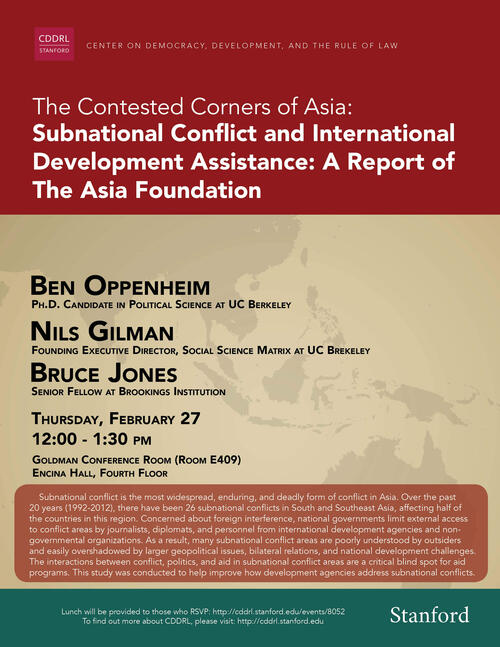
Subnational conflict is the most widespread, enduring, and deadly form of conflict in Asia. Over the past 20 years (1992-2012), there have been 26 subnational conflicts in South and Southeast Asia, affecting half of the countries in this region. Concerned about foreign interference, national governments limit external access to conflict areas by journalists, diplomats, and personnel from international development agencies and non-governmental organizations. As a result, many subnational conflict areas are poorly understood by outsiders and easily overshadowed by larger geopolitical issues, bilateral relations, and national development challenges. The interactions between conflict, politics, and aid in subnational conflict areas are a critical blind spot for aid programs. This study was conducted to help improve how development agencies address subnational conflicts.


Speaker Bios:

Ben Oppenheim is a Fellow (non-resident) at the Center on International Cooperation at New York University. His research spans a diverse set of topics, including fragile states, transnational threats (including pandemic disease risks and terrorism), and the strategic coherence and effectiveness of international assistance in fragile and conflict-affected areas.

Oppenheim has consulted for organizations including the World Bank, the United Nations, the Asia Foundation, the Institute for the Future, and the Fritz Institute, on issues including organizational learning, strategy, program design, foresight, and facilitation. In 2009, he served as Advisor to the first global congress on disarmament, demobilization, and reintegration, supported by the World Bank and the UN.

In 2013, Oppenheim was a visiting fellow at the Uppsala University Forum on Democracy, Peace, and Justice. His research has been supported by a Simpson Fellowship, and a fellowship with the Institute on Global Conflict and Cooperation. He was also a research fellow with UC Berkeley's Institute of International Studies, affiliated with the New Era Foreign Policy Project.


Nils Gilman is the Executive Director of Social Science Matrix. He holds a B.A., M.A. and Ph.D. in History from the University of California, Berkeley. Gilman’s first scholarly interest was in American and European intellectual history, with a particular focus on the institutional development of the social sciences, the lateral transfer and translation of ideas across disciplinary boundaries, and the impact of social scientific ideas on politics and policy.

Gilman is the author of Mandarins of the Future: Modernization Theory in Cold War America (Johns Hopkins University Press, 2004), the co-editor of Staging Growth: Modernization, Development, and the Global Cold War (University of Massachusetts Press, 2003) and Deviant Globalization: Black Market Economy in the 21st Century (Continuum Press, 2011), as well as the founding Co-editor of Humanity: An International Journal of Human Rights, Humanitarianism, and Development. He also blogs and tweets.

Prior to joining Social Science Matrix in September 2013, Gilman was research director at Monitor 360, a San Francisco consultancy that addresses complex, cross-disciplinary global strategic challenges for governments, multinational businesses, and NGOs. He has also worked at a variety of enterprise software companies, including Salesforce.com, BEA Systems, and Plumtree Software. Gilman has taught and lectured at a wide variety of venues, from the Harvard University, Columbia University, and National Defense University, to PopTech, the European Futurists Conference, and the Long Now Foundation.


Bruce Jones is a senior fellow and the director of the Project on International Order and Strategy in the Foreign Policy program at the Brookings Institution. He is also the director of the Center on International Cooperation at New York University.

Jones served as the senior external advisor for the World Bank’s 2011 World Development Report, Conflict, Security and Development, and in March 2010 was appointed by the United Nations secretary-general as a member of the senior advisory group to guide the Review of International Civilian Capacities. He is also consulting professor at the Center for International Security and Cooperation at Stanford University and professor (by courtesy) at New York University’s department of politics.

Jones holds a Ph.D. from the London School of Economics, and was Hamburg fellow in conflict prevention at Stanford University.

He is co-author with Carlos Pascual and Stephen Stedman of Power and Responsibility: Building International Order in an Era of Transnational Threats (Brookings Press, 2009); co-editor with Shepard Forman and Richard Gowan of Cooperating for Peace and Security (Cambridge University Press, 2009); and author of Peacemaking in Rwanda: The Dynamics of Failures(Lynne Reinner, 2001).

Jones served as senior advisor in the office of the secretary-general during the U.N. reform effort leading up to the World Summit 2005, and in the same period was acting secretary of the Secretary-General’s Policy Committee. In 2004-2005, he was deputy research director of the High-level Panel on Threats, Challenges and Change. From 2000-2002 he was special assistant to and acting chief of staff at the office of the U.N. special coordinator for the Middle East peace process. 

Richard and Rhoda Goldman Conference Room

Ben Oppenheim Ph.D. Candidate in Political Science Speaker UC Berkeley
Nils Gilman Founding Executive Director, Social Science Matrix Speaker UC Berkeley
Bruce Jones Senior Fellow Speaker Brookings Institution
Seminars

China is a rising global power with a rich culture and history, yet it is not generally well understood by outsiders. The 2008 Beijing Olympics brought increased attention to this ancient nation. To promote a deeper understanding of Chinese culture, history, and contemporary issues, we recommend the following diverse set of teaching resources and curriculum tools to bring China to life in K-12 classrooms. In addition, SPICE offers a national distance-learning course for high school students called the China Scholars Program.

News Type
News
Date
Paragraphs

REAP co-director Scott Rozelle builds on a ten-part series for Caixin Magazine titled, "Inequality 2030: Glimmering Hope in China in a Future Facing Extreme Despair." In his third column, Rozelle explains why rural children are unprepared for preschool. When they do attend, rural preschools are not only hard to find but also of notably poor quality. 

REAP co-director Scott Rozelle builds on a ten-part series for Caixin Magazine titled, "Inequality 2030: Glimmering Hope in China in a Future Facing Extreme Despair." In his third column, Rozelle explains why rural children are unprepared for preschool. When they do attend, rural preschools are not only hard to find but also of notably poor quality. 

To read the column in Chinese, click here.

> To read Column 1: Why We Need to Worry About Inequality, click here.

> To read Column 2: China's Inequality Starts During the First 1,000 Days, click here.  

> To read Column 4: Behind Before They Start - The Preschool Years (Part 2), click here.  

> To read Column 5: How to Cure China's Largest Epidemic, click here.

> To read Column 6: A Tale of Two Travesties, click here. 


Image

Inequality 2030:

Glimmering Hope in China in a Future Facing Extreme Despair


Caixin Column 3: Behind Before They Start - The Preschool Years


I have two sons. Both were raised in the sunny suburbs of California. By the time the oldest was three years old, I knew he was self-motivated, goal-oriented and driven. I decided to enroll him in a Montessori preschool. In Montessori schools, children are encouraged to be independent, given a lot of freedom to choose which activities to perform, and allowed to freely proceed from one activity to another, learning and completing tasks at their own pace.

My second son was a bit different. He loved nature, exploring, and interacting with children, but he did not like competing with his peers. He was less interested in the goal-oriented focus of his older brother’s Montessori program and certainly would have been uncomfortable with the competition that was always just under the surface. So I sent son number two to a Waldorf preschool. The philosophy of Waldorf is that the best way to launch kids on a path of lifetime learning is simply to let them explore, play, and learn from nature. In these schools, children play and learn collaboratively and there is plenty of unstructured time to get out into the playground and beyond, running and shouting and playing games together.

And both my very different sons thrived in their very different preschool environments. And when it came time to enter elementary school, both were ready to learn and to thrive all over again.

Across the world, the toddlers of our friends in Beijing have equal access to a wide variety of preschools and other early childhood educational institutions. One couple we know has enrolled their children in Fun-First, an innovative preschool that lets kids learn how to play and learn from play. There are Beijing and Shanghai Montessori schools and Waldorf schools. There are Saturday classes for moms and daughters and for dads and sons that teach both parties—parents and their children—how to play and learn together. And all of these widely varied programs help these toddlers develop the basic skills they will need once it comes time to start elementary school: how to socialize with others, how to think and to learn, and how to engage in a classroom environment.

Unfortunately, kids in rural China are not so lucky. In the past, most did not go to preschool. They were strapped to Grandma’s back while she worked in the field. Older sister took care of younger brother while Dad went off to work. In most cases, these kids were simply left on their own to amuse themselves in the lanes of the village. At the very most, they went to private, for-pay daycare centers in nearby townships with poor conditions: dirty; dark; emotionless. Although preschool offerings in rural areas began to expand in the mid 2000s, preschools in rural areas remain poor quality and are often poorly attended. 

And so we have stumbled upon another gap between urban and rural China. But how much difference does preschool really make? Is there any reason to believe that rural kids are suffering from their less structured toddler-hoods?

Unfortunately, strong evidence produced by Rural Education Action Program—REAP—show that rural toddlers are lagging behind their urban counterparts when it comes to what is called “educational readiness.” What does that mean exactly? For the past several decades, Dr. Ou Mujie, formerly a child psychologist at Beijing Medical University, has developed, refined and benchmarked a test of educational readiness for children of different age groups.  The test is multidimensional, assessing each child’s cognitive ability, language skills, communication ability, independence, and fine and gross motor capacity. The test is designed to determine whether or not a child is ready for the next phase in their formal education. For four and five-year-olds, the test indicates whether or not a child is ready, as compared to the rest of their peers, to start kindergarten.

Based on this work, Dr. Ou produced a definitive distribution of educational readiness scores for four to five-year-olds. According to her work, most urban Chinese children have readiness test scores between 85 and 115, with the distribution centered around 100 points. A child is deemed “not ready” for the next phase of education if he or she scores below 70 points. Dr. Ou believes this distribution is representative of urban four to five-year-olds in urban China. Sure enough, only about three percent of urban children aged four to five years were found to be “unready” for school on this test.  

In a study done by REAP, we used Dr. Ou’s test to measure the readiness of nearly 750 rural four-year-olds from 40 townships in Shaanxi, Gansu and Henan Provinces. We produced what we believe is the first set of scores and distributions of educational readiness for children from poor rural areas in China. We show that China's rural children scored much lower on standardized tests of educational readiness than their urban counterparts. More than one half of the rural children (57 percent) in our sample were “not ready” to continue on to the next stage of formal education. In fact, fully 86 percent of rural children were less ready for the next step of education than the average urban child. In shortest and simplest terms, rural children failed their educational readiness tests in an enormous way.

From this we can understand a lot about the pervasive inequality of education in China. Educational inequality in China today is not solely due to the fact that rural compulsory schools are inferior to urban schools. The inequality is likely in no small part due to the fact that rural children are behind before they start.

Which gets us back to a more fundamental question: Why is it that rural toddlers are doing so poorly in their cognitive development? In other words: Why are rural children not ready for school?

One key set of reasons, of course, was spelled out in last month’s column. Read it if you missed it. Children in poor rural areas are cognitively underdeveloped as toddlers because they were cognitively underdeveloped as infants. Infants in poor rural areas are cognitively behind their urban peers because of the combined effects of poor nutrition and poor parenting skills.

However this is not the end of the story. We argue that another key reason that toddlers in poor rural areas are cognitively underdeveloped is that they are not going to good quality preschools. 

In recent years there has been a lot of research around the world demonstrating that preschool education produces many positive benefits. There is evidence that preschool education helps raise the academic and cognitive test scores of young children. It also reduces their chance of grade repetition during elementary school. Stunningly, these positive effects last: children who attend preschool are found to demonstrate better skills and achievements during high school and even college. It has even been shown that children that attend preschool go on to earn higher incomes and commit fewer crimes after they grow up. Given these documented benefits, many educators in developed countries advocate for the universal provision of preschool to all children.

Importantly for China, these results have also been found to be valid in developing countries. Though it may seem they are doing little more than playing, children that attend preschool do in fact come away from the experience with tangible benefits that support them in the rest of their academic lives and beyond. In response to these findings, educators in developing countries across the world have begun promoting preschool education as a necessary foundation and first step for the entire educational system. 

So might the observed inequality in preschool attendance be having an impact on students’ educational readiness? It certainly looks that way, with troubling ramifications for Inequality 2030.

In 2008, REAP conducted a survey across rural areas of Henan, Shaanxi, Gansu, and Qinghai Provinces to find out exactly what rural children were getting in the way of preschool education. Unfortunately, the state of preschool offerings across much of rural China remains discouraging. Our survey found that few families in rural China enrolled their young children in formal childcare or early childhood education (ECE) programs. The study showed that there were practically no facilities available in rural villages for children under three years of age. This was the case in all of our study’s locations. Even for slightly older children attendance was troublingly low. Only 44% of rural children aged four to six years in our sample counties were attending preschool (15%) or kindergarten (29%) in 2008. When examining the poorest counties, attendance in preschool and kindergarten was even lower. 

So why is it that so few children from poor rural areas are going to preschool? According to the REAP survey, a lack of access to ECE services is the main problem: only 11% of villages were found to have their own local preschool services. Almost no villages in designated poor areas had them.

However, lack of services is not the only challenge. We have also found that what few preschools can be found in poor areas generally provide programs that are notably low in quality. The teacher-to-student ratios are high. The facilities are poor. The teachers are poorly trained. Other essential services—in particular health and nutrition—are almost always absent. Perhaps most disheartening of all, there are few efforts to promote innovative curricula. We have been into many preschools that look much more like minimalistic day care centers: children are left to play on their own in musty, sterile environments without any guidance. But unlike my second son, exploring nature and learning freely in his Waldorf preschool, these children have only a dirty dark room in an abandoned shop or government building for a playground.

Of course, if such services were free and provided by the government, one could understand the poor quality. What do you expect of a free program with little incentive to produce high quality classes that attract customers? However, these schools are not government-provided and are anything but free. While primary schools across the country are now tuition-free, preschools and kindergartens are not. In most rural areas and in almost all poor areas, preschools are private—and expensive. Almost all the expenses of running ECE institutions are met by tuition and fees. Our survey found that ECE tuition and fees can be so high that many parents—especially those in poor rural areas—choose not to send their children to preschool and kindergarten because of the expense.

So what’s to be done? As budding literature is testifying to the importance of preschool education, rural Chinese children are being left to their own devices, and left to a less promising future. To the government’s credit, in recent years there has been an effort to expand preschool offerings. Chinese educators are finally getting on the preschool bandwagon. Facilities are being built. Vocational education programs are producing preschool teachers that are in high demand. The schools are still charging considerable tuition, but our impression is that attendance is in fact rising as access is being facilitated. Better late than never.

Or is it? Of course, the real question is whether the new commitment to preschool is really producing children that are more educationally ready.  Unfortunately, there is reason to be skeptical.

> To read Column 4: Behind Before They Start - The Preschool Years (Part 2), click here. 

Hero Image
14687441256 d0f396e1f8 z
All News button
1
News Type
News
Date
Paragraphs

Once again, 15-year-olds in Shanghai have scored at the top of the PISA global education assessment, ranking number one in the world in reading, math and science -- but is it the same across China? CNN cites data from REAP to paint a stark picture of how Shanghai's education success is not repeated in China's less wealthy, rural interior.

Read the full article on CNN's website here.

Hero Image
5341186731 7d6580249c z
All News button
1
Subscribe to Asia-Pacific