-

Abstract:

The study of autocracy is arguably one of the most visible fields in political science, producing an already voluminous and still growing literature. The field, however, is not without its problems. One fact perhaps stands out: The field has become extremely fragmented as the field has expanded. This state of fragmentation has its costs. We put forward an integrated and dynamic framework for understanding autocratic politics. An integrated framework allows us to better organize empirical data, reconcile diverging results and interpretations, and reveal neglected and hidden interactions of factors, mechanisms, and pathways. Equally important, an integrated framework exposes critical gaps within our knowledge and suggests new directions for further inquiries.


Speaker Bio:

Image
tang 2012
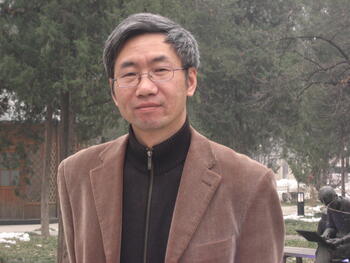
Shiping Tang is Fudan Distinguished Professor and Dr. Seaker Chan Chair Professor at the School of International Relations and Public Affairs (SIRPA), Fudan University, Shanghai, China. He is currently a Fulbright visiting research scholar (2015-16) at the School of Global Policy and Strategy, University of California at San Diego. Prof. Tang has very broad research interests and has published widely. His most recent book, The Social Evolution of International Politics (2013), received the International Studies Association (ISA) “Annual Best Book Award” in 2015. He is also the author of A General Theory of Institutional Change (2011), A Theory of Security Strategy for Our Time: Defensive Realism (2010), and many articles in journals in international relations, institutional economics, sociology, and philosophy of the social sciences.

Shiping Tang Fudan Distinguished Professor
Seminars
Paragraphs

Divided Lenses: Screen Memories of War in East Asia is the first attempt to explore how the tumultuous years between 1931 and 1953 have been recreated and renegotiated in cinema. This period saw traumatic conflicts such as the Sino-Japanese War, the Pacific War, and the Korean War, and pivotal events such as the Rape of Nanjing, Pearl Harbor, the Battle of Iwo Jima, and the bombings of Hiroshima and Nagasaki, all of which left a lasting imprint on East Asia and the world. By bringing together a variety of specialists in the cinemas of East Asia and offering divergent yet complementary perspectives, the book explores how the legacies of war have been reimagined through the lens of film.

This turbulent era opened with the Mukden Incident of 1931, which signaled a new page in Japanese militaristic aggression in East Asia, and culminated with the Korean War (1950–1953), a protracted conflict that broke out in the wake of Japan's post–World War II withdrawal from Korea. Divided Lenses explores how the intervening decades have continued to shape politics and popular culture throughout East Asia and the world. Essays in part I examine historical trends at work in various "national" cinemas, including China, Taiwan, Japan, Korea, and the United States. Those in part 2 focus on specific themes such as comfort women in Chinese film, the Nanjing Massacre, or nationalism, and how they have been depicted or renegotiated in contemporary films. Of particular interest are contributions drawing from other forms of screen culture, such as television and video games.

This book is an outcome of the conference, Divided Lenses: Film and War Memory in Asia, that the Shorenstein Asia-Pacific Research Center hosted in December 2008, part of the Divided Memories and Reconciliation research project.

All Publications button
1
Publication Type
Books
Publication Date
Journal Publisher
University of Hawai'i Press
Authors
-

About the Topic: An important factor of China’s economic success in the past 35 years was its labor force: its growing size, increasing education level, and reallocation to more efficient sectors. In contrast, China’s labor force is shrinking today, and rural-to-urban migration has slowed significantly.  To maintain a reasonable growth rate, improving human capital and increasing the productivity of labor is key. This talk will discuss pressing issues regarding China’s education, in particular its efficiency and distribution, and offer potential policy recommendations. 


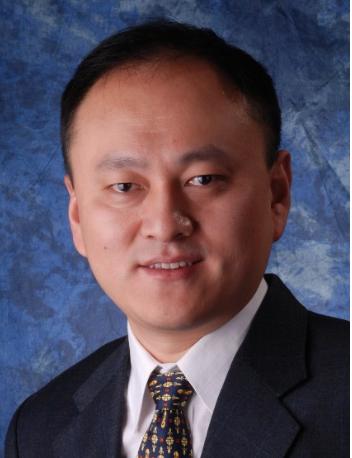
About the Speaker:  Hongbin Li is the C.V. Starr Chair professor of economics in the School of Economics and Management at Tsinghua University in Beijing, China. He also founded and served as the executive associate director of the China Data Center.  He obtained his Ph.D. in economics from Stanford University in 2001, and is currently a visiting professor of economics at the Stanford Center for International Development and the Stanford Institute for Economic Policy Research.

Goldman Conference Room

Encina Hall East, 4th floor

616 Serra St.

Stanford, CA 94305

C.V. Starr Chair Professor of Economics Tsinghua University
Seminars
News Type
News
Date
Paragraphs


Grant Miller, associate professor of medicine and a Stanford Health Policy core faculty member and senior fellow at the Freeman Spogli Institute, has been working to help residents of a state in India access the micronutrients that they are lacking. The work, which involves a fortified rice, includes several Indian ministries, nonprofit organizations, and faculty from across the Stanford campus to assess and support the collaborative effort.

In this video, Miller says Stanford's collaborative community and institutes help projects like his in the southeastern India state of Tamil Nadu succeed. "Micronutrient deficiency rates in Tamil Nadu are extremely high," he says. "We're working with the government of Tamil Nadu to see if it's possible to introduce fortification into what's called the public distribution system — which distributes rice at no cost to all residents of Tamil Nadu."

And, Miller says, he would not be able to carry out that research without the teamwork generated here on campus.


Hero Image
grant miller team approach
All News button
1
-

Incompetent and dishonest politicians are common in developing countries. Scholars who write about corruption and poor governance tend to take the existence of bad politicians as a given and focus on the damage that they do. Few study the ways in which politicians are recruited in order to improve that process. Some scholars acknowledge the need to encourage the creation of a political class that is competent and honest. But none have gone further by conducting real-world experiments to evaluate the efficacy of screening and incentivizing competent and virtuous citizens to stand for public office, that is, how to nudge good people to become politicians in the first place.

Dr. Ravanilla will describe a policy intervention designed to attract able and ethical candidates to public service. Can a leadership-training workshop and non-monetary status rewards be used to screen and motivate good people to serve the public good? His answer is yes. The results of a randomized field experiment among youth running for an elective post in the Philippines show that such an intervention is indeed feasible and can be effective in motivating able and moral individuals to seek public office while at the same time discouraging candidates who do not meet these criteria.

Image
rnico
Nico Ravanilla will begin an assistant professorship in the School of Global Policy and Strategy at the University of California, San Diego, in September 2016.  The Southeast Asia Research Group named him a Young Southeast Asia Fellow for 2015-16.  He earned his PhD in political science and public policy at the University of Michigan in 2015.

Nico Ravanilla 2015-16 Shorenstein APARC Postdoctoral Fellow, Stanford University
Seminars
News Type
News
Date
Paragraphs

David Shear, assistant secretary of defense for Asian and Pacific security affairs, visited Stanford on Jan. 22 for a daylong series of discussions on the state of U.S. defense strategy in the Asia-Pacific region.

Shear facilitated a closed-door dialogue with Stanford-based senior military fellows studying national security issues at the Freeman Spogli Institute for International Studies and the Hoover Institution.

Shear also met with faculty members of the Walter H. Shorenstein Asia-Pacific Research Center and the Center for International Security and Cooperation, and delivered a lecture to a packed audience at Encina Hall.

The events were sponsored by the U.S.-Asia Security Initiative led by Ambassador Karl Eikenberry. The initiative seeks to produce research outcomes and constructive interaction between academic and governmental experts on security challenges facing the Asia-Pacific region. More information about the initiative can be found here.

Hero Image
ds events v2
(L) David Shear, assistant secretary of defense for Asian and Pacific security affairs, listens to a question posed by an audience member; (R) Shear facilitates a closed-door dialogue with a cohort of Senior Military Fellows at Stanford.
All News button
1
-

Image
april 19 flyer
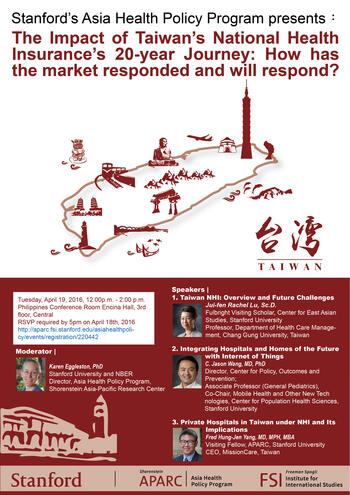
In 2015, Taiwan National Health Insurance (NHI) is celebrating its 20th anniversary since its historical inauguration in 1995. The NHI program, which provides universal health coverage (UHC) to Taiwan’s population of 23 million, has had a profound impact on Taiwan's health care market.   This seminar will showcase Taiwan's NHI scheme, the challenges encountered, and the market responses.

The single-payer NHI program, operated by National Health Insurance Administration (NHIA), was established through integrating three existing social insurance schemes and extended the coverage to the then uninsured 43% of the population. Taiwan NHI offers comprehensive benefit coverage that includes ambulatory care as well as inpatient services. On the service side, Taiwan has a market-oriented health care delivery system, reflecting its free-enterprise economy, as evidenced by the pluralistic organization of health services. Hospital ownership is mixed where public hospitals only account for 35% of all beds. Sixty-three percent of allopathic physicians are salaried employees of hospitals; the remainder, fee-for-service private practitioners. Over the years, hospitals have developed large outpatient departments and affiliated clinics for primary care in order to maintain inpatient volume and compete with private practitioners who operate free-standing clinics with beds. There is no gate keeping mechanism and the insured essentially enjoy complete freedom of choice which is likely a source of overuse.

NHI revenue mainly relies on payroll-based premiums, supplemented by a levy on non-payroll income and government subsidies. In 2013, NHI spent roughly NTD 492 (USD 16.4) billion on medical claims, accounting for approximately 52% of national health expenditures, and in total, Taiwan devoted 6.6% of GDP to health.  As a single payer, NHIA has effectively exploited its market power to experiment with various payment reforms in its 20-year history.  NHIA gradually set up separate global budgets for dental services, Chinese medicines, primary care services, and hospital services since 1998.  The annual growth rate of the total NHI budget is negotiated among stakeholders. 

Our seminar will look to the future with presentations on innovative healthcare delivery models and coping strategies by private hospitals.

Shorenstein APARC
Stanford University
Encina Hall E301
Stanford, CA 94305-6055

(650) 723-9072 (650) 723-6530
0
Senior Fellow at the Freeman Spogli Institute for International Studies
Professor, by courtesy, Health Policy
Faculty Research Fellow of the National Bureau of Economic Research
Faculty Affiliate at the Stanford Center on China's Economy and Institutions
karen-0320_cropprd.jpg PhD

Karen Eggleston is a Senior Fellow at the Freeman Spogli Institute for International Studies (FSI) at Stanford University and Director of the Stanford Asia Health Policy Program at the Shorenstein Asia-Pacific Research Center at FSI. She is also a Fellow with the Center for Innovation in Global Health at Stanford University School of Medicine, and a Faculty Research Fellow of the National Bureau of Economic Research (NBER). Her research focuses on government and market roles in the health sector and Asia health policy, especially in China, India, Japan, and Korea; healthcare productivity; and the economics of the demographic transition.

Eggleston earned her PhD in public policy from Harvard University and has MA degrees in economics and Asian studies from the University of Hawaii and a BA in Asian studies summa cum laude (valedictorian) from Dartmouth College. Eggleston studied in China for two years and was a Fulbright scholar in Korea. She served on the Strategic Technical Advisory Committee for the Asia Pacific Observatory on Health Systems and Policies and has been a consultant to the World Bank, the Asian Development Bank, and the WHO regarding health system reforms in the PRC.

Director, Asia Health Policy Program at the Walter H. Shorenstein Asia-Pacific Research Center
Stanford Health Policy Associate
CV
Date Label
Moderator Director, Asia Health Policy Program, Shorenstein Asia Pacific Research Center, Stanford University
Jui-fen Rachel Lu Professor, Department of Health Care Management Speaker Chang Gung University, Taiwan
C. Jason Wang Associate Professor (General Pediatric), Co-Chair, Mobile Health and Other New Technologies, Center for Population Health Sciences Speaker Stanford University
Fred Hung-Jen Yang Visiting Fellow, APARC, Stanford University Speaker CEO, MissionCare, Taiwan
Seminars
Subscribe to Asia-Pacific