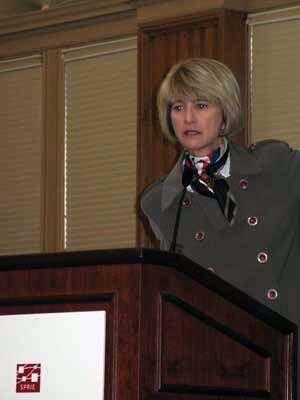
Jeff Raikes: A Perspective from the Bill & Melinda Gates Foundation
Catalytic philanthropy
The Gates Foundation, through its Agricultural Development Initiative, has been a leader in addressing global food security issues. The Foundation allocates 25% of its resources to global development and to addressing the needs of the 1 billion people who live in extreme poverty ($1/day). 70-75% of those people live in rural areas and are dependent on subsistence agriculture for their livelihoods.
The Gates Foundation is driven by the principle: how can it invest its resources in ways that can leverage performance and address market failures? Its approach embodies a novel concept driven by both private sector motives and public responsibilities. Raikes describes this as catalytic philanthropy.
"The Foundation identifies where its investments can create an innovation, a new intervention that can really raise the quality of lives for people," said Raikes. "If successful, it can be scaled up and sustained by the private sector if we can show that there is a profit opportunity or the public sector if we can show that this is a better way to improve the overall quality of society through investment in public dollars."
Photo credit: Michael Prince |
In the realm of agriculture, allocating resources across the agricultural value chain has proven to be the most effective approach. As an example of this strategy, Raikes talked about a farmer-owned, Gates-supported dairy chilling plant in Kenya. The cooling facility provided the storage necessary to provide a predictable price at which to sell farmers' milk. This price knowledge and market access gave farmers the confidence to invest in better technology and better dairy cattle. The plant also provided artificial insemination services and extension services to teach farmers how to get greater amounts of milk from the cattle.
"I love the concept. I also love the numbers," said Raikes. "In just two or three years there were now 3,000 farmers in a 25 kilometer radius that were able to access this dairy chilling plant and able to sell their milk."
In addition to improving incomes, Raikes remarked that very consistently what he hears is when farmers are able to improve their incomes the first thing they do with the money is invest in the education of their children.
Upcoming challenges to food security
During the next 40 years or so, global food production must double to accommodate a growing and richer population. Climate change and water scarcity contribute to this challenge. The places that will suffer the most severe weather are also the places where the poorest farmers live. 95% of sub-Saharan agriculture is rain fed with very little irrigation.
"If we are going to be able to feed the world we are going to have to figure out how to achieve more crop per drop," cautioned Raikes. "This includes trying to breed crop varieties that will better withstand water shortages. Early results show that you can get as much as a 20% increase in yield or more under stressed conditions when you have varieties that are bred for that need."
These challenges are compounded by the current economic crisis that is putting pressure on budgets in both donor and developing countries. In 2009, the G20 committed 22 billion dollars to agricultural development in recognition of the importance of agricultural development to food security. However, of the 22 billion promised, 224 million dollars went to five countries in the first round of grants in June. By November, when 21 additional countries submitted their proposals, just 97 million dollars were available to be dispersed and 17 countries were turned away empty handed.
High- and low-tech solutions
In an effort to alleviate some of this deficit, the Gates Foundation has committed 300 million dollars in six grants that span the value chain. These include investments in science and technology, farm management practices, farmer productivity, and market access as well as the data and policy environment to support the Foundation's work. The grants are intended to support about 5 ½ million farm families in sub-Saharan Africa and South Asia.
"We believe innovative solutions can come from both high-tech and low-tech," said Raikes. "On the high-tech end, submergent genes are allowing rice crops to survive periods of flooding up to 15 days. In areas of rice farming prone to flooding, this can save entire crops traditionally wiped out by such weather disasters."
|
Photo credit IRRI/Ariel Javellana
|
The sub1gene seeds are now being used by 400,000 farmers and are on track to be used by 20 million rice farmers by 2017. On the low-tech end, the Gates Foundation is providing $2 triple layer bags to farmers to reduce crop loss from pests; an affordable solution that has increased average income per farmer by $150/year.
"We primarily support conventional breeding, but we also support biotechnology breeding. In some cases we think that breeders in Africa and South Asia will want to take advantage of the modern tools we use here in our country to provide better choices for their farmers," explained Raikes.
Reasons for optimism
After years of diminished support, US Agricultural Development assistance to sub-Saharan Africa has gone from about 650 million in 2005 to about 1.5 billion in 2009. In developing countries, the Comprehensive Agricultural Development Program (CADP) in Africa has challenged countries to dedicate 10% of their national budgets to agriculture with the goal of improving annual agricultural growth by 6%. 20 countries have signed on to the CADP compacts, and 10 countries are exceeding the 6% growth target. Finally, since 1990, 1.3 billion people worldwide have lifted themselves out of poverty primarily through improvements in agricultural productivity.
Raikes pointed to Ghana as a success story. Since 1990, casaba production, an important staple food for poor smallholder farmers, has increased fivefold. Tomato production increased six fold. The cocoa sector has been revived and hunger has been cut by 75%.
"The key to success in Ghana was a combination of getting the right developing country policy with the right macroeconomic reform, the right institutional reform, smart public investment, and an overall good policy environment," said Raikes.
Supporting good policy is an important part of the Foundation's food security strategy, and was a strong motivation behind its funding of FSE's Global Food Policy and Food Security Symposium series.
"We see this symposium series as an opportunity to gather policy leaders who will bring new ideas of what will be effective policy approaches and effective economic environments in the countries we care a lot about, in particular sub-Saharan Africa and South Asia," said Raikes.
Raikes concluded his remarks by reminding everyone that the key to improving food security globally is making sure women, who make up at least 70% of the farm labor population, are included in the equation.
Greg Page: Balancing the race to caloric sufficiency with rural sociology
As the largest global agricultural firm, Cargill has an influential role to play in the world of food and agriculture. Cargill is a major supplier of food and crops and a provider of farmer services, inputs, and market access.
|
Photo credit: Olaf Hammelburg
|
Together with the Gates Foundation, Cargill has reached out and trained 200,000 cocoa farmers in the Ivory Coast, Ghana, and Cameroon. One tribe and one small village at a time the company has helped improve food safety, quality maintenance, and storage; benefiting the farmers, Cargill, and customers further down the supply chain. Cargill has also assisted, through financing and product purchasing, 265,000 farmers in Benin, Burkina Faso, the Ivory Coast, Malawi, Uganda, Zambia, and Zimbabwe.
Can the world feed itself?
A billion people lack sufficient caloric intake on a daily basis. In sub-Saharan Africa, 38% of all children are chronically malnourished, largely the result of inadequate agricultural productivity. While nine of the ten countries that have the highest prevalence of malnourishment are in sub-Saharan Africa, the two countries with the largest absolute number of malnourished people are India and China.
"This points to the difficulty of this problem," said Page. "India exports corn and soybean protein and China has 2.5 trillion dollars of hard currency reserves. These issues aren't necessarily of ability to feed people, but a willingness and commitment to do so."
Can the world feed itself? Yes, said Page.
When you break down the number of calories needed per malnourished person per day and convert that to tons of whole grains required to extinguish that hunger you get 30 million tons; 1/6 the amount of grain we converted to fuel globally last year. In the U.S. alone, 40% of our corn goes to ethanol.
"It isn't an issue of caloric famine-it is an issue of economic famine," stated Page. "In other words, this is not a food supply problem, but rather the lack of purchasing power to pay for a diet. An adequate price must be assured to reward the farmer for his efforts and to provide enough money that she can do it again the following year."
Rural sociology premium
What we face is the need to keep smallholders on the farm-despite the fact that they may not be the low-cost producer of foodstuffs-in order to avoid a rural population migration that would be unsustainable. As a result, the challenge the world faces is who is going to pay that rural sociology premium? If it costs more to raise crops on small farms is that burden going to be borne by the urban poor or is there going to be an alternative funding mechanism that allows smallholders to succeed?
What is the survival price for a smallholder farmer? Page explained that if you wanted a family of four on a farm in sub-Saharan Africa to receive an income commensurate with the average per capita income of the urban population, you would come up with a price near $400 a ton.
"To put this in context, the highest price for maize that has ever been reached here in the United States is about $275 a ton," said Page. "This rural sociology premium to sustain smallholders is not an insignificant amount of money. How do we achieve fairness between the revenue received by the rural smallholder and the price borne by the urban consumer?"
State of disequilibrium - complacency to crisis
Today we are experiencing incredible price volatility where commodity prices are in a continuous state of disequilibrium. Very small changes in production have outsized impacts on price. This is in contrast to the last two and a half decades when the world operated with fairly robust stocks due to crop subsidies in the United States and Western Europe.
"This period of subsidization was when the western world probably did more harm to sub-Saharan Africa and South Asia than any other period in history," said Page. "We refused to allow price to signal to western farmers to produce less. As a result, the world price of grains fell far below the ability of any smallholder to compete. We then shipped those surpluses to developing countries, which then failed to invest in their agriculture for decades."
Today we are lurching from complacency to crisis. The ability of information and market speculation to be transmitted rapidly is affecting purchasing decisions of thousands to millions of consumers. Rising fuel prices, export restrictions, increasing demand for crops for biofuels, and unpredictable weather have all contributed to higher prices. Some of the drivers of price, however, are good things, such as the increase in per capita income and the capacity of more people to have a more dense and nutritious diet.
"Interestingly, the upside of the ethanol and biofuels program is that it brought prices back to a sufficiency that reinvigorated investment in agriculture," noted Page. "On one level I think a very good argument could be made that the biofuels program brought the world further from famine than it ever had been because of the price."
Critical food security factors
Page concluded by summarizing the elements that Cargill believes are critically important to increase food security. The first is the ability to understand the tradeoffs between a fast path to caloric sufficiency and the needs of rural sociology. Second, that crops be grown in the right soil, with the right technology, and relying on free trade so we can harvest competitive advantage to its fullest.
Another critical factor is rural property rights. Smallholders must have the ability to own the land, have access to it, and transfer it to future generations if you want a farmer to reinvest in his farm, said Page.
"Smallholders in developing countries need some degree of revenue certainty and access to a reliable market if we expect them to do what their countries really need them to do, which is raise productivity," explained Page. "Today they are often forced to sell at harvest, often below the cost of production, and lack the storage capabilities and capital to provide crops sufficiently and continuously."
Open, trust-based markets also play a key role in ensuring food security. Governments need to support trade. When Russia, Ukraine, and Argentina turned to embargos as a way to protect domestic food prices open markets were jeopardized and price volatility increased. Finally, there are very important roles for the world's governments in the creation of infrastructure that is vital to provide access to markets.
"I believe fully and completely in the world's capacity to harvest photosynthesis to feed every single person and to do it at prices that can be borne by all," concluded Page.