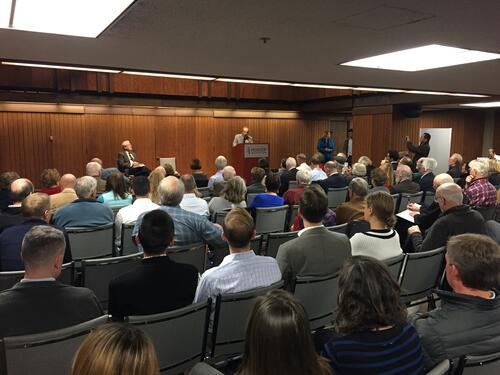
The 12th annual Draper Hills Summer Fellows Programgathered 25 democracy leaders from around the developing world for a three-week training program on democracy, good governance, and the rule of law reform. Selected from a large pool of applicants, the fellows have diverse backgrounds across sectors and geographies, working in civil society, public service, social enterprise, media and technology.
Fellows were instructed by an all-star roster of Stanford scholars and policy experts, including former U.S. Secretary of State Condoleezza Rice; FSI Director and former U.S. Ambassador to Russia Michael McFaul; CDDRL Mosbacher Director Francis Fukuyama and Larry Diamond, senior fellow at the Freeman Spogli Institute for International Studies. Fellows also met industry leaders such as Eric Schmidt of Google, democracy leaders such as Carl Gershman of the National Endowment for Democracy and others. During the program, they shared their personal stories about the struggle in their home countries, but also stories of their fight for justice, equality, and democracy, stories of optimism and endurance.
You can find some of their talks below and for more videos visit our YouTube channel.
Kasha Nabagesera (Uganda)
The founding member of Uganda's LGBTI Movement
"I am the only founding member of Uganda's LGBTI movement who is still based in the country"
Kasha Nabagesera is the executive director of Kuchu Times Media Group, the first LGBTI media platform in Africa. She is known as the “founding mother” of the LGBTI movement in Uganda - where homosexuality is illegal - advocating for equal rights and the eradication of all forms of discrimination based on sexual orientation. Listen to her story about big losses and big wins, everyday dangers and hope.
Rafael Marques de Morais (Angola)
Investigative reporter, MakaAngola
"Why the government is after you when you are sleeping so much?"
Rafael Marques de Morais is an award-winning journalist and human rights activist in Angola, working to investigate corruption and abuse of power by the country’s ruling family. He founded Makaangola, a watchdog website dedicated to exposing corruption and human rights abuses in Angola. Find out why his son thinks that his father is harmless for the government.
Belabbes Benkredda (Algeria)
The founder of Munathara Initiative
"Debate is the central part of the democratic equation."
Belabbes Benkredda is an award-winning social innovator and the founder of the Munathara Initiative, the Arab world’s largest online and television debate forum highlighting voices of youth, women, and marginalized communities. Operating in 11 Arab countries, Munathara’s monthly prime-time TV debates are the only civil society-run, independent political talk program on Arabic television. Munathara Initiative organized over 650 workshops with more than 10 thousand participants from 12 countries. They have around 90 thousand of registered users. More importantly, Munathara Initiative provided safe public space for young women to voice their opinions and mark their presence in public, traditionally dominated by the middle-aged men.
Sex differences in mortality vary over time and place as a function of social, health, and medical circumstances. The magnitude of these variations, and their response to large socioeconomic changes, suggest that biological differences cannot fully account for sex differences in survival. Drawing on a wide swath of mortality data across countries and over time, we develop a set of empiric observations with which any theory about excess male mortality and its correlates will have to contend. We show that as societies develop, M/F survival first declines and then increases, a “sex difference in mortality transition” embedded within the demographic and epidemiologic transitions. After the onset of this transition, cross-sectional variation in excess male mortality exhibits a consistent pattern of greater female resilience to mortality under socio-economic adversity. The causal mechanisms underlying these associations merit further research.
This event has reached capacity. Please join us to watch the live-stream at this link.
The symposium will focus on the key questions that impact health through the year 2020. How could the 2016 election affect health care in the U.S.? How will payment reform affect health systems, physicians and patients? Are the insurance exchanges viable? What challenges pose the biggest threat to global health? Experts from Stanford and beyond address these topics and more as they discuss the future of health policy.
Lloyd Minor, Dean, Stanford University School of Medicine
Image
Minor, MD, is a scientist, surgeon and academic leader. He is the Carl and Elizabeth Naumann Dean of the Stanford University School of Medicine, a position he has held since December 2012. Minor leads more than 1,500 faculty and 1,000 students at the oldest medical school in the West and has made precision health — the prevention of disease before it strikes — a hallmark of research, education and patient care at Stanford Medicine.
Bob Kocher,a partner at the Silicon Valley venture capital firm, Venrock
Bob Kocher
Kocher, MD, is a partner at Venrock who focuses on healthcare IT and services investments and is a consulting professor at Stanford University School of Medicine. He served in the Obama Administration as special assistant to the president for health care and economic policy and was one of the key shapers of the Affordable Care Act.
David Entwistle, President and CEO, Stanford Health Care
Image
Entwistle joined Stanford Health Care as its President and CEO in July, bringing extensive executive experience at leading academic medical centers. Most recently he served as CEO of the University of Utah Hospitals & Clinics, the only academic medical center in the Intermountain West region. While serving at UUHC, Entwistle received the Modern Healthcare “Up and Comers Award,” for significant contributions in health-care administration, management or policy.
Chris Dawes, President and CEO, Lucile Packard Children’s Hospital
Image
Christopher G. Dawes became President and Chief Executive Officer of Lucile Packard Children’s Hospital Stanford in 1997 after five years of service as Chief Operating Officer. Under his guidance, the hospital, research center and regional medical network has been ranked as one of the best in the nation, as an industry leader in patient safety and innovation in providing a full complement of services for children and expectant mothers.
Panelists:
Marcella Alsan, Assistant Professor of Medicine, Stanford University
Marcella Alsan’s research focuses on the relationship between health and socioeconomic disparities with a focus on infectious disease. Another vein of research focuses on the microfoundations of antibiotic overuse and resistance. She received a BA degree in cognitive neuroscience from Harvard University, a master’s degree in international public health from Harvard School of Public Health, a medical degree from Loyola University, and a PhD in economics from Harvard University. She is board-certified in both internal medicine and infectious disease. She trained at Brigham and Women’s Hospital, completing the Hiatt Global Health Equity Residency Fellowship in internal medicine. She combined her PhD with an Infectious Disease Fellowship at Massachusetts General Hospital. She currently is an infectious disease specialist at the Department of Veterans Affairs, Palo Alto.
Laurence Baker, Chair of Health Research and Policy, Stanford University
Laurence Baker is an economist interested in the organization and economic performance of the U.S. health-care system, and his research has investigated a range of topics including financial incentives in health care, competition in health-care markets, health insurance and managed care and health-care technology adoption. Baker is a past recipient of the ASHE medal from ASHEcon and the Alice Hersch Award from AcademyHealth. He received his BA from Calvin College, and his MA and PhD in economics from Princeton University.
Eran Bendavid, Assistant Professor of Medicine, Stanford University
Eran Bendavid is an infectious diseases physician. His research interests involve understanding the relationship between policies and health outcomes in developing countries. He explores how decisions about foreign assistance for health are made, and how those decisions affect the health of those whom assistance aims to serve. Dr. Bendavid is also a disease modeler, and uses that skill to explore issues of resource allocation in low and middle-income countries with cost-effectiveness analyses. His recent research projects include an impact evaluation of the US assistance program for HIV in Africa, and an exploration of the association between drug prices, aid and health outcomes in countries heavily affected by HIV.
Jay Bhattacharya, Professor of Medicine, Stanford University
Jay Bhattacharya’s research focuses on the constraints that vulnerable populations face in making decisions that affect their health status, as well as the effects of government policies and programs designed to benefit vulnerable populations. He has published empirical economics and health services research on the elderly, adolescents, HIV/AIDS and managed care. Most recently, he has researched the regulation of the viatical-settlements market (a secondary life-insurance market that often targets HIV patients) and summer/winter differences in nutritional outcomes for low-income American families. He is also working on a project examining the labor-market conditions that help determine why some U.S. employers do not provide health insurance.
M. Kate Bundorf, Associate Professor of Medicine, Stanford University
M. Kate Bundorf is a Faculty Research Fellow at the National Bureau of Economic Research. She received her M.B.A. and M.P.H. degrees from The University of California at Berkeley and her Ph.D. from The Wharton School. She was a Fulbright Lecturer and Visiting Professor at Fudan School of Public Health in Shanghai, China in 2009 and 2010. Her research, which focuses on health insurance markets, has been published in leading economics and health policy journals and has received funding from the U.S. National Institutes of Health, the Agency for Health Care Research and Quality and the Robert Wood Johnson Foundation. She received the 13th Annual Health Care Research Award from The National Institute for Health Care Management in 2007.
David Chan, Assistant Professor of Medicine, Stanford University
David Chan is a physician and economist whose research focuses on productivity in US health care. His research draws on insights from labor and organizational economics. He is particularly interested in studying what drives physician behavior, how this explains differences in productivity in health care delivery, and what the implications are for the design of health care. He is the recipient of the 2014 NIH Director’s High-Risk, High-Reward Early Independence Award to study the optimal balance of information in health information technology for patient care. David Chan is also an investigator at the Department of Veterans Affairs and a Faculty Research Fellow at the National Bureau of Economic Research.
Kathryn M. McDonald, Executive Director of the Center for Health Policy and the Center for Primary Care and Outcomes Research, Stanford University
Kathryn McDonald, MM, is the Executive Director of the Center for Health Policy (CHP) and Center for Primary Care and Outcomes Research (PCOR) and a senior scholar at the Centers. She is also Associate Director of the Stanford-UCSF Evidence-based Practice Center (under RAND). Her work focuses on measures and interventions to achieve evidence-based patient-centered healthcare quality and patient safety. Mrs. McDonald has served as a project director and principal investigator on a number of research projects at the Stanford School of Medicine, including the development and ongoing enhancement of the Quality and Patient Safety Indicators for the Agency for Healthcare Research and Quality. She has authored numerous peer reviewed articles and government reports, including several with wide enough followership to merit recent updates: Care Coordination Measures Atlas, Closing the Quality Gap, and Patient Safety Practices.
Michelle Mello, Professor of Law and of Health Research and Policy, Stanford University
Michelle Mello is Professor of Law at Stanford Law School and Professor of Health Research and Policy at Stanford University School of Medicine. She conducts empirical research into issues at the intersection of law, ethics, and health policy. She is the author of more than 150 articles and book chapters on the medical malpractice system, medical errors and patient safety, public health law, research ethics, the obesity epidemic, pharmaceuticals, and other topics. From 2000 to 2014, Dr. Mello was a professor at the Harvard School of Public Health, where she directed the School’s Program in Law and Public Health. In 2013-14 she completed a Lab Fellowship at Harvard University’s Edmond J. Safra Center for Ethics. Dr. Mello teaches courses in torts and public health law. She holds a J.D. from the Yale Law School, a Ph.D. in Health Policy and Administration from the University of North Carolina at Chapel Hill, an M.Phil. from Oxford University, where she was a Marshall Scholar, and a B.A. from Stanford University. In 2013, she was elected to the National Academy of Medicine (formerly known as the Institute of Medicine).
Grant Miller, Associate Professor of Medicine, Stanford University
Grant Miller is Director of the Stanford Center for International Development, an Associate Professor of Medicine at the Stanford University School of Medicine, a Core Faculty Member at the Center for Health Policy/Primary Care and Outcomes Research, a Senior Fellow at the Freeman Spogli Institute for International Studies (FSI) and the Stanford Institute for Economic Policy Research (SIEPR), and a Research Associate at the National Bureau of Economic Research (NBER). His primary interests are health economics, development economics, and economic demography. As a health and development economist based at the Stanford Medical School, Dr. Miller’s overarching focus is research and teaching aimed at developing more effective health improvement strategies for developing countries. His agenda addresses three major interrelated themes. (1) First, what are the major causes of population health improvement around the world and over time? (2) Second, what are the behavioral underpinnings of the major determinants of population health improvement? (3) Third, how can programs and policies use these behavioral insights to improve population health more effectively?
Douglas K. Owens, Director of the Center for Health Policy and the Center for Primary Care and Outcomes Research, Stanford University
Douglas K. Owens, MD, MS, is the Henry J. Kaiser, Jr., Professor at Stanford University, where he is a professor of medicine. He is director of the Center for Health Policy in the Freeman Spogli Institute for International Studies and director of the Center for Primary Care and Outcomes Research (PCOR) in the Department of Medicine. He is a general internist and associate director of the Center for Innovation to Implementation at the Veterans Affairs Palo Alto Health Care System. A past member of the U.S. Preventive Services Task Force, he has helped lead the development of national U.S. guidelines on screening for HIV, hepatitis C, hepatitis B, lung cancer, colorectal cancer, breast cancer, and use of aspirin and statins to prevent cardiovascular disease.
Maria Polyakova, Assistant Professor of Health Research and Policy, Stanford University
Maria Polyakova, PhD, is an Assistant Professor of Health Research and Policy at the Stanford University School of Medicine. Her research investigates questions surrounding the role of government in the design and financing of health insurance systems. She is especially interested in the relationships between public policies and individuals’ decision-making in health care and health insurance, as well as in the risk protection and re-distributive aspects of health insurance systems. She received a BA degree in Economics and Mathematics from Yale University and a PhD in Economics from MIT.
David M. Studdert, Professor of Medicine and of Law, Stanford University
David M. Studdert is a leading expert in the fields of health law and empirical legal research. His scholarship explores how the legal system influences the health and well-being of populations. A prolific scholar, he has authored more than 150 articles and book chapters, and his work appears frequently in leading international medical, law and health policy publications. Professor Studdert has received the Alice S. Hersh New Investigator Award from AcademyHealth, the leading organization for health services and health policy research in the United States. He was awarded a Federation Fellowship (2006) and a Laureate Fellowship (2011) by the Australian Research Council. He holds a law degree from University of Melbourne and a doctoral degree in health policy and public health from the Harvard School of Public Health.
Abstract: Grand strategy represents a state's overarching theory of what constitutes national security and how best to produce national security. Do U.S. presidential administrations have grand strategies? If so, do these theoretical frameworks shape the actual practice of American foreign policy? This seminar addresses these questions, focusing on the grand strategies of the Bush and Obama administrations and American foreign policy in the Middle East since 9/11.
About the Speaker: Dr. Colin Kahl is the National Security Advisor to the Vice President and Deputy Assistant to the President. He is on public service leave from Georgetown University, where he is an associate professor in the Security Studies Program at the Edmund A. Walsh School of Foreign Service. He previously served as the Deputy Assistant Secretary of Defense for the Middle East at the Pentagon (2009-2011), where he received the Outstanding Public Service Medal in 2011. He has published articles on U.S. foreign and defense policy in the Middle East in Foreign Affairs, Foreign Policy, International Security, the Los Angeles Times, Middle East Policy, the National Interest, the New York Times, the Washington Post, and the Washington Quarterly. Kahl's previous research, including his book States, Scarcity, and Civil Strife in the Developing World (Princeton, 2006), focused on the causes of civil and ethnic conflict. Kahl received his B.A. in political science from the University of Michigan (1993) and his Ph.D. in political science from Columbia University (2000).
Encina Hall, 2nd floor
Colin Kahl
National Security Advisor to the Vice President, Deputy Assistant to the President
Office of the Vice President
What will happen when a new US president is sworn in? Michael McFaul, former US ambassador to Russia and director of the Freeman Spogli Institute for International Studies, leads a panel of faculty experts to discuss the imminent foreign policy challenges that the next president must face.
CDDRL
Stanford University
Encina Hall, C147
616 Jane Stanford Way
Stanford, CA 94305-6055
(650) 724-6448
(650) 723-1928
0
ldiamond@stanford.edu
Mosbacher Senior Fellow in Global Democracy at the Freeman Spogli Institute for International Studies
William L. Clayton Senior Fellow at the Hoover Institution
Professor, by courtesy, of Political Science and Sociology
diamond_encina_hall.png
MA, PhD
Larry Diamond is the William L. Clayton Senior Fellow at the Hoover Institution, the Mosbacher Senior Fellow in Global Democracy at the Freeman Spogli Institute for International Studies (FSI), and a Bass University Fellow in Undergraduate Education at Stanford University. He is also professor by courtesy of Political Science and Sociology at Stanford, where he lectures and teaches courses on democracy (including an online course on EdX). At the Hoover Institution, he co-leads the Project on Taiwan in the Indo-Pacific Region and participates in the Project on the U.S., China, and the World. At FSI, he is among the core faculty of the Center on Democracy, Development and the Rule of Law, which he directed for six and a half years. He leads FSI’s Israel Studies Program and is a member of the Program on Arab Reform and Development. He also co-leads the Global Digital Policy Incubator, based at FSI’s Cyber Policy Center. He served for 32 years as founding co-editor of the Journal of Democracy.
Diamond’s research focuses on global trends affecting freedom and democracy and on U.S. and international policies to defend and advance democracy. His book, Ill Winds: Saving Democracy from Russian Rage, Chinese Ambition, and American Complacency, analyzes the challenges confronting liberal democracy in the United States and around the world at this potential “hinge in history,” and offers an agenda for strengthening and defending democracy at home and abroad. A paperback edition with a new preface was released by Penguin in April 2020. His other books include: In Search of Democracy (2016), The Spirit of Democracy (2008), Developing Democracy: Toward Consolidation (1999), Promoting Democracy in the 1990s (1995), and Class, Ethnicity, and Democracy in Nigeria (1989). He has edited or coedited more than fifty books, including China’s Influence and American Interests(2019, with Orville Schell), Silicon Triangle: The United States, China, Taiwan the Global Semiconductor Security (2023, with James O. Ellis Jr. and Orville Schell), and The Troubling State of India’s Democracy(2024, with Sumit Ganguly and Dinsha Mistree).
During 2002–03, Diamond served as a consultant to the US Agency for International Development (USAID) and was a contributing author of its report, Foreign Aid in the National Interest. He has advised and lectured to universities and think tanks around the world, and to the World Bank, the United Nations, the State Department, and other organizations dealing with governance and development. During the first three months of 2004, Diamond served as a senior adviser on governance to the Coalition Provisional Authority in Baghdad. His 2005 book, Squandered Victory: The American Occupation and the Bungled Effort to Bring Democracy to Iraq, was one of the first books to critically analyze America's postwar engagement in Iraq.
Among Diamond’s other edited books are Democracy in Decline?; Democratization and Authoritarianism in the Arab World; Will China Democratize?; and Liberation Technology: Social Media and the Struggle for Democracy, all edited with Marc F. Plattner; and Politics and Culture in Contemporary Iran, with Abbas Milani. With Juan J. Linz and Seymour Martin Lipset, he edited the series, Democracy in Developing Countries, which helped to shape a new generation of comparative study of democratic development.
615 Crothers Way,
Encina Commons, Room 128A
Stanford University
Stanford, CA 94305
(650) 721-4052
0
Research Fellow, Hoover Institution
abbas_milani_photo_by_babak_payami.jpg
PhD
Abbas Milani is the Hamid and Christina Moghadam Director of Iranian Studies at Stanford University and a visiting professor in the department of political science. In addition, Dr. Milani is a research fellow and co-director of the Iran Democracy Project at the Hoover Institution.
Prior to coming to Stanford, Milani was a professor of history and political science and chair of the department at Notre Dame de Namur University and a research fellow at the Institute of International Studies at the University of California at Berkeley. Milani was an assistant professor in the faculty of law and political science at Tehran University and a member of the board of directors of Tehran University's Center for International Studies from 1979 to 1987. He was a research fellow at the Iranian Center for Social Research from 1977 to 1978 and an assistant professor at the National University of Iran from 1975 to 1977.
Dr. Milani is the author of Eminent Persians: Men and Women Who Made Modern Iran, 1941-1979, (Syracuse University Press, Syracuse, NY, 2 volumes, November, 2008); King of Shadows: Essays on Iran's Encounter with Modernity, Persian text published in the U.S. (Ketab Corp., Spring 2005); Lost Wisdom: Rethinking Persian Modernity in Iran, (Mage 2004); The Persian Sphinx: Amir Abbas Hoveyda and the Riddle of the Iranian Revolution (Mage, 2000); Modernity and Its Foes in Iran (Gardon Press, 1998); Tales of Two Cities: A Persian Memoir (Mage 1996); On Democracy and Socialism, a collection of articles coauthored with Faramarz Tabrizi (Pars Press, 1987); and Malraux and the Tragic Vision (Agah Press, 1982). Milani has also translated numerous books and articles into Persian and English.
Milani received his BA in political science and economics from the University of California at Berkeley in 1970 and his PhD in political science from the University of Hawaii in 1974.
Hamid and Christina Moghadam Director of Iranian Studies
CISAC
Stanford University
Encina Hall, E216
Stanford, CA 94305-6165
(650) 725-9754
(650) 723-0089
0
zegart@stanford.edu
Senior Fellow at the Freeman Spogli Institute for International Studies
Morris Arnold and Nona Jean Cox Senior Fellow at the Hoover Institution
Senior Fellow at the Stanford Institute for Human-Centered AI
Professor, by courtesy, of Political Science
amyzegart-9.jpg
PhD
Dr. Amy Zegart is the Morris Arnold and Nona Jean Cox Senior Fellow at the Hoover Institution. The author of five books, she specializes in U.S. intelligence, emerging technologies, and national security. At Hoover, she leads the Technology Policy Accelerator and the Oster National Security Affairs Fellows Program. She also is an associate director and senior fellow at the Stanford Institute for Human-Centered AI; a senior fellow at the Freeman Spogli Institute; and professor of political science by courtesy, teaching 100 students each year about how emerging technologies are transforming espionage.
Her award-winning research includes the leading academic study of intelligence failures before 9/11: Spying Blind: The CIA, the FBI, and the Origins of 9/11 (Princeton, 2007) and the bestseller Spies, Lies, and Algorithms: The History and Future of American Intelligence (Princeton, 2022), which was nominated by Princeton University Press for the Pulitzer Prize. She also coauthored Political Risk: How Businesses and Organizations Can Anticipate Global Insecurity, with Condoleezza Rice (Twelve, 2018). Her op-eds and essays have appeared in Foreign Affairs, Politico, the New York Times, the Washington Post, and the Wall Street Journal.
Zegart has advised senior officials about intelligence and foreign policy for more than two decades. She served on the National Security Council staff and as a presidential campaign foreign policy advisor and has testified before numerous congressional committees. Before her academic career, she spent several years as a McKinsey & Company consultant.
Zegart received an AB in East Asian studies from Harvard and an MA and a PhD in political science from Stanford. She serves on the boards of the Council on Foreign Relations, Kratos Defense & Security Solutions, and the American Funds/Capital Group.
European governments are struggling with the biggest refugee crisis since World War II, but there exists little evidence regarding how the management of the asylum process affects the subsequent integration of refugees in the host country. We provide new causal evidence about how one central policy parameter, the length of time that refugees wait in limbo for a decision on their asylum claim, affects their subsequent economic integration. Exploiting exogenous variation in wait times and registry panel data covering refugees who applied in Switzerland between 1994 and 2004, we find that one additional year of waiting reduces the subsequent employment rate by 4 to 5 percentage points, a 16 to 23% drop compared to the average rate. This deleterious effect is remarkably stable across different subgroups of refugees stratified by gender, origin, age at arrival, and assigned language region, a pattern consistent with the idea that waiting in limbo dampens refugee employment through psychological discouragement, rather than a skill atrophy mechanism. Overall, our results suggest that marginally reducing the asylum waiting period can help reduce public expenditures and unlock the economic potential of refugees by increasing employment among this vulnerable population.
Pick Hall 411
5828 S. University Avenue
Chicago, Illinois 60637
0
rterman@uchicago.edu
rochelleterman_rsd17_076_0417a.jpg
Rochelle is an assistant professor in the Department of Political Science at the University of Chicago. Her research examines international norms, gender and advocacy, with a focus on the Muslim world. She is currently working on a book project that examines resistance and defiance towards international norms. The manuscript is based on her dissertation, which won the 2017 Merze Tate (formerly Helen Dwight Reid) Award for the best dissertation in international relations, law, and politics from the American Political Science Association. Rochelle received her Ph.D. in Political Science with a designated emphasis in Gender & Women’s Studies at the University of California, Berkeley. Before coming to Chicago, she was a post-doc at the Center for International Security and Cooperation at Stanford University.
The neighboring north Indian districts of Jaipur and Ajmer are identical in language, geography, and religious and caste demography. But when the famous Babri Mosque in Ayodhya was destroyed in 1992, Jaipur burned while Ajmer remained peaceful; when the state clashed over low-caste affirmative action quotas in 2008, Ajmer's residents rioted while Jaipur's citizens stayed calm. What explains these divergent patterns of ethnic conflict across multiethnic states? Using archival research and elite interviews in five case studies spanning north, south, and east India, as well as a quantitative analysis of 589 districts, Ajay Verghese shows that the legacies of British colonialism drive contemporary conflict.
Because India served as a model for British colonial expansion into parts of Africa and Southeast Asia, this project links Indian ethnic conflict to violent outcomes across an array of multiethnic states, including cases as diverse as Nigeria and Malaysia. The Colonial Origins of Ethnic Violence in Indiamakes important contributions to the study of Indian politics, ethnicity, conflict, and historical legacies.
The Asia Health Policy Program at Stanford’s Shorenstein Asia-Pacific Research Center, in collaboration with scholars from Stanford Health Policy's Center on Demography and Economics of Health and Aging, the Stanford Institute for Economic Policy Research, and the Next World Program, is soliciting papers for the third annual workshop on the economics of ageing titled Financing Longevity: The Economics of Pensions, Health Insurance, Long-term Care and Disability Insurance held at Stanford from April 24-25, 2017, and for a related special issue of the Journal of the Economics of Ageing.
The triumph of longevity can pose a challenge to the fiscal integrity of public and private pension systems and other social support programs disproportionately used by older adults. High-income countries offer lessons – frequently cautionary tales – for low- and middle-income countries about how to design social protection programs to be sustainable in the face of population ageing. Technological change and income inequality interact with population ageing to threaten the sustainability and perceived fairness of conventional financing for many social programs. Promoting longer working lives and savings for retirement are obvious policy priorities; but in many cases the fiscal challenges are even more acute for other social programs, such as insurance systems for medical care, long-term care, and disability. Reform of entitlement programs is also often politically difficult, further highlighting how important it is for developing countries putting in place comprehensive social security systems to take account of the macroeconomic implications of population ageing.
The objective of the workshop is to explore the economics of ageing from the perspective of sustainable financing for longer lives. The workshop will bring together researchers to present recent empirical and theoretical research on the economics of ageing with special (yet not exclusive) foci on the following topics:
Public and private roles in savings and retirement security
Living and working in an Age of Longevity: Lessons for Finance
Defined benefit, defined contribution, and innovations in design of pension programs
Intergenerational and equity implications of different financing mechanisms for pensions and social insurance
The impact of population aging on health insurance financing
Economic incentives of long-term care insurance and disability insurance systems
Precautionary savings and social protection system generosity
Elderly cognitive function and financial planning
Evaluation of policies aimed at increasing health and productivity of older adults
Population ageing and financing economic growth
Tax policies’ implications for capital deepening and investment in human capital
The relationship between population age structure and capital market returns
Evidence on policies designed to address disparities – gender, ethnic/racial, inter-regional, urban/rural – in old-age support
The political economy of reforming pension systems as well as health, long-term care and disability insurance programs
Submission for the workshop
Interested authors are invited to submit a 1-page abstract by Sept. 30, 2016, to Karen Eggleston at karene@stanford.edu. The authors of accepted abstracts will be notified by Oct. 15, 2016, and completed draft papers will be expected by April 1, 2017.
Economy-class travel and accommodation costs for one author of each accepted paper will be covered by the organizers.
Invited authors are expected to submit their paper to theJournal of the Economics of Ageing. A selection of these papers will (assuming successful completion of the review process) be published in a special issue.
Submission to the special issue
Authors (also those interested who are not attending the workshop) are invited to submit papers for the special issue in the Journal of the Economics of Ageing by Aug. 1, 2017. Submissions should be made online. Please select article type “SI Financing Longevity.”
About the Next World Program
The Next World Program is a joint initiative of Harvard University’s Program on the Global Demography of Aging, the WDA Forum, Stanford’s Asia Health Policy Program, and Fudan University’s Working Group on Comparative Ageing Societies. These institutions organize an annual workshop and a special issue in the Journal of the Economics of Ageing on an important economic theme related to ageing societies.