-

Co-sponsored by CDDRL Program on Arab Reform and Democracy, the Europe Center, Stanford Humanities Center, and the Abbasi Program in Islamic Studies

More info: http://www.stanford.edu/group/mediterranean/cgi-bin/web/2012/08/democratization-and-freedom-of-speech-a-focus-on-turkey-arab-world-and-ukraine/

Image

Richard and Rhoda Goldman Conference Room

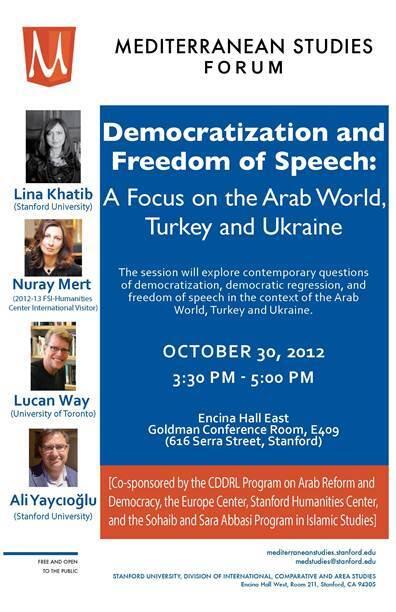
Nuray Mert FSI-Humanities Center International Visitor Panelist
Lina Khatib Program Manager for the Program on Arab Reform and Democracy Panelist CDDRL
Lucan Way Associate Professor of Political Science Panelist University of Toronto
Ali Yaycioğlu Assistant Professor of Middle East History Moderator Stanford
Panel Discussions
-

Co-sponsored by the Abbasi Program on Islamic Studies, CDDRL Program on Arab Reform and Democracy, the Europe Center, Stanford Humanities Center, the Mediterranean Studies Forum, and the Center for Russian, East European and Eurasian Studies.

Reuben W. Hills Conference Room

Nuray Mert 2012-13 FSI-Humanities International Visitor Speaker
Lina Khatib Speaker
Lucan Way Speaker
Ali Yaycioğlu Speaker
Panel Discussions
-

About the Topic: The Tiananmen Square massacre of June 1989 remains a taboo topic in the People’s Republic of China (PRC); the ruling Chinese Communist Party (CCP) still detains participants and suppresses online, popular, and scholarly discussions of it.  The twentieth anniversary of the end of the transatlantic Cold War, however, saw the release of new sources from high-level contacts between the CCP and foreign leaders. These new sources, combined with older ones, show the extent to which Chinese political leaders were obsessed with the democratic changes in Eastern Europe and were willing to take violent action to prevent similar events on their territory.

About the Speaker: Mary Sarotte is professor of history and professor of international relations at the University of Southern California. Her most recent book, 1989: The Struggle to Create Post-Cold War Europe, was called a new "classic" by Foreign Affairs and selected as a Book of the Year by the Financial Times. It received the DAAD Prize for Distinguished Scholarship in German and European Studies and became the first book to win both the Ferrell Prize for the best book on US foreign policy and the Shulman Prize for the best book on Communist foreign policy. Professor Sarotte received her PhD in History from Yale. She has been a White House Fellow and a member of the Institute for Advanced Study in Princeton. Professor Sarotte is also a member of the Council on Foreign Relations.

CISAC Conference Room

Mary Sarotte Professor of History and Professor of International Relations, University of Southern California Speaker
Seminars

Y2E2 building
E-IPER, room 226
473 Via Ortega
Stanford, CA 94305-4020

0
PhD student, Emmett Interdisciplinary Program in Environment and Resources
Fran_Moore_Photo_hs.jpg MS

Frances C. Moore is a PhD student in the Emmett Interdisciplinary Program in Environment and Resources at Stanford University. She is working with David Lobell and Larry Goulder to study how farmers are likely to adapt to climate change so as to reduce its negative effects. Understanding the likely rate and effectiveness of this autonomous adaptation is important for accurately estimating the future impact of climate change on agricultural production and food security. Fran is combining experimental, statistical, and field-based methods from economics, anthropology and psychology with climate data and models in order to better model adaptation in agriculture.

Fran’s previous work focused on the negotiation of international climate agreements and she has published several articles on the mitigation potential of short-lived greenhouse gases in developing countries and on the negotiation of international adaptation policy. Fran is a Stanford Interdisciplinary Graduate Fellow, a former Switzer Foundation Fellow and a former NSF Graduate Research Fellow. She holds a Masters of Environmental Science from the Yale School of Forestry and Environmental Studies and a B.A., summa cum laude, in Earth and Planetary Science from Harvard University.

Lobell laboratory

Authors
News Type
News
Date
Paragraphs
Roland Benedikter, Dott. Dr. Dr. Dr., is European Foundation Fellow 2009-2013, in residence at the Orfalea Center for Global and International Studies of the University of California at Santa Barbara, with duties as the European Foundations Research Professor of Political Sociology. His main field of interest is the multidimensional analysis of what he calls the current “Global Systemic Shift”, which he tries to understand by bringing together the six typological discourses (and systemic order patterns) of Politics, Economy, Culture, Religion, Technology and Demography. Roland is currently working on two major book projects: One about the “Global Systemic Shift”, and one about the “Contemporary Cultural Psychology of the West”, the latter comparing culturo-political trends in the European and American hemispheres. With both projects he is also involved in European Policy Advice.
All News button
1

Encina Hall
616 Serra Street, C205-4
Stanford, CA 94305

0
Visiting Scholar, The Europe Center
Smetana_3x4_Fotka.jpg

Vit Smetana is a senior research fellow at the Institute of Contemporary History – Academy of Sciences of the Czech Republic, and also teaches modern international history at the Faculty of Social Sciences, Charles University in Prague.  His professional interest lies primarily in the policies of the great powers towards Czechoslovakia and Central Europe in the late 1930s and throughout the 1940s. His research during his stay at Stanford focuses on the topic “The Czech, Slovak and other Central European exiles in the Second World War and beyond”.

Dr. Smetana is the author of In the Shadow of Munich. British Policy towards Czechoslovakia from the Endorsement to the Renunciation of the Munich Agreement (1938-1942) (2008) and co-author of Draze zaplacená svoboda. Osvobození Československa 1944-45  (Dearly Paid Freedom. The Liberation of Czechoslovakia 1944-45) in two volumes (2009).  He also edited  the Czech version of the Robert F. Kennedy memoir of the Cuban Missle Crisis, Thirteen Days (1999).

-

Please note venue changed to Oksenberg Conference Room

Coverage of the Democratic People’s Republic of Korea (DPRK) all too often focuses solely on nuclear proliferation, military parades, and the personality cult around its leaders. As the British ambassador to North Korea, John Everard had the rare experience of living there from 2006, when the DPRK conducted its first nuclear test, to 2008, just before Kim Jong Il’s stroke. While stationed in Pyongyang, Everard’s travels around the DPRK provided him with numerous opportunities to meet and converse with North Koreans.

Only Beautiful, Please, Everard's new book, goes beyond official North Korea to unveil the human dimension of life in that hermetic nation. In it, Everard recounts his impressions of the country and its people, his interactions with them, and his observations on their way of life. He provides a picture as well of the life of foreigners in this closed society, considers how the DPRK evolved to its current state, and discusses the failure of current approaches to tackle the challenges that it throws up. The book is illustrated with striking and never-before-seen photographs taken by Everard during his stay in North Korea.

About the Speaker

During his twenty-seven year career as a British diplomat, John Everard worked in a variety of countries and was appointed ambassador twice (to Belarus and to Uruguay) before undertaking his final assignment as British ambassador to North Korea. Everard is now a consultant for the UN and resides with his wife in New York City.

Oksenberg Conference Room

No longer in residence.

0
2010-2011 Pantech Fellow
Everard_Headshot.jpg

John Everard, a retired British diplomat, is now a consultant for the UN.

In October 2006, only a few short months after Everard arrived in Pyongyang to serve as the British ambassador, North Korea conducted its first-ever nuclear test. Everard spent the next two-and-a-half years meeting with North Korean government officials and attending the official events so beloved by the North Korean regime. During this complicated period he provided crucial reports back to the British government on political developments.

He also traveled extensively throughout North Korea, witnessing scenes of daily life experienced by few foreigners: people shopping for food in Pyongyang’s informal street markets, urban residents taking time off to relax at the beach, and many other very human moments. Everard captured such snapshots of everyday life through dozens of photographs and detailed notes.

His distinguished career with the British Foreign and Commonwealth Office spanned nearly 30 years and four continents (Africa, Asia, Europe, and Latin America), and included a number of politically sensitive posts. As the youngest-ever British ambassador when he was appointed to Belarus (1993 to 1995), he built an embassy from the ground up just a few short years after the fall of the Soviet Union. He also skillfully managed diplomatic relations as the UK ambassador to Uruguay (2001 to 2005) during a period of economic crisis and the country’s election of its first left-wing government.

From 2010 to 2011 Everard spent one year at Stanford University’s Walter H. Shorenstein Asia-Pacific Research Center, conducting research, writing, and participating in major international conferences on North Korea.

He holds BA and MA degrees in Chinese from Emmanuel College at Cambridge University, and a diploma in economics from Beijing University. Everard also earned an MBA from Manchester Business School, and is proficient in Chinese, Spanish, German, Russian, and French.

An avid cyclist and volunteer, Everard enjoys biking whenever he has the opportunity. He has been known to cycle from his London home to provincial cities to attend meetings of the Youth Hostels Association of England and Wales, of which he was a trustee from 2009 to 2010.

Everard currently resides with his wife in New York City.


Pantech Fellowships, generously funded by Pantech Group of Korea, are intended to cultivate a diverse international community of scholars and professionals committed to and capable of grappling with challenges posed by developments in Korea. We invite individuals from the United States, Korea, and other countries to apply.

John Everard Former UK Ambassador to North Korea Speaker
Seminars
Authors
News Type
News
Date
Paragraphs

The horror of the atomic bombs dropped on Hiroshima and Nagasaki has become an inescapable part of childhood in Japan. For Toshihiro Higuchi – a CISAC fellow who this last academic year focused on the political risks and fallout of nuclear weapons – it started with comic books and pencil sales for victims of the American bombs.

“For me, like every kid in Japan, the discourse about Hiroshima and Nagasaki was always familiar – from reading graphic books about the hell-like aftermath to joining a donation drive at school for victim relief,” said Higuchi, a historian and postdoctoral fellow at CISAC. “I remember that I was fascinated by the sheer power of nuclear weapons, and how that power overshadows everything else about war and conflict.”

That fascination with the political and social fallout of nuclear weapons and the complexities of nuclear energy is what drives the six nuclear fellows at the Center for International Security and Cooperation. The fellows – funded by grants from the Stanton Foundation and the John D. and Catherine T. MacArthur Foundation – spend their time at Stanford conducting research to build public engagement and shape government policy.

“I have great respect for scientists who can apply their knowledge not just to advance their field, but to use their skills to more directly improve policy,” said Robert Forrest, a physicist examining the role of nuclear reactors driven by particle accelerators. “In some small way, I hope to eventually be one of them. Nuclear issues present not only a fascinating and profound set of problems, but I feel a sort of responsibility toward them as a physicist.”

Seminars, mentorships with Stanford scholars and some of the world’s thought-leaders on nuclear science and policy, as well as annual visits to national laboratories, military bases and security conferences enhance the decades-old CISAC nuclear fellowship program.

“I got properly interested in nuclear weapons on a CISAC trip to the Nevada Test Site,” said John Downer, a Stanton postdoctoral fellow who focuses on the risks of nuclear power. “It’s one thing to read about atomic bombs; it’s another to stand on the edge of a giant crater in the desert.”


Lynn Eden, CISAC’s associate director for research, recently led the center’s postdoctoral fellows to the two-day Strategic Command Deterrence Symposium in La Vista, Neb., in which top military brass, academics and policymakers gathered to discuss nuclear deterrence in the emerging international security environment.

“Panelists had very different ideas about the role of nuclear weapons now and in the future,” said Eden, author of the groundbreaking book, Whole World on Fire, which explores how the U.S. government has underestimated the potential damage of nuclear detonations. “I have to say, the Shultz, Perry, Kissinger, Nunn vision of a world without nuclear weapons was not at the top of the agenda.”

Eden was referring to the watershed editorial in the Wall Street Journal co-authored by the four Cold War veterans, who are now advocating for a vision of a world free of nuclear weapons. The heft of their credentials and the passion behind their argument enabled President Barack Obama to call for the same, and be honored with a Nobel.

Eden said many of Strategic Command’s responsibilities regarding nuclear war planning have not changed under the Obama administration, but the thinking of their top officers has. U.S. Air Force Gen. Robert Kehler, the commander of Strategic Command, met privately with the CISAC fellows. “None of our questions surprised him, and his answers were extremely thoughtful,” she said. 

The March 11, 2011, earthquake in Japan and subsequent tsunami and nuclear meltdown at the Fukushima Daiichi power plant gave the fellows rich, real-world lessons about the human and environmental costs of nuclear energy gone wrong. The worst nuclear disaster since the Chernobyl meltdown of 1986 galvanized Stanford scholars across the campus to study the cause and effects of the Japanese tragedy.  

“As someone who is interested in technological risk, I think there is no technological sphere where the stakes are higher and the knowledge more political than in nuclear power – except maybe in nuclear weapons,” Downer said. “The way formal reports and journalistic accounts construe nuclear disasters and radioactive fallout is often terrifyingly misleading. I think I can contribute something by helping restructure debates about nuclear risks.”

In keeping with CISAC’s mission, the fellows are encouraged to engage in pubic debate by drawing out the policy relevance of an issue. They publish in scholarly journals and write academic papers, as well as blog and submit op-eds and editorials to online sites.  Forrest, for example, had a commentary on Huffington Post that urged Congress to maintain federal funding for scientific research and development.

Benoît Pelopidas, a postdoctoral nuclear fellow from France, ran a Friday evening film series this last academic year, highlighting such traditional films as the Kurosawa classic “I Live in Fear” – about a Japanese man whose fear of another nuclear bomb drives him to insanity – to the recent South African science fiction thrilled, “District 9,” which explores strands of xenophobia and social segregation behind national security.

“At Stanford, I found a real interdisciplinary community interested in nuclear issues and unexpected access to policymakers,” Pelopidas said, including former U.S. Secretary of State George Shultz and Ambassador James Goodby, senior fellows at CISAC’s neighboring Hoover Institution who called on him to write a paper about the future of nuclear deterrence. “This helped me appreciate the value of interdisciplinary research in the nuclear discourse – to create opportunities for change.”

What’s next for the six fellows:

  • Edward Blandford: University of New Mexico, assistant professor of nuclear engineering in the Department of Chemical and Nuclear Engineering
  • Alexandre Debs: Yale University, assistant professor of political science
  • John Downer: University of Bristol, U.K., assistant professor of risk and resilience in the School of Sociology, Politics and International Studies
  • Robert Forrest: Continues his research at CISAC into the role of particle accelerators in a nuclear-powered future
  • Toshihiro Higuchi: University of Wisconsin-Madison, an ACLS/Mellon Foundation postdoctoral fellow in the Department of the History of Science
  • Benoît Pelopidas: University of Bristol, U.K., assistant professor of international relations at the School of Sociology, Politics and International Studies
Hero Image
Pika don project logo
The Stanford Graphic Novel Project, Pika-Don (crash-boom), tells the true story of Tsutomu Yamaguchi, a naval engineer during WWII in Hiroshima, who survived the 1945 atomic bombings.
Stanford Graphic Novel Project
All News button
1
News Type
News
Date
Paragraphs

Josef Joffe, a senior fellow at FSI and the Hoover Institution and the editor-publisher of Germany's Die Zeit, reviews Jonathan Fenby's  The General: Charles de Gaulle and the France He Saved in The New York Times Book Review Sunday Aug. 19. Fenby, says Joffe, knows how to turn historical breath and depth "into enthrallment " and proceeds to prove his point.

Not just a biography of Charles de Gaulle, the book tells the story of the 20th century giant "who captivated the public's imagination while still alive" and also "traces the story of a great nation that refused to come to terms with the loss of the strategic preeminence it had once enjoyed."

"As France hunkered down behind the Maginot line after World War I, de Gaulle preached the armored offense Hitler's panzer armies would use with devastating efficiency," Joffe says. When Hitler subdued France in 1940 in a matter of weeks, de Gaulle escaped to London, where he sparred with both Winston Churchill and Franklin Roosevelt.   With Germany's defeat finally in sight, de Gaulle returned to Paris. Yet after only a few days as head of government he resigned and went to Colombey-les-Deux-Eglises where he would spend the next 12 years.

After the chaotic years of France's Fourth Republic, where "it lost Indochina, Suez, and l'Algerie francaise," de Gaulle returned to France.  He reigned over the Fifth Republic, Joffe says, "like a latter day Sun King, forced to suffer the ornery ways of democratic politics."

The French student riots of May 1968, "the mightiest student revolt in the West," per Joffe, were to prove his undoing.  de Gaulle went to French Army headquarters then in Germany to plead for the support of the military.  Meanwhile,"the faithful in Paris rallied and de Gaulle won a huge majority in the parliamentary elections of June 1968."  But, as Joffe says, he was the nation's savior no more.  When he called for a referendum on his reforms, he lost and resigned the same day. In November 1970, just before his 80th birthday, he died in Colombey.

As Joffe concludes in his review, "There is no more fitting epitaph than Fenby's last sentence: 'The world would not see his like again.'"

All News button
1
Authors
News Type
News
Date
Paragraphs

The demise of Moammar Gadhafi’s regime gave Abdulhafid Sidoun a second chance at life.

Six days before Sidoun was to be executed for promoting democracy in Libya, rebels toppled the government and emptied the country’s jails of its political prisoners. After more than five months of beatings and abuse on death row, Sidoun was free. Weeks later, Gadhafi was dead, gunned down by the rebels.

Sidoun’s fight to bring democracy and accountability to Libya is far from over. Qadaffi’s 40-year stranglehold starved Libya of political debate and evolution, and Sidoun knew he needed a crash-course in building an open, stable society. He received one this summer at Stanford, joining 23 other pro-democracy advocates from 22 countries in the Draper Hills Summer Fellows Program on Democracy and Development.

“Gadhafi is gone, but we still have a corrupt system we need to clean up,” says Sidoun, a Tripoli-based lawyer who waged a social media campaign to unite Gadhafi opponents. “My country needs me now. I have to work with my friends and colleagues and other lawyers and tell them what I’ve learned.”

Abdulhafid Sidoun was sentenced to death for trying to topple Moammar Gadhafi’s regime.
Photo credit: Rod Searcey

He has chronic back pain from the blows dealt by prison guards. And he winces when he talks about being torn from his family and isolated in a dark cell where he had no idea how – or even whether – the revolt against Gadhafi was unfolding until rebels broke him free.

For three weeks in late July and early August, Sidoun and the other fellows participated in faculty-led sessions on democracy, economic development, global health and hunger, human rights and the new technologies making it easier to organize and inspire reform. They took field trips to San Francisco and Monterey and met with officials at Google, Facebook and the Omidyar Network, a philanthropic investment firm that is contributing to the fellowship program.

And they spent time getting to know each other. Entrepreneurs, lawyers, journalists, politicians and civil society leaders sharing stories of overwhelming repression and the small successes they’ve had in trying to reform governments in places like Chile, China, Serbia and Zimbabwe.

“Everyone here has different stories and cultures, but we all talk about the same corruption,” Sidoun says. “We are learning that our problems are not very different.”

Fighting ignorance, encouraging debate

Now in its eighth year, the Draper Hills program – run by the Center on Democracy, Development and the Rule of Law at Stanford’s Freeman Spogli Institute for International Studies – has created and grown a worldwide network of up-and-coming leaders.

About 200 fellows from more than 60 countries have passed through the program and are now trying to craft policy and bring about political and economic reform.

“Many governments in Latin America are suffering from very strong political leaders who were elected presidents but think they are little kings or queens who own the country,” says Laura Alonso, a national representative in the Argentine Congress selected as one of this year’s fellows.

“The main problem is that the people who become so powerful distort the rule of law,” she says. “There is a rule of law for their friends and a different rule of law for their enemies. So this is what I want to go home and address – how can we have a rule of law that applies to everyone? My time at Stanford is giving me the perspective I need to go back to the basics of democracy.”

The fellowship program also addresses the overlap of business and government, and has increased its emphasis on the role entrepreneurs play in building democracy.

"We have brought a few entrepreneurs into the group of fellows," says Kathryn Stoner, an expert on Russia who lectured to the fellows about democratic transitions. "It is good for them to know how to get around corrupt practices in government. We also know that a strong middle class is the backbone of democracy. Once people have property, they tend to want to protect it as well as to demand representation for any taxes they pay. Encouraging entrepreneurship then is a good way to pursue both economic and political development worldwide."

While they’re all at Stanford to learn, the fellows are eager to share their newfound knowledge.

Kamal Siddiqi uses his position as a newspaper editor to strengthen democracy in Pakistan.
Photo credit: Rod Searcey

Bassim Assuqair was raised in Yemen by parents who forbade him from working as a teenager so he could devote all his energy to his studies. After earning a degree in English education from Sana’a University, he has worked for various development organizations. But he’s most interested in organizing Yemen’s youth and teaching them about the benefits of living in a country with free elections and the rule of law.

“There is so much ignorance, so much illiteracy in my country,” he says. “The people aren’t bad. They’re simple. They need awareness. I want them to know peace. It’s my task – I am ordering myself – to explain to others what I’m learning here.”

Kamal Siddiqi is another self-styled evangelist of democracy. As editor of The Express Tribune, an English-language daily in Pakistan, Siddiqi uses the newspaper as a check on government power while making the case that “a very bad elected prime minister is still better than a very good dictator.”

As a Draper Hills fellow, Siddiqi picked up technological tips and made connections with Stanford faculty that will help him better monitor crime, corruption and his country’s upcoming elections.

“I want to draw on the strength of the faculty and fellows of CDDRL to write for my newspaper,” he says. “They will play a part in my attempt to introduce some more ideas and issues in the general debate on elections and democracy.”

A chance to reflect

When FSI Director Coit D. Blacker and a core group of FSI’s senior fellows – including CDDRL Director Larry Diamond, Stoner-Weiss, former Stanford President Gerhard Casper and Michael A. McFaul, now Washington’s ambassador to Moscow – created the fellowship program, they wanted to give practitioners a chance to reflect and learn about democratic theory.

"We felt that practitioners from developing countries or countries in political and economic transition often feel isolated in the work that they do and they burn out," says Stoner-Weiss. "There were no such programs for international practitioners when we began eight years ago. We wanted to provide them with a sense of international community and the knowledge that they are not toiling away on their own." 

And the lessons the fellows learn from Stanford faculty can be invaluable. When it comes to building a constitution – something several of the fellows grapple with – Francis Fukuyama says there’s only a certain amount of time for a newly formed government to “get it right.”

FSI's Gerhard Casper waves a copy of the Magna Carta while speaking to the fellows about the rule of law.
Photo credit: Rod Searcey

“If you don’t, your window of opportunity slams shut,” says Fukuyama, a FSI senior fellow who lectured to the group about economic development and governance.

“But you don’t want to invite more problems by not thinking through exactly what kind of government you want," he says. "You need to have a theoretical and academic perspective.”

And the learning goes both ways.

“I’m getting the problems and issues of 22 countries downloaded onto me in a very short period of time,” says Erik Jensen, a law professor and CDDRL faculty member who also helped start the fellowship program.

“The fellows bring important insights and opinions that don’t land on the front page of The New York Times, but are integral to understanding what’s going on in the developing world,” he says. “That’s pretty great to have in one room.”

Courage, risk and magic

After building momentum and attracting a growing number of faculty who wanted to work with the fellows, the program that began in 2005 quickly caught the interest of venture capitalist Bill Draper and philanthropist Ingrid Hills. Their $1.5 million gift gave the program its name in 2007.

Draper’s interest in the program is deeply tied to his background running the United Nations Development Programme between 1986 and 1994.

“There are wonderfully courageous leaders in this world who are willing to take risks,” Draper says. “It’s magical what can happen, and I’ve seen how one person really can make an enormous difference. A lot of people selected for this fellowship program have that opportunity.”

Hills anticipates the fellows will create a network that extends beyond the three weeks they spend together at Stanford. And former fellows plan to connect in Africa later this year to explore how to combat regional corruption and increase government accountability.

“My hope is that the program will give the fellows the knowledge and tools to build an infrastructure in their respective countries based on democratic principles,” Hills said.

Diamond, whose opening day lecture on defining democracy sets the stage for the learning that unfolds over the coming weeks, says the program ultimately invests in people with the potential to expand democracy.

“It gives them skills, ideas and comparative experiences to draw on,” he says. “Some of these people will continue to work in an important and incremental way to advance and defend human rights and the rule of law. Some will go on to have very prominent roles in government and civil society.”

Life sentence

Some of them, like Ethiopia’s Birtukan Midekssa, are already renowned political leaders whose stories underscore the most extreme hardships of building democracy.

Pardoned from the lifelong prison sentence she received for opposing Ethiopia's authoritarian government, Birtukan Midekssa is still fighting for democratic reform.
Photo credit: Rod Searcey

By the second time Midekssa was in prison, her daughter was old enough to ask if her mother was going to come home.

“I’ll be back,” Midekssa told the 3-year-old. But the promise was tenuous. She was serving a life sentence, convicted of trying to overthrow Ethiopia’s constitutional order. Her actual crime was promoting honest democracy in a country run by a government intolerant of dissent and dismissive of civil liberties.

She was first sentenced to life in prison in 2005. Her daughter was 8 months old and Midekssa – then a federal judge – was just elected deputy chair of the Coalition for Unity and Democracy. Her party had won a majority in parliament, but Prime Minister Meles Zenawi cracked down on the rising opposition. Midekssa and about 30,000 others were thrown in jail. Security forces killed nearly 200 demonstrators during rallies that began peacefully.

Midekssa was pardoned 18 months later, but re-arrested in 2008 after being accused of violating the terms of that agreement. She had also recently been elected chair of a new opposition group.

“They had me in solitary confinement and cut off from the entire world,” she says. “Sometimes I felt like the whole world was forgetting about me.”

It had not. When she was pardoned again in 2010, throngs of overjoyed supporters greeted her with shouts, songs and dance when she returned to her neighborhood in Addis Ababa.

But Midekssa was drained. Her party was weakened and her political prospects were uncertain. With few options in Ethiopia, she and her daughter moved to the United States in 2011.

“There was little I could do,” she says. “I wanted to learn more, study more and figure out how to establish democracy and stability.”

Landing a Draper Hills fellowship meant the chance to tap into a deep academic perspective and think about how she might take another pass at building democracy when Ethiopia’s authoritarian system shows some sign of opening up.

“She’s not a revolutionary in favor of violence or radical change,” Diamond says. “If the regime decides it wants to negotiate a process of political reform and put the political system on the foundations of greater legitimacy, she’s one of the first people they’d need to reach out to.”

But until they do, Midekssa will wait patiently. Studying. Retooling. Sharing her experiences. And repeating the promise she made to her daughter years ago:

“I’ll be back.”

All News button
1
Subscribe to Europe