News Type
News
Date
Paragraphs

NEWS RELEASE

April 27, 2011

Contact:

Marie-Pierre Ulloa

Executive Officer for International Programs, Stanford Humanities Center,

(650) 724 8106, mpulloa@stanford.edu

International Scholars in Residence at the Humanities Center 2011-2012

Distinguished scholars from Australia, Hong Kong - Ghana, Spain, the United Kingdom and France chosen as joint Stanford Humanities Center/FSI international visitors.

The Stanford Humanities Center and the Freeman Spogli Institute for International Studies (FSI) are pleased to announce that four international scholars have been chosen to come to Stanford in 2011-12 as part of a jointly sponsored international program entering its third year. Nominated by Stanford departments and research centers, the international scholars will be on campus for four-week residencies. They will have offices at the Humanities Center and will be affiliated with their nominating unit, the Humanities Center, and FSI.

A major purpose of the residencies is to bring high-profile international scholars into the intellectual life of the university, targeting scholars whose research and writing engage with the missions of both the Humanities Center and FSI.

The following six scholars have chosen to be in residence during the 2011-2012 academic year:

  • Adams Bodomo (October-November 2011) is the Chair of the Department of Linguistics in the School of Humanities at the University of Hong Kong and the Director of the University’s African Studies Program. A linguist hailing from Ghana, his primary expertise resides in the structure of West-African languages (Akan, Dagaare). He has recently undertaken research on the African diaspora in Asia, as well as conducted fieldwork on Zhuang, a minority language in China. He was nominated by the Department of Linguistics.
  • Mario Carretero (January 2012) is a Professor of Psychology at Autonoma University of Madrid, and one of the most prominent leaders studying how young people develop historical consciousness and how they understand history. His work has been at the forefront of the “history wars” since the 1990s over what and who should determine the curriculum on the Spanish-speaking world. Carretero’s research, unlike scholars who explore such issues by dissecting textbooks, is unique in its commitment to fieldwork - conducting interviews with adolescents and observing them in real life situations to understand the dynamics of cultural transmission and resistance. He was nominated by the School of Education.
  • Catherine Gousseff (February 2012) is a world-renowned leading figure in East-Central European history, politics and society of the twentieth Century, as well as of the former Soviet Union. A researcher at the French CNRS (Centre National de la Recherche Scientifique) she is currently affiliated with the Marc Bloch Center in Berlin. While at Stanford, she will share insights into her new research project on collective memories of displacements, diaspora politics in wartime and post-war eras, notably the Polish-Ukrainian population exchange (1944-1950). She was nominated by the Europe Center.
  • James Laidlaw (April 2012) is an anthropologist at Cambridge University. Professor Laidlaw is deeply engaged in fieldwork in Asia, researching the Buddhist ethics of self-cultivation, looking at how the traditional means by which Buddhists practice self-cultivation –asceticism, meditation- are undergoing a massive restructuring. Practices once reserved for male monks are now being adopted by women and laity. James Laidlaw has edited seven books, the two latest ones on the cognitive approaches to religion, exploring them from an ethnographic perspective. He is also an expert on Jainism, a tradition of monastic renunciation like Buddhism that is also the religion of choice of a larger lay population. He was nominated by the Department of Anthropology.
  •    Monica Quijada (October-November 2011) is a public intellectual and historian of Spain and Latin America at the Consejo Superior de Investigaciones Cientificas (CSIC) in Madrid. Her engagement with the UN in Argentina (working with refugees) and her directorship of the investigation carried out in the late 1990s regarding Nazi activities during the Second World War and in post-war Argentina shows her commitment to the public space. She has written extensively on dictatorship, populism, and war and their effect on the public sphere in Argentina and Spain as well as on the relationship between nineteenth-century Latin American states and their indigenous populations. She was nominated by the History Department and the Center for Latin American Studies.
  •    Patrick Wolfe (May-June 2012) is a historian at La Trobe University in Melbourne, Australia. He is a premier historian of settler colonialism, currently working on a comparative transnational history of settler-colonial discourses of race in Australia, Brazil, the United States, and Israel/Palestine. While at Stanford, he will give lectures based on his core work on Australia and also on his forthcoming book Settler Colonialism and the American West, 1865-1904 (Princeton University Press). He was nominated by the Bill Lane Center for the American West.

While at Stanford, the scholars will offer informal seminars and public lectures and will also be available for consultations with interested faculty and students. For additional information, please contact Marie-Pierre Ulloa, mpulloa@stanford.edu.

Relevant URLs:

Stanford Humanities Center

http://shc.stanford.edu/

Freeman Spogli Institute for International Studies

http://fsi.stanford.edu/

All News button
1

More than two-thirds of the population in Africa must leave their home to fetch water for drinking and domestic use. It is estimated that some 40 billion hours of labor each year are spent hauling water, a responsibility often borne by women and children. Cutting the walking time to a water source by just 15 minutes can reduce under-five mortality of children by 11 percent, and slash the prevalence of nutrition-depleting diarrhea by 41 percent.

News Type
News
Date
Paragraphs

The Center for International Security and Cooperation is pleased to announce the selection of 13 rising seniors for participation in its Undergraduate Honors Program in International Security Studies. 

The program provides an opportunity for eligible students focusing on international security subjects in any field to earn an honors certificate.

Students selected intern with a security-related organization, attend the program's honors college in Washington, D.C. in September, participate in a year-long core seminar on international security research, and produce an honors thesis with policy implications.


Joshua Alvarez

International Relations, Minor in Economics

Identity and Security: Turkey's Grand Strategy in the Middle East


Keshia Bonner

International Relations, Minor in Economics

United States Policy Towards Hamas and Hezbollah as State Actors


Stephen Craig

Political Science

Security Issues and Domestic Constraints on European Integration


Noura Elfarra

Political Science

How does Regime Change and Revolution Affect the Secret Police?


Alison Epstein

International Relations

British and American Intelligence Cooperation: the Iraq Inquiry and the New Face of the Special Relationship


Peter Hong

Political Science

Recalibrating and Resolving Deficiencies in Multinational Nuclear Fuel Cycle Initiatives


Mohammad Islam

Electrical Engineering, Minor in International Relations

Domestic Terrorism Prevention Strategies in the US and UK


Suraya Omar

Materials Science and Engineering

North Korea's Ambitions for a Light Water Reactor


Clay Ramel

Science, Technology & Society – Energy Engineering Concentration

National Security Dimensions of Developing an Energy Secure United States 


Nick Rosellini

International Relations, Minor in Economics & Modern Languages

The NATO Strategic Concept: Evolution of a Nuclear Posture 1957-2010


Ram Sachs

Earth Systems, Minor in Modern Languages

Environmental Dimensions of Security - Yemen and Violent Extremism


Jeffrey Sweet

Materials Science and Engineering

The Effect of Public Perceptions of Diseases such as HIV, H1N1, SARS, and Anthrax on the Effectiveness of Controlling Epidemics


Reagan Thompson

International Relations, Minor in Chinese

The Chinese Influence in Africa: Case Studies of Ghana and Angola


All News button
1
Authors
Larry Diamond
News Type
Commentary
Date
Paragraphs
In a new piece published on the Foreign Affairs website, CDDRL Director Larry Diamond argues that the Arab Spring is witnessing a thawing and freezing across the region as anti-democratic forces threaten nascent democratic transformations.

The decades-long political winter in the Arab world seemed to be thawing early this year as mass protests toppled Tunisian President Zine el-Abidine Ben Ali in January and Egyptian President Hosni Mubarak in February. It appeared as though one rotten Arab dictatorship after another might fall during the so-called Arab Spring. Analogies were quickly conjured to 1989, when another frozen political space, Eastern Europe, saw one dictatorship after another collapse. A similar wave of democratic transitions in the Arab world was finally possible to imagine, particularly given the extent to which previous transformations had been regional in scope: Portugal, Spain, and Greece all democratized in the mid-1970s; much of Latin America did shortly thereafter; Korea and Taiwan quickly followed the Philippines’ political opening in 1986; and then a wave of change in sub-Saharan Africa began in 1990. All of those were part of the transformative “third wave” of global democratization. In March, many scholars and activists reasonably imagined that a “fourth wave” had begun. 

Two months later, however, a late spring freeze has seemingly hit some areas of the region. And it could be a protracted one. Certainly, each previous regional wave of democratic change had to contend with authoritarian hard-liners, opposition divisions, and divergent national trends. But most of the Arab political openings are closing faster and more harshly than happened in other regions -- save for the former Soviet Union, where most new democratic regimes quickly drifted back toward autocracy.

If Tunisia still provides grounds for cautious optimism, the Egyptian situation is already deeply worrying. Its senior officer corps, which currently controls the government, does not want to facilitate a genuine democratic transition. It will try to prevent it by generating conditions on the ground that discredit democracy and make Egyptians (and U.S. policymakers) beg for a strong hand again. The ruling officers have turned a blind eye to mounting religious and sectarian strife (and an alarming explosion in crime). The military has spent enormous effort arresting thousands of peaceful protesters in Tahrir Square and trying them in military tribunals over the last two months. (In April, one such detainee, a blogger named Maikel Nabil, was sentenced to three years in prison for “insulting the military establishment.”) Yet it claims that it cannot rein in rising insecurity. Many Egyptians see this as part of the military’s grand design to undermine democracy before it takes hold.

The parliamentary elections slated for September are unlikely to help: New political forces have no chance of being able to build competitive party and campaign structures in time. The Muslim Brotherhood, which initially said it would only contest a third of the parliamentary seats, has now announced its intention to contest half of all seats, forming a new political party (Freedom and Justice) for the purpose. If the electoral system retains its highly majoritarian nature, it might well win a thumping majority of the seats it contests (perhaps 40 percent in all), with most of the rest going to local power brokers and former stalwarts of the Mubarak-era ruling party, the National Democratic Party.

Both theory and political experience teach that regimes with spent legitimacy do not last, and the legitimacy of the Libyan, Syrian, and Yemeni dictators is utterly depleted.

Elsewhere in the region, Bahrain’s minority Sunni monarchy opted to crush peaceful protests and arrest and torture many of those with whom it might have negotiated some future power-sharing deal. With active Iranian support and a bizarre degree of American and Israeli acceptance, Syrian President Bashar al-Assad unleashed a slow-motion massacre that could go on for weeks or even months. In Yemen, the government is paralyzed, food prices are rising, and the country is drifting. Having seen the fate of Mubarak, Yemeni President Ali Abdullah Saleh is playing for time, but his legitimacy is irretrievably drained, and he lacks the ability to mobilize repressive force on the scale of Assad’s.

Of course, not every country in the region has been affected by the apparent freeze and some could still avoid it. Jordan and Morocco are not yet in crisis but could be soon. Both countries face the same conditions that brought down seemingly secure autocracies in Tunisia and Egypt -- mounting frustration with corruption, joblessness, social injustice, and closed political systems. Not yet facing mass protests, Jordan’s King Abdullah is in a position to lead a measured process of democratic reform from above to revise electoral laws, rein in corruption, and grant considerably more freedom. Yet there is little sign that he has the vision or political self-confidence to modernize his country in this way.

Morocco’s King Mohammed VI is still domestically revered and internationally cited as a reformer, but he is even weaker and more feckless than Abdullah. He has been unwilling to rein in the deeply venal interests that surround the monarchy, or ease the country’s extraordinary concentration of wealth and business ownership. Instead, his security forces, narrow circle of royal friends, and oligopolistic business cronies fend off demands for accountability and reform, further isolate the king, and aggravate the political storm that is gathering beneath a comparatively calm surface.

For now, both monarchies are treading familiar water: launching committees to study political reform but never moving toward real political change. This game cannot last forever. As a former Jordanian official recently commented to me privately: “Everyone is expecting serious changes to the way the king rules the country, and if these changes don’t happen, the system will be in trouble. The king can’t keep talking about reform without implementing it.”

Scholars of the Arab world had been arguing for years that the region’s various repressive regimes (not least Saudi Arabia’s Al Saud dynasty, which keeps several thousand princes on the take) would either pursue democratic reform, or rot internally until they were overthrown. Ultimately, the options remain the same for the regimes that have avoided revolution this year. Those who have reasserted authoritarianism will find only temporary reprieve. Both theory and political experience teach that regimes with spent legitimacy do not last, and the legitimacy of the Libyan, Syrian, and Yemeni dictators is utterly depleted. They will surely be overthrown if not now, then in coming years. The Jordanian and Moroccan monarchies, however, could still survive if they spend what remains of their political legitimacy on democratic reform. In other words, even if the Arab spring comes in fits and starts, it will eventually bring fundamental political change. But whether democracy is the end result depends in part on how events unfold and how regimes and international actors engage the opposition forces.

Short of the wars that have periodically broken out in the region, the United States has never faced a more urgent set of opportunities and challenges there: real prospects for democratic development exist alongside the very real risks of Islamist ascension, political chaos, and humanitarian disaster. Countries across the Arab world differ widely in their political structures and social conditions, and the United States cannot pursue a one-size-fits-all strategy. But there are a few basic principles that it should apply everywhere. As it has generally and in a number of specific cases, the Obama administration must explicitly and consistently denounce all violent repression of peaceful protest. And it should enhance the credibility of those words by tying them to consequences. For example, in Libya, the United States identified and froze the overseas assets of top officials who were responsible for brutality. Additionally, it imposed travel bans on them and their family members, and asked Europe to do the same. In the past few days, the Obama administration has also moved to freeze the personal assets of Assad and other top Syrian officials. In extreme cases -- Libya is one, and Syria has now become another -- the United States can press the United Nations Security Council to refer individuals to the International Criminal Court for crimes against humanity.

When Arab governments turn arms against peaceful protesters, the United States and Europe should stop supplying them with weapons. Western countries have been selling (or giving) regimes, such as Saleh’s in Yemen, the tools of repression, including tear gas, ammunition, sniper rifles, close-assault weapons, and rockets and tanks. Although Saleh may have been a valuable asset in the fight against terrorism at one time, he has become a liability. By ending such trade, the United States would firmly send the message to the leaders of Bahrain (another recipient) and Yemen that if they are going to violently assault and arbitrarily arrest peaceful demonstrators for democracy, they are at least not going to continue doing so with U.S. guns.

For now, there is an urgent need for mediation to break the impasse between rulers and their oppositions and to find ways to ease the region’s remaining dictators out of power. Recognizing the need for an active UN role during the Arab uprising, UN Secretary-General Ban Ki-moon has begun to dispatch experienced and talented UN staff to engage in dialogue with different groups in Yemen and elsewhere. These diplomats can help develop possible political accommodations with the protesters. The United States should encourage the UN to try to mediate these conflicts, reconcile deeply divided forces within political oppositions, and help governments pave the way for credible elections. Because it is more neutral, the UN is the international actor best suited to mediate as well as convene experts on institutional design and help supply technical support for drafting constitutions.

American diplomats will have their own role to play: They can channel financial and programmatic support and provide another venue for different actors to meet and discuss differences. They should also speak out for human rights, civil society, and the democratic process. Such expressions of moral and practical support have made a significant difference in transitional situations in other countries, such as Chile, the Philippines, Poland, and South Africa. The Arab world has its own distinct sensitivities, but the ongoing uprisings present an unusual opportunity for U.S. ambassadors to join with representatives of other democracies to lean on Arab autocrats and aid Arab democrats.

The United States should help Arab democrats get the training and financial assistance they need to survive while urging them to cooperate with one another. This does not just mean more grants to civil society organizations. There is, of course, a need for such funding, but too much U.S. money thrown at these groups will discredit them as “American pawns” or promote corruption. Aid should be pooled among multiple donors, provide core (rather than project-related) funding for organizations with a proven track record of advancing democratic change, and must be carefully monitored to ensure that it is being used effectively.Western countries have been selling (or giving) regimes, such as Saleh’s in Yemen, the tools of repression, including tear gas, ammunition, sniper rifles, close-assault weapons, and rockets and tanks.

Finally, given its enormous demographic weight and political influence in the Arab world, as Egypt goes, so will go the region. Engaging Egypt will prove vital to any larger strategy of fostering democratic change in the Arab world. Beyond aid and vigilant monitoring of the political process, the United States must deliver a clear message to the Egyptian military that it will not support a deliberate sabotage of the democratic process, and that a reversion to authoritarianism would have serious consequences for the U.S.-Egyptian bilateral relationship, including for future flows of U.S. military aid. The United States cannot allow the Egyptian military to play the cynical double game that the Pakistani military has, or Egypt may become another Pakistan in two senses: an overbearing military may hide behind the façade of democracy to run the country, and the military may consort with our friends one day and our enemies -- radical Islamists within Egypt and Hamas outside it -- the next, to show it cannot be taken for granted.

This period of change in the Arab world will not be short or neatly circumscribed. Not a continuous thaw or freeze, the coming years will see cycles -- ups and downs in a protracted struggle to define the future political shape of the Arab world. The stakes for the United States are enormous. And the need for steady principles, clear understanding, and long-term strategic thinking has never been more pressing.

All News button
1
Authors
News Type
News
Date
Paragraphs

Fourteen visionary, young trailblazers from around the world — including an astrobiologist, a Middle East peace worker and cultural educator, an Asian elephant specialist, a wastewater engineer, a filmmaker and a science entrepreneur — have been named to the 2011 class of National Geographic Emerging Explorers. Jennifer Burney, a Scripps postdoctoral researcher and FSE fellow helping to understand how changes in cooking habits could have complementary effects on climate change and public health, was named one of them.

The award provides financial support to the research efforts of scientists who are in their early careers. Burney is a University of California President’s Postdoctoral Fellow at Scripps Institution of Oceanography, UC San Diego and is an affiliate of Stanford University's Program on Food Security and the Environment. At Scripps, she is part of a team headed by Professor of Climate and Atmospheric Science Veerabhadran Ramanathan studying the effects of replacing homemade cookstoves in rural India with cleaner-burning alternatives in an effort called Project Surya.
“I love the puzzle of figuring out how to measure something be it with data or instrumentation and Surya by its nature is just a giant web of measurement problems. It’s a really great synergy,” said Burney, who received her doctorate in physics from Stanford University in 2007.

Among Burney’s objectives is to study the links between energy poverty and food and nutrition security and the environmental impacts of food production and consumption. In the case of Project Surya, this will mean helping Ramanathan assess what happens when emissions of soot and other black carbon are substantially reduced in a given area. Ramanathan expects that the experiment will show immediate reduction in the contribution of greenhouse agents from that area. On a large scale, the reduction of such pollution created by use of wood and dung as cooking fuel could have a major mitigative impact on climate change. It could also improve the respiratory health of local residents, who frequently must inhale the smoke from their stoves as they cook in poorly ventilated kitchens.

The Project Surya team is hoping to launch a phase later this year in which cookers are replaced with cleaner stoves in a 10-square-kilometer (four-square-mile) area in India. They will then measure emissions of black carbon via satellite and at ground level with help from local residents.

Burney will separately study the agricultural effects associated with temperature and precipitation changes that could be triggered by the cookstove switch.

“I am really delighted, but not surprised, that Jen got this well deserved honor,” said Ramanathan. “She brings lots of talent and experience to the Surya research. She is an asset.”

Burney said that the award will also support another project she is conducting in West Africa in which she is assessing the feasibility of using solar power to improve irrigation capabilities there.

The Emerging Explorers each receive a $10,000 award to assist with research and to aid further exploration. Burney and the other new Emerging Explorers are introduced in the June 2011 issue of National Geographic magazine, and comprehensive profiles can be found at http://www.nationalgeographic.com/emerging.

Hero Image
jen cell
All News button
1
-

Bruce Jones will present on the World Bank's 2011 World Development Report, on "Conflict, Security and Development." The report, which is the World Bank's flagship annual research product, reviews and challenges previous Bank findings on the causes of conflict and fragility; provides new research findings on strategies for recovery from conflict and violence; and sets out a series of directions for national policy and international institutional reform. Dr. Jones will brief on these, as well as on the politics of research and implementation at the World Bank and the UN.

Dr. Bruce Jones is director and senior fellow of the NYU Center on International Cooperation, and senior fellow and director of the Managing Global Insecurity Program at the Brookings Institution. Currently, his is also the Senior External Advisor for the World Bank's Development Report (WDR) on Conflict, Security and Development. Jones will provide an overview and account of the WDR and will be joined by Dr. Francis Fukuyama who will participate as a discussant on the topic.

In March 2010, Jones was appointed by the United Nations Secretary-General as a member of the Senior Advisory Group to guide the Review of International Civilian Capacities.
Dr. Jones’ research focuses on US policy on global order and transnational threats; on multilateral institutions in peace and security issues; on the role of the United Nations in conflict management and international security; and on global peacekeeping, post-conflict operations and fragile state engagements.

Prior to assuming the Directorship of the Center, Dr. Jones served in several capacities at the United Nations. He was Senior Advisor in the Office of the Secretary-General during the UN reform effort leading up to the World Summit 2005, and in the same period was Acting Secretary of the Secretary-General’s Policy Committee. In 2004-2005, he was Deputy Research Director of the High-level Panel on Threats, Challenges and Change. From 2000-2002 he was Special Assistant to the UN Special Coordinator for the Middle East peace process; and held assignments in the UN Interim Mission in Kosovo, and in the Office for the Coordination of Humanitarian Affairs.  

Dr. Jones has been interviewed by or cited in US and international media, including the New York Times, LA Times, Globe and Mail, BBC, CNN, Fox, NPR, and Al Jazeera.
Dr. Jones holds a Ph.D. from the London School of Economics; and was Hamburg Fellow in Conflict Prevention at Stanford University. He is co-author with Carlos Pascual and Stephen Stedman of Power and Responsibility: Building International Order in an Era of Transnational Threats (Brookings Press, 2009); co-editor with Shepard Forman of Cooperating for Peace and Security (Cambridge University Press, 2009); author of Peacemaking in Rwanda: The Dynamics of Failures; Series Editor of the Annual Review of Global Peace Operations (Lynne Reinner) and author of several book chapters and journal articles on US strategy, global order, the Middle East, peacekeeping, post-conflict peacebuilding, and strategic coordination.

He is Consulting Professor at Stanford University, Adjunct Faculty at the NYU Wagner School of Public Service, and Professor by Courtesy at the NYU Department of Politics.

CISAC Conference Room

CDDRL
Encina Hall, C152
616 Jane Stanford Way
Stanford, CA 94305-6055

(650) 725-2705 (650) 724-2996
0
Senior Fellow at the Freeman Spogli Institute for International Studies
Professor, by courtesy, of Political Science
Stedman_Steve.jpg PhD

Stephen Stedman is a Senior Fellow at the Freeman Spogli Institute for International Studies (FSI) and the Center on Democracy, Development and the Rule of Law (CDDRL), an affiliated faculty member at CISAC, and professor of political science (by courtesy) at Stanford University. He is director of CDDRL's Fisher Family Honors Program in Democracy, Development and Rule of Law, and will be faculty director of the Program on International Relations in the School of Humanities and Sciences effective Fall 2025.

In 2011-12 Professor Stedman served as the Director for the Global Commission on Elections, Democracy, and Security, a body of eminent persons tasked with developing recommendations on promoting and protecting the integrity of elections and international electoral assistance. The Commission is a joint project of the Kofi Annan Foundation and International IDEA, an intergovernmental organization that works on international democracy and electoral assistance.

In 2003-04 Professor Stedman was Research Director of the United Nations High-level Panel on Threats, Challenges and Change and was a principal drafter of the Panel’s report, A More Secure World: Our Shared Responsibility.

In 2005 he served as Assistant Secretary-General and Special Advisor to the Secretary- General of the United Nations, with responsibility for working with governments to adopt the Panel’s recommendations for strengthening collective security and for implementing changes within the United Nations Secretariat, including the creation of a Peacebuilding Support Office, a Counter Terrorism Task Force, and a Policy Committee to act as a cabinet to the Secretary-General.

His most recent book, with Bruce Jones and Carlos Pascual, is Power and Responsibility: Creating International Order in an Era of Transnational Threats (Washington DC: Brookings Institution, 2009).

Director, Fisher Family Honors Program in Democracy, Development and Rule of Law
Director, Program in International Relations
Affiliated faculty at the Center for International Security and Cooperation
Date Label
Stephen J. Stedman Senior Fellow Moderator Stanford University

Encina Hall, C148
616 Jane Stanford Way
Stanford, CA 94305

0
Olivier Nomellini Senior Fellow at the Freeman Spogli Institute for International Studies
Director of the Ford Dorsey Master's in International Policy
Research Affiliate at The Europe Center
Professor by Courtesy, Department of Political Science
yff-2021-14290_6500x4500_square.jpg

Francis Fukuyama is the Olivier Nomellini Senior Fellow at Stanford University's Freeman Spogli Institute for International Studies (FSI), and a faculty member of FSI's Center on Democracy, Development and the Rule of Law (CDDRL). He is also Director of Stanford's Ford Dorsey Master's in International Policy, and a professor (by courtesy) of Political Science.

Dr. Fukuyama has written widely on issues in development and international politics. His 1992 book, The End of History and the Last Man, has appeared in over twenty foreign editions. His book In the Realm of the Last Man: A Memoir will be published in fall 2026.

Francis Fukuyama received his B.A. from Cornell University in classics, and his Ph.D. from Harvard in Political Science. He was a member of the Political Science Department of the RAND Corporation, and of the Policy Planning Staff of the US Department of State. From 1996-2000 he was Omer L. and Nancy Hirst Professor of Public Policy at the School of Public Policy at George Mason University, and from 2001-2010 he was Bernard L. Schwartz Professor of International Political Economy at the Paul H. Nitze School of Advanced International Studies, Johns Hopkins University. He served as a member of the President’s Council on Bioethics from 2001-2004. He is editor-in-chief of American Purpose, an online journal.

Dr. Fukuyama holds honorary doctorates from Connecticut College, Doane College, Doshisha University (Japan), Kansai University (Japan), Aarhus University (Denmark), the Pardee Rand Graduate School, and Adam Mickiewicz University (Poland). He is a non-resident fellow at the Carnegie Endowment for International Peace. He is a member of the Board of Trustees of the Rand Corporation, the Board of Trustees of Freedom House, and the Board of the Volcker Alliance. He is a fellow of the National Academy for Public Administration, a member of the American Political Science Association, and of the Council on Foreign Relations. He is married to Laura Holmgren and has three children.

(October 2025)

CV
Date Label
Francis Fukuyama Senior Fellow Panelist Stanford University
Bruce Jones Director and Senior Fellow Speaker NYU Center on International Cooperation
Seminars
News Type
News
Date
Paragraphs

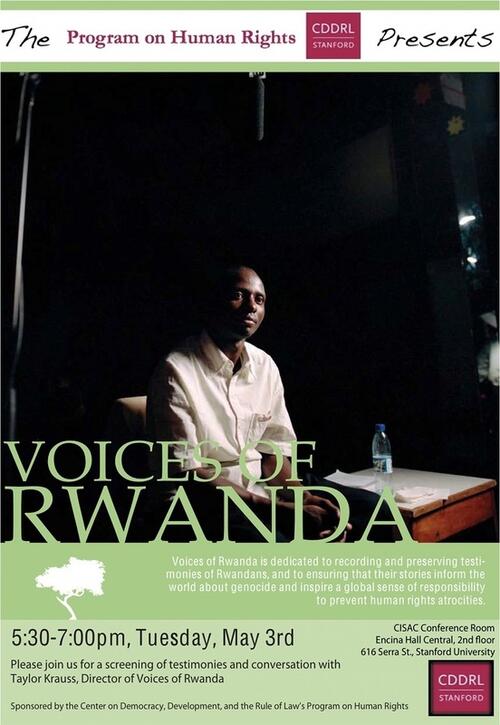
On May 3, 2011, the Program on Human Rights at CDDRL hosted Taylor Krauss, executive director of Voices of Rwanda and an award-winning video-journalist. Krauss screened a short film of testimonies from survivors of the Rwandan genocide to a rapt audience of 40 at the CISAC Central Conference room in Encina Hall. Learn more about Voices of Rwanda and view clips of testimony at http://www.voicesofrwanda.org.

All News button
1
Paragraphs

This paper was prepared for Stanford University’s Global Food Policy and Food Security Symposium Series, hosted by the Center on Food Security and the Environment, and supported by the Bill and Melinda Gates Foundation.


Sub-Saharan Africa (SSA) is home to two-thirds of the world’s ultra-poor today. This paper offers current thinking on the structural causes of the spatially concentrated, persistent ultra-poverty that has plagued Africa for a generation and some key entry points for facilitating Africans’ escape from persistent ultra-poverty.

The increased recognition of persistent ultra-poverty has rekindled long-dormant interest in poverty traps. The essence of a poverty trap is that there exists one or more low equilibrium level(s) of well-being in which people appear caught unnecessarily. Small adjustments fail to move people out of those equilibria sustainably. Rather, systems must change, major positive shocks must occur, or both. And in the absence of systemic change, recurring adverse shocks only drive more people into the trap.

The ultra-poverty trap that characterizes much of rural SSA today is intimately caught up with (i) the bidirectional interrelationship among hunger, ill-health, low productivity, weak institutions and natural resources degradation, all of which become manifest in low incomes, (ii) poor initial conditions associated with health and nutrition, especially early in childhood, but also with the state of infrastructure and the natural resource base on which rural livelihood disproportionately depend, and (iii) uninsured risk exposure, which is especially severe in rural areas and in agriculture. The closely coupled nature of these problems adds substantially to the challenge of addressing any one of them on its own and thereby makes integrated strategies essential. 

The available theory and evidence suggests that the policy focus must fall squarely on stimulating a smallholder food productivity revolution. Toward that end, the paper concludes by identifying and explaining key entry points for assisting the escape from persistent ultra-poverty in sub-Saharan Africa.

  1. Build and protect the productive asset endowments of the ultra-poor
  2. Improve the productivity of the ultra-poor’s current asset holdings
  3. Improve risk management options for the ultra-poor
  4. Facilitate favorable transitions out of agriculture

Although the topic of persistent ultra-poverty would seem to lend itself to a pessimistic ending, the future for Africa is actually rather hopeful. The East Asian experience demonstrates that mass, rapid escape from persistent ultra-poverty is feasible. Real agricultural output growth rates are accelerating in SSA, nearly doubling from the 1980s rate so that per capita food output is growing again, helping reduce rural poverty rates in countries enjoying increased agricultural productivity. Finally, the  policymaking and donor communities are now appropriately focusing on how best to stimulate investment incentives, productivity growth, risk management and productive transitions out of agriculture. These broad foci are appropriate and reasonably well-grounded in both theory and empirical evidence.  

All Publications button
1
Publication Type
Books
Publication Date
Journal Publisher
Center on Food Security and the Environment
Authors
News Type
News
Date
Paragraphs

 
Shadi Bushra
 
Colin Casey
 
Nicholas DugdaleContent-Disposition: form-data; name="preferredphoto3"

1
Nicholas Dugdale
 
Roxana Gharegozlou
Roxana Gharegozlou
 
Daniel Mattes

Daniel Mattes
 
Jack Mosbacher
Jack Mosbacher
 
Jenna Nicholas
Jenna Nicholas
 
Daniel Ong
Daniel Ong
 
Annamaria Prati
Annamaria Prati
 
Otis Reid

The Center on Democracy, Development, and the Rule of Law (CDDRL) at Stanford University is pleased to announce the 2012 class of Senior Honors Students. This marked the first year that CDDRL is officially an interdisciplinary honors program, allowing the Center to reach beyond the traditional international relations discipline and recruit students from computer science, economics, political science, history, and beyond.

The 2012 class is composed of 12 remarkable juniors with a global footprint and social conscious, who are interested in undertaking significant research in areas examining civil society in Sudan, Uganda's emerging oil economy, technology's impact on democracy, and transnational justice, among others. This diverse cohort was selected from among a competitive pool of applicants for the opportunity to join the CDDRL scholarly community for the 2011-12 academic year.

Honors students will spend four quarters participating in research seminars to refine their proposed thesis topic, while working in consultation with a CDDRL faculty advisor to supervise their project. In September, the group will travel to Washington DC for honors college where they will visit leading government and development organizations to witness policymaking in practice and consult with key decision-makers.

Please join CDDRL in congratulating the 2012 Senior Honors students and welcoming them to the Center.

Below are profiles of our 12 honors students highlighting their academic interests, what brought them to apply to CDDRL, and some fun facts.  


Mitul Bhat
Mitul Bhat

Major: Economics, International Relations

Hometown: New Delhi

Perspective thesis topic: Relationship between income inequality and corruption in Latin America

What interests you about the field of Democracy, Development, and Rule of Law? I was lucky enough to grow up in several different countries, which I think gave me a very real awareness of how different economic development is across and even within countries. I want to better understand why the discrepancies exist and what can be done to help the people who suffer most from global inequity. I recognize that this is a multifaceted issue, with obstacles and potential solutions in government, civil society, the business sector, and elsewhere, and this is why I am interested in the combined field of Democracy, Development and the Rule of Law.

Why you are excited about joining the CDDRL community? I am drawn to the interdisciplinary nature of the Center -- an issue like development, in which I am particularly interested, cannot be solved through Political Science or Economics methods alone and so I can learn about the topic in a more well-balanced way. The chance to interact with professors and fellow students who are engaged in interesting work across all aspects of the field of democracy, development, and the rule of law, appeals to me as well.

Future aspiration post-Stanford: Work in the field of development economics

Fun fact about yourself: I have never broken a bone.


Shadi Bushra
Shadi Bushra

Major: International Relations/ Human Biology

Hometown: Khartoum, Sudan; Savage, MN

Perspective thesis topic: How can youth movements in Sudan promote democracy and government accountability?

What interests you about the field of Democracy, Development, and Rule of Law? The process of democratization is one of the most studied and least uniform among any of political science's many subfields. It has been proven to be correlated with greater welfare, higher standards of living, peace and more responsive government. Yet despite these documented effects, a large portion of the world is living under faux-democratic or authoritarian governments.

More personally, my own family left Sudan in the early years of the Bashir regime because my father was a political activist, although we return for summers. Having seen the first-hand effects of such repression on individuals and communities I am very interested in how democracy can be spread to those places where it is least likely. I think my country of Sudan is a good place to start.

Why you are excited about joining the CDDRL community? CDDRL boasts some of the greatest scholars in the field of democracy. It will be an honor and a pleasure to tap the Center's resources and minds to further my own understanding and research in the field.

Future aspiration post-Stanford: Perhaps working in journalism in Africa or the Middle East. Other options include working with an NGO or the UN in the aforementioned regions.


Fun fact about yourself: I love watching and practicing boxing, Brazilian jiu-jitsu and mixed martial arts. I'm also a budding photography enthusiast.


Colin Casey
Colin Casey

Major: Political Science

Hometown: Annapolis, Maryland

Perspective thesis topic: Political Economy of Conflict and Transition in Sudan

What interests you about the field of Democracy, Development, and Rule of Law?Throughout my time at Stanford I have been moved by both the remarkable successes and dramatic failures of economic development and political transformation across the globe. My work both inside and outside the classroom has forced me to confront the fact that today newspapers are filled with stories of both healthy political discourse and nation-sweeping political upheaval, of civil stability and civil war, of fabulous wealth and stunning poverty. The field of Democracy, Development, and Rule of Law has captivated my interest, therefore, not only because it is intellectually challenging but also because the questions that define it are critical to the well-being of people all over the world. Having the chance to explore these questions with the CDDRL program is an honor and a privilege.

Why you are excited about joining the CDDRL community? The opportunity to write an honors thesis with at CDDRL is an opportunity to explore, to engage, and to grapple. It is an opportunity to build upon the work I have done and to deepen my understanding of the work I will do. It is an opportunity to apply my love for critical thinking and problem solving, to journey further into the fascinating complexities of the developing world, and to face off with the awesome challenges of political and economic transformation. And because it provides me the privilege of utilizing extensive resources, working hands-on with leaders of the academic world, and sharing thoughts and theories on issues of global importance with other smart and passionate students, it is an opportunity that thrills me.

Future aspiration post-Stanford: After I graduate, I hope to work in the international development field. There are a number of organizations that are finding new and creative ways to stimulate emerging markets through investment and micro-finance, but the industry as a whole still suffers from structural inefficiencies, and there is great progress to be made both in terms of identifying viable and profitable enterprises and unleashing the enormous potential of the developing world.

Fun fact about yourself: Last summer, I rode my bike across the country from New Jersey to  California to raise money for the Valentino Achak Deng Foundation, a San Francisco based organization that is building a school in Southern Sudan. 


Nicholas DugdaleContent-Disposition: form-data; name="preferredphoto3"

1
Nicholas Dugdale
Nick Dugdale

Major: Political Science and Classics

Hometown: Corte Madera, CA

Perspective thesis topic: Tax Evasion in Greece (more specifically: what social, political, and economic factors promote widespread tax evasion, particularly in the Greek context)

What interests you about the field of Democracy, Development, and Rule of Law?

Why you are excited about joining the CDDRL community? CDDRL provides an amazing  opportunity to work closely with the leading scholars in the field, as well as to collaborate with other students who share similar interests. 

Future aspiration post-Stanford: Work in the international development field for the UN or a similar organization 

Fun fact about yourself: I am a competitive sailor and have represented the US at 3 world championships.


Roxana Gharegozlou
Roxana Gharegozlou
Roxana Gharegozlou

Major: International Relations

Hometown: Tehran, Iran/ Vancouver, Canada

Prospective thesis topic: Transitional Justice: Assessing the Impact of Truth Commissions

What interests you about the field of Democracy, Development, and Rule of Law? The range of salient issues that the field encompasses and its potential to break new ground in theory, practice, and policy formation. I am particularly interested in the linkages between human rights and governance.

Why you are excited about joining the CDDRL community? I am looking forward to being part of a global network of talented scholars and practitioners whose insights and experiences will be an invaluable resource as I move forward with my research into democracy, development, and the rule of law.

Future aspiration post-Stanford: Fieldwork in human rights

Fun fact about yourself: I am originally from the Qashqa'i tribe of Iran.


Daniel Mattes

Daniel Mattes
Daniel Mattes

Major: International Relations (Minor in Modern Languages - Italian and Arabic)

Hometown: San Francisco, California

Perspective thesis topic: The International Criminal Court and Efforts at Localization of its Mission

What interests you about the field of Democracy, Development, and Rule of Law? My interests continue to center on the Middle East and Africa, two regions with the worst human rights records and most tragic histories of conflict, but ones that also offer clear opportunities for reform, growth, and inspirational transformation. The rule of law, most directly pertinent to my thesis topic, is and will continue to be a vital facet in encouraging domestic and global societies to respect the rights of their people. This field is filled with arduous challenges as well as tremendous opportunities that surface each day in the current events facing the world.


Why you are excited about joining the CDDRL community? The program at CDDRL offers a tremendous opportunity in the form of a smaller student group that is motivated for discussion, analysis, and research by the dynamic professors with whom they work, the great resources available to them by the Center, and their own personal desire to not only observe but also impact the world. I want a pragmatic and useful thesis that contributes to the creation of strong human rights protections and hope where there currently is none. CDDRL, its resources, and the faculty offer me such an opportunity.

Future aspiration post-Stanford: I would love to spend some more time in Italy (following my six months in Florence), but even more, I want to travel around the Middle East and Africa, both for personal interest and for career/academic opportunities. After that, I’m open to any opportunity that comes my way – whether that is law or graduate school, a job, or even the Peace Corps.


Fun fact about yourself: I live in a house called the Enchanted Broccoli Forest.


Hava Mirell

Major: History and the Law

Hometown: Los Angeles, CA

Perspective thesis topic: The Impact of International Diplomatic Pressure on Zimbabwe

What interests you about the field of Democracy, Development, and Rule of Law?  As a history major focusing on Southern Africa, I'm constantly studying successful and unsuccessful democracies, failed development projects, and the complete absence of the rule of law. After studying these topics for the past three years and spending six months in South Africa, I want to use the CDDRL Honors Program to finally understand from a political science perspective why it is that democracy has or has not succeeded in Southern Africa, why corruption is so prevalent, and how we can improve economic growth in the region. 

Why you are excited about joining the CDDRL community? I'm excited to join the CDDRL community because of the incredible resources, especially the brilliant faculty, that the Center offers. Nowhere else on campus can you ask a question about governance in Zimbabwe and receive a response from one of the leading experts on this topic. Just the opportunity to talk to the CDDRL faculty, let alone actually work with them and have them as advisors, is unbelievable. I'm beyond excited for the upcoming year.  

Future aspiration post-Stanford: International human rights lawyer

Fun fact about yourself: I've never seen The LIttle Mermaid.


Jack Mosbacher
Jack Mosbacher
Jack Mosbacher

Major: Political Science

Hometown: Woodside, CA

Perspective thesis topic: The Implications of Uganda's Emerging Oil Economy

What interests you about the field of Democracy, Development, and Rule of Law? I am most interested in the emphasis on policy-making and the constantly evolving scholarship in this very contemporary area of academia.


Why you are excited about joining the CDDRL community? I am so excited to have the opportunity to work one-on-one with the wonderful researchers in the CDDRL community and to be a part of the international effort to promote improved governance and substantive rule of law in some of the world's darkest places.

Future aspiration post-Stanford: Chaplain in US Army.


Fun fact about yourself: I play on the baseball team at Stanford - but I also love musical theater and opera.


Jenna Nicholas
Jenna Nicholas
Jenna Nicholas           

Major: International Relations

Hometown: London

Perspective thesis topic: What is the genesis, evolution and apparent trajectory of Chinese philanthropy, non-profits and social enterprise in China?

What interests you about the field of Democracy, Development, and Rule of Law? I think that often democracy, development and the rule of law are considered as independent entities but they are deeply interconnected with one another. As we promote any one of them, it is essential that we consider the causal effects on the other two.

Why you are excited about joining the CDDRL community? I am really excited about engaging with people who are all working on different areas of study and are willing and interested to share their research with each other. As we embark on trying to understand the complexities of democracy, development and the rule of law, it is fascinating to reflect upon cross-disciplinary approaches to issues, innovation of thoughts and ideas whilst at the same time appreciating consensus and respecting divergence of views.

Future aspiration post-Stanford: I am very interested in the integration of business with societal issues which leads to fields such as philanthro-capitalism, social entrepreneurship, micro-finance and venture philanthropy. I am particularly interested in models of organization which facilitate cooperative research and develop metrics of success in the developmental field. I intend to find a role for myself somewhere at the forefront of creative development which will have an impact on the world.


Fun fact about yourself: When I was 12 years old, I spoke on behalf of the Baha’i faith on the importance of protecting the environment for Commonwealth Day at Westminster Abbey. Before the event I was talking to Desmond Tutu and he gave me a high five for being cheeky! Recently I met him again at the Skoll World Forum and reminded him of our last encounter. This time he gave me two high fives and a hug!  


Daniel Ong
Daniel Ong
Daniel Ong

Major: Computer Science

Hometown: Facebook

Physical Hometown: Singapore

Perspective thesis topic: How technology (mobile phones, email, twitter/fb) is changing the way social consciousness is formed- and how that affects democratic processes.

What interests you about the field of Democracy, Development, and Rule of Law? I may be majoring in a very different field, but the issues and questions that DDRL constantly visits are ones which come up constantly in my mind. If there was more time, I would have double majored in Political Science and CS- but right now, I'm focused on learning all I can and seeing how I can use technology to make things better.


Why you are excited about joining the CDDRL community? The conversations, and the chance to bounce ideas and thoughts off people who have so much domain knowledge in these areas. Just the chance to learn from them, and refine my ideas is invaluable in itself.


Future aspiration post-Stanford: Entrepreneur-in-Government, or startup


Fun fact about yourself: I am a machine which turns coffee into code (and hopefully, a thesis paper)


Annamaria Prati
Annamaria Prati
Annamaria Prati

Major: International Relations

Hometown: Mountain View, California

Perspective thesis topic: United Nations Electoral Assistance

What interests you about the field of Democracy, Development, and Rule of Law? This field works to answer some of the most pertinent questions of our time and can have widespread implications for the greater world.

Why you are excited about joining the CDDRL community? It is a great community of scholars that is working on incredibly interesting projects. CDDRL has shown me that research does not mean looking down from an ivory tower, and I am looking forward to learning more.

Future aspiration post-Stanford: Going to grad school

Fun fact about yourself: I play the harp


Otis Reid
Otis Reid

Major: Public Policy and Economics

Hometown: Chapel Hill, NC

Perspective thesis topic:  Regulatory Development and Stock Market Effectiveness in Ghana

What interests you about the field of Democracy, Development, and Rule of Law?  Development is, in my opinion, the central challenge of our time. I'm very excited about having the chance to help contribute to our knowledge of this field and ultimately to help accelerate the development process, especially in Sub-Saharan Africa. Given the interconnections between development, governance, and accountability, being at a center that looks at all three is particularly interesting.

Why you are excited about joining the CDDRL community? Honestly, it was the T-shirt that really got me ("Democracy Never Looked So Good"). No, more seriously, I'm very excited to have a chance to build more relationships across the different disciplines of democracy, development, and governance and to see how research can help to drive policy.

Future aspiration post-Stanford: After Stanford, I want to enter the policy-making community around development. I'm interested in the intersection of development and security, so I'd ultimately love to have a position on the National Security Council helping to coordinate development policy. (Professor Jeremy Weinstein's current position on the NSC is a model for the type of position that I'd like to hold.)

Fun fact about yourself: I spent my seventh grade year living in Paris, France - the second most time I've spent outside the country is last summer, which I spent in Accra, Ghana.

Hero Image
encina 4x6
All News button
1
Subscribe to Sub-Saharan Africa