-

Image
header for Technology and Geopolitics: EU Proposals for Regulating Rights, Security and Trade

The future of technology policy in Europe will be affected by growing nationalism and protectionism, cyber and national security threats, and great power rivalries. The Program on Democracy and the Internet invites you to a technology policy discussion led by International Policy Director, Marietje Schaake. Join us on September 16th from 9 AM - 12 PM PST (6 PM - 9 PM CET), as we dive into conversations on EU legislative packages, digital trade rules, and cybersecurity & geopolitics. We hope to develop a more precise understanding of how the EU and its allies can collaborate to create compatible technology standards, build more resilient supply chains, and address novel opportunities and risks presented by emerging technologies.This event is organized by the Program on Democracy and the Internet (part of the Cyber Policy Center and the Center on Philanthropy and Civil Society) and co-sponsored by the Institute for Human-Centered Artificial Intelligence.

Moderators: 


Speakers:


Seminars
-

About the Seminar: Africa arguably poses some of the most challenging conditions for democratic emergence and survival.  According to our existing theories, this is due to a number of economic, social, geographic factors, and institutional legacies of predatory neo-colonial states. Yet three decades of democratic endurance in significant, key cases suggest that the continent has much to teach us about how democracies maintain despite extremely challenging conditions. And the wave of global democratic backsliding has particular contours across the continent that illuminate how democratic institutions are utilized for autocratization, and with what constraints. This research project explores two most-different cases – South Africa and Benin – with highly diverse challenges and yet strikingly similar pathways to establish and maintain democracy against all odds, and the contemporary challenges that are pushing both to autocratic concessions.


Image
rachel_beatty_riedl.jpg
About the Speaker: Rachel Beatty Riedl (PhD Princeton University) is the John S. Knight Professor of International Studies, Director of the Einaudi Center for International Studies, and professor in the Department of Government at Cornell University. Her research interests include institutional development in new democracies, local governance and decentralization policy, authoritarian regime legacies, and religion and politics, with a regional focus in Africa. Previously, she was an Associate Professor in the Department of Political Science, Faculty Fellow in the Institute for Policy Research, and Director of the Program of African Studies at Northwestern University. Riedl is co-host of the podcast Ufahamu Africa, featuring weekly episodes of news highlights and interviews about life and politics on the African continent.

Online, via Zoom

Rachel Beatty Riedl Cornell University, John S Knight Professor of International Studies
Seminars
-

About the Seminar: US response to 9/11 included a major focus on peace building through democracy promotion. The seminar examines the rationale and milestones for American engagement in distant lands. How will such an approach work in future foreign policy implementation is also discussed with some conclusions about future engagement.


For Fall Quarter 2021, we will be hosting a hybrid weekly Research Seminar Series. All events will be open to the public online via Zoom, and a limited-capacity in-person element for Stanford affiliates may be added in accordance with the County's health and safety guidelines.


Image
Shirin Tahir-Kheli
About the Speaker: Dr. Shirin Tahir-Kheli is a Senior Fellow and Founding Director of the South Asia Program at the Foreign Policy Institute of the Johns Hopkins University School of Advanced International Studies (SAIS). In 2011, Tahir-Kheli was named by Newsweek as one of the "150 Women Who Shake the World." She specializes in South Asia, nuclear non-proliferation, United Nations and U.S. foreign policy, and women's empowerment.

She is the author and editor of several monographs, including Pakistan Today: The Case for U.S.-Pakistan Relations (with Shahid Javed Burki, Foreign Policy Institute, 2017); Manipulating Religion for Political Gain in Pakistan: Consequences for the U.S. and the Region (Foreign Policy Institute, 2015); and India, Pakistan and the United States: Breaking with the Past (Council on Foreign Relations, 1997).

Democracy Promotion in U.S. Foreign Policy: Looking Back, Looking Forward
Download pdf

Online, via Zoom

Shirin Tahir-Kheli Ambassador & Senior Fellow, Foreign Policy Institute, Johns Hopkins School of Advanced International Studies, Washington DC Organization
Seminars
Authors
Mark C. Thurber
News Type
News
Date
Paragraphs

PESD Associate Director Mark Thurber co-authored a new paper in The Electricity Journal on the electricity grid improvements that are needed to unlock the full potential of wind and solar energy in Africa. Donors and development agencies need to devote more attention to these missing pieces, rather than assuming that bans on fossil fuel financing alone will spur the desired transition to cleaner energy. 

Hero Image
getty poverty africa
Getty Images
All News button
1
Paragraphs

Whether the targets are local governments, hospital systems, or gas pipelines, ransomware attacks in which hackers lock down a computer network and demand money are a growing threat to critical infrastructure. The attack on Colonial Pipeline, a major supplier of fuel on the East Coast of the United States, is just one of the latest examples—there will likely be many more. Yet the federal government has so far failed to protect these organizations from the cyberattacks, and even its actions since May, when Colonial Pipeline was attacked, fall short of what’s necessary.

Read more 

All Publications button
1
Publication Type
Commentary
Publication Date
Subtitle
Op-ed in Bulletin of the Atomic Scientists, by Gregory Falco and Sejal Jhawer
Authors
-

With the rise of national digital identity systems (Digital ID) across the world, there is a growing need to examine their impact on human rights. While these systems offer accountability and efficiency gains, they also pose risks for surveillance, exclusion, and discrimination. In several instances, national Digital ID programmes started with a specific scope of use, but have since been deployed for different applications, and in different sectors. This raises the question of how to determine appropriate and inappropriate uses of Digital ID programs, which create an inherent power imbalance between the State and its residents given the personal data they collect.

On Wednesday, June 23rd @ 10:00 am Pacific Time, join Amber Sinha of India’s Center for Internet and Society (CIS), Anri van der Spuy of Research ICT Africa (RIA) and Dr. Tom Fischer of Privacy International in conversation with Kelly Born, Director of the Hewlett Foundation’s Cyber Initiative and fellow at Stanford’s Cyber Policy Center, to discuss the challenges and opportunities posed by digital identity systems, a proposed framework for assessing trade-offs and ensuring that human rights are adequately protected, and a discussion of experiences in translating and adapting new digital ID assessment framework by CIS and RIA to different contexts and geographies.

Amber Sinha 
Anri van der Spuy
Dr. Tom Fischer 
Kelly Born
Authors
News Type
News
Date
Paragraphs

Despite important agricultural advancements to feed the world in the last 60 years, a new study shows that global farming productivity is 21% lower than it could have been without climate change. This is the equivalent of losing about seven years of farm productivity increases since the 1960s.

The future potential impacts of climate change on global crop production has been quantified in many scientific reports, but the historic influence of anthropogenic climate change on the agricultural sector had yet to be modeled. Now, a new study published April 1 in Nature Climate Change provides these insights. 

David Lobell, professor of earth system science at Stanford University and coauthor of the study, said that the results show clearly that adaption efforts must look at the whole supply chain, including labor and livestock. “They also show that even as agriculture becomes more mechanized and sophisticated, the sensitivity to weather does not go away,” he said. “This is counter-intuitive for most people, and we need a deeper understanding of why.”

“We find that climate change has basically wiped out about seven years of improvements in agricultural productivity over the past 60 years,” said Ariel Ortiz-Bobea, associate professor in the Charles H. Dyson School of Applied Economics and Management at Cornell University and lead author of the study. “It is equivalent to pressing the pause button on productivity growth back in 2013 and experiencing no improvements since then. Anthropogenic climate change is already slowing us down.”

The scientists and economists developed an all-encompassing econometric model linking year-to-year changes in weather and productivity measures with output from the latest climate models over six decades to quantify the effect of recent human-caused climate change on what economists call “total factor productivity,” a measure capturing overall productivity of the agricultural sector.

Ortiz-Bobea said they considered more than 200 systematic variations of the econometric model, and the results remained largely consistent. “When we zoom into different parts of the world, we find that the historical impacts of climate change have been larger in areas already warmer, including parts of Africa, Latin America and Asia,” he said.

Humans have already altered the climate system, Ortiz-Bobea said, as climate science indicates the globe is about 1 degree Celsius warmer than without atmospheric greenhouse gases.

“Most people perceive climate change as a distant problem,” Ortiz-Bobea said. “But this is something that is already having an effect. We have to address climate change now so that we can avoid further damage for future generations.”

Ortiz-Bobea and Robert G. Chambers, professor of production economics at the University of Maryland, have been pioneering new productivity calculations in agriculture to include weather data that has not been addressed historically, aiming to bring new accuracy to climate models.

“Productivity is essentially a calculation of your inputs compared to your outputs, and in most industries, the only way to get growth is with new inputs,” Chambers said. “Agricultural productivity measurement hasn’t historically incorporated weather data, but we want to see the trends for these inputs that are out of the farmer’s control.” 

“My sense is that we are just getting better at eliminating all the non-weather constraints on production, but we need to scrutinize various possible explanations,” said Lobell, who examines the impact of climate change on crop production and food security. “This study is a big leap beyond the traditional focus on a few major grain crops,” he said. “By looking at the whole system – the animals, the workers, the specialty crops – we can see that the entire agricultural economy is quite sensitive to weather. It seems that in agriculture, practically everything gets harder when it’s hotter.”


In addition to Ortiz-Bobea, Chambers and Lobell, the co-authors are Toby R. Ault, professor of earth and atmospheric sciences in the College of Agriculture and Life Sciences; and Carlos M. Carrillo, research associate in the Department of Earth and Atmospheric Science. 

Funding was provided by USDA National Institute of Food and Agriculture and the National Science Foundation.


Media Contacts: 

Blaine Friedlander, bpf2@cornell.edu, 607-254-8093

Devon Ryan, devonr@stanford.edu, 650-497-0444

Hero Image
Hills of tilled grain in South Africa
All News button
1
-

Image
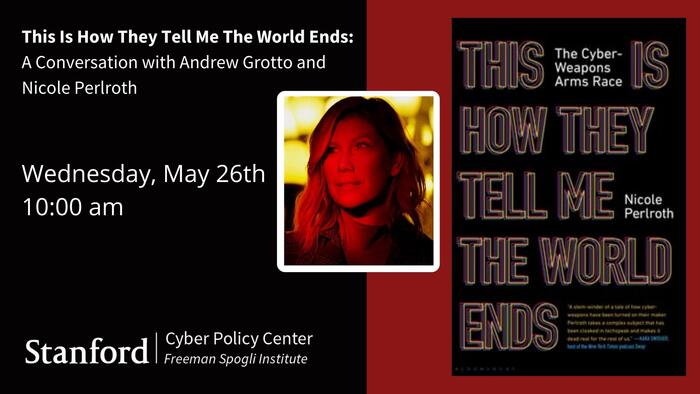
this is how they tell me the world ends event at cyber policy center

On Wednesday, May 26 at 10 am pacific time, please join Andrew Grotto, Director of Stanford’s Program on Geopolitics, Technology and Governance, for a conversation with Nicole Perlroth, New York Times Cybersecurity Reporter, about the underground market for cyber-attack capabilities.

In her book “This Is How They Tell Me the World Ends: The Cyberweapons Arms Race,” Perlroth argues that the United States government became the world's dominant hoarder of one of the most coveted tools in a spy's arsenal, the zero-day vulnerability. After briefly cornering the market, in her account, the United States then lost control of its hoard and the market.

Perlroth and Grotto, a former Senior Director for Cybersecurity Policy at the White House in both the Obama and Trump Administrations, will talk about the development and evolution of this market, and what it portends about the future of conflict in cyberspace and beyond.

This event is co-sponsored by the Freeman Spogli Institute for International Studies and the Cyber Policy Center.

Praise for “This Is How They Tell Me the World Ends”: “Perlroth's terrifying revelation of how vulnerable American institutions and individuals are to clandestine cyberattacks by malicious hackers is possibly the most important book of the year . . . Perlroth's precise, lucid, and compelling presentation of mind-blowing disclosures about the underground arms race a must-read exposé.” —Booklist, starred review

CISAC
Stanford University
Encina Hall, C428

Stanford, CA 94305-6165

(650) 723-9866
0
Andrew Grotto

Andrew J. Grotto is a research scholar at the Center for International Security and Cooperation at Stanford University.

Grotto’s research interests center on the national security and international economic dimensions of America’s global leadership in information technology innovation, and its growing reliance on this innovation for its economic and social life. He is particularly interested in the allocation of responsibility between the government and the private sector for defending against cyber threats, especially as it pertains to critical infrastructure; cyber-enabled information operations as both a threat to, and a tool of statecraft for, liberal democracies; opportunities and constraints facing offensive cyber operations as a tool of statecraft, especially those relating to norms of sovereignty in a digitally connected world; and governance of global trade in information technologies.

Before coming to Stanford, Grotto was the Senior Director for Cybersecurity Policy at the White House in both the Obama and Trump Administrations. His portfolio spanned a range of cyber policy issues, including defense of the financial services, energy, communications, transportation, health care, electoral infrastructure, and other vital critical infrastructure sectors; cybersecurity risk management policies for federal networks; consumer cybersecurity; and cyber incident response policy and incident management. He also coordinated development and execution of technology policy topics with a nexus to cyber policy, such as encryption, surveillance, privacy, and the national security dimensions of artificial intelligence and machine learning. 

At the White House, he played a key role in shaping President Obama’s Cybersecurity National Action Plan and driving its implementation. He was also the principal architect of President Trump’s cybersecurity executive order, “Strengthening the Cybersecurity of Federal Networks and Critical Infrastructure.”

Grotto joined the White House after serving as Senior Advisor for Technology Policy to Commerce Secretary Penny Pritzker, advising Pritzker on all aspects of technology policy, including Internet of Things, net neutrality, privacy, national security reviews of foreign investment in the U.S. technology sector, and international developments affecting the competitiveness of the U.S. technology sector.

Grotto worked on Capitol Hill prior to the Executive Branch, as a member of the professional staff of the Senate Select Committee on Intelligence. He served as then-Chairman Dianne Feinstein’s lead staff overseeing cyber-related activities of the intelligence community and all aspects of NSA’s mission. He led the negotiation and drafting of the information sharing title of the Cybersecurity Act of 2012, which later served as the foundation for the Cybersecurity Information Sharing Act that President Obama signed in 2015. He also served as committee designee first for Senator Sheldon Whitehouse and later for Senator Kent Conrad, advising the senators on oversight of the intelligence community, including of covert action programs, and was a contributing author of the “Committee Study of the Central Intelligence Agency’s Detention and Interrogation Program.”

Before his time on Capitol Hill, Grotto was a Senior National Security Analyst at the Center for American Progress, where his research and writing focused on U.S. policy towards nuclear weapons - how to prevent their spread, and their role in U.S. national security strategy.

Grotto received his JD from the University of California at Berkeley, his MPA from Harvard University, and his BA from the University of Kentucky.

Research Scholar, Center for International Security and Cooperation
Director, Program on Geopolitics, Technology, and Governance
Date Label
Nicole Perlroth
Authors
Austin Cooper
News Type
News
Date
Paragraphs

In January, the French historian Benjamin Stora filed a report commissioned by the French President Emmanuel Macron aimed at “reconciliation of memories between France and Algeria,” which France ruled as the jewel of its colonial empire for more than 130 years.

Read the rest at Bulletin of the Atomic Scientists

Hero Image
Director of nuclear experiment center, General Jean Thiry, pressing a button to trigger the explosion of the third French atomic bomb at the Reggane test site in the Algerian Sahara, December 27, 1960
Director of nuclear experiment center, General Jean Thiry, pressing a button to trigger the explosion of the third French atomic bomb at the Reggane test site in the Algerian Sahara, December 27, 1960 | AFP/Getty Images
All News button
1
Subtitle

French President Emmanuel Macron commissioned a report aimed at “reconciliation of memories between France and Algeria,” which France ruled as the jewel of its colonial empire for more than 130 years. The Stora Report addressed several scars from the Algerian War for Independence and still comes up short of a clear path toward nuclear reconciliation.

Subscribe to Sub-Saharan Africa