
Technology
Authors
News Type
News
Date
Paragraphs

Motivation & Overview


India’s services sector is internationally renowned and has helped propel the country’s economic growth. Indeed, in recent years, a majority of the value added to India’s GDP has been concentrated in services. Especially noteworthy are India’s software and computing services, which include large multinational conglomerates like Infosys and Tata Communications Services. 

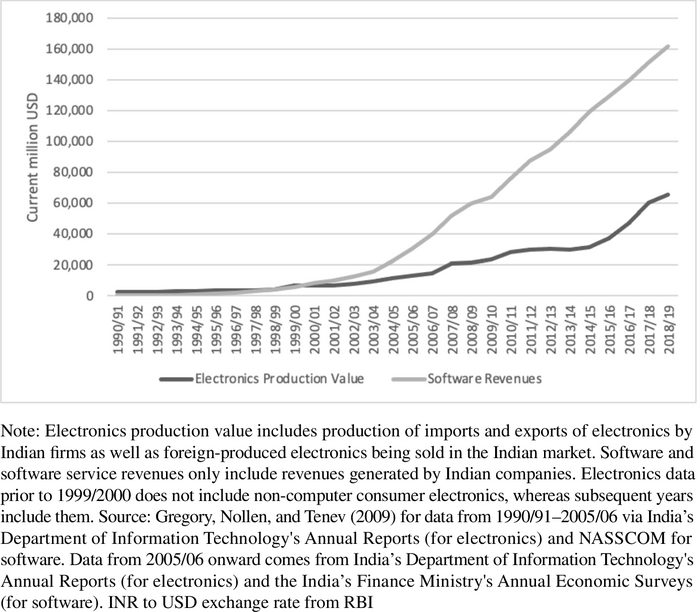
Yet as Indian software has flourished, the growth of its computer hardware and manufacturing has been sluggish. Tellingly, India is still a net importer of hardware and other electronics. At first glance, this divergence is puzzling because both the software and hardware sectors should have benefited from India’s educated labor pool and infrastructure. How can these different sectoral outcomes be explained?


Image
Fig. 1: Electronics production value compared to software and software service revenues


Fig. 1: Electronics production value compared to software and software service revenues.


In “Comparing Advantages in India’s Computer Hardware and Software Sectors,” Dinsha Mistree and Rehana Mohammed offer an explanation in terms of state capacity to meet the different functional needs of each sector. Their account of India’s computing history emphasizes the inability of various state ministries and agencies to agree on policies that would benefit the hardware sector, such as tariffs. Meanwhile, cumbersome rulemaking procedures inherited from British colonialism impeded the state’s flexibility. Although this disadvantaged India’s hardware sector, its software sector needed comparatively less from the state, building instead on international networks and the efforts of individual agencies.

The authors provide a historically and theoretically rich account of the political forces shaping India’s economic rise. The paper not only compares distinct moments in Indian history but also draws parallels with other landmark cases, like South Korea’s 1980s industrial surge. Such a sector-based analysis could be fruitfully applied to understand why different industries succeed or lag in emerging economies. 

Different Sectors, Different Needs


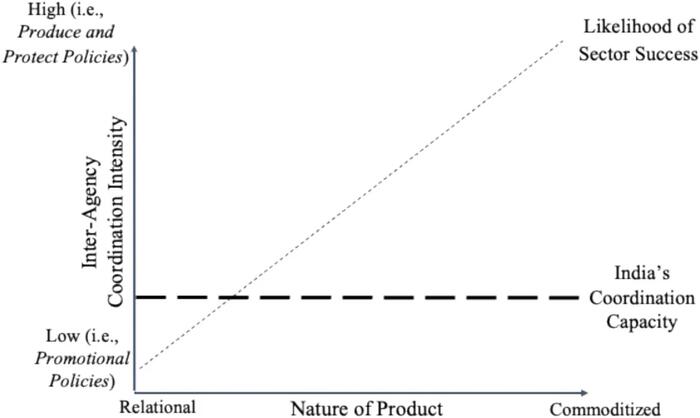
In order to become competitive — both domestically and (especially) internationally — hardware manufacturers often need much from the state, what the authors call a “produce and protect regime.” This can include the construction of factories and the formation of state-owned industries (SOEs), as well as tariffs to reduce competition or labor laws that restrict union strikes. Perhaps most importantly, manufacturers need a state whose legislators and bureaucrats can coordinate with each other in response to market challenges. Such a regime is incompatible with excessive “red tape” or with the “capture” of regulators by narrow interest groups. Because customers tend to view manufactured goods as “substitutable” with each other, firms will face intense competition as regards price and quality.


Image
Fig. 2: Inter-agency coordination required for sectoral success


Fig. 2: Inter-agency coordination required for sectoral success.


The situation is very different for service providers, whose success depends on building strong relationships with customers. States are not essential to this process, even if their promotional efforts can be helpful. Coordination across government agencies is similarly less important, as just one agency could provide tax breaks or host promotional events that benefit service providers. Compared with manufacturing, customers tend to view services as less substitutable — they are more intangible and customizable, which renders competition less fierce. Understanding India’s computing history reveals that the state’s inability to meet hardware manufacturers’ needs severely constrained the sector’s growth. 

The History of Indian Computing


Although India inherited a convoluted bureaucracy from the British Raj, the future of its computing industry in the 1960s seemed promising: political elites in New Delhi supported a produce-and-protect regime, relevant agencies and SOEs were created, and foreign computing firms like IBM successfully operated in the country. 

Yet by the 1970s, some bureaucrats and union leaders feared that automation would threaten the federal government’s functioning and India’s employment levels, respectively. Strict controls in both the public and private sectors were thus adopted, for example, requiring trade unions — which took a strong anti-computer stance — to approve the introduction of computers in specific industries. The authors make special mention of India’s semiconductor industry. It arguably failed to develop due to lackluster government investment, the need for manufacturers to obtain multiple permits across agencies, decision makers ignoring recommendations from specialized panels, and so on.

Meanwhile, implementing protectionist policies proved challenging. For example, decisions to allow the importation of previously banned components required permission from multiple ministries and agencies. After India’s 1970s balance-of-payments crisis, international companies deemed inessential were forced to dilute their equity to 40% and take on an Indian partner. IBM then left the Indian market. At the same time, SOEs faced growing competition over government contracts and workers, owing to the growth of state-level SOEs.

The mid-1980s represented a partial turning point as Rajiv Gandhi became Prime Minister and liberalized the computing industry. Within weeks, Rajiv introduced a host of new policies and shifted the government’s focus from supporting public sector production to promoting private firms, which would no longer face manufacturing limits and would be eligible for duty exemptions. Changes to tariff rates and import limits would not require approval from multiple agencies. Meanwhile, international firms reengaged with Indian markets via the building of satellite links, facilitating cross-continental work, such as between Citibank employees in Mumbai and Santa Cruz.

However, this liberalizing period was undermined and partially reversed after 1989, when Rajiv’s Congress Party (INC) lost its legislative majority and public policy became considerably more fragmented. Anti-computerization forces, especially the powerful Indian trade unions, worked to stymie Rajiv’s reforms. Pro-market reformists were forced out of their positions in Indian bureaucracies. Rajiv was assassinated in 1991, after which Congress formed a minority government with computer advocate P. V. Narasimha Rao as PM. Yet all of this occurred at a delicate time, as India was at risk of defaulting and had almost completely exhausted its foreign exchange.

By the late 1990s, both the hardware and software sectors should have benefited from the rising global demand for computers, yet India’s history of poor state coordination hindered manufacturers. Meanwhile, software firms were able to take advantage of global opportunities given their comparatively limited needs from state actors and political networks — for example, helping European Union banks change their computer systems to Euros. Ultimately, the Indian state has powerfully shaped the fortunes of these different sectors.

*Research-in-Brief prepared by Adam Fefer.

Hero Image
Monitor showing Java programming
Ilya Pavlov via Unsplash
All News button
1
Subtitle

CDDRL Research-in-Brief [4-minute read]
Date Label
-

Join the Gordian Knot Center for National Security Innovation as they bring together leaders from government, industry, and academia to explore how emerging technologies are shaping global power dynamics and security. The event will feature a day of student-run panels, cutting-edge discussions, networking, and insights into the future of innovation and defense.

Frances C. Arrillaga Alumni Center
326 Galvez St, Stanford, CA 94305

Conferences
Date Label
Paragraphs

Recent reporting on Meta’s internal AI guidelines serves as a stark reminder that the rules governing AI behaviors are frequently decided by a small group of the same people, behind closed doors. The sheer scale of work every AI company grapples with, from determining ethics and mapping acceptable behaviors to enforcing content policies, affects millions of people through processes that the public has no visibility into.

The truth is that these silos are constantly happening across the industry.

Tech policy, particularly AI policy, is often so complex and evolves so rapidly that everyday perspectives are not easily captured. As consumers, we’ve grown accustomed to a system where the most important decisions about technology governance happen in exclusive settings.

But what if we flipped the script? What if users helped create the rules?

All Publications button
1
Publication Type
Journal Articles
Publication Date
Journal Publisher
Tech Policy Press
Authors
Alice Siu
Paragraphs

American companies are world leaders in technology—be it innovative software, cloud services, artificial intelligence, or cybersecurity products. Yet beginning as many as three years ago, hackers believed to be backed by the Chinese government did something the United States, the tech powerhouse, could not adequately defend against: they gained and maintained access to major U.S. telecommunications networks, copying conversations and building the ability to track the movements of U.S. intelligence officers and law enforcement agents across the country. The attack, dubbed “Salt Typhoon,” constituted a large part of a global campaign against telecoms, and it penetrated systems at many U.S. carriers so thoroughly that officials will almost certainly never know the full scope of the capabilities China achieved to spy on Americans’ communications.

Salt Typhoon was more than a one-off intelligence success for China. It reflected a deeper, troubling reality. Mere decades after the widespread adoption of the Internet opened a new realm of geopolitical contestation, China is positioning itself to dominate the digital battle space. The United States has fallen behind, failing to secure a vast digital home front—and the physical assets that depend on it. Because cyberspace has no borders, the U.S. homeland is always in the fight. Every hospital, power grid, pipeline, water treatment plant, and telecommunications system is on the frontlines, and most of the United States’ critical infrastructure is unready for battle.

Continue reading at foreignaffairs.com.

All Publications button
1
Publication Type
Commentary
Publication Date
Subtitle

America Needs a New Strategy of Deterrence

Authors
0
CDDRL Honors Student, 2025-26
img_1259_3_-_emma_wang.jpg

Major: Political Science
Hometown: Naperville, Illinois
Thesis Advisor: Jonathan Rodden

Tentative Thesis Title: Broadband for All: Historical Lessons and International Models for U.S. Internet Policy

Future aspirations post-Stanford: After completing my master's in computer science, I hope to go to law school and work in technology law.

A fun fact about yourself: I started lion dancing when I came to college!

Date Label
News Type
News
Date
Paragraphs

Introduction


Generative AI has become an incredibly attractive and widespread tool for people across the world. Alongside its rapid growth, AI tools present a host of ethical challenges relating to consent, security, and privacy, among others. As Generative AI has been spearheaded primarily by large technology companies, these ethical challenges — especially as viewed from the vantage point of ordinary people — risk being overlooked for the sake of market competition and profit. What is needed, therefore, is a deeper understanding of and attention to how ordinary people perceive AI, including its costs and benefits.

The Meta Community Forum Results Analysis, authored by Samuel Chang, James S. Fishkin, Ricky Hernandez Marquez, Ayushi Kadakia, Alice Siu, and Robert Taylor, aims to address some of these challenges. A partnership between CDDRL’s Deliberative Democracy Lab and Meta, the forum enables participants to learn about and collectively reflect on AI. The impulse behind deliberative democracy is straightforward: people affected by some policy or program should have the right to communicate about its contents and to understand the reasons for its adoption. As Generative AI and the companies that produce it become increasingly powerful, democratic input becomes even more essential to ensure their accountability. 

Motivation & Takeaways


In October 2024, the third Meta Community Forum took place. Its importance derives from the advancements in Generative AI since October 2023, when the last round of deliberations was held. One such advancement is the move beyond AI chatbots to AI agents, which can solve more complex tasks and adapt in real-time to improve responses. A second advancement is that AI has become multimodal, moving beyond the generation of text and into images, video, and audio. These advancements raise new questions and challenges. As such, the third forum provided participants with the opportunity to deliberate on a range of policy proposals, organized around two key themes: how AI agents should interact with users and how they should provide proactive and personalized experiences for them.

To summarize some of the forum’s core findings: the majority of participants value transparency and consent in their interactions with AI agents as well as the security and privacy of their data. In turn, they are less comfortable with agents autonomously completing tasks if this is not transparent to them. Participants have a positive outlook on AI agents but want to have control over their interactions. Regarding the deliberations themselves, participants rated the forum highly and felt that it exposed them to alternative perspectives. The deliberators wanted to learn more about AI for themselves, which was evidenced by their increased use of these tools after the deliberations. Future reports will explore the reasoning and arguments that they used while deliberating.


Image
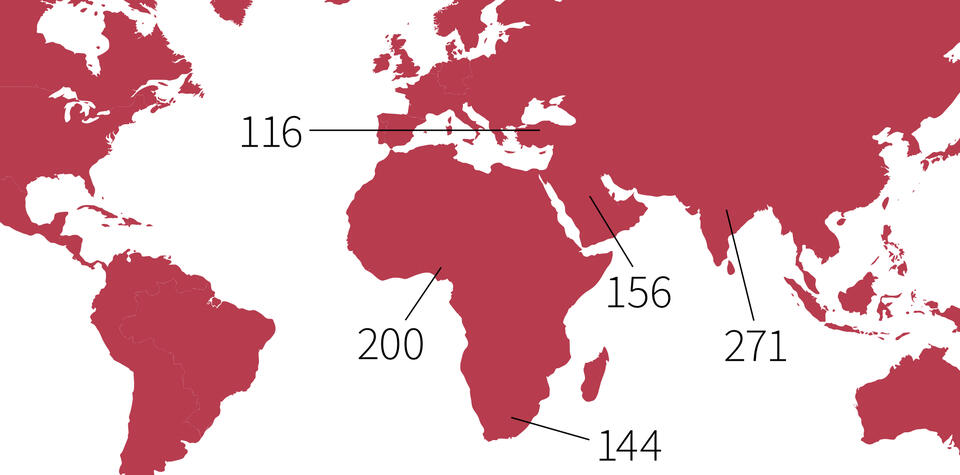
Map of where participants hailed from.


The participants of this Community Forum were representative samples of the general population from five countries - Turkey, Saudi Arabia, India, Nigeria, and South Africa. Participants from each country deliberated separately in English, Hindi, Turkish, or Arabic.


Methodology & Data


The deliberations involved around 900 participants from five countries: India, Nigeria, Saudi Arabia, South Africa, and Turkey. Participants varied in terms of age, gender, education, and urbanicity. Because the deliberative groups were recruited independently, the forum can be seen as five independent deliberations. Deliberations alternated between small group discussions and ‘plenary sessions,’ where experts answered questions drawn from the small groups. There were around 1000 participants in the control group, who did pre- and post-surveys, but without deliberating. The participant sample was representative with respect to gender, while the treatment and control groups were balanced on demography as well as on their attitudes toward AI. Before deliberating on the proposals, participants were presented with background materials as well as a list of costs and benefits to consider.

In terms of the survey data, large majorities of participants had previously used AI. There was a statistically significant increase in these proportions after the forum. For example, in Turkey, usage rates increased from nearly 70% to 84%. In several countries, there were large increases in participants’ sense of AI’s positive benefits after deliberating, as well as a statistically significant increase in their interest. The deliberations changed participants’ opinions about a host of claims; for example, “people will feel less lonely with AI” and “more proactive [agents] are intrusive” lost approval whereas “AI agents’ capability to increase efficiency…is saving many companies a lot of time and resources” and “AI agents are helping people become more creative” gained approval. After deliberating, participants demonstrated an improved understanding of some factual aspects of AI, although the more technical aspects of this remain challenging. One example here is AI hallucinations, or rather, the generation of false or nonsensical outputs, usually because of flawed training data.


Image
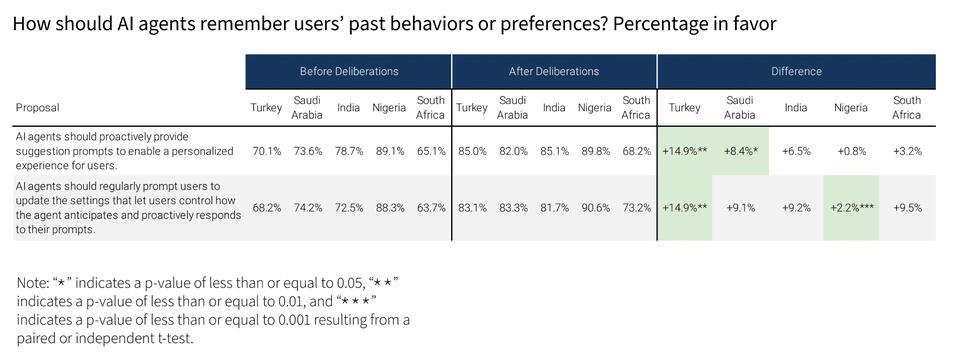
Chart: How should AI agents remember users' past behaviors or preferences? Percentage in favor


Proposals


Participants deliberated on nineteen policy proposals. To summarize these briefly: In terms of whether and how AI remembers users’ past behaviors and preferences, participants preferred proposals that allowed users to make active choices, as opposed to this being a default setting or only being asked once. They also preferred being reminded about the ability of AI agents to personalize their experience, as well as agents being transparent with users about the tasks they complete. Participants preferred that users be educated on AI before using it, as well as being informed when AI is picking up on certain emotional cues and responding in “human-like” ways. They also preferred proposals whereby AI would ask clarifying questions before generating output. Finally, when it comes to agents helping users with real-life relationships, this was seen as more permissible when the other person was informed. Across the proposals, gender was neither a significant nor consistent determinant of how they were rated. Ultimately, the Meta Community Forum offers a model for how informed, public communication can shape AI and the ethical challenges it raises.

*Research-in-Brief prepared by Adam Fefer.

 
Hero Image
Agentic AI Workflow Automation, Artificial intelligence AI driven decision-making concept illustration blue background
iStock / Getty Images
All News button
0
Subtitle

CDDRL Research-in-Brief [4-minute read]
Date Label
Paragraphs

In recent years, the previous bipolar nuclear order led by the United States and Russia has given way to a more volatile tripolar one, as China has quantitatively and qualitatively built up its nuclear arsenal. At the same time, there have been significant breakthroughs in the field of artificial intelligence (AI) technologies, including for military applications. As a result of these two trends, understanding the AI-nuclear nexus in the context of U.S.-China-Russia geopolitical competition is increasingly urgent.

There are various military use cases for AI, including classification models, analytic and predictive models, generative AI, and autonomy. Given that variety, it is necessary to examine the AI-nuclear nexus across three broad categories: nuclear command, control, and communications; structural elements of the nuclear balance; and entanglement of AI-enabled conventional systems with nuclear risks. While each of these categories has the potential to generate risk, this report argues that the degree of risk posed by a particular case depends on three major factors: the role of humans, the degree to which AI systems become a single point of failure, and the AI offense-defense balance.

Continue reading at cnas.org 

All Publications button
0
Publication Type
Reports
Publication Date
Subtitle

U.S.-China-Russia Rivalry at the Nexus of Nuclear Weapons and Artificial Intelligence

Paragraphs

Since the release of ChatGPT in November 2022, the breakneck pace of progress in artificial intelligence has made it nearly impossible for policymakers to keep up. But the AI revolution has only just begun. Today’s most powerful AI models, often referred to as “frontier AI,” can handle and generate images, audio, video, and computer code, in addition to natural language. Their remarkable performance has prompted ambitions among leading AI labs to achieve what is called “artificial general intelligence.” According to a growing number of experts, AGI systems equaling or surpassing humans across a wide range of cognitive tasks—the equivalent of millions of brilliant minds working tirelessly at the top of their fields at machine speed—may soon be capable of unlocking scientific discoveries, enhancing economic productivity, and tackling tough national security challenges. With advances once in the realm of science fiction now in the realm of possibility, the United States has no time to spare in crafting a coherent and truly global strategy.

Continue reading at foreignaffairs.com

All Publications button
0
Publication Type
Commentary
Publication Date
Subtitle

To Stay Ahead of China, Trump Must Build on Biden’s Work

Paragraphs

Discussions in Washington about artificial intelligence increasingly turn to how the United States can win the AI race with China. One of President Donald Trump’s first acts on returning to office was to sign an executive order declaring the need to “sustain and enhance America’s global AI dominance.” At the Paris AI Action Summit in February, Vice President JD Vance emphasized the administration’s commitment to ensuring that “American AI technology continues to be the gold standard worldwide.” And in May, David Sacks, Trump’s AI and crypto czar, cited the need “to win the AI race” to justify exporting advanced AI chips to the United Arab Emirates and Saudi Arabia.

Continue reading at foreignaffairs.com

All Publications button
0
Publication Type
Commentary
Publication Date
Subtitle

America Needs More Than Innovation to Compete With China

Paragraphs

Introduction:

Artificial intelligence (AI), particularly machine learning (ML), has transformed computing, offering potential benefits in the nuclear enterprise, which encompasses weapons, delivery systems, platforms, and command and control infrastructure. While AI can enhance efficiency in areas like predictive maintenance and operational planning, its integration into the nuclear enterprise poses significant risks, some of which are inherent in the nature of ML. Five principles should guide AI’s responsible application in a nuclear weapons context: maintaining meaningful human control in nuclear decision-making processes; evaluating AI risks within a nation’s broader nuclear posture; recognizing the challenges of verifying international agreements on AI restrictions; managing risks through self-imposed limitations; and leveraging AI to enhance human oversight. While AI offers opportunities to improve nuclear surety and operational efficiency in areas like planning and predictive maintenance, its deployment must prioritize minimizing catastrophic risks and preserving human judgment in critical decision-making processes.

Read the article at tnsr.org

All Publications button
1
Publication Type
Journal Articles
Publication Date
Subtitle

While AI can enhance efficiency in areas like predictive maintenance and operational planning, its integration into the nuclear enterprise poses significant risks, some of which are inherent in the nature of ML.

Authors
Herbert Lin
Subscribe to Technology