Arms Control
-

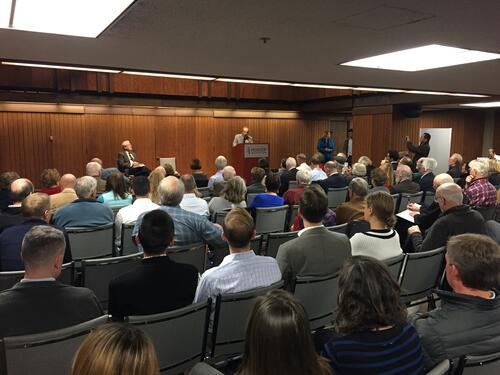
The sixteenth session of the Strategic Forum brings together distinguished South Korean and U.S. West Coast-based American scholars, experts, and former officials to discuss the U.S.-South Korean alliance, North Korea, and regional dynamics in Northeast Asia. The session is hosted by the Korea Program in association with The Sejong Institute, a top South Korean think tank.

 
Conferences
News Type
Commentary
Date
Paragraphs

In a recent interview with Yonhap News, David Straub, associate director of the Korea Program, says "Although the United States and the PRC certainly have differences [in dealing with the North Korean nuclear issue], they pale in copmarison to U.S.-Soviet differences."

Yonhap News article in English (February 12, 2016)


Straub also offers, in an extended interview with South Korea's Segye Ilbo newspaper, his thoughts on Pyongyang's motivations for pursuing nuclear weapons. He argues that the appropriate policy response is to continue to increase pressure on the regime to convince it that nuclear weapons will bring more costs than benefits, while holding open the door to good-faith negotiations to resolve peninsular issues. 

Segye Ilbo article in Korean (January 8, 2016)


All News button
1
News Type
Commentary
Date
Paragraphs

North Korea claimed it successfully tested a hydrogen bomb on Jan. 6, according to a broadcast from the nation’s Korean Central Television. Experts at the Freeman Spogli Institute for International Studies offered their analyses to media.

Scholars from the Walter H. Shorenstein Asia-Pacific Center (APARC) and the Center for International Security and Cooperation (CISAC) contributed to a Stanford news release. Although the scholars said they are skeptical of North Korea’s claim, they also said the test would have a destabilizing effect on the region.

In a Q&A, Siegfried Hecker answered nine questions, offering perspective on the situation and how the United States should respond. Hecker, a CISAC senior fellow, is a former director of the Los Alamos National Laboratory and has visited North Korea seven times since 2004.

David Straub, associate director of the Korea Program, commented on the North Korean nuclear program in an NK News article. He said the timing of the nuclear test, now the nation’s fourth, was likely only marginally influenced by external factors such as Kim Jong-un’s birthday. The primary factor is technical, he said. Straub also spoke with Yonhap News on Feb. 12. In the interview, Straub said "although the United States and the People's Republic of China certainly have differences [in dealing with the North Korean nuclear issue], they pale in comparison to U.S.-Soviet differences." 

Straub also offered, in an extended interview with South Korea's Segye Ilbo newspaper, his thoughts on Pyongyang's motivations for pursuing nuclear weapons. He argued that the appropriate policy response is to continue to increase pressure on the regime. Pressure applied by Washington is meant to convince Pyongyang that nuclear weapons will bring more cost than benefit, while holding open the door to good-faith negotiations to resolve peninsular issues.

Shorenstein APARC Associate Director for Research Daniel Sneider talked with Al Jazeera America and Slate about the developments. He said the nuclear test signified North Korea’s uneasiness and was largely an accommodation of domestic politics.

In early February, South Korea announced temporary closure of Kaesong Industrial Complex (KIC), a jointly held project with North Korea. In Chosun Ilbo newspaper, Straub argued that South Korea's closure of KIC was a necessary response to North Korea's fourth nuclear test and latest satellite rocket launch. Two articles were published in Korean; the first is available here and the second here.

Hero Image
rtx1baqp
North Korean leader Kim Jong Un provides field guidance at the newly built National Space Development General Satellite Control and Command Centre in this undated photo released by North Korea's Korean Central News Agency (KCNA) in Pyongyang, May 3, 2015.
Reuters/KCNA
All News button
1
-

Abstract: Why do states acquire nuclear weapons? Existing theories of nuclear proliferation fail to account for the impact of bargaining on the process---i.e., credible agreements exist in which rival states make sufficient concessions to convince the potential rising state not to proliferate. I show the existence of that range of settlements and the robustness of the inefficiency puzzle and then provide two main explanations as to why states proliferate anyway. First, if the would-be proliferator expects to lose the ability to construct nuclear weapons in the future, the states face a commitment problem: the rival state would like to promise to continue providing concessions into the future but will renege once proliferation is no longer an option. And second, if the proliferator's rival faces some sort of uncertainty---whether regarding the potential proliferator's ability to go nuclear or regarding its previous proliferation activity---the optimal offer can entail positive probability of nuclear investment. However, the nonproliferation regime's mission to increase the cost of building often leads to Pareto improvement. Put differently, rising states sometimes benefit directly by making their nuclear options more costly.

About the Speaker: William Spaniel received a PhD in international relations, formal theory, and quantitative methodology from the University of Rochester in 2015. His research investigates the credibility of nuclear agreements in the absence of verifiable compliance. As a Stanton Nuclear Security Fellow at CISAC for 2015-2016, he is working on the potentially perverse effects of nuclear safeguards. His publications have appeared in International Studies Quarterly, International Interactions, and The Journal of Theoretical Politics.

Stanton Nuclear Security Postdoctoral Fellow CISAC
Seminars
Paragraphs

Abstract:

This paper evaluates the causal impact of Rio de Janeiro’s Pacifying Police Units (UPPs), probably the largest–scale police reform initiative taking place in the developing world. The main goals of the UPPs were: 1) to regain control of territories previously dominated by armed criminal groups; and 2) to improve security for these communities through reduction of lethal violence. In the course of six years, more than 9,000 police officers were permanently assigned to the UPPs, servicing close to half million residents in the city slums (favelas). We are interested in understanding the process through which governments supply a basic public service –the police -- in poor urban neighborhoods that have long been abandoned to the arbitrary rule of non-state armed actors. Moreover, our paper documents Rio de Janeiro’s painful trajectory of police violence, illuminating some of it major institutional facilitators. Painstakingly geo-coding homicides and police killings from 2005 to 2013, we provide answers to some of the most critical questions about police use of lethal force, including the determinants of variations in who is targeted by police repression and how different strategies for policing the slums have impacted police killings. To evaluate the UPP impact on lethal violence, we use a variety of causal identification strategies that leverage spatial and temporal variation in the introduction of the UPP as well as geo-referenced data of more than 22,000 incidents of lethal violence. Our empirical models reveal that the UPP had mixed results. The introduction of the UPPs did not play a significant role in reducing murders in the favelas that were pacified. The UPP’s failure to reduce homicides imply that the poor in the slums continue to be subject to two or three times higher murder rates than the white middle class. Nonetheless, the UPP is breaking long-held practices of extreme use of police lethal violence. Our empirical results convincingly demonstrate that police killings would have been 60 percent larger without the UPP intervention.

All Publications button
1
Publication Type
Working Papers
Publication Date
Journal Publisher
CDDRL Working Papers
Authors
Beatriz Magaloni
Paragraphs

As restrictions on the right to carry guns in public are challenged in American courts, Stanford historian Priya Satia argues that a rigorous analysis of British history and law (as it is invoked by both sides) supports the right of governments to regulate gun ownership and use in the October 21, 2015 edition of Slate.

All Publications button
1
Publication Type
Commentary
Publication Date
Journal Publisher
Slate
Authors
Authors
News Type
News
Date
Paragraphs

Former U.S. Secretary of Defense William J. Perry said he was concerned that the Islamic State in Iraq and Syria (ISIS) could buy, steal or build a nuclear weapon capable of killing a hundred thousand or more people in a single strike.

And, he said, stopping the flow of oil money to ISIS should be the main, short-term objective of the United States and its allies in the fight against the terrorist organization.

“They have demonstrated their objective is just killing as many Americans as they can, or Europeans as the case may be…and there is no better way of doing that than with nuclear weapons,” Perry said.

Image
Perry made his comments in front of a crowd gathered at Stanford University to celebrate the launch of his new memoir “My Journey at the Nuclear Brink.”

“If they can buy or steal a nuclear bomb, or if they could buy or steal fissile material, they could probably make a bomb – a crude improvised bomb,” he said.

Even a crude nuclear weapon could have an explosive power equivalent to around fifteen thousand tons of TNT – similar to the bomb that destroyed the Japanese city of Hiroshima near the end of World War II.

Perry said there was evidence that Al Qaeda had actively tried to get nuclear weapons, and he said it was likely that ISIS was also pursuing its own nuclear strategy.

“The big difference between ISIS and Al Qaeda in that respect is that ISIS has access to huge amounts of resources through the oil that they now control,” Perry said.

“I believe that our primary objective in dealing with ISIS should be to stop that flow of money, stop the trading they’re doing in oil which is giving them the resources.”

U.S. warplanes reportedly destroyed 116 trucks in Eastern Syria on Monday that American officials said were being used to smuggle crude oil.

U.S. fighter jets dropped leaflets before the attack, warning the drivers to abandon their vehicles, according to a report in The New York Times.

The Russian Air Force also claimed its planes had struck around 500 oil tankers that were carrying oil from Syria to Iraq for processing.

Perry said that combating ISIS over the long run was a “hugely difficult problem” for Western powers.

“To really stop ISIS completely it would be a long and brutal and ugly fighting on the ground, which I don’t believe we’re going to want to do again,” he said.

“What we can do however, a more limited objective is stopping the resources they’re getting, stopping their access to this oil money. And that limits quite a bit what they can do…That can be done I think in more of a targeted and effective way, and without having to put armies on the ground to do it.”

Hero Image
isis flag reuters rtr4fed5
Smoke rises behind the Islamic State flag after a battle with Iraqi security forces and Shiite militia in the city of Saadiya in November, 2014.
Reuters
All News button
1
-

Abstract: Two months after the breakup of the Soviet Union, I was in the Russian closed nuclear cities of Sarov and Snezhinsk, home of the Russian equivalent to the Los Alamos and Lawrence Livermore national laboratories. With our Russian counterparts, John Nuckolls, director of LLNL, and I developed a plan for scientific cooperation that would become a 20-plus year program, which began with fundamental science and then expanded to weapon safety and security, nuclear materials security, nonproliferation, and countering nuclear terrorism. Fundamental science collaboration resulted in professional respect, which, in turn, allowed us to develop the trust necessary to address the serious technical challenges resulting from the dissolution of the Soviet Union. I will describe some of the similarities and differences in how Russian and American laboratories tackled problems ranging from fundamental science to nuclear weapons stockpile stewardship. 

About the Speaker: Siegfried S. Hecker is a professor (research) in the Department of Management Science and Engineering and a senior fellow at the Freeman Spogli Institute for International Studies (FSI). He was co-director of CISAC from 2007-2012. From 1986 to 1997, Dr. Hecker served as the fifth Director of the Los Alamos National Laboratory. Dr. Hecker is an internationally recognized expert in plutonium science, global threat reduction, and nuclear security.

Dr. Hecker’s current research interests include plutonium science, nuclear weapons policy, nuclear security, and the safe and secure expansion of nuclear energy. Over the past 20 years, he has fostered cooperation with the Russian nuclear laboratories to secure and safeguard the vast stockpile of ex-Soviet fissile materials.

Dr. Hecker’s research projects at CISAC focus on reducing the risks of nuclear terrorism worldwide and the challenges of nuclear India, North Korea, Pakistan, and the nuclear aspirations of Iran. Dr. Hecker is also compiling and editing a book with two of his Russian colleagues on the history of Russian-U.S. laboratory-to-laboratory cooperation since 1992.

Dr. Hecker joined Los Alamos National Laboratory as graduate research assistant and postdoctoral fellow before returning as technical staff member following a tenure at General Motors Research. He led the laboratory's Materials Science and Technology Division and Center for Materials Science before serving as laboratory director from 1986 through 1997, and senior fellow until July 2005.

Among his professional distinctions, Dr. Hecker is a member of the National Academy of Engineering; foreign member of the Russian Academy of Sciences; fellow of the TMS, or Minerals, Metallurgy and Materials Society; fellow of the American Society for Metals; fellow of the American Physical Society, honorary member of the American Ceramics Society; and fellow of the American Academy of Arts and Sciences.

His achievements have been recognized with the Presidential Enrico Fermi Award, the American Physical Society’s Leo Szilard Prize, the American Nuclear Society's Seaborg Medal, the Department of Energy's E.O. Lawrence Award, the Los Alamos National Laboratory Medal, among other awards including the Alumni Association Gold Medal and the Undergraduate Distinguished Alumni Award from Case Western Reserve University, where he earned his bachelor's, master's, and doctoral degrees in metallurgy.

CISAC
Stanford University
Encina Hall, C220
Stanford, CA 94305-6165

(650) 725-6468 (650) 723-0089
0
Senior Fellow, Freeman Spogli Institute for International Studies, Emeritus
Research Professor, Management Science and Engineering, Emeritus
hecker2.jpg PhD

Siegfried S. Hecker is a professor emeritus (research) in the Department of Management Science and Engineering and a senior fellow emeritus at the Freeman Spogli Institute for International Studies (FSI). He was co-director of CISAC from 2007-2012. From 1986 to 1997, Dr. Hecker served as the fifth Director of the Los Alamos National Laboratory. Dr. Hecker is an internationally recognized expert in plutonium science, global threat reduction, and nuclear security.

Dr. Hecker’s current research interests include nuclear nonproliferation and arms control, nuclear weapons policy, nuclear security, the safe and secure expansion of nuclear energy, and plutonium science. At the end of the Cold War, he has fostered cooperation with the Russian nuclear laboratories to secure and safeguard the vast stockpile of ex-Soviet fissile materials. In June 2016, the Los Alamos Historical Society published two volumes edited by Dr. Hecker. The works, titled Doomed to Cooperate, document the history of Russian-U.S. laboratory-to-laboratory cooperation since 1992.

Dr. Hecker’s research projects at CISAC focus on cooperation with young and senior nuclear professionals in Russia and China to reduce the risks of nuclear proliferation and nuclear terrorism worldwide, to avoid a return to a nuclear arms race, and to promote the safe and secure global expansion of nuclear power. He also continues to assess the technical and political challenges of nuclear North Korea and the nuclear aspirations of Iran.

Dr. Hecker joined Los Alamos National Laboratory as graduate research assistant and postdoctoral fellow before returning as technical staff member following a tenure at General Motors Research. He led the laboratory's Materials Science and Technology Division and Center for Materials Science before serving as laboratory director from 1986 through 1997, and senior fellow until July 2005.

Among his professional distinctions, Dr. Hecker is a member of the National Academy of Engineering; foreign member of the Russian Academy of Sciences; fellow of the TMS, or Minerals, Metallurgy and Materials Society; fellow of the American Society for Metals; fellow of the American Physical Society, honorary member of the American Ceramics Society; and fellow of the American Academy of Arts and Sciences.

His achievements have been recognized with the Presidential Enrico Fermi Award, the 2020 Building Bridges Award from the Pacific Century Institute, the 2018 National Engineering Award from the American Association of Engineering Societies, the 2017 American Nuclear Society Eisenhower Medal, the American Physical Society’s Leo Szilard Prize, the American Nuclear Society's Seaborg Medal, the Department of Energy's E.O. Lawrence Award, the Los Alamos National Laboratory Medal, among other awards including the Alumni Association Gold Medal and the Undergraduate Distinguished Alumni Award from Case Western Reserve University, where he earned his bachelor's, master's, and doctoral degrees in metallurgy.
Date Label
FSI Senior Fellow, Research Professor of Management Science and Engineering Stanford University
Seminars
-

Abstract: Nuclear risks changed dramatically when the Soviet Union collapsed at the end of 1991. Suddenly the world was threatened more by Russia’s weakness than its strength. Never before had a country with the capacity to destroy the world experienced such dramatic political, economic and cultural turmoil. The United States and much of the world was concerned about loose nukes, loose nuclear materials, loose nuclear expert knowledge, and loose nuclear exports. I will describe how scientists and engineers at the U.S. nuclear weapons laboratories joined forces with counterparts in the Russian nuclear weapons complex for more than 20 years to avoid what looked like the perfect nuclear storm. I will also reflect on how today’s strained political relations between Washington and Moscow have curtailed that cooperation to the detriment of a safer and more secure world. 

About the Speaker: Siegfried S. Hecker is a professor (research) in the Department of Management Science and Engineering and a senior fellow at the Freeman Spogli Institute for International Studies (FSI). He was co-director of CISAC from 2007-2012. From 1986 to 1997, Dr. Hecker served as the fifth Director of the Los Alamos National Laboratory. Dr. Hecker is an internationally recognized expert in plutonium science, global threat reduction, and nuclear security.

Dr. Hecker’s current research interests include plutonium science, nuclear weapons policy, nuclear security, and the safe and secure expansion of nuclear energy. Over the past 20 years, he has fostered cooperation with the Russian nuclear laboratories to secure and safeguard the vast stockpile of ex-Soviet fissile materials.

Dr. Hecker’s research projects at CISAC focus on reducing the risks of nuclear terrorism worldwide and the challenges of nuclear India, North Korea, Pakistan, and the nuclear aspirations of Iran. Dr. Hecker is also compiling and editing a book with two of his Russian colleagues on the history of Russian-U.S. laboratory-to-laboratory cooperation since 1992.

Dr. Hecker joined Los Alamos National Laboratory as graduate research assistant and postdoctoral fellow before returning as technical staff member following a tenure at General Motors Research. He led the laboratory's Materials Science and Technology Division and Center for Materials Science before serving as laboratory director from 1986 through 1997, and senior fellow until July 2005.

Among his professional distinctions, Dr. Hecker is a member of the National Academy of Engineering; foreign member of the Russian Academy of Sciences; fellow of the TMS, or Minerals, Metallurgy and Materials Society; fellow of the American Society for Metals; fellow of the American Physical Society, honorary member of the American Ceramics Society; and fellow of the American Academy of Arts and Sciences.

His achievements have been recognized with the Presidential Enrico Fermi Award, the American Physical Society’s Leo Szilard Prize, the American Nuclear Society's Seaborg Medal, the Department of Energy's E.O. Lawrence Award, the Los Alamos National Laboratory Medal, among other awards including the Alumni Association Gold Medal and the Undergraduate Distinguished Alumni Award from Case Western Reserve University, where he earned his bachelor's, master's, and doctoral degrees in metallurgy.

CISAC
Stanford University
Encina Hall, C220
Stanford, CA 94305-6165

(650) 725-6468 (650) 723-0089
0
Senior Fellow, Freeman Spogli Institute for International Studies, Emeritus
Research Professor, Management Science and Engineering, Emeritus
hecker2.jpg PhD

Siegfried S. Hecker is a professor emeritus (research) in the Department of Management Science and Engineering and a senior fellow emeritus at the Freeman Spogli Institute for International Studies (FSI). He was co-director of CISAC from 2007-2012. From 1986 to 1997, Dr. Hecker served as the fifth Director of the Los Alamos National Laboratory. Dr. Hecker is an internationally recognized expert in plutonium science, global threat reduction, and nuclear security.

Dr. Hecker’s current research interests include nuclear nonproliferation and arms control, nuclear weapons policy, nuclear security, the safe and secure expansion of nuclear energy, and plutonium science. At the end of the Cold War, he has fostered cooperation with the Russian nuclear laboratories to secure and safeguard the vast stockpile of ex-Soviet fissile materials. In June 2016, the Los Alamos Historical Society published two volumes edited by Dr. Hecker. The works, titled Doomed to Cooperate, document the history of Russian-U.S. laboratory-to-laboratory cooperation since 1992.

Dr. Hecker’s research projects at CISAC focus on cooperation with young and senior nuclear professionals in Russia and China to reduce the risks of nuclear proliferation and nuclear terrorism worldwide, to avoid a return to a nuclear arms race, and to promote the safe and secure global expansion of nuclear power. He also continues to assess the technical and political challenges of nuclear North Korea and the nuclear aspirations of Iran.

Dr. Hecker joined Los Alamos National Laboratory as graduate research assistant and postdoctoral fellow before returning as technical staff member following a tenure at General Motors Research. He led the laboratory's Materials Science and Technology Division and Center for Materials Science before serving as laboratory director from 1986 through 1997, and senior fellow until July 2005.

Among his professional distinctions, Dr. Hecker is a member of the National Academy of Engineering; foreign member of the Russian Academy of Sciences; fellow of the TMS, or Minerals, Metallurgy and Materials Society; fellow of the American Society for Metals; fellow of the American Physical Society, honorary member of the American Ceramics Society; and fellow of the American Academy of Arts and Sciences.

His achievements have been recognized with the Presidential Enrico Fermi Award, the 2020 Building Bridges Award from the Pacific Century Institute, the 2018 National Engineering Award from the American Association of Engineering Societies, the 2017 American Nuclear Society Eisenhower Medal, the American Physical Society’s Leo Szilard Prize, the American Nuclear Society's Seaborg Medal, the Department of Energy's E.O. Lawrence Award, the Los Alamos National Laboratory Medal, among other awards including the Alumni Association Gold Medal and the Undergraduate Distinguished Alumni Award from Case Western Reserve University, where he earned his bachelor's, master's, and doctoral degrees in metallurgy.

Date Label
FSI Senior Fellow, Research Professor of Management Science and Engineering Stanford University
Seminars
Subscribe to Arms Control