Peacekeeping
-

A documentary film festival featuring films speaking to Martin Luther King, Jr.'s vision of the World House


For the 2022 King Holiday, the World House Project will host a free, four-day webinar and virtual film festival, from the evening of January 14 through January 17, 2022. This virtual event will feature over 30 documentaries, musical performances, interviews, and panel discussions that speak to Dr. King's vision of the World House. 

The webinar will consist of daily Zoom meetings with the World House Project director Dr. Clayborne Carson who will speak with guests and webinar registrants on a range of topics, from the history of the civil rights movement to the legacy of Martin Luther King, Jr., and the African American freedom struggles.

The films and performances cover a variety of themes, from the history of the civil rights and anti-apartheid movements to James Baldwin and Martin Luther King's global visions. A full list of featured films and short descriptions will be available shortly.

The festival is produced in partnership with the Martin Luther King Jr. Freedom CenterCalifornia NewsreelClarity Films, the Camera as Witness Program (Stanford Arts), the Office for Religious & Spiritual Life at Stanford, and the Kunhardt Film Foundation.
 

Online via Zoom. Register Now

Film Screenings
All Publications button
1
Publication Type
Journal Articles
Publication Date
Subtitle
Is it possible to reduce crime without exacerbating adversarial relationships between police and citizens? Community policing is a celebrated reform with that aim, which is now adopted on six continents. However, the evidence base is limited, studying reform components in isolation in a limited set of countries, and remaining largely silent on citizen-police trust. We designed six field experiments with Global South police agencies to study locally designed models of community policing using coordinated measures of crime and the attitudes and behaviors of citizens and police. In a preregistered meta-analysis, we found that these interventions led to mixed implementation, largely failed to improve citizen-police relations, and did not reduce crime. Societies may need to implement structural changes first for incremental police reforms such as community policing to succeed.
Journal Publisher
Science
Authors
Number
Issue 6571
-

On Friday, October 22, 2021 from 10:00-11:00 am PT, The World House Global Network is honored to have Andre Kamenshikov as our guest speaker. We will be discussing current challenges for civil society in Russia, Belarus, and Ukraine.

Register Now


Image
Andre Kamenshikov
Andre Kamenshikov is a civil society activist in the field of peacebuilding, with both a US and Russian background. He graduated Moscow State University majoring in sociology in 1991 as well as studied various subjects in Carroll College, Waukesha, Wisconsin and undertook courses in human rights and other relevant topics. He is the representative of a US-based NGO Nonviolence International and the regional coordinator of an international civil society network - the Global Partnership for the Prevention of Armed Conflict (GPPAC) in the Eastern Europe region. He has over 28 years of experience as a civil peacebuilding activist in conflict areas of the ex-USSR. He was the founder of Nonviolence International–CIS, a civil society organization that was based in Moscow and operated in the post-soviet states for 22 years until it had to be closed due to the current political climate in Russia. Since 2015 he has been based in Kyiv, Ukraine, working primarily with the local civil society sector on enhancing its capacities to contribute to peace and democratic development of the country. He is an author of a number of publications about the role of civil society in post-soviet conflicts, including “International experience of civilian peacebuilding in the post-soviet space” (2016), the “Strategic framework for the development of civil peacebuilding activities in Ukraine” (2017).

Online via Zoom. Register Now

Andre Kamenshikov
Lectures

Shorenstein APARC
Stanford University
Encina Hall, Room E301
Stanford, CA 94305-6055

(650) 736-0656 (650) 723-6530
0
mike_breger.jpg

Michael (Mike) Breger joined APARC in 2021 and serves as the Center's communications manager. He collaborates with the Center's leadership to share the work and expertise of APARC faculty and researchers with a broad audience of academics, policymakers, and industry leaders across the globe. 

Michael started his career at Stanford working at Green Library, and later at the Center for Russian, East European and Eurasian Studies, serving as the event and communications coordinator. He has also worked in a variety of sales and marketing roles in Silicon Valley.

Michael holds a master's in liberal arts from Stanford University and a bachelor's in history and astronomy from the University of Virginia. A history buff and avid follower of international current events, Michael loves learning about different cultures, languages, and literatures. When he is not at work, Michael enjoys reading, painting, music, and the outdoors.

Communications Manager
Date Label
Authors
Callista Wells
News Type
News
Date
Paragraphs

In collaboration with Global:SF and the State of California Governor’s Office of Business and Economic Development, the China Program at Shorenstein APARC presented session five of the New Economy Conference, "Navigating Chinese Investment, Trade, and Technology," on May 19. The program featured distinguished speakers Ambassador Craig Allen, President of the US-China Business Council; David K. Cheng, Chair and Managing Partner of China & Asia Pacific Practice at Nixon Peabody LLPJames Green, Senior Research Fellow at the Initiative for U.S.-China Dialogue on Global Issues at Georgetown University; and Anja Manuel, Co-Founder and Principal of Rice, Hadley, Gates & Manuel LLC. The session was opened by Darlene Chiu Bryant, Executive Director of GlobalSF, and moderated by Professor Jean Oi, William Haas Professor of Chinese Politics and director of the APARC China Program.

U.S.-China economic relations have grown increasingly fraught and competitive. Even amidst intensifying tensions, however, our two major economies remain intertwined. While keeping alert to national security concerns, the economic strength of the United States will depend on brokering a productive competition with China, the world’s fastest growing economy. Precipitous decoupling of trade, investment, and human talent flows between the two nations will inflict unnecessary harm to U.S. economic interests--and those of California.  

Chinese trade and investments into California have grown exponentially over the last decade. But they have come under increasing pressure following geopolitical and economic tensions between the two nations, particularly in the science and technology sectors. Ambassador Craig Allen, David Cheng, James Green, and Anja Manuel explored the role of Chinese economic activity in California in the context of the greater US-Chinese relationship. Watch now: 

Read More

American and Chinese flags
News

U.S.-China Relations in the Biden Era

Dr. Thomas Wright examines the recent history of US-China relations and what that might mean for the new administration.
U.S.-China Relations in the Biden Era
Hero Image
Blue image with event title, time, and date
All News button
1
Subtitle

Ambassador Craig Allen, David Cheng, James Green, and Anja Manuel explore the role of Chinese economic activity in California in the context of the greater US-Chinese relationship.

Authors
Callista Wells
News Type
News
Date
Paragraphs

The China Program at Shorenstein APARC had the privilege of hosting Jude Blanchette, the Freeman Chair in China Studies at the Center for Strategic and International Studies (CSIS). The program, entitled "What’s ‘Communist’ about the Communist Party of China?," explored the goals and ideology of the Chinese Communist Party (CCP), as well as what they might mean for the future of China in the global community. Professor Jean Oi, William Haas Professor of Chinese Politics and director of the APARC China Program, moderated the event.

After the death of Mao Zedong in 1976, the goals of the CCP became less clear. As the country began to adopt market reforms in the 1980s and 1990s, CCP theorists were forced into contortions providing ideological justifications for policies that appeared overtly capitalist. Deng Xiaoping’s concept of “Socialism with Chinese characteristics” came to be seen as a theoretical fig leaf rather than a description of an egalitarian economic system, and by the 2000s, a consensus emerged that the CCP had completely abandoned any pretense of pursuing the Marxist vision it purported to hold. With the rise of Xi Jinping, however, the Party talks with renewed vigor about Marxism-Leninism and the goal of achieving actual, existing socialism. Has the CCP re-discovered communism?  In his talk, Blanchette discussed the abandoned and existing legacies of Mao Zedong, Marxism-Leninism, and the CCP’s vision of socialism. Watch now: 

Read More

Min Ye speaking
News

Domestic or International? The Belt and Road Initiative Is More Internally Focused Than We Think, Says Expert Min Ye

Domestic or International? The Belt and Road Initiative Is More Internally Focused Than We Think, Says Expert Min Ye
Banner of Hau L. Lee
News

The Pandemic, U.S.-China Tensions and Redesigning the Global Supply Chain

The Pandemic, U.S.-China Tensions and Redesigning the Global Supply Chain
American and Chinese flags
News

U.S.-China Relations in the Biden Era

Dr. Thomas Wright examines the recent history of US-China relations and what that might mean for the new administration.
U.S.-China Relations in the Biden Era
Hero Image
National Emblem of the People's Republic of China on the Great Hall of the People
All News button
1
Subtitle

Is the Chinese Communist Party really communist at all? Expert Jude Blanchette, Freeman Chair in China Studies at the Center for Strategic and International Studies, weighs in.

Authors
Callista Wells
News Type
News
Date
Paragraphs

On February 24, 2021, the China Program at Shorenstein APARC hosted Dr. Thomas Wright, director of the Center on the United States and Europe and a senior fellow in the Project on International Order and Strategy at the Brookings Institution. Professor Jean Oi, William Haas Professor of Chinese Politics and director of the APARC China Program, moderated the event.

The program, entitled "U.S.-China Relations in the Biden Era," explored the future of US-China relations based on experience from past administrations. Under former President Trump, U.S. relations with China evolved into outright rivalry. In his talk, Dr. Wright discussed whether this rivalry will continue and evolve during a Biden administration by analyzing the roots of strategic competition between the two countries and various strands of thinking within the Biden team. According to Wright, the most likely outcome is that the competition between the two countries will evolve into a clash of governance systems and the emergence of two interdependent blocs where ideological differences become a significant driver of geopolitics. Cooperation is possible but it will be significantly shaped by conditions of rivalry. Watch now:

Read More

Min Ye speaking
News

Domestic or International? The Belt and Road Initiative Is More Internally Focused Than We Think, Says Expert Min Ye

Domestic or International? The Belt and Road Initiative Is More Internally Focused Than We Think, Says Expert Min Ye
Banner of Hau L. Lee
News

The Pandemic, U.S.-China Tensions and Redesigning the Global Supply Chain

The Pandemic, U.S.-China Tensions and Redesigning the Global Supply Chain
Photograph of Xi Jinping and Vladmir Putin walking in front of two lines of armed Chinese soldiers
News

Military Competition with China: Harder to Win Than During the Cold War?

On February 10th, the APARC China Program hosted Professor Oriana Mastro to discuss military relations between the US and China, and why deterrence might be even more difficult than during the Cold War.
Military Competition with China: Harder to Win Than During the Cold War?
Hero Image
American and Chinese flags
All News button
1
Subtitle

Dr. Thomas Wright examines the recent history of US-China relations and what that might mean for the new administration.

-

This is a virtual event. Please click here to register and generate a link to the talk. 
The link will be unique to you; please save it and do not share with others.

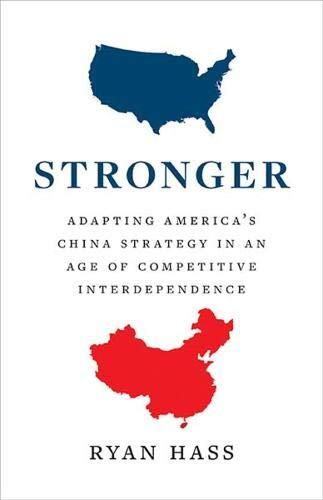
How can the U.S. best manage its relationship with China? The country is at once a major and increasingly hostile competitor to the U.S., a formidable challenger to U.S.’ regional and global leadership, and an important partner on a range of transnational challenges. Will it be possible for both sides to coexist amidst intensifying competition? How great is the risk of US-China conflict, including over Taiwan? Ryan Hass, author of Stronger: Adapting America’s China Strategy in an Age of Competitive Interdependence, will address these questions and more in opening comments before engaging in an open Q&A on the future of the world’s most consequential bilateral relationship.


Image
Portrait of Ryan Hass
Ryan Hass is a senior fellow and the Michael H. Armacost Chair in the Foreign Policy program at Brookings, where he holds a joint appointment to the John L. Thornton China Center and the Center for East Asia Policy Studies. He is also the Interim Chen-Fu and Cecilia Yen Koo Chair in Taiwan Studies. Hass focuses his research and analysis on enhancing policy development on the pressing political, economic, and security challenges facing the United States in East Asia. He is the author of Stronger: Adapting America’s China Strategy in an Age of Competitive Interdependence, published by Yale University Press.

Image
"Stronger" Book Cover
From 2013 to 2017, Hass served as the director for China, Taiwan and Mongolia at the National Security Council (NSC) staff. In that role, he advised President Obama and senior White House officials on all aspects of U.S. policy toward China, Taiwan, and Mongolia, and coordinated the implementation of U.S. policy toward this region among U.S. government departments and agencies. He joined President Obama’s state visit delegations in Beijing and Washington respectively in 2014 and 2015, and the president’s delegation to Hangzhou, China, for the G-20 in 2016, and to Lima, Peru, for the Asia-Pacific Economic Cooperation (APEC) Leaders Meetings in 2016. Prior to joining NSC, Hass served as a Foreign Service Officer in U.S. Embassy Beijing, where he earned the State Department Director General’s award for impact and originality in reporting. Hass also served in Embassy Seoul and Embassy Ulaanbaatar, and domestically in the State Department Offices of Taiwan Coordination and Korean Affairs. 


Image
American and Chinese flags
This event is part of the 2021 Winter/Spring Colloquia series, Biden’s America, Xi’s China: What’s Now & What’s Next?, sponsored by APARC's China Program.


Via Zoom Webinar. Register at: https://bit.ly/3c3v10W

Ryan Hass Senior Fellow, Michael H. Armacost Chair in Foreign Policy Studies, Brookings Institution
Seminars
Authors
Callista Wells
News Type
News
Date
Paragraphs

On February 10, 2021, the China Program at Shorenstein APARC hosted Professor Oriana Skylar Mastro, Center Fellow at the Freeman Spogli Institute for International Studies​ for the virtual program "Military Competition with China: Harder to Win Than During the Cold War?" Professor Jean Oi, William Haas Professor of Chinese Politics and director of the APARC China Program, moderated the event.

As US-China competition intensifies, experts debate the degree to which the current strategic environment resembles that of the Cold War. Those that argue against the analogy often highlight how China is deeply integrated into the US-led world order. They also point out that, while tense, US-China relations have not turned overtly adversarial. But there is another, less optimistic reason the comparison is unhelpful: deterring and defeating Chinese aggression is harder now than it was against the Soviet Union. In her talk, Dr. Mastro analyzed how technology, geography, relative resources and the alliance system complicate U.S. efforts to enhance the credibility of its deterrence posture and, in a crisis, form any sort of coalition. Mastro and Oi's thought-provoking discussion ranged from the topic of why even US allies are hesitant to take a strong stance against China to whether or not Taiwan could be a catalyst for military conflict. Watch now: 

Read More

Min Ye speaking
News

Domestic or International? The Belt and Road Initiative Is More Internally Focused Than We Think, Says Expert Min Ye

Domestic or International? The Belt and Road Initiative Is More Internally Focused Than We Think, Says Expert Min Ye
Banner of Hau L. Lee
News

The Pandemic, U.S.-China Tensions and Redesigning the Global Supply Chain

The Pandemic, U.S.-China Tensions and Redesigning the Global Supply Chain
Hero Image
Photograph of Xi Jinping and Vladmir Putin walking in front of two lines of armed Chinese soldiers Getty Images
All News button
1
Subtitle

On February 10th, the APARC China Program hosted Professor Oriana Mastro to discuss military relations between the US and China, and why deterrence might be even more difficult than during the Cold War.

-

This is a virtual event. Please click here to register and generate a link to the talk. 
The link will be unique to you; please save it and do not share with others.


U.S. relations with China evolved into outright rivalry during the Trump administration. In this talk, Thomas Wright will look at whether this rivalry will continue and evolve during a Biden administration. To answer this question, he will look at the roots of strategic competition between the two countries and various strands of thinking within the Biden team. The most likely outcome is that the competition will evolve into a clash of governance systems and the emergence of two interdependent blocs where ideological differences become a significant driver of geopolitics. Cooperation is possible but it will be significantly shaped by conditions of rivalry.


Image
Portrait of Thomas Wright
Thomas Wright is the director of the Center on the United States and Europe and a senior fellow in the Project on International Order and Strategy at the Brookings Institution. He is also a contributing writer for The Atlantic and a nonresident fellow at the Lowy Institute for International Policy. He is the author of “All Measures Short of War: The Contest For the 21st Century and the Future of American Power” which was published by Yale University Press in May 2017. His second book "Aftershocks: Pandemic Politics and the End of the Old International Order" will be published by St Martin's Press in 2021. Wright also works on U.S. foreign policy, great power competition, the European Union, Brexit, and economic interdependence.

Wright has a doctorate from Georgetown University, a Master of Philosophy from Cambridge University, and a bachelor's and master's from University College Dublin. He has also held a pre-doctoral fellowship at Harvard University's Belfer Center for Science and International Affairs and a post-doctoral fellowship at Princeton University. He was previously executive director of studies at the Chicago Council on Global Affairs and a lecturer at the University of Chicago's Harris School for Public Policy.


Image
American and Chinese flags
This event is part of the 2021 Winter/Spring Colloquia series, Biden’s America, Xi’s China: What’s Now & What’s Next?, sponsored by APARC's China Program.


Via Zoom Webinar. Register at: https://bit.ly/3r1glp7

Thomas Wright Director, Center on the United States and Europe, Brookings Institution; Senior Fellow, Foreign Policy, Project on International Order and Strategy, Brookings Institution
Seminars
Subscribe to Peacekeeping