Nuclear Risk
Paragraphs

The paper provides technical and circumstantial evidence that the detection of a "double flash" by a Vela satellite on 9/22/79 was that of an Israeli nuclear test logistically assisted by South Africa, putting both countries in violation of their commitments under the Limited Test Ban Treaty. The implications of this are explored in light of the controversy over the Iran nuclear agreement.

All Publications button
1
Publication Type
Journal Articles
Publication Date
Journal Publisher
Bulletin of Atomic Scientists
Authors
Leonard Weiss
Paragraphs

The fourteenth session of the Korea-U.S. West Coast Strategic Forum, held Stanford University on June 25, 2015, convened senior South Korean and American policymakers, scholars and regional experts to discuss North Korea policy and recent developments on the Korean Peninsula. Hosted by the Korea Program at the Walter H. Shorenstein Asia-Pacific Research Center at Stanford University, the Forum is also supported by the Korea National Diplomatic Academy.

All Publications button
1
Publication Type
Policy Briefs
Publication Date
-

Abstract: Peter Hayes will talk about the risk of nuclear war and complexity. In a February 2015 report (Peter Hayes, "Nuclear command-and-control in the Millenials era", NAPSNet Special Reports, February 17, 2015, http://nautilus.org/napsnet/napsnet-special-reports/nuclear-command-and…), he stated that “very few leaders or even strategic scholars pay attention to the new complexity of the operating environment in which national nuclear command-and-control systems operate, or the new characteristics of the command-and-control systems and their supporting CISR systems that may contribute to the problem of loss-of-control and rapid escalation to nuclear war.”

“Today, the underlying ground is moving beneath the feet of nuclear-armed states. The enormous flow across borders of people, containers, and information, and the growth of connectivity between cities, corporations, and communities across borders, is recasting the essential nature of security itself to a networked flux of events and circumstances that no agency or state can control. The meta-system of nuclear command-and control systems has emerged in this new post-modern human condition.” The report can be accessed here.

About the speaker: Peter Hayes is Honorary Professor, Center for International Security Studies, Sydney University, Australia and Director, Nautilus Institute in Berkeley, California. He works at the nexus of security, environment and energy policy problems. Best known for innovative cooperative engagement strategies in North Korea, he has developed techniques at Nautilus Institute for seeking near-term solutions to global security and sustainability problems and applied them in East Asia, Australia, and South Asia. Dr. Hayes has worked for many international organizations including UN Development Programme, Asian Development Bank, and Global Environment Facility. He was founding director of the Environment Liaison Centre in Kenya in 1975. He has traveled, lived, and worked in Asia, North America, Europe and Africa.

Encina Hall, 2nd floor


Peter Hayes Director Speaker Nautilus Institute
Seminars
Authors
News Type
News
Date
Paragraphs

Today’s landmark deal between six world powers and Iran, which would limit Iran’s nuclear program in exchange for lifting economic sanctions, was an important step toward stopping Iran from building a nuclear bomb.

However, the key challenge for the international community will be making sure Iran keeps its part of the bargain, according to Stanford experts.

“Both sides have made a series of compromises that will help Iran’s economy in exchange for constraining its nuclear capabilities – and that’s a deal worth making, in my view,” said Scott Sagan, the Caroline S.G. Munro professor of political science and senior fellow at the Center for International Security and Cooperation.

“Iran will still have a technical capability to develop nuclear weapons, given the technology and materials that they have, but under this deal it will both take them a much longer period of time and would require them to take actions that would be easily discerned by the International Atomic Energy Agency, so it constrains their break-out capabilities in important ways.”

[[{"fid":"219719","view_mode":"crop_870xauto","fields":{"format":"crop_870xauto","field_file_image_description[und][0][value]":"","field_file_image_alt_text[und][0][value]":"","field_file_image_title_text[und][0][value]":"Final plenary session at the United Nations Office in Vienna, Austria. Photo credit: U.S. State Department","field_credit[und][0][value]":"","field_caption[und][0][value]":"","field_related_image_aspect[und][0][value]":"","thumbnails":"crop_870xauto","pp_lightbox":false,"pp_description":false},"type":"media","attributes":{"title":"Final plenary session at the United Nations Office in Vienna, Austria. Photo credit: U.S. State Department","width":"870","style":"width: 400px; height: 266px; float: right; margin-left: 15px","class":"media-element file-crop-870xauto"}}]]The U.S.-led negotiations also included fellow United Nations Security Council members Britain, China, France, and Russia, as well as Germany – a group known collectively as as the "P5+1."

Sig Hecker, former Los Alamos National Laboratory director and senior fellow at Stanford’s Center for International Security and Cooperation, said the nuclear deal was “hard-won and is better than any other reasonably achievable alternative.”

“Iran agreed to considerably greater restrictions on its program than what I thought was possible before the Joint Plan of Action was signed in November 2013,” said Hecker.

Abbas Milani, director of Iranian studies at Stanford and an affiliate at the Center for Democracy Development and the Rule of Law, called it the “least bad deal” for both Iran and the international community.

“Nobody gets everything they want,” Milani said. “Every side gets some of what they want.”

Under the deal, Iran would be allowed to continue to enrich uranium for peaceful purposes in its energy and health industries.

But it would have to reduce the number of its centrifuges from 19,000 to 6,000, and cut its stockpile of low enriched uranium down from more than 20 thousand pounds to about 660 pounds.

“Reducing that stockpile actually lengthens the breakout time more than any other measure,” said Hecker.

These limits were designed to increase the “breakout time” it would take for Iran to produce enough fissile material to make a nuclear weapon from the current two to three months, to one year over a period of the next 10 years.

The agreement still faces a series of political hurdles before it gets implemented, and will face tough scrutiny from a Republican-controlled U.S. Congress, as well as the parliaments of European countries that were parties to the talks.

“I think it’s going to be hard for the U.S. Congress and [European] parliaments to kill the deal and be perceived as the ones who would rather have a war than give diplomacy a chance,” said Thomas Fingar, distinguished fellow at the Freeman Spogli Institute for International Studies.

[[{"fid":"219720","view_mode":"crop_870xauto","fields":{"format":"crop_870xauto","field_file_image_description[und][0][value]":"","field_file_image_alt_text[und][0][value]":"","field_file_image_title_text[und][0][value]":"The Iranian delegation attend the final plenary session in Vienna, Austria. Photo credit: U.S. State Department","field_credit[und][0][value]":"","field_caption[und][0][value]":"","field_related_image_aspect[und][0][value]":"","thumbnails":"crop_870xauto","pp_lightbox":false,"pp_description":false},"type":"media","attributes":{"title":"The Iranian delegation attend the final plenary session in Vienna, Austria. Photo credit: U.S. State Department","width":"870","style":"width: 400px; height: 268px; float: right; margin-left: 15px","class":"media-element file-crop-870xauto"}}]]If the deal survives the inevitable political challenges, inspectors from the International Atomic Energy Agency will be responsible for confirming that Iran is living up to its obligations.

“The key is going to be the effectiveness of the verification procedures and IAEA access,” Fingar said.

“There’s an element of trust, but a far more important part is the rigorous verification protocols.”

As soon as the IAEA confirms that Iran is abiding by the terms of the agreement, economic sanctions can be lifted.

Sagan warned that the international community should not be surprised if Iran pushed the limits of the agreement, and should be ready to reimpose economic sanctions if Iran violated the deal.

“We should anticipate that Iranian opponents to the agreement will try to stretch it and do things that are potential violations and that we have to call them on that, and not treat every problem that we see as unexpected,” said Sagan.

“We should anticipate such problems and be ready, if necessary, to reimpose sanctions. Having the ability to reimpose sanctions is the best way to deter the Iranians from engaging in such violations.”

But Hecker said the international community should focus on incentivizing Iran.

“The best hope is to make the civilian nuclear path so appealing – and then successful – that Tehran will not want to risk the political and economic consequences of that success by pursuing the bomb option,” he said.

Image
19067549804 85591212aa o
The negotiations were a diplomatic balancing act, with serious consequences for both sides of the negotiations if they failed to reach an agreement.

Iran faced the threat of military action if it continued to press forward with its nuclear program.

While Russia and China had both signaled that they were likely to abandon the sanctions regime if talks fell apart.

One of the key challenges to reaching an agreement was “finding a language that would allow both parties to declare victory”, according to Milani.

“Iran has clearly made some very substantive concessions, but Iran has also been allowed to keep enough of its infrastructure so that it can declare at least partial victory for the domestic political audience."

Now the scramble is on in Tehran to claim credit for the deal.

Reformists, led by current Iranian President Hassan Rouhani and former president Akbar Hashemi Rafsanjani, hope it will strengthen their hand as they head into the next election.

On the other side of the political spectrum, conservatives believe it could give them the edge in the battle to succeed Ayatollah Ali Khamenei as Iran’s Supreme Leader.

“They understand that whoever gets the credit for this will be in a much better position to determine the future leadership and future direction of Iran’s foreign policy,” said Milani.

It’s too early to tell what impact the agreement might have on Iran’s foreign policy, which is often at odds with U.S. interests in hot spots like Iraq, Syria, Yemen and Afghanistan. But Sagan said today’s deal was an important step in making sure that future conflicts with Iran don’t go nuclear.

“Hopefully those disagreements will be played out without the shadow of nuclear weapons hanging over the future, and that’s a good thing.”

Hero Image
19663913956 8ed26a22fe o
U.S. Secretary of State John Kerry speaks with Hossein Fereydoun, the brother of Iranian President Hassan Rouhani, and Iranian Foreign Minister Javad Zarif before announcing a historic nuclear agreement to reporters in Vienna, Austria.
U.S. State Department
All News button
1
-

The United States’ strategy for the storage and disposal of highly radioactive nuclear waste is at a stalemate: spent nuclear fuel accumulates at nuclear power plants, yet there is no long-term, national strategy for spent fuel management and disposal. The Blue Ribbon Commission for America’s Nuclear Future emphasized the urgency of finding a geologic repository, but work on the proposed site -- Yucca Mountain – has stopped, and there is no active program to site a new geologic repository.  The political impasse has overwhelmed thoughtful discussion of technical, regulatory, risk and public policy issues.  

To inform efforts to reset the U.S. nuclear waste program, the Center for International Security and Cooperation, with the support of FSI and the Precourt Institute for Energy, is sponsoring a series of meetings to review and discuss the nuclear waste management strategy in the United States. 

The agenda and prospectus can be downloaded below.

For information related to the first meeting in this series, and relevant materials, please click here.


Reset Conference Documents for meeting no. 2 can be accessed through this link.


Follow-up materials


Back to Home Page

Meeting 2: The Structure and Behavior of a Nuclear Waste Management Organization
Download pdf
Prospectus for Meeting 2 of the Reset of U.S. Nuclear Waste Management Strategy and Policy
Download pdf
Bios of Steering Committee Members
Encina Hall 616 Serra StreetStanford, CA 94305 
Agenda can be downloaded below
Authors
News Type
News
Date
Paragraphs

Weeks away from a final international accord on Iran’s nuclear program, Stanford scholars are focusing on the technical, political and practical aspects of the pending deal intended to loosen sanctions while restricting Tehran’s ability to build a nuclear weapon.

“In two to three weeks we will have what some pundits are already calling the most revolutionary positive change in Iranian-American relations and others are saying a disastrous policy of appeasement to the Iranian regime,” said Scott Sagan, a senior fellow at the university’s Freeman Spogli Institute for International Studies. Sagan moderated a discussion at the FSI's Center for International Security and Cooperation (CISAC) on Tuesday that included FSI’s Siegfried Hecker and Thomas Fingar, as well as Abbas Milani, director of Stanford’s Iranian Studies.

Hecker, a former director of the Los Alamos National Laboratory, said Iran has developed its civilian nuclear capabilities to concurrently have a nuclear weapon option. However, at this point, they do not yet have nuclear weapons, nor have they produced the fissile materials, plutonium or highly enriched uranium, that would fuel such weapons.

“They’ve demonstrated they can enrich uranium to the levels allowed for civilian applications, but that gives them the capability to produce highly enriched uranium for bombs should they choose to do so,” Hecker said. “If they complete the Arak reactor, they will have the potential for plutonium production, although they have not developed a facility to extract the plutonium. If you look in terms of timelines for making fissile materials, they were somewhere between weeks to a month or two away for making enough fissile material for one bomb at the start of the negotiations in November 2013. The nuclear deal would move that timeline, called the ‘breakout’ time to one year, giving the international community more time to respond.”

Hecker said the technical issues are “secondary to whether Iran actually wants to go ahead and decide to build the bomb.”

He met with Iranian negotiators – including Foreign Minister Mohammad Javad Zarif – in 2013, and said the officials were anxious to reach a deal.

“Zarif told me that the cost of acquiring strategic capabilities will make Iran less safe rather than more safe,” Hecker said.

Fingar, who chaired the National Intelligence Council while also serving as the U.S. deputy director of national intelligence for analysis between 2005 and 2008, stressed the need for strong verification mechanisms if any deal with Iran is going to work.

“Verification can establish some facts but what it means is fundamentally a contextual and political judgment. What is most important? Catching somebody in a technical violation or preserving the overall purpose for which you are conducting verification. Verification requirements are an integral part of the negotiating process,” Fingar said.

That is especially true for Iran, which has proven that it is not trustworthy, he said.

“It did have a military program, it was seeking the bomb. It continues to lie about it. It lied to the European negotiators, to the UN, to the IAEA,” Fingar said. "This history mandates having a rigorous verification capability."

Monitoring is done in three bins, he said. The first, and most important, is the IAEA on-site inspections. The second is that done by other countries’ intelligence services, including those of the other P5 plus 1 countries and Israel. The third bin is the U.S. intelligence community.

“We will learn far more about what Iran is doing from the IAEA inspections than from any other mechanism,” Fingar said.

Milani focused on the politics of the deal inside Iran. Discussion of this political dimension, he said, cannot be understood unless we take into account two critical issues: Recent concerns with the health of Iran’s supreme leader, Ayatollah Ali Khamenei, and the heated battle on who might succeed him; and secondly the rise of ISIS and the fact that they are near Iran’s borders and have repeatedly threatened the country’s Shiites.

The debate in Iran is heated, he said, with many in favor of the agreement and a few opposed to it.

“Part of what is being fought over is what happens after the deal,” he said. “Who can claim victory for the deal? Who can take blame for it? These are profoundly political issues and they are being fought over.”

Milani said that he has never seen any policy issue, in the entire 35-year history of the Islamic Republic, being discussed with as much detail, and with as much ferocity as the nuclear deal.

There are occasional, detailed debates happening in Tehran University and other places Milani said. One side –typically pro-regime hard-liner – argues that this is the worst deal in Iran’s history. Reformists and scholars supporting President Rouhani’s government defend the agreement.

But he said these conservative opponents of the agreement are in the minority. He estimates that they have no more than 7 to 10 million supporters in a country with a population of 75 million. The vast majority of the population wants a deal, he said. The Iranian Revolutionary Guard Corps, which wields more power than any other group, is not all in favor of the deal and has made threats against the government in recent weeks.

Still, the ultimate political obstacle is that the deal must contain language that all actors can sell to their respective constituencies as a victory. And finding a language that passes this political hurdle is every bit as hard as the problems discussed by Hecker and Fingar.

Joshua Alvarez is a freelance writer.

Hero Image
Negotiations About Future of Iran's Nuclear Program
Secretary Kerry Poses for a Photo With P5+1 Leaders and Iranian Foreign Minister Zarif Following Negotiations About Future of Iran's Nuclear Program
State Department
All News button
1
Authors
News Type
News
Date
Paragraphs

It’s been 29 years since the Chernobyl nuclear disaster, but two nuclear security experts affiliated with the Center for International Security and Cooperation (CISAC) say there are still lessons to be learned from the worst nuclear accident of the 20th century.

In a new book by Sonja Schmid, the former CISAC science fellow argues that the consensus in the West about the cause of the disaster – that it was an inevitable result of a deeply flawed, backward Soviet system –  has precluded Western nuclear industries and policymakers from meaningfully incorporating the Soviet experience into their own practices.

The book, “Producing Power: The Pre-Chernobyl History of the Soviet Nuclear Industry”, is being praised by leading experts in the nuclear security field, including Freeman-Spogli Institute (FSI) Senior Fellow David Holloway who wrote: "[Schmid's] argument that the Soviet experience has to be incorporated into our broader understanding of the nuclear industry is both convincing and important."

Schmid was a social science research associate at Stanford University, a science fellow at CISAC, and a lecturer in the Program in Science, Technology and Society (STS) at Stanford from 2005-2007. She is now an assistant professor in Virginia Tech’s STS Department.

Schmid credits CISAC with providing resources crucial to the conception, research, and completion of “Producing Power,” including multiple travel grants to conduct research for the book, help with editing preliminary drafts, and a final book edit.

Schmid also tapped CISAC’s stable of nuclear experts. Along with Holloway, CISAC Associate Director for Research Lynn Eden mentored and supported her project. Siegfried Hecker, an FSI senior fellow, connected her with multiple Russian interviewees.

“Mentoring Sonja was a great pleasure. She came to CISAC with deep insight about the close connection between Soviet state bureaucracies and the reactor design choices that those bureaucrats made. It was an amazingly interesting and ambitious project,” Eden said.

“CISAC is a scholarly community that encourages and supports outstanding research and writing that is in some way policy-relevant,” she said. “For our pre- and post-doctoral fellows especially, we want to encourage them and help them to think deeply and/or broadly about a question that affects people’s lives, and to write clearly about it.”

Edward Geist, a MacArthur Nuclear Security Fellow at CISAC, said Schmid’s book is the first to grapple with the institutional history of Soviet nuclear power.

“The traditional accounts have tended to organize events around a ‘what went wrong’ narrative,” said Geist, whose article “Political Fallout: The Failure of the Emergency Management at Chernobyl”, appeared in the spring issue of Slavic Review. ”There’s a school of thought that emerged in the Soviet Union and was readily picked up abroad that says the Chernobyl disaster was the ultimate example of everything that was wrong with the Soviet Union,” Geist said.

This worries Geist, who specializes in nuclear power, Soviet history, and emergency management.

“As a result of having lived through the worst, Russian and Ukrainian nuclear energy industry leaders, to my mind, actually have a more realistic mindset regarding the hazards of nuclear energy than their Western counterparts,” Geist said.  “While a catastrophic nuclear accident in the United States is really unlikely, the nuclear industry claims to have made nuclear power safe through superior methods and procedures–and that attitude can forestall effective emergency planning.”

The Chernobyl disaster hurt popular trust in nuclear energy, including in the United States. The still-popular narrative that Chernobyl was a problem purely of Soviet making was spun by representatives of nuclear industries in other countries to protect their interests from popular backlash.

By detailing the decision processes and procedures behind the Soviet Union’s nuclear reactor choice, design and commercialization, Schmid aims to show that the Soviet process was rational and the product of expert input rather than an irrational byproduct of the Communist regime. Chernobyl, in short, was an accident of history rather than a byproduct of an illegitimate system and should therefore be studied by members of the Western nuclear industry and policymakers.

“The Western nuclear field has more to learn from the Soviet experience than they care to admit. The bureaucratic practices of the Soviets are not really that unique to them and can be repeated by our bureaucracies,” said Geist.

The 2011 Fukushima nuclear disaster in Japan was a case in point. Fukushima’s reactors were designed and built by Americans.

It’s Schmid’s hope that by putting Chernobyl in the context of what was a sophisticated nuclear energy bureaucracy that had many more successes than failures, much like its American counterpart, that lessons of caution can be drawn by the latter.

“What Chernobyl has demonstrated (and Fukushima has only confirmed),” writes Schmid, “is that organizing a civilian nuclear industry remains at best a high-stakes process of trial and error.”

Geist, with an eye on his field of emergency management, agrees.

“The lesson from Chernobyl and Fukushima is accidents happen no matter what procedures or levels of sophistication, but accidents need not be catastrophes if you’re willing to learn from others’ errors and incorporate them into planning.”

Hero Image
chornobyl dsc 0181 26
All News button
1
Authors
News Type
Q&As
Date
Paragraphs


On April 22, 2015, the Wall Street Journal published the article “China Warns North Korean Threat is Rising,” reporting on estimates from Chinese and American nuclear experts of the DPRK nuclear arsenal. The article quotes CISAC’s Siegfried Hecker, director of the Nuclear Risk Reduction Project, on his assessment of the North Korean nuclear crisis and presents the estimates of Dr. Hecker’s Chinese counterparts. In the following Q&A, Hecker, who has been an authority in the United States on technical assessments of the progress of the North Korean nuclear program — having visited North Korea seven times since 2004 and having been granted unprecedented access to North Korea’s Yongbyon nuclear facilities — discusses the information presented in the Wall Street Journal article and provides insight both on the nature of technical estimates of the DPRK nuclear arsenal as well as on the critical takeaways from these assessments.

What was the nature of the meeting referenced in the Wall Street Journal article in which China’s estimates were presented?

This meeting was an off-the-record, non-governmental, non-official dialogue on U.S. – China security issues. The discussion on North Korea’s nuclear program was one of many security topics discussed. Both Chinese and American experts made presentations. The headline of the WSJ article is misleading – it is not “China” that made these estimates, but Chinese nuclear experts.

Have you conferred with Chinese nuclear experts about the North Korean nuclear program before the referenced meeting?

As part of my Nuclear Risk Reduction project at Stanford University, I have conferred regularly with nuclear and policy experts in China and Russia, as well as American experts and officials, of course. We have done so since January in 2004, when I first visited the Yongbyon Nuclear Center and returned through Beijing (the normal transit in and out of Pyongyang).

On that trip, North Korean nuclear officials showed me plutonium metal that they had reprocessed from the spent fuel rods that were stored since the beginning of the Agreed Framework in 1994. When the Agreed Framework fell apart in late 2002, Pyongyang expelled the international inspectors and withdrew from the Nonproliferation Treaty.  I believed they showed me their nuclear facilities and the plutonium to try to convince Washington that they had the bomb.

How did these visits inform your assessment of the DPRK nuclear program?

I visited North Korea seven times in total, with four of those visits to the Yongbyon Nuclear Center. After each of these visits, I compared observations and analyses with Chinese nuclear experts. During the first few visits, the Chinese experts and Chinese international relations scholars were quite skeptical of North Korea’s nuclear capabilities. I believe that my observations helped to inform their subsequent analysis since Chinese experts did not have access to Yongbyon at the time.

So what precipitated the change in the perception of your Chinese colleagues of North Korea’s nuclear capabilities?

During the first few years of discussion, my estimates of North Korea’s capabilities exceeded those of Chinese experts.  However, during my most recent visit to Yongbyon in November 2010, North Korean nuclear officials showed me their newly constructed uranium enrichment facility, housing 2,000 modern centrifuges, and the beginning of the construction of an experimental light water reactor. Overhead imagery shows that the exterior of the reactor is essentially complete, that the size of the centrifuge hall has been doubled, and that significant additional construction has occurred in the fuel fabrication complex, where the centrifuge facility is housed.

Pyongyang’s move to augment their limited plutonium production in the 5 MW-electric reactor (at most one bomb’s worth of plutonium per year) with enriched uranium changed the game.

Changed the game, how?

It opened the second path to the bomb and made it difficult to assess North Korea’s nuclear capabilities. Unlike the reactor production of plutonium, centrifuges are easy to hide. So, post-2010 it became more difficult to make accurate estimates, but all of us believed that North Korea enhanced its nuclear capacity significantly.

I published my most recent estimates in an article in the Bulletin of the Atomic Scientists along with a brief history of North Korea’s nuclear build-up. The latest estimates by Chinese nuclear experts now exceed mine. I believe that we base our estimates on the same open-source data.

If you base your estimates on the same information, what accounts for the discrepancies between your assessments and the estimates from your Chinese colleagues?

Developing these estimates is not an exact science. There are huge uncertainties in estimating the enrichment capacity that is likely present at covert sites. One particular problem is the difficulty in assessing how much indigenous capacity North Korea has to make the key materials and components for centrifuges. To demonstrate the great uncertainties, the WSJ article cites a recent report by David Albright of the Institute of Science and International Security that shows the possible range of bomb-fuel capacity in 2020 to vary from 20 to 100 bombs. The Chinese experts’ and my estimates fall within that range.

The Wall Street Journal article reported that American officials recently stated that North Korea possesses an intercontinental ballistic missile with sufficient range to reach the United States. Is the threat of nuclear attack on the United States from North Korea imminent?

I view the threat to the United States posed by an untested missile, the so-called KN-08, with a hypothetical miniaturized nuclear warhead as unrealistic any time in the near future. The KN-08 has not been tested to our knowledge. I believe North Korea would require more long-range missile tests and more nuclear tests to pose a direct threat to the United States.

With the international community’s attention directed toward the U.S.-Iran nuclear deal, what are your thoughts on the analogy made in the article between the Iran Nuclear Deal and the 1994 Agreed Framework with North Korea?

I don’t concur with the analogy of the failings of the Agreed Framework to the potential Iran deal. It is true that North Korea continued to develop uranium enrichment capabilities during the Agreed Framework. However, without the Agreed Framework, North Korea could have produced a nuclear arsenal as large as they have today 10 years earlier. And, by terminating the Agreed Framework, Washington traded the threat of uranium bombs that was at least 10 more years away for plutonium bombs that were built within a year.

Then what is the critical takeaway from your and your Chinese colleagues’ assessments of North Korea’s nuclear capabilities?

The real tragedy, in my opinion, is that whereas in 2003 North Korea likely had no nuclear weapons, it appears to have a rapidly expanding arsenal today. During the past 12 years we have witnessed the North Korean program grow from having the option for a bomb in 2003, to having a handful of bombs five years later, to having an expanding nuclear arsenal now.

Why does an expanding arsenal matter?

I believe it has made Pyongyang increasingly reliant on its nuclear weapons for regime survival and has dimmed the prospect of a denuclearized Korean peninsula. Such an arsenal may instill Pyongyang’s leadership with a false sense of confidence and almost certainly expands what it may think are its tactical and strategic options. The potential for miscalculations and accidents increases, and the consequences will be greater if it has more bombs and more sophisticated bombs with greater reach.


Hero Image
sig photo
All News button
1
Authors
News Type
News
Date
Paragraphs


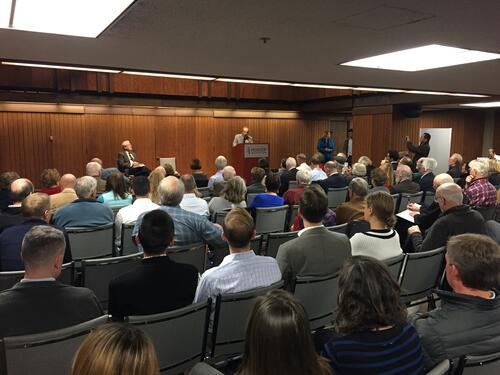
Retired Pakistani Lt. Gen. Khalid Kidwai told an audience of some 50 South Asia and nuclear experts at Stanford that India and Pakistan need a joint strategic vision to attain permanent peace and economic stability on the Subcontinent.

Kidwai, addressing a CISAC seminar on March 30, 2015, said the enmity between India and Pakistan - born from the partition of the subcontinent in 1947 that effectively divided Hindus and Muslims into two separate nations - will never be resolved until people are brought out of abject poverty.

"The obvious is not sinking into our regional calculations," he said. "The obvious is the elephant in the room: sustained socioeconomic progress."

More than 22 percent of Pakistan's 196 million people are living in poverty and 46 percent of its rural population falls below the global poverty line, according ot the Sustainable Development Policy Institute.

"Conflict resolution without socioeconomic progress will never work," said Kidwai, who is one of the most decorated generals in Pakistan. "There is no running away from this stark reality. For 68 years we have blustered and blundered our way through solutions, leaving 1.5 billion people condemned to hunger, filth and squalor."

He offered hope, in that there are two relatively new, democratically elected leaders now leading the nuclear-armed neighbors, which have gone to war three times since partition. Narendra Modi became India's 15th prime minister last year; Pakistan elected a new president, Nawaz Sharif, the year before that. They represent two political parties with strong elctroal mandates.

"We are waiting for the two leaderships to grasp, sit together, explore conflict resolution and go for it in a manner that all partners on all sides win," Kidwai said. "It needs vision, statesmanship and guts."

Image

Kidwai is advisor to Pakistan's National Command Authority and was the inaugural director general of the country's Strategic Plans Division, which he headed for 15 years. He conceived and executed Islamabad's nuclear policy and deterrence doctrines. He also is the architect of Pakistan's civilian nuclear energy and space programs.

Kidwai, who was hosted by CISAC's Siegfried Hecker, told the Stanford audience that he wanted to dispel what he called "two fallacious counter-narratives that have taken root in our neighborhood."

The first, he said, is that Pakistan supports and conducts terrorism inside India. "What would Pakistan attempt to achieve from this strategy?" he said, adding that the Mumbai terrorist attacks of 2008 were not backed by Islamabad. On that day, 10 Pakistani men associated with the terrorist group Lashkar-e-Taiba killed 164 people during four days of attacks throughout the city. India has repeatedly accused Islamabad of supporting the terrorists; Islamabad said non-state actors were responsible for the attacks.

"Terrorism is not a Pakistani invention," he said. "What would Pakistan attempt to achieve from this strategy?" 

The second myth, he said, is that the Pakistani military purposely keeps tensions at a high boil in an effort to boost its defense budget.

"Nothing could be further from the truth," he said. "The Pakistan Army is all for an equitable, just and ordinary peace with India. We recognize that war is not an option."

Kidwai believes the presence of nuclear weapons in South Asia is a stabilizing force and that any new peace initiatives lay with India. 

India conducted its first "peaceful" nuclear explosion, code-named "Smiling Buddha," in May of 1974; it would then conduct five nuclear tests in May 1998. Seventeen days after the first of those tests, Islamabad announced that it had detonated six nuclear devices, which happened to match the Indian total.

Today, India is believed to have between 90 and 110 nuclear warheads; Pakistan has between 100 to 120, according to the Arms Control Association.

Kidwai said the tried-and-tested concept of Mutually Assured Destruction has maintained a tenuous truce between the two nations. MAD follows the theory of deterrence, where the threat of using nuclear weapons against the enemy prevents the enemy's use of those same weapons.

He considered the concept of space for limited conventional war highly problematic and explained that Pakistan opted to develop a variety of short-range, low-yield nuclear weapons as a defensive deterrence response to what he called an aggressive Indian doctrine.

Kidwai assured the Stanford audience that Pakistan's nuclear weapons were safe, secure and under complete institutional and professional control. 

"For the last 15 years, Pakistan has taken its nuclear security obligations very seriously," he said. "We have invested heavily in terms of money, manpower, weapons and preparedness."

Kidwai was challenged about the deterrence utility of tactical, or battlefield, nuclear weapons compared to the increased security and safety risks of their potential deployment. Although Kidwai made a convincing case for improved security of Pakistan's nuclear assets during his tenure at the Strategic Plans Division, concerns were nevertheless expressed because of Pakistan's challenging internal security environment.


You can listen to the audio file of his talk here.


Hero Image
screen shot 2015 04 06 at 4 07 06 pm
All News button
1
-

Abstract: Scholars know quite a lot about U.S. nuclear war planning from the end of World War II to the end of the Cold War. We know a great deal about how nuclear deterrence was and is supposed to work. We know much less about how officers and others understood the circumstances and consequences if deterrence had failed and these plans had been used in war. What was it like to make very specific and workable plans for a war that, in President Ronald Reagan’s words, “cannot be won and must never be fought”—but nonetheless—might have been fought? This is a problem of understanding how organizations build complex technical and logistical routines, and how people in these organizations understood and made sense of the possibility that in some circumstances, nuclear weapons would be used. How did war planners imagine the circumstances? The scenarios of what might ensue? The consequences? It is one thing to say the whole situation was a paradox, or a conundrum; it is another to understand the many meanings of this situation for those involved. Explanation hinges on how people in organizations make plans, develop scenarios, and tell stories.

About the Speaker: Lynn Eden is Associate Director for Research at the Center for International Security and Cooperation, Freeman Spogli Institute for International Studies, Stanford University. Eden received her Ph.D. in sociology from the University of Michigan, held several pre- and post-doctoral fellowships, and taught in the history department at Carnegie Mellon before coming to Stanford.

In the area of international security, Eden has focused on U.S. foreign and military policy, arms control, the social construction of science and technology, and organizational issues regarding nuclear policy and homeland security. She co-edited, with Steven E. Miller, Nuclear Arguments: Understanding the Strategic Nuclear Arms and Arms Control Debates (Ithaca, N.Y.: Cornell University Press, 1989). She was an editor of The Oxford Companion to American Military History (New York: Oxford University Press, 2000), which takes a social and cultural perspective on war and peace in U.S. history. That volume was chosen as a Main Selection of the History Book Club.

Eden's book Whole World on Fire: Organizations, Knowledge, and Nuclear Weapons Devastation (Ithaca: Cornell University Press, 2004; New Delhi: Manas Publications, 2004) explores how and why the U.S. government--from World War II to the present--has greatly underestimated the damage caused by nuclear weapons by failing to predict damage from firestorms. It shows how well-funded and highly professional organizations, by focusing on what they do well and systematically excluding what they don't, may build a poor representation of the world--a self-reinforcing fallacy that can have serious consequences, from the sinking of the Titanic to not predicting the vulnerability of the World Trade Center to burning jet fuel. Whole World on Fire won the American Sociological Association's 2004 Robert K. Merton Award for best book in science, knowledge, and technology.

Eden has also written on life in small-town America. Her first book, Crisis in Watertown (Ann Arbor: University of Michigan Press, 1972), was her college senior thesis; it was a finalist for a National Book Award in 1973. Her second book, Witness in Philadelphia, with Florence Mars (Baton Rouge: Louisiana State University Press, 1977), about the murders of civil rights workers Schwerner, Chaney, and Goodman in the summer of 1964, was a Book of the Month Club Alternate Selection.

Encina Hall (2nd floor)

Not in residence

0
Affiliate
rsd15_078_0365a.jpg PhD

Lynn Eden is a Senior Research Scholar Emeritus. She was a Senior Research Scholar at Stanford University's Center for International Security and Cooperation until January 2016, as well as was Associate Director for Research. Eden received her Ph.D. in sociology from the University of Michigan, held several pre- and post-doctoral fellowships, and taught in the history department at Carnegie Mellon before coming to Stanford.

In the area of international security, Eden has focused on U.S. foreign and military policy, arms control, the social construction of science and technology, and organizational issues regarding nuclear policy and homeland security. She co-edited, with Steven E. Miller, Nuclear Arguments: Understanding the Strategic Nuclear Arms and Arms Control Debates (Ithaca, N.Y.: Cornell University Press, 1989). She was an editor of The Oxford Companion to American Military History (New York: Oxford University Press, 2000), which takes a social and cultural perspective on war and peace in U.S. history. That volume was chosen as a Main Selection of the History Book Club.

Eden's book Whole World on Fire: Organizations, Knowledge, and Nuclear Weapons Devastation (Ithaca: Cornell University Press, 2004; New Delhi: Manas Publications, 2004) explores how and why the U.S. government--from World War II to the present--has greatly underestimated the damage caused by nuclear weapons by failing to predict damage from firestorms. It shows how well-funded and highly professional organizations, by focusing on what they do well and systematically excluding what they don't, may build a poor representation of the world--a self-reinforcing fallacy that can have serious consequences, from the sinking of the Titanic to not predicting the vulnerability of the World Trade Center to burning jet fuel. Whole World on Fire won the American Sociological Association's 2004 Robert K. Merton Award for best book in science, knowledge, and technology.

Eden has also written on life in small-town America. Her first book, Crisis in Watertown (Ann Arbor: University of Michigan Press, 1972), was her college senior thesis; it was a finalist for a National Book Award in 1973. Her second book, Witness in Philadelphia, with Florence Mars (Baton Rouge: Louisiana State University Press, 1977), about the murders of civil rights workers Schwerner, Chaney, and Goodman in the summer of 1964, was a Book of the Month Club Alternate Selection.

CV
Lynn Eden Associate Director for Research at CISAC; Senior Research Scholar Speaker Stanford University
Seminars
Subscribe to Nuclear Risk