Catalonia: Cultural Policy and Global Nation
Related Multimedia


Presentation

This is a CDDRL's Special Event within our Democracy in Taiwan Program. It is also co-sponsored by the Public Diplomacy/Emerging Publics Project of the Center for the Pacific Rim at University of San Francisco. In this seminar, Dr. Richard Madsen will talk about his new book that explores the religious renaissance that has reformed, revitalized, and renewed the practices of Buddhism and Daoism in Taiwan and how this religious renaissance embraces democracy modernity.
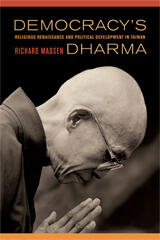
Richard Madsen received an MA in Asian studies and a Ph.D. in sociology from Harvard.
"Madsen is a genial and well-informed guide, both to social-political change in Taiwan and to the ins and outs of religious movements. His engaging writing skillfully interweaves profound insights and themes into the descriptive analytical narrative. Democracy's Dharma presents new material based on recent research while offering a fresh spin on thinking about Asian religions."–Thomas Gold, editor of Social Connections in China: Institutions, Culture, and the Changing Nature of Guanxi
Philippines Conference Room
As the building blocks of a new approach, this presentation will focus on four themes: 1) re-examination of ways to accelerate regionalism, with attention to leadership, energy cooperation, and the role of Russia; 2) development of a more comprehensive outlook on values, with attention to shared modernity, gradualism, and the role of Japan; 3) discussion of the next phase in managing North Korea, attentive to Sino-U.S. accord and the role of South Korea; and 4) evaluation of U.S. priorities and how a new president may view Northeast Asia within an overall agenda. The objective of this talk will be to stimulate thinking on a region at a crossroads in order to capitalize on recent currents of change.
Gil Rozman attended Princeton's Critical Languages Program, returning to Carleton College as an independent major in Chinese and Russian studies. He received his PhD in sociology at Princeton with a field on Chinese, Japanese, and Russian societies and a plan to concentrate on historical comparisons first and on the domestic roots of international relations later. His books have appeared in clusters, including: four on comparative pre-modern urban development and stages of modernization; three on debates in the Soviet Union, China, and Japan over bilateral relations and changes in socialism; two on regionalism; and four on strategic thinking in Northeast Asia. Although he is still learning about Korea, many recent writings have looked at Korea within a regional context.
Philippines Conference Room
He holds a PhD in Information Sciences. He is a professor at the Department of Journalism and Communication Sciences of the UAB, specialising in the history of communication, analysis of the information society, the study of cultural industries and mass culture. He has also taught about cultural management, political communication, communication policies and media analysis.
He received a summa cum laude Doctorate in Information Sciences (1988-89), the award for research into Mass Communication of the Generalitat de Catalunya (1989), and the Joan Fuster essay award (1994). Among others publications, he has written 'El Regne del Subjecte' (1987) and 'Cultura de masses i postmodernitat' (1994) which he co-wrote with Enric Marín, 'D'Ací i D'Allà, aparador de la modernitat' (1993) and 'La gènesi de la societat de masses a Catalunya' 1888-1939 (1999) which he co-wrote with Francesc Espinet. He has written some fifty academic articles and texts on social communication and has co-written the reports on 'Seguiment de L'impacte social de les noves tecnologies de la informació i la comunicació', sponsored by the Fundació Bofill, and has written 'Un segle de recerca sobre comunicació a Catalunya'. He coordinated the "Cultura" blog of the Informe per a la Catalunya del 2000 (1999).
He was the director of the Department of Journalism and Communication Sciences of the UAB (1991-1993) and coordinator of the degree in Journalism at the UAB (1997-1999). He was a member of the Institutional Advertising Advisory Committee of the Generalitat (1998-1999), a director of the Catalan Radio and Television Corporation (2000), director of the Catalan Audiovisual Council in charge of research, studies and publications (2000-2006), chairman of the Board for Diversity in the Audiovisual Media (2005-2006) and member of the Mixed Commission for State-Generalitat Transfers (2004-2006). He is vice-president of the Catalan Communication Society, a subsidiary of the Catalan Studies Institute.
CISAC Conference Room
Encina Ground Floor Conference Room
Seattle, WA
Encina Hall
616 Jane Stanford Way
Stanford, CA 94305-6055
Michael McFaul is the Ken Olivier and Angela Nomellini Professor of International Studies in Political Science, Senior Fellow at the Freeman Spogli Institute for International Studies, and the Peter and Helen Bing Senior Fellow at the Hoover Institution, all at Stanford University. He joined the Stanford faculty in 1995 and served as FSI Director from 2015 to 2025. He is also an international affairs analyst for MSNOW.
McFaul served for five years in the Obama administration, first as Special Assistant to the President and Senior Director for Russian and Eurasian Affairs at the National Security Council at the White House (2009-2012), and then as U.S. Ambassador to the Russian Federation (2012-2014).
McFaul has authored ten books and edited several others, including, most recently, Autocrats vs. Democrats: China, Russia, America, and the New Global Disorder, as well as From Cold War to Hot Peace: An American Ambassador in Putin’s Russia, (a New York Times bestseller) Advancing Democracy Abroad: Why We Should, How We Can; and Russia’s Unfinished Revolution: Political Change from Gorbachev to Putin.
He is a recipient of numerous awards, including an honorary PhD from Montana State University; the Order for Merits to Lithuania from President Gitanas Nausea of Lithuania; Order of Merit of Third Degree from President Volodymyr Zelenskyy of Ukraine, and the Dean’s Award for Distinguished Teaching at Stanford University. In 2015, he was the Distinguished Mingde Faculty Fellow at the Stanford Center at Peking University.
McFaul was born and raised in Montana. He received his B.A. in International Relations and Slavic Languages and his M.A. in Soviet and East European Studies from Stanford University in 1986. As a Rhodes Scholar, he completed his D. Phil. in International Relations at Oxford University in 1991.
CDDRL
Encina Hall, C152
616 Jane Stanford Way
Stanford, CA 94305-6055
Stephen Stedman is a Senior Fellow at the Freeman Spogli Institute for International Studies (FSI) and the Center on Democracy, Development and the Rule of Law (CDDRL), an affiliated faculty member at CISAC, and professor of political science (by courtesy) at Stanford University. He is director of CDDRL's Fisher Family Honors Program in Democracy, Development and Rule of Law, and will be faculty director of the Program on International Relations in the School of Humanities and Sciences effective Fall 2025.
In 2011-12 Professor Stedman served as the Director for the Global Commission on Elections, Democracy, and Security, a body of eminent persons tasked with developing recommendations on promoting and protecting the integrity of elections and international electoral assistance. The Commission is a joint project of the Kofi Annan Foundation and International IDEA, an intergovernmental organization that works on international democracy and electoral assistance.
In 2003-04 Professor Stedman was Research Director of the United Nations High-level Panel on Threats, Challenges and Change and was a principal drafter of the Panel’s report, A More Secure World: Our Shared Responsibility.
In 2005 he served as Assistant Secretary-General and Special Advisor to the Secretary- General of the United Nations, with responsibility for working with governments to adopt the Panel’s recommendations for strengthening collective security and for implementing changes within the United Nations Secretariat, including the creation of a Peacebuilding Support Office, a Counter Terrorism Task Force, and a Policy Committee to act as a cabinet to the Secretary-General.
His most recent book, with Bruce Jones and Carlos Pascual, is Power and Responsibility: Creating International Order in an Era of Transnational Threats (Washington DC: Brookings Institution, 2009).
According to a common view in Mexico today, the attempt to transform Mexican political institutions according to liberal values since the nineteenth century has been a complete failure. On this view, the reasons for this failure are, primarily, that liberal values and ideas were “foreign” and “imported”, such that they could hardly have taken root in a society that had recently emerged from three centuries of colonial rule and was, therefore, backwards and “traditional”. Scholars often complain that liberals failed to realize the values of freedom and equality, that there is no rule of law, no public culture of toleration, and no effective enforcement of fundamental individual rights either civil or political.
Encina Ground Floor Conference Room
He is the author of A Dangerous Mind: Carl Schmitt in Post-War European Thought (Yale University Press, 2003; German, French, Japanese, and Chinese translations) and Another Country: German Intellectuals, Unification and National Identity (Yale University Press, 2000). In addition, he has edited German Ideologies since 1945: Studies in the Political Thought and Culture of the Bonn Republic (Palgrave, 2003) and Memory and Power in Post-War Europe: Studies in the Presence of the Past (Cambridge UP, 2002). His book Constitutional Patriotism is published by Princeton UP in 2007.
He has been a fellow at the Collegium Budapest Institute for Advanced Study, Harvard University, the Remarque Institute, NYU. and the Robert Schuman Centre, European University Institute, Florence; he has also taught as a visiting professor at the EHESS, Paris. He serves on the editorial boards of the European Journal of Political Theory, the Journal of Contemporary History, and Raison Publique: Revue Internationale de Philosophie Pratique et Appliquée.
Co-sponsored with the Linda Randall Meier Research Workshop in Global Justice and the Forum on Contemporary Europe at Stanford
Encina Ground Floor Conference Room


