Energy and Climate Policy
Paragraphs

Many international policy problems, including climate change, have been characterized as global public goods. We adopt this theoretical framework to identify the baseline determinants of individual opinion about climate policy. The model implies that support for climate action will be increasing in future benefits, their timing, and the probability that a given country's contribution will make a difference while decreasing in expected costs. Utilizing original surveys in France, Germany, the United Kingdom, and the United States, we provide evidence that expected benefits, costs, and the probability of successful provision as measured by the contribution of other nations are critical for explaining support for climate action. Notably, we find no evidence that the temporality of benefits shapes support for climate action. These results indicate that climate change may be better understood as a static rather than a dynamic public goods problem and suggest strategies for designing policies that facilitate climate cooperation.

All Publications button
1
Publication Type
Journal Articles
Publication Date
Journal Publisher
SSRN
Authors
Authors
Callista Wells
News Type
News
Date
Paragraphs

The Stanford Center at Peking University (SCPKU), the Center on Democracy, Development and the Rule of Law (CDDRL), and the APARC China Program jointly hosted a workshop on China’s Belt and Road Initiative (BRI) in early March. The workshop, held on March 2 and 3, welcomed researchers from around the world with expertise in the Initiative. Unfortunately, because of the rapidly developing health emergency related to the coronavirus, participants from not only China, but also Japan, were prevented from attending. As described by Professor Jean Oi, founding director of SCPKU and the China Program, and Professor Francis Fukuyama, director of CDDRL and the Ford Dorsey Master's in International Policy, who co-chaired the workshop, the meeting aimed to provide a global perspective on the BRI, consolidate knowledge on this opaque topic, and determine the best method and resources for future research.  

The workshop began with presentations from several of the invited guests. Dr. Atif Ansar from the University of Oxford’s Saïd Business School kicked off the first day by describing not only the tremendous opportunity that the BRI presents to developing economies, but also the serious pitfalls that often accompany colossal infrastructure projects. Pointing out the poor returns on investment of mega infrastructure projects, Ansar examined the frequest cost and schedule overruns, random disasters, and environmental degradation that outweigh the minimal benefits that they generally yield. China’s own track record from domestic infrastructure projects does little to mitigate fear of these risks, Ansar claimed. In response, he urged professional management of BRI investments, institutional reforms, and intensified deployment of technology in BRI projects. Dr. Ansar was followed by Dr. Xue Gong of the S. Rajaratnam School of International Studies, Nanyang Technological University, Singapore. Dr. Gong’s analysis centered on the extent to which China’s geopolitical motivations influenced its outward foreign direct investments (OFDI). Although her research was still in the early stages, her empirical analysis of China’s OFDI inflows into fifty BRI recipient countries from 2007-2018 nevertheless revealed that geopolitical factors often outweigh economic factors when it comes to China’s OFDI destinations.

Image
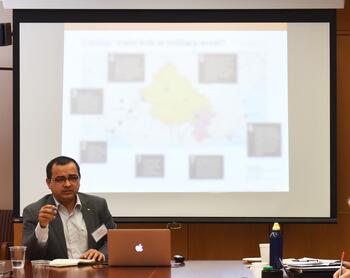
Amit Bhandari of Gateway House: Indian Council on Global Relations presents his research at the Belt and Road Workshop.
Participants then heard presentations from Amit Bhandari of Gateway House: Indian Council on Global Relations and Professor Cheng-Chwee Kuik of the National University of Malaysia. Mr. Bhandari’s talk focused on Chinese investments in India’s six neighboring countries, which tend to center more on energy rather than connectivity projects. He first found that the investments are generally not economical for the host countries because they come with high costs and high interest rates. Secondly, he argued that these projects often lacked a clear economic rationale, appearing instead to embed a geopolitical logic not always friendly to India. Professor Kuik, by contrast, provided a counterexample in his analysis of BRI projects in Southeast Asia. He described how, in Southeast Asia, host countries’ reception of the BRI has varied substantially; and how various stakeholders, including states, sub-states and other entities, have used their leverage to shape outcomes more or less favorable to themselves. Kuik’s analysis injected complexity into the often black-and-white characterizations of the BRI. He highlighted the multidimensional dynamics that play out among local and state-level players in pursuit of their goals, and in the process of BRI implementation.

Professor Curtis J. Milhaupt and Scholar-in-Residence Jeffrey Ball, both at Stanford Law School, followed with individual presentations on the role of State-Owned Enterprises (SOEs) in the BRI and the emissions impact of the BRI on climate change, respectively. Professor Milhaupt  characterized Chinese SOEs as both geopolitical and commercial actors, simultaneously charged with implementing Party policies and attaining corporate profits. Chinese SOEs are major undertakers of significant overseas BRI projects, acting not only as builders but also as investors, partners, and operators. This situation, Milhaupt asserted, carries significant risks for SOEs because these megaprojects often provide dismal returns, have high default rates, and can trigger political backlash in their localities. Milhaupt highlighted the importance of gathering firm-level data on businesses actually engaged in BRI projects to better infer geostrategic, financial, or other motivations. Jeffrey Ball turned the discussion to carbon emissions from BRI projects and presented preliminary findings from his four-country case studies. He concluded that, on aggregate, the emissions impact of the BRI is still “more brown than green.” Twenty-eight percent of global carbon emissions may be accounted for by BRI projects, Ball asserted, underscoring the importance of the BRI to the future of global climate change.

The day concluded with presentations by  Michael Bennon, Managing Director at the Stanford Global Projects Center, and Professor David M. Lampton, Oksenberg-Rohlen Fellow at the Freeman Spogli Institute for International Studies. Bennon first presented findings from two empirical case studies of BRI projects and then went on to describe how the BRI is now practically the “only game in town” for infrastructure funding for developing countries. Lengthy environmental review processes at Western multilateral banks have turned the World Bank, for example, from a lending bank into a “knowledge bank,” he argued. He also highlighted that, in general, economic returns on BRI projects for China are very poor, even though recipient countries may accrue macroeconomic benefits from these projects. Finally, Professor Lampton turned the discussion back to Southeast Asia, where China is currently undertaking massive cross-border high-speed rail projects through eight ASEAN countries. He described how each host country had varying capacity to negotiate against its giant neighbor, and how the sequential implementation of these cross-border rail projects also had varying impacts on the negotiating positions of these host countries. BRI played out differently in each country, in other words, eliciting different reactions, push-backs and negotiated terms.

The second day of the workshop was dedicated to working toward a collaborative approach to future BRI research. The group discussed the key gaps in the existing research, including how to know what China’s true intentions are, how to measure those intentions, who the main players and their interests in both China and the host countries are, and even what the BRI is, exactly. Some cautioned that high-profile projects may not be representative of the whole. Participants brainstormed about existing and future sources of data, and stressed the importance of diversifying studies and seeking empirical evidence.

Hero Image
Participants in the Belt and Road Initiative Workshop at Stanford University, March 2-3, 2020.
All News button
1
0
picture-62-1384135037.jpg

R. Quentin Grafton, FASSA, is Professor of Economics, ANU Public Policy Fellow, Fellow of the Asia and the Pacific Policy Society and Director of the Centre for Water Economics, Environment and Policy (CWEEP) at the Crawford School of Public Policy at the Australian National University. In April 2010 he was appointed the Chairholder, the UNESCO Chair in Water Economics and Transboundary Water Governance and between August 2013 and July 2014 served as Executive Director at the Australian National Institute of Public Policy(ANIPP). He currently serves as the Director of the Food, Energy, Environment and Water Network.

News Type
News
Date
Paragraphs

On November 2 at the University of Hawaii, Program on Energy and Sustainable Development (PESD) Director Frank Wolak gave a special seminar "How Should the Public Utilities Commission Regulate Hawaiian Electric Company for Better Integration of Renewable Energy?" He summarized inefficiencies in Hawaii's electricity system and advocates a "cost based" market in which long-term competitive contracts for power would be used in conjunction with a regulated optimization model that would set real-time prices for buying and selling of electricity and grid services.  

Read more (includes links to video of Professor Wolak's talk and slides)

Hero Image
gettyimages 566347891 Getty Images
All News button
1
News Type
News
Date
Paragraphs

Program on Energy and Sustainable Development (PESD) Director Frank Wolak, Associate DIrector Mark Thurber, and doctoral candidate Trevor Davis led an Electricity Market Simulation Workshop as part of the 2018 Western Electricity Market Forum September 20-21 in Boise, Idaho.  The audience was comprised of regulators and regulatory staff as well as policy makers representing states from across the western U.S.

The workshop used the PESD-developed Energy Market Game to explore timely questions about how electricity markets with a high share of renewable resources might function. “The Energy Market Game allows people of diverse backgrounds to understand market dynamics,” Thurber explained. “It can help policy makers and regulators set up incentives for market participants which naturally align with desired outcomes.”

The PESD team ran games with two contrasting policy approaches aimed at ensuring resource adequacy, with workshop participants playing the role of generating companies (“gencos”). In a high-renewable world, the specific resource adequacy concern is that thermal power plants won’t run enough to be profitable, and gencos therefore won’t build or keep enough thermal power plants to back up renewables when wind and sun aren’t available.

In the first game scenario, capacity markets were used to spur gencos to build enough gas-fired power plants to meet demand. Capacity markets straight-out pay gencos for holding generation capacity. They are used in a number of real-world electricity markets, but the games suggested they may not result in the cheapest power for consumers.


wemf 18 PESD Director Frank Wolak helps a workshop participant set up an Energy Market Game scenario.

PESD Director Frank Wolak helps a workshop participant set up an Energy Market Game scenario.
Photo Credit:  Maury Galbraith, Western Energy Board


In the second game scenario, forward contracts for electricity created the incentive for gencos to build power plants. If a genco doesn’t produce enough electricity to cover its forward contract, it risks having to buy the shortfall out of the spot market at high prices. Forward contracts therefore encourage gencos not only to build adequate generation capacity, but also to bid that capacity into the market at competitive prices. As this second game scenario showed, that can mean cheaper power for consumers.

Hero Image
wemf 1
PESD team members Frank Wolak, Mark Thurber, and Trevor Davis lead an Electricity Market Simulation Workshop in Boise, Idaho, September 2018.
Maury Galbraith, Western Energy Board
All News button
1
Paragraphs

Abstract


As an increasing number of California households install solar panels, the current approach to retail electricity pricing makes it harder for the state’s utilities to recover their costs. Unless policymakers change how they price grid-supplied electricity, a regulatory crisis where a declining number of less affluent customers will be asked to pay for a growing share of the costs is likely to occur.


All Publications button
1
Publication Type
Policy Briefs
Publication Date
Journal Publisher
Stanford Institute for Economic Policy Research (SIEPR)
Authors
Frank Wolak
Subscribe to Energy and Climate Policy