
Rolling Through Iowa
It is the end of summer and time for another Iowa report. My wife and I own a medium-sized farm in East Central Iowa that produces corn and soybeans, and beef from a cow/calf herd. My day job is as Professor of International Agricultural Policy at Stanford University, typically working on hunger problems in Asia. The summer keeps me in direct contact with rural life in the Midwest.
My previous Iowa postings have been dominated by weather—severe drought in 2012, massive flooding in 2013, and tornados in 2014. In a different way, weather features again this year. We had 10 inches of rain and a hailstorm during the first 10 days following my June return from California. But after that episode, the weather has been nearly perfect for our locale. Things could still go wrong—a typical farmer comment—but at the moment, we are looking at near-record yields on our farm. My guess is 210 bushels per acre for corn, and 65 bushels per acre for soybeans, both about 10% higher than for recent years.
Crops throughout the region look generally good, and the following couplet is a standard feature of local conversations:
“Don’t the crops look great?”
“Yeah, but they aren’t worth nothing.”
A sharp run-up in corn prices the last two weeks of June—from $3.50 to $4.40 per bushel—left farmers hopeful with what would turn out to be faulty expectations. As many waited for further price increases before selling, the good weather and the economic slow down in China caused corn prices to tumble. By Sept 1, prices were back at $3.50. These low prices left many farmers with dashed expectations, substantial amounts of 2014 corn in farm storage, and the prospects of a large upcoming October harvest. Nor will crop insurance help very much. The combination of yields and prices this year will leave most farmers just outside the range that would qualify them for 75%-revenue-protection payments.
Few outside the farming community realize that marketing decisions are often more important than production in defining a successful farm year. Few also appreciate the differential impact on Iowa’s general prosperity from the $7 corn that prevailed in 2012-13, versus the current $3.50.

Gloom is not the only thing that has been rolling across the landscape. Two parades really had to be seen to be appreciated. Each year since 1973, the state has hosted a bike ride across Iowa called Ragbrai. It is a weeklong activity that starts at the Missouri River to the west, and ends 500 miles to the east at the Mississippi River. It has grown into a massive affair that attracts some 15,000 riders.
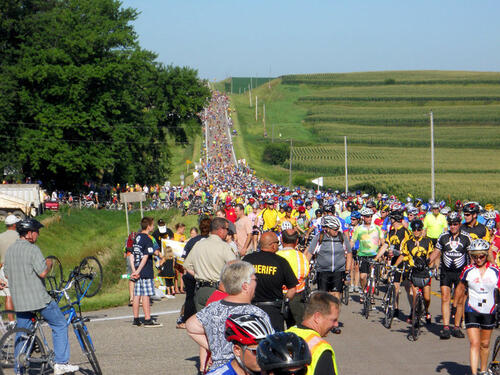
Photo Credit: C. Benz
This year’s ride was special, at least for us. This mass of rolling humanity came within two miles of our farm, and it included a sizeable number of Stanford faculty and students (including my boss, pictured below) who, among others, made mini-detours to visit us. What were most interesting to my wife and me were the impressions expressed both by the bikers and the local hosts.
The riders marveled at the rolling topography of Iowa; the vast expanses of corn and soybeans; the welcoming hospitality of Iowans; the infinite ways pork could be served on a stick; and the best sweet corn in the world! The locals were bemused that so many sane people of all shapes and sizes would voluntarily ride 500 miles in the heat and rain; amazed by the short-term chaos that 15,000 cyclists could cause in small rural communities that were attempting to move machinery and feed cattle; and pleased by the magnitude of the expenditures. The latter was deftly described by a neighbor as “our own economic stimulus package,” and more pointedly summarized by a local headline, “Circus, Economic Windfall, or Occupying Army?”

Photo Credit: R. Naylor
Politicians formed the second parade (charade?) that has been rolling across the state. Iowa—with the dubious honor of having the first primary/caucus—is a genuinely purple state. It voted for President Barack Obama in 2012 and for Senator Joni Ernst in 2014. Iowans pride themselves on being able to pick winners and on being stubbornly independent. The prevailing general mood at the moment, however, is some combination of confusion and disgust. Donald Trump draws the most comments. And while he leads the polls, I have yet to hear anyone (literally) this summer say that he or she favored him. Time will tell what Iowans really believe.
Nowhere was the comedy and chaos more vivid than at the recently completed Iowa State Fair. Some 15 presidential candidates showed up. Most of them spoke at the fair’s “Soapbox Corner” before conspicuously casting their kernel-of-corn vote at the straw (corn?) ballot table. They also had the obligatory pictures taken with the life-sized cow sculpted in butter, the fair’s largest bull (there must be some symbolism here), and the fair’s heaviest pig. The latter was a 500-pound specimen named Mac. (I was disappointed that an earlier winner, my namesake “Wally”, was not in the competition.) And to no one’s surprise, all candidates thought that corn-based ethanol was a really good idea. Most of them even expressed favor with the fair’s latest cuisine contribution—the Bomb—brisket, wrapped in bacon, served on a stick!
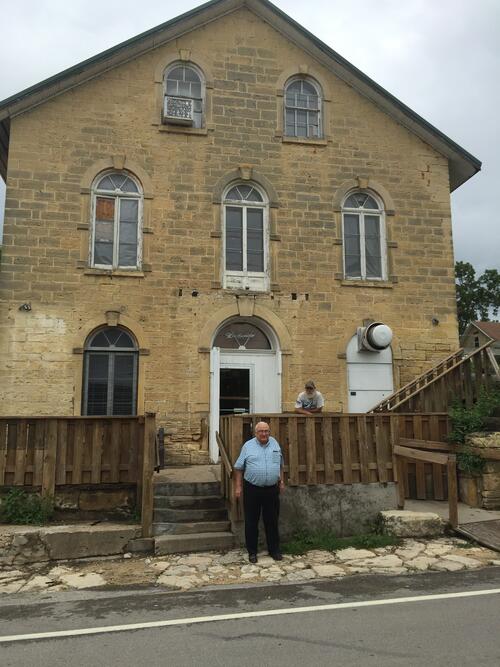
Photo Credit: R. Naylor
Readers of previous reports will be pleased to know that the 1868 Waubeek general store and restaurant still serves as the morning gathering place. It has changed hands, but continues its long tradition of watery coffee and stale pastry. (By request, I have included pictures; I am California hatless, plus a shot of the outside.) Besides prices, bikers, and politicians, three new topics of conversation have cropped up: water, cover crops, and weeds. All three are environmental issues that are distinctly operational. They also remind me of just how much information is exchanged around tables such as this one, though on any given morning that conclusion is not always obvious!

By far the most controversial topic of the summer has been water. (And to be clear, the issue is about water quality and the nutrients carried in the water, not about water supplies or allocations.) Many farmers realize that nutrient runoff from livestock operations and from fertilizer applied to fields is a very serious problem; most of them are also loathsome about EPA efforts to redefine and regulate what constitutes water flows in the U. S.
During the last week in August, the EPA announced new clean-water rules that would give the agency new jurisdiction over bodies of water (and land), including many in agriculture, which were previously unregulated. But it remains to be seen which bodies of waters would be covered, and which specific agricultural situations that would be exempted from the rules. Six states have sued the EPA, and the question of when or if the rules will be implemented is now caught up in the courts. The Farm Bureau has declared an all-out offensive against the rules, and farm publications have added further fuel to the fire. To complicate matters even more, the Des Moines Water Works has brought suit against three counties upstream of its water plant that would require farmers to change practices and/or make investments to reduce nutrient flows (particularly nitrates) into the Raccoon River.
Most scientists and many farmers believe that nutrient runoff constitutes the largest remaining environmental problem facing agriculture. Thus the fight, in many ways, is less about the problem, and more about philosophy. Most farmers prefer voluntary solutions arranged with the state or the USDA. They typically dislike mandatory rules of any sort, and they are particularly concerned that regulations might be of the one-size-fits-all character. The discourse is inflamed by uncertainty: the EPA has yet to write all of the regulations, and farmers simply do not know what to expect. In the absence of information, they fear the worst. Everyone I talked with had a relevant question. Will we need to get a permit to spread manure? How will drainage tiles that empty into or near creeks be handled? Will we need to file a nitrogen plan for every farm that specifies amounts and timing of fertilizer applications? On our farm, for example, we have a flowing creek that traverses a large permanent pasture. The creek provides water for the cowherd, which has direct access to it. What, if anything, will need to be changed in that arrangement? All of us wonder about the flexibility in timing and scope that will be accorded farmers who may be faced with large corrective investments. Many also fear that the regulators will know little about agricultural practices. In short, what waters are to be regulated, for what purposes, and with what instruments are issues still to be resolved? At the moment, there is considerable heat, but very little light about the answers.
Virtually all Iowa farmers have transitioned to minimum tillage systems; plowing has become a field operation of the past. This change in tillage also creates new cropping opportunities.

Photo Credit: USDA
Five years ago, there was virtually no talk about or use of “cover crops.” These crops are sown in residues immediately after corn or soybean harvest. Certain of them survive the winter, but others do not. Radishes (shades of the English agricultural revolution, circa 1700!) produce long roots that punch holes in clay layers of the soil, thereby assisting drainage. They can also be grazed. Small grains are also being seeded, which add to add organic matter and can sometimes be chopped as forage for dairy or beef operations.
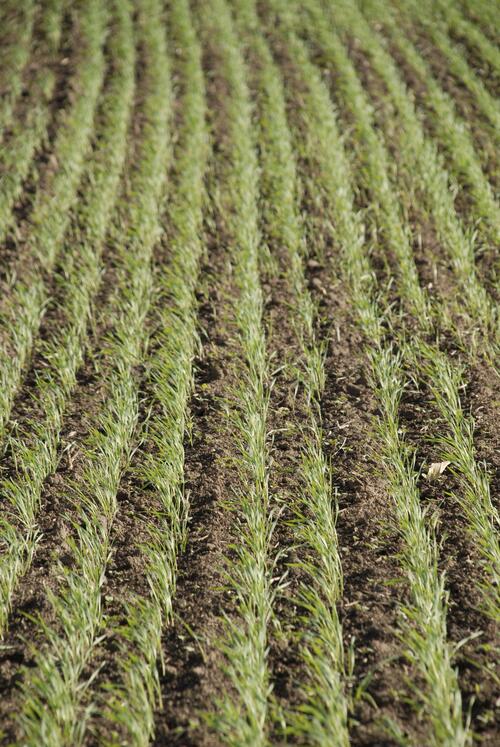
Photo Credit: Mühlhausen/landpixel
Cover crops are clearly still a work in progress, but they provide an interesting example of active on-farm experimentation. Best solutions seem to vary from farm to farm—from no cover, to radishes, to triticale—and seem importantly dependent on particular crop-livestock combinations. Discussions about the use of triticale—a cross between rye and either bread wheat or durum—were of particular interest to me. I worked with Norman Borlaug at the International Wheat and Maize Improvement Center in Mexico during the 1980s to develop modern varieties of this crop, but it has been slow to find appropriate niches in cropping systems around the world. In the 1980s, I never even contemplated that Iowa might be such a place.
Several forces drive the new concern about weeds. Falling crop prices have squeezed profit margins severely, causing farmers to look seriously at each cost component. For the first time, I have heard farmers question new seed varieties (virtually all GMOs), both because of their cost and their effectiveness. They increasingly wonder if the $200 seed-cost-per-acre for corn is justified. The current year, with its excellent growing season, meant there was less need for certain stacked traits such as drought resistance. Moreover, the year was equally good for weeds, whose resistance to major herbicides like Roundup seemed to be spreading.
Water hemp, in particular, gave soybean farmers grief, and is causing them to rethink seed-weed strategies. They worry about the consequences from applying new combination-herbicides (some still under various reviews) that attack both grasses and broad-leafed weeds. They are particularly concerned that spraying some of the new products will also destroy the grasses in waterways left specifically to prevent water erosion.
My conjecture is that most farmers will still use the specialized seeds next year. I predict, however, that they will also be searching more carefully for lower-cost ways—both via seeds and herbicides—to manage weeds. The growing weed resistance problem has begun to scare them—a recent Greenwire Poll indicates that 90% are worried—and has belatedly driven home the difficulties that arise from overuse of only one or two herbicides.
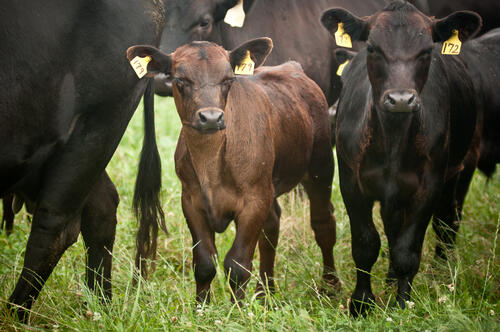
No Iowa report is complete without some cattle commentary.
My father was a cattle feeder, and some of those “cattle genes” carried forward a generation. I grew up knowing a lot about purebreds, about corn and soybean-meal feed rations, and about 2-pound-per-day rates of gain that produced 1100-pound animals for sale. Fast forward to 2015. When I look around, virtually all cattle have been crossbred for size and vigor (though in the market they may still be advertised as Angus!). Soybean meal has dropped completely out of the rations being fed in our county, having been replaced by the high-protein distillers grain, the by-product of making corn sweeteners and ethanol. Rates of gain are now 3.25 pounds per day, and finished animals are sold at 1500 pounds. What has not changed, however, is the riskiness of the enterprise. Even with cheap corn, buying 700 pound feeders for $2.25 per pound, and selling 1500 pound steers at $1.45 per pound has not been a great way to get rich in 2015!
My final impression of the summer is a memorable one: rolling down the Mississippi River on a paddle boat, celebrating my wife’s and my birthdays with good friends, viewing a glorious sunset, and eating world-class prime rib. Now that’s the way to get ready for a new year of Stanford classes.

Photo credit: flickr/Lance and Erin


 Dr. Cary Fowler in Svalbard, Norway, the home of the Svalbard Global Seed Vault.
 Seed storage boxes at the Svalbard Global Seed Vault.


 Marshall Burke and his wife rocking climbing with their two-year-old daughter at Joshua Tree.

