
Experts Gather to Share Findings, Brainstorm Approaches, and Spur Further Research on China’s Belt and Road Initiative
News Type
News
Date
Paragraphs
The Stanford Center at Peking University (SCPKU), the Center on Democracy, Development and the Rule of Law (CDDRL), and the APARC China Program jointly hosted a workshop on China’s Belt and Road Initiative (BRI) in early March. The workshop, held on March 2 and 3, welcomed researchers from around the world with expertise in the Initiative. Unfortunately, because of the rapidly developing health emergency related to the coronavirus, participants from not only China, but also Japan, were prevented from attending. As described by Professor Jean Oi, founding director of SCPKU and the China Program, and Professor Francis Fukuyama, director of CDDRL and the Ford Dorsey Master's in International Policy, who co-chaired the workshop, the meeting aimed to provide a global perspective on the BRI, consolidate knowledge on this opaque topic, and determine the best method and resources for future research.
The workshop began with presentations from several of the invited guests. Dr. Atif Ansar from the University of Oxford’s Saïd Business School kicked off the first day by describing not only the tremendous opportunity that the BRI presents to developing economies, but also the serious pitfalls that often accompany colossal infrastructure projects. Pointing out the poor returns on investment of mega infrastructure projects, Ansar examined the frequest cost and schedule overruns, random disasters, and environmental degradation that outweigh the minimal benefits that they generally yield. China’s own track record from domestic infrastructure projects does little to mitigate fear of these risks, Ansar claimed. In response, he urged professional management of BRI investments, institutional reforms, and intensified deployment of technology in BRI projects. Dr. Ansar was followed by Dr. Xue Gong of the S. Rajaratnam School of International Studies, Nanyang Technological University, Singapore. Dr. Gong’s analysis centered on the extent to which China’s geopolitical motivations influenced its outward foreign direct investments (OFDI). Although her research was still in the early stages, her empirical analysis of China’s OFDI inflows into fifty BRI recipient countries from 2007-2018 nevertheless revealed that geopolitical factors often outweigh economic factors when it comes to China’s OFDI destinations.
Image
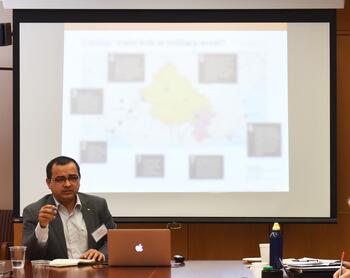
Professor Curtis J. Milhaupt and Scholar-in-Residence Jeffrey Ball, both at Stanford Law School, followed with individual presentations on the role of State-Owned Enterprises (SOEs) in the BRI and the emissions impact of the BRI on climate change, respectively. Professor Milhaupt characterized Chinese SOEs as both geopolitical and commercial actors, simultaneously charged with implementing Party policies and attaining corporate profits. Chinese SOEs are major undertakers of significant overseas BRI projects, acting not only as builders but also as investors, partners, and operators. This situation, Milhaupt asserted, carries significant risks for SOEs because these megaprojects often provide dismal returns, have high default rates, and can trigger political backlash in their localities. Milhaupt highlighted the importance of gathering firm-level data on businesses actually engaged in BRI projects to better infer geostrategic, financial, or other motivations. Jeffrey Ball turned the discussion to carbon emissions from BRI projects and presented preliminary findings from his four-country case studies. He concluded that, on aggregate, the emissions impact of the BRI is still “more brown than green.” Twenty-eight percent of global carbon emissions may be accounted for by BRI projects, Ball asserted, underscoring the importance of the BRI to the future of global climate change.
The day concluded with presentations by Michael Bennon, Managing Director at the Stanford Global Projects Center, and Professor David M. Lampton, Oksenberg-Rohlen Fellow at the Freeman Spogli Institute for International Studies. Bennon first presented findings from two empirical case studies of BRI projects and then went on to describe how the BRI is now practically the “only game in town” for infrastructure funding for developing countries. Lengthy environmental review processes at Western multilateral banks have turned the World Bank, for example, from a lending bank into a “knowledge bank,” he argued. He also highlighted that, in general, economic returns on BRI projects for China are very poor, even though recipient countries may accrue macroeconomic benefits from these projects. Finally, Professor Lampton turned the discussion back to Southeast Asia, where China is currently undertaking massive cross-border high-speed rail projects through eight ASEAN countries. He described how each host country had varying capacity to negotiate against its giant neighbor, and how the sequential implementation of these cross-border rail projects also had varying impacts on the negotiating positions of these host countries. BRI played out differently in each country, in other words, eliciting different reactions, push-backs and negotiated terms.
The second day of the workshop was dedicated to working toward a collaborative approach to future BRI research. The group discussed the key gaps in the existing research, including how to know what China’s true intentions are, how to measure those intentions, who the main players and their interests in both China and the host countries are, and even what the BRI is, exactly. Some cautioned that high-profile projects may not be representative of the whole. Participants brainstormed about existing and future sources of data, and stressed the importance of diversifying studies and seeking empirical evidence.
Hero Image

All News button
1
Audio: Tariffs Expand for Goods Going Between the United States and China
News Type
Commentary
Date
Paragraphs
Does the current trade-talk stalemate between the U.S. and China portend a larger confrontation? Oksenberg-Rohlen Fellow David Lampton says yes, and shared with VOA Asia reasons for why the two countries find themselves so much at odds. Listen below (first 8 minutes):
Hero Image

All News button
1
The Double-Edged Sword of Palm Oil
News Type
Blogs
Date
Paragraphs
Widespread cultivation of oil palm trees has been both an economic boon and an environmental disaster for tropical developing-world countries. New research points to a more sustainable path forward through engagement with small-scale producers.
Nearly ubiquitous in products ranging from cookies to cosmetics, palm oil represents a bedeviling double-edged sword. Widespread cultivation of oil palm trees has been both an economic boon and an environmental disaster for tropical developing-world countries, contributing to large-scale habitat loss, among other impacts. New Stanford-led research points the way to a middle ground of sustainable development through engagement with an often overlooked segment of the supply chain (read related overview and research brief).
"The oil palm sector is working to achieve zero-deforestation supply chains in response to consumer-driven and regulatory pressures, but they won’t be successful until we find effective ways to include small-scale producers in sustainability strategies,” said Elsa Ordway, lead author of a Jan. 10 Nature Communications paper that examines the role of proliferating informal oil palm mills in African deforestation. Ordway, a postdoctoral fellow at The Harvard University Center for the Environment, did the research while a graduate student in Stanford’s School of Earth, Energy & Environmental Sciences.
Image

An oil palm plantation in Cameroon (Image credit: Elsa Ordway)
Using remote sensing tools, Ordway and her colleagues mapped deforestation due to oil palm expansion in Southwest Cameroon, a top producing region in Africa’s third largest palm oil producing country (read about related Stanford research). Contrary to a widely publicized narrative of deforestation driven by industrial-scale expansion, the researchers found most oil palm expansion and associated deforestation occurred outside large, company-owned concessions, and that expansion and forest clearing by small-scale, non-industrial producers was more likely near low-yielding informal mills, scattered throughout the region. This is strong evidence that oil palm production gains in Cameroon are coming from extensification instead of intensification.
Possible solutions for reversing the extensification trend include improving crop and processing yields by using more high-yielding seed types, replanting old plantations, and upgrading and mechanizing milling technologies, among other approaches. To prevent intensification efforts from inciting further deforestation, they will need to be accompanied by complementary natural resource policies that include sustainability incentives for smallholders.
In Indonesia, where a large percentage of the world’s oil palm-related forest clearing has occurred, a similar focus on independent, smallholder producers could yield major benefits for both poverty alleviation and environmental conservation, according to a Jan. 4 Ambio study led by Rosamond Naylor, the William Wrigley Professor in the School of Earth, Energy & Environmental Sciences and a senior fellow at the Stanford Woods Institute for the Environment and the Freeman Spogli Institute for International Studies(Naylor coauthored the Cameroon study led by Ordway).
Using field surveys and government data, Naylor and her colleagues analyzed the role of small producers in economic development and environmental damage through land clearing. Their research focused on how changes in legal instruments and government policies during the past two decades, including the abandonment of revenue-sharing agreements between district and central governments and conflicting land title authority among local, regional and central authorities, have fueled rapid oil palm growth and forest clearing in Indonesia.
They found that Indonesia’s shift toward decentralized governance since the end of the Suharto dictatorship in 1998 has simultaneously encouraged economic development through the expansion of smallholder oil palm producers (by far the fastest growing subsector of the industry since decentralization began), reduced rural poverty, and driven ecologically destructive practices such as oil palm encroachment into more than 80 percent of the country’s Tesso Nilo National Park.
 A worker in East Kalimantan, Indonesia, loads palm fruit for transport to a factory that will process it into palm oil (Image credit: Joann de Zegher)
A worker in East Kalimantan, Indonesia, loads palm fruit for transport to a factory that will process it into palm oil (Image credit: Joann de Zegher)
Among other potential solutions, Naylor and her coauthors suggest Indonesia’s Village Law of 2014, which devolves authority over economic development to the local level, be re-drafted to enforce existing environmental laws explicitly. Widespread use of external facilitators could help local leaders design sustainable development strategies and allocate village funds more efficiently, according to the research. Also, economic incentives for sustainable development, such as an India program in which residents are paid to leave forests standing, could make a significant impact.
There is reason for hope in recent moves by Indonesia’s government, including support for initiatives that involve large oil palm companies working with smallholders to reduce fires and increase productivity; and the mapping of a national fire prevention plan that relies on financial incentives.
“In all of these efforts, smallholder producers operating within a decentralized form of governance provide both the greatest challenges and the largest opportunities for enhancing rural development while minimizing environmental degradation,” the researchers write.
Coauthors of “Decentralization and the environment: Assessing smallholder oil palm development in Indonesia” include Matthew Higgins, a research assistant at Stanford’s Center on Food Security and the Environment; Ryan Edwards of Dartmouth College, and Walter Falcon, the Helen C. Farnsworth Professor of International Agricultural Policy, Emeritus, at Stanford.
Coauthors of “Oil palm expansion at the expense of forests in Southwest Cameroon associated with proliferation of informal mills” include Raymond Nkongho, a former fellow at Stanford’s Center for Food Security and the Environment; and Eric Lambin, the George and Setsuko Ishiyama Provostial Professor in the School of Earth, Energy & Environmental Sciences and a senior fellow at the Stanford Woods Institute for the Environment.
Hero Image

All News button
1
Sell Low and Buy High: Arbitrage and Local Price Effects in Kenyan Markets
Paragraphs
Large and regular seasonal price fluctuations in local grain markets appear to offer African farmers substantial inter-temporal arbitrage opportunities, but these opportunities remain largely unexploited: small-scale farmers are commonly observed to "sell low and buy high" rather than the reverse. In a field experiment in Kenya, we show that credit market imperfections limit farmers' abilities to move grain inter-temporally. Providing timely access to credit allows farmers to buy at lower prices and sell at higher prices, increasing farm revenues and generating a return on investment of 28%. To understand general equilibrium effects of these changes in behavior, we vary the density of loan offers across locations. We document significant effects of the credit intervention on seasonal price fluctuations in local grain markets, and show that these GE effects shape individual level profitability estimates. In contrast to existing experimental work, the results indicate a setting in which microcredit can improve firm profitability, and suggest that GE effects can substantially shape microcredit's effectiveness. In particular, failure to consider these GE effects could lead to underestimates of the social welfare benefits of microcredit interventions.
All Publications button
1
Publication Type
Working Papers
Publication Date
Journal Publisher
NATIONAL BUREAU OF ECONOMIC RESEARCH
Pamela Ronald
0
pcronald@ucdavis.edu
Affiliated scholar
Pamela Ronald was a Visiting Professor at the Center on Food Security and the Environment in 2018 and remains an FSE affiliate. She is also a Distinguished Professor in the Department of Plant Pathology and the Genome Center at UC Davis and serves as Director of Grass Genetics at the Joint Bioenergy Institute in Emeryville, California and Faculty Director of the UC Davis Institute for Food and Agricultural Literacy.
Ronald’s laboratory studies the genetic basis of resistance to disease and tolerance to stress in rice. Together with her collaborators, she has engineered rice for resistance to disease and tolerance to flooding, which seriously threaten rice crops in Asia and Africa. For example, Ronald and collaborators discovered the rice XA21 immune receptor and the rice Sub1A submergence tolerance transcription factor. In 2015, five million farmers planted Sub1 rice varieties developed by breeders at the International Rice Research Institute. In 1996, she established the Genetic Resources Recognition Fund, a mechanism to recognize intellectual property contributions from less developed countries.
She and her colleagues were recipients of the USDA 2008 National Research Initiative Discovery Award for their work on rice submergence tolerance. She was awarded a Guggenheim Fellowship, the Fulbright-Tocqueville Distinguished Chair and the National Association of Science Writers Science in Society Journalism Award. She is an elected fellow of the American Association for the Advancement of Science. In 2011, she was selected as one of the 100 most creative people in business by Fast Company Magazine. In 2012, Ronald was awarded the Louis Malassis International Scientific Prize for Agriculture and Food and the Tech Award for innovative use of technology to benefit humanity. In 2015 Scientific American selected Ronald as one of the world’s 100 most influential people in biotechnology. In 2016, Grist magazine named Ronald as one of 50 innovators who will lead us toward a more sustainable future.
Can Africa rise to the challenge of feeding itself in the 21st century?
Related Multimedia

Improving environmental practices in agricultural supply chains: The role of company-led standards
Paragraphs
Food retailers and manufacturers are increasingly committing to address agricultural sustainability issues in their supply chains. In place of using established eco-certifications, many companies define their own supply chain sustainability standards. Scholars remain divided on whether we should expect such company-led programs to affect change. We use a major food retailer as a critical case to evaluate the effectiveness of a company-led supply chain standard in improving environmental farm management practices. We find that the company-led standard increases the adoption of most environmental best management practices among the company's fruit, vegetable and flower growers in South Africa. This result is robust across two identification strategies: a panel analysis of over 950 farm audits and a cross-sectional matching analysis using original survey data. In-depth interviews suggest that the program's unique focus on capacity building through audit visits by highly trained staff, coupled with a close business relationship between the retailer and their growers help to explain the increased effectiveness of the program as compared to other private environmental standards. Contrary to the argument that company-led initiatives are mere window dressing, this study provides a critical example of the positive role private governance mechanisms can play in improving environmental farm management practices globally.
All Publications button
1
Publication Type
Journal Articles
Publication Date
Journal Publisher
Global Environmental Change
Historical effects of CO2 and climate trends on global crop water demand
Paragraphs
A critical question for agricultural production and food security is how water demand for staple crops will respond to climate and carbon dioxide (CO2) changes1, especially in light of the expected increases in extreme heat exposure2. To quantify the trade-offs between the effects of climate and CO2 on water demand, we use a ‘sink-strength’ model of demand3,4 which relies on the vapour-pressure deficit (VPD), incident radiation and the efficiencies of canopy-radiation use and canopy transpiration; the latter two are both dependent on CO2. This model is applied to a global data set of gridded monthly weather data over the cropping regions of maize, soybean, wheat and rice during the years 1948–2013. We find that this approach agrees well with Penman–Monteith potential evapotranspiration (PM) for the C3 crops of soybean, wheat and rice, where the competing CO2 effects largely cancel each other out, but that water demand in maize is significantly overstated by a demand measure that does not include CO2, such as the PM. We find the largest changes in wheat, for which water demand has increased since 1981 over 86% of the global cropping area and by 2.3–3.6 percentage points per decade in different regions.
All Publications button
1
Publication Type
Journal Articles
Publication Date
Journal Publisher
Nature Climate Change