History
-

Webinar recording: https://youtu.be/ShtOUZ67F-s


Webinar Description:

From amazing athletic feats to beautiful pageantry, the Olympics command the world’s attention like no other event. Students and families alike are sure to watch at least some of this summer’s games from Tokyo. But how might we, as teachers, use the Olympics to introduce topics from East Asian history? In this webinar, Ethan Segal explores the many meanings of the Olympics for China, Japan, and South Korea, from displaying recovery to promoting democracy. Join us for an interesting, engaging session that will provide useful background content, help you rethink some old assumptions, and highlight some connections for teachers to use in bringing the Olympics into your classroom.

Register at https://bit.ly/3gU7SC5.

This webinar is a joint collaboration between SPICE, the National Consortium for Teaching about Asia (NCTA), and Stanford's Center for East Asian Studies.


Featured Speaker:

Professor Ethan Segal

Image
Professor Ethan Segal

Ethan Segal is Associate Professor of History at Michigan State University. He earned his Ph.D. at Stanford University, was a Fulbright Scholar at the University of Tokyo, and taught as a visiting professor at Harvard. Professor Segal’s research topics include economic and social history, nationalism, women and gender, and contemporary popular culture. He is the author of Coins, Trade, and the State: Economic Growth in Early Medieval Japan as well as numerous articles, reviews, and videos in scholarly journals and online. Professor Segal has won multiple teaching awards and is a regular contributor to NCTA and other outreach workshops and seminars.


Via Zoom Webinar. Registration Link: https://bit.ly/3gU7SC5.

Professor Ethan Segal Associate Professor of History, Michigan State University
Workshops
News Type
News
Date
Paragraphs

In his latest round of nominations, President Biden nominated FSI's MLK, Jr. Centennial Professor Emeritus Dr. Clayborne Carson to the Civil Rights Cold Case Review Board.

As noted in the nomination accouncement from the White House, Dr. Carson has devoted most of his professional life to the study of Martin Luther King, Jr. and the movements King inspired. Since receiving his doctorate from UCLA in 1975, Dr. Carson has taught at Stanford University, where he is Martin Luther King, Jr., Centennial Professor of History (Emeritus).

In 1985, the late Coretta Scott King invited Dr. Carson to direct a long-term project to edit and publish the authoritative edition of her late husband’s speeches, sermons, correspondence, publications, and unpublished writings. Under Carson’s direction, the King Papers Project has produced seven volumes of The Papers of Martin Luther King, Jr. In 2005 Carson founded the Martin Luther King, Jr. Research and Education Institute to endow and expand the educational outreach of the King Papers Project.

I’m very fortunate to have lived during a period when I could make at least a small contribution to the Black Freedom Movement and then make a contribution to making sure that those who made larger contributions have gradually gotten their due.
Clayborne Carson
MLK, Jr. Centennial Professor Emeritus, FSI

Carson is mindful of the unique arc of his academic and personal life. "I grew up in Los Alamos, New Mexico where we were one of only three Black families. What I knew about Black America was mainly what I read in the newspapers. I read about these heroic figures like Martin Luther King Jr., Bob Moses, Diane Nash, and John Lewis, and I wanted to be like them. I went to the March on Washington as a nineteen-year-old and watched and listened to what these leaders were working to accomplish. One of the remarkable things about my life is that I've been able to meet and get to know so many of the people who spoke or performed at the march or were on the speaker's platform at the Lincoln Memorial."

Dr. Carson is currently completing his final year as the director of the King Institute, afterwhich he will continue his research and teaching at Stanford’s Center on Democracy, Development, and the Rule of Law of the Freeman Spogli Institute for International Studies.

As Carson looks towards the future, he's appreciative of the opportunities ahead. "I’m still excited about the idea of exploring little known aspects of African-American history, so that should be good preparation for studying largely forgotten 'cold cases,'" he says.

Dr. Clayborne Carson

Clayborne Carson

MLK, Jr. Centennial Professor Emeritus, FSI
Full Profile

Read More

Dr. Carson photo
News

Welcoming Dr. Clayborne Carson to CDDRL

We are delighted to welcome Dr. Clayborne Carson as the Martin Luther King, Jr. Centennial Professor Emeritus at FSI.
Welcoming Dr. Clayborne Carson to CDDRL
gettyimages 1217563637
News

What Protests For Racial Justice Tell Us About U.S. Democracy

American democracy is facing its most serious challenge in decades, says Larry Diamond on the World Class Podcast. But there are signs of hope.
What Protests For Racial Justice Tell Us About U.S. Democracy
police brutality
News

New Research from the Poverty, Violence, and Governance Lab Examines Police Brutality

For the last 10 years, a team of social scientists at the Poverty, Violence, and Governance (PovGov) lab at the Freeman Spogli Institute for International Studies (FSI) have been developing action-oriented research to support human rights and inform policy on the root causes and devastating consequences of violence.
New Research from the Poverty, Violence, and Governance Lab Examines Police Brutality
Hero Image
Dr. Clayborne Carson
Stanford
All News button
1
Subtitle

In his new role on the Civil Rights Cold Case Review Board, Dr. Carson, a seminal scholar on the life and writing of Dr. Martin Luther King Jr., will review dozens of unsolved and racially motivated murder cases from the civil rights era.

Authors
Gary Mukai
News Type
Blogs
Date
Paragraphs

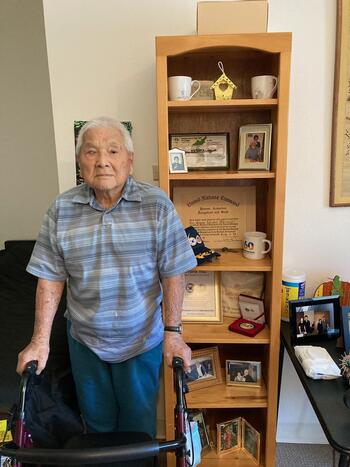
Last week, I had the chance to visit one of my uncles, George Mukai (92), who is a veteran of the Korean War. He recently moved into an assisted-living facility and had very few items delivered from his home to his new residence. One thing that he did have delivered was a curio cabinet that contains Korean War-related items including medals, a cap, a United Nations Command certificate, and a piece of wire from the DMZ.

Image
United Nations Command Certificate
As he has in the past, he shared recollections of his experiences during the Korean War, but unlike when he was young, his recollections felt more poignant. He is a very proud veteran. Another one of my uncles, Roy Mukai (deceased), was also a Korean War veteran, and a third, Toichi Mukai, was stationed in Korea after the Korean Armistice Agreement was signed in 1953.

This month marks the 71st anniversary of the beginning of the Korean War on June 25, 1950. After my visit with George, I started to reflect on the work that my colleagues (past and present) at SPICE have done to promote the study of Korea in U.S. schools and directly to students in the United States. They are:

They have developed extensive curriculum on Korea. The offerings can be found on this webpage and includes offerings such as the following:

  • Colonial Korea in Historical Perspective
  • Divided Memories: Comparing History Textbooks
  • Dynamics of the Korean American Experience
  • Economic Development: The Case of South Korea
  • Inter-Korean Relations: Rivalry, Reconciliation, and Reunification
  • Traditional and Contemporary Korean Culture
  • Uncovering North Korea
  • U.S.–South Korean Relations
     

In addition, the Sejong Korea Scholars Program, an online course for high school students in the United States, has been offered by SPICE since 2013. The SKSP annually selects 20–25 exceptional high school students from throughout the United States and engages them in an intensive study of Korea and U.S.–Korea relations. Selected students participate in the online course on Korea from February to June of each year. The current instructor is Jang.

Lastly, SPICE offers annual summer institutes to middle school and high school teachers in partnership with the National Consortium for Teaching about Asia, and also the East Asia Seminars for Teachers in Hawaii. These are facilitated respectively by Edman, Naomi Funahashi, and Sekiguchi. These programs focus in part on Korea and are funded by the Freeman Foundation.

Image
George Mukai 2021
I wish that I could inform veterans of the Korean War about programs such as these that help to promote a greater understanding of Korea and U.S.–Korea relations among students in the United States, and also to encourage students to reflect upon the sacrifices that were made by the veterans.

Read More

High school student with a diploma standing in front of a banner
Blogs

My Experience with the Sejong Korea Scholars Program in the Midst of a Global Pandemic

The following reflection is a guest post written by Jason Lu, an alumnus of the Sejong Korea Scholars Program, which is currently accepting applications for the 2021 course.
My Experience with the Sejong Korea Scholars Program in the Midst of a Global Pandemic
Student in a red dress presenting at a podium with Stanford signage
Blogs

Coming Full Circle: The Sejong Korea Scholars Program and Stanford

The following reflection is a guest post written by Sandi Khine, an alumna of the Reischauer Scholars Program and the Sejong Korea Scholars Program, which are currently accepting applications for the 2021 courses.
Coming Full Circle: The Sejong Korea Scholars Program and Stanford
5thbuchanan banner
News

SPICE Wins Buchanan Prize for Fifth Time

SPICE Wins Buchanan Prize for Fifth Time
Hero Image
George Mukai in Munsan, a town south of the Imjin River near Panmunjom, during the Korean War, 1951
George Mukai in Munsan, a town south of the Imjin River near Panmunjom, during the Korean War, 1951; image courtesy George Mukai
All News button
1
Subtitle

SPICE offers a series of Korea-focused lesson plans, an online course for U.S. high school students, and teacher professional development opportunities.

News Type
News
Date
Paragraphs

The California Department of Education adopted the Ethnic Studies Model Curriculum last March. Chapter 3 of the Model Curriculum includes a section on “Native American Studies.”

On June 18, 2021, SPICE will host a panel of three Native and Indigenous scholars to reflect on California’s new model curriculum and the state of ethnic studies in their respective regions. The panel will include Navajo, Native Hawaiian, and Ainu educators who will provide a range of educational perspectives on Native and Indigenous studies in the United States and Japan.

  • Dr. Harold Begay, Superintendent of Schools, Navajo Nation
  • Dr. Sachi Edwards, Faculty Member at Soka University in Tokyo, Japan
  • Dr. Ronda Māpuana Shizuko Hayashi-Simpliciano, Vice Principal, Ke Kula Kaiapuni ʻo Ānuenue, Honolulu, Hawaiʻi

The webinar, titled “Indigenous Voices: Educational Perspectives from Navajo, Native Hawaiian, and Ainu Scholars in the Diaspora,” will address several additional topics, such as the various academic field names of the study of Native and Indigenous people, the complexity and diversity of Native and Indigenous people’s experiences, and recommended resources for K–12 educators.

These topics are not only relevant to teachers in California but to educators in other states as well. K–12 educators and administrators are encouraged to attend. Register in advance at https://bit.ly/3z4kxtc.

This webinar is a joint collaboration with the National Consortium for Teaching about Asia (NCTA) and the Center for East Asian Studies at Stanford University.

To stay informed of SPICE news, join our email list and follow us on Facebook, Twitter, and Instagram.

Read More

Tokyo’s Shin Okubo neighborhood, known for its Korea Town
Blogs

Global Human Rights and Minority Social Movements in Japan: A Webinar by Professor Kiyoteru Tsutsui

Tsutsui introduced the audience to three minority groups in Japan—the Ainu, resident Koreans (Zainichi), and the Burakumin—and illustrated how human rights have galvanized minority social movements there.
Global Human Rights and Minority Social Movements in Japan: A Webinar by Professor Kiyoteru Tsutsui
Chinese railroad workers
Blogs

Stanford’s Center for East Asian Studies and SPICE Co-Sponsor Webinar on “Chinese Railroad Workers in North America Project”

The speakers shared extensive primary source documents from Stanford Libraries’ Department of Special Collections, as well as free lesson plans from SPICE's online curriculum unit on Chinese railroad workers.
Stanford’s Center for East Asian Studies and SPICE Co-Sponsor Webinar on “Chinese Railroad Workers in North America Project”
Hero Image
Flyer for the SPICE webinar "Indigenous Voices: Educational Perspectives from Navajo, Native Hawaiian, and Ainu Scholars in the Diaspora"
The June 18 webinar will feature Dr. Harold Begay, Dr. Sachi Edwards, and Dr. Ronda Māpuana Shizuko Hayashi-Simpliciano.
All News button
1
Subtitle

Navajo, Native Hawaiian, and Ainu educators will join together on June 18 to examine the state of Indigenous studies.

-

Webinar recording: https://youtu.be/sQBR-NZBWks


Webinar Description:

On March 18, 2021, the California Department of Education adopted the Ethnic Studies Model Curriculum. Chapter 3 of the Model Curriculum includes a section on “Native American Studies.” Three Native and Indigenous educators will reflect on this and the state of ethnic studies in their regions. The educators are Dr. Harold Begay, Dr. Sachi Edwards, and Dr. Ronda Māpuana Shizuko Hayashi-Simpliciano. Kasumi Yamashita will serve as the moderator of the panel. She is an Instructor for SPICE and was trained as a cultural anthropologist at Harvard University and was a Fulbright Scholar to Brazil.

Some of the topics that will be addressed include (1) the various academic field names of the study of Native and Indigenous people; (2) the complexity and diversity of Native and Indigenous people’s experiences, highlighting key concepts like indigeneity, settler colonialism, diaspora, social justice and activism; and ontological and epistemological philosophy; and (3) recommended resources for K–12 educators.

These topics are not only relevant to teachers in California but to teachers in other states as well. K–12 educators and administrators are encouraged to sign up at https://bit.ly/3z4kxtc.

This webinar is a joint collaboration between the National Consortium for Teaching about Asia (NCTA), Center for East Asian Studies, and SPICE.
 

Featured Speakers:

Dr. Harold Begay

Image
Harold headshot

Dr. Harold Begay, Superintendent of Schools, Navajo Nation, was raised on the Navajo Nation in northern Arizona, amid a deep bicultural chasm irrevocably bound by his traditional Dine’ (Navajo) culture upbringing and mainstream Western Greco-Roman education in the United States. He completed his Ph.D. in school finance/economics, concentrating his advanced studies in educational administration, bilingual education, and social foundations of education from the University of Arizona. Dr. Begay has worked in several Native American school districts in different teaching and administrative capacities over a span of 25 years. Has been a Visiting Scholar at U.C. Berkeley and is currently doing transnational educational work with Stanford University.


Dr. Sachi Edwards

Image
sachi headshot

Dr. Sachi Edwards is a Faculty Member at Soka University in Tokyo, Japan, and also a Lecturer in the Educational Foundations department at the University of Hawaiʻi, Mānoa. Her areas of research include higher education, internationalization, and religious identity, diversity, and oppression. Dr. Edwards received a Ph.D. in higher education from the University of Maryland, College Park. She teaches classes about higher education, international and intercultural education, educational theory/philosophy, qualitative research methods, and academic writing. She was recently featured with Dr. Ronda Māpuana Shizuko Hayashi-Simpliciano in discussion on “Ainu in Diaspora: Rising from Shame, Honoring Ainu Resilience,” hosted by the Japanese American Memorial Pilgrimages.


Dr. Ronda Māpuana Shizuko Hayashi-Simpliciano

Image
mapuana headshot

Dr. Ronda Māpuana Shizuko Hayashi-Simpliciano is Vice Principal of the Hawaiian language immersion school, Ke Kula Kaiapuni ʻo Ānuenue, Honolulu, Hawaiʻi. She is an Ainu-Hawaiian scholar and educator who works in the field of indigenous language and culture restoration. She did her doctoral work at the University of Hawaiʻi, Mānoa. Dr. Hayashi-Simpliciano recently gave a talk on “Ainu in Diaspora History,” hosted by the Japanese American Memorial Pilgrimages.

Via Zoom Webinar. Registration Link: https://bit.ly/3z4kxtc.

Dr. Harold Begay Superintendent of Schools, Navajo Nation
Dr. Sachi Edwards Faculty Member at Soka University in Tokyo, Japan
Dr. Ronda Māpuana Shizuko Hayashi-Simpliciano Vice Principal, Ke Kula Kaiapuni ʻo Ānuenue, Honolulu, Hawaiʻi
Workshops
Authors
News Type
Q&As
Date
Paragraphs

Vietnam and China are frequently referred to as 'authoritarian regimes,' but in history, political practice, and social governance these two countries are starkly different. This is particularly true of how each government responds to social pressure and civil unrest. Nhu Truong, one of APARC's 2020-21 Shorenstein Postdoctoral Fellows, is researching the root causes of these differences, what they reveal about the specific contexts of each nation's political trajectory, and how they can inform academic discussions of authoritarianism.

Nhu Truong’s dissertation explains how and why the two most similar communist, authoritarian regimes of China and Vietnam differ in their responsiveness to mounting unrest caused by government land seizures. Despite their many similarities, Vietnam has exhibited greater institutionalized responsiveness, whereas China has been relatively more reactive. While at APARC, Nhu has been refining 16 months of fieldwork into a book manuscript. Following her tenure as a Shorenstein Fellow at APARC, she will join the Council for Southeast Asian Studies and the Council for East Asian Studies at Yale University as a postdoctoral associate and has accepted a position as an assistant professor at Denison University starting in 2022.

Nhu sat down to talk more about her research and how the ongoing pandemic has heightened the need to better understand the ways in which different governments implement policy and address social issues. She also shares how she's stayed grounded and positive during an unusual year of change and being a long-distance fellow.

1. Can you give us an overview of your research and the topics you’re investigating?

My research addresses the following question: Why are some authoritarian regimes more responsive to social unrest than others? While it might seem counterintuitive to think of authoritarian regimes in this light, repression and responsiveness often occur in tandem under authoritarian rule. Centered on a comparison between Vietnam and China, I document the steps that each has taken to address social discontent fueled by pervasive government seizures of rural land. In response to societal input between 2003 and 2017, Vietnam enacted comprehensive and programmatic reforms to reduce the permissible scope for government land expropriation whereas those enacted by China were relatively marginal and piecemeal. At the subnational level, this difference has had important implications for land rights and the security of villagers in both countries. In summary, despite their many similarities, the manner and degree of their responsiveness have varied. My research then traces the historical origins that undergird the political development and institutional character of Vietnam and China’s divergent responsiveness to social unrest. 

2. How did you first become interested in these topics?

My interest in the repressive-responsive character of authoritarian regimes stems from my preoccupation with questions of political legitimacy, societal resistance, and institutional dynamics in authoritarian contexts. One particular experience that stoked my interest was my visit to Wukan, Guangdong in 2016. Wukan was once hailed as an emblematic case of grassroots democracy and accommodation by the Chinese state, when villagers’ outcries against the local government’s seizure of their land resulted in the re-election of the village committee in 2012. Yet, when I visited in 2016, villagers expressed that nothing had changed, and that “everything that could be done has already been done.” This experience led me to question what responsiveness means in authoritarian contexts.

3. During the last year, the world has changed significantly because of the pandemic and fluctuating politics in many nations. Have these changing global situations given you any new insights into your research?

The pandemic has underscored the need for a nuanced and contextual understanding of democracies and non-democracies. For instance, the variation in state responses to COVID-19 suggests that there is no clear correlation between responsiveness or the effectiveness of government responses to COVID-19 and regime types. Consider Vietnam’s proactive approach and success at containing the pandemic as opposed to the US. Other recent developments such as the crackdowns on pro-democracy protests in Thailand and mass protests against the recent military coup in Myanmar showcase how quickly state responsiveness to social demands can erode, even in multi-party states.

4. What has your experience as one of our Shorenstein Fellows been like during this unusual period of time when we haven’t physically been together at APARC?

My fellowship has been remote, and I have therefore needed to be much more proactive to stay as engaged as possible. I have consulted with my mentor often over Zoom, and reached out to other scholars for their feedback and advice on my research. I have also especially appreciated the chance to participate in the China Social Science Workshop, where I've shared my work and learned from other presenters. Other postdoctoral fellows at APARC and I have also gotten together virtually to exchange stories and to share our experiences from this unusual year.  

5. What are some of the things you've done during this past year to give yourself a break from work and have some fun?

Due to the pandemic, I have been living back home to Austin, Texas, since March of last year. The last time that I was home for this long must have been after I graduated from college. So, for the first time in a long time, I've planted tomatoes, eggplants, and sunflowers in our garden, and I've really enjoyed watching them bloom and ripen. With everything growing, it feels like I've spent most of my break in our backyard defending our flowers, fruits, and vegetables from squirrels and bunnies! But luckily I also have our two dogs, Wishie and Sushi, to help me!

6. As the state of the pandemic changes and things in academia and our communities, what are some things you are looking forward to both professionally and personally?

I'm certainly looking forward to having conferences in person again! I'm also still not sure when it will be possible and safe for me to visit Asia again, especially Vietnam and China, but I have missed these places. I'm also learning Khmer this summer, and I'm excited to eventually visit Cambodia to pursue my research there.

Read More

[Left] Hong Kong skyline; [Right] Encina Hall, Stanford
Q&As

Predoctoral Spotlight: Shan Huang on Development and Urban Politics in Hong Kong

Meet Shan Huang, a Stanford doctoral candidate in anthropology and a 2020-21 APARC predoctoral fellow, whose dissertation provides an ethnographic account of Hong Kong’s political culture in the post-Handover era.
Predoctoral Spotlight: Shan Huang on Development and Urban Politics in Hong Kong
[Left] Postdoc Spotlight, Jeffrey Weng, Shorenstein Postdoctoral Fellow in Contemporary Asia, [Right] Jeffrey Weng
Q&As

Postdoc Spotlight: Jeffrey Weng on Language and Society

Shorenstein Postdoctoral Fellow in Contemporary Asia Jeffrey Weng shares insights from his research into how language and society shape one another, particularly how the historical use of Mandarin affects contemporary Chinese society and linguistics.
Postdoc Spotlight: Jeffrey Weng on Language and Society
Hero Image
Postdoc Spotlight on Nhu Truong, 2020-21 Shorenstein Fellow
All News button
1
Subtitle

2020-21 Shorenstein Postdoctoral Fellow Nhu Truong, who studies how authoritarian regimes like China and Vietnam respond to social pressure, explains why understanding differences in governance is crucial in an era of fluctuating politics and pandemic.

Authors
News Type
News
Date
Paragraphs

In a webinar dated, February 12, 2021, a panel of Stanford University scholars shared their reflections on the legacy of the January 25, 2011 Uprising in Egypt. Marking the 10-year anniversary of the uprising and the ouster of Hosni Mubarak, the panel examined the trajectory of authoritarianism in the country over the past decade. Moderated by ARD Associate-Director Hesham Sallam, the panel included former CDDRL Visiting Scholar Nancy Okail, Stanford Professor of History Emeritus Joel Beinin, and CDDRL Senior Research Scholar Amr Hamzawy. The panelists addressed a variety questions including: How have political developments in Egypt and elsewhere in recent years informed our understanding of the January 25 Uprising and its significance? In what ways have authoritarian institutions adapted in the aftermath of the 2011 uprising and how have they shaped the prospects for political change and/or stability? Where are the sites of political contestation and resistance in today’s Egypt?


Hero Image
Joel Beinin Nancy Okail Amr Hamzawy Hesham Sallam
All News button
1
-


After the collapse of the Soviet Union, the newly gained dominance of liberal democracy as a political regime was accompanied by a new dominance of liberal democracy as a descriptive language. Concepts of political science, sociology, and economics which had been developed for the analysis of Western-type polities were applied to the various phenomena in the newly liberated countries. Bálint Magyar and Bálint Madlovics from Central European University (CEU DI) argue that the language of liberal democracies blurs the understanding of the current state of post-communism as it leads to conceptual stretching and brings in a host of hidden presumptions.

Magyar and Madlovics present at Stanford their most recent book, The Anatomy of Post-Communist Regimes (CEU Press, 2020). It is a comprehensive attempt to break with the traditional analysis, proposing a systematic renewal of our descriptive vocabulary. The authors have created categories as well as a whole new grammar for the region’s political, economic, and social phenomena. Focusing on Central Europe, the post-Soviet countries, and China, their study provides concepts and theories to analyze the actors, institutions, and dynamics of post-communist democracies, autocracies, and dictatorships.

Image
Bálint Magyar

Bálint Magyar is a Research Fellow at CEU Democracy Institute (since 2020), holding University Doctoral degree in Political Economy (1980) from Eötvös Loránd University in Budapest. He has published and edited numerous books on post-communist mafia states since 2013. He was an Open Society Fellow for carrying out comparative studies in this field (2015-2016), Hans Speier Visiting Professor at New School (2017), Senior Fellow at CEU Institute for Advanced Study (2018-2019), and Research Fellow at Financial Research Institute (2010-2020). Formerly, he was an activist of the Hungarian anti-communist dissident movement, founder of the liberal party of Hungary (SZDSZ, 1988), Member of Hungarian Parliament (1990-2010), and Minister of Education (1996-1998, 2002-2006).

Image
Bálint Madlovics

Bálint Madlovics is a political scientist, economist, and sociologist, currently working as a Research Assistant at CEU Democracy Institute (since 2020). He holds an MA in Political Science (2018) from Central European University in Budapest, a BA in Applied Economics (2016) from Corvinus University of Budapest, and a BA in Sociology (2021) from Eötvös Loránd University in Budapest. He contributed a chapter to one of Bálint Magyar’s volumes on the post-communist mafia state of Hungary, and has co-authored past and upcoming publications since 2015. He was a Research fellow of Financial Research Institute in Budapest (2018-2019).

Online via Zoom

Bálint Magyar CEU Democracy Institute
Bálint Madlovics CEU Democracy Institute
-


During the past decade, many parliamentary democracies have experienced bargaining delays when forming governments. For example, after the Swedish parliamentary election in 2018, it took 134 days to install a new government, which is especially surprising since all previous Swedish governments since the 1930s have formed within four weeks. The previous literature has attributed protracted government formation processes to a high degree of preference uncertainty among the political parties and a high level of bargaining complexity (resulting, for example, from a high degree of party-system fragmentation). We draw on such theories, but we also highlight a feature that hasn’t received much attention in the previous literature on bargaining duration: “pre-electoral commitments.” We consider such commitments both in terms of positive statements made by parties about alliances with other parties and in terms of negative statements about parties that are considered “pariahs.” Pre-electoral commitments can reduce complexity in a bargaining situation by ruling out certain potential governments as viable alternatives, but they can also increase complexity in cases where the outcome of the election is different from what the parties expected: parties then have to worry about the electoral and intra-party costs that are associated with breaking commitments made before the election. We evaluate our hypotheses using a nested research design, combining a large-n study of approximately 400 government-formation processes in 17 West European parliamentary democracies (1945-2018) with an in-depth case study that is based on 37 interviews with leading Swedish politicians concerning the government-formation process in 2018–2019. This allows us to analyze the effects of pre-electoral commitments on bargaining duration and the causal mechanisms that explain these effects.


Jan TeorellJan Teorell, Professor of Political Science and holder of the Lars Johan Hierta professorial chair, received his PhD in 1998 from the Department of Government, Uppsala University, on a dissertation on intra-party democracy. In 2004-2006, he served as Project Coordinator at the Quality of Government Institute, Göteborg University, responsible for creating the Quality of Government Dataset (www.qog.pol.gu.se), which won the Lijphart, Przeworski, Verba Award for Best Dataset by the APSA Comparative Politics Section at the 2009 Annual Meetings (together with Bo Rothstein and Sören Holmberg), and the Varieties of Democracy dataset (www.v-dem.net), which won the same award in 2016 (together with a large international research team). His research interests include political methodology, history, Swedish and comparative politics, comparative democratization, corruption, and state making.

Online via Zoom

Jan Teorell Stockholm University
Subscribe to History