History
Authors
Daniel C. Sneider
News Type
Commentary
Date
Paragraphs

When Barack Obama became the first sitting U.S. president to visit Hiroshima, his speech outlined the threat to humanity of nuclear weapons and the need for humankind to turn its ingenuity to the task of achieving a world free of them. Reactions were largely warm, but as Shorenstein APARC Associate Director for Research Daniel Sneider writes, the voices of those who found his remarks lacking may serve as a signpost toward a future of deeper reconciliation in the Asia-Pacific.

Read the Nippon.com editorial in English and Japanese.

Hero Image
Obama embraces Hiroshima survivor
U.S. President Barack Obama hugs Shigeaki Mori, an atomic bomb survivor, during a ceremony at Hiroshima Peace Memorial Park in Hiroshima, Japan, May 27, 2016. | Getty Images
All News button
1
-

The fifth annual Hana-Stanford Conference on Korea for U.S. Secondary School Teachers takes place this summer, from July 25 to 28, at Stanford. It will bring together secondary school educators from across the United States as well as a cadre of educators from Korea for intensive and lively sessions on a wide assortment of Korean studies-related topics ranging from Korean history and economics, to North Korea, U.S.-Korea relations, and Korean culture. In addition to scholarly lectures, the teachers will take part in curriculum workshops and receive numerous classroom resources developed by Stanford Program on International and Cross-Cultural Education (SPICE).

During the conference, the Sejong Korean Scholars Program (SKSP), a distance-learning program on Korea, will also honor high school students for their exceptional performance in the SKSP program. The finalists will be chosen based on their final research papers, and their overall participantion and preformance in the online course. The SKSP honorees will be presenting their research essays at the conference. The SKSP program is generously supported by the Korea Foundation. 

For more information about the conference, please visit the conference site at SPICE.

Paul Brest Hall
555 Salvaterra Walk
Stanford University

Conferences
Paragraphs

No nation is free from the charge that it has a less-than-complete view of the past. History is not simply about recording past events—it is often contested, negotiated, and reshaped over time. The debate over the history of World War II in Asia remains surprisingly intense, and Divergent Memories examines the opinions of powerful individuals to pinpoint the sources of conflict: from Japanese colonialism in Korea and atrocities in China to the American decision to use atomic weapons against Japan.

Rather than labeling others' views as "distorted" or ignoring dissenting voices to create a monolithic historical account, Gi-Wook Shin and Daniel Sneider pursue a more fruitful approach: analyzing how historical memory has developed, been formulated, and even been challenged in each country. By identifying key factors responsible for these differences, Divergent Memories provides the tools for readers to both approach their own national histories with reflection and to be more understanding of others.


"A well-written investigation on the legacy of World War II in Asia, greatly contributes to the field of cultural and military history.” —Mel Vasquez, H-War

"This book is an important counterweight to prevailing tendencies that promote uncritical nationalism and is thus an invaluable resource for this generation’s Asian and American youth to gain a critical understanding of their national histories...[T]he authors’ non-judgmental approach, coupled with persistence in pursuing the multiple interpretations and experiences of these traumatic events, provoke a reconsideration of our notions of justice, equality, and humanity within our nationalist thinking."—Grace Huang, Journal of American-East Asian Relations, Vol. 26.2


This book is part of the Studies of the Walter H. Shorenstein Asia-Pacific Research Center series at Stanford University Press.

All Publications button
1
Publication Type
Books
Publication Date
Journal Publisher
Stanford University Press
Authors
Gi-Wook Shin
Daniel C. Sneider
News Type
Commentary
Date
Paragraphs

Fifty years have passed since the beginning of China’s Cultural Revolution, a mass political movement led by Mao Zedong that lasted a decade and provoked widespread violence and social upheaval. Stanford sociologist Andrew Walder, a noted expert on contemporary Chinese society, offered his commentary and analysis to various media outlets, cited below.

In the years just following Mao’s death in 1976, the Communist Party showed an “incredible openness” toward addressing the horrors caused by the Cultural Revolution, he told The Guardian. The Communist Party denounced the Cultural Revolution and some within the Party led efforts to document the chaos and bloodshed under Mao’s tenure, Walder recounted on CNN International.

In the 1980s, however, young Chinese activists began to shift their attention from the legacy of the Cultural Revolution to the lack of government reform in China. The Tiananmen Square protests of 1989, despite being short-lived, disquieted the regime more than the Cultural Revolution did, he told The Guardian.

The Chinese government today, compared to the 1970s and early 80s, is much less inclined to discuss Mao’s historical record. Yet, when compared to other socialist regimes that experienced rebellion such as the Soviet Union, China has been much more open to confronting its dark historical past, Walder said in an interview with The Globe and Mail.

Walder is the author of China Under Mao: A Revolution Derailed and Fractured Rebellion: The Beijing Red Guard Movement (Harvard University Press, 2015 and 2009, respectively). He leads a research project focused on political movements in authoritarian regimes and recently published a journal article on transitions from state socialism and its economic impact.

Hero Image
mao soldier
A Chinese soldier stands near the portrait of Mao Zedong outside the gate of heavenly peace, Tiananmen Square, Beijing. | Flickr/Suivez-Nous.Asia
All News button
1
News Type
News
Date
Paragraphs


Event Recap: Networks of European Enlightenment

Networks of European EnlightenmentConventional wisdom suggests that there were multiple enlightenments, each of which was distinctive and national in nature. Yet did the "Scottish Enlightenment," for instance, truly develop apart from the "German Enlightenment"? At the end of April, Stanford University hosted the "Networks of European Enlightenment" conference, which brought together leading scholars studying the role of transnational networks and communication in spreading knowledge throughout the enlightenment. The works presented at this conference suggest an alternative to the conventional wisdom: there was significant communication between enlightenment thinkers, resulting in a diffusion of knowledge throughout Europe.

Over the course of the conference, participants presented work ranging from theoretical and empirical approaches to studying historical networks, to the role of particular individuals and locales in the diffusion of enlightenment thought, to the ways in which religious and epistemic communities facilitated this diffusion of knowledge. The participants in this conference included scholars from Stanford University, Carnegie Mellon University, Princeton University, Queen Mary University of London, the University of Cambridge, the University of Helsinki, University of Nice Sophia-Antipolis, the University of Oxford, the University of Vienna, and Yale University.

The Networks of European Enlightenment conference was convened by Dan Edelstein, who is the William H. Bonsall Professor of French and Chair of the Division of Literatures, Cultures, and Languages and a TEC faculty affiliate. Dan earned his Ph.D. in French from the University of Pennsylvania in 2004 and joined the faculty at Stanford in that same year. His research interests lie at the nexus of literature, history, political theory, and digital humanities and his work typically focuses on eighteenth-century France.

The Networks of European Enlightenment conference was co-sponsored by The Europe Center, Stanford Humanities Center, the French Culture Workshop, the France-Stanford Center, and the Division of Literatures, Cultures, and Languages.


Featured Faculty Research: Amir Eshel

We would like to introduce you to some of The Europe Center’s faculty affiliates and the projects on which they are working. Our featured faculty member this month is Amir Eshel, who is the Edward Clark Crossett Professor of Humanistic Studies, Professor of German Studies and Comparative Literature, and former Director of The Europe Center.

Amir EshelAmir earned his Ph.D. in German Literature from Hamburg University in 1998 and joined the faculty at Stanford that same year. In his research, Amir is interested in how literary and cultural portrayals of modernity are used as commentary on contemporary philosophical, political, and ethical questions. In his current project, The Contemporary, which is supported in part by The Europe Center, Amir and his colleagues examine the cultural and political portrayals and uses of defining moments of the twentieth century, such as 1945, 1973, 1989, and 2001. This project is both interdisciplinary and global in scope and seeks to not only understand how these pivotal moments are portrayed and used, but also why and how some moments become important cultural reference points, while others do not. Throughout this academic year, The Contemporary has hosted numerous events engaging scholars from across the United States and Europe, including speakers from Uppsala University in Sweden, Goethe University in Germany, and the University of Antwerp in Belgium, among others. For more information about The Contemporary, please visit the project's website.


Featured Graduate Student Research: Suddhaseel Sen

We would like to introduce you to some of the graduate students that we support and the projects on which they are working. Our featured graduate student this month is Suddhaseel Sen (Musicology). Suddhaseel is a Ph.D. candidate in the Department of Music at Stanford University. Prior to beginning his doctoral studies at Stanford, Suddhaseel arranged Indian music for Western ensembles in India and Canada, in addition to doing academic research in English literature.

Suddhaseel SenSuddhaseel is a musicologist who is interested in Indian music and the orchestral, chamber, and operatic repertoires of the nineteenth and early-twentieth centuries. Supported in part by The Europe Center, Suddhaseel spent summer 2015 conducting fieldwork for his dissertation, Intimate Strangers: Cross-Cultural Exchanges between Indian and Western Musicians 1880-1940. During his fieldwork, Suddhaseel spent time in the archives of the French National Library (Bibliothèque nationale de France), examining letters and writings by French composers known to have visited India and incorporated Indian themes and musical elements in their compositions. From this research, he discovered that French composers came into greater direct contact with the music of the Maghreb, on the one hand, and the music of Southeast Asia, on the other, as a result of which the musical traditions from these non-Western regions were more influential than Indian or South Asian music in France at the beginning of the twentieth century. Since completing his fieldwork in France, Suddhaseel has conducted further research in London and is currently located at Presidency University in Kolkata, India. Suddhaseel is continuing to work on his dissertation, which he hopes to defend in the 2016-2017 academic year.

For more information about The Europe Center's Graduate Student Grant program, please visit our website.


Spring 2016 Graduate Student Grant Competition Winners Announced

Please join us in congratulating the winners of The Europe Center Spring 2016 Graduate Student Grant Competition:

  • Lindsay Der, Anthropology, "Animal Symbolism and Inequality at the Origins of Agriculture."
  • Jane Esberg, Political Science, "Strategies of Repression: Killings, Courts, and Censorship in Military Dictatorships."
  • Andre Fischer, German Studies, "Myth in German Postwar Literature, Film, and Art."
  • Nicole Gounalis, Italian, "From Futurism to Neorealism: Art, Politics, and Civil Society in Italy, 1909-1959."
  • Benjamin Hein, History, "Gateway to the Americas: ArcGIS and the Spatial History of Frankfurt's Financial Hinterland."
  • Torin Jones, Cultural Anthropology, "Reluctant Integration: African Migrants and the New Sicilian Imagination."
  • Nicholas Levy, History, "Rust Proof: Industrial Development and Urban Life in the Socialist 1970s."
  • Lachlan McNamee, Political Science, "Sowing the Seeds of Conflict: The Long-Term Political Effects of the Irish Plantation Scheme."
  • Fayola Neely, German Studies, "Metalinguistic Awareness in the Acquisition of German as a Third Language: The role of L2 Proficiency."
  • Jessi Piggott, Theater and Performance Studies, "Political Street Theater: A Comparative History of Agitprop and Contemporary Art Activism."
  • Jens Pohlmann, German Studies, "Capitalizing on the Avant-Garde? An Analysis of Adversarial Author's Marketing Strategies in the Second Half of the 20th Century."
  • Justin Tackett, English, "Listening Between the Lines: Sound Technology and Poetry, 1850-1930."
  • Michael Webb, Economics, "Skill-Biased Technical Change in the UK Manufacturing Sector: Does It Explain Inequality?"

Please visit our website for more information about our Graduate Student Grant program.


The Europe Center-Alliance of Liberals and Democrats for Europe Exchange Program

Over the past month, The Europe Center has welcomed our first two visitors from the Alliance of Liberals and Democrats for Europe (ALDE) as part of an exchange program agreement set last year. Both visitors are senior policy advisors - one focused on trade and the other on the budget. While at Stanford, they interacted with faculty and students to discuss the critical issues facing Europe and examine solutions for them. The other part of the exchange agreement, the Summer Internship Program with the ALDE Group, was implemented last June. Selected Stanford undergraduate interns work on policy related research projects while also learning about the legislative work of the European Parliament.

For more information about The Europe Center's Undergraduate Internship Program in Europe, please visit our website.

Hero Image
stanford events logo
All News button
1
Authors
News Type
News
Date
Paragraphs

In a talk dated April 20, 2016, American University of Kuwait Scholar Farah Al-Nakib discussed her recently released book Kuwait Transformed: A History of Oil and Urban Life (Stanford University Press, 2016). The book traces the relationships between the urban landscape, patterns and practices of everyday life, and social behaviors and relations in Kuwait, from its settlement in 1716 through the bridge of oil discovery to the twenty-first century. The history that emerges reveals how decades of urban planning, suburbanization, and privatization have eroded an open, tolerant society and given rise to the insularity, xenophobia, and divisiveness that characterize Kuwaiti social relations today. However, over the past decade several social forces and youth-based movements—from political protesters to architects and small entrepreneurs—have been staking claims to the city and demanding a different kind of urban experience. Beyond simply reviving the declined urban center, Al-Nakib argues, their efforts have the potential to restore Kuwaiti society’s lost urbanity.


Hero Image
screen shot 2016 05 17 at 11 26 11 am
All News button
1
News Type
News
Date
Paragraphs

China and the United States have lately been characterized as geostrategic rivals and on a path toward inevitable conflict. But, according to Fu Ying, chairperson of China’s Foreign Affairs Committee of the National People’s Congress and former ambassador to the Philippines, Australia and the United Kingdom, this picture is incomplete and misrepresents a reality that is much more nuanced.

Fu discussed the current state of U.S.-China relations in a keynote speech at Stanford on Tuesday. Speaking to a full house in Encina Hall, she described different perspectives and shared challenges of China and the United States, and urged a new consensus between the world’s two largest economies.

“In the past thirty years, we’ve had friendly moments, but we were never very close. We had problems, but the relationship was strong enough to avoid derailing.

“Now we are at a higher level. If we work together now, we are capable of making big differences in the world. But if we fight, we will bring disasters – not only to the two countries, but to the world,” Fu said.

Fu’s visit was co-hosted by the China Program at the Shorenstein Asia-Pacific Research Center and the Center on Democracy, Development, and the Rule of Law, two centers in the Freeman Spogli Institute (FSI). Following her remarks, Thomas Fingar, a Shorenstein APARC Distinguished Fellow and former chairman of the National Intelligence Council, offered comments and took questions from the audience.

Fu opened her speech by saying she welcomed alternative views and “a debate.”

Misunderstandings, she said, afflict the U.S.-China relationship. Confusion shared between the two countries can largely be attributed to a “perception gap,” which, she said, is aggrandized through media reporting.

Concern on the American side over China, she said, is tied to its own doubts over its “constructive engagement” strategy. An approach held during the past eight U.S. administrations, the strategy was based on an assumption that supporting market-based reforms in China would lead to political change, she said. However, this has not occurred, and some in the U.S. are now urging the construction of another “grand strategy.”

The United States, she said, also has “rising anxiety about what kind of a global role China is going to play,” and about the future direction of the Chinese economy after its growth slid to hover around seven percent in the last two years compared to its once double digit growth in the past decade.

China interprets the United States’ apprehension as misguided, Fu said. “We see it as a reflection of the United States’ fear of losing its own primary position in the world.”

On the other hand, China, she said, is “relatively more positive” about its overall engagement with the United States. The purpose of Chinese foreign policy, Fu said, is to improve the international environment and to raise the standard of living of its people without exporting its values or seeking world power. “We believe China has achieved this purpose,” she added.

The United States and others must also remember that the past can loom large in the minds of the Chinese people, Fu said.

In attempting to understand China, “one should not lose sight of the historical dimension,” she said. China at various times in the nineteenth to early twentieth century was under occupation by foreign powers, she said, and this is a reason why sovereignty is a closely held value in the Chinese ethos.

The overall “perception gap” between China and the United States has moved from misunderstanding to fear, and that, she said, is causing negative spillover effects for both countries.

Two manifestations of this fear, she cited, are the United States’ “reluctance to acknowledge China’s efforts to help improve the existing order,” such as the development of the Asian Infrastructure Investment Bank and ‘One Belt, One Road’ initiative, and the U.S.’ “growing interference” in South China Sea issues.

“Will it lead to a reckless urge to ‘throw down the gauntlet’?” Fu asked.

She acknowledged that collision is a concern. China is focused on addressing its challenges with the United States, including avoiding potential incidents and finding ways “to adapt to and participate in adjustment in international order,” Fu said.

Yet, she cautioned that the two countries be realistic in their aims and know that China is not seeking to emulate the United States. China and the United States, unlike Japan and South Korea, do not have a formal strategic or security alliance, and they need not have one, Fu said.

“China is not an ally, and it should not be an enemy either,” she said.

“Can we accept and respect each other, and build new consensus?” she asked. She then stated, “I want to end my speech with a question mark as a salute to Stanford University which is renowned for its capability of addressing difficult questions.”

Fingar gave a brief response to Fu’s address.

Calling it largely “fictional,” he challenged the notion that there is high “American anxiety” about China. Instead, he noted, “Americans do not think very much about China,” as reflected in the multitude of polls taken recently during the primary campaigns. Thus, “there isn’t a lot of public drive to do things differently with China.”

Among U.S. academics, however, there is “puzzlement,” Fingar suggested. Puzzlement, he explained, borne less from any kind of loss of confidence in U.S. policy of constructive engagement but rather from China’s seeming departure from a trajectory that it had set for itself over the last 40 years. At the moment China’s reforms appear “bogged down;" its leaders, slow to take the critical steps necessary for economic growth; and its engagement with the outside world, increasingly unpredictable. “The puzzlement about China,” therefore, and “concern about policy has at least as much to do with concern that China may be stumbling as it does about a rising China,” he added. Debunking the zero-sum notion of international relations, Fingar emphasized instead that the United States has “done very well as a nation” in part because of its active engagement with and because of China’s success. “We welcome the rise of China, the rise of others,” he stated.

Fingar concluded with his opinion that the debacle in the South China Sea does not pose a serious threat to the relationship. Instead, “the world needs more examples of joint U.S.-Chinese cooperation and leadership” as was the case with recent breakthroughs in climate change between the United States and China. Otherwise, he added, other countries will not commit their resources for fear of a veto or objection from either the United States or China.

Later that day, Fu met with faculty members of FSI and Hoover.

Related links:

Photo gallery from the event

Hero Image
fu fingar headline
Fu Ying, chairperson of China's Foreign Affairs Committee at the National People's Congress, speaks with Thomas Fingar about U.S.-China relations at Stanford, May 10. | Adam Martyn
All News button
1
News Type
Commentary
Date
Paragraphs

In the wake of this month’s G7 Summit in Japan, U.S. President Barack Obama has an opportunity to make a presidential visit to Hiroshima. Such a visit would reinforce his vision of a nuclear-free world and solidify an important legacy of his foreign policy, Shorenstein APARC Director Gi-Wook Shin and Associate Director for Research Daniel Sneider write in an editorial for The Diplomat. The co-authors argue that the visit be framed in a way that would contribute to historical reconciliation in Northeast Asia and not undermine progress made between Japan and South Korea. 

Sneider wrote in an earlier Toyo Keizei editorial that while the White House has not yet announced a decision, the momentum for such a visit exists. And while issues of divided historical memory cannot be ignored, the occasion would not include an apology. The editorial can be viewed online in English and Japanese.

Sneider also contributed to Public Radio International's podcast series "Whose Century Is It?" and two articles on the Huffington Post Japan website. The first article, written in Japanese, examines how the history of atomic bombings are taught in the United States, and the second article, written in English, explores the question of acceptability of President Obama's visit to Hiroshima by the Japanese people.

During the visit, Obama delivered a speech that outlined the threat of nuclear weapons and the need for a world free from them. Writing for Nippon.com, Sneider said the speech and overall visit was well-received by many, but also had its critics. "The best judgment of the impact of Obama's Hiroshima visit may be what follows in Northeast Asia, where the task of postwar reconciliation remains unfinished," he wrote. The editorial can be viewed online in English and Japanese.

Shin and Sneider lead a decade-long research project that examines historical reconciliation in Asia, and are co-authors of the forthcoming book, Divergent Memories, about elite opinion and wartime memory in Asia.

Hero Image
hiroshima visit
During a break in the G7 Ministerial Meetings in Japan, a delegation visits the Hiroshima Peace Memorial on April 11, 2016 with U.S. Secretary of State John Kerry. | Flickr/U.S. Department of State
All News button
1
Authors
News Type
News
Date
Paragraphs

From atomic bombs to harsh military occupations in the World War II period, the past is very much the present in the Asia Pacific region.

Stanford scholars are striving to help heal these wounds from yesteryear. Helping old enemies better understand each other today is the aim of the Divided Memories and Reconciliation project, a multi-year comparative study of the formation of historical memory regarding the wartime period in countries such as China, Japan, South Korea, Taiwan and the United States.

Left unattended, misguided wartime narratives may exacerbate current disputes to the point of armed conflict, said Daniel Sneider, associate director of research at Stanford's Shorenstein Asia-Pacific Research Center. He leads the Divided Memories project along with Gi-Wook Shin, a Stanford sociology professor and the Shorenstein center director.

Sneider points out the critical importance of textbooks and what is taught in schools – especially given the rise of nationalism among youth in China, Japan, Taiwan and South Korea.

"Dialogue among youth of the different nations is needed, along with an appreciation for the diversity of views and the complexity of history," he said.

Shin said, "Each nation in northeast Asia and even the U.S. has selective or divided memories of the past, and does not really understand the views of the other side."

Education and history

Launched in 2006, the Divided Memories project has published research findings, issued recommendations and convened conferences. In the early days, the researchers examined high school history textbooks in China, Japan, Korea, Taiwan and America.

Image
divided memories 1
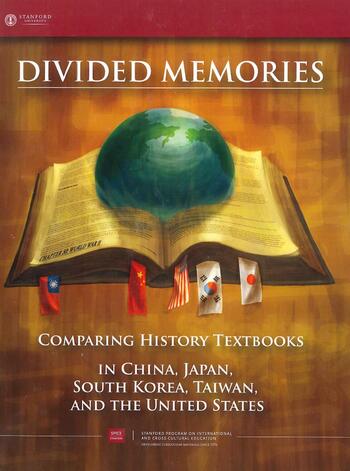
The outcome was the project's first book in 2011, History Textbooks and the Wars in Asia: Divided Memories, which suggests that an "introspective effort" to understand national narratives about WWII has the potential to bring about historical reconciliation in the region. Sneider describes it as the first comparative study of textbooks in the countries involved; it soon evolved into a classroom supplemental textbook published by the Stanford Program on International and Cross-Cultural Education.

"Formal education is a powerful force in shaping our historical understandings," Sneider noted. "We wanted to look at the textbooks that have the most impact and usage."

A 2014 book, Confronting Memories of World War II: European and Asian Legacies, which was co-edited by Shin, Sneider and Daniel Chirot, a sociologist with the University of Washington, compared successful European WWII reconciliations with lagging Asian efforts. Another book, Divided Lenses, published earlier this year, examined the impact of dramatic film and other forms of popular culture on wartime memory. A new book is due out this summer, Divergent Memories: Opinion Leaders and the Asia-Pacific War, which focuses on leaders in politics, the media and academia in Japan, China, South Korea and the U.S.

The Divided Memories project aims to generate discussions and collaborations among those who create "historical memories" – educators, policymakers and government leaders. One report that grew out of such dialogues included suggestions for reconciliation:

  • Create supplementary teaching materials on the issue. 
  • Launch dialogues among Asian, American and European historians. 
  • Offer educational forums for journalists, policymakers and students. 
  • Conduct museum exchanges and create new museums, such as one wholly dedicated to WWII reconciliation in Asia. 
  • Increase student exchanges among all the countries involved. 

History is reflected in today's geopolitics, as noted in the revived disputes by these nations over rival claims to islands in the South China Sea and elsewhere. Without resolution, these disagreements can flare up into military conflicts, Sneider wrote.

"The question of history taps into sensitive and deeply rooted issues of national identity," he noted.

Whether recounting Japanese atrocities in China, China's exaggerated account of its Communist fighters' role in World War II, or the U.S. decision to drop atomic bombs on Japan, no nation is immune to re-creating the past to further its own interests today, Sneider wrote.

For example, Divided Memories research on Chinese textbooks shows how the Chinese government in recent decades embarked on a "patriotic education" campaign to indoctrinate young people by exaggerating its role in Japan's WWII defeat. This narrative suits the nationalistic desires of a Chinese government no longer exclusively motivated by communist ideology, Sneider said.

One project of APARC and its Japan Program that was also an outgrowth of Divided Memories involved Stanford scholars urging Japanese Prime Minister Shinzo Abe to show "clear, heartfelt remorse" in a 2015 speech on the 70th anniversary of the end of WWII. A 15-page report featured hypothetical statements suggesting what Abe might say to make amends for Japanese actions in China and Korea.

"While we cannot claim to have directly influenced the prime minister, his statement did go further in the direction of an expression of remorse over the war and the need to continue to look clearly and honestly at the past than many expected," said Sneider.


Image
divided memories 2

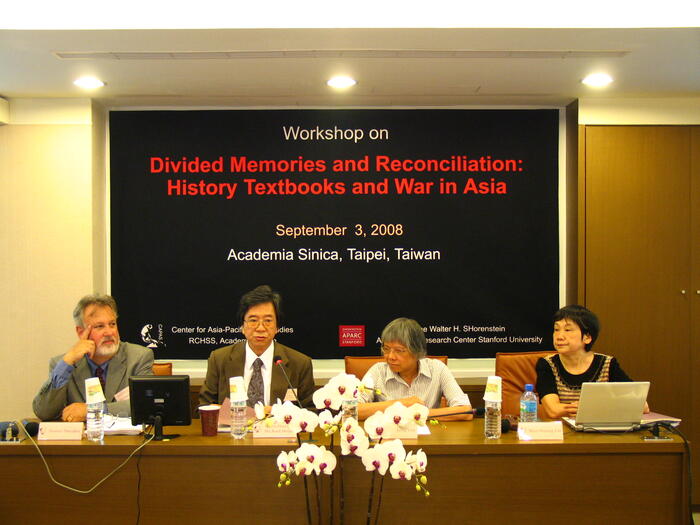
A workshop on history textbooks co-hosted by Shorenstein APARC and Academia Sinica's Center for Asia-Pacific Area Studies takes places in Taipei, Sept. 3, 2008.


Generations and grievances

Consciousness-raising on other fronts, however, is getting results, thanks to Stanford's Divided Memories project. A 2015 landmark agreement between Japan and South Korea over the WWII "comfort women" dispute was reached due to extensive U.S. involvement. Comfort women were women and girls who were forced into sexual slavery by the Imperial Japanese Army in occupied territories before and during World War II.

In an article, Sneider explained how the U.S. perceived that the dysfunctional relationship between South Korea and Japan over this issue, among others, threatened to undermine American strategic interests in Asia. 

Shin highlights the importance of U.S. involvement. "The U.S. is not just an outsider to historical and territorial disputes in the region," he said. "From a geopolitical perspective, the U.S. has done a wonderful job in reviving the devastated region into a prosperous one after 1945, but from a historical reconciliation perspective, the U.S. has done a poor job."

He suggests that America should "play a constructive role in promoting historical reconciliation" among the countries involved. And so, the Divided Memories project has included the United States in its efforts.

According to Sneider, Divided Memories is unique among all reconciliation projects for its emphasis on the inclusion of the U.S.; comparative analyses across countries; and real-world policy impacts. As part of the Shorenstein research center, it is housed within Stanford's Freeman Spogli Institute for International Studies.

"This project reflects what Stanford, our center and the Freeman Spogli Institute are all about – true interdisciplinary research and engagement," Sneider said.

Clifton Parker is a writer for the Stanford News Service.

Hero Image
divided memories reconciliation headline
Japanese soldiers in Shanghai, March 23, 1927 | A Stanford project encourages World War II reconciliation and historical accuracy about the conflict and its consequences in Japan, China, Korea, Taiwan and the United States. Progress has been made on classroom textbooks and scholarly discussions and exchanges. | Getty Images
All News button
1
Subscribe to History